
Is an Indexed Annuity Safe
As an Independent Annuity Broker, we compare rates across 100+ carriers and 1,000 different annuities— not just one company’s product offerings — to find the best fit for your goals.
Is an Indexed Annuity Safe

Jason Stolz CLTC, CRPC, DIA, CAA
Is an indexed annuity safe? It is one of the most important questions retirees ask when evaluating options that offer protection from market volatility without surrendering all growth potential. The honest answer has two parts: a properly structured fixed indexed annuity (FIA) is designed to protect your principal from market losses, but “safe” is not synonymous with “risk-free.” Safety in an indexed annuity is specific — it applies to certain risks and not others — and understanding which risks are genuinely eliminated, which risks remain in modified form, and which risks are simply shifted from the product to the contract holder is the foundation of an informed decision. At Diversified Insurance Brokers, Jason Stolz, CLTC, CRPC, DIA, CAA, helps clients evaluate indexed annuities in the context of the full retirement income plan — not as a standalone product purchase. What a fixed indexed annuity is, how it differs from other product types, and who is best suited for an indexed annuity are the starting points for any serious evaluation.
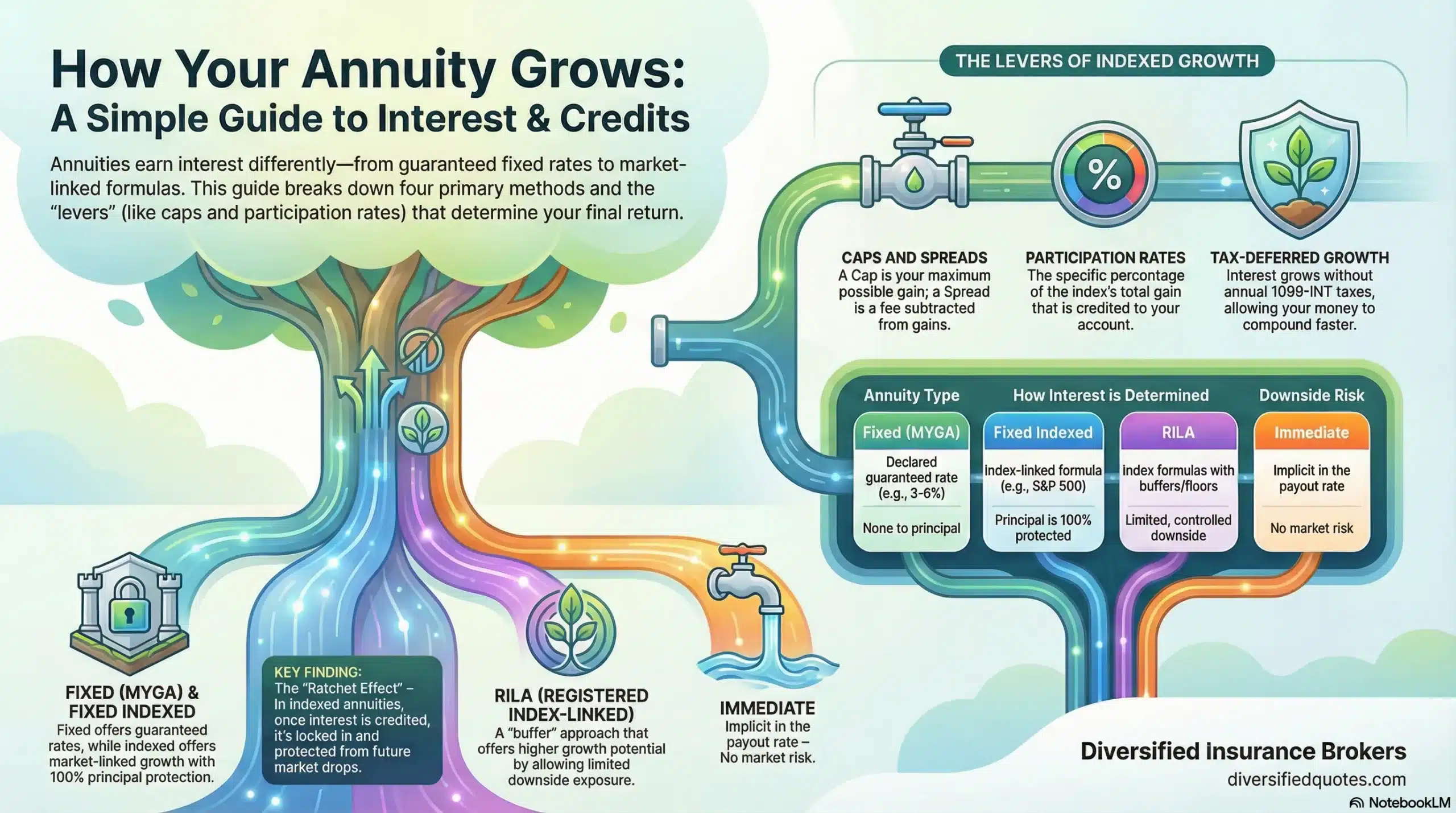
An indexed annuity is an insurance contract — not a stock market investment, and not a bank deposit. Your premium is not directly invested in the S&P 500 or any external index. Instead, the insurance carrier uses a crediting formula tied to index performance to determine how much interest, if any, will be credited to your account value at the end of each crediting period. If the index rises, you may receive credited interest up to a cap rate, spread rate, or participation rate depending on the contract design. If the index declines, most indexed annuities apply a 0% floor — you receive zero credited interest for that period, but you do not lose principal due to negative market performance. That structural floor is the mechanism behind the principal protection that makes indexed annuities attractive to risk-conscious retirees. The broader question of whether annuities are a good investment in retirement provides the full context in which indexed annuities should be evaluated alongside other retirement income tools.
Ensure you are receiving the absolute top rates
Current Fixed Annuity Rates
Compare today’s best fixed annuity rates from top carriers.
Current Bonus Annuity Rates
See which annuities offer the highest upfront bonus today.
Request an Annuity Quote
Submit our annuity request form to get personalized rate options.
Lifetime Income Calculator
Use our calculator to see how much guaranteed income your annuity can provide.
The Core Safety Feature — What the 0% Floor Actually Means
The 0% floor in an indexed annuity means that if the linked index produces a negative return during the crediting period, the annuity holder receives 0% interest for that period rather than suffering a loss in their account value. This is the central safety mechanism that distinguishes indexed annuities from variable annuities, which expose account value directly to market performance through subaccounts that function like mutual funds and can lose value in a down market. The structural difference is fundamental: in a variable annuity, the policyholder’s account is invested in market subaccounts, and market losses directly reduce account value. In an indexed annuity, the carrier accepts the market risk in exchange for limiting the policyholder’s participation in market gains through caps, spreads, or participation rates.
The tradeoff embedded in this structure is predictable and intentional. In strong bull market years when the S&P 500 returns 20% or 25%, an indexed annuity with a 7% annual cap credits 7%. The holder does not lose money — but they do not capture the full market return either. Safety in an indexed annuity is achieved by exchanging unlimited upside for protected downside. That exchange is exactly right for certain financial goals — specifically, households that need their retirement assets to maintain value and generate income reliably rather than maximize growth — and exactly wrong for others, specifically households with long time horizons, high risk tolerance, and no near-term income need, who might sacrifice too much growth potential for protection they do not urgently need. Whether you lose your principal in an indexed annuity and the full pros and cons of fixed indexed annuities cover these trade-offs in detail. Fixed indexed annuity myths debunked addresses the common misunderstandings that cause both over-confidence and unwarranted skepticism about how these products actually work.
The Dimensions of Safety in an Indexed Annuity — and Where Risk Remains
Indexed annuity safety has multiple independent dimensions, each of which must be evaluated separately. Market protection — the 0% floor — is the most widely understood. But it is not the only relevant dimension, and in some planning scenarios it is not even the most important one.
Liquidity risk is the dimension most frequently underestimated by new purchasers. Most indexed annuities include surrender periods ranging from five to ten years, during which withdrawals above the contractual free withdrawal allowance — typically 10% of account value per year — trigger surrender charges that reduce the amount received. Those charges decline over the surrender period and reach zero at the end of it, but during the surrender period a large unplanned withdrawal can meaningfully reduce the value actually available. This is not market loss — the principal itself is not exposed to the index — but it is a genuine liquidity constraint that must be planned for. Safety in an indexed annuity requires matching the surrender period to the household’s actual liquidity timeline. An annuity purchase funded with money that might be needed within the next three years is not a safe use of that money regardless of how strong the market protection provisions are.
Insurer strength is another dimension of safety that is distinct from the product’s contractual protections. Indexed annuities are backed by the claims-paying ability of the issuing insurance carrier — not by FDIC insurance or any government guarantee in the same sense as a bank deposit. Insurance companies are required to maintain statutory reserves and meet state regulatory capital requirements, and they are regulated by state insurance departments rather than by federal banking regulators. Before purchasing an indexed annuity, reviewing the carrier’s financial strength ratings from rating agencies and evaluating long-term stability is essential. The contractual guarantees printed in the policy are only as reliable as the carrier issuing them. State guaranty associations provide additional protection up to coverage limits that vary by state, but these associations are not a substitute for selecting a financially strong carrier — they are a last resort in the unlikely event of insolvency.
Comparing Safety Across Annuity and Fixed-Income Alternatives
| Feature | Fixed Indexed Annuity | Variable Annuity | MYGA / Fixed Annuity | Bank CD |
|---|---|---|---|---|
| Principal Protection | Yes — 0% floor; index declines do not reduce principal | No — account value exposed directly to subaccount performance | Yes — declared rate guaranteed; no market exposure | Yes — FDIC insured up to limits |
| Growth Potential | Index-linked; potential above fixed rates, capped by contract terms | Unlimited — full market participation including losses | Declared fixed rate for term; no upside beyond stated rate | Declared rate for term; no upside variation |
| Lifetime Income Option | Available through income riders (GLWB); see income rider mechanics | Available with additional riders at additional cost | Not typically available; term-based only | Not available |
| Tax Treatment | Tax-deferred growth; ordinary income on distributions | Tax-deferred growth; ordinary income on earnings distributions | Tax-deferred growth; ordinary income on distributions | Interest taxable as ordinary income in year credited |
| Liquidity | Surrender period 5–10 years; free withdrawal typically 10%/year | Surrender period varies; free withdrawal provisions vary | Surrender period equals term; early withdrawal penalties apply | Term-based; early withdrawal penalty typically 90 days interest |
Income Riders and Longevity Protection — A Different Kind of Safety
Many fixed indexed annuities are purchased specifically for the income rider rather than for the accumulation features. A Guaranteed Lifetime Withdrawal Benefit (GLWB) rider allows the holder to withdraw a specified percentage of an “income base” each year for life — even if the actual account value (cash surrender value) declines to zero as a result of withdrawals and rider fees over time. This addresses what many retirement income planners consider the most significant financial risk in retirement: longevity risk, the risk of outliving your assets. For a retiree who is primarily concerned about ensuring income continues regardless of market performance or how long they live, the GLWB rider can be more important than the indexed annuity’s growth mechanics.
The income base is a separate accounting value from the cash surrender value and is used solely to calculate the annual withdrawal amount. It is not available as a lump sum — a contract holder who cancels an annuity with an income rider receives the cash surrender value, not the income base. Understanding this distinction before purchase prevents the single most common source of confusion and dissatisfaction with income riders. How annuity income riders work, whether income riders have fees, what a fixed indexed annuity with an income rider provides, and whether a lifetime income rider makes sense for your situation all cover the mechanics and fit criteria in detail. For the comparison between using a rider and annuitizing, annuitization versus income rider differences covers what each approach actually delivers. The best fixed indexed annuities with lifetime income riders and best FIAs for income cover the current competitive landscape for income-focused designs.
Risks That Remain in an Indexed Annuity
Inflation risk is the most consequential residual risk in indexed annuities and the one most frequently underestimated during low-inflation periods. While an indexed annuity protects principal from negative market returns, credited interest may not always outpace long-term inflation over a multi-decade retirement. An account balance that grows at 3% annually while costs rise at 4% annually loses purchasing power in real terms even though the nominal balance increases. For retirees drawing income from an indexed annuity, the interaction between fixed or slowly growing income and rising prices can erode the real value of that income significantly over 20 or 30 years. Some contracts offer increasing income options — typically an annual income step-up or an increasing payout percentage over time — but higher future income generally comes with a lower starting payout, requiring analysis of which structure produces better outcomes at different longevity assumptions. Inflation-protected income annuity designs and the broader concept of sequence-of-returns risk both factor into this analysis.
Tax treatment represents another dimension that affects the real net value of an indexed annuity. Growth inside the contract is tax-deferred — credited interest is not taxed until withdrawn — which can meaningfully enhance compounding over time compared to a taxable alternative. However, when distributions are taken, earnings are taxed as ordinary income for non-qualified contracts, meaning growth receives the same treatment as wage income rather than the potentially lower capital gains rate that applies to other long-term investments. For qualified contracts (funded with IRA or 401(k) assets), the tax treatment is the same as any other qualified plan distribution. Required minimum distributions apply to qualified annuities, and understanding RMD rules after SECURE 2.0 is essential for aligning the annuity’s contract mechanics with mandatory distribution requirements. For rollovers specifically, how to transfer an IRA to an annuity, how to transfer a SEP IRA to an annuity, and best annuities for 401(k) rollover all cover correct implementation that preserves tax deferral and avoids unintended distribution events.
Bonus Annuities and MYGA Alternatives — When Different Structures Fit Better
Bonus indexed annuities offer upfront premium credits — sometimes ranging from 5% to 20% or more of the initial premium — that increase the account value or income base at policy issuance. These bonuses are genuinely valuable in the right context, but they are not free money. They are typically funded by longer surrender periods, modified crediting formulas, or lower cap rates than comparable non-bonus products. A bonus annuity with a 10% upfront credit and a 10-year surrender period may or may not produce better real outcomes than a non-bonus annuity with better crediting terms and a 7-year surrender — the answer depends on the holding period, the crediting history, and whether the income rider or accumulation value matters more to the holder. Current bonus annuity rates, bonus annuity comparison, and what a bonus annuity vesting schedule means provide the context for evaluating these structures correctly rather than being attracted by the headline bonus number alone.
For retirees whose primary objective is guaranteed interest rather than index-linked growth potential, a multi-year guaranteed annuity (MYGA) may be a simpler and equally appropriate structure. MYGAs offer a declared fixed interest rate for a specified term — functioning similarly to a CD but with tax deferral and typically higher rates than comparable bank products. Best MYGA annuity rates and fixed annuities versus fixed indexed annuities cover how these two structures compare for households where simplicity and rate certainty are more important than growth potential. For conservative investors specifically, annuities for conservative investors covers how both structures fit within a risk-conscious retirement income plan. The common annuity myths that cause unnecessary hesitation about both product types are addressed directly as a counterbalance to the misconceptions that affect decision quality on both sides.
Indexed annuities also interact with Social Security timing and Medicare planning in ways that affect the overall safety of the retirement plan rather than just the safety of the annuity itself. How Social Security and annuities work together covers the coordination between guaranteed income sources. Medicare Advantage versus Medicare Supplement comparison and key retirement considerations address the adjacent planning coordinates that a financially safe retirement requires beyond the annuity itself. A complete retirement income plan — one that coordinates guaranteed income, healthcare coverage, tax efficiency, and legacy goals — produces a materially safer outcome than any single product can provide in isolation. The reasons fixed indexed annuities are so popular with pre-retirees and the annuity rescue plan for existing contracts that no longer serve their original purpose both help households evaluate where they stand and what adjustments are available.
Talk With an Advisor Today
Choose how you’d like to connect—call or message us, then book a time that works for you.
Schedule here:
calendly.com/jason-dibcompanies/diversified-quotes
Licensed in all 50 states • Fiduciary, family-owned since 1980
Frequently Asked Questions: Is an Indexed Annuity Safe?
Can I lose money in a fixed indexed annuity?
From market performance, no — the 0% floor in a fixed indexed annuity means that if the linked index produces a negative return during the crediting period, your account value does not decrease due to that market decline. You receive 0% interest for that period rather than a negative return. However, there are two situations in which the amount you receive from the contract can be less than the amount you put in. First, if you withdraw funds in excess of the free withdrawal allowance during the surrender period, surrender charges apply and can reduce the amount you receive to below your original premium. Second, income rider fees — charged annually against the account value — reduce the cash surrender value over time. These fees do not typically reduce the income base used to calculate lifetime withdrawals, but they do reduce the account value available for lump-sum access. Understanding the difference between the cash surrender value (what you receive if you cancel) and the income base (what drives lifetime income calculations) is essential before purchasing any indexed annuity with an income rider.
How is an indexed annuity different from a variable annuity in terms of safety?
The structural difference is fundamental and directly determines the safety profile. In a variable annuity, your account value is allocated to market subaccounts that function like mutual funds — when those subaccounts decline in value, your account value declines proportionally. A significant market downturn can reduce a variable annuity’s account value by 20%, 30%, or more depending on the allocation. In a fixed indexed annuity, your premium is not directly invested in any market subaccount. The carrier uses a crediting formula linked to an external index to determine how much interest, if any, to credit at the end of each period. If the index falls, you receive 0% interest — not a negative return. Your principal is contractually protected from downward index movement. The trade-off for that protection is capped upside: in strong market years, the FIA credits interest only up to its cap, spread, or participation rate rather than the full index return. Variable annuities can participate more fully in bull markets but expose account value to bear markets. Indexed annuities trade some upside for a structural floor that eliminates market downside risk to principal.
Are indexed annuities FDIC insured like bank CDs?
No. Indexed annuities are insurance contracts backed by the claims-paying ability of the issuing insurance company, not by FDIC insurance or any government deposit guarantee. FDIC insurance applies to deposits held at FDIC-member banks — checking accounts, savings accounts, money market deposit accounts, and CDs — up to the applicable coverage limits. Insurance companies are regulated by state insurance departments, must maintain statutory reserves, and must meet state capital requirements, but the guarantee behind an indexed annuity is the financial strength of the carrier, not a government guarantee fund. State insurance guaranty associations provide additional protection in the unlikely event of an insurer insolvency — up to coverage limits that vary by state — but these associations are a last resort rather than a primary protection mechanism. The practical implication is that carrier financial strength matters when selecting an indexed annuity in a way it does not when selecting a bank CD. Reviewing AM Best, Moody’s, or S&P financial strength ratings before purchasing is a standard part of the due diligence process for any indexed annuity purchase.
What is the surrender period and how does it affect safety?
The surrender period is a defined time window — typically five to ten years depending on the contract — during which withdrawals above the free withdrawal allowance trigger surrender charges that reduce the amount received. Surrender charges typically start at 7% to 10% in year one and decline to zero by the end of the surrender period. They are not a market loss — your principal is not at risk from the market — but they are a contractual liquidity constraint that reduces how much you can access without penalty during the surrender window. The free withdrawal allowance, typically 10% of the account value annually, is available without a surrender charge in most contracts. Understanding the surrender schedule and aligning it with the household’s actual liquidity needs is a core part of evaluating whether a specific indexed annuity is appropriate for a specific situation. An indexed annuity funded with money that might be needed within the next three years — for a home purchase, a planned expense, or an emergency — is a poor match regardless of how strong the principal protection provisions are, because the surrender charge transforms a liquidity need into a financial cost.
How does a Guaranteed Lifetime Withdrawal Benefit (GLWB) work in an indexed annuity?
A Guaranteed Lifetime Withdrawal Benefit is an optional rider — available on many but not all fixed indexed annuities, typically for an additional annual fee — that allows the holder to withdraw a specified percentage of an “income base” each year for life, regardless of how the actual account value (cash surrender value) performs. The income base is a separate accounting value that often grows at a guaranteed rate during an accumulation phase and serves as the foundation for calculating the annual withdrawal amount. The key distinction that causes the most confusion: the income base is not the same as the cash surrender value, and it is not available as a lump sum. If a contract holder cancels an indexed annuity with a GLWB rider, they receive the cash surrender value — which may be less than the income base, particularly if the rider fee has been deducted over many years. The GLWB provides income protection — guaranteed annual withdrawals for life even if the account value reaches zero — not asset accumulation. It addresses longevity risk specifically: the risk of outliving your assets. For retirees whose primary concern is income continuity rather than account value maximization, the GLWB can be the most valuable feature in the entire contract.
About the Author:
Jason Stolz, CLTC, CRPC, DIA, CAA and Chief Underwriter at Diversified Insurance Brokers (NPN 20471358), is a senior insurance and retirement professional with more than 25 years of real-world experience helping individuals, families, and business owners protect their income, assets, and long-term financial stability. As a long-time partner of the nationally licensed independent agency Diversified Insurance Brokers, Jason provides trusted guidance across multiple specialties—including fixed and indexed annuities, long-term care planning, personal and business disability insurance, life insurance solutions, Group Health, Travel Medical and Evacuation Insurance, and short-term health coverage. Diversified Insurance Brokers maintains active contracts with over 100 highly rated insurance carriers, ensuring clients have access to a broad and competitive marketplace.
His practical, education-first approach has earned recognition in publications such as VoyageATL, and contributions from his agency featured in Kiplinger and GoBankingRates— highlighting his commitment to financial clarity and client-focused planning. Drawing on deep product knowledge and years of hands-on field experience, Jason helps clients evaluate carriers, compare strategies, and build retirement and protection plans that are both secure and cost-efficient. Visitors who want to explore current annuity rates and compare options across multiple insurers can also use this annuity quote and comparison tool.
Explore More Annuity Options: Browse our complete guide to What Is a Fixed Indexed Annuity? — covering FIA education, mechanics, crediting methods & indexed annuity strategies from 100+ carriers.
Last Reviewed: June 14, 2026 |
Reviewed by: Jason Stolz, CLTC, CRPC, DIA, CAA
Chief Underwriter, Diversified Insurance Brokers, Inc. | NPN: 20471358 | Diversified Insurance Brokers, Inc. — Licensed in all 50 states
Fact Checked by: Tonia Pettitt, CMIP©
Medicare Specialist, Diversified Insurance Brokers, Inc. | NPN: 14374308 | Diversified Insurance Brokers, Inc. — Licensed in all 50 states
Did you find this content helpful? Leave us a Google review — it helps others find trustworthy guidance too.
Editorial Standards: Diversified Insurance Brokers maintains rigorous editorial standards to ensure accuracy, clarity, and independence in all content. Learn more about our editorial standards and commitment to transparency.
