
What is an SP500 Index in an Annuity
As an Independent Annuity Broker, we compare rates across 100+ carriers and 1,000 different annuities— not just one company’s product offerings — to find the best fit for your goals.
What is an SP500 Index in an Annuity

Jason Stolz CLTC, CRPC, DIA, CAA
An S&P 500 index in an annuity functions as a reference benchmark — a measuring tool the insurance carrier uses to determine how much interest to credit to your contract during a defined crediting period, not as a direct investment in the stock market. Understanding this distinction is the single most important foundation for evaluating any fixed indexed annuity that references the S&P 500, because the phrase “S&P 500 strategy” on an annuity illustration means something fundamentally different from “S&P 500 index fund” on a brokerage statement. In a fixed indexed annuity, your principal is held in the insurance carrier’s general account, supported by the carrier’s financial strength and claims-paying ability. The S&P 500 is used only to calculate the interest credit — if the index rises over the crediting period, you receive a portion of that gain subject to contractual limits; if the index falls, the interest credit for that period is zero, not negative, and your accumulated value is protected from index decline. At Diversified Insurance Brokers, we help retirees and pre-retirees compare S&P 500 indexed annuity options across multiple carriers, crediting methods, and contract designs — so the decision is grounded in real mechanics rather than marketing language. For the technical foundation behind how crediting methods work across different strategies, our resource on annuity crediting methods provides the mechanics context that makes product comparisons genuinely meaningful.
Ensure you are receiving the absolute top rates
Current Fixed Annuity Rates
Compare today’s best fixed annuity rates from top carriers.
Current Bonus Annuity Rates
See which annuities offer the highest upfront bonus today.
Request an Annuity Quote
Submit our annuity request form to get personalized rate options.
Lifetime Income Calculator
Model how much guaranteed income a fixed indexed annuity with an S&P 500 strategy could provide at your age and premium amount.
S&P 500 in an Annuity vs. Direct S&P 500 Investing: The Core Differences
The most important comparison any person evaluating an S&P 500 indexed annuity needs to make explicit is the comparison between the S&P 500 as a reference index inside a fixed indexed annuity and direct S&P 500 ownership through an index fund or ETF. These are structurally different instruments that perform differently under different market conditions and serve different planning purposes. The table below maps the key dimensions of this comparison side by side.
S&P 500 in a Fixed Indexed Annuity vs. Direct S&P 500 Index Fund
| Dimension | S&P 500 in a Fixed Indexed Annuity | Direct S&P 500 Index Fund / ETF |
|---|---|---|
| Principal Protection | Protected from negative index performance; 0% floor means no loss from index decline | Full market risk; account value falls directly with index declines |
| Dividend Inclusion | Generally excluded; price-return only tracked | Fully included in total return |
| Upside Potential | Limited by cap rate, participation rate, or spread; varies by carrier and product | No cap; full price appreciation plus dividends |
| Market Ownership | No shares owned; carrier credits interest based on index movement | Direct ownership of index shares or fund units |
| Tax Treatment | Tax-deferred growth; taxable at withdrawal (as ordinary income outside a Roth) | Dividends and realized gains taxable annually (in taxable account); long-term gains rates may apply |
| Annual Reset / Gain Lock-In | Credited interest locked in at period end; next period starts from current level; prior credits not reversed | No lock-in; prior gains can be fully erased by subsequent declines |
| Guaranteed Income Option | Optional lifetime income riders available for contractually guaranteed withdrawals | No contractual income guarantee; income determined by portfolio value and withdrawal rate |
| Liquidity | Surrender schedule applies; limited free withdrawal (typically 10% annually); long-term commitment | Generally fully liquid at any time; no surrender charges |
Neither structure is universally superior — the right choice for any specific household depends on their planning priorities, time horizon, income needs, and risk tolerance. The person who needs the S&P 500 to generate the highest possible long-term return and can accept full market volatility for a decade or more is a better fit for direct index investment. The person who wants meaningful growth potential with principal protection and the option to convert accumulated value into guaranteed lifetime income is a better fit for the annuity structure. Most retirees have legitimate reasons to use both — an index fund for growth-oriented long-horizon assets and a fixed indexed annuity for protected accumulation and income planning.
What “S&P 500 Strategy” Actually Means Inside a Fixed Indexed Annuity
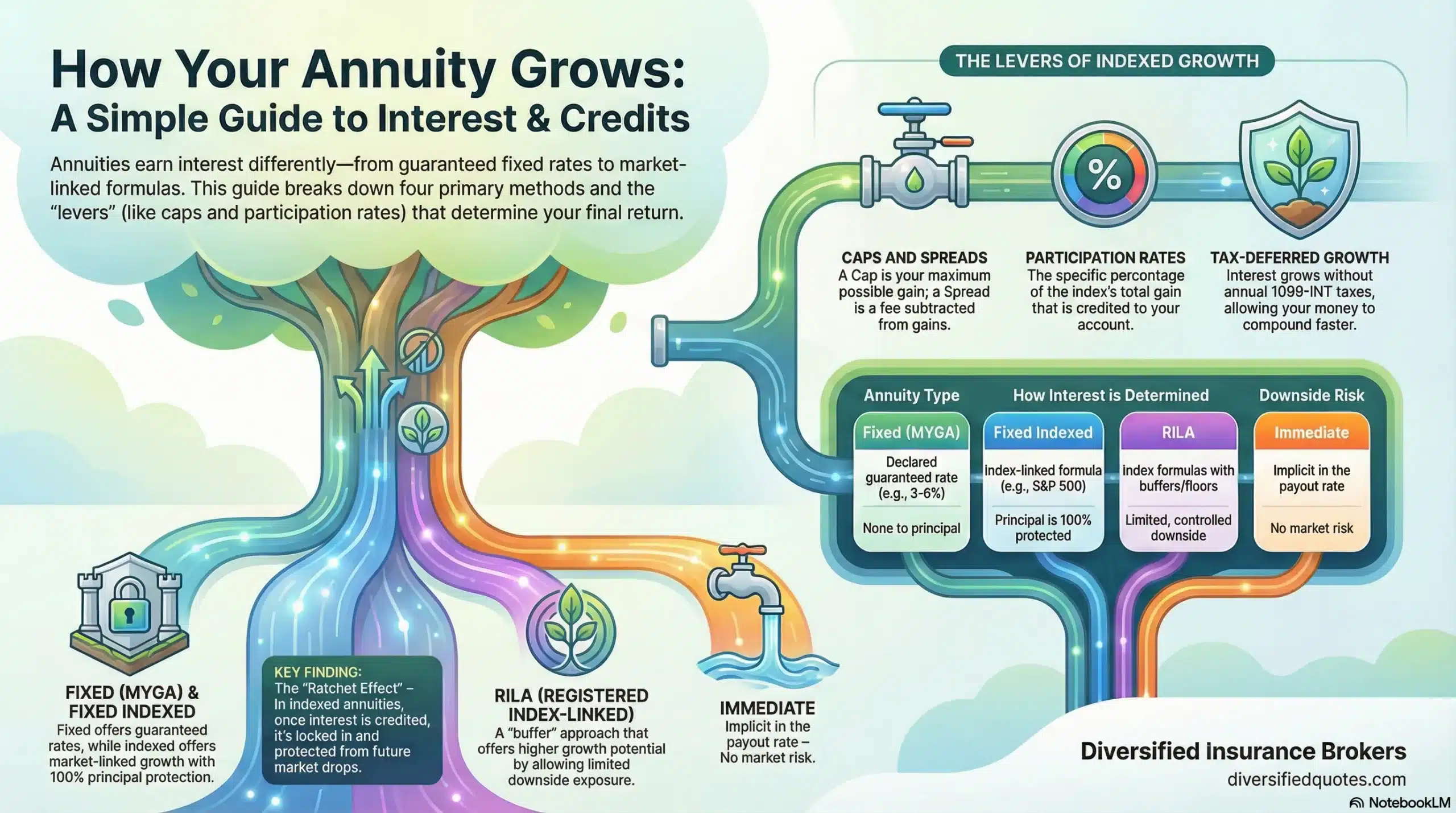
When an annuity contract lists an “S&P 500 strategy,” it means the carrier will measure the S&P 500’s price movement over a defined crediting period and use that measurement — filtered through a specific crediting method — to calculate the interest credited to your account value for that period. The crediting period is typically one year for annual strategies, though two-year, three-year, and five-year crediting windows also exist in some products. The crediting method is the contractual rule that determines how much of the index’s measured movement is translated into your credited interest.
Three primary crediting methods are used across the industry for S&P 500 strategies. A cap rate sets the maximum interest that can be credited during a crediting period regardless of how much the index gains. If the S&P 500 rises 18 percent during the period and the cap is 7 percent, you receive 7 percent. If it rises 5 percent, you receive 5 percent — the full gain because it falls below the cap. A participation rate credits a defined percentage of the index gain rather than using a ceiling. At 60 percent participation, a 12 percent index gain produces a 7.2 percent credit; a 5 percent gain produces 3 percent. There is no separate ceiling because the participation rate itself is the limiting mechanism. A spread (sometimes called a margin) subtracts a defined percentage from the index gain before crediting. A 2 percent spread on a 10 percent index gain produces an 8 percent credit; on a 5 percent gain, it produces a 3 percent credit; on a 1.5 percent gain, it produces zero — the same as the floor — because the spread exceeds the gain.
In all three methods, the floor remains zero: if the index performance for the period is negative, the credit is zero regardless of how deeply the index declined. This is the fundamental protection built into every S&P 500 strategy inside a fixed indexed annuity. Understanding how each method performs across different index return environments — not just in the abstract but with actual numbers — is essential before comparing illustrations across carriers. Our resource on index annuity crediting methods provides the detailed mechanical breakdowns for each approach.
Why the S&P 500 in an Annuity Excludes Dividends
One of the most practically important facts about the S&P 500 as a reference index inside a fixed indexed annuity is that the interest credit is based on the index’s price return — the movement of the index level itself — rather than the total return, which would include dividends paid by the 500 constituent companies. Over long historical periods, dividends have represented a meaningful component of total S&P 500 returns, often accounting for roughly one to two percentage points of annualized total return depending on the measurement period and dividend yield environment at the time. By tracking price-return only, the FIA credits are based on a lower effective return benchmark than what a total-return index fund investor would experience.
Understanding why this occurs requires understanding how carriers fund the interest crediting promise. When premium is deposited into a fixed indexed annuity, the carrier invests it primarily in high-quality fixed-income instruments — bonds and similar assets — rather than in stocks. The fixed-income portfolio generates a predictable yield. From that yield, the carrier purchases options on the S&P 500 (typically call options) that allow it to credit interest when the index rises, without directly exposing policyholder principal to equity risk. The options are priced based on the price-return index, not the total-return index. If the carrier were to include dividends in the crediting calculation, the options required to fund that promise would be significantly more expensive, consuming more of the yield and leaving less for other purposes including the guaranteed minimum rates and the carrier’s operating margin. The exclusion of dividends is therefore a structural economic fact of how FIAs work — not a concealed cost, but an inherent feature of the protection-for-limited-upside tradeoff that defines the product category.
This is why comparing “the S&P 500 was up X percent last year” to “my annuity credited Y percent” is not a valid apples-to-apples comparison. The annuity’s credit is based on price-return only, filtered through a cap, participation rate, or spread. The S&P 500 return most people cite is often the total return including dividends. A realistic evaluation of any FIA’s S&P 500 strategy should model the credit against price-return benchmarks with the applicable limits applied, not against total return figures — and should treat the exclusion of dividends as a known, expected feature rather than a surprise.
The Four Common S&P 500 Crediting Strategies in Annuities
Beyond the choice of crediting method (cap, participation, or spread), the measurement approach used to calculate the index return during the crediting period also varies across products. Four common measurement approaches appear frequently in S&P 500 FIA strategies, each with distinct performance characteristics in different market environments.
Annual point-to-point is the most straightforward and most commonly offered approach. The carrier records the index value on the contract anniversary date and compares it to the index value exactly one year later. If the index level is higher on the ending date, the percentage gain is calculated and applied to the crediting method. If the ending index level is lower than the starting level, the credit is zero. Annual point-to-point’s simplicity makes illustrations easy to interpret and evaluate. Its weakness is sensitivity to the specific ending-date index level: a sharp decline just before the measurement end date can convert a positive crediting year into a zero, even if the index was substantially higher throughout most of the period.
Monthly sum strategies measure the index change each month over the twelve months of the crediting period and sum those monthly changes, typically applying a monthly cap to each month’s contribution before summing. Monthly caps are typically much lower than annual caps — sometimes as low as 1 to 2 percent per month. In a strongly trending market, monthly sum can underperform annual point-to-point because each month’s contribution is capped before accumulation. In a volatile “up and down” market with moderate net annual gains, monthly sum can sometimes accumulate competitive credits because positive months contribute even when net annual movement is modest. Monthly sum strategies require careful evaluation in the context of their specific monthly cap, which is the key parameter determining long-term performance.
Multi-year point-to-point strategies measure the index change over a longer window — two, three, or five years — and credit interest at the end of that full period. They often offer higher caps or participation rates than annual strategies because the carrier prices the hedge over the longer measurement window. The tradeoff is that you wait longer for interest credits to post, the credited amount cannot be accessed without surrender implications during the period, and the single-point measurement exposes results to the same end-date sensitivity as annual point-to-point over a longer horizon. Multi-year strategies are most appropriate for genuinely long-term committed funds that align with the measurement window and the broader surrender schedule.
Averaging strategies — including monthly averaging, daily averaging, or high-water-mark approaches — use the average of index values across multiple measurement points rather than a single ending-point comparison. This reduces the impact of a single bad measurement day on the period’s result, providing some smoothing against end-date timing risk. The tradeoff is that averaging also reduces the benefit of a sharp end-period rally, since the high final level gets blended with lower readings from earlier in the period. Averaging strategies can be appropriate for buyers who specifically want to reduce single-point timing exposure, accepting modestly lower expected credits in exchange for more consistent period-to-period outcomes.
How Gains Lock In: The Annual Reset Mechanism
One of the most structurally distinctive features of S&P 500 indexed annuity strategies is the annual reset — the mechanism by which credited interest becomes permanently part of the contract value at the end of each crediting period, and the index measurement starting point resets to the current level for the next period. The annual reset creates a compounding pattern that differs materially from how direct equity investment accumulates value across volatile market cycles.
When a crediting period ends with a positive index result, the credited interest — however much the cap, participation rate, or spread allows — is added to the contract’s accumulated value. That new, higher accumulated value becomes the base for the next crediting period. No subsequent index decline can reduce the interest that was already credited. The carrier’s guarantee that previously credited amounts are locked in means the FIA’s accumulated value can never go below its prior credited-interest level due to index performance, regardless of how far the index subsequently falls.
When a crediting period ends with negative index performance, the credit is zero, and the next period begins measurement from the current (lower) index level. This reset after a down period is the second important element of the annual reset mechanism: the FIA buyer participates in the recovery from the lower level, not from the prior high. A direct index fund investor who experiences a 20 percent decline in year one and a 25 percent recovery in year two nets approximately zero over the two-year period on the affected capital (the math is not exactly zero due to compounding, but it is close). An FIA contract with an annual reset credits zero in the down year (principal preserved) and then credits based on the 25 percent recovery in year two — filtered through the cap or participation limit but measuring from the lower starting point. This structural difference in how downturns and recoveries interact is one of the primary reasons many retirees see FIAs as appropriate for the portion of their retirement savings where principal preservation is a priority. The sequence of returns risk framework explains exactly why this protection matters most for retirees who are drawing from or near their retirement assets — early declines with locked-in zeros rather than losses can significantly improve long-term outcomes compared to experiencing direct equity-level volatility with mandatory withdrawals.
The Role of the S&P 500 Strategy When an Income Rider Is Attached
Many people researching S&P 500 indexed annuities are evaluating the product for its income potential — specifically the guaranteed lifetime withdrawal benefit that an optional income rider can provide. When a lifetime income rider is attached to the contract, the contract maintains two separate values that serve different purposes: the account value (actual accumulated balance) and the income benefit base (a separate calculation value used solely to determine the guaranteed withdrawal amount). Understanding how the S&P 500 strategy interacts with both values is essential for evaluating income-oriented FIA contracts.
The income benefit base typically grows at a contractual roll-up rate during the deferral period — often 5 to 8 percent annually regardless of index performance. This roll-up growth is not tied to the S&P 500 at all; it accrues on the benefit base according to the rider’s contractual terms. The S&P 500 strategy primarily affects the account value — the actual accumulated balance — which serves as the long-term funding pool for the income rider and the source of any legacy value remaining after income withdrawals have continued for some period.
In a well-performing S&P 500 environment, stronger account value growth complements the income rider by maintaining more liquid value alongside the guaranteed income base, providing flexibility and potentially extending the life of the account value even while income withdrawals are active. In a flat or modest performance environment, the account value grows more slowly (or stays level after fees), but the guaranteed income base continues rolling up at its contractual rate — and when income begins, the guaranteed amount is determined by the income base, not the account value, which means the guaranteed income is protected from weak S&P 500 performance during the deferral period. This is one of the most important design features to understand about income-rider FIAs: the income guarantee is not dependent on market performance, which is precisely its value for retirement income planning. Our resources on what a fixed indexed annuity with an income rider is and how much income an annuity can pay cover this structure in detail.
S&P 500 Strategies vs. Proprietary Indices in Annuities
The S&P 500 is one of the most recognized and most frequently used reference indices in fixed indexed annuities, but it is not the only option available. Many modern FIA products offer allocations to proprietary indices — custom-designed indices created specifically for use inside insurance products — in addition to or instead of the S&P 500. Understanding the structural difference between the S&P 500 as a reference and proprietary indices helps buyers evaluate why different products may offer very different caps or participation rates across their available strategies.
Proprietary indices are typically designed with built-in volatility controls — mechanisms that reduce the index’s exposure to individual asset classes when market volatility rises, shifting allocations toward lower-risk instruments to maintain a target volatility level. This volatility management reduces the cost of the options the carrier must purchase to fund the interest crediting promise for that index, which allows the carrier to offer higher caps or more favorable participation rates for the proprietary index strategy compared to the pure S&P 500 strategy. The S&P 500 is a high-volatility index by options-pricing standards, which makes its hedging costs relatively high — meaning S&P 500 strategies typically offer lower caps and participation rates than strategies referencing volatility-controlled proprietary indices for the same premium budget.
The tradeoff for the better terms on proprietary index strategies is complexity. Proprietary indices are not publicly followed or widely reported — you cannot look up the proprietary index’s daily performance the way you can look up the S&P 500. Their volatility-control mechanisms can also cause them to underperform the S&P 500 in strong trending bull markets because the volatility-triggered rebalancing toward lower-risk assets reduces upside exposure during strong equity runs. Many buyers choose to allocate across multiple strategies — a portion to an S&P 500 strategy for familiarity and simpler tracking, and a portion to a proprietary index strategy for potentially more favorable crediting terms — rather than treating the choice as mutually exclusive.
When S&P 500 Indexed Annuities Are a Strong Fit
An S&P 500 indexed annuity strategy can be a compelling choice for households in specific planning situations. The first is repositioning conservative assets — CDs, money market funds, low-yield savings — that are generating minimal returns and where the primary goal is protecting the asset while providing meaningful growth potential without equity risk. For someone with $100,000 in a 5-year CD earning 4.5 percent who wants to maintain principal safety but is willing to accept capped-upside market-linked growth potential, an S&P 500 FIA strategy may offer better growth prospects in positive years while maintaining the principal protection the CD provides.
The second situation is building a “protected accumulation bucket” within a broader retirement portfolio. Many retirement planners divide assets into categories by purpose — growth assets, income assets, and protected assets. The S&P 500 FIA strategy is naturally suited to the protected asset category: it participates in positive market conditions up to its limits but does not decline with the market, allowing a more aggressive posture for the growth assets while ensuring the protected bucket does not erode. This bucket-based approach addresses one of the most common retirement planning anxieties — the concern that a market decline will permanently impair the retirement asset base. For background on how this protection directly addresses retirement income risk, our resource on how fixed indexed annuities work provides the full structural framework.
The third situation is planning for predictable guaranteed lifetime income. For buyers who want to convert a portion of accumulated assets into a pension-like guaranteed income stream, an S&P 500 FIA with an income rider combines the potential for account value growth with a contractually guaranteed income base that grows independently of market performance. The S&P 500 strategy in this context supports the account value component while the income rider’s roll-up rate builds the guaranteed income base. When income is eventually activated, the guaranteed withdrawal is determined by the income base — not the account value — providing income security that is insulated from whatever the S&P 500 does during the deferral period. Our resource on what the safest type of annuity is covers how FIAs compare to other annuity structures on the protection-versus-growth spectrum.
What to Evaluate Before Choosing an S&P 500 Annuity Strategy
Several specific evaluation steps apply when comparing S&P 500 strategies across different FIA products. The first is understanding the exact crediting method: “S&P 500 1-year” can mean annual point-to-point, monthly sum, averaging, or another approach — and the method matters as much as the headline cap or participation rate for predicting realistic outcomes. An illustration that does not clearly identify the crediting method and measurement approach cannot be properly evaluated.
The second is distinguishing current parameters from contractual minimums. Most FIA carriers can adjust caps, participation rates, and spreads at each annual crediting period renewal, subject to contractual minimums. The current offered cap may be 8 percent, but the contractual minimum may be 1 or 2 percent. While carriers generally try to maintain competitive current parameters to retain business, understanding the guaranteed minimum gives you a realistic floor for worst-case crediting terms over the contract’s life. Carriers with strong financial strength ratings and consistent histories of competitive parameter management have track records that inform this evaluation.
The third is evaluating the surrender schedule honestly against your liquidity needs. S&P 500 indexed annuities are long-term insurance contracts — typically with 7 to 10 year surrender periods for competitive products. The annual free withdrawal provision (commonly 10 percent of account value beginning in the second contract year) provides limited liquidity without penalty, but meaningful access above that threshold triggers surrender charges. Our resource on annuity surrender charges explained covers how these charges are structured and how to evaluate them against your planning horizon. Choosing a surrender schedule that genuinely matches your intended holding period — rather than choosing the longest available period because it has the highest current cap — is one of the most important suitability considerations in FIA selection. For buyers using a fixed annuity ladder approach across multiple vehicles, our resource on the fixed annuity ladder strategy covers how staggered surrender periods can provide both competitive terms and liquidity at defined intervals.
See How S&P 500 Strategies Compare Across Carriers
Get a personalized illustration showing crediting options, caps, participation rates, surrender schedules, and income rider choices for your age and premium amount.
Request a Personalized IllustrationRelated Pages: S&P 500 Annuity Strategies and FIA Resources
Continue researching FIA mechanics, crediting methods, income riders, and carrier options.
Financial Protection Essentials
Income planning tools, surrender schedule resources, FIA product pages, and retirement strategy guides.
Talk With an Advisor Today
Choose how you’d like to connect—call or message us, then book a time that works for you.
Schedule here:
calendly.com/jason-dibcompanies/diversified-quotes
Licensed in all 50 states • Fiduciary, family-owned since 1980
FAQs: S&P 500 Index in an Annuity
Do I lose money if the S&P 500 goes down inside a fixed indexed annuity?
No — negative index performance results in a zero percent interest credit for that crediting period, not a reduction in your accumulated contract value. The zero-percent floor is the fundamental principal protection built into every S&P 500 strategy inside a fixed indexed annuity. If the S&P 500 declines 15 percent during a crediting period, your credit for that period is zero, your accumulated value is unchanged by the index performance, and the next crediting period begins measuring from the current (lower) index level.
There are, however, other ways that account value can decrease that the zero floor does not protect against. Withdrawals above the annual free withdrawal amount during the surrender period trigger surrender charges that reduce your net proceeds. Optional income rider fees, typically 0.5 to 1.5 percent of the income benefit base annually, are deducted from the account value each year regardless of index performance — and in periods of minimal or zero index credits, these ongoing fees can gradually reduce the account value even with the zero floor in place. Understanding which costs are contractually applied to the account value, and how they interact with the crediting pattern over time, is a critical part of realistic FIA evaluation.
Does an S&P 500 annuity include dividends?
No. Fixed indexed annuities that reference the S&P 500 almost universally track the price-return version of the index — the movement of the index level itself — rather than the total return, which would include dividends paid by the 500 constituent companies. This means the interest credit calculation is based on a lower effective benchmark than the total return an S&P 500 index fund investor would experience.
The reason dividends are excluded is structural: carriers fund the S&P 500 interest crediting promise by purchasing call options on the price-return S&P 500 index using a portion of the yield from fixed-income investments that hold the premium. Including dividends in the crediting calculation would require more expensive options, consuming a larger portion of the available yield and leaving less budget for the guaranteed minimum rates, carrier operations, and principal protection. The exclusion of dividends is an expected, built-in feature of the FIA structure — not a hidden cost — and is part of the overall tradeoff between principal protection and full participation in equity returns that defines the product category.
Is an S&P 500 annuity the same as investing in the stock market?
No — they are fundamentally different in structure, ownership, risk exposure, and return profile. In a fixed indexed annuity referencing the S&P 500, you do not own any stocks or shares of the S&P 500 companies. Your premium is held in the insurance carrier’s general account, invested primarily in fixed-income instruments. The S&P 500 is used only as a measurement tool for calculating interest credits. You participate in positive index movement up to contractual limits (cap, participation rate, or spread) but you are protected from negative index movement through the zero-percent floor.
Direct S&P 500 index fund investment works differently in every key dimension: you own actual shares (or fractional shares) of the fund that holds S&P 500 stocks, you receive full participation in both price appreciation and dividend income with no cap, and your account value moves directly with the index — rising in up markets and falling in down markets. The FIA’s S&P 500 strategy captures a portion of the upside while eliminating the downside from index declines, in exchange for limited upside participation, dividend exclusion, and a long-term contractual commitment with surrender charges. Neither structure is “better” in the abstract — the FIA’s S&P 500 reference is appropriate for money where principal protection and income guarantees are the priority; direct S&P 500 investment is appropriate for long-horizon growth assets where full market participation outweighs volatility concern.
Can caps and participation rates change after I purchase the annuity?
Yes. Most fixed indexed annuities allow the carrier to adjust caps, participation rates, and spreads at each annual crediting period renewal, subject to contractual minimums. The current offered rate at purchase is declared for the first crediting period; at each renewal, the carrier may maintain, increase, or decrease the parameter based on option costs, interest rate environment, and their own pricing decisions. The contractual minimum is the floor below which the carrier cannot reduce the parameter — it is the only binding guarantee on future crediting terms.
This variability is normal and expected in FIA contracts — it is how carriers manage the option budget as market conditions change. When options become more expensive (in high-volatility environments) or the fixed-income yield supporting the option budget decreases (in lower interest rate environments), carriers may reduce current parameters. When conditions improve, parameters may increase. Evaluating a carrier’s history of parameter management — whether they have historically maintained competitive current rates relative to contractual minimums — is a meaningful part of long-term product evaluation. Carriers with strong financial strength ratings and consistent track records of competitive renewal parameters have demonstrated a sustained commitment to policyholder value that newer or less financially robust carriers may not have established. Always review both the current declared rate and the contractual minimum when comparing products.
Are S&P 500 annuities good for retirement income?
They can be highly effective for retirement income when paired with a well-designed guaranteed lifetime withdrawal benefit rider. In that structure, the S&P 500 strategy primarily drives the account value’s growth trajectory during the deferral period, while the income rider’s benefit base — which grows at its own contractual roll-up rate independent of index performance — determines the guaranteed income amount when withdrawals begin. The S&P 500 strategy’s contribution to retirement income planning is therefore twofold: it supports account value growth that maintains liquid value alongside the guaranteed income base, and it provides protection from account value declines in down markets that would otherwise reduce the remaining liquid reserve.
The income rider itself provides the guarantee that makes S&P 500 FIAs specifically valuable for retirement income planning: regardless of what the S&P 500 does during the deferral period or after income begins, the guaranteed withdrawal continues for the policyholder’s lifetime as long as the terms of the rider are followed. This means the income floor is insulated from market performance in a way that a portfolio-based withdrawal strategy cannot replicate without accepting the risk that withdrawals in a down market permanently deplete the asset base. When the goal is predictable, insured lifetime income alongside the potential for account value growth, an S&P 500 indexed annuity with a lifetime income rider is a design worth evaluating against alternatives.
What is the annual reset and why does it matter for S&P 500 strategies?
The annual reset is the mechanism by which credited interest is locked in at the end of each crediting period and the index measurement starting point is reset to the current level for the next period. Two consequences of the annual reset directly affect how an S&P 500 FIA strategy performs across volatile market cycles compared to direct equity investment.
The first consequence is permanent gain protection: once interest is credited at the end of a positive period, it cannot be reversed by subsequent index declines. Your accumulated value after a good year is protected going forward. The second consequence is systematic repositioning after downturns: when the index declines in a period and the credit is zero, the next period begins measurement from that lower level. When the index then recovers, the FIA credits interest from the lower starting point — participating in the recovery from where the market actually is, rather than needing to first make up the lost ground before generating credits. This is a meaningful structural advantage specifically in markets that experience periodic sharp declines followed by recoveries, because the FIA always participates in recoveries from actual current levels rather than from prior highs. The direct investor must recover the prior losses before generating net gains; the FIA policyholder begins generating positive credits immediately from the reset starting point.
About the Author:
Jason Stolz, CLTC, CRPC, DIA, CAA and Chief Underwriter at Diversified Insurance Brokers (NPN 20471358), is a senior insurance and retirement professional with more than 25 years of real-world experience helping individuals, families, and business owners protect their income, assets, and long-term financial stability. As a long-time partner of the nationally licensed independent agency Diversified Insurance Brokers, Jason provides trusted guidance across multiple specialties—including fixed and indexed annuities, long-term care planning, personal and business disability insurance, life insurance solutions, Group Health, Travel Medical and Evacuation Insurance, and short-term health coverage. Diversified Insurance Brokers maintains active contracts with over 100 highly rated insurance carriers, ensuring clients have access to a broad and competitive marketplace.
His practical, education-first approach has earned recognition in publications such as VoyageATL, and contributions from his agency featured in Kiplinger and GoBankingRates— highlighting his commitment to financial clarity and client-focused planning. Drawing on deep product knowledge and years of hands-on field experience, Jason helps clients evaluate carriers, compare strategies, and build retirement and protection plans that are both secure and cost-efficient. Visitors who want to explore current annuity rates and compare options across multiple insurers can also use this annuity quote and comparison tool.
Browse More Resources: Return to our complete Fixed Indexed Annuity Products & Education guide — covering FIA products and education from top carriers.
Last Reviewed: June 19, 2026 |
Reviewed by: Jason Stolz, CLTC, CRPC, DIA, CAA
Chief Underwriter, Diversified Insurance Brokers, Inc. | NPN: 20471358 | Diversified Insurance Brokers, Inc. — Licensed in all 50 states
Fact Checked by: Tonia Pettitt, CMIP©
Medicare Specialist, Diversified Insurance Brokers, Inc. | NPN: 14374308 | Diversified Insurance Brokers, Inc. — Licensed in all 50 states
Did you find this content helpful? Leave us a Google review — it helps others find trustworthy guidance too.
Editorial Standards: Diversified Insurance Brokers maintains rigorous editorial standards to ensure accuracy, clarity, and independence in all content. Learn more about our editorial standards and commitment to transparency.
