
Current Bonus Annuity Rates
Current Bonus Annuity Rates

Jason Stolz CLTC, CRPC, DIA, CAA
Current bonus annuity rates represent one of the most competitive windows in the modern fixed indexed annuity market. In September 2026, leading carriers are offering upfront premium bonuses that range from 3% on shorter 8-year surrender products to 34% on 15-year designs — a range that reflects both the competitive landscape for long-term retirement money and the underlying economics of how insurance carriers fund these credits. The phrase “current bonus annuity rates” covers two distinct but connected concepts: the bonus percentage credited at issuance, and the ongoing index crediting terms — caps, participation rates, and spreads — that determine how the contract accumulates value across the full holding period. Neither number alone tells the complete story. A buyer who evaluates only the current bonus percentage and ignores the crediting terms will frequently select a product that looks impressive on day one and underperforms over the actual holding period. A buyer who evaluates both together — using the bonus as a starting point and the crediting terms as the annual engine — will make a significantly better decision. This page provides the current market landscape, the economics that drive bonus levels, the four evaluation questions every buyer should ask about any current offer, and a practical framework for using current rates to identify products worth requesting full illustrations on. If you are evaluating annuities for the first time, our annuities overview and Annuities 101 guide provide the foundational context for understanding any annuity product before narrowing to bonus-specific designs. For the full current rate landscape across both bonus and non-bonus structures, our current annuity rates page provides the broadest market view.
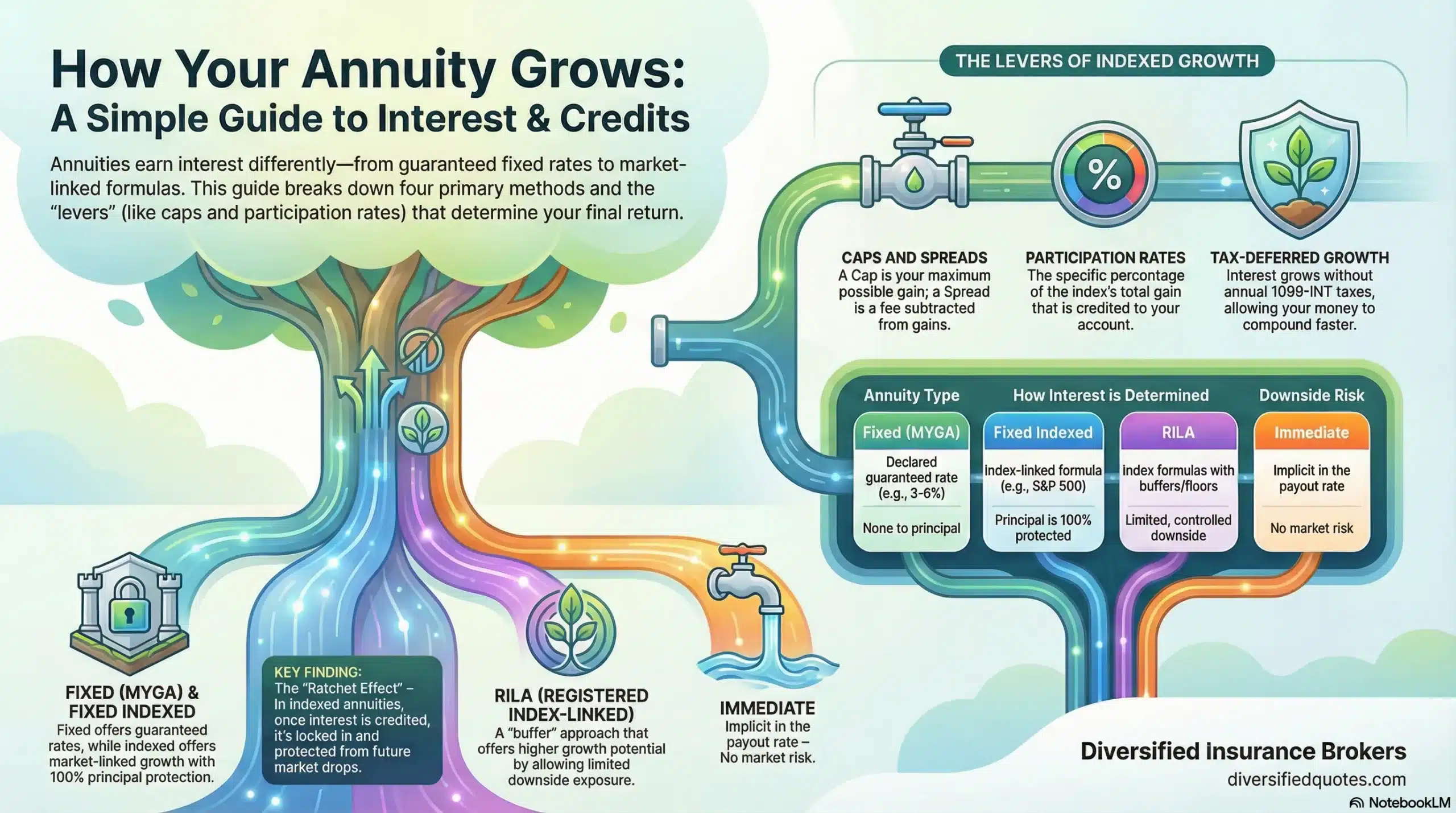
The fixed indexed annuity structure is the vehicle through which virtually all current bonus annuity rates are offered. FIAs protect principal from market losses — in years where the index performs negatively, the contract credits zero rather than passing the loss through to the policyholder — while crediting interest linked to the performance of an external index, typically subject to caps, participation rates, or spreads that define the maximum annual gain. Understanding how a fixed indexed annuity works before evaluating any current bonus offer is essential because the bonus is layered on top of this structure — it does not replace or simplify the FIA mechanics. For a review of the most commonly misunderstood aspects of how FIAs actually perform versus how they are sometimes marketed, our resource on common FIA myths is useful context before interpreting any current rate offering. Current bonus FIA products from the carriers listed in the rate table below carry A.M. Best ratings ranging from A- to A+, meaning all of them have passed the insurance industry’s financial stability evaluation at an investment-grade level — though the specific rating for each carrier still matters in the context of a long-term commitment and should be reviewed before purchase.
The current bonus annuity market is structured around term length tiers that reflect fundamentally different risk and reward profiles for both the carrier and the buyer. Short-term bonus products (5–7 years) offer meaningful upfront credits — currently in the 12%–17% range from competitive carriers — in exchange for a shorter commitment window. Mid-term products (8–10 years) offer a blend of upfront bonus and competitive indexing, with current offers ranging from 3% to 26% depending on the carrier’s product design philosophy. Long-term products (14–15 years) offer the largest current bonuses — 31% to 34% — but require the buyer to commit through a surrender period that extends well into the next decade. The right tier for any individual buyer is determined by their actual planning horizon and liquidity expectations, not by which tier offers the highest bonus percentage. Our resources on the 10% bonus annuity category, the best upfront bonus annuity options, and the full bonus annuity comparison guide provide complementary frameworks for evaluating each tier against alternatives.
Ensure you are receiving the absolute top rates
Current Fixed Annuity Rates
Compare today’s best fixed annuity rates from top carriers.
View Current RatesCurrent Bonus Annuity Rates
See which annuities offer the highest upfront bonus today.
View Bonus RatesRequest an Annuity Quote
Submit our annuity request form to get personalized rate options.
Quote Request FormLifetime Income Calculator
Use our calculator to see how much guaranteed income your annuity can provide.
What Drives Current Bonus Annuity Rates — The Economics Behind the Numbers
The size of the bonus a carrier can offer on a given product is directly connected to the economics of the carrier’s general account investment portfolio and the competitive dynamics of the retirement savings marketplace. Insurance carriers that offer annuities invest policyholder premiums primarily in investment-grade fixed income instruments — corporate bonds, government securities, and structured products — across the full term of the surrender period. The yield on these investments, relative to the carrier’s cost of providing principal protection, income guarantees, and operating costs, determines how much the carrier can credit back to policyholders in the form of bonuses and ongoing interest. When long-term interest rates are higher — as they have been since 2022 — carriers generate more investment income on the same premium dollar, creating more capacity to offer attractive bonus and crediting features. This is why the current bonus market reflects bonuses in the 25%–34% range on longer-term products: the sustained higher rate environment of the past few years has given carriers the economic headroom to compete aggressively for large retirement rollovers by front-loading value through upfront credits.
The competitive dynamics matter equally. The market for large IRA, 401(k), and pension rollovers is intensely contested among insurance carriers. When one carrier increases its bonus offering to attract rollover money, competitors typically respond by adjusting their own bonus levels, crediting terms, or rider features to remain competitive. This competitive pressure has driven the current market to historically high bonus levels — 30%+ on 15-year products — that reflect both the interest rate environment’s capacity support and competitive positioning. The buyer implication is important: current bonus levels are the result of a favorable environment for bonus-type products, which makes the current market a genuinely attractive window for buyers who have the right planning horizon and goal alignment. However, because these bonuses are funded by specific economic conditions, buyers should understand that the bonuses they see today reflect today’s market — they are not permanent features of these products. A carrier that offers a 34% bonus today may offer a 20% bonus in a lower-rate environment, or may restructure the product entirely. This is one reason to act on attractive current offers once the comparison evaluation is complete, rather than deferring the decision indefinitely while waiting for “better” rates.
✅ Current Bonus Annuity Offers (as of September 2026)
The rate table below provides a snapshot of current bonus annuity offers available from highly rated carriers. Each row represents a product that has been competitively positioned for the current market environment. The bonus percentages reflect current market offerings, but the evaluation process should extend well beyond these numbers: where is the bonus credited, what are the vesting and recapture terms, how do the indexing terms compare to non-bonus alternatives at the same term length, and what does the carrier’s financial strength rating indicate about the counterparty relationship over the full contract horizon?
| Term | Bonus | Provider | Product | AM Best Rating |
|---|---|---|---|---|
| 5 Years | 13% | Axonic | Trailhead Plus | A- |
| 7 Years | 18% | Axonic | Trailhead Plus | A- |
| 8 Years | 3% | Nationwide | New Heights Select | A+ |
| 9 Years | 24% | American National | Strategy Plus Accum | A |
| 10 Years | 29% | AuguStar | Omega Bonus Plus | A |
| 14 Years | 31% | North American | NAC Charter Plus | A+ |
| 15 Years | 27% | Athene | Performance Elite Plus | A+ |
Bonus amounts apply to the initial premium and may vary by state availability, rider selection, and contract terms. Some products also include guaranteed lifetime income, enhanced death benefits, or liquidity features. Rates and bonus levels are subject to change; confirm current terms with a carrier illustration before purchasing.
Annuity Interest Rate Examples by Deposit Size
See how annuity interest and income potential can vary depending on the size of your investment.
Current Bonus Rates by Term Length — What Each Window Actually Offers
The current bonus annuity market is stratified across surrender period lengths in a way that reflects the distinct risk-reward profiles of each tier. Understanding what each term length currently offers — and what tradeoffs come with each — is essential for identifying which window is appropriate before narrowing to specific products.
Short-Term (5–7 Year): Current Bonuses in the 12%–17% Range
The 5 and 7-year tier currently offers some of the most compelling short-term bonus products in the market, with Axonic’s Trailhead Plus delivering 12% and 17% bonuses respectively. These products appeal to buyers who want the bonus advantage but cannot or will not commit to a 10+ year surrender period. The tradeoff at this term length is that the crediting period is shorter — there are fewer years for index credits to compound above and beyond the bonus credit — which means the initial bonus credit represents a proportionally larger share of the total potential return. Buyers in this tier should evaluate the net accumulated value at year 5 or 7 against a MYGA at the same term: if a competitive MYGA is crediting 5% annually guaranteed and the bonus FIA credits an average of 3% per year through the crediting mechanics, the MYGA overcomes the 12% bonus by year 4. The 5-year bonus product wins when the index performs well enough in the crediting strategy to average 4%+ annually through the cap or participation structure. For buyers who are 60–65 and want a 5-year bridge before starting income at 65–70, a 5-year bonus product can serve as a positioning vehicle that ends right when the income planning phase begins. For more information on annuities for this pre-retirement age group, our resource on annuities for buyers in their 40s and 50s provides planning context for this transition window.
Mid-Term (8–10 Year): Current Bonuses from 3% to 26%
The mid-term tier shows the widest range of current bonus levels — from Nationwide’s 3% at 8 years (a product designed for strong crediting mechanics rather than bonus emphasis) to Athene’s 26% at 10 years (a product designed to attract large rollover balances with a visible upfront credit). This range is instructive: it shows how different carriers use the bonus feature differently within the same surrender period length. Nationwide’s 8-year product prioritizes competitive index crediting terms and is positioned for buyers who want the strongest net accumulation or income result over the full 8-year period, with the bonus as a secondary feature. Athene’s 10-year product prioritizes the initial credit for buyers who respond to the visible day-one advantage and who have a primary income goal that benefits from the boosted starting income base. Both Nationwide and Athene carry A+ A.M. Best ratings — the highest available among the carriers in this tier. For buyers evaluating Nationwide’s financial strength and product design or Athene’s carrier profile, our dedicated carrier review pages provide the detailed context.
Long-Term (14–15 Year): Current Bonuses at 31%–34%
The longest-term products in the current market — North American’s NAC Charter Plus at 14 years and Athene’s Performance Elite Plus at 15 years — offer the most dramatic upfront credits currently available: 31% and 34% respectively. These products are structured for buyers with genuinely long planning horizons — typically pre-retirees in their 50s who are doing a large retirement account rollover with a plan that extends 10+ years into the future. The 31% and 34% bonuses currently available in this tier represent historically competitive levels that reflect both the favorable interest rate environment and aggressive carrier positioning for large rollover balances. North American and Athene both carry A+ A.M. Best ratings, providing the highest level of available financial strength credibility for these long-term commitments. Buyers considering these products should model the full 14 or 15-year illustration carefully — the large bonus creates a compelling day-one position, but the evaluation must confirm that the crediting terms across those years produce a genuinely competitive net result compared to shorter-term alternatives that could be renewed at market rates available at that future date.
The Four Questions to Ask About Any Current Bonus Annuity Offer
Current rates in the rate table above are starting points — they tell you which products are worth requesting full illustrations on. The following four questions transform a current rate observation into a complete product evaluation.
Question 1 — Where Does the Current Bonus Actually Credit?
The most important structural question for any current bonus annuity offer is whether the bonus credits the accumulation value (the actual cash value of the contract), the income benefit base (a separate calculation bucket used only for guaranteed lifetime withdrawal calculations), or both. Our dedicated resource on what an annuity income bonus is explains the mechanics of each structure in full detail. For income-focused buyers, a current bonus that credits the income base is genuinely valuable — it raises the starting point from which lifetime income will be calculated and from which any guaranteed roll-up rate compounds during the deferral period. For accumulation-focused buyers or those who want a stronger death benefit, a current bonus that credits only the income base provides no improvement in the values that matter to them. Confirming the bonus credit location before any purchase is non-negotiable.
Question 2 — What Are the Current Vesting and Recapture Terms?
A current bonus annuity rate means nothing if the bonus is subject to a vesting schedule that recaptures it upon early exit. Understanding the bonus annuity vesting schedule for any product you are considering tells you when the bonus fully belongs to you and what percentage would be recaptured at any point during the surrender period if you needed to exit. Many of the highest-bonus products currently in the market carry vesting schedules that recapture 100% of the bonus in year one, declining by 10%–15% per year until fully vested at the end of the surrender period. This is not inherently problematic — for buyers who genuinely intend to hold through the surrender period, the vesting schedule is irrelevant. But for buyers with any uncertainty about their actual holding timeline, the vesting-adjusted effective value of the current bonus is the correct number to evaluate, not the headline percentage.
Question 3 — How Do Current Crediting Terms Compare to Non-Bonus Alternatives?
Every current bonus offer is paired with a set of index crediting parameters — caps, participation rates, and spreads — that determine how much interest the contract accumulates annually across positive index years. Understanding what an annuity cap rate is and how participation rates function as crediting tools, alongside our explanation of annuity spread rates, provides the complete picture of how annual interest is determined in any FIA contract. Current bonus products typically feature more conservative crediting parameters than non-bonus FIAs at the same term length from the same or competing carriers — the cost of the current bonus is priced into the crediting mechanics. The comparison between a current bonus product’s net accumulated value (after accounting for the conservative crediting terms) and a current non-bonus FIA’s accumulated value (with stronger crediting terms but no bonus) is the only way to determine whether the current bonus offer creates a genuine advantage for a specific buyer’s goal and timeline. For the principal protection mechanics that underpin all FIA products including bonus designs, our dedicated resource covers how the zero-credit floor works in practice.
Question 4 — What Is the Carrier’s Financial Strength and Long-Term Stability?
Current bonus annuity rates are made by carriers — and the carrier making the guarantee matters as much as the guarantee itself. A current bonus of 34% on a 15-year contract from a financially strong carrier represents a very different risk proposition than the same bonus from a financially weaker carrier. All of the carriers in the current rate table carry A.M. Best investment-grade ratings, but the specific ratings vary: Americo at A, Axonic at A-, and Nationwide, Athene, and North American at A+. The rating matters for a 15-year commitment with ongoing income obligations that may extend 20–30 years. Our carrier review resources provide detailed financial strength context for the key current market leaders: Athene, North American, and Nationwide.
Current Bonus Rates and the Income Planning Opportunity
For buyers whose primary goal is generating guaranteed lifetime income, the current bonus annuity market represents a significant opportunity — particularly for pre-retirees who have a meaningful deferral window before income activation. The mechanics of why current bonus rates create an income opportunity are straightforward: income riders apply a guaranteed roll-up rate (currently in the 6%–8% range for competitive products) to the income base during the deferral period. A current 26% bonus on a 10-year product with a $300,000 deposit credits $78,000 to the income base on day one, creating a $378,000 starting income base. At a 7% guaranteed annual roll-up, that $378,000 compounds for 7 years (if income is activated at year 7) to approximately $607,000. At a 5.5% payout factor, that $607,000 income base produces approximately $33,400 per year in guaranteed lifetime withdrawals. Compare this to the same product without the bonus: a $300,000 starting income base growing at 7% for 7 years reaches approximately $482,000, producing approximately $26,500 per year. The current 26% bonus created a difference of approximately $6,900 per year in guaranteed lifetime income on a $300,000 deposit — a number that compounds meaningfully over a 20–25 year retirement period.
Understanding how annuity income riders work in conjunction with current bonus designs is the most important technical knowledge for income-focused buyers. The income rider mechanics — roll-up rate, payout factor at target age, rider fee — interact with the current bonus credit to produce the final guaranteed income amount. Our resource on lifetime income annuity options provides the broader context for how different income structures compare, and our resource on using annuities for monthly retirement income planning connects the income math to practical retirement budgeting. For a quick estimate of what different premium amounts and deferral periods can produce at current market terms, our income annuity calculator provides a useful benchmarking tool before requesting full carrier illustrations. The resource on how much income an annuity pays translates different premium amounts into realistic income ranges that help frame the opportunity size of current bonus rates in practical terms.
Current Bonus Rates and Retirement Rollover Planning
The most common buyer entering the current bonus annuity market is a pre-retiree or recent retiree rolling over a significant balance from a 401(k), traditional IRA, pension lump sum, or TSP account. The rollover context makes current bonus rates particularly significant because the initial placement decision creates a permanent starting position for everything that follows. A current 26% bonus on a $400,000 401(k) rollover credits $104,000 immediately — before any index crediting period has begun. That $104,000 represents either a larger accumulation base, a stronger income base, or both, depending on the product’s bonus credit structure. For buyers evaluating what to do with a large retirement account balance at or near retirement, our resources on what to do with a 401(k) after retiring and what to do with a pension after retiring provide the full decision framework for this transition, including when a bonus annuity is the right choice and when alternative structures serve the buyer better.
The pension alternative strategy is a specific use case where current bonus rates create compelling opportunity. Buyers who elect a higher single-life pension payout (rather than the reduced joint-and-survivor option) and use the income differential to fund a bonus annuity can create a guaranteed income stream that replaces the survivor protection at potentially higher total household income across the retirement period. The current 26% bonus on a 10-year product used in this strategy immediately raises the annuity’s starting income base — strengthening the replacement income position relative to what the joint-and-survivor pension would have provided. For buyers evaluating whether a current bonus annuity or a continued market investment represents the better choice for rollover money, our resource on whether an annuity or 401(k) is better for retirement provides the comparative framework. For younger buyers who are earlier in the planning process, our resource on annuities for buyers in their 40s and 50s covers how current bonus rates can be used in long-horizon strategies where the compound effect of early bonus credits is most powerful.
Why Current Bonus Rates Are Not “Free Money” — Understanding the Trade-Off Structure
The current bonus annuity market’s most competitive offerings — 26% at 10 years, 31% at 14 years, 34% at 15 years — represent genuine value for buyers with the right planning horizon and goal alignment. They are not, however, free credits from carriers who have simply decided to be generous. Every current bonus offer is priced into the contract economics through adjustments that balance the upfront credit with the carrier’s need to maintain sustainable economics across the full surrender period. Three primary adjustments appear in current bonus product pricing. First, current crediting terms — caps, participation rates, and spreads — in bonus products are typically more conservative than in non-bonus FIAs from the same carrier at the same term length. A current non-bonus 10-year FIA might offer a 6.5% annual cap on the S&P 500 point-to-point strategy, while the carrier’s current 26% bonus 10-year FIA might cap the same strategy at 3.5%. That 3% cap differential compounds across every positive index crediting year of the 10-year term. Second, the surrender period aligns with the carrier’s need to earn back the cost of the current bonus through the investment portfolio spread. Third, vesting and recapture provisions protect the carrier from the adverse selection risk of buyers who take the bonus and exit immediately. Understanding this trade-off structure — and evaluating whether current bonus products produce a better net outcome than non-bonus alternatives given these trade-offs — is the core analytical task for any serious current bonus annuity evaluation. Our resource on bonus annuity pros and cons provides a complete treatment of the trade-off structure across current and historical bonus product designs.
Tax Considerations When Evaluating Current Bonus Annuity Rates
Current bonus annuity rates are offered in both qualified and non-qualified funding contexts, and the tax treatment differs between these funding sources in ways that affect the true value of the current bonus. For qualified money — IRA, 401(k), 403(b), 457, TSP — the current bonus credits to the contract on a tax-deferred basis without creating a taxable event at issuance. Distributions from qualified annuities are taxed as ordinary income when received, and required minimum distributions apply at the required beginning date. Most current bonus products accommodate RMD withdrawals without triggering surrender charges — but confirm this for any specific product under consideration, and verify whether RMD withdrawals affect the income rider base or the vesting status of the current bonus. For non-qualified money (after-tax personal savings), the current bonus accumulates inside the contract on a tax-deferred basis. The IRS applies LIFO ordering to non-qualified annuity distributions — the current bonus and all subsequent interest credits come out first as ordinary income, before the original after-tax premium is returned tax-free. Our resource on non-qualified annuities and our annuity exclusion ratio guide cover the full tax mechanics for after-tax-funded annuity distributions. For buyers doing a 1035 exchange from an existing non-qualified annuity into a current bonus product, the exchange is generally tax-free if structured as a direct carrier-to-carrier transfer — but the economics of the exchange (including remaining surrender charges on the existing contract) must be evaluated against the value of the current bonus before proceeding.
Legacy and Death Benefit Planning With Current Bonus Rates
For buyers with significant legacy objectives alongside their income or accumulation goals, current bonus annuity rates interact with the death benefit provisions of the contract in ways that vary by product design. When a current bonus credits the accumulation value, the death benefit begins from a larger base — most FIA contracts define the death benefit as the greater of the accumulation value or the total premiums paid, and a current bonus that increases the accumulation value from day one improves the early-year death benefit floor. Some current products also offer enhanced death benefit riders that lock in the highest accumulation value reached on each anniversary, creating a step-up mechanism that compounds with the current bonus credit over time. Our resource on annuity beneficiary and death benefit provisions covers the mechanics of how different death benefit structures interact with bonus credits, and what buyers should confirm about the specific death benefit calculation methodology before purchasing any current bonus product with legacy goals in mind. For conservative investors who are repositioning assets into a current bonus product primarily for legacy purposes, the confirmation that the bonus credits accumulation value (not just the income base) is a prerequisite for the product to serve the legacy objective.
How to Use Current Rates to Build a Shortlist Worth Illustrating
Current bonus annuity rates — including the rate table above — are the starting material for a shortlist, not the endpoint of an evaluation. The correct process for using current rates to identify products worth the time investment of a full illustration comparison is as follows. Step one: identify your primary goal (income, accumulation, or a combination) and your actual intended holding horizon. This determines which term tier in the current market is relevant — a buyer with a 7-year horizon should evaluate 5 and 7-year products, not 14-year products regardless of how attractive the current 31% bonus appears. Step two: within the appropriate term tier, identify two or three current bonus products worth illustrating, plus one non-bonus FIA with the strongest available crediting terms at the same term length, plus a MYGA at the best available current declared rate. Step three: request carrier-issued illustrations for all identified products using your actual premium, actual age, state, and consistent rider elections. The illustration request is the pivot point between rate-shopping and real evaluation. Step four: apply the evaluation framework from the four questions above — bonus location, vesting terms, crediting term comparison, and carrier strength — to the illustrations. Step five: compare projected outcomes at your target date under conservative and moderate crediting assumptions to identify which current product produces the best result for your specific goal. For the broadest market context on what current rates look like across all annuity structures (not just bonus), our current annuity rates page and the benchmark resource on highest guaranteed annuity rates provide the MYGA and fixed-rate comparisons that belong in any complete current bonus annuity evaluation. For a comprehensive context on the age-specific dynamics of how current rates serve specific buyer profiles, our resource on the best annuity for a 65-year-old illustrates how current rate evaluation works in a specific age context, even for buyers outside the Georgia market where this resource was specifically written.
Find the Best Current Bonus Annuity Rates for Your Goals
We compare current bonus annuity options across dozens of carriers to identify the designs that match your timeline, liquidity needs, and income goals. Request your personalized comparison today.
Talk With an Advisor Today
Choose how you’d like to connect—call or message us, then book a time that works for you.
Schedule here:
calendly.com/jason-dibcompanies/diversified-quotes
Licensed in all 50 states • Fiduciary, family-owned since 1980
FAQs: Current Bonus Annuity Rates
Why are current bonus annuity rates so high — what is driving 26%–34% bonuses?
Current bonus levels in the 26%–34% range reflect two convergent forces. First, the sustained higher interest rate environment since 2022 has increased the investment income carriers generate on policyholder premiums, creating more economic headroom to offer large upfront credits. Insurance carriers invest premium reserves primarily in investment-grade fixed income, and higher long-term rates directly improve the spread between investment returns and the cost of providing annuity guarantees. Second, intense competitive pressure for large IRA, 401(k), and pension rollover balances drives carriers to position their bonus features aggressively. When one carrier increases its bonus level to attract rollover money, competitors often adjust their own offers to remain competitive. The result is a current bonus market that reflects both genuine economic capacity and competitive pricing strategy — and buyers who act in this environment lock in terms that may not be available if rates decline or competitive dynamics shift.
Are current bonus annuity rates locked in at purchase, or can they change?
The bonus percentage and the terms that govern how it applies — including the vesting schedule, recapture provisions, and the specific value bucket it credits — are locked in at contract issue and do not change. Once the contract is issued, the carrier cannot retroactively reduce the credited bonus or alter the vesting schedule for the original credit. However, other crediting parameters — specifically the index caps, participation rates, and spreads that determine annual interest crediting — are typically subject to renewal at the end of each crediting period (usually annually or at policy anniversary). The carrier sets new crediting terms at renewal within the minimums specified in the contract, meaning annual crediting can be adjusted over the life of the contract even though the initial bonus is fixed. This is why evaluating current crediting terms alongside the current bonus level is important: the crediting terms you see today represent the carrier’s initial terms, which may be adjusted (typically conservatively) at future renewals.
What does the current bonus actually do to my contract on day one?
On the day the contract is issued, the carrier credits the bonus percentage to one or more defined value buckets within the contract. If the current bonus credits the accumulation value, the contract’s cash balance immediately reflects the premium plus the bonus — so a $200,000 deposit with a 26% bonus shows $252,000 in accumulation value on day one. If the current bonus credits the income benefit base, the income base shows $252,000 while the accumulation value remains at or near $200,000 (plus any initial interest crediting). The practical implication of this distinction is significant: the accumulation value affects surrender value, liquidity, and the death benefit calculation; the income base affects only guaranteed lifetime withdrawal calculations. Confirming which bucket receives the current bonus before purchase is the most important clarifying question in any bonus annuity transaction.
How long will current bonus levels remain available?
Current bonus levels are driven by the current interest rate environment and competitive dynamics — both of which can change. If long-term interest rates decline meaningfully, carriers will have less investment income capacity to fund large upfront credits, and bonus levels will likely decrease. Competitive dynamics can shift as well: if a major carrier exits the bonus product market or changes strategy, the pressure on others to maintain current bonus levels may reduce. Buyers cannot predict exactly when or how current bonus levels will change, but they should understand that the current window — reflecting both favorable rate economics and intense competition — may not persist indefinitely. Buyers who have completed their evaluation and confirmed that a current bonus product produces a better outcome than alternatives for their specific goal should act on that conclusion rather than deferring while attempting to time the market for even higher bonuses. Current rates available today represent a contractual offer that can be confirmed through purchase — future rates are speculative.
Can I lose the current bonus if I need to access my money early?
Yes, in most cases. The majority of current bonus annuity products include vesting schedules that allow the carrier to recapture some or all of the bonus if you surrender the contract or take withdrawals above the free-withdrawal allowance before the vesting period is complete. A current 26% bonus on a 10-year product that vests linearly over the surrender period would be subject to approximately 80% recapture if you exited in year two — effectively reducing the actual bonus retained to about 5.2% rather than the full 26%. Current free-withdrawal provisions (typically 5%–10% of accumulation value annually after year one) allow limited access without triggering recapture or surrender charges. Hardship waivers for nursing home confinement, terminal illness, and disability also allow additional penalty-free access under qualifying conditions. But large withdrawals — including full surrenders — during the vesting period can eliminate most or all of the current bonus that made the product attractive. This is why current bonus products are best suited for buyers who genuinely intend to hold through the surrender period.
How do current bonus annuity rates affect guaranteed lifetime income amounts?
When the current bonus credits the income benefit base — the calculation bucket used for guaranteed lifetime withdrawals — it immediately raises the starting point from which the income base grows through the guaranteed roll-up rate during the deferral period. Current roll-up rates in the 6%–8% range compound on this higher starting base, creating a significantly larger income base at the target activation age than the same premium without the bonus would produce. The practical impact: a current 26% bonus on a $300,000 deposit that credits the income base creates a $378,000 starting income base. At a 7% annual roll-up rate compounding for 7 years, that $378,000 grows to approximately $607,000 at income activation. At a 5.5% payout factor, the annual guaranteed income is approximately $33,400. Without the bonus, the same $300,000 grows to approximately $482,000 at the same roll-up rate, producing approximately $26,500 in annual guaranteed income. The current 26% bonus created a $6,900 per year difference in guaranteed lifetime income on a $300,000 deposit — a meaningful number that compounds across a 20–25 year retirement.
Is the current bonus taxable when it is credited to the contract?
No. The current bonus credit does not create a taxable event in the year it is received. Like all growth within an annuity, the bonus accumulates on a tax-deferred basis until distributions are taken. For qualified accounts (IRA, 401(k), 403(b)), all withdrawals are taxed as ordinary income when distributed. For non-qualified accounts funded with after-tax dollars, the IRS applies LIFO ordering — the current bonus credit and all subsequent interest come out first and are taxed as ordinary income, while the original after-tax premium is returned last without additional taxation. Non-qualified annuity income payments use an exclusion ratio to separate the taxable and tax-free portions of each payment over time. The tax deferral on the current bonus and all subsequent growth is one of the significant advantages of the annuity structure, allowing the full credited amount to compound without annual taxation drag — a meaningful benefit over taxable alternatives when evaluated over the full holding period.
Can I use my current 401(k) or IRA to take advantage of today’s bonus annuity rates?
Yes. All of the carriers and products currently featured in the rate table accept qualified retirement account funding — 401(k), traditional IRA, 403(b), 457, TSP, and SEP-IRA — through direct rollover or trustee-to-trustee transfer. The rollover is structured to avoid triggering a taxable event, and the current bonus is credited on the transferred premium amount, subject to each product’s minimum premium requirements and state availability. The current market window — with its historically competitive bonus levels — represents a particularly attractive environment for buyers who are at or near retirement and evaluating where to place a large rollover balance. The combination of current bonus levels, principal protection, and income rider options creates a compelling case for buyers whose planning timeline aligns with the available surrender period lengths. Confirm current bonus availability for your specific state and premium amount before beginning the application process, as product availability and terms can vary by state filing.
How do I know if the current crediting terms paired with a bonus are competitive?
The current crediting terms — caps, participation rates, and spreads — for any bonus product should be compared directly against two benchmarks: the same carrier’s non-bonus FIA at the same term length (to isolate the cost of the bonus in crediting terms), and the strongest-crediting non-bonus FIA from a competing carrier at the same term length (to confirm whether the bonus product is competitive in the broader market). If a current bonus FIA offers a 3.5% cap on the primary S&P 500 strategy and the best non-bonus FIA at the same term length offers a 6.0% cap, the 2.5% differential compounds annually across every positive index year. Depending on the bonus size and the time horizon, this differential may or may not be overcome by the bonus credit. The illustration comparison — modeling both products under conservative, moderate, and maximum crediting assumptions over the full surrender period — is the definitive tool for determining whether current crediting terms paired with the current bonus produce a genuinely competitive result for your specific goal.
What is the right process for evaluating current bonus annuity rates before purchasing?
The correct evaluation process follows five steps. Step one: confirm your primary goal (income, accumulation, or combination) and your actual intended holding horizon — this determines which term tier in the current market is relevant. Step two: identify two or three current bonus products from the appropriate term tier that are worth illustrating, plus a non-bonus FIA with the strongest available current crediting terms at the same term length, plus a MYGA at the best current declared rate. Step three: request carrier-issued illustrations for all identified products using your actual premium, age, state, and consistent rider elections. Step four: apply the four evaluation questions — where the bonus credits, vesting terms, crediting term comparison against non-bonus alternatives, and carrier financial strength — to the illustrations. Step five: compare projected outcomes at your target date under conservative and moderate crediting assumptions to identify which current product produces the best result for your specific goal. The product that performs best across these metrics under realistic assumptions — not the one with the highest current bonus percentage — is the correct selection.
Are current bonus annuity rates available in all states?
Not universally. State insurance department approvals govern which products can be sold in each state, and some current bonus products may not be approved in all 50 states. Additionally, state-specific filings may result in different terms — including different bonus percentages, different crediting parameters, or different rider structures — than what is advertised nationally. Before investing significant time in evaluating any current bonus product, confirm with the carrier or your advisor that the specific product is available in your state and that the terms you are evaluating reflect your state’s filing. Comparable alternatives with similar bonus structures and surrender schedules are typically available in states where a specific featured product is not approved — the carrier or an independent broker can identify the closest available equivalent in your state if the primary product is not accessible.
About the Author:
Jason Stolz, CLTC, CRPC, DIA, CAA and Chief Underwriter at Diversified Insurance Brokers (NPN 20471358), is a senior insurance and retirement professional with more than 25 years of real-world experience helping individuals, families, and business owners protect their income, assets, and long-term financial stability. As a long-time partner of the nationally licensed independent agency Diversified Insurance Brokers, Jason provides trusted guidance across multiple specialties—including fixed and indexed annuities, long-term care planning, personal and business disability insurance, life insurance solutions, Group Health, Travel Medical and Evacuation Insurance, and short-term health coverage. Diversified Insurance Brokers maintains active contracts with over 100 highly rated insurance carriers, ensuring clients have access to a broad and competitive marketplace.
His practical, education-first approach has earned recognition in publications such as VoyageATL, and contributions from his agency featured in Kiplinger and GoBankingRates— highlighting his commitment to financial clarity and client-focused planning. Drawing on deep product knowledge and years of hands-on field experience, Jason helps clients evaluate carriers, compare strategies, and build retirement and protection plans that are both secure and cost-efficient. Visitors who want to explore current annuity rates and compare options across multiple insurers can also use this annuity quote and comparison tool.
Explore More Annuity Options: Browse our complete guide to Current Annuity Rates — covering current fixed, bonus, MYGA & income annuity rates by term from top carriers from 100+ carriers.
Last Reviewed: September 1, 2026 |
Reviewed by: Jason Stolz, CLTC, CRPC, DIA, CAA
Chief Underwriter, Diversified Insurance Brokers, Inc. | NPN: 20471358 | Diversified Insurance Brokers, Inc. — Licensed in all 50 states
Fact Checked by: Tonia Pettitt, CMIP©
Medicare Specialist, Diversified Insurance Brokers, Inc. | NPN: 14374308 | Diversified Insurance Brokers, Inc. — Licensed in all 50 states
Did you find this content helpful? Leave us a Google review — it helps others find trustworthy guidance too.
Editorial Standards: Diversified Insurance Brokers maintains rigorous editorial standards to ensure accuracy, clarity, and independence in all content. Learn more about our editorial standards and commitment to transparency.
