
What is the Interest Rate on a $50,000 Annuity
As an Independent Annuity Broker, we compare rates across 100+ carriers and 1,000 different annuities— not just one company’s product offerings — to find the best fit for your goals.
What is the Interest Rate on a $50,000 Annuity

Jason Stolz CLTC, CRPC, DIA, CAA
Many people approaching a $50,000 annuity decision begin with a version of the same question: what interest rate would that money earn? It is a natural starting point — you know the amount you have to invest, and you want to understand what that money can reasonably grow to before you commit. The direct answer is that the interest rate on a $50,000 annuity is not determined by the investment amount itself. A $50,000 premium and a $500,000 premium in the same annuity product from the same carrier in the same state on the same day will typically receive the same credited rate. What determines the interest rate is the type of annuity selected, the term length, the contract design, the carrier’s current rate schedule, and the prevailing bond market environment that drives what insurers can offer at any given point in time. Understanding this distinction — that it is the product and timing that set the rate, not the dollar amount — is the essential foundation for evaluating what a $50,000 annuity can realistically do for your retirement plan.
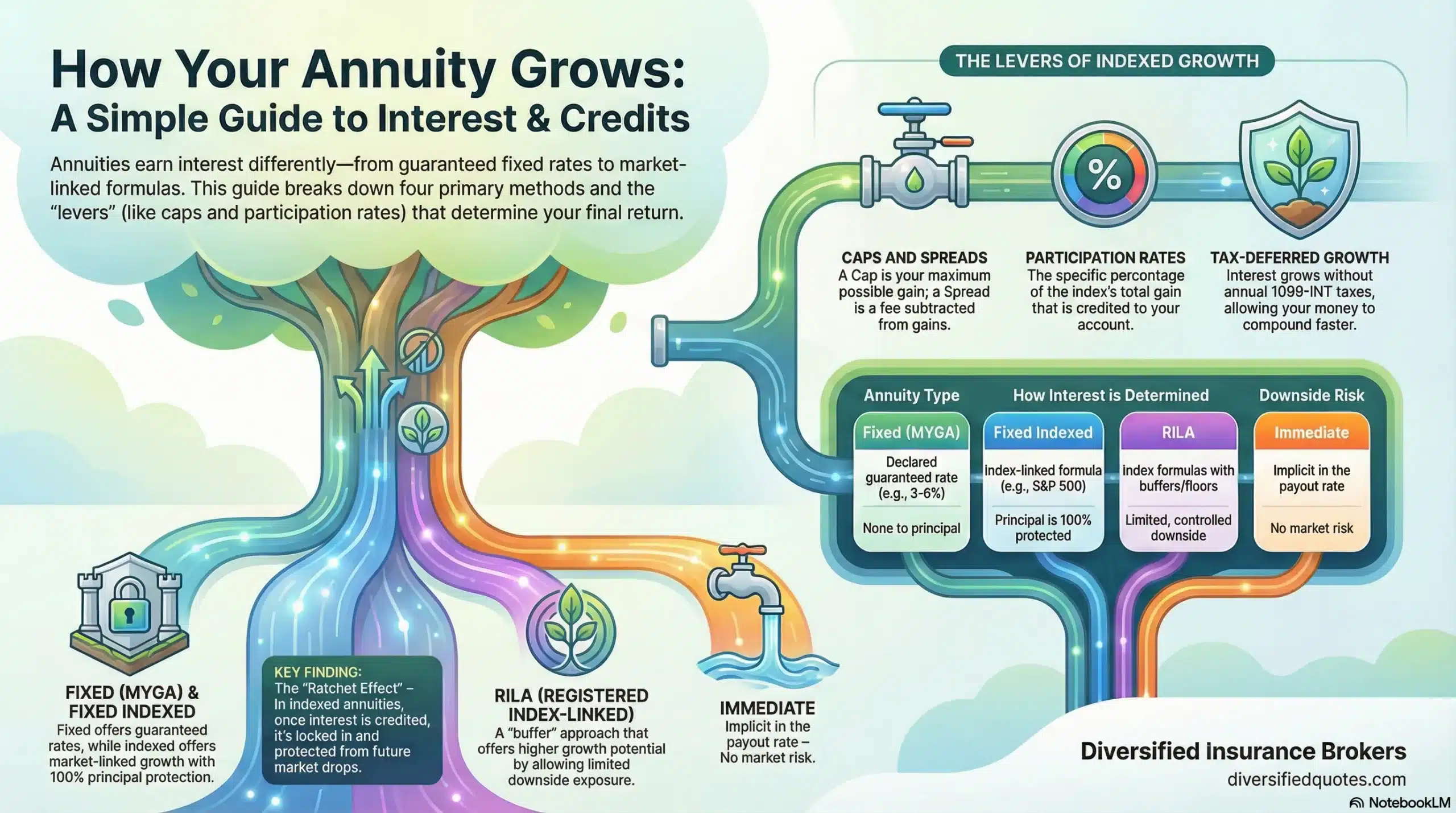
There are three primary annuity structures through which a $50,000 premium can earn interest, and they work in meaningfully different ways. A fixed annuity (often a multi-year guaranteed annuity, or MYGA) locks in a declared interest rate for a defined term — two years, five years, seven years — and that rate is contractually guaranteed to remain in place for the full term regardless of what happens to market rates in the interim. A fixed indexed annuity credits interest based on the performance of an external market index — a portion of any positive index performance, subject to a cap or participation rate — while protecting the principal completely from negative index years. An immediate income annuity converts the $50,000 into a stream of guaranteed payments beginning within 30 days, with no accumulation phase — the “rate” becomes expressed as a monthly payment amount rather than a credited percentage. Each structure serves a different planning purpose, and the one that makes the most sense for your $50,000 depends on whether your primary objective is safe accumulation for a defined period, principal-protected growth with some upside participation, or immediate guaranteed income.
The purpose of this page is to give you a complete understanding of how interest works on a $50,000 annuity — including the mechanics of each annuity type, the factors that drive rate levels up or down, how tax deferral magnifies the compounding effect versus taxable alternatives, how term selection interacts with rate levels, and how $50,000 fits into a broader retirement plan as either a standalone allocation or part of a laddering strategy. For actual current rates — which change as carriers adjust to the interest-rate environment — our live rate resources are the right reference point rather than any specific percentage you might read here. Our resource on how annuities earn interest covers the crediting mechanics in detail, and our annuities 101 guide provides the full product landscape context. If an investment risk analysis is part of your evaluation — comparing where a $50,000 annuity sits relative to other savings vehicles in your overall risk profile — those tools can help clarify where guaranteed growth belongs in the broader picture.
Ensure you are receiving the absolute top rates on your $50,000
Current Fixed Annuity Rates
Compare today’s best fixed annuity rates from top carriers.
Current Bonus Annuity Rates
See which annuities offer the highest upfront bonus today.
Request an Annuity Quote
Submit our annuity request form to get personalized rate options.
Lifetime Income Calculator
See how much guaranteed income your $50,000 could generate — and how it grows across different carriers and terms.
Compare Multi-Year Guaranteed Annuity Rates by Term
Explore the best rates by term length to find the option that fits your $50,000 timeline.
How Interest Actually Works on a $50,000 Annuity
When you place $50,000 into an annuity, the insurer credits interest to your account value according to the contract’s crediting mechanism — and the type of annuity determines everything about how that mechanism works. In a fixed MYGA, the insurer declares a specific annual interest rate at the time the contract is issued and guarantees that rate for the full term. If the contract declares a rate for a 5-year term, that rate applies each contract year for five consecutive years regardless of what happens to prevailing market rates during that period. Your account value grows at the guaranteed rate, compounding annually, and you can track the exact accumulation because it follows a predictable mathematical path with no market-driven variability. In a fixed indexed annuity, the insurer credits interest based on the performance of an external index — such as the S&P 500 — measured over a defined crediting period, subject to the contract’s participation rate, cap, or spread. In a positive index year, you receive a portion of the index gain up to the cap; in a negative index year, your account credits zero — but the principal from which future interest is calculated does not decline. The interest earned in past crediting periods is locked in, protected from being taken back by future negative index performance.
In both cases, the insurer funds the interest credits from the return on its general account investment portfolio — primarily high-quality bonds and other fixed-income securities. The spread between what the insurer earns on its investments and what it credits to policyholders covers the carrier’s operating costs, reserves, and profit margin. The credited rate you receive is the net rate after that spread — which is why carriers that can invest more efficiently or accept tighter margins can often offer higher credited rates than competitors. For a $50,000 annuity owner, understanding this mechanics helps explain why MYGA rates track the bond market so closely: when bond yields rise, insurers can offer more competitive credited rates because the raw material of their earnings has improved. When bond yields decline, credited rates compress because the insurer’s investment returns decline proportionally. Our comprehensive resource on understanding multi-year guaranteed annuities (MYGAs) covers the full crediting and compounding mechanics in detail, and our resource on how MYGAs compare to CDs covers how annuity rates stack up against bank alternatives in the same rate environment.
Hypothetical Growth of a $50,000 Annuity at Different Rates
The tables below illustrate how $50,000 grows under three hypothetical crediting rates across different time horizons. These figures are purely illustrative examples — they use round-number hypothetical rates to demonstrate compounding mechanics and are not quotes, projections, or representations of currently available rates. Actual annuity rates depend on the specific product, carrier, term length, state, and date of purchase. For current live rates, our best MYGA annuity rates and current annuity rates pages reflect what is available from active carriers today.
| Year | 4.00% (Hypothetical) | 5.00% (Hypothetical) | 6.00% (Hypothetical) |
|---|---|---|---|
| Year 1 | $52,000 | $52,500 | $53,000 |
| Year 3 | $56,243 | $57,881 | $59,551 |
| Year 5 | $60,833 | $63,814 | $66,911 |
| Year 7 | $65,797 | $70,356 | $75,180 |
| Year 10 | $74,012 | $81,445 | $89,542 |
| Year 15 | $90,047 | $103,947 | $119,791 |
| Year 20 | $109,556 | $132,665 | $160,356 |
All figures are hypothetical illustrations of compound interest mechanics only. These are not quotes or projections of current available rates. Actual annuity interest rates depend on the specific annuity product, carrier, term length, state of purchase, and date of purchase, and may be higher or lower than the illustrative rates shown. Tax deferral is assumed — no annual tax drag reduces the compounding base. Consult a licensed insurance professional and a tax advisor for guidance specific to your situation.
The growth difference between the three hypothetical rates becomes more pronounced over time because compounding amplifies rate differentials. At year 5, the difference between a 4% and 6% hypothetical result is approximately $6,000. At year 20, that same 2-percentage-point difference produces approximately $50,000 more in accumulated value on the original $50,000 premium. This is why carrier selection and rate competitiveness at the time of purchase matter so much — a fraction of a percentage point in credited rate, sustained across a full guarantee period, produces a measurable difference in the total accumulation. The only way to know whether the rate you have been offered is competitive is to compare it against the full field of active carriers for the same term in your state on the same day you are evaluating it.
Tax Deferral — How It Magnifies the Compounding Advantage
The compounding tables above assume full tax deferral throughout the accumulation period, which is one of the most significant structural advantages an annuity provides over a taxable savings alternative earning the same gross rate. In a non-qualified annuity (funded with after-tax money), credited interest accumulates inside the contract without generating a current-year tax liability. The IRS defers tax recognition until you take a distribution — meaning the full credited interest in each year remains in the account and earns additional interest the following year without being partially redirected to taxes. In contrast, a bank CD or taxable savings account earning the same gross rate credits interest that is recognized as ordinary income in the year it is earned, regardless of whether it is withdrawn. The taxes paid on that income in the current year reduce the compounding base for subsequent years, producing a lower effective accumulation than the same gross rate in a tax-deferred vehicle over a multi-year holding period.
The magnitude of this deferral advantage depends on the investor’s marginal tax rate and the length of the holding period. The higher the marginal rate and the longer the holding period, the larger the effective advantage of tax deferral over annual taxation. For a $50,000 annuity held for 10 or more years by an investor in a 22% or higher federal marginal bracket, the tax deferral advantage over a taxable CD earning the same gross rate is a real and quantifiable benefit — not a theoretical one. This is one of the core structural reasons why many conservative savers choose annuities over CDs even when the gross rate is similar: the after-tax accumulation is higher in the annuity for the same gross rate, because the full credited interest compounds without annual tax reduction. For a full treatment of the tax deferral comparison, our resource on how to protect your funds in retirement covers the framework within which these safe-money accumulation decisions belong.
How Term Length Affects the Interest Rate on a $50,000 Annuity
One of the most practical levers available to a $50,000 annuity buyer is term selection — and it interacts directly with rate level. Insurers generally offer higher credited rates on longer guarantee periods because the longer commitment allows the carrier to invest the premium in longer-duration bonds that typically carry higher yields. A 7-year MYGA frequently offers a higher rate than a 3-year MYGA in the same rate environment from the same carrier, because the carrier can match the longer-duration assets to the longer surrender period with greater confidence. The rate differential between short and long terms varies by rate environment and carrier — in some environments it is significant, in others it is minimal — but it is a real variable in the annuity rate decision.
For a $50,000 annuity buyer, term selection should be driven first by the actual timeline of the funds — how long can this money genuinely remain in the contract using only the annual free-withdrawal provision — and secondarily by how the rate differential between terms justifies the additional commitment. A 7-year surrender period on $50,000 provides more flexibility over that period than the total inability to access funds suggests, because most MYGA contracts include a 10% annual penalty-free withdrawal provision. But committing to a 7-year term on funds that may be needed in three years creates unnecessary friction. Our best short-term MYGA annuities resource covers the case for shorter terms when liquidity is a priority, and the resources linked below cover the competitive rate landscape at each specific term so the rate differential can be evaluated with actual current market data rather than general assumptions. Understanding annuity free withdrawal rules ensures you understand what liquidity access is available during the chosen term before committing.
Factors That Drive Annuity Interest Rates — What Determines What You’re Offered
Understanding what determines the annuity interest rate offered to any buyer — regardless of premium amount — helps you evaluate quotes intelligently rather than accepting or rejecting the first offer without context. The primary driver is the bond market: insurance companies invest the premiums they collect primarily in investment-grade fixed-income securities, and the yield on those securities determines the raw material available to fund credited rates. When the Federal Reserve increases short-term rates or bond market yields rise, annuity carriers can generally offer higher credited rates because their new premium investments produce higher returns. When yields decline, credited rates compress along with them. This is why annuity rates rose substantially during periods of rising bond yields and why they can decline when the bond market shifts in the other direction.
The second major factor is the carrier’s competitive strategy and operating efficiency. Not all carriers offer identical rates on equivalent products — some carriers accept tighter profit margins to compete aggressively on rate, while others price conservatively. The surrender period is the third factor: as described above, longer terms typically correlate with higher rates because longer duration assets can be matched to longer commitments. The fourth factor is product design. Some annuities include features — bonus credits, income riders, enhanced death benefits — that consume part of the carrier’s available margin, which can result in a lower base credited rate than a simpler contract without those features. A bonus annuity that adds an upfront percentage to your premium at issue may credit a slightly lower ongoing rate than a no-bonus alternative, and the net outcome depends on how long you hold the contract. The relative value of a bonus versus a higher ongoing rate is a function of holding period — for shorter holds, the bonus adds more; for longer holds, the higher ongoing rate often wins. Our how much an annuity income rider costs resource covers how rider fees interact with base credited rates in income-focused FIA designs.
How a $50,000 Annuity Converts to Retirement Income
Growth and accumulation are the focus for most $50,000 annuity buyers during the years before retirement, but the ultimate purpose of most annuity contracts is income. When the accumulation phase ends — either at the contract’s maturity or when the owner elects to begin distributions — the accumulated value can be converted to a retirement income stream in several ways. Systematic withdrawals allow the owner to take a defined dollar amount each year from the accumulated value until it is depleted. A period-certain annuitization pays a fixed monthly amount for a defined number of years regardless of life expectancy. Lifetime income annuitization converts the accumulated value into a guaranteed payment that continues for the rest of the annuitant’s life — and if a joint life option is elected, continues for the life of the surviving spouse. And for fixed indexed annuities with a guaranteed lifetime withdrawal benefit (GLWB) rider, income begins at the owner’s election and continues for life without requiring formal annuitization.
The monthly or annual income amount a $50,000 contract can produce depends on the accumulated value at income start, the annuitant’s age, the income structure selected, and current payout factors offered by the carrier at the time income begins. A $50,000 contract that grows for 10 years at a competitive rate before income begins has a larger base from which to generate income than one where income starts immediately. This two-phase approach — accumulate first, then convert to income — is why many $50,000 annuity buyers select a MYGA or FIA for the accumulation phase and plan to convert to income either through the same contract or through a new contract at maturity. The Lifetime Income Calculator embedded above models what different premium amounts and deferral periods produce in guaranteed monthly income from active carriers. Our resource on best annuity rates for seniors covers the income and accumulation options most relevant for retirees evaluating $50,000 allocations, and our resource on bonus annuity with lifetime income covers how bonus FIA designs integrate income guarantee riders. For scale context, our resource on how much a $6 million annuity pays illustrates how income scales proportionally with premium — the same mechanics apply at every premium level, including $50,000. Our how much does an annuity pay guide and companion resources for $100,000 and $500,000 premiums provide proportional context for understanding income at different investment sizes. For the Social Security coordination dimension of retirement income planning, our Social Security planning strategies resource covers how guaranteed annuity income layers with Social Security for a complete income floor.
$50,000 in a MYGA Ladder — The Strategy That Creates Staggered Access
One of the most effective uses of a $50,000 annuity allocation — particularly for buyers who want some ongoing liquidity rather than a single long surrender commitment — is as one rung in a MYGA ladder. Rather than placing the full $50,000 into a single contract with a single maturity date, a ladder divides the allocation across multiple contracts with staggered terms: perhaps a 2-year contract, a 3-year contract, and a 5-year contract, each funded with a portion of the $50,000. As each contract matures, the owner can either renew, withdraw, or redirect the funds based on the rate environment and their planning needs at that point in time. The laddering approach solves two problems simultaneously: it prevents the entire allocation from being locked in at a single rate environment for the maximum term, and it creates periodic access points that don’t require surrendering the entire position to meet expected future needs.
For a $50,000 total allocation, a ladder might divide the funds across three contracts — perhaps $15,000 in a 2-year, $15,000 in a 3-year, and $20,000 in a 5-year — creating three separate maturity dates at different points in time. The shorter-term contracts typically carry slightly lower rates in most rate environments, but the flexibility of having a portion of the allocation accessible every two to three years may justify that tradeoff for buyers who want periodic liquidity options without surrendering the full position. The laddering approach is covered in detail in our comprehensive resource on understanding multi-year guaranteed annuities and in our guide to best short-term MYGA annuities, which covers the specific use cases for 1- and 2-year contracts that often serve as the short end of a ladder strategy.
$50,000 as Part of a Larger Retirement Plan — The Partial Allocation Strategy
Many buyers who place $50,000 into an annuity are not putting their entire retirement savings into that single contract — they are allocating a defined portion of a larger retirement portfolio to a guaranteed vehicle while leaving other assets in a more flexible investment structure. This partial allocation approach is the most commonly recommended framework in retirement income planning: assign a specific amount to the annuity based on its specific job in the plan (guaranteed accumulation, income floor contribution, or safe-money preservation), and let the rest of the portfolio do different work with different tools. A $50,000 annuity might represent the safe-money anchor of a retirement portfolio — the portion protected from market loss, earning a competitive guaranteed rate with tax deferral — while a larger IRA or investment account remains allocated for growth, liquidity, and discretionary use.
This division of purpose is particularly powerful when the annuity’s guaranteed growth contributes to a future income stream that covers essential expenses, leaving the non-annuity portion of the portfolio without the pressure of being the sole funding source for all retirement spending. When the annuity income covers the baseline, the rest of the portfolio can be managed for opportunity rather than necessity — with the result that sequence of returns risk is substantially reduced for the overall plan. For the inflation protection dimension of this allocation, our resource on annuities with inflation protection for seniors covers how to structure the income component with inflation adjustment features. And for broader market context around where a safe-money annuity allocation fits alongside risk assets, our resource on downside protection strategies in bear markets covers how guaranteed instruments serve the portfolio in volatile market environments. If you have already received an annuity proposal and want to verify whether the product and rate are competitive for a $50,000 investment, our second-opinion annuity quote review provides that independent comparison across our full carrier panel.
Talk With an Advisor Today
Choose how you’d like to connect—call or message us, then book a time that works for you.
Schedule here:
calendly.com/jason-dibcompanies/diversified-quotes
Licensed in all 50 states • Fiduciary, family-owned since 1980
FAQs: What Is the Interest Rate on a $50,000 Annuity?
What interest rate can a $50,000 annuity earn?
The interest rate on a $50,000 annuity depends on the type of annuity, the term length, the carrier, and the prevailing interest-rate environment at the time of purchase — not on the $50,000 premium amount itself. A $50,000 and a $250,000 premium placed in the same contract from the same carrier on the same day typically receive the same credited rate. For fixed MYGAs, the rate is declared in the contract and guaranteed for the full term. For fixed indexed annuities, interest is credited based on index performance subject to the contract’s cap or participation rate. For current competitive rates across active carriers, our live rate pages reflect what is actually available today, because rates change frequently with the bond market environment.
Does the $50,000 investment amount affect the annuity rate offered?
In most cases, annuity interest rates are determined by the contract design, term length, carrier, and market conditions — not the premium amount. A $50,000 annuity and a $500,000 annuity in the same product from the same carrier typically earn the same credited rate. Some carriers do set minimum premium thresholds — for example, requiring a minimum of $10,000 or $25,000 to open a contract — and a few carriers offer slightly higher rates on very large premiums as a volume consideration, but these are exceptions rather than the rule. For most buyers at the $50,000 level, the rate evaluation is the same as for any other buyer: compare the specific rate available for the desired term from qualified carriers in your state.
How does compound interest work inside a $50,000 annuity?
Annuity interest compounds annually in most fixed MYGA designs: the credited rate is applied to the account value at the end of each contract year, and the resulting interest is added to the account value, which then serves as the base for the following year’s interest calculation. This means interest earns interest each subsequent year. Because annuities grow tax-deferred, the full credited interest remains in the account each year without being reduced by annual income tax obligations — the entire accumulated value, including all credited interest, participates in compounding each period. Over a 10- to 20-year holding period, this combination of annual compounding and tax deferral produces meaningful advantages over taxable savings vehicles earning the same gross rate.
How does term length affect the rate on a $50,000 annuity?
In most rate environments, longer MYGA terms carry higher credited rates than shorter terms because the longer surrender period allows the carrier to invest in longer-duration bonds that typically yield more. A 7-year MYGA often offers a higher rate than a 3-year MYGA in the same rate environment, though the specific differential varies by carrier and market conditions. The tradeoff is the longer commitment and surrender period — access to funds beyond the annual penalty-free withdrawal provision is restricted for the full term. Term selection should be driven first by the actual timeline of the funds (how long can the money genuinely remain in the contract) and second by how the rate differential between terms compares to the value of shorter-term access. Our rate pages for each term length — 1-year through 10-year — allow direct rate comparison across the market for each specific duration.
Can a $50,000 annuity produce retirement income?
Yes — a $50,000 annuity can be converted to a retirement income stream through annuitization or, for FIAs with GLWB riders, through guaranteed lifetime withdrawals. The income amount depends on the accumulated value at the time income begins, the annuitant’s age, the income structure selected (life-only, joint life, period-certain), and current payout factors at the time of income election. A $50,000 contract that has grown through a multi-year accumulation phase before income begins will produce more income than the same amount starting immediately, because the larger accumulated base generates higher payments. The Lifetime Income Calculator on this page allows you to model what different deferral periods and ages produce in guaranteed monthly income from active carriers.
Are annuity interest rates guaranteed?
Fixed MYGA annuity rates are guaranteed for the full contract term — the declared rate cannot be reduced during the guarantee period regardless of what happens to market interest rates. This means a $50,000 MYGA buyer knows from day one exactly what rate will apply for the full term and exactly what the account value will be at maturity. Fixed indexed annuity credits are not declared in advance — they are determined each crediting period based on index performance and the contract’s crediting parameters (caps, participation rates, spreads). The principal is guaranteed never to decline from market losses, but the interest credited in any given year is not pre-declared. Both product types provide principal protection; they differ in how interest is determined and how predictable the accumulation path is.
What is the advantage of a $50,000 annuity over a CD?
For many conservative savers, the primary advantages of a $50,000 MYGA over a CD earning a similar gross rate are tax deferral and rate competitiveness. Tax deferral means the credited interest is not recognized as taxable income in the year it is earned — the full accumulation continues to compound without annual tax reduction. For investors in higher marginal brackets holding the money for multiple years, this produces a measurably better after-tax accumulation than a CD taxed annually on the same gross rate. Additionally, MYGA rates frequently exceed comparable CD rates at equivalent terms because insurance carriers invest at longer durations and can pass a portion of the higher yield back to policyholders. MYGAs are backed by the issuing insurer and state guaranty associations rather than FDIC insurance — a distinction that makes carrier financial strength evaluation important. For a direct comparison, our resource on how MYGAs compare to CDs covers this analysis in full detail.
What should I look for when comparing $50,000 annuity options?
When comparing $50,000 annuity options, evaluate: (1) The credited rate — specifically whether it is competitive against the full field of carriers for the same term in your state on the same day, not just the first carrier you encounter. (2) The surrender period — whether the term matches your actual timeline and how the free-withdrawal provision works during the surrender period. (3) Carrier financial strength — the AM Best rating and Comdex score of the issuing carrier, with a preference for A- or better for any meaningful long-term commitment. (4) Waiver provisions — whether the contract includes nursing home or terminal illness waivers that allow access without surrender charges in qualifying circumstances. (5) Maturity options — how the contract handles the end of the guarantee period and whether automatic renewal at potentially lower rates is a risk to manage. Comparing across multiple qualified carriers using identical inputs — same premium, term, state, and date — is the only reliable way to determine whether a specific offer is competitive.
About the Author:
Jason Stolz, CLTC, CRPC, DIA, CAA and Chief Underwriter at Diversified Insurance Brokers (NPN 20471358), is a senior insurance and retirement professional with more than 25 years of real-world experience helping individuals, families, and business owners protect their income, assets, and long-term financial stability. As a long-time partner of the nationally licensed independent agency Diversified Insurance Brokers, Jason provides trusted guidance across multiple specialties—including fixed and indexed annuities, long-term care planning, personal and business disability insurance, life insurance solutions, Group Health, Travel Medical and Evacuation Insurance, and short-term health coverage. Diversified Insurance Brokers maintains active contracts with over 100 highly rated insurance carriers, ensuring clients have access to a broad and competitive marketplace.
His practical, education-first approach has earned recognition in publications such as VoyageATL, and contributions from his agency featured in Kiplinger and GoBankingRates— highlighting his commitment to financial clarity and client-focused planning. Drawing on deep product knowledge and years of hands-on field experience, Jason helps clients evaluate carriers, compare strategies, and build retirement and protection plans that are both secure and cost-efficient. Visitors who want to explore current annuity rates and compare options across multiple insurers can also use this annuity quote and comparison tool.
Explore More Annuity Options: Browse our complete guide to How Much Does an Annuity Pay? — covering annuity payout calculators, income amounts & interest rates by investment size from 100+ carriers.
Last Reviewed: June 3, 2026 |
Reviewed by: Jason Stolz, CLTC, CRPC, DIA, CAA
Chief Underwriter, Diversified Insurance Brokers, Inc. | NPN: 20471358 | Diversified Insurance Brokers, Inc. — Licensed in all 50 states
Fact Checked by: Tonia Pettitt, CMIP©
Medicare Specialist, Diversified Insurance Brokers, Inc. | NPN: 14374308 | Diversified Insurance Brokers, Inc. — Licensed in all 50 states
Did you find this content helpful? Leave us a Google review — it helps others find trustworthy guidance too.
Editorial Standards: Diversified Insurance Brokers maintains rigorous editorial standards to ensure accuracy, clarity, and independence in all content. Learn more about our editorial standards and commitment to transparency.
