
Understanding Multi-Year Guaranteed Annuities (MYGAs)
Understanding Multi-Year Guaranteed Annuities (MYGAs)
A Multi-Year Guaranteed Annuity — universally referenced as a MYGA — is the simplest annuity product in the insurance marketplace, and for a specific type of retirement investor it may also be the most effective. The mechanics are deliberately straightforward: you deposit a lump sum with a licensed insurance carrier, select a term — typically ranging from two to ten years — and the carrier locks in a guaranteed fixed interest rate for the entire duration of that term. Your principal does not fluctuate based on market conditions, your interest rate does not depend on index performance or participation rates, and your credited rate does not decline if interest rates fall during your term. You know from day one exactly what rate your money will earn and exactly how much your contract value will be at maturity — information that virtually no market-based investment, money market account, or CD ladder can provide with the same certainty over a multi-year period. For conservative investors and retirees who prioritize principal protection, predictable compounding, and tax-deferred growth over any form of market participation, MYGAs represent one of the most straightforward and efficient tools available in the safe-money landscape. Our resource on best fixed annuities for conservative investors provides the broader context for how MYGAs compare to other fixed annuity structures across the risk-averse portion of the annuity market.

The MYGA’s most significant structural advantage over bank CDs — the product it most closely resembles — is tax deferral. When interest accrues inside a CD, it is recognized as ordinary income in the year it is earned, regardless of whether you withdraw it. In a taxable account, a CD earning competitive interest produces a tax liability that reduces the effective annual return and reduces the amount of principal available to compound in subsequent years. A MYGA grows tax-deferred: interest credits accumulate without current-year tax recognition, and taxes are deferred entirely until the funds are actually withdrawn. Over a multi-year guarantee period, this deferral creates a meaningful compounding advantage — the full credited interest is available to earn additional interest each year rather than being partially redirected to the IRS. For investors in higher marginal tax brackets, the effective after-tax return difference between a MYGA and a comparable CD can be substantial even before accounting for any rate differential. Our live current fixed annuity rates page shows where MYGA rates sit across different term lengths and carriers, and our broader current annuity rates overview covers the full product landscape within which MYGA rates are most useful when compared directly against competing safe-money alternatives.
The MYGA is not a universal fit for every dollar of retirement savings — it is the right fit for the portion of savings where the priorities are principal protection, competitive guaranteed growth, and tax-deferred compounding, with a commitment to leaving the funds in place for the full guarantee period or using only the contract’s permitted free-withdrawal provision during the term. For dollars that must remain fully liquid at all times, a MYGA’s surrender period is a genuine constraint. For dollars that are being invested for total-return participation in equity markets, a MYGA deliberately forgoes that upside in exchange for its guarantee structure. Understanding where a MYGA fits within a broader retirement asset allocation — and where it doesn’t — is the foundation of using it effectively. This page covers everything you need to know: how MYGAs work mechanically, how they compare to CDs and other safe-money alternatives, how tax deferral creates the compounding advantage, how to select the right term, how free withdrawals and surrender schedules work, how laddering strategies create periodic access without surrendering early, and how to evaluate MYGAs across the full carrier market rather than accepting the first rate offered. Our annuities 101 resource covers the foundational product categories within which MYGAs sit, and our what is a deferred annuity resource covers the accumulation structure that defines how MYGAs grow over time.
Ensure you are receiving the absolute top rates
Current Fixed Annuity Rates
Compare today’s best fixed annuity rates from top carriers.
Current Bonus Annuity Rates
See which annuities offer the highest upfront bonus today.
Request an Annuity Quote
Submit our annuity request form to get personalized rate options.
Lifetime Income Calculator
Model guaranteed income from a MYGA or transition to an income annuity — compare options side by side.
What a MYGA Is — The Mechanics Without Ambiguity
A Multi-Year Guaranteed Annuity is a single-premium deferred annuity — meaning you make one lump-sum deposit and the contract grows over a defined period without requiring additional contributions. The insurance carrier applies the guaranteed interest rate to your account value at each crediting interval (typically annually or monthly, depending on the contract), and the credited interest compounds into the account value for subsequent periods. Your credited rate is defined in the contract at the time of purchase and guaranteed for the full term — it cannot be reduced during the guarantee period regardless of what happens to prevailing interest rates. Unlike certificates of deposit, which are bank products backed by FDIC insurance, MYGAs are insurance contracts backed by the financial strength of the issuing insurance company and supported by state guaranty association protections within applicable limits. This distinction between FDIC backing and insurer backing is important to understand before purchase, as the protection mechanisms are different in structure even though the product mechanics are similar in concept.
The guarantee period terminates at the end of the selected term, at which point the policyholder typically has a window to make an election about what to do with the accumulated value — renew into a new guarantee period, request a lump-sum distribution, transfer the value to a different annuity through a 1035 exchange, begin systematic withdrawals, or convert to an income stream. Most contracts include a brief window at maturity (often 30 days) during which the policyholder can make these decisions without triggering surrender charges. If no election is made during the window in some contract designs, the contract may automatically renew into a new guarantee period at the carrier’s then-current rate for a new term — which is why active management at maturity is important. The simplicity of the MYGA’s accumulation mechanics — one rate, one term, guaranteed compounding — makes it one of the easiest annuity products to evaluate and compare across carriers. For the MYGA comparison to be meaningful, the inputs must be consistent: same term, same premium, same state, same credit quality threshold for carrier selection. Everything else follows from those inputs.
MYGA vs. CD vs. Other Safe-Money Alternatives
| Feature | MYGA | Bank CD | High-Yield Savings Account | Fixed Indexed Annuity (FIA) |
|---|---|---|---|---|
| Rate guarantee | Fully guaranteed for entire term — locked at purchase, cannot be reduced | Fully guaranteed for term — locked at issuance | Variable — rate can be changed by the bank at any time | Not declared; linked to index performance subject to cap/participation rates that can reset annually |
| Tax treatment of growth | Tax-deferred — no annual tax recognition; all taxes deferred until withdrawal | Taxed annually — interest recognized as ordinary income each year regardless of withdrawal | Taxed annually — same as CD, income recognized whether withdrawn or not | Tax-deferred — same as MYGA |
| Principal protection | Yes — principal fully protected from market loss | Yes — principal protected (within FDIC limits) | Yes — FDIC insured (within limits) | Yes — 100% downside protection from index loss; account value cannot decline from market movement |
| Safety backing | Insurance company general account + state guaranty association (up to applicable state limits) | FDIC (up to $250,000 per depositor per institution) | FDIC (up to $250,000 per depositor per institution) | Insurance company general account + state guaranty association |
| Rate competitiveness | Generally higher than comparable CDs — insurance carriers invest at longer durations and pass a portion back as higher credited rates | Rate reflects bank funding needs; typically below MYGA rates for comparable terms | Variable — competitive in elevated rate environments but subject to rate reduction without notice | No declared rate; upside potential higher in positive index years but zero in negative years |
| Liquidity during term | Typically 10% annual penalty-free withdrawal; excess withdrawals subject to surrender charges and possible MVA | Early withdrawal penalty (typically 3–6 months of interest) for early CD termination | Fully liquid — no penalty for withdrawal | Similar to MYGA — typically 10% annual penalty-free; surrender charges for excess |
| Annual fees | None in most MYGA designs — costs built into the spread between investment earnings and credited rate | None | None (some accounts have minimum balance requirements) | None for base FIA; income rider adds annual fee deducted from account value |
Specific rates, surrender schedules, free withdrawal provisions, and state guaranty association coverage limits vary by carrier, product, state, and time of purchase. All figures and comparisons reflect general market characteristics — not any specific product. MYGA rates and CD rates change frequently; always request current illustrations before making any decision. State guaranty association coverage is not equivalent to FDIC insurance and varies by state. Consult a licensed insurance professional and a tax advisor before making any annuity purchase.
The Tax Deferral Advantage — How It Compounds Over Time
The tax deferral benefit of a MYGA is not simply a convenience — it is a quantifiable compounding advantage that produces a measurably higher effective return than a taxable alternative earning the same gross rate, particularly for investors in higher marginal brackets over longer holding periods. The mechanism is straightforward: a CD earning interest credits that income to the account each year, and the IRS taxes that income in the same year at the investor’s ordinary income rate. The portion of interest that goes to taxes is not available to compound in the following year — the effective compounding base is permanently reduced by the tax paid annually. A MYGA earning the same gross rate defers the tax obligation entirely until withdrawal — every dollar of credited interest remains in the account and participates fully in compounding for the remaining term. The longer the holding period and the higher the marginal tax rate, the larger the effective compounding advantage produced by deferral versus annual taxation on the same gross rate.
This deferral advantage is most powerful in non-qualified (after-tax) money held by investors in higher marginal brackets who do not need the annual interest income. For investors who need current income — who plan to take the credited interest as distributions each year rather than allowing it to compound — the tax deferral benefit is reduced because the distribution triggers the deferred tax each year regardless. The MYGA’s compounding advantage is most fully realized when the credited interest is allowed to accumulate inside the contract for the full term, with taxes deferred until maturity. For money already inside an IRA or other tax-deferred qualified account, the deferral benefit of a MYGA is less incremental — the qualified account is already tax-deferred — but the MYGA still contributes principal protection, a guaranteed rate for the full term, and the contractual certainty that the rate will not change during the guarantee period, all of which can be genuinely valuable inside a qualified account even without the additional tax deferral benefit. Our resource on how to transfer an IRA to an annuity covers the mechanics of moving qualified funds into a MYGA, including the direct rollover process that preserves tax-deferred status throughout the transfer.
Choosing the Right MYGA Term — Matching Duration to Your Timeline
The single most important structural decision in MYGA selection is term length — and it should be driven by your actual timeline rather than by rate optimization alone. The principle is simple: the MYGA term should match the period during which you genuinely do not need access to those funds beyond the contract’s permitted free-withdrawal provision. A five-year MYGA in a portfolio where the funds may be needed in three years creates unnecessary friction; a three-year MYGA for funds that could comfortably remain in place for seven years sacrifices the typically higher rates available at longer terms without a corresponding benefit. The rate differential between term lengths is real but not dramatic in most rate environments — the additional rate earned on a seven-year MYGA versus a five-year MYGA does not meaningfully compensate for a surrender period that doesn’t match the policyholder’s actual liquidity horizon. Our resource on best short-term MYGA annuities covers the specific case for shorter terms and when they are the more appropriate choice.
Across each term length, our dedicated rate resources provide the competitive context for evaluating where the current market is pricing guaranteed rates at that specific duration. Whether you are evaluating a 1-year, 2-year, 3-year, 4-year, 5-year, 6-year, 7-year, 8-year, 9-year, or 10-year guarantee period, those resources show the current top rates available from qualified carriers at each specific duration. Because MYGA rates change frequently as carriers adjust to the interest-rate environment, a rate that is highly competitive today may not be available tomorrow — and a rate that seems modest today may represent a carrier’s best offer for a specific term. The only way to evaluate whether a specific MYGA rate is competitive is to compare it against the full field of active carriers at the same term on the same day, which is exactly what those rate resources provide.
Free Withdrawals, Surrender Schedules, and Liquidity Planning
Most MYGA contracts include an annual penalty-free withdrawal provision — typically 10% of the account value or accumulated interest — that allows limited access to funds during the surrender period without triggering surrender charges or market value adjustments. This provision is a meaningful liquidity safety valve for investors who may need modest access to funds during the guarantee period without fully surrendering the contract. The 10% free-withdrawal provision means that a $200,000 MYGA can produce up to $20,000 per year in accessible distributions without penalty — which for many retirees represents a meaningful supplemental income resource during the accumulation phase if needed. The specific free-withdrawal mechanics — what percentage is permitted, when it begins, whether it is cumulative, and how it interacts with any MVA provision — are defined in the contract and must be verified from the specific product’s policy document rather than assumed from general descriptions. Our resource on annuity free withdrawal rules covers how these provisions work across the MYGA market and what to look for when comparing contracts.
For withdrawals that exceed the free-withdrawal provision during the surrender period, surrender charges apply — typically a declining percentage schedule that starts higher in the first year and decreases to zero at the end of the surrender period. Some MYGA contracts also include a market value adjustment (MVA) that can apply to excess withdrawals during the guarantee period, adjusting the surrender value based on how interest rates have moved since the contract was issued. Contracts that include an MVA often offer higher credited rates than no-MVA alternatives in exchange for sharing some interest-rate timing risk with the policyholder in an early-exit scenario. Our resource on annuity surrender charges and MVA covers both of these mechanics in detail and explains how they interact in an early-exit scenario. The combined impact of surrender charges and a potential negative MVA in a rising-rate environment can be substantial — which reinforces why the term should be matched to the actual timeline before any MYGA is purchased.
MYGAs vs. Fixed Indexed Annuities — When Each Is the Better Fit
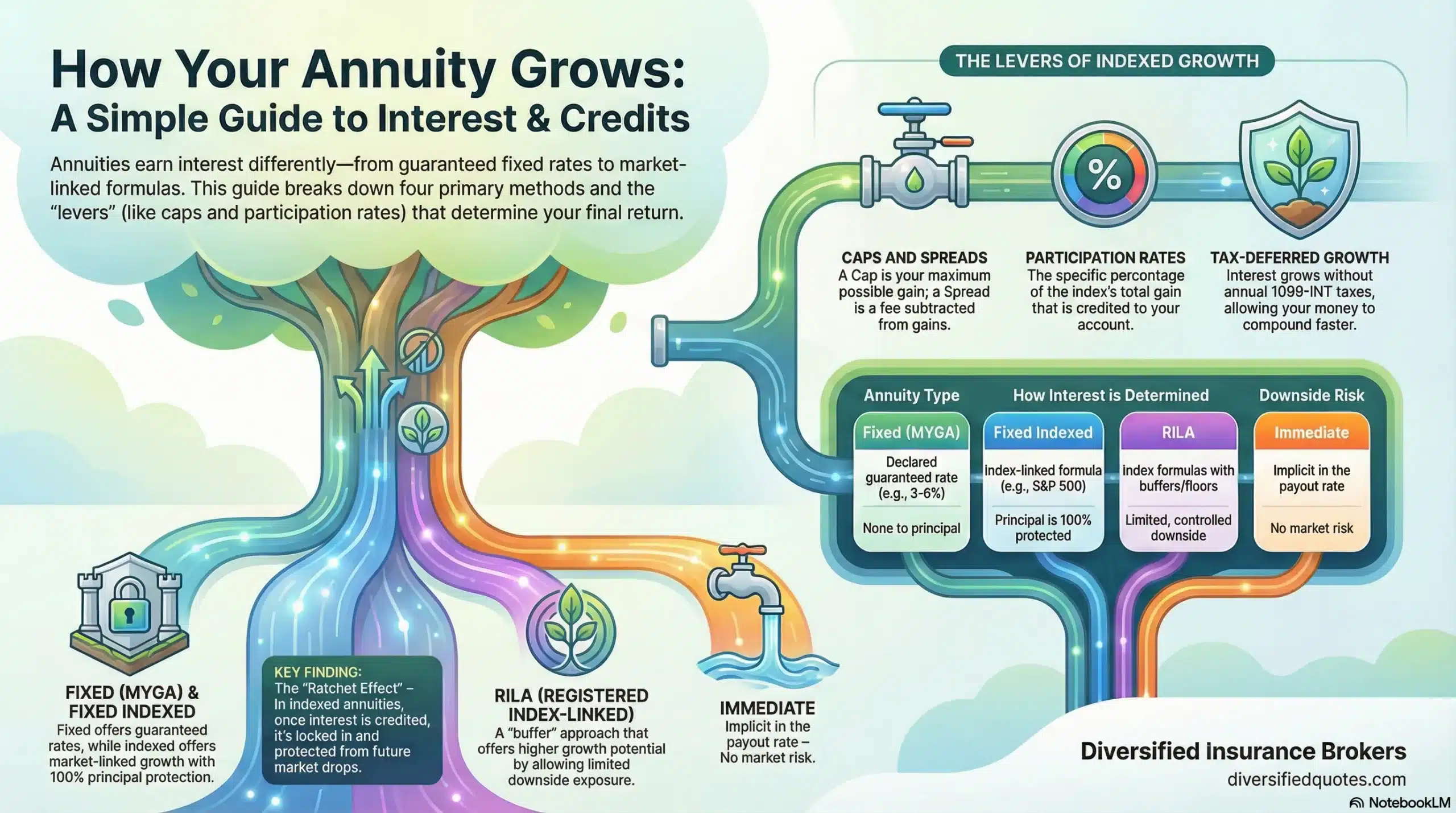
The most common comparison for consumers evaluating safe-money annuity options is MYGA versus fixed indexed annuity — and the distinction is more significant than it might appear from the surface-level similarity that both provide principal protection from market loss. A MYGA provides a declared fixed rate that is fully guaranteed for the entire term. You know your credited rate, you know your account value at every point in the term, and the outcome is entirely predictable. A fixed indexed annuity provides interest credits based on the performance of an external index — subject to caps, participation rates, or spreads that determine how much of any positive index performance is credited to your account. In a strong index year, an FIA can credit substantially more than a MYGA. In a flat or negative index year, the FIA credits zero (your principal is protected but you earn nothing from the index that year). Over a multi-year period, the FIA’s indexed crediting can produce higher or lower accumulation than a MYGA depending on market conditions — but it cannot produce a contractually certain outcome in the same way a MYGA can.
The practical choice comes down to the investor’s priorities. If certainty of outcome is the primary value — knowing exactly what you will have at maturity regardless of market conditions — the MYGA’s declared rate is the cleaner solution. If the investor is comfortable with the indexed crediting variability in exchange for the possibility of higher accumulation in good market years, a FIA may produce better outcomes over a full market cycle. Many retirement portfolios include both: a MYGA for the safe-money anchor where outcome certainty is the priority, and a FIA for the portion of safe-money assets where some indexed upside potential is acceptable within the principal protection constraint. Our resource on how a fixed indexed annuity works covers the FIA mechanics in full detail, and our resource on how indexed annuities work and who should consider them covers the broader evaluation framework for when indexed structures make sense. Our resource on what are the best fixed indexed annuities for income covers the income-oriented FIA designs that represent a different planning objective than MYGA accumulation. The broader fixed annuity category context — including where MYGAs sit within the full spectrum — is covered in our resource on what is a fixed annuity.
MYGA Laddering — The Strategy That Creates Periodic Liquidity
The MYGA laddering strategy is the annuity equivalent of CD laddering — a technique that preserves periodic access to a portion of accumulated funds while maintaining the full rate advantage of multi-year guarantees on the overall portfolio. Rather than placing all available safe-money funds into a single MYGA with one term, a laddered approach divides the total allocation across multiple contracts with staggered maturity dates. For example, a retiree with a $500,000 safe-money allocation might place $100,000 into each of five MYGAs with terms of two, three, four, five, and six years. Each contract matures at a different point, creating a staggered series of decision windows where a portion of the total allocation becomes available for reinvestment, withdrawal, or repositioning without triggering surrender charges on the rest of the portfolio.
The laddering strategy offers several planning benefits. It reduces the risk of having the entire allocation locked in at a single rate environment — if rates improve in two years, the portion of the ladder maturing then can be rolled into a new MYGA at the prevailing higher rate. It creates predictable access points that can be coordinated with anticipated spending needs, required minimum distributions, or income planning milestones. And it avoids the concentration risk of a single maturity date where all funds must be repositioned simultaneously, which requires making a single large rate-environment bet rather than spreading the decision across multiple market cycles. The trade-off of laddering is that shorter-term MYGAs in the ladder typically carry lower rates than the longer-term contracts — the rate benefit of a 6-year MYGA is partially diluted by the lower rate on the 2-year portion. The question is whether the periodic flexibility gained justifies the rate cost of the shorter terms, which depends on the specific rate differential at any given time and the investor’s genuine access needs during the period. Our live best MYGA annuity rates page provides the current rate data for each term length needed to model a specific ladder strategy with accurate pricing. And our resource on how MYGAs compare to CDs covers the structural comparison that underlies why the laddering analogy is so instructive for retirees who are already familiar with CD laddering from their banking relationships.
Carrier Financial Strength — Why Not All MYGAs Are Equal
A MYGA is backed by the financial strength of the issuing insurance company — and that backing is only as good as the carrier’s ability to honor its guaranteed obligations over the full term of the contract. Carrier financial strength is not a marketing variable; it is the foundational promise underlying the guaranteed rate and principal protection that define what a MYGA is. For a 5-year MYGA, you are committing principal to the carrier’s general account for five years — you need to be confident that the carrier will be in a position to fulfill its contractual obligations throughout that period and at maturity. This is why AM Best financial strength ratings — the industry’s primary carrier quality metric — matter in MYGA evaluation as much as they do in any other long-term insurance product.
Most experienced advisors recommend a minimum of A- (Excellent) from AM Best as the financial strength threshold for new annuity purchases — with a preference for A or higher for larger premium amounts or longer terms. Selecting a MYGA from a carrier below that threshold for a higher rate is a trade-off that requires explicitly understanding the financial strength discount being accepted in exchange for the additional yield. Our carrier review pages — including resources like is Nationwide a good insurance company — illustrate the framework we use to evaluate carrier financial strength, rating history, and overall competitive positioning before recommending any carrier’s MYGA in a specific client scenario. At Diversified Insurance Brokers, we compare MYGA options across more than 75 top-rated carriers — which means the best available rate in a client’s state, for a specific term, within a specified carrier quality range, is identified through systematic comparison rather than by defaulting to one carrier’s offering. Our second-opinion annuity quote review provides that independent carrier comparison for consumers who have already received a MYGA proposal and want to verify it against the full market. Our annuity rescue plan covers the specific situation where an existing contract is underperforming and repositioning into a more competitive MYGA may produce a better outcome. And our resource on how to protect your funds in retirement covers the broader safe-money framework within which MYGA carrier selection is evaluated.
Transitioning From MYGA Accumulation to Retirement Income
MYGAs are accumulation vehicles — their core purpose is to grow assets at a guaranteed rate with tax deferral for a defined period. But for many retirees, the accumulated MYGA value eventually needs to transition into retirement income. That transition can take several forms depending on timing, income objectives, and other income sources already in place. The simplest transition is systematic withdrawals from the accumulated MYGA value at maturity — withdrawing a defined amount monthly or annually from the contract value. This approach provides control and flexibility but does not provide longevity protection — withdrawals deplete the account value, and if the retiree lives longer than expected or withdraws at too high a rate, the account could be exhausted. The structured approach is to exchange the matured MYGA into an income-focused annuity — either an immediate income annuity or a fixed indexed annuity with a guaranteed lifetime withdrawal benefit rider — that converts the accumulated value into a guaranteed income stream that cannot be outlived regardless of how long the retiree lives.
This two-phase strategy — MYGA accumulation first, then income annuity conversion — is a common planning framework for retirees who are not yet ready to begin income but want to build a guaranteed income asset over a defined period before income starts. The MYGA grows at a guaranteed rate during the accumulation phase; at maturity, the accumulated value (now larger than the original premium due to compounding) is repositioned through a 1035 exchange or direct rollover into the income vehicle. Our resources on lifetime income annuity strategies and annuity beneficiary and death benefits cover the income and legacy mechanics that apply when a MYGA’s accumulated value is repositioned into an income structure. The question of whether to continue in a MYGA or convert to an income vehicle is one that involves coordinating with Social Security timing, required minimum distribution schedules, and other income sources — our resource on do I still need life insurance in retirement covers the parallel question of how insurance assets are evaluated within the full retirement income picture.
Talk to an Advisor or Request Your Annuity Quote
Ready to explore this annuity in more detail—or compare it with other carriers to see if even higher rates are available? With guaranteed income, principal protection, and long-term growth potential on the line, making the right choice is essential. The experienced advisors at Diversified Insurance Brokers will guide you through the options and design a strategy tailored to your retirement goals.
Schedule here:
calendly.com/jason-dibcompanies/diversified-quotes
Licensed in all 50 states • Fiduciary, family-owned since 1980
FAQs: Understanding Multi-Year Guaranteed Annuities (MYGAs)
What is a Multi-Year Guaranteed Annuity (MYGA)?
A Multi-Year Guaranteed Annuity (MYGA) is a single-premium fixed deferred annuity that locks in a guaranteed interest rate for a set term — typically 2 to 10 years. You deposit a lump sum with an insurance carrier, the carrier applies the guaranteed rate to your account value each crediting period, and your principal is fully protected from market loss. The credited rate cannot be reduced during the guarantee period regardless of what happens to prevailing interest rates. Your money grows tax-deferred throughout the term, with taxes deferred until withdrawal. There are no annual management fees in most MYGA designs. At maturity, you can renew, withdraw, transfer, or convert to income. MYGAs are backed by the financial strength of the issuing insurance company and supported by state guaranty associations within applicable limits — not FDIC-insured like bank CDs.
How does a MYGA differ from a traditional fixed annuity or CD?
A MYGA is a type of fixed annuity that locks in a specific rate for a multi-year period — similar to a CD in structure but with tax deferral, typically higher rates, and insurer backing rather than FDIC coverage. Traditional fixed annuities may have rates that reset after an initial guarantee period at the carrier’s then-current renewal rate, while a MYGA’s rate is fixed for the entire guarantee period defined in the contract. CDs are bank products taxed annually on interest earned; MYGAs defer taxes until withdrawal, producing a meaningful compounding advantage for investors who do not need current income. CDs carry FDIC insurance up to $250,000; MYGAs are backed by the issuing insurer and state guaranty associations with varying coverage limits.
What terms are available for MYGAs?
Common MYGA terms range from 2 to 10 years, with 3-, 5-, and 7-year terms being the most frequently purchased. The right term depends on your actual timeline and liquidity needs — the term should match the period during which the funds can genuinely remain in place using only the contract’s free-withdrawal provision. Many retirees choose 3–5 year terms to balance competitive rates with periodic access points. Some carriers also offer 1-year or 2-year MYGAs for shorter-horizon needs, and some offer 8-, 9-, or 10-year options for maximum rate optimization in higher-rate environments. The rate differential between term lengths is real but not dramatic in most rate environments — term selection should be driven by timeline match, not solely by rate maximization.
Is my principal guaranteed in a MYGA?
Yes — MYGAs provide full principal protection from market loss. Your account value cannot decline due to stock market performance, index movements, or interest rate changes. Your credited rate is guaranteed for the full term and cannot be reduced. The guarantee is backed by the financial strength of the issuing insurance company and supported by your state’s guaranty association within applicable coverage limits. MYGAs are not FDIC-insured — the protection mechanism is insurer-backed rather than bank-backed. Choosing a carrier with a strong AM Best financial strength rating (typically A- or better) is the primary risk management step for ensuring the insurer can honor its obligations throughout the contract term.
How are MYGAs taxed?
MYGA interest grows tax-deferred — you do not pay taxes on credited interest in the year it is earned. Taxes are deferred until you make a withdrawal, at which point gains are taxed as ordinary income (not at capital gains rates). For non-qualified (after-tax) MYGAs, the “interest-first” rule applies: gains are considered withdrawn before principal, so early distributions are fully taxable until all accumulated gain is exhausted. Withdrawals before age 59½ may also be subject to a 10% IRS early withdrawal penalty in addition to ordinary income tax on the gain. For MYGAs held inside IRAs or other qualified accounts, all distributions are taxed as ordinary income since the original contributions were tax-deferred. Non-qualified MYGAs have no contribution limits, making them useful for safe-money accumulation after tax-advantaged account limits are reached. Always consult a tax advisor for guidance specific to your situation.
Can I access my money during the MYGA term?
Most MYGAs allow limited penalty-free withdrawals during the surrender period — typically 10% of the account value per contract year, though exact terms vary by carrier and product. Withdrawals within the penalty-free provision do not trigger surrender charges. Withdrawals above the free amount are subject to surrender charges (a declining percentage schedule) and may also trigger a market value adjustment (MVA) depending on the contract design. Withdrawals before age 59½ are also subject to a potential 10% IRS early withdrawal penalty on any gain. Many contracts also waive surrender charges for specific qualifying events — terminal illness, nursing home confinement, or death — though exact waiver terms are contract-specific and must be confirmed from the policy document. Full liquidity is typically restored at the end of the surrender period.
What happens when the MYGA term ends?
At the end of the guarantee period, most MYGA contracts provide a decision window — typically 30 days — during which you can choose to renew into a new guarantee period at the carrier’s then-current rate, request a full lump-sum distribution, transfer to a different annuity through a 1035 exchange (potentially preserving tax deferral), begin systematic withdrawals, or convert to an income stream. If no election is made during the window in some contract designs, the contract may automatically renew into a new guarantee period at the carrier’s then-declared rate. Active management at maturity is important — comparing the renewal rate against competing carriers’ current offerings often reveals more competitive options available in the full market. Never assume the auto-renewal rate is the best available option without comparing it against the current MYGA rate landscape.
Are MYGAs safer than market-based investments?
MYGAs are not tied to stock market performance and provide guaranteed interest and full principal protection from market loss — which makes them fundamentally different from equities, bonds, and market-based funds in terms of risk profile. Your account value cannot decline from market movements. However, MYGAs do not offer the same growth potential as equity investments, and they carry the insurer financial strength risk that FDIC-insured bank products avoid. They also carry liquidity risk during the surrender period if you need access beyond the free-withdrawal provision. For the conservative portion of a retirement portfolio — the “safe money” allocation where principal protection and guaranteed growth are the priority — MYGAs are one of the most effective tools available. They are not designed to replace growth-oriented investments that serve a different portfolio objective.
Can MYGAs be used for retirement income?
Yes — MYGAs are most commonly used as accumulation tools that eventually transition into retirement income. The two primary paths are: systematic withdrawals from the MYGA’s accumulated value at maturity (flexible but without longevity protection), or exchange of the matured MYGA into an income-focused annuity (a guaranteed lifetime withdrawal benefit FIA or immediate income annuity) that converts the accumulated value into guaranteed income that cannot be outlived. The two-phase approach — MYGA accumulation now, income annuity conversion later — is a common planning framework for retirees who want to grow a guaranteed income asset before they need income to begin. MYGA maturities can also be coordinated with Social Security timing, RMD schedules, and other income planning milestones to create smooth transitions from accumulation to distribution.
Who is a good candidate for a MYGA?
MYGAs are well suited for conservative savers and retirees who want principal protection, guaranteed interest, and tax-deferred compounding with no exposure to market volatility — and who can commit to leaving the funds in place for the full guarantee period using only the permitted free-withdrawal provision. Common scenarios include retirees who have large balances in low-yielding savings accounts or money market accounts, investors rolling over CDs and wanting to maintain safety with improved tax efficiency, pre-retirees building a guaranteed accumulation base before income begins, investors using laddering strategies to create periodic access points across staggered maturities, and anyone seeking a predictable guaranteed outcome rather than market-dependent growth. MYGAs are less appropriate for investors who may need full liquidity at short notice, who want market upside potential, or who need guaranteed lifetime income starting immediately.
About the Author:
Jason Stolz, CLTC, CRPC, DIA, CAA and Chief Underwriter at Diversified Insurance Brokers (NPN 20471358), is a senior insurance and retirement professional with more than 25 years of real-world experience helping individuals, families, and business owners protect their income, assets, and long-term financial stability. As a long-time partner of the nationally licensed independent agency Diversified Insurance Brokers, Jason provides trusted guidance across multiple specialties—including fixed and indexed annuities, long-term care planning, personal and business disability insurance, life insurance solutions, Group Health, Travel Medical and Evacuation Insurance, and short-term health coverage. Diversified Insurance Brokers maintains active contracts with over 100 highly rated insurance carriers, ensuring clients have access to a broad and competitive marketplace.
His practical, education-first approach has earned recognition in publications such as VoyageATL, and contributions from his agency featured in Kiplinger and GoBankingRates— highlighting his commitment to financial clarity and client-focused planning. Drawing on deep product knowledge and years of hands-on field experience, Jason helps clients evaluate carriers, compare strategies, and build retirement and protection plans that are both secure and cost-efficient. Visitors who want to explore current annuity rates and compare options across multiple insurers can also use this annuity quote and comparison tool.
Explore More Annuity Options: Browse our complete guide to What Is a Fixed Annuity? — covering fixed annuities, MYGAs, laddering strategies & conservative growth options from 100+ carriers.
Last Reviewed: June 25, 2026 |
Reviewed by: Jason Stolz, CLTC, CRPC, DIA, CAA
Chief Underwriter, Diversified Insurance Brokers, Inc. | NPN: 20471358 | Diversified Insurance Brokers, Inc. — Licensed in all 50 states
Fact Checked by: Tonia Pettitt, CMIP©
Medicare Specialist, Diversified Insurance Brokers, Inc. | NPN: 14374308 | Diversified Insurance Brokers, Inc. — Licensed in all 50 states
Did you find this content helpful? Leave us a Google review — it helps others find trustworthy guidance too.
Editorial Standards: Diversified Insurance Brokers maintains rigorous editorial standards to ensure accuracy, clarity, and independence in all content. Learn more about our editorial standards and commitment to transparency.
