
Global Atlantic ForeLifetime Income Fixed Index Annuity
As an Independent Annuity Broker, we compare rates across 100+ carriers and 1,000 different annuities— not just one company’s product offerings — to find the best fit for your goals.
Global Atlantic ForeLifetime Income Fixed Index Annuity
ForeLifetime Income now stands in place of ForeIncome II in Global Atlantic’s fixed index annuity lineup. If you already own a ForeIncome II contract, nothing about it changes — your existing terms, rider mechanics, and guarantees continue exactly as issued. This page is about the product that has taken its place going forward, and the design philosophy behind it is different enough from its predecessor that it’s worth understanding on its own terms rather than assuming it’s simply a renamed version of the same idea.

Jason Stolz, CLTC, CRPC, DIA, CAA, is Chief Underwriter at Diversified Insurance Brokers, and this is exactly the kind of contract where the single most important conversation happens before an application is ever signed — not after. As an independent broker representing Global Atlantic alongside dozens of other carriers, we’ll walk through the one truly irreversible decision this contract requires and make sure you understand exactly what it locks in before you make it.
Considering ForeLifetime Income and want the mechanics explained plainly before you commit?
Talk to an Annuity Specialist
| Feature | Detail |
|---|---|
| Issuing Carrier | Forethought Life Insurance Company, Indianapolis, Indiana. Part of Global Atlantic Financial Group, a wholly-owned subsidiary of KKR (NYSE: KKR). Not FDIC or NCUA insured; not a bank deposit; may lose value; not a condition of any banking activity. |
| Product Type | Single premium fixed index annuity, purpose-built around guaranteed lifetime income beginning at a predetermined future year. Not a direct market investment or registered security. |
| Issue Ages | 45–85 |
| Premium Limits | Minimum $25,000. Maximum $1,000,000 for ages 45–80; $500,000 for ages 81–85. Limits apply on a per-client aggregate basis across all annuity contracts owned by that client — company approval is required to exceed them. |
| Account Types | Non-Qualified, Traditional IRA, Roth IRA, SEP IRA. |
| Contract Maturity | The contract anniversary following the owner’s 95th birthday. |
| Withdrawal Charge Period | 10 years, declining from 10% to 0%. Market value adjustment applies to excess withdrawals and to annuitization during this period. |
| GLWB Rider Charge | 1.30% annually, identical regardless of which of the two available rider options is elected. Included at issue; one option must be chosen. |
| Death Benefit | Remaining Contract Value passes to beneficiaries at no additional charge. No enhanced death benefit rider is offered on this product. |
| State Availability | Not currently authorized in New York. Confirm availability in your specific state before applying. |
Ensure you are receiving the absolute top rates
Current Fixed Annuity Rates
Compare today’s best fixed annuity rates from top carriers.
Current Bonus Annuity Rates
See which annuities offer the highest upfront bonus today.
Request an Annuity Quote
Submit our annuity request form to get personalized income projections.
Lifetime Income Calculator
Use our calculator to see how much guaranteed income your annuity can provide.
What Actually Changed From ForeIncome II
The shift from ForeIncome II to ForeLifetime Income isn’t cosmetic — it reflects a genuinely different philosophy about how guaranteed income should be designed. ForeIncome II was built around growing an income base over time, using a rollup mechanic combined with a performance-linked multiplier tied to earned interest credits, with the owner deciding when to activate income once that growth had accumulated. ForeLifetime Income takes the opposite approach: you declare your target income start year at application, and the guaranteed payment is built around that plan from day one, rather than around open-ended base growth.
| ForeIncome II | ForeLifetime Income | |
|---|---|---|
| Rider mechanic | Fixed annual rollup to the Withdrawal Base, or a performance-linked multiplier on earned interest credits | 10% annual simple interest Deferral Bonus (up to 10 years), or no bonus at all, sized instead by the Lifetime Withdrawal Percentage |
| Deferral | Rollup continued until income was activated, up to a maximum period | Deferral Years declared at application and locked in — not adjustable afterward |
| Rider cost structure | Charges differed between the two available rider options | Identical 1.30% charge for both rider options — a pure timeline decision, not a cost decision |
| Income Enhancement Benefit | Present | Present, in substance unchanged |
The honest editorial takeaway: because both riders now cost exactly the same, the choice between them on ForeLifetime Income is a pure question of timeline — do you want income sooner, or are you deferring for several years — not a cost-versus-benefit trade-off the way it may have been under the prior design. That’s a genuinely simpler decision in one sense. But it comes with a new, more consequential decision in its place, covered next, that didn’t exist in quite the same form under the prior product.
The Two Rider Options, Side by Side
| Income Payout Rider | Income Builder Rider | |
|---|---|---|
| Annual rider charge | 1.30% | 1.30% |
| Deferral Bonus | None | 10% annual simple interest on the Withdrawal Base, for up to 10 years |
| Generally suits | Starting income relatively soon | Deferring income for several years |
| Election timing | Chosen at application. Cannot be changed after issue, under either option. | |
Once elected, this choice is permanent for the life of the contract. Both riders guarantee lifetime income and share the identical annual cost — the entire decision comes down to whether the Deferral Bonus is worth more to you than starting income sooner would be, given your actual timeline.
The Decision You Can’t Take Back: Deferral Years
This is the single most important mechanic to understand before applying, and it’s genuinely easy to misread on a first pass. At application, you declare a number of income Deferral Years. That number is locked permanently — it cannot be revised later. But here’s the part that surprises people: you are not actually required to activate income in that declared year. You can activate earlier or later than planned.
The catch is what happens when you do. If you activate income at a different time than your declared Deferral Year, your Lifetime Withdrawal Percentage is based on the percentage tied to your actual income start age and the actual number of years you deferred, not the plan you declared at application. The resulting Lifetime Annual Payment can land higher or lower than what was originally targeted when you applied. Declare an optimistic deferral period, then activate earlier than planned because circumstances change, and you may find the guaranteed payment is meaningfully lower than the number you had in mind when you signed the application. This is precisely the behavioral trap worth understanding clearly before you commit to a specific Deferral Year: the number you declare should reflect a timeline you’re genuinely prepared to follow, not an optimistic best case.
Want help thinking through a Deferral Year that actually matches your real retirement timeline?
Talk Through Your Timeline
Contract Value vs. Withdrawal Base: The Distinction That Prevents the Most Common Misunderstanding
Nothing about this contract matters more to understand clearly than the difference between these two figures, because confusing them is the single most common misunderstanding we see with this type of product.
| Contract Value | Withdrawal Base | |
|---|---|---|
| What it is | Your actual annuity account balance | A calculation figure only, called the Benefit Base |
| What it does | Grows via index crediting; reduced by rider charges and withdrawals; income payments come out of it; beneficiaries receive it | Used with your Lifetime Withdrawal Percentage at activation to set your Lifetime Annual Payment |
| What it is NOT | — | Not available for withdrawal. Not a death benefit. Not a cash surrender value. |
| At income activation | Continues fluctuating with crediting and withdrawals | Locks permanently — Lifetime Annual Payments never reduce it further |
The number that grows on your statement labeled the Withdrawal Base is not money you can access, spend, withdraw, or leave to a beneficiary. It exists purely as an input to a formula. This is a genuinely important thing to internalize before purchasing this contract, because seeing a growing Withdrawal Base figure alongside your actual Contract Value can create the impression that you have more accessible money than you actually do.
Here is the feature that makes this design genuinely valuable despite that distinction: once income activates, your Lifetime Annual Payment is guaranteed for life regardless of what happens to Contract Value afterward. If Contract Value is eventually drawn down to zero through ordinary income payments, the identical guaranteed payment continues for as long as you live. This is the actual insurance being purchased — not growth, but the guarantee that outliving your own account balance doesn’t mean outliving your income.
Before Income Activates: Withdrawals Still Matter
Prior to activating your GLWB, any withdrawal from Contract Value reduces your future Lifetime Annual Payment — this holds true regardless of which rider you elected. After activation, withdrawing more than your guaranteed Lifetime Annual Payment in a given year reduces future payments proportionally to how much that excess withdrawal reduced Contract Value. In both cases, the lesson is the same: this contract is built around a defined, planned income stream, and pulling extra money out along the way has a real, lasting cost to that plan.
A Detail Worth Knowing If You’re Applying Before Age 50
This is a genuine quirk of the product that’s easy to overlook. For contracts issued before the owner turns 50, Deferral Bonuses and Withdrawal Base increases don’t actually begin accruing until the first contract anniversary following the owner’s 50th birthday — and rider charges aren’t assessed until that same anniversary either. The Withdrawal Base and Deferral Bonus Base initialize based on Contract Value as of the contract anniversary immediately prior to turning 50. For a jointly owned contract, it’s the younger owner’s age that determines when this activates. If you’re applying well before 50, this timing detail is worth understanding clearly, since it affects exactly when the growth mechanics you’re counting on actually start working.
Interest Crediting and the Structured Strategy Option
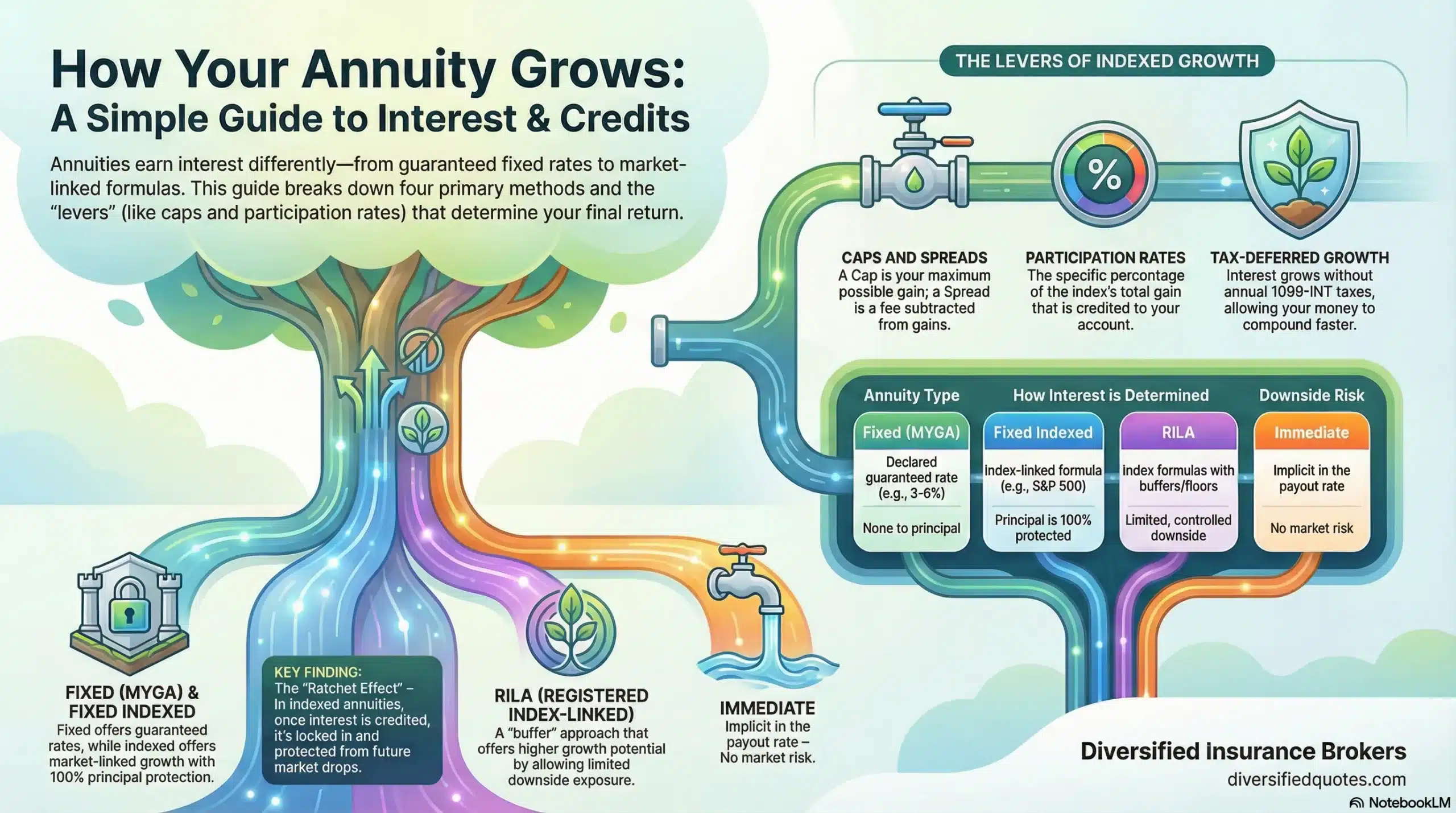
Interest is credited to Contract Value based on your choice among available Interest Crediting Strategies, Structured Strategy Allocations, or both. Our broader explanation of how indexed annuity crediting methods work, including cap rates and participation rates, covers these mechanics in general. You are never directly invested in an index under any of these approaches; this is not a security or a stock market investment.
A Structured Strategy Allocation is a pre-defined, static blend of index strategies that automatically rebalances back to its original allocation at the end of each strategy term. Only one Structured Strategy Allocation may be selected at a time, whether at application or at a later reallocation opportunity. One detail worth flagging clearly: the specific rates applied to strategies inside a Structured Strategy Allocation can differ from the same strategies used outside of one, and those rates can also vary depending on which of the two GLWB riders you’ve selected. This means a side-by-side illustration comparing crediting strategies only tells the full story once your rider election is factored in — the rider decision and the crediting decision aren’t fully independent of each other.
Free Withdrawals and the Withdrawal Charge Schedule
Up to 10% of the beginning-of-year Contract Value can be withdrawn annually without a withdrawal charge. Amounts beyond that allowance during the withdrawal charge period are subject to both a withdrawal charge and, in most cases, a market value adjustment.
| Contract Year | 1 | 2 | 3 | 4 | 5 | 6 | 7 | 8 | 9 | 10 | 11+ |
|---|---|---|---|---|---|---|---|---|---|---|---|
| Charge | 10% | 9% | 8% | 7% | 6% | 5% | 4% | 3% | 2% | 1% | 0% |
A separate Guaranteed Minimum Surrender Value applies only if GLWB income has not yet been activated — it equals premium paid less any withdrawals taken, and after the withdrawal charge period ends, it’s used in place of Contract Value for the death benefit, full surrender, and annuitization calculations whenever it’s the larger figure. Once income activates, this guarantee no longer applies, since the GLWB’s own lifetime guarantee takes over as the relevant protection.
The Income Enhancement Benefit: A Real Feature With Real Conditions
Included automatically at no additional cost, this benefit can temporarily double your Lifetime Annual Payment, for a minimum of two years and up to a maximum of five, if the covered person is unable to perform at least two of six specific Activities of Daily Living — bathing, continence, dressing, eating, toileting, and transferring — for at least 90 consecutive days, subject to certification and recertification requirements.
Several conditions genuinely matter here. The rider must be in force for a full year before it can be exercised. Maximum issue age for eligibility is 75. It can only be used one time over the life of the contract — once a benefit period ends, income reverts permanently to the original guaranteed amount, and a second benefit period is never available. Under a joint income election, only a spouse qualifies as a covered life for this benefit. And critically, Contract Value must exceed a required minimum threshold, both when the benefit is first activated and on every contract anniversary throughout the minimum benefit period, or the benefit terminates early. This benefit is explicitly not long-term care insurance, and availability varies by state.
Health Event Waivers, Included at No Cost
Two additional protections come standard. A Nursing Care Waiver, available any time after issue, waives withdrawal charges and any market value adjustment on withdrawn Contract Value if the owner is confined to an approved nursing facility for at least 90 consecutive days. A Terminal Illness Waiver provides the same relief if the owner is diagnosed with a terminal illness after the first contract anniversary. Both require documentation as specified in the applicable rider, and state variations apply. Our broader explanation of how nursing home waivers function and what counts as an Activity of Daily Living covers this territory in more depth.
Tax Treatment and an Honest Note on Qualified Funds
Growth inside this contract is tax-deferred until withdrawal, at which point distributions are taxed as ordinary income, with a potential 10% federal penalty on withdrawals taken before age 59½. IRA-held contracts follow standard IRA distribution rules. One point worth stating plainly: if this annuity is purchased inside an already tax-advantaged account, such as an IRA, it provides no additional tax deferral benefit beyond what the account already offers — the case for using it inside a qualified plan rests entirely on the value of guaranteed lifetime income and the death benefit protection, not on any incremental tax advantage. Our overview of how annuities are taxed covers the general framework in more detail.
Where Global Atlantic Stands as a Carrier
Global Atlantic operates as part of KKR, a large, publicly traded alternative asset manager, giving Forethought Life Insurance Company meaningful institutional backing. Financial strength ratings are a genuinely important part of evaluating any annuity carrier, and they can change over time — we always confirm a carrier’s current rating directly before recommending a specific contract, rather than relying on a figure that may no longer reflect where things stand today. Our full explanation of what an AM Best rating actually means is worth reading alongside our standalone review of whether Global Atlantic is a good insurance company, which covers the carrier itself in full detail.
Who This Contract Genuinely Fits
ForeLifetime Income suits someone who wants to plan retirement income deliberately rather than decide later — someone comfortable declaring a target income start year now and building the rest of their retirement plan around a known, guaranteed number. It fits well for a buyer who values the certainty of knowing their guaranteed payment continues for life even if Contract Value is eventually exhausted, and who has genuinely thought through whether they’re likely to stick with their declared Deferral Year rather than needing to activate early.
It fits poorly for anyone who isn’t confident about their actual timeline, since activating earlier than declared can meaningfully reduce the guaranteed payment below what was originally targeted. It’s a weaker fit for anyone prioritizing maximum death benefit or legacy planning specifically, since no enhanced death benefit rider exists here — remaining Contract Value passes to beneficiaries, nothing more. And it’s not the right tool for anyone expecting an annuity inside a qualified account to add tax benefits beyond what the account already provides; the case here rests on income guarantees, not incremental tax advantages.
How We Help
The Deferral Year decision and the rider election are the two choices on this contract you genuinely cannot revisit once made, which is exactly why we work through both in detail before any application is submitted, not after. We’ll help you think honestly about your real income timeline, walk through exactly how Contract Value and Withdrawal Base actually function for your specific numbers, and compare this contract directly against other guaranteed income structures available in the market before you commit to either.
Our broader guidance on choosing the right annuity and genuine annuity suitability reflects the same care we bring to every income-focused contract. If you already hold an annuity and are wondering whether a product like this one might genuinely serve you better, our second-opinion review is built for exactly that conversation, and our guide on replacing an annuity the right way walks through what that would actually involve.
Ready to work through your Deferral Year and rider election before you apply?
Get Your Annuity Comparison
Financial Protection Essentials
Explore annuity taxation, retirement account rules, and early withdrawal planning.
Talk to an Advisor or Request Your Annuity Quote
Ready to explore this annuity in more detail—or compare it with other carriers to see if even higher rates are available? With guaranteed income, principal protection, and long-term growth potential on the line, making the right choice is essential. The experienced advisors at Diversified Insurance Brokers will guide you through the options and design a strategy tailored to your retirement goals.
Schedule here:
calendly.com/jason-dibcompanies/diversified-quotes
Licensed in all 50 states • Fiduciary, family-owned since 1980
Does ForeLifetime Income replace an existing ForeIncome II contract I already own?
No. ForeLifetime Income has replaced ForeIncome II in Global Atlantic’s current lineup for new applications, but any ForeIncome II contract already in force continues entirely unaffected, under its original terms, rider mechanics, and guarantees. This page describes the product now available going forward, not a change to any existing contract.
What happens if I activate income earlier or later than my declared Deferral Year?
Your Lifetime Withdrawal Percentage is based on your actual income start age and the actual number of years you deferred, not the plan declared at application. This means your resulting Lifetime Annual Payment can land higher or lower than what was originally targeted. Since the declared Deferral Year itself cannot be changed after issue, it’s worth declaring a timeline you’re genuinely likely to follow rather than an optimistic best case.
What is the difference between Contract Value and Withdrawal Base?
Contract Value is your actual annuity account balance — it grows through index crediting, is reduced by rider charges and withdrawals, and is what your income payments and death benefit actually come from. Withdrawal Base is a calculation figure only, used together with your Lifetime Withdrawal Percentage to set your guaranteed payment amount at activation. It is not available for withdrawal, not a death benefit, and not a cash surrender value. Once income activates, Withdrawal Base locks permanently and Lifetime Annual Payments never reduce it further.
What happens to my guaranteed income if Contract Value reaches zero?
Your Lifetime Annual Payment continues at the identical guaranteed amount for as long as you live, even after Contract Value is fully depleted through ordinary income payments. This is the core insurance function of the GLWB rider — protection against outliving your own account balance, not a guarantee about account growth.
Can I switch between the Income Payout Rider and the Income Builder Rider after my contract is issued?
No. This election is made at application and cannot be changed after issue, under either rider option. Since both riders carry the identical 1.30% annual charge, the decision comes down entirely to your income timeline rather than any cost difference between the two.
Does this contract include an enhanced death benefit?
No. Remaining Contract Value passes to beneficiaries at no additional charge, but no enhanced death benefit rider is offered on this product. The Withdrawal Base is expressly not available as a death benefit under any circumstance. A buyer whose primary goal is maximizing what passes to heirs should weigh this honestly against products specifically designed around legacy value.
What is the Income Enhancement Benefit, and is it long-term care insurance?
It’s an included, no-cost benefit that can temporarily double your Lifetime Annual Payment for two to five years if the covered person is unable to perform at least two of six Activities of Daily Living for at least 90 consecutive days. It requires one year in force before it can be used, a maximum issue age of 75, and Contract Value above a required threshold both at activation and throughout the benefit period. It can only be used once over the life of the contract. This benefit is explicitly not long-term care insurance and should not be relied upon as a substitute for it.
Does buying this annuity inside my IRA provide any extra tax benefit?
No. An IRA already provides tax-deferred growth on its own, so placing this annuity inside one adds no incremental tax advantage beyond what the account already offers. The case for using this contract inside a qualified account rests entirely on the value of guaranteed lifetime income and the death benefit protection it provides, not on any additional tax deferral.
About the Author:
Jason Stolz, CLTC, CRPC, DIA, CAA and Chief Underwriter at Diversified Insurance Brokers (NPN 20471358), is a senior insurance and retirement professional with more than 25 years of real-world experience helping individuals, families, and business owners protect their income, assets, and long-term financial stability. As a long-time partner of the nationally licensed independent agency Diversified Insurance Brokers, Jason provides trusted guidance across multiple specialties—including fixed and indexed annuities, long-term care planning, personal and business disability insurance, life insurance solutions, Group Health, Travel Medical and Evacuation Insurance, and short-term health coverage. Diversified Insurance Brokers maintains active contracts with over 100 highly rated insurance carriers, ensuring clients have access to a broad and competitive marketplace.
His practical, education-first approach has earned recognition in publications such as VoyageATL, and contributions from his agency featured in Kiplinger and GoBankingRates— highlighting his commitment to financial clarity and client-focused planning. Drawing on deep product knowledge and years of hands-on field experience, Jason helps clients evaluate carriers, compare strategies, and build retirement and protection plans that are both secure and cost-efficient. Visitors who want to explore current annuity rates and compare options across multiple insurers can also use this annuity quote and comparison tool.
Explore More Lifetime Income Options: Browse our complete guide to Lifetime Income Annuities & Products — covering best annuities for lifetime income, GLWB riders, joint income annuities & top carrier products from 100+ carriers.
Last Reviewed: September 26, 2026 |
Reviewed by: Jason Stolz, CLTC, CRPC, DIA, CAA
Chief Underwriter, Diversified Insurance Brokers, Inc. | NPN: 20471358 | Diversified Insurance Brokers, Inc. — Licensed in all 50 states
Fact Checked by: Tonia Pettitt, CMIP©
Medicare Specialist, Diversified Insurance Brokers, Inc. | NPN: 14374308 | Diversified Insurance Brokers, Inc. — Licensed in all 50 states
Did you find this content helpful? Leave us a Google review — it helps others find trustworthy guidance too.
Editorial Standards: Diversified Insurance Brokers maintains rigorous editorial standards to ensure accuracy, clarity, and independence in all content. Learn more about our editorial standards and commitment to transparency.
