
Travel Medical Insurance
Travel Medical Insurance

Jason Stolz CLTC, CRPC, DIA
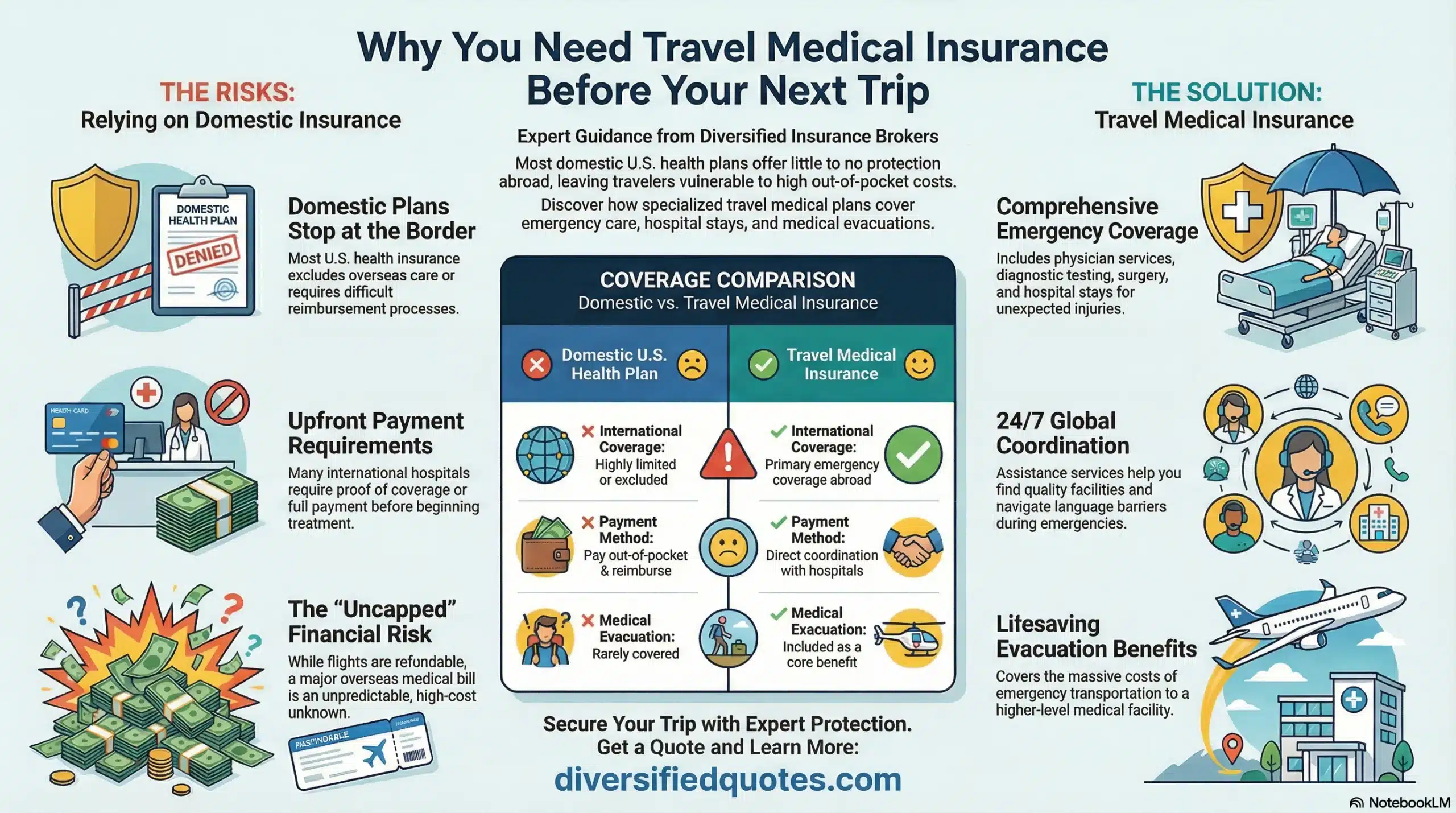
Travel medical insurance is emergency health coverage designed specifically for international travel — filling the gap that exists when U.S. domestic health plans stop at the border. Most American health insurance was built around a domestic care network and is not equipped to handle an overseas hospitalization, an emergency evacuation, or even a straightforward urgent care visit in a foreign country. When you travel internationally, that gap becomes real very quickly: a stomach illness that requires IV fluids and an overnight stay, a fall during a day excursion that leads to imaging and stitches, or a respiratory infection that turns into a multi-day hospital admission can all generate bills that are difficult to manage without coverage in place. At Diversified Insurance Brokers, we help travelers access travel medical coverage through International Medical Group (IMG) and Petersen International/Lloyds of London — two of the most established names in travel health insurance — so that an unexpected health event abroad does not compound into a financial emergency on top of a medical one.
This page explains what travel medical insurance covers, how it differs from other travel protection products, what to look for when comparing plans, and who needs it. If you are also evaluating how trip cancellation protection fits alongside medical coverage, our resource on trip cancellation insurance covers that side of the protection picture — because the two products solve different problems and are most useful when understood as separate decisions.
Travel Medical Insurance — International Medical Group (IMG)
Emergency medical coverage for international travelers, with help coordinating care and assistance when you need it most.
Tell us where you’re going, how long you’ll be gone, traveler ages, and whether you want stronger evacuation protection. We’ll help you match coverage to your trip.
Why Your U.S. Health Insurance Falls Short Abroad
The core problem with relying on domestic health insurance for international travel is structural: U.S. plans are built around contracted U.S. provider networks, and care received outside those networks — whether in another state or another country — is handled very differently. Many plans cover international care only as out-of-network, meaning you pay the full bill upfront, submit a claim, and wait for partial reimbursement based on the plan’s out-of-network schedule — which may cover far less than the actual cost. Medicare does not cover care received outside the United States in most situations at all, making travel medical insurance particularly important for retirees on Medicare who travel internationally. Even employer-sponsored group health plans that advertise some international benefits typically cap those benefits at amounts that would not meaningfully offset a serious overseas medical event. The coverage gap is especially pronounced when you factor in what international care actually costs: a hospital admission in a Western European country can run thousands of dollars per day, and care in more remote destinations can involve transport costs and facility transfer costs on top of the underlying medical bill. Travel medical insurance is not a luxury add-on — it is the coverage layer that makes international travel financially manageable if something goes wrong.
| Feature | Travel Medical Insurance | Comprehensive Trip Insurance | International Health Insurance | Domestic Health Plan Abroad |
|---|---|---|---|---|
| Primary purpose | Emergency medical treatment and evacuation while traveling outside the home country for a defined trip period | Trip cancellation, interruption, delay, baggage, and medical — bundled protection for the financial investment of the trip itself | Comprehensive ongoing medical coverage for individuals living or working abroad for extended periods | Coverage of medical expenses incurred domestically — not designed for international use |
| International medical coverage | Core benefit — designed specifically for emergency and urgent medical treatment at international providers | Included but often secondary — medical limits may be lower than standalone travel medical plans | Comprehensive — routine, preventive, specialist, and emergency care all typically included | Minimal to none — most US plans provide no meaningful international benefit outside emergency scenarios |
| Emergency evacuation | Core benefit — often includes real-time coordination assistance for medical transport and receiving facility arrangements | Often included — limits and coordination quality vary by carrier and plan design | Typically included — coverage for transport to appropriate care facilities as part of comprehensive design | Not included — domestic plans do not cover international medical evacuation |
| Trip cancellation / interruption | Not included — focused exclusively on medical and evacuation during the travel period | Core benefit — reimburses non-refundable trip costs for covered cancellation or interruption reasons | Not included — designed for healthcare, not trip financial protection | Not included |
| Trip duration fit | Days to several months — designed for temporary international travel with flexible duration options and renewability on some plans | Single defined trip — tied to specific departure and return dates; limited flexibility if travel extends | Long-term — designed for six months or more of continuous international residence | Annual — not trip-specific; applies regardless of whether the insured is traveling |
| Pre-existing conditions | Generally excluded — some plans offer limited acute-flare coverage for stable pre-existing conditions during lookback period | Varies by plan — some comprehensive trip plans offer pre-existing condition waivers when purchased within a defined window of initial trip deposit | Often covered — long-term international plans more commonly include chronic condition management | Covered domestically under ACA rules — does not extend to international care |
| Best fit for | Travelers whose primary concern is an unexpected medical event abroad — vacationers, mission teams, students, digital nomads, business travelers | Travelers with significant non-refundable trip costs who want both financial trip protection and medical coverage in one product | Expats, long-term missionaries, employees on extended international assignments, and digital nomads with settled international base | Coverage for domestic medical needs — not a substitute for any international travel protection |
What Travel Medical Insurance Covers
IMG travel medical plans are structured around the core risk of international travel: an unexpected illness or injury that requires medical attention while you are outside your home country. The coverage is event-driven — it responds to qualifying medical events, not routine care or pre-planned treatment. Within that framework, coverage typically includes emergency inpatient and outpatient treatment, physician and specialist services, diagnostic imaging and laboratory testing, prescription medications connected to a covered event, hospital room and board, and surgery when required. For many travelers, those core categories address the most financially significant outcomes. A covered hospitalization that would otherwise cost tens of thousands of dollars out of pocket becomes a manageable situation when travel medical coverage is in place.
Beyond the core medical benefits, IMG plans typically include assistance services that help you navigate care logistics while abroad — locating an appropriate facility near your destination, coordinating pre-authorization or approval when required, translating communications with local providers, and arranging transportation to a higher-level facility when the nearest available option cannot adequately address your condition. This coordination layer matters significantly in practice: knowing a number to call and having a support team managing the logistics allows you to focus on the medical situation rather than trying to research providers and navigate language barriers under stress. Some plans also include limited emergency dental coverage for injury-related dental damage, and repatriation of remains coverage for worst-case scenarios. For travelers in destinations where evacuation is a genuine consideration, evacuation benefits deserve their own evaluation alongside base medical coverage — our resource on emergency medical evacuation insurance covers how evacuation coverage works and why it is often the most financially significant benefit for travelers to remote or lower-resource destinations.
Travel Medical Insurance vs. Other Travel Protection Products
Travel medical insurance covers the personal health risk side of international travel — unexpected illness, injury, hospitalization, and evacuation. It is distinct from trip cancellation insurance, which covers the financial investment already made in non-refundable travel costs when a trip must be canceled or cut short for a covered reason. These two products are often bundled or discussed together, but they solve entirely different problems. Trip cancellation reimburses your flights, hotels, and prepaid tour costs if a qualifying event forces you to cancel before departure or return home early. Travel medical coverage pays for your medical care regardless of what you paid for the trip. A traveler who buys only trip cancellation coverage is protected financially against losing the money spent on the trip, but remains fully exposed to a large overseas medical bill. A traveler who buys only travel medical coverage has their health protected but does not have their non-refundable trip costs covered. Many travelers choose both for complete coverage across both risk categories.
Travel medical insurance also differs from international health insurance and international major medical insurance, which are designed for longer-term stays rather than short-term travel. A student studying abroad for a year, an expat on a multi-year assignment, or a retiree spending extended time overseas has different coverage needs than a traveler on a two-week vacation. Our resources on international health insurance and international major medical insurance cover how those longer-horizon products are structured and when they become a better fit than a short-term travel medical plan. For U.S. citizens on international trips, our resource on emergency travel medical insurance for U.S. citizens covers the most relevant plan structures for American travelers, and our resource on emergency travel health insurance for foreign nationals addresses how the coverage picture differs for non-U.S. residents traveling internationally.
How to Choose Medical Limits and Deductibles
The most practical way to approach coverage limits is to focus on protecting against high-cost outcomes rather than trying to optimize coverage for minor expenses. A basic urgent care visit for a minor illness — a stomach bug, a sinus infection, a small cut requiring stitches — is typically manageable out of pocket for most travelers. Hospitalization, surgery, and medical evacuation are the scenarios that create genuine financial disruption, and those are the outcomes that travel medical coverage is primarily designed to address. For base medical benefits, a minimum of $50,000 in coverage is a reasonable starting point for most international destinations, and many travelers choose $100,000 or more — particularly for destinations where medical care is expensive, where transport to a suitable facility could be required, or where longer trip duration increases overall risk exposure.
Evacuation limits deserve specific attention because the cost of evacuation bears no relationship to the cost of the underlying medical event. A medical evacuation from a remote destination to a major hospital can cost $50,000 to $250,000 or more depending on distance, mode of transport, and the complexity of the coordination involved. Travelers to remote or less medically developed destinations should evaluate evacuation coverage as a primary consideration rather than a secondary one. Deductible selection involves a straightforward tradeoff: a higher deductible reduces the premium cost but means absorbing more expense if a claim occurs. For travelers who primarily want protection against catastrophic outcomes and are comfortable managing minor medical costs out of pocket, a higher deductible can make coverage more cost-effective. For travelers who want coverage that feels usable across a wider range of medical situations, a lower deductible is typically the better fit. Our resource on how to get the best travel medical insurance rates walks through how plan design choices affect cost and how to match coverage structure to the actual risk profile of your specific trip.
Who Should Buy Travel Medical Insurance
Travel medical insurance is appropriate for any international traveler whose domestic health coverage does not adequately protect against overseas medical costs. That encompasses a wide range of traveler types: retirees on Medicare taking international vacations, families traveling internationally with children, business travelers crossing borders regularly, students studying abroad for a semester, and individuals on extended international stays before committing to a long-term coverage arrangement. It is also particularly relevant for travelers going to destinations where the local healthcare infrastructure is limited and medical evacuation to a higher-quality facility would be necessary in a serious situation — because evacuation is both the most expensive potential outcome and the one least likely to be covered by domestic health insurance.
Physically active travelers face elevated injury risk from excursions, adventure activities, and unfamiliar terrain — but the risk of needing medical care abroad is not limited to adventure travel. Stairways, rental vehicles, unfamiliar driving patterns, water quality differences, and standard tourism activities all carry everyday risk that can result in a trip to a local emergency room. Coverage is about reducing financial exposure from unpredictable events, not assuming that the worst will happen. Group travel adds another planning dimension: a single medical event affecting one member of a large group can disrupt the entire itinerary and create organizational liability for the group leader. Our resources on travel insurance for church groups, mission trip travel insurance, and travel insurance for humanitarian aid workers cover how group travel medical coverage is typically structured for organized travel programs. For expats and longer-term international residents who need something more comprehensive than a short-term travel plan, our resource on travel medical insurance for expats explains how coverage needs shift for extended international stays.
Destination Risk and Why It Changes the Coverage Decision
Where you are going matters significantly in travel medical planning, because the risk profile of a trip to Western Europe differs meaningfully from a trip to sub-Saharan Africa, Central Asia, or a remote Pacific island. Destinations with strong medical infrastructure — major cities in Europe, Japan, Australia, Canada — generally mean that a serious medical event can be addressed locally with good quality care, and the primary financial risk is the cost of that care rather than the logistics of getting to adequate care. Destinations with limited or fragmented medical infrastructure raise a different set of concerns: whether appropriate care is available locally, whether transport to a regional hub or back to the U.S. would be needed, and how quickly evacuation could be arranged if required.
For travelers heading to higher-risk or more remote destinations, evacuation coverage becomes the most important coverage layer — more so than the base medical limit — because the scenario most likely to create a crisis is one where local care is inadequate and transport is expensive. Our country-specific resources — including travel medical and evacuation coverage for Kuwait and dozens of other destinations — cover how destination-level considerations shape both the medical and evacuation coverage priorities that travelers should evaluate before departure. Non-U.S. residents traveling into the U.S. face a different planning scenario entirely, where the concern is the cost of care within the American healthcare system rather than access to care abroad — a scenario addressed specifically by our resource on major medical coverage for foreign nationals.
What IMG Travel Medical Plans Include in Practice
IMG is one of the most widely recognized travel insurance providers in the world, with decades of experience serving international travelers across a broad range of trip types and destinations. IMG plans are structured to provide practical protection for unexpected illness and injury without requiring travelers to navigate a complex claims process while still abroad. The quoting and enrollment process is straightforward — travelers enter trip details, destination, dates, and traveler ages, select a plan configuration, and can typically obtain coverage the same day. Many travelers can finalize coverage in under fifteen minutes, which matters when travel arrangements are confirmed close to departure. IMG’s assistance services are one of the distinguishing features in practice: having a 24/7 support resource that can help locate a nearby facility, coordinate with providers in a foreign language, and arrange transport or evacuation when needed makes a meaningful difference in how a medical event actually unfolds abroad — as opposed to having coverage that exists on paper but provides no practical support in the moment.
For travelers evaluating whether travel medical insurance is cost-effective relative to the protection it provides, our resource on whether travel medical insurance is expensive frames the cost-to-protection ratio in practical terms. The cost of a travel medical plan for most short-to-medium length trips is modest relative to the financial exposure from a serious overseas medical event — which makes the decision less about whether coverage is affordable and more about which plan structure best matches the specific trip’s risk profile.
Get Covered Before You Depart
Compare IMG travel medical plan options and enroll online — often the same day you apply.
Leaving soon or already traveling? We’ll confirm the best-fit structure for your destination, trip length, and traveler profile — quickly and at no cost.
Related Travel Medical Pages
Talk With an Advisor Today
Choose how you’d like to connect—call or message us, then book a time that works for you.
Schedule here:
calendly.com/jason-dibcompanies/diversified-quotes
Licensed in all 50 states • Fiduciary, family-owned since 1980
Travel Medical Insurance FAQs
Most domestic U.S. health insurance plans provide limited or no coverage for care received outside the United States. Some plans offer minimal international emergency benefits, but many require you to pay out of pocket at the time of service and submit for reimbursement afterward — a process that can be slow, complicated, and subject to coverage disputes. Medicare generally does not cover care outside the United States at all. Travel medical insurance is designed specifically to fill this gap, providing coverage for unexpected illness or injury abroad without requiring you to rely on a domestic plan that was never designed for international use.
Travel medical insurance and trip cancellation insurance solve entirely different problems. Travel medical insurance addresses the personal health risk side of international travel — covering unexpected illness or injury abroad, emergency hospitalization, and medical evacuation when needed. Trip cancellation insurance addresses the financial investment side — reimbursing non-refundable trip costs if you need to cancel or cut a trip short due to a covered reason. Many travelers purchase both, because each category of protection covers exposure that the other leaves unaddressed. If you have to choose one, and your primary concern is the financial unpredictability of an overseas medical event, travel medical coverage is typically the higher-priority protection for most international travelers.
IMG travel medical plans are designed to cover unexpected illness or injury while traveling internationally. Coverage typically includes emergency medical treatment, physician and specialist services, diagnostic testing and imaging, hospital stays, surgery, and prescriptions connected to a covered medical event. Some plans also include limited emergency dental coverage for injury-related needs, repatriation of remains benefits, and assistance services that help coordinate care logistics — including facility location, approval coordination, and transportation arrangements when needed. Exact benefits, limits, and exclusions vary by plan type, selected deductible, coverage maximum, and destination rules. Reviewing the specific plan certificate before purchase is the most reliable way to understand what any individual plan covers for your specific trip.
The right coverage amount depends on your destination, trip length, and risk tolerance. The most important factor is not optimizing for small expenses but protecting against high-severity outcomes — hospitalization, surgery, and medical evacuation are the scenarios that create serious financial exposure. For most international destinations, a minimum of $50,000 in medical coverage is a reasonable baseline, and many travelers in remote or higher-risk destinations choose $100,000 or more. Medical evacuation limits deserve separate attention — evacuation from a remote location to an appropriate facility can cost $50,000 to $250,000 or more depending on the circumstances, making evacuation coverage one of the most important protection layers to evaluate alongside base medical limits.
In many cases, yes — IMG and similar travel medical plans can be purchased after departure, though some plans have eligibility windows or waiting periods that apply to coverage purchased after travel has already begun. Purchasing coverage before departure is always preferable because it eliminates waiting period concerns and ensures coverage is active from the first day of your trip. If you have already departed and are looking for coverage, the best approach is to compare available plan options and review any post-departure eligibility restrictions carefully before enrolling. Contact us with your trip details and departure date and we can help identify the best available options for your specific situation.
For most international trips — even short ones — travel medical insurance is worth evaluating, because the financial exposure from a serious medical event is not proportional to the length of the trip. A three-day international trip carries the same potential for a serious illness or injury as a three-week trip. The cost of a travel medical policy for a short trip is typically modest, while the financial downside of an uncovered overseas hospitalization or evacuation is substantial regardless of trip length. The practical question is not whether the trip is long enough to justify coverage — it’s whether you could comfortably absorb a significant unexpected medical bill from a foreign hospital without coverage in place.
Coverage for pre-existing conditions varies by plan. Some IMG plans include an acute onset of pre-existing condition benefit — which covers sudden, unexpected flare-ups of a stable pre-existing condition that require emergency treatment, up to specified limits. This is not the same as ongoing management or treatment of a chronic condition, which is typically excluded. If you have a significant pre-existing medical condition, reviewing the specific plan’s pre-existing condition language carefully before purchase is important for understanding what is and is not covered. Contact us with your health profile and destination details and we can help identify which plan structures provide the most relevant coverage for your situation.
Browse All Travel Insurance Guides
About the Author:
Jason Stolz, CLTC, CRPC, DIA, CAA and Chief Underwriter at Diversified Insurance Brokers (NPN 20471358), is a senior insurance and retirement professional with more than 25 years of real-world experience helping individuals, families, and business owners protect their income, assets, and long-term financial stability. As a long-time partner of the nationally licensed independent agency Diversified Insurance Brokers, Jason provides trusted guidance across multiple specialties—including fixed and indexed annuities, long-term care planning, personal and business disability insurance, life insurance solutions, Group Health, Travel Medical and Evacuation Insurance, and short-term health coverage. Diversified Insurance Brokers maintains active contracts with over 100 highly rated insurance carriers, ensuring clients have access to a broad and competitive marketplace.
His practical, education-first approach has earned recognition in publications such as VoyageATL, and contributions from his agency featured in Kiplinger and GoBankingRates— highlighting his commitment to financial clarity and client-focused planning. Drawing on deep product knowledge and years of hands-on field experience, Jason helps clients evaluate carriers, compare strategies, and build retirement and protection plans that are both secure and cost-efficient. Visitors who want to explore current annuity rates and compare options across multiple insurers can also use this annuity quote and comparison tool.
Explore All Insurance & Retirement Services: Return to our Diversified Insurance Brokers home page — covering annuities, life insurance, disability, Medicare, long term care, burial insurance & more from 100+ carriers.
Last Reviewed: June 17, 2026 |
Reviewed by: Jason Stolz, CLTC, CRPC, DIA, CAA
Chief Underwriter, Diversified Insurance Brokers, Inc. | NPN: 20471358 | Diversified Insurance Brokers, Inc. — Licensed in all 50 states
Fact Checked by: Tonia Pettitt, CMIP©
Medicare Specialist, Diversified Insurance Brokers, Inc. | NPN: 14374308 | Diversified Insurance Brokers, Inc. — Licensed in all 50 states
Did you find this content helpful? Leave us a Google review — it helps others find trustworthy guidance too.
Editorial Standards: Diversified Insurance Brokers maintains rigorous editorial standards to ensure accuracy, clarity, and independence in all content. Learn more about our editorial standards and commitment to transparency.
