
How to get the Best Travel Medical Insurance Rates
How to get the Best Travel Medical Insurance Rates

Jason Stolz CLTC, CRPC, DIA, CAA
Getting the best travel medical insurance rates requires understanding what drives pricing, which coverage variables are worth paying for, and which choices inflate your premium without meaningfully improving your protection. Travel medical insurance is not a commodity where the cheapest policy is automatically the best value — a plan with an inadequate medical maximum or exclusions for medical evacuation can leave a traveler with catastrophic out-of-pocket costs that dwarf the premium savings. At the same time, a traveler who understands the pricing levers available can often obtain excellent coverage at a significantly lower price than a traveler who simply accepts the first quote they receive. At Diversified Insurance Brokers, Jason Stolz, CLTC, CRPC, DIA, CAA, works with individual travelers, groups, expatriates, students, and mission organizations to navigate the travel medical insurance market and secure coverage that matches the actual risk of each trip at a cost that makes financial sense.
The scale of the risk that travel medical insurance addresses is substantial. Emergency medical care overseas — hospital admission, surgery, intensive care — routinely costs tens of thousands of dollars in developed countries and can generate bills in the hundreds of thousands when evacuation to an appropriate facility is required. Medical evacuation alone frequently costs $50,000 to $250,000 depending on origin and destination, a cost that most domestic health insurance plans do not cover overseas and that Medicare covers only in very limited circumstances. According to the U.S. Travel Insurance Association, the average cost of a travel insurance plan ranges from approximately four to eight percent of the trip’s total cost — a relatively modest premium when measured against the potential financial exposure of an uninsured medical emergency abroad. Our companion resource on the primary reason people buy travel medical insurance covers the core protection rationale, and our resource on travel medical insurance overview explains the foundational coverage categories.
Compare Travel Medical Insurance Plans
Get side-by-side quotes from top-rated carriers. Filter by medical maximum, evacuation coverage, deductible, and destination.
How Travel Medical Insurance Rates Are Determined
Travel medical insurance pricing differs fundamentally from domestic health insurance because it is structured as a per-day or per-trip product rather than an annual premium. Carriers price each policy based on a defined set of risk variables specific to each traveler and each trip, and understanding these variables is the essential first step to managing what you pay. Unlike domestic health insurance where the premium is relatively fixed once selected, travel medical insurance premiums respond directly to the choices you make at the time of purchase — including coverage limits, deductible selection, and trip duration — giving travelers meaningful control over the final cost.
Age is the single most influential pricing variable in travel medical insurance. Older travelers represent statistically higher medical claim risk, and carriers price this directly into daily and trip-based premiums. A 65-year-old traveler pays roughly double what a 30-year-old pays for the same coverage, and travelers over 70 may pay twenty to forty percent more than travelers in their fifties. For senior travelers specifically, some carriers also reduce available coverage limits at advanced ages — an important coverage consideration beyond premium cost alone. Our resource on travel medical insurance for seniors addresses both the pricing and coverage limit considerations that apply specifically to older travelers.
Trip duration directly multiplies the per-day premium. A thirty-day trip costs more than a fourteen-day trip, and a ninety-day trip costs proportionally more still. For travelers who take multiple shorter trips in a year, an annual multi-trip policy — which covers all trips within a twelve-month period up to a defined maximum length per trip — can produce substantially lower per-trip costs than purchasing individual single-trip policies. The break-even point for annual travel medical insurance is generally around three international trips per year, at which point the annual policy almost always produces lower total cost than purchasing separate policies for each trip.
Five Key Pricing Variables in Travel Medical Insurance
| Pricing Variable | How It Affects Premium | Rate Impact | Optimization Strategy |
|---|---|---|---|
| Traveler age | Directly increases premium; older age brackets carry higher per-day rates | Travelers over 70 may pay 20–40% more than those in their 50s; 65-year-olds typically pay ~2x what a 30-year-old pays | Compare plans with flat-rate senior pricing; use higher deductible to offset age premium |
| Trip duration | Longer trips produce higher total premium; per-day rate is typically fixed once age bracket is set | Each additional week adds proportional cost; 90-day trip costs roughly 6x a 15-day trip | Annual multi-trip plan for 3+ trips per year; ensures accurate trip length to avoid over-coverage |
| Medical maximum / coverage limits | Higher medical maximums increase premium; evacuation limits affect cost independently of medical limit | Moving from $50,000 to $500,000 medical maximum can shift premium up to 99% in some plans | $250,000–$500,000 minimum for international travel; do not reduce evacuation coverage to save on premium |
| Deductible selection | Higher deductible meaningfully reduces premium; per-trip or per-policy deductible options available | Moving from $0 to $2,500 deductible can reduce daily rate by 30–50% on some plans | Best lever for healthy travelers without chronic conditions; select deductible you could absorb out of pocket |
| Destination risk | High-risk destinations — conflict zones, politically unstable regions, areas with limited medical infrastructure — carry premium surcharges | Highest-risk destinations can add up to 45% to base premium | Compare carriers that specialize in high-risk destinations; ensure evacuation coverage is adequate for specific region |
Strategy One: Use the Deductible as Your Primary Rate Lever
The deductible is the most controllable rate variable in travel medical insurance for travelers in good health. Unlike age and trip duration — which are fixed inputs — the deductible is a choice the traveler makes at the time of purchase, and it directly and substantially affects the premium. Selecting a higher deductible reduces the carrier’s expected payout for small and moderate medical claims, and carriers pass a meaningful share of this risk reduction back to the policyholder through lower premiums. On many travel medical plans, moving from a $0 deductible to a $1,000 deductible produces a thirty to fifty percent premium reduction — making the higher deductible option a rational financial choice for travelers who could absorb that out-of-pocket amount if a minor medical event occurred.
The practical guidance is to select a deductible that represents an amount you could pay without financial hardship if needed, and use the premium savings to increase coverage limits in areas where the financial exposure is most catastrophic — specifically medical evacuation. A traveler who reduces their deductible to $0 to save potential out-of-pocket costs while carrying a $100,000 medical evacuation limit has made the wrong trade-off: the deductible is a manageable known cost, while an insufficient evacuation limit can produce a six-figure shortfall in a genuine emergency. The right structure for most healthy travelers is a moderate to high deductible paired with robust medical and evacuation maximums. Our resource on whether travel medical insurance is expensive provides context on where premium dollars produce the most protection value.
Strategy Two: Choose Annual Multi-Trip Coverage for Frequent Travelers
For travelers who take three or more international trips per year, an annual multi-trip travel medical plan almost always produces lower total cost than purchasing individual single-trip policies for each journey. The math is straightforward: the annual policy has a fixed cost that covers all trips within the twelve-month period (up to the per-trip maximum duration defined in the policy — commonly thirty, forty-five, or sixty days per trip), while purchasing three separate single-trip policies requires paying three separate premiums. At three trips, the annual policy typically reaches or passes its break-even point, and at four or more trips it produces meaningful savings per trip.
The annual multi-trip structure also eliminates the administrative friction of purchasing a new policy before each trip, the risk of forgetting to purchase coverage for a last-minute trip, and the gap in coverage if a trip extends beyond its original planned end date (subject to the per-trip maximum). Frequent business travelers, expatriates, missionaries and humanitarian workers, retirees who split time between countries, and families who take multiple international vacations per year are the natural fit for annual coverage. Our resources on travel medical insurance for expats, travel insurance for digital nomads, travel insurance for humanitarian aid workers, and business travel accident insurance address the specific considerations for travelers in each of these situations.
Strategy Three: Match Coverage Limits to Actual Destination Risk
Travel medical insurance coverage limits should be calibrated to the actual medical cost environment of the specific destination, not selected from a default. A traveler going to Western Europe or Japan — where high-quality hospital care is broadly accessible and costs, while significant, are more contained — needs a different coverage ceiling than a traveler going to a remote destination where emergency evacuation to a capable facility requires an international flight. The evacuation coverage component is particularly destination-sensitive: evacuating from a major European city to the United States costs far less than evacuating from sub-Saharan Africa, Southeast Asia, or a remote wilderness area where the nearest adequate medical facility may require ground transport followed by air medical evacuation.
The minimum medical maximum that provides meaningful protection in most international destinations is $250,000, with $500,000 being the more conservative and broadly recommended threshold for extended travel or travel to destinations with limited local medical infrastructure. Medical evacuation coverage of $500,000 to $1,000,000 is appropriate for destinations where evacuation is complex or expensive — conflict zones, remote locations, and developing country destinations particularly warrant higher evacuation limits. Our destination-specific resources cover the medical and evacuation insurance considerations for a wide range of international destinations, including Australia, Ukraine, Iraq, Syria, and Yemen. For broader guidance on high-risk destination coverage, our resource on high-risk travel insurance and travel and medical insurance for high-risk travel provide the full framework.
Strategy Four: Separate Travel Medical from Trip Cancellation When Possible
Comprehensive travel insurance plans — which bundle trip cancellation, trip interruption, baggage loss, travel delay, and medical coverage into a single policy — are priced as a percentage of total trip cost, which can make them significantly more expensive than standalone travel medical insurance for travelers whose primary concern is health protection rather than trip cost reimbursement. A standalone travel medical policy does not include trip cancellation coverage and therefore is not priced as a percentage of trip cost — it is priced based solely on the traveler’s age, trip duration, coverage limits, and deductible selection. Travel medical insurance averages approximately $4.60 per day, making it a cost-effective option for travelers who have refundable bookings, flexible itineraries, or simply prioritize medical protection over trip cost recovery.
Cancel For Any Reason coverage — an upgrade available on some comprehensive policies — typically adds forty to sixty percent to the premium while reimbursing only seventy-five percent of trip costs, making it a poor value for most travelers. Travelers whose primary concern is the financial exposure of a medical emergency or medical evacuation are better served by a standalone medical plan with robust limits than by a comprehensive plan with modest medical coverage that inflates the premium with trip cancellation benefits the traveler may not need. Our resource on cheap travel insurance provides guidance on identifying policies that deliver strong medical and evacuation protection at lower price points, and the resource on how to get travel medical insurance last-minute addresses the specific considerations for travelers who need coverage on short notice.
Strategy Five: Compare Carriers Through an Independent Advisor
Travel medical insurance is sold through dozens of carriers with meaningfully different pricing, underwriting standards, coverage definitions, and claim payment practices. The same traveler with the same trip profile can receive quotes that vary by fifty percent or more across carriers — and the cheapest quote does not reliably indicate the best value once coverage exclusions, claims payment track record, and financial strength are considered. Pre-existing condition treatment is a particularly important area of carrier variation: some plans cover acute onset of pre-existing conditions, meaning a sudden unexpected recurrence of a known condition that requires emergency care within a defined window, while others exclude pre-existing conditions entirely. For travelers with any chronic health history, this distinction can determine whether a critical claim is paid or denied.
Working through an independent advisor who accesses multiple carriers simultaneously provides the equivalent of a competitive market analysis — every carrier quoting the same trip specifications at their best available price, with the coverage differences highlighted rather than hidden. Diversified Insurance Brokers works with IMG Global, one of the most respected names in international travel medical insurance, alongside other carrier options to match each traveler’s specific profile, destination, and coverage needs to the plan that provides the best protection at the most competitive price. Our resources on travel medical insurance for large groups, travel medical insurance for religious groups, travel insurance for church groups, travel insurance for missionary groups, and travel medical insurance for volunteer groups address the specific considerations for group travel arrangements that require multi-person policy structures.
Talk With an Advisor Today
Choose how you’d like to connect—call or message us, then book a time that works for you.
Schedule here:
calendly.com/jason-dibcompanies/diversified-quotes
Licensed in all 50 states • Fiduciary, family-owned since 1980
Frequently Asked Questions: How to Get the Best Travel Medical Insurance Rates
How much does travel medical insurance typically cost?
Travel medical insurance pricing is highly variable because it is priced per day and per traveler based on individual risk factors. The average daily cost of a standalone travel medical plan is approximately $4.60 per day, according to Squaremouth’s marketplace data, though actual costs range from well below a dollar per day for young travelers with high deductibles and modest coverage limits to over thirty dollars per day for older travelers with low deductibles and high coverage maximums. For comprehensive travel insurance that includes trip cancellation, the average cost is four to eight percent of the total trip cost, according to the U.S. Travel Insurance Association. For a fourteen-day trip without trip cancellation coverage, a family of four may pay between $25 and $125 for a medical-only plan depending on ages, coverage levels, and destination. The most significant pricing variable is age — a 65-year-old typically pays approximately twice what a 30-year-old pays for equivalent coverage — followed by trip duration, coverage limits, and deductible selection. See our resource on whether travel medical insurance is expensive for a more detailed cost discussion.
What is the most effective way to reduce travel medical insurance premiums?
The most direct and effective premium reduction lever is increasing the deductible. Moving from a $0 deductible to a $500 or $1,000 deductible can reduce the daily premium by thirty to fifty percent on many plans — while still providing full protection for the catastrophic claims that justify purchasing travel medical insurance in the first place. This trade-off makes financial sense for travelers in good health who could absorb a moderate out-of-pocket expense if a minor medical event occurred, while relying on the insurance for the large-scale emergencies — hospitalization, surgery, medical evacuation — that could produce bills of $50,000 to $250,000 or more. The critical caveat is to ensure the deductible savings are not achieved by reducing medical maximums or evacuation coverage to inadequate levels. A $1,000 deductible with $500,000 in medical coverage and $1,000,000 in evacuation coverage is a stronger and often lower-cost combination than a $0 deductible with $50,000 in medical coverage. For frequent travelers, switching to an annual multi-trip plan provides the second most significant cost reduction, typically saving meaningfully on total premium cost compared to buying separate single-trip policies for each journey.
Does my domestic health insurance cover me overseas?
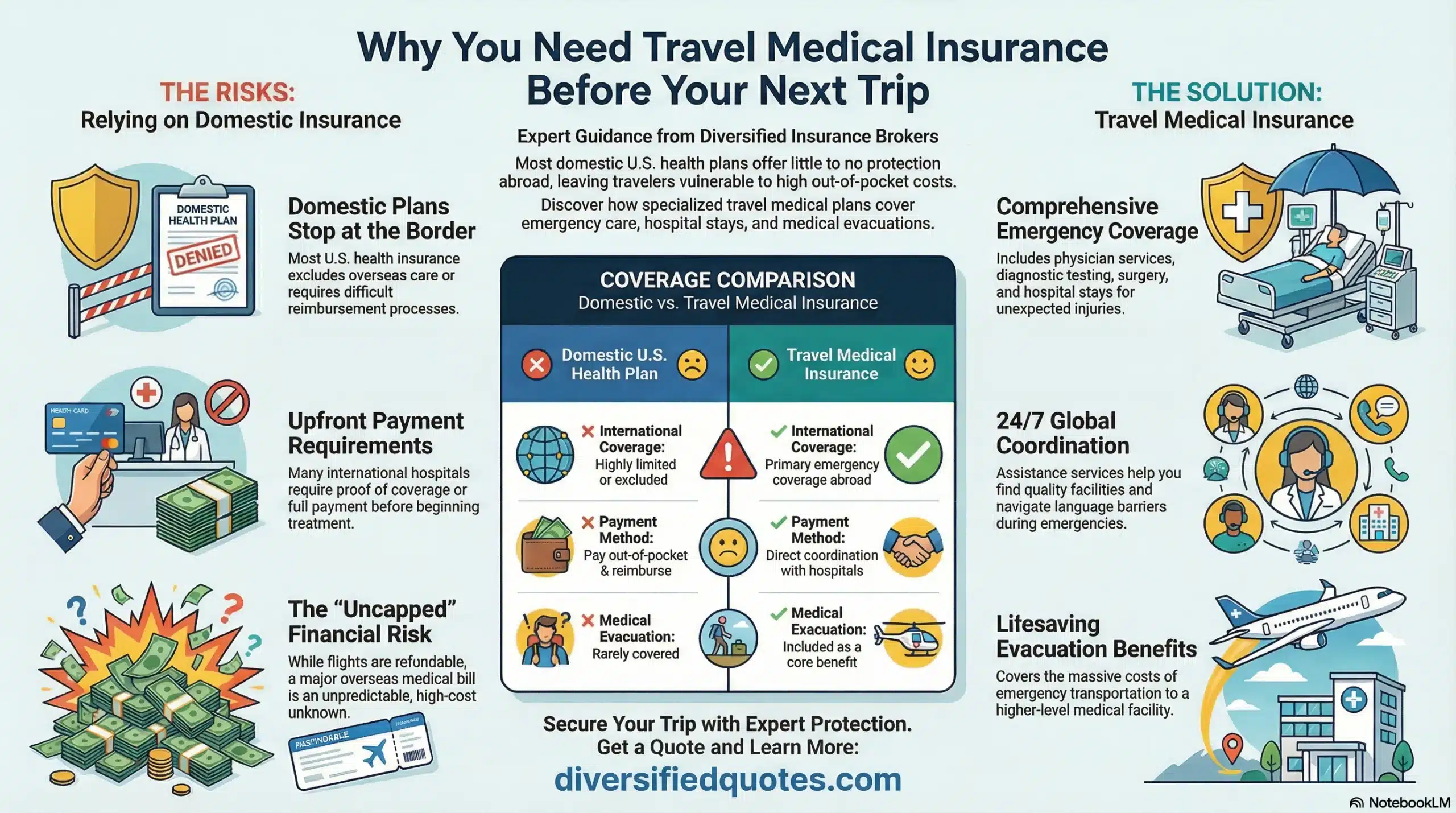
In most cases, domestic health insurance provides limited or no coverage outside the United States, which is the core reason travel medical insurance exists. Most employer-sponsored group health plans are designed for domestic use and explicitly exclude or severely limit overseas medical benefits. Individual market health plans purchased through the ACA marketplace typically provide emergency care coverage internationally in very limited circumstances. Medicare — the federal program covering most Americans over sixty-five — provides no overseas coverage in the vast majority of situations, with the exception of a few narrow circumstances involving travel through Canada or in close proximity to US territory. Even plans that technically provide some international coverage almost never cover the cost of medical evacuation — the emergency transport required to move a patient from a remote destination or a country with limited medical infrastructure to an appropriate medical facility — which is often the largest single cost in an international medical emergency. Travel medical insurance fills this gap specifically, providing coverage from the first day of international travel without the network restrictions and domestic-market limitations that make domestic health plans inadequate for international use.
When should I choose an annual multi-trip plan versus a single-trip plan?
An annual multi-trip plan becomes cost-effective at approximately three international trips per year. If you take three or more trips in a twelve-month period, the annual plan’s fixed cost is typically lower than the combined premium of three separate single-trip policies for the same traveler profile. Beyond cost savings, annual plans eliminate the administrative friction of purchasing a new policy before each trip — reducing the risk of departing without coverage due to time pressure or oversight. The key limitation of annual plans is the per-trip maximum duration: most annual policies cap individual trips at thirty, forty-five, or sixty days. A traveler spending ninety consecutive days overseas would need to evaluate whether that single trip exceeds the annual plan’s per-trip limit. For expats, digital nomads, and travelers on extended stays, a longer-duration single-trip plan or an expat-specific policy may be more appropriate than a standard annual plan with a short per-trip ceiling. See our resources on expat travel medical insurance and digital nomad travel insurance for these specific cases.
How much medical coverage and evacuation coverage do I actually need?
For most international travel to destinations with reasonable local medical infrastructure, a minimum medical maximum of $250,000 with at least $500,000 in medical evacuation coverage provides meaningful protection. For travel to remote destinations, high-risk regions, conflict zones, or locations with limited medical facilities where evacuation to an appropriate hospital may require complex multi-leg transport, $500,000 to $1,000,000 in medical coverage and $1,000,000 in evacuation coverage is the more appropriate threshold. The evacuation coverage component is often the most financially significant element in a genuine overseas emergency — medical air evacuation from remote sub-Saharan Africa, for example, can cost $100,000 to $250,000 before any in-hospital treatment costs are counted. Reducing evacuation coverage to save on premium is rarely a sound trade-off. The per-day cost difference between a $500,000 evacuation limit and a $1,000,000 evacuation limit is typically modest, while the financial consequence of being underinsured for an evacuation event can be catastrophic. Our resources on specific high-risk destinations — including Iraq, Syria, and Ukraine — address the specific coverage considerations for high-complexity evacuation environments.
Does travel medical insurance cover pre-existing conditions?
Standard travel medical insurance typically excludes coverage for treatment of known pre-existing conditions during travel. The policy covers unexpected, new medical events — an illness or injury that arises during the trip without prior diagnosis or treatment. However, many plans include an important exception called “acute onset of a pre-existing condition” coverage, which pays for emergency care resulting from a sudden and unexpected recurrence of a known condition that requires treatment within a defined time window (often twenty-four hours of the onset of symptoms). This provision provides meaningful protection for travelers with managed chronic conditions — a diabetic who experiences a severe hypoglycemic episode, or a cardiac patient who has an unexpected arrhythmia — without converting the policy into a comprehensive health plan for ongoing treatment of those conditions. The presence, scope, and time window definition of acute onset coverage varies significantly across carriers and plans, making it one of the most important coverage details to verify when comparing options. Travelers with significant pre-existing conditions should specifically ask whether and how the plan handles acute onset events and whether the plan requires documentation of stability period prior to travel. Our resource on travel medical insurance for seniors addresses pre-existing condition considerations specifically for older travelers.
What is primary versus secondary travel medical coverage?
Primary travel medical coverage pays claims without requiring the traveler to first submit to any other insurance. Secondary coverage requires the traveler to exhaust other applicable insurance — domestic health insurance, credit card travel benefits, or any other applicable coverage — before the travel medical plan pays the remaining balance. For most US travelers whose domestic health plan provides little or no international coverage, the distinction is often academic in practice, because there is no primary coverage to submit first. However, for travelers whose domestic plan does provide some overseas emergency benefits, a secondary travel medical plan reduces the total premium (secondary coverage is typically less expensive than primary coverage for the same limits) while still providing the gap-filling protection for costs the domestic plan does not cover and for evacuation costs that domestic plans almost never cover. For travelers with no domestic coverage that applies overseas — including Medicare enrollees, travelers whose employer plan explicitly excludes international care, and those on individual market plans with no overseas benefits — a primary travel medical plan ensures direct claim submission without the coordination-of-benefits process. Our resource on emergency travel medical insurance for US citizens covers this distinction in the context of common US traveler coverage gaps.
What coverage does Medicare provide for international travel?
Original Medicare — Parts A and B — provides virtually no coverage for healthcare received outside the United States under normal circumstances. The narrow exceptions involve specific situations related to travel through Canada between Alaska and the continental US, or emergencies occurring on a ship within US territorial waters. Medicare Advantage plans (Part C) may offer some emergency international coverage, but the scope is limited and varies by plan — most cap international coverage at a defined dollar amount and restrict it to genuine emergencies. Medicare Supplement (Medigap) plans — specifically Plans C, D, F, G, M, and N — include a lifetime foreign travel emergency benefit that covers eighty percent of international emergency medical costs after a $250 deductible, up to a $50,000 lifetime limit. This limit is frequently insufficient for a significant international medical emergency, particularly if evacuation is required. For Medicare-age travelers, a separate travel medical insurance policy provides the evacuation coverage, higher medical maximums, and comprehensive international protection that Medicare and its supplements cannot adequately provide alone. Our resource on travel medical insurance for seniors covers the Medicare coverage gap analysis and the appropriate travel medical policy structure for seniors traveling internationally.
About the Author:
Jason Stolz, CLTC, CRPC, DIA, CAA and Chief Underwriter at Diversified Insurance Brokers (NPN 20471358), is a senior insurance and retirement professional with more than 25 years of real-world experience helping individuals, families, and business owners protect their income, assets, and long-term financial stability. As a long-time partner of the nationally licensed independent agency Diversified Insurance Brokers, Jason provides trusted guidance across multiple specialties—including fixed and indexed annuities, long-term care planning, personal and business disability insurance, life insurance solutions, Group Health, Travel Medical and Evacuation Insurance, and short-term health coverage. Diversified Insurance Brokers maintains active contracts with over 100 highly rated insurance carriers, ensuring clients have access to a broad and competitive marketplace.
His practical, education-first approach has earned recognition in publications such as VoyageATL, and contributions from his agency featured in Kiplinger and GoBankingRates— highlighting his commitment to financial clarity and client-focused planning. Drawing on deep product knowledge and years of hands-on field experience, Jason helps clients evaluate carriers, compare strategies, and build retirement and protection plans that are both secure and cost-efficient. Visitors who want to explore current annuity rates and compare options across multiple insurers can also use this annuity quote and comparison tool.
Explore More Travel Medical Insurance Options: Browse our complete guide to Travel Insurance Planning & Education — covering how it works, costs, last minute coverage, high risk travel & buying guides.
Last Reviewed: June 11, 2026 |
Reviewed by: Jason Stolz, CLTC, CRPC, DIA, CAA
Chief Underwriter, Diversified Insurance Brokers, Inc. | NPN: 20471358 | Diversified Insurance Brokers, Inc. — Licensed in all 50 states
Fact Checked by: Tonia Pettitt, CMIP©
Medicare Specialist, Diversified Insurance Brokers, Inc. | NPN: 14374308 | Diversified Insurance Brokers, Inc. — Licensed in all 50 states
Did you find this content helpful? Leave us a Google review — it helps others find trustworthy guidance too.
Editorial Standards: Diversified Insurance Brokers maintains rigorous editorial standards to ensure accuracy, clarity, and independence in all content. Learn more about our editorial standards and commitment to transparency.
