
Travel Medical and Evacuation from Yemen
Travel Medical and Evacuation from Yemen

Jason Stolz CLTC, CRPC, DIA, CAA
Travel to Yemen is not like traveling to most other destinations. The country has faced prolonged instability, major disruptions in public infrastructure, and serious strain on healthcare resources across large portions of the country. In many areas, access to consistent medical treatment can be limited or unpredictable, and even when a clinic or hospital is nominally available, advanced care — including specialized diagnostics, intensive care monitoring, complex surgical capability, or reliable medication supply — may not be present at the moment it is needed. That is why securing travel medical and emergency evacuation insurance for Yemen is one of the most consequential steps any traveler can take before departure, regardless of the length of the visit or the purpose of the trip.
This type of coverage provides two essential and complementary protections: emergency medical coverage that helps pay eligible treatment costs when illness or injury occurs, and medically necessary evacuation coordination that arranges transport to the nearest appropriate facility when local care is insufficient for the patient’s condition. For many travelers in Yemen, that nearest appropriate facility will not be inside the country. In real emergencies, evacuation may require transport to Oman, Djibouti, Saudi Arabia, or another regional location where the advanced care the patient requires is accessible. At Diversified Insurance Brokers, we help travelers compare international travel medical options built for higher-risk destinations — whether you are traveling for humanitarian deployment, journalism, contract work, family obligations, or specialized projects, having strong evacuation benefits and a reliable 24/7 assistance team in place before you depart is the difference between a manageable medical emergency and a crisis that becomes medically, logistically, and financially overwhelming. Emergency medical evacuation insurance covers in detail how evacuation works, what triggers it, how medical necessity is determined, and why the assistance provider’s operational capability matters as much as the financial limit on the policy. High-risk travel insurance covers the specialized coverage options for destinations where conditions create elevated risk profiles that standard travel plans are not designed to address. Travel and medical insurance for high-risk travel covers the broader coverage design considerations for complex destinations where the care pathway and the assistance team’s operational capability are primary determinants of real-world protection value.
Why Travel Medical Coverage Matters in Yemen
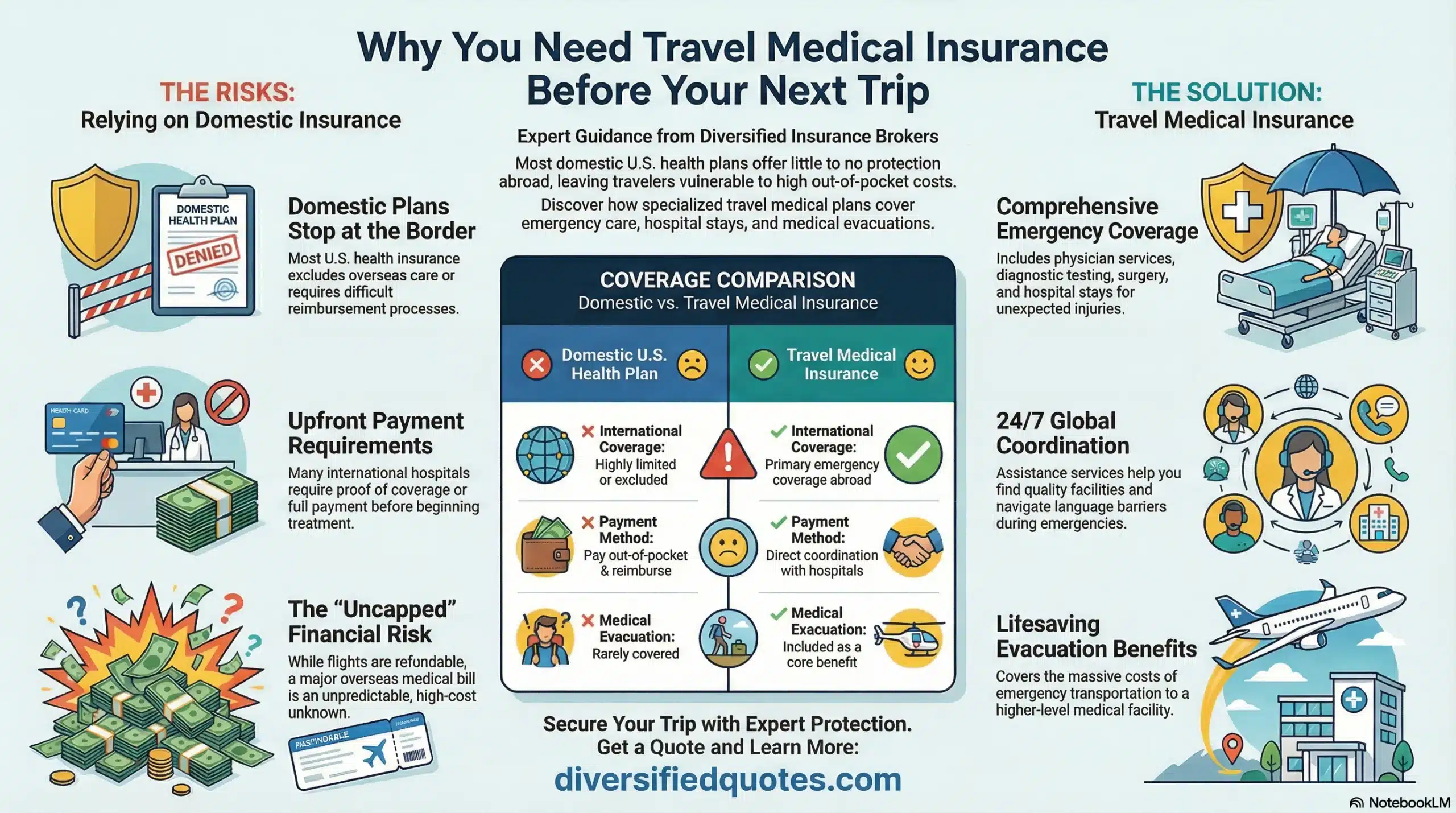
The assumption that domestic U.S. health insurance follows travelers overseas is among the most consequential misunderstandings in international travel planning — and it matters most in destinations like Yemen where the gap between what domestic plans provide internationally and what a serious medical emergency actually requires is widest. Most U.S. health plans provide limited or no coverage for medical treatment received outside the United States, and even when international reimbursement provisions technically exist, they almost never include coordinated medical evacuation services, real-time assistance with locating appropriate providers, direct-pay arrangements with international facilities, or the clinical coordination required to manage a care sequence involving transfer between facilities in different countries. In Yemen, that gap is not a minor administrative inconvenience — it is a serious operational problem because the medical events most likely to require evacuation are precisely the events where all of those missing capabilities matter most.
Travel medical insurance in a destination like Yemen provides both a financial backstop against the cost of emergency treatment and an operational response through the assistance team — the combination of which is what makes coverage genuinely protective rather than nominally present. The financial benefit matters: hospitalization, surgery, emergency diagnostics, and the cost of medically supervised transport can accumulate costs that exceed most travelers’ capacity to absorb from personal resources. The operational benefit matters equally: in a destination where communications may be inconsistent, local medical infrastructure may be under strain, and logistics can change rapidly, having a professional assistance team working behind the scenes to coordinate care is often the most critical element of the entire coverage package. What is the primary reason people buy travel medical insurance covers the risk assessment framework that underlies the coverage decision — useful context for understanding why the combination of financial and operational protection is what experienced travelers prioritize when evaluating plans for high-risk destinations. How to get the best travel medical insurance rates covers the comparison methodology for identifying the most appropriate coverage for a given destination, trip duration, and traveler profile without sacrificing the protections that matter most in serious emergencies.
Yemen Travel Medical: Risk Profile and Coverage Priorities
| Risk Category | Yemen-Specific Context | What Adequate Coverage Addresses | Risk of Inadequate Coverage |
|---|---|---|---|
| Healthcare infrastructure | Many facilities lack advanced imaging, consistent surgical capacity, ICU monitoring, reliable blood products, and specialty staffing — capability varies dramatically by location and can change with operational conditions | Assistance team directs traveler to the best available local option and coordinates evacuation when local capability cannot meet the patient’s clinical requirements | Patient receiving stabilization-only care at an inadequate facility with no coordinated pathway to definitive treatment while condition deteriorates |
| Evacuation complexity and cost | Yemen evacuations typically require cross-border coordination to Oman, Saudi Arabia, or Djibouti — involving air ambulance, medical escort, border logistics, and receiving facility confirmation | Assistance provider manages the full logistics chain — transport coordination, border documentation, receiving facility acceptance, and clinical handoff — without requiring the traveler to negotiate independently under emergency conditions | Traveler or family attempting to independently arrange a complex international medical evacuation at a cost that can easily exceed $50,000–$100,000 without institutional relationships or regional operational knowledge |
| Medication and supply availability | Prescription drugs, antibiotics, specialty medications, and medical supplies may be inconsistently available depending on location and current supply chain conditions | Assistance team can help identify alternative supply sources or expedite evacuation when medication unavailability creates a medical risk for the patient’s condition | Traveler managing a medication-dependent condition facing supply disruption with no support system for identifying alternatives or accessing appropriate care |
| Medical vs. security evacuation distinction | Yemen’s security environment creates pressure to conflate medical evacuation with security extraction — standard travel medical plans respond only to medical events requiring clinically necessary transport | Clear pre-departure understanding of what medical evacuation covers, what it excludes, and what separate products address non-medical security extraction needs specific to Yemen’s operating environment | Traveler discovering during a non-medical crisis that their medical plan does not activate, with no separate security extraction product in place and no clear pathway to removal from a dangerous situation |
| Pre-existing condition exposure | In a destination where local management of any medical condition may require evacuation, a claim denial based on pre-existing condition exclusion eliminates coverage at the most consequential moment | Plans with acute-flare coverage for stable pre-existing conditions; pre-departure review of stability requirements, lookback window definitions, and what the plan does and does not cover for the traveler’s specific health history | Claim denied for the event that most required treatment, leaving the traveler responsible for full treatment and evacuation costs in one of the world’s most logistically complex evacuation environments |
How Medical Evacuation Works — and Why It Is Not Automatic
One of the most important concepts for travelers to understand about this type of coverage is that medical evacuation is not a voluntary benefit that activates on request or personal preference. It is a clinically determined service that activates when a physician certifies that appropriate care for the patient’s condition is not available at the current location and that transferring the patient to a facility capable of delivering that care is medically appropriate given the patient’s stability for transport. The evacuation is then coordinated by the plan’s assistance team — not initiated by the traveler independently — and the coordination involves confirming which facility can receive the patient, arranging the appropriate transport modality based on the patient’s medical stability, managing the clinical handoff documentation between sending and receiving providers, and executing the logistics of a cross-border medical transfer that most travelers are not equipped to arrange independently.
Medical necessity triggers in the Yemen context commonly arise when the treating facility cannot perform a necessary surgical procedure, lacks appropriate ICU monitoring or stabilization capability for the patient’s condition, does not have access to advanced diagnostics required for accurate diagnosis and treatment planning, cannot provide specialist care appropriate to the specific medical situation, or where continuing care at the current location would significantly increase the medical risk to the patient relative to transfer to a more capable facility. The assistance team works with treating physicians to make these determinations — evacuation is a medical decision made in coordination with clinical oversight, not an administrative one made by the traveler or their family. In practice, the most common evacuation destinations from Yemen are facilities in Muscat (Oman), Djibouti City, or facilities in Saudi Arabia accessible from Yemen’s northern regions, depending on the patient’s location, condition, and available transport infrastructure at the time of the event. Travel medical and evacuation from Syria and travel medical and evacuation from Libya cover comparable complex evacuation environments in the broader region and provide useful reference points for understanding how evacuation logistics scale across different destination risk profiles. Travel medical and evacuation insurance for Afghanistan covers one of the most operationally similar destinations to Yemen in terms of evacuation complexity and local medical infrastructure limitations.
What This Coverage Typically Includes
Travel medical and evacuation coverage for Yemen is designed to address the most expensive and urgent risks: emergency treatment at the point of initial care and the ability to move the patient to a higher level of care when local options are not sufficient for their condition. Emergency medical benefits typically cover eligible inpatient and outpatient care for sudden illness or injury — including physician evaluation and consultation, urgent care and emergency room treatment, inpatient hospitalization including room, board, and nursing care, diagnostic testing including laboratory work and imaging tied to a covered condition, surgical procedures when medically necessary, and prescription medications related to a covered illness or injury event. Emergency medical evacuation benefits cover medically necessary transport to the nearest appropriate facility capable of delivering the required level of care, which in Yemen will frequently involve cross-border transport to a regional hub. Plans typically include 24/7 emergency assistance services that help locate appropriate care, coordinate hospital admission, manage payment arrangements when possible, initiate evacuation coordination when medically indicated, and support communication with the traveler’s family or employer throughout the emergency. Repatriation of remains is also typically included as a benefit in the event of death while traveling.
It is equally important to understand clearly what this coverage does not include. Medical evacuation benefits in standard travel medical plans respond strictly to medical events — they do not cover political or security evacuation, voluntary relocation because the traveler prefers a different facility or country, or departure from Yemen due to security deterioration, conflict, border closures, or other non-medical threats. Assistance coordination is typically required for evacuation coverage to apply — the assistance provider must coordinate the transport rather than the traveler arranging it independently. Travelers whose primary concern in Yemen includes security-driven evacuation needs must purchase specialized security evacuation services separately from their travel medical coverage. International health insurance covers the longer-term alternative for travelers on extended assignments where a comprehensive ongoing health plan is more appropriate than a short-term travel medical plan. International travel health coverage covers the full range of international medical protection options and helps travelers identify which product category fits their specific assignment length and care access requirements. Emergency travel health insurance covers the emergency-focused international medical coverage option for travelers prioritizing protection against unexpected medical events in complex destinations.
The Assistance Team: The Operational Engine Behind the Policy
One of the most significant mistakes travelers make when evaluating travel medical coverage for high-risk destinations is treating the policy as a reimbursement product and evaluating it exclusively on the basis of premium cost and stated financial limits. In a destination like Yemen, the assistance team’s operational capability — their established relationships with regional facilities, their operational knowledge of current evacuation routes and receiving facility capacity, their authority to coordinate care without requiring the traveler to manage negotiations independently, and their ability to maintain communication when standard channels are impaired — is often the most valuable component of the coverage package. A plan with high financial limits but a weak or understaffed assistance team provides less real-world protection in a Yemen medical emergency than a plan with somewhat lower limits backed by a genuinely operational 24/7 assistance infrastructure.
During a medical emergency in Yemen, a traveler is managing simultaneously the stress of the medical event itself, potentially compromised communication infrastructure, an unfamiliar healthcare system operating under strain, and the need to make rapid care decisions under uncertainty. The assistance team provides the institutional capability that allows those decisions to be made effectively: identifying where to go, how to secure admission, how to manage payment demands, when to initiate evacuation, which facility can receive the patient, and how to manage the logistics of a complex cross-border transfer. Treating the assistance hotline as the first call during any serious medical event — after immediate stabilization needs are addressed — is the most practically important pre-travel mindset shift any Yemen traveler can make. Early involvement of the assistance team maximizes the options available and minimizes the time lost to improvised coordination under emergency conditions. Travel medical and evacuation from Iran, travel medical and evacuation from Nigeria, and travel medical and evacuation from Congo cover comparable destinations where assistance team quality is similarly determinative of real-world protection value — useful parallel context for travelers who operate across multiple complex destinations.
Who Travels to Yemen and Why Coverage Is Essential for Each Group
NGO and humanitarian staff represent the largest category of international travelers to Yemen, and their operational profile creates some of the most acute coverage requirements of any traveler category to any destination. Their work locations are frequently in areas with limited access to even basic stabilization care, their deployment schedules may not permit convenient advance medical planning, and the nature of their work means they are less likely than typical travelers to be near advanced medical facilities when an emergency occurs. Many organizations require specific minimum coverage levels as a condition of deployment to Yemen — travelers should confirm their organization’s requirements and verify that the plan they purchase meets those minimums before departure rather than discovering a gap at deployment time. Travel medical insurance for large groups covers the structural and underwriting considerations for organizations deploying multiple staff members to Yemen who need consistent coverage across the full roster rather than individually managed policies.
Journalists and documentary crews working in Yemen face an elevated risk profile that combines the physical demands of field reporting in a challenging environment with frequent movement between locations where access to stable medical facilities is uncertain. Their operational pattern — tight timelines, variable locations, and work that takes them to areas where active events are occurring — means a medical event requiring evacuation may need to be managed under circumstances that simultaneously affect the surrounding logistics environment. Contractors and business travelers on specialized project assignments may underestimate their risk because the duration of their visit is limited, but the evacuation cost exposure in Yemen does not scale to trip length — a serious emergency on a five-day visit generates the same logistics complexity and cost exposure as one on a five-month assignment. Family visitors returning for personal reasons deserve a clear emergency plan precisely because the emotional stakes of a family medical emergency in Yemen make independent coordination most difficult at the moment it is most necessary. Travel medical insurance for religious groups covers the specific considerations for faith-based travelers who may be traveling to Yemen for religious or community obligations. Travel medical and evacuation insurance for Israel and travel medical and evacuation insurance for Gaza cover regional destinations where many of the same traveler categories operate and where overlapping itineraries are common — useful planning context for travelers whose regional movements include multiple Middle Eastern destinations.
Key Coverage Decisions and Pre-Travel Planning Steps
Coverage selection for Yemen should be driven by the factors that matter most during a real emergency rather than by premium minimization. Emergency medical benefit limits should be sized to handle hospitalization, surgery, diagnostics, and the cost of private care when local public facilities are inadequate — in Yemen, the cost of accessing private care or international-standard treatment can be substantial, and a plan with an artificially low medical limit provides nominal rather than genuine financial protection in a serious event. Evacuation benefit limits should reflect the realistic cost of air ambulance transport and cross-border medical coordination from Yemen — which can exceed $50,000 in straightforward scenarios and go significantly higher in complex multi-leg evacuations. The 24/7 assistance center should have documented operational experience in the region and the capacity to coordinate care actively rather than simply providing a claims reimbursement hotline after the fact. Policy length must cover the full travel window including travel days and any buffer for delays that are common in Yemen’s operating environment. Pre-existing condition terms require explicit review — travelers should understand exactly how the policy defines pre-existing conditions, what the lookback period is, and whether any acute-flare provisions apply to their specific medical history.
Practical pre-travel preparation steps that make insurance work more effectively include confirming policy dates and geographic scope cover Yemen and all anticipated transit or intermediate locations, saving the policy number and 24/7 assistance hotline in multiple locations — phone, printed document, email, and shared with a home contact — to ensure accessibility when connectivity and device integrity cannot be assumed. Travelers taking prescription medications should bring supply sufficient for the full stay plus a meaningful buffer for delays, maintain a physical copy of the prescription list and basic medical history that can be shared with a treating provider, and plan for the practical reality that some facilities will require deposits or payment guarantees before proceeding with care. Sharing complete itinerary and coverage details with a trusted family member or organizational contact at home ensures that someone can assist with coordination and communication if the traveler is incapacitated and unable to communicate independently. Travel medical and evacuation from North Korea, travel medical and evacuation from Sierra Leone, and travel medical and evacuation from Angola cover destinations with comparable operational preparation requirements where similar pre-travel planning principles apply across different regional contexts.
Apply for Yemen Travel Medical Coverage
Get emergency medical and medical-evacuation-only protection before you travel.
What to Do During a Medical Emergency in Yemen
If you become seriously ill or injured while traveling in Yemen, the response steps that follow the immediate clinical event are as important as the medical care itself for determining how effectively the situation is managed. The immediate priority is reaching the nearest available facility for triage and stabilization — not the ideal facility, but the nearest one that can safely evaluate the patient’s condition and provide initial care while the next decision point is assessed. Once immediate stabilization needs are addressed, the second step is contacting the assistance hotline as early as possible to open a case and begin coordination. Early contact — not waiting until the situation becomes critical — gives the assistance team the maximum time to evaluate care options, identify receiving facilities if evacuation is indicated, and initiate logistics before conditions change in ways that complicate the process.
When contacting the assistance team, provide your location details, a description of the condition and current symptoms, the name and location of the treating facility if you are already receiving care, and your policy number. Follow the assistance team’s instructions regarding transfers, documentation requirements, and approvals — the coverage for medically necessary evacuation is typically contingent on the assistance team coordinating the transport rather than the traveler arranging it independently, which means departing from their process can affect coverage applicability. Save all medical reports, receipts, and documentation from the treating facility throughout the event for subsequent claims processing. The assistance team can guide the full process from initial evaluation through evacuation to the receiving facility — the traveler’s role is to communicate clearly, follow the coordination process, and allow the professional infrastructure to function as it was designed to in exactly this kind of situation. Travel medical and evacuation from Pakistan, travel medical and evacuation from Burundi, and travel medical and evacuation from Ivory Coast cover destinations with comparable emergency response planning requirements — useful reference points for travelers operating across multiple complex regional environments.
Get Medical Coverage for Travel to Yemen
Apply online today for emergency medical and medical-evacuation-only protection.
Related Travel Medical Pages
Compare additional travel medical and evacuation resources to find the right coverage limits and assistance features.
Related Destination Pages
Explore destination-specific pages that explain why medical evacuation coverage matters in higher-risk locations.
Travel Medical and Evacuation — Israel
Travel Medical and Evacuation — Afghanistan
Travel Medical and Evacuation — Syria
Travel Medical and Evacuation — Libya
Travel Medical and Evacuation — Iran
Travel Medical and Evacuation — Sudan
Travel Medical and Evacuation — Nigeria
Travel Medical and Evacuation — Ukraine
Travel Medical and Evacuation — Pakistan
Talk With an Advisor Today
Choose how you’d like to connect—call or message us, then book a time that works for you.
Schedule here:
calendly.com/jason-dibcompanies/diversified-quotes
Licensed in all 50 states • Fiduciary, family-owned since 1980
Frequently Asked Questions: Travel Medical and Evacuation Insurance for Yemen
What makes medical evacuation from Yemen more complex than from most other destinations?
Yemen’s evacuation complexity stems from the combination of limited local medical infrastructure, restricted air transport access in many areas, the need for cross-border coordination through active or constrained border points, and the challenge of confirming receiving facility capacity in regional hubs during a time-sensitive medical emergency. Unlike evacuations from destinations with functional commercial air networks and straightforward border access, Yemen evacuations often require multi-leg coordination — ground transport to an air-accessible departure point, air ambulance or charter flight to a regional hub, border documentation management, and receiving facility acceptance confirmation — all of which must be executed simultaneously under emergency conditions. This is precisely why the assistance provider’s operational experience and regional relationships are so critical for Yemen coverage.
Will my travel medical insurance cover me if fighting or conflict directly causes my injury?
This depends on the specific policy language — war and conflict exclusions vary significantly between carriers and plan designs. Many standard travel medical plans include exclusions for injuries sustained as a direct result of war, civil war, or armed conflict. Some plans designed for higher-risk and conflict-affected destinations include broader coverage that addresses injuries sustained in conflict zones, while others maintain exclusions. Travelers planning to operate in Yemen — particularly journalists, contractors, and humanitarian workers whose roles may take them near conflict-affected areas — should explicitly confirm how the specific plan they are evaluating treats conflict-related injuries before purchasing. This is a policy term that must be verified in the specific plan documents, not assumed based on general travel insurance conventions.
Where would a medical evacuation from Yemen typically go?
The most common evacuation destinations from Yemen are Muscat, Oman — which has well-developed specialty medical capability and established logistics connections with Yemen — and Djibouti, which is accessible from Yemen’s coastal areas and serves as a regional medical hub for east African and Arabian Peninsula evacuations. Evacuations from northern Yemen may route to Saudi Arabian facilities when border access permits. The specific destination is determined by the patient’s clinical condition and the treatment requirements of their case, the available transport infrastructure at the time of the event, and the receiving facility’s capacity and acceptance — not by geographic convenience or the patient’s preference for a particular country.
Does medical evacuation insurance cover leaving Yemen due to deteriorating security conditions?
No — standard travel medical evacuation benefits cover medically necessary transport when a physician certifies that appropriate care for the patient’s condition is not available locally and that transport to a higher-capability facility is medically appropriate. Leaving Yemen because of deteriorating security conditions, increased conflict activity, government travel advisories, or personal safety concerns is not a medical event and is not covered under standard medical evacuation benefits. Travelers who want protection against security-driven departure from Yemen must purchase specialized security evacuation products — sometimes called security extraction or political evacuation coverage — from providers that specifically offer this service. These are separate products from travel medical insurance and must be evaluated and purchased independently.
Can NGOs and humanitarian organizations purchase group coverage for staff deployed to Yemen?
Yes — group travel medical plans are available for organizations deploying multiple staff members to Yemen and offer significant administrative advantages over individual policies when managing coverage for a team. Group plans can provide consistent benefit levels across all enrolled staff, simplify enrollment and documentation processes, and in some cases allow organizations to confirm coverage levels and plan terms that meet their specific deployment requirements. Organizations should confirm that the group plan explicitly covers Yemen, that evacuation benefits are adequate for the operational environment their staff will work in, and that any conflict-related exclusions in the plan terms align with acceptable risk for the specific deployment context. Staff with significant pre-existing medical conditions should review individual plan eligibility and terms as group plan provisions for pre-existing conditions may differ from individual plan options.
About the Author:
Jason Stolz, CLTC, CRPC, DIA, CAA and Chief Underwriter at Diversified Insurance Brokers (NPN 20471358), is a senior insurance and retirement professional with more than 25 years of real-world experience helping individuals, families, and business owners protect their income, assets, and long-term financial stability. As a long-time partner of the nationally licensed independent agency Diversified Insurance Brokers, Jason provides trusted guidance across multiple specialties—including fixed and indexed annuities, long-term care planning, personal and business disability insurance, life insurance solutions, Group Health, Travel Medical and Evacuation Insurance, and short-term health coverage. Diversified Insurance Brokers maintains active contracts with over 100 highly rated insurance carriers, ensuring clients have access to a broad and competitive marketplace.
His practical, education-first approach has earned recognition in publications such as VoyageATL, and contributions from his agency featured in Kiplinger and GoBankingRates— highlighting his commitment to financial clarity and client-focused planning. Drawing on deep product knowledge and years of hands-on field experience, Jason helps clients evaluate carriers, compare strategies, and build retirement and protection plans that are both secure and cost-efficient. Visitors who want to explore current annuity rates and compare options across multiple insurers can also use this annuity quote and comparison tool.
Explore More Travel Medical Insurance Options: Browse our complete guide to Africa & Middle East Travel Medical Insurance — covering medical evacuation coverage for Africa, Middle East & high risk destinations.
Last Reviewed: June 17, 2026 |
Reviewed by: Jason Stolz, CLTC, CRPC, DIA, CAA
Chief Underwriter, Diversified Insurance Brokers, Inc. | NPN: 20471358 | Diversified Insurance Brokers, Inc. — Licensed in all 50 states
Fact Checked by: Tonia Pettitt, CMIP©
Medicare Specialist, Diversified Insurance Brokers, Inc. | NPN: 14374308 | Diversified Insurance Brokers, Inc. — Licensed in all 50 states
Did you find this content helpful? Leave us a Google review — it helps others find trustworthy guidance too.
Editorial Standards: Diversified Insurance Brokers maintains rigorous editorial standards to ensure accuracy, clarity, and independence in all content. Learn more about our editorial standards and commitment to transparency.
