
Travel Medical and Evacuation Insurance for Gaza
Travel Medical and Evacuation Insurance for Gaza

Jason Stolz CLTC, CRPC, DIA, CAA
Travel medical and evacuation insurance for Gaza is not optional planning — it is emergency planning. Whether you are traveling into Gaza for journalism, humanitarian work, contracting, family obligations, or short-term operational support, the biggest risk is not simply the possibility of getting sick or injured in the conventional sense. The biggest risk is what happens after that: where you can actually receive appropriate treatment given the conditions on the ground, how quickly you can be stabilized when local medical capacity is under strain, who is coordinating your care when circumstances change rapidly, and how a medically necessary transfer to a higher level of care can be arranged when local capability is not sufficient for your condition. Travel medical coverage paired with medically necessary evacuation support addresses all of those dimensions — helping cover eligible emergency treatment costs and connecting you to a 24/7 assistance team that can guide your care decisions, coordinate with local providers, and arrange medically necessary transport to the nearest appropriate facility when local resources are inadequate.
This page is focused specifically on emergency medical coverage and medical evacuation coordination — not on security extraction or political evacuation, which are entirely separate services addressing a different category of risk. Many travelers hear the word “evacuation” and assume it means removal from danger due to security threats, but medical evacuation as a benefit in travel insurance plans is structured around medical events specifically. Evacuation under a standard travel medical plan requires physician certification of medical necessity and is coordinated by the plan’s assistance provider based on your clinical condition, the treatment resources available at your location, and the safest pathway to a facility capable of treating you appropriately. Understanding that distinction before departure prevents the most consequential misunderstanding about what your coverage will and will not do in a complex situation. Emergency medical evacuation insurance covers the mechanics of evacuation coverage in detail — how evacuation decisions are made, what constitutes medical necessity, what triggers activation, and why the quality of the assistance provider behind the policy matters as much as the financial limit on the benefit. High-risk travel insurance covers the specialized coverage options for destinations where conditions create elevated risk profiles that standard travel plans may not be designed to address. Travel and medical insurance for high-risk travel covers the broader coverage design considerations for complex destinations where the care pathway matters as much as the medical limit and where the assistance team’s operational capability is a primary determinant of real-world protection value.
Secure Travel Medical & Evacuation Coverage for Gaza
Apply online today and put emergency medical and medically necessary evacuation support in place before you travel.
Why Travel Medical Coverage Matters in Gaza
Gaza travel planning confronts a reality that many travelers underestimate until they are already in the field: a medical emergency is not just about finding a doctor. It is about access, capacity, speed, and coordination under conditions that may not be stable or predictable. In environments where local medical infrastructure is under strain, damaged, or operating below normal capacity, even a medical event that would be straightforward to manage in a well-resourced setting — a fracture, appendicitis, severe infection, respiratory crisis, dehydration complications, or cardiac symptoms — can become complicated quickly if diagnostic capability is limited, if specialty care is unavailable at the moment it is needed, or if the logistics of reaching a facility with appropriate capacity are themselves impaired by the surrounding conditions. Travel medical coverage helps pay eligible emergency treatment costs and, equally important, connects you to a professional assistance team that can direct you to the most appropriate available care and coordinate next steps with the kind of institutional knowledge and operational experience that individuals cannot replicate independently in an unfamiliar environment under pressure.
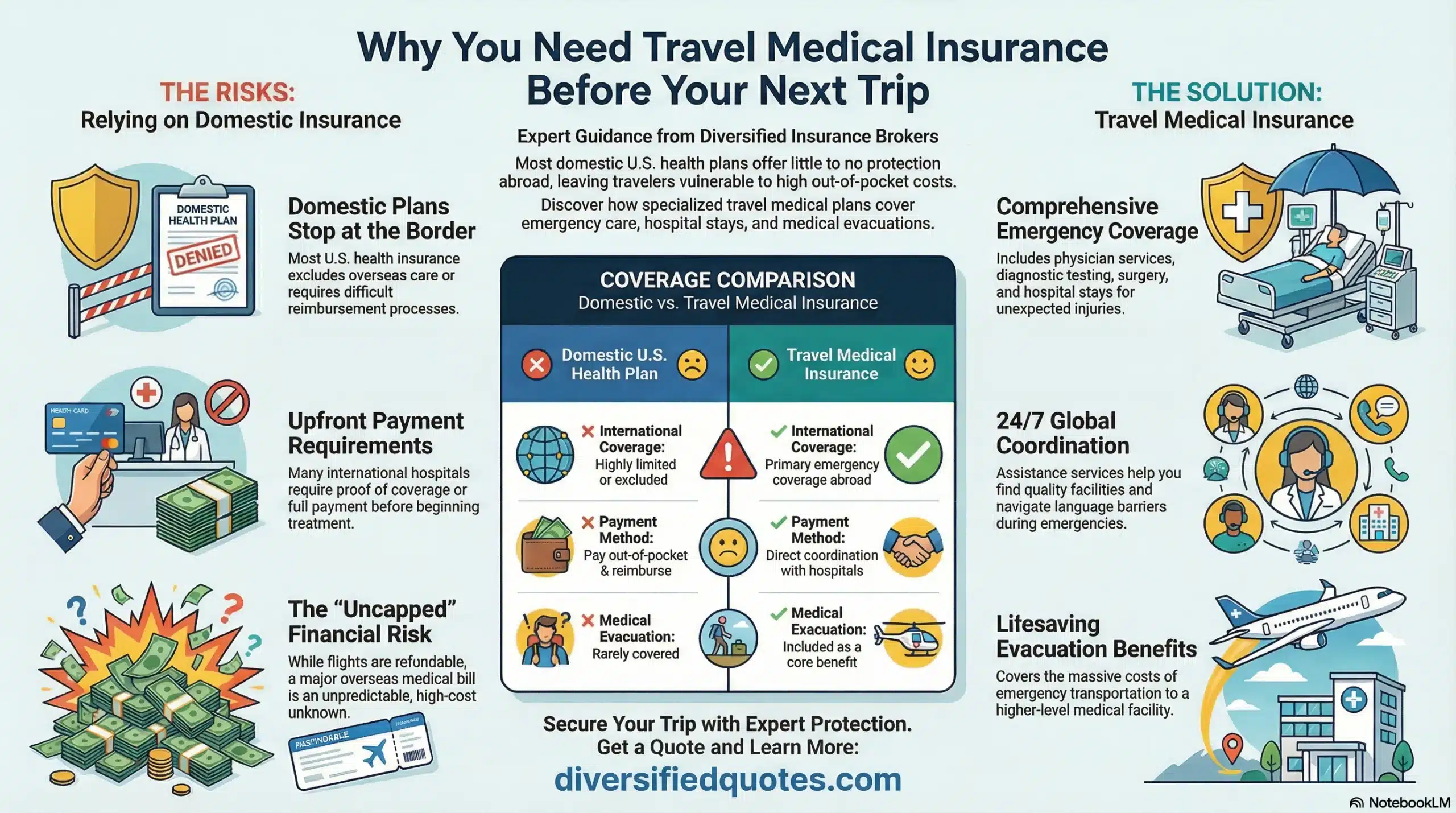
The assumption that domestic U.S. health insurance provides meaningful protection abroad is one of the most common and consequential misunderstandings in travel medical planning. Most U.S. health plans provide limited coverage outside the country, and even when international reimbursement provisions technically exist, they rarely include coordinated evacuation services, real-time assistance with locating appropriate providers, direct payment arrangements with international facilities, or the clinical coordination required to manage a complex care sequence involving transfer between facilities. That gap is costly anywhere and matters especially in Gaza because serious events may require moving to a higher level of care — a process that generates significant transport and coordination costs and that is dramatically more effective when a professional assistance provider is managing it rather than the traveler or their family attempting to navigate it independently. Travel medical and evacuation insurance for Israel covers the neighboring destination that shares many of the same regional dynamics and is commonly included on itineraries that extend across this geographic area — useful context for travelers whose plans include multiple destinations in the region. Travel medical and evacuation from Egypt covers the most common evacuation destination from Gaza when patients require care beyond what is available locally, making it a practically important reference for understanding how evacuation logistics typically function in this regional context.
Gaza Travel Medical: Risk Profile and Coverage Priorities
| Risk Category | Gaza-Specific Context | What Adequate Coverage Addresses | Risk of Inadequate Coverage |
|---|---|---|---|
| Local medical capacity | Healthcare infrastructure may be operating under severe strain or partial capacity — diagnostic capability, specialist availability, and surgical capacity may be limited relative to need | 24/7 assistance team actively directs traveler to the best available care option given current conditions; coordinates care when the first-access facility cannot fully treat the condition | Traveler receiving stabilization-only care at capacity-limited facility with no coordinated pathway to the higher-level care their condition requires |
| Medical evacuation logistics | Evacuation routes from Gaza may require coordination through border crossings with variable access status — Egypt is the primary evacuation corridor but conditions affecting access change | Assistance provider maintains operational knowledge of current access routes, coordinates with relevant authorities, confirms receiving facility acceptance, and manages the full logistics chain | Family or colleagues attempting to independently arrange evacuation through unfamiliar border processes, with no institutional relationships with receiving facilities or transport providers |
| Emergency treatment costs | Private facilities and evacuation transport can generate large upfront costs; some facilities require deposits or payment guarantees before proceeding with care | Direct payment coordination between the insurer’s assistance team and the treating facility, reducing or eliminating the traveler’s need to fund care from personal resources during the emergency | Large out-of-pocket costs, treatment delays while payment arrangements are negotiated, and post-event reimbursement process that may recover less than the full cost incurred |
| Pre-existing condition gaps | In a destination where emergency care access for any condition may be delayed, a claim denial for pre-existing condition exclusion is especially consequential | Plans with acute-flare coverage for stable pre-existing conditions and full coverage for new-onset conditions throughout the trip period | Claim denied for the medical event that most required treatment, leaving traveler with full cost of treatment and evacuation at the moment of maximum vulnerability |
| Communication and coordination | In fluid or disrupted environments, communication channels can be unreliable — coordination must be managed by a party with established relationships and protocols rather than improvised | Assistance team with operational experience in complex environments, established provider networks in the region, and protocols for managing coordination when standard communication channels are impaired | Family and colleagues coordinating independently across time zones without institutional relationships, provider knowledge, or established protocols for this specific regional context |
How Medical Evacuation Actually Works
Medical evacuation is best understood as a coordinated clinical service rather than a simple transportation booking. In a real emergency, the process begins with triage and stabilization at the nearest available facility — not the best facility, but the nearest one capable of safely evaluating the patient’s condition. Once the patient is stable enough for assessment, treating clinicians and the plan’s assistance team evaluate whether appropriate care can be continued at that facility or whether the patient’s condition requires transfer to a facility with greater capability. That determination is made on medical grounds — the patient’s clinical status, the treatment requirements of the condition, the capability of available facilities, and the logistical feasibility of transfer given current conditions on the ground.
In Gaza specifically, evacuation logistics involve a level of operational complexity that is not present in most travel medical scenarios. The primary evacuation corridor from Gaza runs through the Rafah crossing to Egypt, with Egyptian facilities — particularly in Cairo — serving as the most common destination for patients requiring care beyond what local facilities can provide. The assistance provider’s operational knowledge of current crossing access status, existing relationships with receiving facilities in Egypt and elsewhere in the region, and established coordination protocols with local authorities are what make the difference between a successful evacuation and a failed one when conditions are challenging. The transport modality depends on the patient’s medical stability and the available infrastructure — ground transport to a better-equipped facility within the accessible area, air ambulance when the patient’s condition requires it and logistical conditions permit, or commercial transport with medical escort when the patient is stable enough for that level of transfer. Travel medical and evacuation from Lebanon and travel medical and evacuation from Syria cover neighboring destinations with similarly complex evacuation environments — useful for understanding how the regional evacuation infrastructure functions and what travelers should confirm about their plan’s operational capability for this part of the world. Travel medical and evacuation from Libya and travel medical and evacuation from Yemen cover the most challenging evacuation environments in the broader MENA region and provide useful reference points for understanding how evacuation complexity scales across different destination risk levels.
What to Look for When Buying Coverage for Gaza
The first and most operationally important factor in evaluating travel medical coverage for Gaza is the quality of the 24/7 assistance provider behind the plan. In high-stress situations where local medical resources are limited, conditions are changing, and the standard care pathway is not functioning normally, the assistance team is the operational engine that converts a policy document into a real-world emergency response. Travelers should not evaluate a plan purely on premium cost or the stated financial limit of the medical benefit. The response system matters: you want a team with established provider relationships in the region, operational experience in complex environments, the authority to coordinate care and arrange transport without requiring the traveler or family to manage those negotiations independently, and the capacity to maintain communication when standard channels are impaired.
The second critical factor is clear and adequate evacuation language. The most effective evacuation benefits focus on medically necessary transfer to the nearest appropriate facility capable of treating the patient’s condition, with the assistance team coordinating all logistics including receiving facility confirmation, transport arrangements, and clinical handoff. Travelers should pay close attention to how medical necessity is defined in the specific plan they are evaluating, whether the assistance team must coordinate the evacuation for coverage to apply, what the policy says about repatriation once the patient is medically cleared for return home, and what the dollar limits are relative to the realistic cost of air ambulance transport from the Gaza region. Third, emergency medical benefit limits should be sized to realistic worst-case cost scenarios rather than minimum-viable coverage — hospitalization, surgery, and specialized procedures at private or international facilities can accumulate costs quickly, and plans with artificially low limits provide nominal protection rather than genuine financial relief during a serious event. How to get the best travel medical insurance rates covers the comparison methodology that produces the most appropriate coverage for complex destinations without sacrificing essential protections to achieve a lower premium. Cheap travel insurance covers how budget-oriented plans typically reduce coverage and which specific benefit categories are most commonly trimmed first — important context for understanding what you are trading away when cost is the primary selection criterion. International health insurance covers the longer-term international medical coverage option for travelers on extended assignments where a comprehensive ongoing health plan rather than an emergency-focused travel medical plan may be the more appropriate product category.
Who Travels to Gaza and Why Coverage Matters for Each Group
Journalists and media crews operating in Gaza often face the most acute combination of elevated medical risk and constrained access to care. Their work takes them to locations where active events are occurring, they may be moving frequently between locations under tight operational timelines, and a medical event requiring evacuation may need to be managed while the surrounding environment is itself in flux. A policy with strong assistance coordination, meaningful medical limits, and a proven evacuation infrastructure is not optional for this category of traveler — it is a professional necessity. Humanitarian and NGO staff face a different but equally serious profile: their work locations may be in areas with limited access to even basic stabilization, their organizations may have policies requiring specific types of coverage, and the nature of their work means they are unlikely to be near major medical facilities when an emergency occurs. For NGO and humanitarian organizations coordinating coverage for staff deployments, understanding how group plans function is important. Travel medical insurance for large groups covers the structural and underwriting considerations for group travel medical plans when roster size and organizational coordination create specific coverage and administration needs.
Contractors and specialized professionals on short-term assignments may underestimate their risk exposure because the duration of their presence is limited, but medical events do not calibrate to trip length — a serious emergency on a three-day visit creates the same evacuation requirement as one on a three-month assignment. Families traveling for personal reasons, including individuals visiting relatives, benefit from having a structured emergency response plan precisely because the emotional stakes of a family medical emergency make effective independent coordination most difficult at the moment when it is most necessary. Having an assistance team that can manage the coordination while family members focus on each other rather than on logistics materially improves outcomes in serious scenarios. Travel medical insurance for religious groups covers coverage considerations for faith-based travelers — a meaningful category of Gaza visitors — and how group coverage can be structured for organized travel programs to complex destinations. Travel medical and evacuation insurance for Afghanistan covers one of the most comparable destinations in terms of operational complexity, where similar coverage priorities and assistance team requirements apply. Travel medical and evacuation from Ukraine covers a conflict-affected European destination where many of the same coverage evaluation principles apply in a different geographic and infrastructure context.
Practical Pre-Travel Steps That Make Coverage Work
Travel insurance functions as a system most effectively when it is treated as an active component of travel preparation rather than a document filed away and forgotten. Before departure, confirm that your policy dates include all travel days — arrival, departure, and any buffer for delays — and that the geographic scope of the policy explicitly covers Gaza and any additional countries that may be transit or evacuation points during your trip. Save your policy number and the assistance team’s 24/7 contact number in multiple locations: in your phone, in a printed document, in an email to yourself, and with a trusted contact or organization coordinator at home who can assist with communication if you are incapacitated. Treating the contact information as a critical operational tool rather than an administrative footnote is one of the most practical steps travelers can take before a complex-destination trip.
If you take prescription medications, bring a supply sufficient for the full duration of your stay plus a meaningful buffer for unexpected delays — medication supply disruption in complex environments is common and resupply may not be straightforward. Maintain a physical copy of your prescription list and basic medical history that can be shared with a treating provider who does not have access to your medical records. Understand how the plan handles upfront payment demands from facilities — some providers will require deposits before proceeding with care, and knowing in advance whether your plan coordinates direct payment or requires you to pay and seek reimbursement allows you to prepare a financial backstop if needed. Most importantly, treat the assistance provider hotline as your first call during any serious medical event, contacted as early as possible after immediate stabilization needs are addressed — early involvement of the assistance team gives them the maximum window to coordinate care, identify receiving facilities, and arrange transfer before conditions change in ways that complicate logistics. Travel medical and evacuation from Iran, travel medical and evacuation from Pakistan, and travel medical and evacuation from Nigeria cover other destinations where similar operational preparation principles apply across different regional contexts.
Apply Online in Minutes
Secure travel medical coverage and medically necessary evacuation support for Gaza before you travel.
Related Travel Medical Pages
Explore related resources to compare emergency medical benefits, evacuation planning, and coverage options for higher-risk itineraries.
Related Destination Pages
If you are traveling to multiple higher-risk regions, these destination pages highlight why evacuation planning matters and what to look for.
Talk With an Advisor Today
Choose how you’d like to connect—call or message us, then book a time that works for you.
Schedule here:
calendly.com/jason-dibcompanies/diversified-quotes
Licensed in all 50 states • Fiduciary, family-owned since 1980
Frequently Asked Questions: Travel Medical and Evacuation Insurance for Gaza
What is the difference between medical evacuation and security evacuation?
Medical evacuation is a clinically coordinated service that transports a patient to the nearest appropriate medical facility when local care is insufficient for their condition. It requires physician certification of medical necessity and is coordinated by the plan’s assistance provider based on the patient’s clinical status and available treatment options. Security evacuation — also called security extraction — is a completely separate service that removes individuals from locations due to non-medical threats such as armed conflict, political instability, or criminal danger. Standard travel medical plans cover medical evacuation but do not cover security extraction. Travelers who want protection against non-medical security threats must purchase specialized security evacuation services separately from their travel medical coverage.
Where would a medical evacuation from Gaza typically go?
The most common evacuation route from Gaza runs through the Rafah crossing to Egypt, with facilities in Cairo serving as the primary destination for patients requiring care beyond what is available locally. The assistance provider coordinates with Egyptian facilities, manages crossing logistics, and confirms receiving facility acceptance before the evacuation is initiated. Depending on the patient’s condition and the care requirements, evacuation to other regional hubs — Jordan, Turkey, or other countries with appropriate specialty capability — may be arranged when the specific treatment required is not available in Egypt. The evacuation destination is determined by the patient’s medical needs and the available transport infrastructure at the time of the event, not by the patient’s geographic preference.
Will travel medical insurance cover treatment if local hospitals in Gaza are at limited capacity?
Travel medical insurance covers eligible emergency treatment costs at whatever facilities can provide that treatment — it does not restrict coverage to facilities operating at full capacity. If the nearest available facility provides stabilization care but cannot fully treat the patient’s condition, the assistance team evaluates whether transfer to a higher-capability facility is medically appropriate and coordinates that transfer when it is. The coverage follows the care pathway rather than being limited to a specific facility type. The practical value in a capacity-constrained environment is having an assistance team with operational knowledge of what is actually available and accessible — not just what theoretically exists — so that the care pathway decision is based on ground-truth information rather than outdated assumptions.
What should I do first if a medical emergency occurs in Gaza?
Address immediate stabilization needs first — get to the nearest available facility for triage and emergency care. Once the immediate clinical situation is addressed, contact the assistance provider’s 24/7 hotline as early as possible. Early contact gives the assistance team the maximum time to coordinate with the treating facility, evaluate care options, identify receiving facilities if transfer is needed, and initiate the logistics of any evacuation that is medically appropriate. Do not wait until the situation becomes critical before contacting the assistance provider — the earlier they are involved, the more options they have and the more effectively they can manage the coordination. Have your policy number and assistance contact information accessible without requiring internet access, as connectivity cannot be assumed in complex environments.
Is travel medical insurance available for humanitarian workers and NGO staff in Gaza?
Yes — travel medical insurance is available for humanitarian workers, NGO staff, journalists, contractors, and other professional categories traveling to Gaza. Some organizations require specific minimum benefit levels or specific coverage features as a condition of deployment, and travelers should confirm their organization’s requirements before purchasing. For organizations deploying multiple staff members simultaneously, group travel medical plans may be more administratively appropriate than individual policies — both for consistent coverage across all staff and for the organizational coordination that a group plan facilitates. Pre-existing condition terms, evacuation limits, and the quality of the assistance provider should all be evaluated carefully given the specific operational environment and the medical risk profile of individuals being deployed.
About the Author:
Jason Stolz, CLTC, CRPC, DIA, CAA and Chief Underwriter at Diversified Insurance Brokers (NPN 20471358), is a senior insurance and retirement professional with more than 25 years of real-world experience helping individuals, families, and business owners protect their income, assets, and long-term financial stability. As a long-time partner of the nationally licensed independent agency Diversified Insurance Brokers, Jason provides trusted guidance across multiple specialties—including fixed and indexed annuities, long-term care planning, personal and business disability insurance, life insurance solutions, Group Health, Travel Medical and Evacuation Insurance, and short-term health coverage. Diversified Insurance Brokers maintains active contracts with over 100 highly rated insurance carriers, ensuring clients have access to a broad and competitive marketplace.
His practical, education-first approach has earned recognition in publications such as VoyageATL, and contributions from his agency featured in Kiplinger and GoBankingRates— highlighting his commitment to financial clarity and client-focused planning. Drawing on deep product knowledge and years of hands-on field experience, Jason helps clients evaluate carriers, compare strategies, and build retirement and protection plans that are both secure and cost-efficient. Visitors who want to explore current annuity rates and compare options across multiple insurers can also use this annuity quote and comparison tool.
Explore More Travel Medical Insurance Options: Browse our complete guide to Africa & Middle East Travel Medical Insurance — covering medical evacuation coverage for Africa, Middle East & high risk destinations.
Last Reviewed: June 17, 2026 |
Reviewed by: Jason Stolz, CLTC, CRPC, DIA, CAA
Chief Underwriter, Diversified Insurance Brokers, Inc. | NPN: 20471358 | Diversified Insurance Brokers, Inc. — Licensed in all 50 states
Fact Checked by: Tonia Pettitt, CMIP©
Medicare Specialist, Diversified Insurance Brokers, Inc. | NPN: 14374308 | Diversified Insurance Brokers, Inc. — Licensed in all 50 states
Did you find this content helpful? Leave us a Google review — it helps others find trustworthy guidance too.
Editorial Standards: Diversified Insurance Brokers maintains rigorous editorial standards to ensure accuracy, clarity, and independence in all content. Learn more about our editorial standards and commitment to transparency.
