
Travel Medical and Evacuation from Nigeria
Travel Medical and Evacuation from Nigeria

Jason Stolz CLTC, CRPC, DIA, CAA
Nigeria is the most populous country in Africa, the continent’s largest economy by GDP, and home to one of the world’s most dynamic and diverse populations — a country that draws business travelers, investors, energy sector professionals, humanitarian workers, missionaries, researchers, students, and tourists to its major cities and increasingly to its coastal, delta, and northern regions for purposes ranging from commercial contracts to cultural engagement. Lagos is one of West Africa’s defining commercial metropolises, Abuja is a purpose-built capital with a significant diplomatic and international organization presence, Port Harcourt sits at the center of the Niger Delta’s oil and gas industry, and Kano anchors the country’s north as a major commercial and cultural hub. Nigeria’s scale and economic significance mean that the range of travelers coming and going is broad — and the range of medical access experiences they may encounter is equally broad. Private hospitals in Lagos — including Eko Hospital and Suites, St. Nicholas Hospital, and the Reddington Hospital — provide meaningful emergency care capability that approaches regional standards for many types of acute events. Abuja’s National Hospital and private clinic sector provide similar coverage for the capital. But Nigeria’s size means that the country extends far beyond these urban centers, and the gap between what Lagos’s best private hospitals offer and what is available in the Niger Delta field locations, the plateau states, the northeastern regions, or the rural corridors between cities is significant and consequential for any traveler who experiences a serious medical event outside the major urban hubs. Securing travel medical and emergency evacuation insurance from Nigeria before departure is the coverage infrastructure that closes that gap with financial protection and professional coordination rather than improvised response under emergency conditions.
At Diversified Insurance Brokers, we help individuals, families, and organizations select coverage designed for real-world international medical situations — coverage that addresses emergency treatment expenses and coordinates medically necessary evacuation when local resources are not sufficient for the condition at hand. A strong travel medical plan is not only about paying a facility bill; it is about having access to a 24/7 assistance team capable of coordinating where the patient goes, how they get there, and what happens next while the traveler is managing the medical situation itself. For Nigeria, where travel may involve long overland distances between cities with variable road conditions, movement into oil field and offshore environments, or deployment in areas with limited access to advanced care, that coordination function can be the difference between a manageable event and a financial and logistical crisis compounding on top of a medical one. Emergency medical evacuation insurance covers how evacuation benefits work — what triggers them, how medical necessity is determined, and why the assistance team’s coordination capability matters as much as the financial limit. High-risk travel insurance covers specialized coverage options for itineraries that create elevated risk profiles. Travel and medical insurance for high-risk travel covers the broader framework for complex destinations where the care pathway and the assistance team’s operational capability are primary determinants of real-world protection value.
Travel Medical & Evacuation Coverage for Nigeria
Apply online for travel medical insurance that can cover emergency treatment and medically necessary evacuation while you’re in Nigeria.
Why Travel Medical and Evacuation Coverage Matters in Nigeria
Nigeria’s healthcare landscape presents the same fundamental challenge that drives medical evacuation planning across sub-Saharan Africa: the gap between what the best available local facilities can provide for serious specialty events and what the specific condition actually requires. Lagos’s top private hospitals handle a meaningful range of emergency scenarios — significant trauma, cardiac stabilization, acute infections, and many surgical cases — at a level that is credibly comparable to regional standards for those categories. But Nigeria’s private hospital sector is concentrated in a small number of major urban facilities, and even within Lagos or Abuja the specific specialty capability for complex cardiac intervention, advanced neurosurgery, multi-system ICU management, or pediatric subspecialty care may not be reliably available at the level required for the most serious medical events. Outside the major cities — in the oil field regions of Rivers State and Bayelsa, in the remote northern states of Borno and Yobe, in the agricultural southern states, and in the many Nigerian cities and towns that fall between Lagos and Kano on the development spectrum — the infrastructure gap is more pronounced and the evacuation probability for a serious event is correspondingly higher.
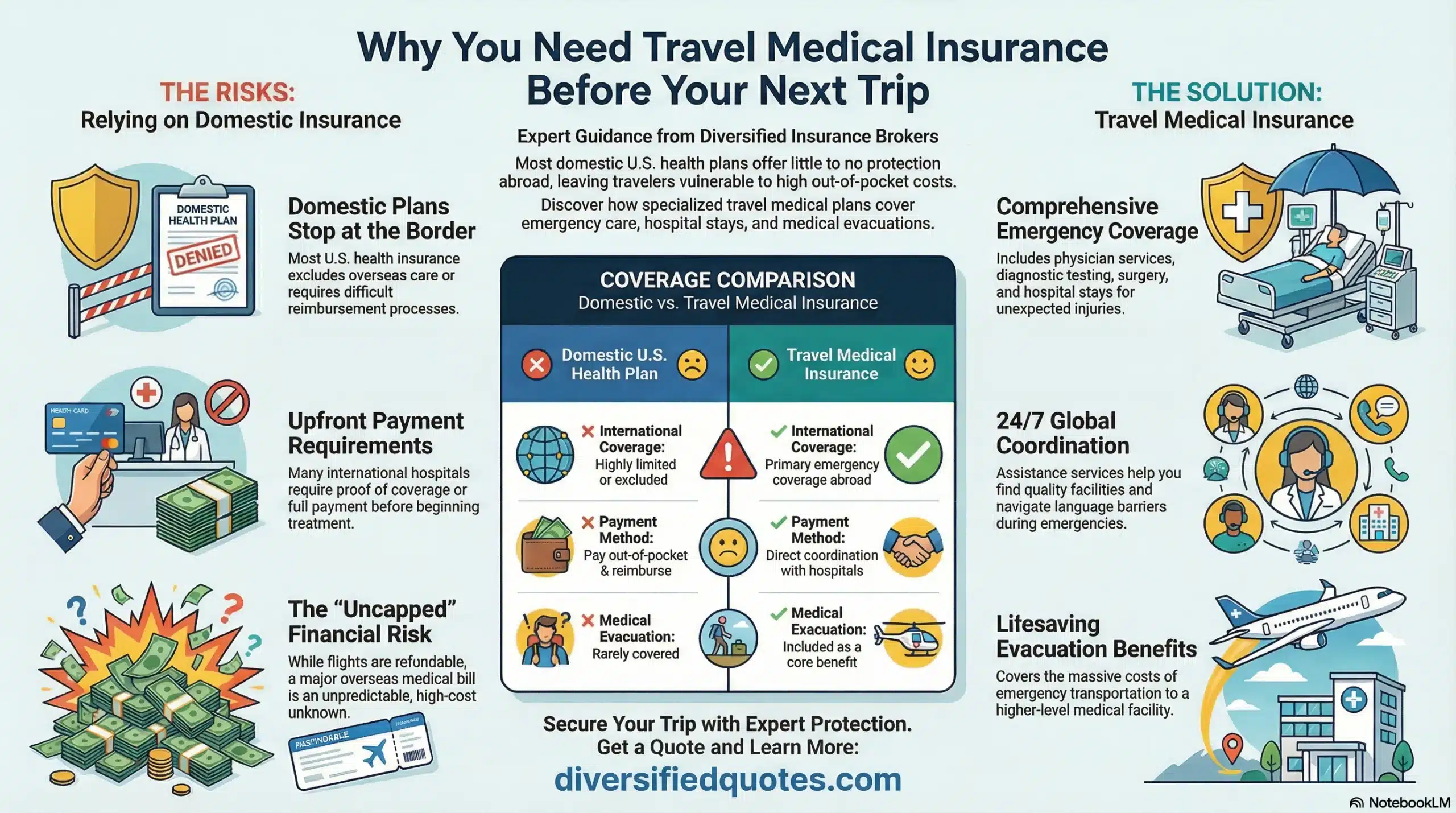
The financial dimension of a serious Nigeria medical event without coverage in place is substantial. Private hospital costs in Lagos for an inpatient event involving surgery, ICU monitoring, and specialist consultation can reach tens of thousands of dollars. Air ambulance evacuation from Nigeria to London, Abidjan, Nairobi, or another regional hub — the typical pathway for events that exceed Nigerian private hospital capability — adds $40,000 to $100,000 or more in logistics costs. The operational complexity of coordinating that evacuation — identifying the receiving facility, confirming acceptance, arranging medical staffing and transport, managing documentation, and communicating with the patient’s family and employer throughout — is not manageable independently for most travelers under the time pressure of a medical crisis. The assistance team that accompanies a quality travel medical plan provides that coordination infrastructure. What is the primary reason people buy travel medical insurance covers the risk assessment framework that underlies coverage decisions for international travelers across different destination risk levels.
Nigeria Travel Medical: Coverage Priorities by Region and Traveler Type
| Nigeria Region / Traveler Type | Medical Access Reality | Most Critical Coverage Priority | Primary Evacuation Route |
|---|---|---|---|
| Lagos — business / tourism | Best available private hospital access in Nigeria; Reddington, St. Nicholas, Eko Hospital handle many emergency scenarios; limited for highest-complexity specialty events; traffic and logistics delays common | Emergency medical limits for Lagos private hospital care; evacuation to London or Abidjan for events exceeding Nigerian private hospital capability; assistance team with Lagos private hospital network knowledge | London as primary for highest-complexity cases — direct flights, established Nigerian medical diaspora receiving network; Abidjan or Accra for West African regional cases; Nairobi for some case types |
| Abuja — diplomatic / government / NGO | Abuja National Hospital and private clinic sector provide reasonable emergency coverage; diplomatic community has some access to international health services; still limited for highest-complexity specialty care | Emergency medical limits for Abuja care; evacuation for complex events; assistance team with Abuja hospital network familiarity; long-term diplomatic and NGO staff coverage continuity | London or Accra as primary; Lagos as intermediate staging for some cases before international evacuation |
| Port Harcourt / Niger Delta — oil sector | Oil company medical facilities on platforms and in installations handle basic care; Port Harcourt private clinics available; offshore incidents require boat or helicopter staging; proximity to waterways creates specific logistics | Offshore and marine incident evacuation capability; assistance team with Nigeria oil sector logistics experience; highest evacuation limits for offshore scenarios; work activity coverage confirmation | Shore-based stabilization then Lagos for initial care; London or Abidjan for specialty events; offshore cases may require multi-segment transport through Port Harcourt |
| Kano / northern Nigeria | Kano has some private hospital access; rural northern states have more limited infrastructure; northeastern regions including Borno and Yobe have significant security and healthcare access constraints | Higher evacuation limits for northern Nigeria given distance from Lagos care; war/conflict exclusion review for northeastern regions; assistance team with northern Nigeria evacuation routing familiarity | Lagos as primary staging for international evacuation; London or Abidjan depending on specialty requirement |
| NGO / humanitarian — field deployments | Rural deployments across multiple Nigerian states with variable medical access; conflict-adjacent areas in northeast face most constrained access; cumulative exposure from extended deployments | Group coverage for organizational deployments; war/conflict exclusion review for northeastern regions; pre-existing condition terms appropriate for deployment staff profiles; organizational coordination capability | Lagos or Abuja as staging; international evacuation to London or Accra depending on specialty requirement and available transport connections |
Medical Evacuation From Nigeria: How It Works and Why It Matters
Medical evacuation from Nigeria follows the same structured sequence as evacuations from other complex destinations — initial stabilization at the nearest available facility, assistance team contact as early as possible in the developing situation, clinical and logistical assessment by the team, receiving facility identification and confirmation, transport arrangement, and continuous communication with the patient’s family and employer throughout the process. For Nigeria specifically, the evacuation geography reflects the country’s international air connectivity: Lagos’s Murtala Muhammed International Airport has direct connections to London, Amsterdam, Frankfurt, Nairobi, Abidjan, and other hubs, making it the most practical international departure point for most Nigeria evacuations. Abuja’s Nnamdi Azikiwe International Airport has fewer international connections but serves as the departure point for Abuja-based cases. Port Harcourt’s airport serves the oil sector population of Rivers State.
London is the most common high-complexity evacuation destination for Nigerian cases, reflecting the historical and institutional connections between Nigeria and the UK and the established Nigerian medical diaspora network at London’s major hospitals. Accra, Ghana is a strong West African regional alternative for cases where the specific clinical requirement can be met at the regional level without requiring European evacuation. Abidjan, Ivory Coast is another regional hub. Nairobi serves some East African routing cases for Nigerian organizations with cross-regional operations. For the most complex specialty events, the specific receiving destination depends on the clinical requirement and the assistance team’s real-time assessment of available transport, receiving facility capability, and logistics. Travel medical and evacuation from Ivory Coast covers Abidjan — the most common West African regional hub for Nigeria cases — and the medical infrastructure context of Ivory Coast’s private hospital sector. Travel medical and evacuation from Egypt covers Cairo as a North African regional hub relevant for some Nigeria cases involving specialized oncological or cardiac care. Travel medical and evacuation from Morocco covers Casablanca’s role as a North African medical hub for West African evacuations.
Health Risks, Pre-Existing Conditions, and Who Needs Coverage
Nigeria’s tropical environment creates specific health risks for international travelers that go beyond the general illness and injury categories common to all international travel. Malaria is endemic across Nigeria including in Lagos and Abuja, and severe malaria — particularly cerebral malaria — is a genuine medical emergency that can progress rapidly and requires immediate advanced supportive care. Yellow fever vaccination is required for entry, and hepatitis A, typhoid, and meningococcal vaccinations are recommended depending on itinerary. Lassa fever, while primarily affecting those in direct contact with rodents in rural areas, is endemic in parts of Nigeria and is a disease that international travelers in affected regions should understand. Waterborne illness from food and water exposure creates gastrointestinal risk that is among the most common Nigeria travel medical claim categories. Road traffic accidents are a consistent and serious travel health risk in Nigeria — road conditions, traffic density in Lagos and other major cities, and the length of intercity travel required to reach many destinations all create accident risk that should factor explicitly into coverage planning. Kidnapping risk in specific Nigerian regions — particularly the Niger Delta and parts of the northeast — is a security concern that is distinct from medical risk but that some travelers to Nigeria must plan around separately from their travel medical coverage.
Pre-existing condition terms require the same explicit review for Nigeria travel that they require for any destination where serious medical events are more likely to require evacuation. The most consequential real-world Nigeria scenarios — cardiac events during the physical and logistical demands of Nigeria travel, severe malaria in travelers with underlying health conditions, road accident trauma requiring specialty care, severe GI illness resulting in hospitalization — are precisely the events most likely to have a pre-existing condition connection for travelers with any meaningful medical history. Travel medical insurance for large groups covers the structural considerations for organizations deploying multiple staff to Nigeria simultaneously — relevant for oil companies, NGOs, development organizations, and faith-based groups with ongoing Nigeria operations. Travel medical insurance for religious groups covers the faith-based travel context for the significant missionary and faith-based development community in Nigeria. Travel medical and evacuation from Niger, travel medical and evacuation from Sierra Leone, and travel medical and evacuation from Angola cover neighboring and regional West and Central African destinations commonly combined with Nigeria in multi-country deployments. Travel medical and evacuation from Burundi, travel medical and evacuation from Congo, and travel medical and evacuation from Libya cover other African destinations where comparable coverage evaluation priorities apply. International health insurance covers the longer-term alternative for extended Nigeria assignments. International travel health coverage covers the full product spectrum. How to get the best travel medical insurance rates covers the comparison methodology for identifying the most appropriate and cost-efficient plan for a given Nigeria itinerary and traveler profile.
Get Travel Medical and Evacuation Coverage for Nigeria
Apply online in minutes and travel with confidence knowing you have coverage that can respond in an emergency.
Related Travel Medical Pages
Compare plan types and understand how medical benefits and evacuation coordination work before you travel.
Related Destination Pages
Compare how travel medical needs change by location, access to care, and evacuation logistics.
Talk With an Advisor Today
Choose how you’d like to connect—call or message us, then book a time that works for you.
Schedule here:
calendly.com/jason-dibcompanies/diversified-quotes
Licensed in all 50 states • Fiduciary, family-owned since 1980
Frequently Asked Questions: Travel Medical and Evacuation Insurance for Nigeria
Where would a medical evacuation from Nigeria typically go?
London is the most common high-complexity evacuation destination for Nigerian cases, reflecting direct flight connections from Lagos, historical UK-Nigeria institutional relationships, and the established Nigerian medical diaspora network at London’s major hospitals. Accra, Ghana is a strong West African regional alternative for cases where the clinical requirement can be addressed at a regional level. Abidjan, Ivory Coast is another regional hub. Nairobi serves some cases for organizations with cross-regional East and West African operations. The specific destination for any given evacuation depends on the patient’s clinical condition, the specialty capability required, and available transport at the time — the assistance team evaluates all factors and selects the receiving facility that best addresses the patient’s specific medical needs.
Are Lagos private hospitals adequate for serious emergencies, or will evacuation always be needed?
Lagos’s top private hospitals — including Reddington Hospital, St. Nicholas Hospital, and Eko Hospital and Suites — handle a meaningful range of serious emergencies including trauma surgery, cardiac stabilization, major infections, and many acute medical presentations at a level comparable to regional West African standards. For many serious but not highest-complexity events, Lagos private hospitals can provide appropriate definitive treatment. Evacuation becomes medically indicated when the specific condition requires specialty care not reliably available locally: advanced interventional cardiology, complex neurosurgery, sustained multi-organ ICU management, or specific subspecialty capabilities. Having evacuation coverage ensures that the decision about whether to treat in Lagos or transfer is made based on clinical necessity rather than financial constraint — which is the right framework for that decision regardless of whether the evacuation ultimately occurs.
Does travel medical insurance cover malaria treatment in Nigeria?
Yes — malaria is covered as an acute illness arising during the trip under standard travel medical plans, including severe malaria complications requiring hospitalization and intensive management. The practical concerns for Nigeria malaria cases are two: first, whether the plan contains specific exclusions for infections foreseeable given the destination — a provision that exists in some plans and is relevant for Nigeria where malaria is endemic. Second, whether severe malaria requiring advanced supportive care exceeds the capability of the nearest facility, creating an evacuation scenario on top of the treatment cost scenario. Travelers should confirm their plan does not contain destination-specific foreseeable disease exclusions, and should understand that the evacuation benefit may be as important as the medical treatment benefit for severe Nigeria malaria cases requiring intensive management not available locally.
What coverage limits should I target for Nigeria travel?
Emergency medical limits of $100,000 or more are a reasonable baseline for Nigeria travel, reflecting the realistic cost of inpatient care at Lagos or Abuja private hospitals plus continued treatment at the receiving facility in London or Accra after evacuation. For evacuation and repatriation, limits of $250,000 or more are commonly recommended because an air ambulance evacuation from Nigeria to London or a West African regional hub can reach $40,000 to $100,000 or more depending on the origin point within Nigeria, the transport modality required, and the patient’s medical condition during transport. Travelers in the Niger Delta or northeastern Nigeria — particularly offshore oil workers and NGO field staff — should target higher evacuation limits because logistics complexity and distance from Lagos create greater transport cost exposure than for Lagos or Abuja-based travel.
Does kidnapping or security risk coverage require a separate plan from travel medical?
Yes — kidnapping response, ransom negotiation, and security-triggered evacuation are categorically different from medical evacuation and are not covered under standard travel medical plans. Medical evacuation responds to medical necessity — a physician-certified clinical condition requiring care not available locally. Security and political risks that do not involve a concurrent medical emergency require separate specialized products: kidnap and ransom insurance, security evacuation coverage, or crisis response services. These are distinct products purchased separately from travel medical coverage. Travelers to Nigeria’s higher-risk regions — particularly the Niger Delta and parts of the northeast — who are concerned about security-related risks as well as medical risks must address both categories with separate appropriate products rather than assuming one product covers both.
About the Author:
Jason Stolz, CLTC, CRPC, DIA, CAA and Chief Underwriter at Diversified Insurance Brokers (NPN 20471358), is a senior insurance and retirement professional with more than 25 years of real-world experience helping individuals, families, and business owners protect their income, assets, and long-term financial stability. As a long-time partner of the nationally licensed independent agency Diversified Insurance Brokers, Jason provides trusted guidance across multiple specialties—including fixed and indexed annuities, long-term care planning, personal and business disability insurance, life insurance solutions, Group Health, Travel Medical and Evacuation Insurance, and short-term health coverage. Diversified Insurance Brokers maintains active contracts with over 100 highly rated insurance carriers, ensuring clients have access to a broad and competitive marketplace.
His practical, education-first approach has earned recognition in publications such as VoyageATL, and contributions from his agency featured in Kiplinger and GoBankingRates— highlighting his commitment to financial clarity and client-focused planning. Drawing on deep product knowledge and years of hands-on field experience, Jason helps clients evaluate carriers, compare strategies, and build retirement and protection plans that are both secure and cost-efficient. Visitors who want to explore current annuity rates and compare options across multiple insurers can also use this annuity quote and comparison tool.
Explore More Travel Medical Insurance Options: Browse our complete guide to Africa & Middle East Travel Medical Insurance — covering medical evacuation coverage for Africa, Middle East & high risk destinations.
Last Reviewed: June 18, 2026 |
Reviewed by: Jason Stolz, CLTC, CRPC, DIA, CAA
Chief Underwriter, Diversified Insurance Brokers, Inc. | NPN: 20471358 | Diversified Insurance Brokers, Inc. — Licensed in all 50 states
Fact Checked by: Tonia Pettitt, CMIP©
Medicare Specialist, Diversified Insurance Brokers, Inc. | NPN: 14374308 | Diversified Insurance Brokers, Inc. — Licensed in all 50 states
Did you find this content helpful? Leave us a Google review — it helps others find trustworthy guidance too.
Editorial Standards: Diversified Insurance Brokers maintains rigorous editorial standards to ensure accuracy, clarity, and independence in all content. Learn more about our editorial standards and commitment to transparency.
