
Best Independent Disability Insurance Broker
As an Independent Disability Insurance Broker, we have access to exclusive discounts and negotiated pricing most captive agents can’t offer — see the full breakdown near the end of this page.
Best Independent Disability Insurance Broker

Jason Stolz CLTC, CRPC, DIA, CAA
Choosing the best independent disability insurance broker can make the difference between owning a policy that truly protects your income and one that fails precisely when you need it most. Disability insurance is one of the most technically complex forms of coverage available, and the differences that determine whether a policy performs at claim time are almost entirely in contract language rather than in premiums or brand names. At Diversified Insurance Brokers, we work exclusively as independent advisors — representing you, not an insurance company — and have done so for clients nationwide since 1980. Independence has been the foundation of every client relationship we have built in the four-plus decades since the firm was founded.
As an independent brokerage, we compare disability insurance policies across multiple top-rated carriers to identify the strongest definitions, most reliable benefit structures, and best pricing available for your occupation and income profile. Our role is not to sell a single product but to design long-term income protection strategies that hold up under real-world claims scenarios. A policy that looks good on paper but fails at claim time is not income protection — it is a false sense of security. The Social Security Administration estimates that a 20-year-old worker today has roughly a one-in-four chance of becoming disabled before retirement, and the average monthly SSDI benefit leaves a substantial income gap for most households. Individual disability insurance, properly structured and placed through an independent broker who shops across the full marketplace, is the most direct solution to that gap.
Compare Individual Disability Insurance Options
Request a personalized disability insurance review and see options from multiple top-rated carriers — no obligation.
Request Disability Insurance ReviewQuestions? Call 800-533-5969
What an Independent Disability Insurance Broker Actually Does
An independent disability insurance broker evaluates the full disability insurance marketplace rather than being constrained to one carrier’s product lineup. This means analyzing how different insurers define disability, structure benefit periods, handle residual claims, underwrite specific occupations, and respond at claim time — across all major carriers simultaneously. Many consumers are unaware that two policies with the same monthly benefit amount can perform very differently when a claim occurs, and that the difference is almost entirely in contract language rather than in the premium. An independent broker’s core value is navigating that complexity systematically on behalf of the client rather than simply selling what one carrier offers.
By working independently, we can align clients with carriers that historically offer favorable underwriting for their profession, income structure, and medical profile. This is especially important for professionals whose income is commission-based, self-employed, or tied to ownership distributions — and for those whose medical history requires specific carrier selection to avoid unnecessary exclusions or ratings. Our process covers more than rate comparison. We evaluate policy definitions, rider structures, underwriting guidelines, claims reputations, and long-term financial strength ratings for every carrier we consider for each individual client. For professionals evaluating whether independent brokerage guidance is the right approach, our resource on whether disability insurance is worth the investment provides the foundational financial case that independent brokerage is designed to optimize.
The difference between working with a captive agent — one who represents only a single carrier — and a true independent broker is practical and financially meaningful. A captive agent’s recommendation ends at the boundaries of their carrier’s product shelf. An independent broker’s recommendation begins with your specific situation and works outward to the entire marketplace to find the best available match. The comparison below illustrates how these two approaches differ across the dimensions that matter most.
Independent Broker vs. Captive Agent vs. Employer Group Plan
| Feature | Independent Broker | Captive Agent | Employer Group Plan |
|---|---|---|---|
| Carrier Access | Multiple top-rated carriers | One carrier only | One carrier only |
| Policy Definition | True own-occupation available | Limited to one carrier’s definition | Often converts to any-occ. after 2 years |
| Income Protected | Base Salary + Commissions | Varies, but limited options | Base salary only (60% or less) |
| Portability | Follows you always | Follows you always | Ends when employment ends |
| Occupational Class Optimization | Shopped across all carriers | Fixed to one carrier | Not applicable |
| Health History Navigation | Carrier-matched to your profile | One underwriting approach only | Limited or no underwriting |
| Residual Disability Coverage | Best available rider selected | One carrier’s rider only | Rarely included |
| COLA Rider Access | Compared across carriers | One carrier’s option only | Rarely available |
| Premium Rate Lock | Non-cancelable options available | Depends on carrier product | Rates can change at renewal |
| Compensation Bias | Identical regardless of carrier | Incentivized toward one carrier | Employer-driven selection |
Why Independence Matters in Disability Insurance
Disability insurance contracts are not standardized. Carriers vary significantly in how they define total disability, partial disability, and recovery benefits — and the practical consequences of those definitional differences appear most clearly at claim time, which is the worst possible moment to discover that the policy does not perform as expected. Captive agents and employer plans typically offer limited options with minimal customization, while independent brokers can compare contract language across the full marketplace to ensure it aligns with the client’s actual work duties and realistic disability risk.
Independence also matters when underwriting challenges arise. A medical history that results in exclusions or ratings at one carrier may be viewed far more favorably by another. An independent broker navigates these differences strategically, reducing the risk of unnecessary declines or permanent exclusions that follow a client through subsequent applications. In the disability insurance market, a premature application to the wrong carrier can create a Medical Information Bureau (MIB) record that complicates future applications — an outcome that experienced independent brokerage specifically works to prevent by evaluating carrier-specific underwriting guidelines before any application is submitted.
The policy features that matter most in disability insurance are precisely those that vary most dramatically between carriers. The definition of disability — whether own-occupation or any-occupation — is the most consequential single provision in any disability policy. A physician with an own-occupation policy who develops a condition preventing surgical work receives full benefits even if they can still work as a consultant or educator. Under an any-occupation definition, those same benefits might be denied entirely. Our comprehensive resource on own-occupation disability insurance covers this critical distinction in full detail, illustrating exactly why which carrier a policy comes from — and how it was structured — determines whether income protection actually performs as expected.
Who Benefits Most from an Independent Disability Insurance Broker
Independent disability insurance brokerage is particularly valuable for professionals whose income depends on their ability to perform specialized duties. Physicians, dentists, attorneys, executives, business owners, and high-income professionals often require tailored policy design to protect earnings that exceed standard group plan limits. For these professionals, the wrong policy definition — an any-occupation clause that converts after two years of disability, or a residual benefit trigger that is set too high — can mean the difference between meaningful income replacement and a denied claim.
Self-employed individuals also benefit significantly from independent guidance. Without employer-sponsored coverage, policy structure, elimination periods, and benefit periods must be coordinated carefully to avoid gaps in protection. For self-employed professionals whose income is documented through Schedule C or K-1 distributions rather than W-2 wages, income verification for underwriting requires specific expertise to ensure the benefit amount accurately reflects actual earning capacity rather than a minimized tax-year figure that may not represent sustainable income. Our resource on disability insurance for independent contractors and self-employed professionals covers the specific planning considerations that make independent brokerage particularly valuable for this population.
Professionals in occupational categories that sit near classification tier boundaries benefit substantially as well. Occupational class assignment directly affects both the premium and the policy features available — a class 5 (5A) professional pays less and has access to better policy definitions than a class 3 professional at the same carrier. Different carriers use different classification systems and apply different criteria to occupations that fall near tier boundaries. An independent broker who knows which carrier assigns the most favorable class to a specific occupational description — such as a dentist with primarily restorative versus primarily surgical work, or an attorney who litigates versus one who primarily drafts — can produce meaningfully different outcomes in both premium and coverage quality than an application made without this knowledge.
Key Policy Features an Independent Broker Evaluates
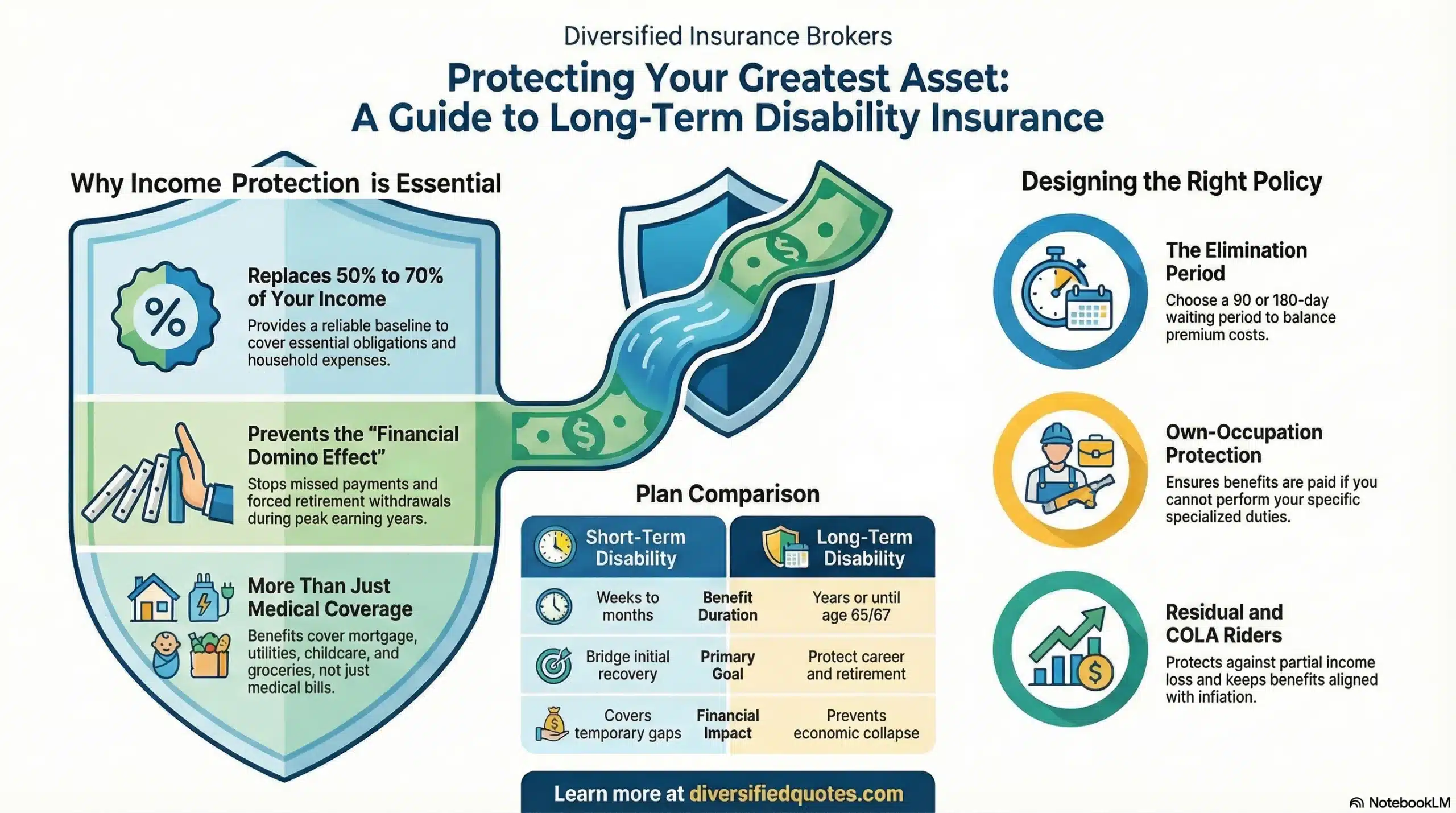
When designing disability coverage, we focus on more than premium cost. A properly structured policy must clearly define disability, protect against partial income loss, provide flexibility as your career evolves, and be backed by a financially strong carrier whose claims-paying commitment will remain intact for the decades a policy may be in force. The following are the provisions that independent analysis compares most carefully across carriers.
Definition of disability — Whether benefits are paid based on inability to perform your own occupation or any occupation is the single most consequential policy provision. Own-occupation definitions vary even between carriers that claim to offer them — some use “pure” own-occupation language that applies for the life of the policy, while others use own-occupation language that applies for a defined period and then transitions to a modified standard. Understanding exactly what definition applies throughout the benefit period — not just during the first two years — is essential.
Residual and partial benefits — How income loss is calculated and whether benefits continue during recovery. Most disabling conditions do not produce complete sudden incapacity — they reduce work capacity gradually or intermittently. A residual disability rider ensures the policy pays when earnings are reduced rather than only when work is entirely impossible. The specific trigger threshold and benefit calculation method of residual riders vary between carriers in ways that have real financial consequences. Our resource on how residual disability insurance benefits work explains this critical feature and how it varies across the market.
Benefit period — How long benefits are paid, from short-term benefit periods (2 or 5 years) through long-term options to age 65, 67, or beyond. The benefit period selection must balance premium cost against the realistic risk of an extended disability that persists beyond a fixed period. For a 35-year-old professional with three decades of working years ahead, a two-year benefit period provides minimal real protection against the long-term disability scenarios that represent the greatest financial risk.
Future purchase options — The ability to increase coverage as income rises without additional medical underwriting. This rider is particularly valuable for young professionals whose income will grow substantially over their careers — and whose health may change in ways that would affect future underwriting if this protection is not secured while they are young and healthy. Our resource on the disability insurance future insurability rider explains how this protection works and why it should be a standard component of any disability policy placed for younger professionals.
Cost-of-living adjustment rider — Increases monthly benefits annually during a disability claim to preserve real purchasing power. For a professional facing a long-term disability that extends a decade or more, a benefit that is adequate today loses meaningful real value without this protection. Our resource on disability income insurance with COLA protection explains how this rider functions and why it matters for extended claims.
Non-cancelable and guaranteed renewable — Locks in both premium rates and coverage terms for the life of the policy, preventing the carrier from increasing premiums or altering definitions as the insured ages or accumulates health history. The distinction between non-cancelable (locks in both premium and terms), guaranteed renewable (locks in terms but allows premium increases at the class level), and conditionally renewable (the weakest form) is consequential for long-term financial planning.
Elimination period — The waiting period before benefits begin. Selecting the right elimination period requires understanding the client’s available financial reserves, employer sick leave, short-term disability coverage, and cash flow resilience. Our guide on how disability insurance elimination periods work explains this decision framework in detail and illustrates how elimination period selection interacts with benefit period and benefit amount to determine the overall structure of protection.
Income Documentation: A Critical Underwriting Challenge
One of the most frequently underestimated challenges in disability insurance placement — particularly for self-employed professionals, business owners, and executives with complex compensation structures — is income documentation for underwriting. The benefit amount an insurer will approve is directly tied to the documented income the applicant can demonstrate, and how income is presented to underwriters has significant consequences for the coverage amount ultimately available.
For W-2 employees, income documentation is relatively straightforward — tax returns, W-2 forms, and employer verification establish the income base from which the benefit amount is calculated. For self-employed professionals and business owners, the picture is more complex. A physician who owns their practice may show personal Schedule C income that reflects aggressive tax deductions, resulting in a taxable income figure substantially lower than what they actually earn and live on. An attorney in a partnership may receive K-1 distributions that require multi-year documentation to establish a stable income baseline for underwriting purposes. A business owner whose compensation includes a combination of salary, distributions, and retained earnings in the business requires specific documentation strategies to accurately represent total economic income rather than the minimized taxable figure that appears on tax returns.
Experienced independent brokers who specialize in disability insurance understand how to present income documentation to underwriters in the format that accurately reflects actual earning capacity — and which carriers’ underwriting guidelines are most favorable for the specific income structure at hand. The difference between a $5,000 monthly benefit and an $8,000 monthly benefit for the same professional can be entirely a function of how income documentation was prepared and presented, not a reflection of actual earning capacity. This underwriting navigation is a dimension of independent brokerage service that produces direct financial value for every client whose income structure has any complexity.
The Claims Advocacy Dimension
The value of a well-structured disability insurance policy extends beyond the placement decision — it includes what happens when a claim needs to be filed. An independent broker who selected the policy with the strongest definitions and most favorable claims procedures has a fundamentally different relationship with the client at claim time than a captive agent who represents the carrier issuing the policy. The independent broker’s obligation runs to the client; the captive agent’s institutional loyalty runs to the carrier.
When a disability claim is filed, the carrier’s claims department evaluates the claim against the policy’s specific provisions — the definition of disability, the residual benefit trigger, the elimination period, and the documentation requirements. An independent broker who helped design the policy understands exactly which provisions should apply, what documentation the carrier needs, and what the client’s rights are under the contract. This advocacy at claim time — ensuring claims are filed correctly, documentation is complete, and the carrier’s obligations under the contract are fulfilled — is one of the most practically valuable services an independent broker provides, even though it occurs years or decades after the policy was placed.
For professionals with complex claims scenarios — partial disability where earnings are reduced but work continues, recovery phases where income fluctuates, claims involving multiple concurrent conditions — the broker’s familiarity with the policy and the carrier’s claims processes can meaningfully affect the outcome. A claim that is initially denied or under-paid due to documentation gaps or definitional interpretation disputes often has a better resolution path when the client has an independent broker who understands the policy deeply and can advocate for the correct application of its provisions.
Disability Insurance for Business Owners and Professionals
Business owners face disability risks that extend beyond personal income. An independent broker can coordinate individual disability insurance with business overhead expense (BOE) coverage, ensuring both personal income and business obligations remain protected during a disability. A self-employed professional whose practice generates $250,000 in annual revenue but whose fixed business costs — office lease, staff payroll, equipment financing, and professional liability insurance — total $120,000 annually needs BOE coverage to prevent a temporary disability from producing permanent business closure. Personal disability insurance replaces the owner’s income; BOE coverage keeps the business alive while they recover. Our resource on business overhead expense disability insurance covers how BOE coverage is structured and why it is essential for practice owners.
For professionals in highly specialized fields, contract definitions must reflect the actual duties performed. A true own-occupation definition ensures benefits are paid even if the insured continues working in a different capacity following a disabling illness or injury. This distinction matters most for professionals whose income reflects rare specialized skills — surgeons, trial attorneys, specialized engineers — whose ability to perform specific duties defines their professional value and earning capacity. For these professionals, the own-occupation definition is not a premium upgrade; it is the foundational protection that makes the entire policy meaningful.
Business owners considering disability insurance as part of a broader succession and continuity plan should also evaluate how disability coverage coordinates with buy-sell agreements and key person planning. At Diversified Insurance Brokers, we coordinate individual disability coverage with the full financial protection picture for business owner clients, ensuring personal income protection, business continuity coverage, and ownership transition planning work together rather than in isolation.
Compare Individual Disability Insurance Options
Request a personalized disability insurance review and see options from multiple top-rated carriers.
Request Disability Insurance ReviewQuestions? Call 800-533-5969
Related Disability & Income Protection Guides
Financial Protection Essentials
Core strategies to protect retirement income, prepare for healthcare costs, and build long-term financial stability.
Talk With an Advisor Today
Choose how you’d like to connect—call or message us, then book a time that works for you.
Schedule here:
calendly.com/jason-dibcompanies/diversified-quotes
Licensed in all 50 states • Fiduciary, family-owned since 1980
Independent Disability Insurance Broker FAQs
An independent disability insurance broker represents multiple top-rated carriers and can compare policies, contract definitions, pricing, and underwriting guidelines across the full marketplace to find the best available option for each individual client. A captive agent represents only one insurance company and is limited to that company’s product lineup — regardless of whether it is the most competitive or most appropriate for the client’s specific occupation, income structure, or health history. The practical consequence of this difference is significant: a captive agent’s recommendation ends at the boundaries of their single carrier’s shelf, while an independent broker’s recommendation is derived from evaluating all available options and selecting the one that best serves the client. At Diversified Insurance Brokers, we are compensated identically regardless of which carrier we recommend — which means every recommendation is based purely on what is best for the client rather than what produces the highest commission for us.
Disability insurance contracts are not standardized — carriers vary dramatically in how they define total disability, partial disability, recovery benefits, and the conditions under which benefits are paid or denied. Two policies with identical monthly benefit amounts and nearly identical premiums can perform very differently when a claim occurs, and that difference is almost entirely in the contract language rather than in the premium. Beyond definitions, carriers differ in how they classify occupations — which directly affects both premium cost and available policy features — and in how they underwrite specific medical histories. A health condition that results in an exclusion rider at one carrier may be fully covered at another. An occupation that receives a lower class rating at one carrier may receive a more favorable classification elsewhere. The carrier selection decision in disability insurance is not a commodity choice — it is the most consequential decision in the entire planning process, and independent brokerage exists specifically to optimize it for each client.
Independent disability insurance brokerage provides the most value for professionals whose income depends on the ability to perform specialized duties — physicians, dentists, attorneys, surgeons, engineers, executives, and other high-income professionals for whom the own-occupation definition is the critical distinction between a policy that performs and one that does not. Self-employed professionals, business owners, and independent contractors benefit significantly because their income documentation requirements, occupational classifications, and the absence of employer-sponsored coverage create planning complexity that a single-carrier captive agent is poorly positioned to address. Professionals with health history considerations — where one carrier’s underwriting approach may produce unnecessary exclusions while another handles the same history more favorably — benefit from independent brokerage’s ability to identify and navigate these carrier-specific differences before any application is submitted.
For most professionals, individual disability insurance is meaningfully more comprehensive than employer group coverage — and the two are not mutually exclusive. Group disability plans typically replace only 60% or less of base salary, exclude bonus income and variable compensation, and are not portable — they terminate when employment ends. Many group plans also include own-occupation definitions that convert to any-occupation standards after two years of disability, potentially denying continued benefits to a professional who remains unable to perform their specific work but could technically do other employment. Individual disability insurance obtained through an independent broker follows you regardless of employment status, can be calibrated to total compensation rather than base salary, maintains strong own-occupation definitions for the life of the policy, and provides contractual guarantees that the carrier cannot alter as long as premiums are paid. For high-income professionals with earnings above group plan caps, supplemental individual coverage is essential for protecting the portion of income that the group plan simply does not reach.
The own-occupation definition of disability is the single most important policy provision — it determines whether benefits are paid based on your inability to perform your specific occupational duties or only when you cannot perform any work at all. For most professionals, the any-occupation standard provides minimal real-world protection for the most likely disability scenarios. Beyond the disability definition, a residual disability rider ensures the policy pays proportionally when earnings are reduced by a disabling condition rather than requiring total incapacity — which is how most disabilities actually manifest. The non-cancelable and guaranteed renewable provision locks in both premium rates and policy terms for the life of the policy. A future purchase option rider allows coverage to grow with income without additional medical underwriting. A cost-of-living adjustment rider preserves the real purchasing power of benefits during extended claims. And the benefit period — whether benefits are paid for two years, five years, or to retirement age — must be selected with an honest assessment of the realistic risk of extended disability in the client’s specific profession and health profile.
An own-occupation disability insurance definition pays benefits when a disabling condition prevents you from performing the material duties of your specific occupation — regardless of whether you can perform other types of work. An any-occupation definition, by contrast, only pays benefits if you cannot perform virtually any gainful employment. The practical difference is enormous for specialized professionals: a surgeon who develops essential tremor that prevents operating may still be able to work as a medical consultant or teacher. Under an any-occupation policy, disability benefits would be denied because the surgeon can technically work. Under an own-occupation policy, the genuine inability to perform surgical work is recognized as the occupational disability it is, and benefits are paid regardless of other work capacity. For physicians, dentists, attorneys, engineers, and other professionals whose specialized skills and licensing define their professional value and income, the own-occupation definition is not optional — it is the only definition that provides meaningful income protection for the disability scenarios most likely to affect their specific careers.
A residual disability rider — sometimes called a partial disability rider — pays proportional benefits when a disabling condition reduces your income without completely eliminating your ability to work. Most disabling conditions do not produce a clean binary of total incapacity followed by full recovery. More commonly, a disability gradually reduces work capacity and income — a professional who can work three days per week instead of five, or who can handle some but not all of their normal duties. Without a residual rider, a total-disability-only policy pays nothing during this partial disability or graduated recovery period, because the insured can technically work. A residual rider supplements reduced earnings proportionally, ensuring the policy provides financial support across the full spectrum of disability severity rather than only at the extreme of complete incapacity. For most professionals, the residual rider is one of the most practically important provisions in any disability policy — and its specific trigger threshold and benefit calculation method vary between carriers in ways that an independent broker specifically evaluates.
Yes — a decline or adverse underwriting action creates a record in the Medical Information Bureau (MIB) that future disability insurance underwriters will review. This means that submitting an application to the wrong carrier — one whose underwriting guidelines are not favorable for your occupation or health history — and receiving a decline can complicate future applications at other carriers, even if those carriers would otherwise have approached your profile more favorably. This is one of the most important reasons to work with an experienced independent broker before submitting any disability insurance application. An independent broker evaluates carrier-specific underwriting guidelines for your specific profile before any application is submitted, identifying which carriers are most likely to produce favorable outcomes and avoiding unnecessary applications to carriers unlikely to offer good terms. Avoiding a preventable MIB record is one of the most valuable services an experienced independent broker provides, particularly for clients with health history considerations.
The foundational benchmark for disability insurance adequacy is whether the monthly benefit — after taxes, if the benefit is taxable — is sufficient to sustain your household’s essential financial obligations during an extended disability. For most professionals, this means replacing 60% to 70% of gross income, though the appropriate figure depends on your specific fixed financial obligations, the presence of a spouse’s income, and your household savings rate. Beyond the monthly benefit amount, adequacy also depends on the benefit period — a policy that pays for only two years provides very different protection than one that pays to age 65. For professionals whose employer group plan covers only base salary, adequacy requires evaluating whether supplemental individual coverage is needed to protect the bonus and variable compensation that the group plan excludes. At Diversified Insurance Brokers, our disability insurance review specifically evaluates adequacy across all of these dimensions — not just whether you have a policy, but whether the policy you have will actually protect your financial life when you need it to.
Yes. Diversified Insurance Brokers works with professionals across all occupational categories — from physicians and surgeons to attorneys and executives, from self-employed tradespeople and independent contractors to business owners and corporate employees. Our carrier access includes both the standard retail disability marketplace — the Big 5 carriers that independent agents access — and specialty and surplus lines markets for high-hazard occupational classifications and excess coverage needs that fall outside standard carrier guidelines. For professionals in physically demanding or chemically hazardous occupations whose disability risk profile places them outside standard carrier eligibility, our specialty market access identifies what is genuinely available and structures coverage that actually responds to the most likely disability scenarios for their specific work. For high-income professionals whose income exceeds standard carrier benefit caps, we structure layered coverage across multiple carriers to provide adequate total benefit amounts. Licensed in all 50 states and operating since 1980, our reach and tenure mean we have worked with virtually every professional category and income structure that disability insurance planning involves.
Browse Disability Insurance Planning & Education Resources
About the Author:
Jason Stolz, CLTC, CRPC, DIA, CAA and Chief Underwriter at Diversified Insurance Brokers (NPN 20471358), is a senior insurance and retirement professional with more than 25 years of real-world experience helping individuals, families, and business owners protect their income, assets, and long-term financial stability. As a long-time partner of the nationally licensed independent agency Diversified Insurance Brokers, Jason provides trusted guidance across multiple specialties—including fixed and indexed annuities, long-term care planning, personal and business disability insurance, life insurance solutions, Group Health, Travel Medical and Evacuation Insurance, and short-term health coverage. Diversified Insurance Brokers maintains active contracts with over 100 highly rated insurance carriers, ensuring clients have access to a broad and competitive marketplace.
His practical, education-first approach has earned recognition in publications such as VoyageATL, and contributions from his agency featured in Kiplinger and GoBankingRates— highlighting his commitment to financial clarity and client-focused planning. Drawing on deep product knowledge and years of hands-on field experience, Jason helps clients evaluate carriers, compare strategies, and build retirement and protection plans that are both secure and cost-efficient. Visitors who want to explore current annuity rates and compare options across multiple insurers can also use this annuity quote and comparison tool.
Explore All Disability Insurance Options: Browse our complete Disability Insurance guide — covering occupations, high risk jobs, medical professionals, self-employed, and planning strategies from 100+ carriers.
Last Reviewed: October 8, 2026 |
Reviewed by: Jason Stolz, CLTC, CRPC, DIA, CAA
Chief Underwriter, Diversified Insurance Brokers, Inc. | NPN: 20471358 | Diversified Insurance Brokers, Inc. — Licensed in all 50 states
Fact Checked by: Tonia Pettitt, CMIP©
Medicare Specialist, Diversified Insurance Brokers, Inc. | NPN: 14374308 | Diversified Insurance Brokers, Inc. — Licensed in all 50 states
Did you find this content helpful? Leave us a Google review — it helps others find trustworthy guidance too.
Editorial Standards: Diversified Insurance Brokers maintains rigorous editorial standards to ensure accuracy, clarity, and independence in all content. Learn more about our editorial standards and commitment to transparency.
