
What is the Primary Reason People Buy Disability Insurance
As an Independent Disability Insurance Broker, we have access to exclusive discounts and negotiated pricing most captive agents can’t offer — see the full breakdown near the end of this page.
What is the Primary Reason People Buy Disability Insurance

Jason Stolz CLTC, CRPC, DIA, CAA
The primary reason people buy disability insurance is to protect the asset that funds every other financial goal in their lives: their ability to earn income. Earned income is the foundation that supports mortgage payments, retirement contributions, college funding, debt service, charitable giving, and every other financial commitment a household has made. When that income disappears because illness or injury prevents someone from working, the financial consequences extend far beyond the immediate paycheck loss — they cascade through every other financial goal that the income was funding. Disability insurance exists to replace a portion of that income during periods when the policyholder cannot work, providing the financial bridge that allows medical recovery without simultaneous financial catastrophe.
What makes disability insurance distinctive among financial protection products is that the risk it addresses is one people consistently underestimate. The Social Security Administration estimates that a 20-year-old worker today faces roughly a one-in-four chance of becoming disabled before reaching retirement age. That is not the probability of a dramatic accident — most long-term disability claims are caused by conditions that develop gradually: musculoskeletal disorders, cardiovascular disease, cancer, mental health conditions, and neurological disorders. The primary reason people buy disability insurance, ultimately, is that they recognize their income is their most valuable financial asset, the probability of losing access to it during their working years is meaningfully higher than they instinctively assume, and the cost of unprotected income loss far exceeds the cost of insuring against it.
At Diversified Insurance Brokers, our role is to help clients identify the disability insurance coverage that actually matches their income structure, occupational profile, and broader financial situation — not just a generic policy that checks the box on income protection. This page covers what disability insurance is designed to do, why income is so often underinsured, how policies actually work, why employer group coverage rarely provides sufficient protection for working professionals, and how to evaluate whether the disability coverage you have today genuinely fits your situation.
Speak With a Disability Insurance Advisor
Our team reviews your current income protection (or lack of it), identifies gaps in employer group coverage, and quotes individual policies calibrated to your actual situation across multiple carriers.
Why Income Is the Asset Most People Fail to Insure
The fundamental insight behind the primary reason people buy disability insurance is one most people never consciously process: their ability to earn income is their largest financial asset by a wide margin, and yet it is the one most consistently left uninsured. Most people insure their cars (worth perhaps $30,000 to $80,000 if totaled), their homes (worth perhaps $300,000 to $1 million if destroyed), their lives (insured because death would interrupt income generation), and even their pets and electronics. But the asset that funds all of those insurance premiums — the underlying income that pays for the protection of every other asset — frequently receives no protection of its own.
Consider the numbers. A 35-year-old earning $150,000 per year, who continues working until age 65 with modest 3% annual income growth, will earn approximately $7.1 million in nominal income over the remaining career. A 30-year-old physician earning $300,000 will earn well over $20 million across their professional career. Even modest career income trajectories produce total lifetime earnings that dwarf home values, retirement account balances, and other assets people instinctively insure. The income stream itself, however, typically receives no protection equivalent to the protection people consider essential for assets worth a fraction of its value.
This pattern reflects how people instinctively process probability rather than how they should financially evaluate risk. Most people have never had a serious disability claim happen to them or anyone close to them, so the risk feels abstract. They have, however, had a friend or relative experience a car accident or home damage, so those risks feel concrete and worth insuring against. Just as financial planners use frameworks like investment risk analysis to systematically evaluate portfolio risks rather than relying on intuition, disability insurance evaluation should start with an honest assessment of how much income is exposed to disability risk and what the realistic financial consequences would be if that income stopped — not with an intuitive sense of whether it “feels likely.”
The Probability of Disability Is Higher Than Most People Assume
The Social Security Administration’s estimate that approximately one in four 20-year-old workers will become disabled before reaching retirement age comes from actuarial analysis of actual disability claims data, not theoretical modeling. That probability does not distribute evenly across the population — it concentrates in certain occupational categories, age groups, and health profiles — but the population-wide one-in-four estimate captures the reality that disability is one of the more probable income-disrupting events a working-age adult will encounter.
The conditions driving most long-term disability claims are not the dramatic injuries people imagine when they think of disability. The leading causes of long-term disability claims, according to industry claims data, are musculoskeletal disorders (including back and joint conditions), cardiovascular disease, cancer, mental health disorders, and neurological conditions. These conditions develop gradually, can affect anyone at any career stage, and produce extended absences from work that can last months or years. A back surgery requiring six months of recovery, a cancer treatment requiring a year of disability, a depressive episode requiring extended leave — these are the scenarios that generate the majority of disability claims, not the workplace accidents most people picture.
The financial consequences of these conditions extend beyond the immediate medical recovery period. Many disabilities produce graduated return-to-work arcs where the individual can resume some work capacity but not full pre-disability income for extended periods. Some disabilities permanently reduce work capacity. Others recur after partial recovery. Disability is rarely a binary “fully disabled then fully recovered” event — it is more often a multi-month or multi-year process with varying capacity at different stages. Comprehensive disability insurance is designed to provide income support across this full disability arc, not just at the peak of incapacity. For broader context on how to think about income protection within an overall financial plan, our resource on downside protection strategies covers the general framework within which income protection fits as one of several risk-management tools.
The Financial Cascade When Income Stops Without Disability Coverage
The primary reason people buy disability insurance becomes most concrete when we trace what actually happens financially when a working professional’s income stops without disability coverage in place. The immediate consequence is that fixed financial obligations continue while incoming cash flow disappears. Mortgage payments, utilities, food, vehicle payments, insurance premiums, retirement contribution obligations (for some), and other recurring costs do not pause for medical recovery. The household must fund these obligations from somewhere.
The first source of funding is typically liquid savings. A household with three to six months of expenses in emergency savings can sustain itself for that period without external support. The savings deplete, however, and as they deplete, the household faces an increasingly constrained set of choices. The second funding source is often retirement account withdrawals. These produce immediate tax consequences and potential early-distribution penalties for under-59½ households, in addition to permanently reducing the retirement portfolio that was supposed to fund decades of post-career living. The third source is debt: home equity loans, credit card balances, personal loans. This funding is expensive, creates ongoing payment obligations that compound the cash flow problem, and continues affecting household finances long after the disability has resolved. The fourth source is family assistance, which strains relationships and is often not sufficient to bridge multi-month or multi-year disability periods.
The downstream effects extend years beyond the disability itself. Retirement savings that were withdrawn during disability lose decades of potential compounding growth. Debt accumulated during disability requires post-recovery income to service, reducing the amount available for retirement contributions. Career trajectories disrupted by long absences may produce permanent income reduction even after physical recovery, because the career growth that would have occurred during the disability period never happened. The financial damage extends well beyond the disability period itself — and disability insurance is the protection layer designed to prevent that cascade from beginning in the first place.
How Disability Insurance Actually Works
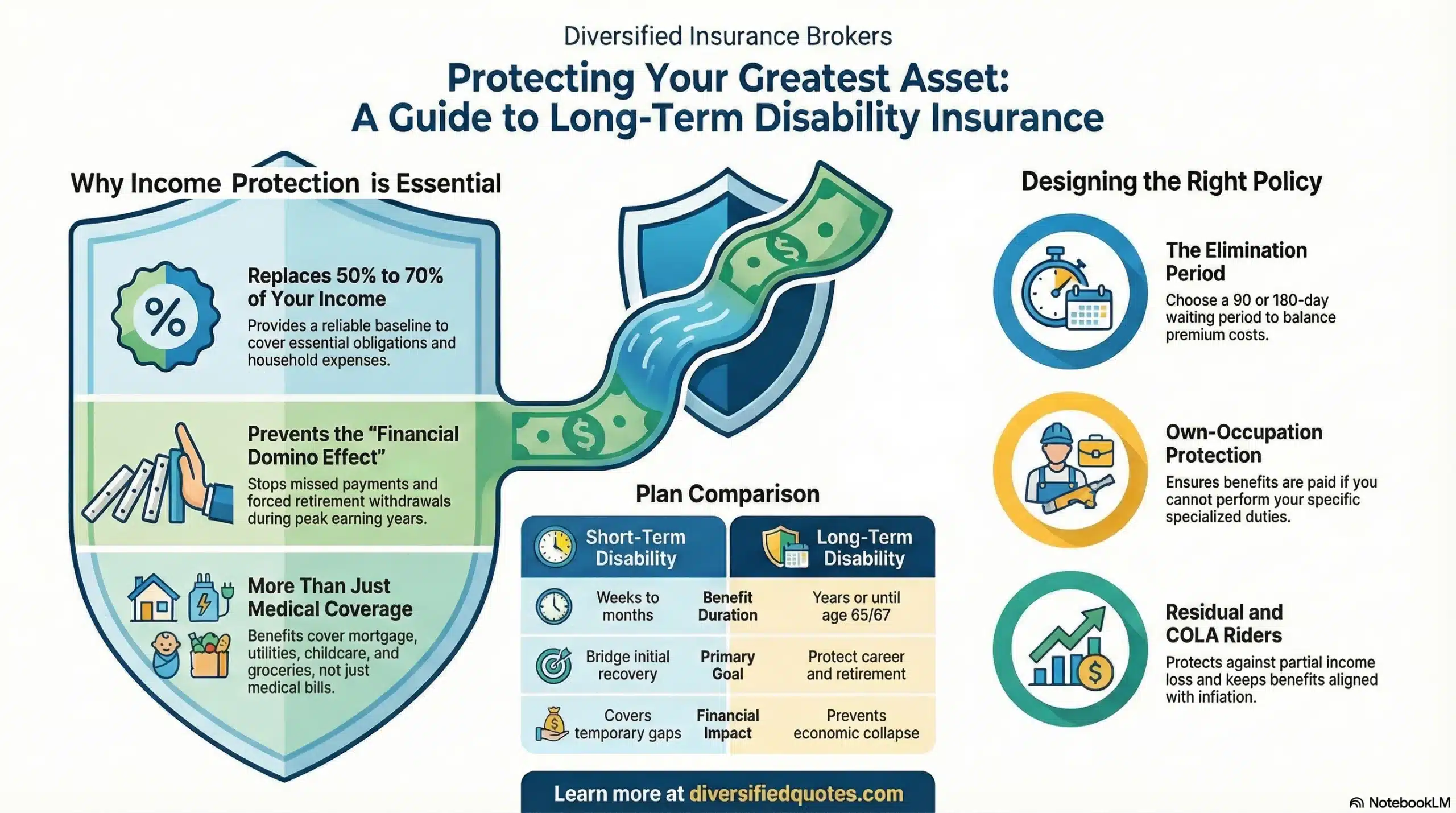
Disability insurance policies provide monthly benefit payments when a policyholder cannot perform the duties of their occupation due to illness or injury. The benefit amount is typically calibrated to a percentage of pre-disability income — most individual disability policies provide 60 to 70 percent of gross monthly income, with the specific percentage and any maximum monthly cap determined by carrier underwriting based on the buyer’s occupation, total income, and other factors. The 60 to 70 percent target reflects a balance: enough to sustain essential financial obligations during disability while maintaining some economic incentive to return to work when medically feasible.
Benefits begin after the elimination period — the waiting time between the onset of disability and when policy payments start. Elimination periods commonly range from 30 to 180 days, with the right choice depending on the buyer’s available financial reserves, any employer sick leave, and any short-term disability coverage that may bridge the initial weeks. Once benefits begin, payments continue for the benefit period specified in the policy, which may be a fixed number of years (typically 2, 5, or 10) or extend to retirement age (typically 65 or 67). For most working professionals, a to-age-65 benefit period provides the appropriate match between expected career length and disability protection. Our complete resource on disability insurance elimination periods covers the elimination period decision in detail.
Individual disability insurance policies can include several optional riders that significantly affect how the policy performs across the full range of disability scenarios. A cost-of-living adjustment (COLA) rider increases monthly benefits annually during a claim to preserve real purchasing power against inflation — particularly valuable for to-age-65 benefit periods where a young claimant might receive benefits for 30 or 40 years. Our resource on disability income insurance with a COLA rider covers this inflation protection in detail. A residual disability rider pays proportional benefits when a condition reduces but does not eliminate work capacity — essential for the graduated return-to-work arcs that characterize most real disability recoveries. A future purchase option (FPO) rider allows benefit amounts to increase as income grows without additional medical underwriting — particularly valuable for early-career professionals whose income will substantially increase over time.
The Group Plan Gap: Why Employer Disability Coverage Is Rarely Enough
For most working professionals, the first question about disability insurance is whether the group coverage available through their employer provides sufficient protection. The honest answer for most professionals — particularly those with significant income, variable compensation, or specialized skills — is no. Employer group disability coverage is generally designed as a baseline benefit at relatively low coverage levels, with structural limitations that produce significant gaps for higher-earning professionals. Understanding these gaps is essential to evaluating whether individual disability insurance is needed as a supplement.
Employer Group Disability vs. Individual Disability Insurance
| Coverage Feature | Employer Group DI | Individual DI |
|---|---|---|
| Income Basis | Base salary only; usually excludes bonus and commission | Total compensation including bonus, commission, K-1 |
| Replacement Percentage | 60% of base salary, often capped at $5,000–$15,000/mo | Calibrated to actual total income |
| Portability | Terminates immediately at employment separation | Owned personally; continues regardless of job changes |
| Definition of Disability | Often shifts from own-occupation to any-occupation after 2 years | True own-occupation can extend to benefit period end |
| Tax Treatment of Benefits | Typically taxable (employer paid premium) | Tax-free if premiums paid with after-tax dollars |
| Coverage Stability | Subject to employer plan changes or termination | Guaranteed renewable at original terms |
| Underwriting | Typically guaranteed issue at enrollment | Medical underwriting required at application |
| Benefit Period Options | Set by employer plan; often capped | Buyer selects (2, 5, 10 years or to age 65/67) |
The taxability difference alone makes employer group coverage substantially less protective than the headline percentages suggest. An employer group plan replacing 60 percent of $200,000 base salary appears to provide $120,000 of annual income during disability. But because the employer paid the premium with pre-tax dollars, the resulting benefits are taxable to the recipient as ordinary income — which means a recipient in a 30 percent combined federal and state tax bracket actually nets approximately $84,000 of after-tax income. That same recipient, before disability, was likely netting closer to $140,000 from the $200,000 gross salary (after retirement contributions, taxes, and other deductions). The disability benefit replaces approximately 60 percent of after-tax pre-disability income — not 60 percent of gross income, despite how the policy is marketed.
Individual disability insurance addresses these gaps. When premiums are paid with after-tax personal dollars, the resulting benefits are received tax-free, meaning a 60 percent replacement of gross income actually delivers approximately 60 percent of after-tax pre-disability income — a substantially better replacement ratio. The income basis includes bonuses, commissions, partnership distributions, and other variable compensation that employer group plans exclude. The portability means the coverage continues during career transitions, partnership changes, and other employment shifts that increasingly characterize professional careers. Our resource on why working with an independent disability insurance broker matters covers how to navigate the carrier marketplace to find individual coverage that genuinely fits your specific income structure and occupational profile.
Own-Occupation Disability: The Most Important Policy Provision for Professionals
For any professional whose income reflects specialized training, licensure, or skills developed over years, the most consequential provision in a disability insurance policy is the definition of disability itself. The two basic definitions — own-occupation and any-occupation — produce dramatically different outcomes for professionals whose careers depend on specific skills that a disabling condition might affect without eliminating all work capacity.
An own-occupation definition pays disability benefits when a disabling condition prevents you from performing the material duties of your specific profession — regardless of whether you could still perform some other work in some capacity. A surgeon who develops a hand tremor preventing operating but who could theoretically work as a medical consultant would receive full benefits under an own-occupation policy because the surgeon cannot perform their specific profession. A litigator whose condition prevents standing for long courtroom sessions but who could theoretically do transactional work would receive full benefits under own-occupation. The policy recognizes that the income those professionals lost was tied specifically to their professional capacity, and provides the income replacement for that specific loss.
An any-occupation definition pays benefits only when the disabling condition prevents virtually any gainful employment. The surgeon who could work as a consultant, the litigator who could do transactional work — under any-occupation, neither would qualify for benefits because they retain some work capacity, however unrelated to their original profession. For specialized professionals whose income depends on their specific skills, an any-occupation definition provides minimal real-world protection because the disability scenarios most likely to affect their careers (those that affect their specific skills without producing total incapacity) are not covered.
Group disability plans frequently include own-occupation definitions that convert to any-occupation standards after a defined period — typically two years. After that conversion, a previously eligible claimant may lose benefits if they retain capacity for any other work. This is one of the most significant structural limitations of employer group coverage for specialized professionals: the protection that mattered most about own-occupation evaporates exactly when long-term disability has become established and the income replacement need is most acute. Individual disability policies with true own-occupation definitions through the full benefit period avoid this conversion entirely. Our complete resource on own-occupation disability insurance covers how this provision works in detail, why it matters for specialized professionals, and how to identify carriers and policies that provide the strongest own-occupation language.
Disability Insurance Riders That Matter
Beyond the core definition of disability, several optional riders significantly affect how disability insurance performs across realistic claim scenarios. The right combination of riders for any specific buyer depends on age, income trajectory, and household financial situation — but a few are particularly important to understand.
The residual disability rider — sometimes called a partial disability rider — pays proportional benefits when a disabling condition reduces work capacity without eliminating it. This rider matters because most disability recoveries follow a graduated arc: the condition prevents work entirely for an initial period, then gradually allows resumption of partial work, then ultimately allows full work resumption (or persists as partial impairment). Without a residual rider, a total-disability-only policy pays nothing once the policyholder can perform any work, even if their work capacity is materially reduced. The residual rider supplements the reduced earnings throughout the partial disability period — typically until earnings return to a defined percentage of pre-disability income.
The COLA rider increases monthly benefits annually during a claim to preserve real purchasing power against inflation. For young professionals with to-age-65 benefit periods, a long-term disability claim could span 30 or 40 years — during which fixed-dollar benefits would lose substantial real value to inflation. COLA riders typically increase benefits 3 to 6 percent annually during a claim, depending on the specific rider design. The cost of a COLA rider adds meaningfully to premium, but for buyers with long potential benefit periods, the inflation protection often justifies the additional cost.
The future purchase option (FPO) or future increase option (FIO) rider allows benefit amounts to increase as income grows over time without additional medical underwriting. This is particularly valuable for early-career professionals — physicians in residency, attorneys in early practice, professionals on rising salary tracks — whose income will substantially increase over their careers. Without an FPO rider, increasing benefit amounts later requires new medical underwriting, and any health changes since the original policy issue could make additional coverage more expensive or unavailable. Our resource on disability insurance future insurability rider covers how this future-increase mechanism works, and our broader resource on disability insurance riders explained covers the full rider landscape for comparing policies.
Who Needs Disability Insurance Most
While almost everyone with earned income benefits from some form of disability protection, several specific professional categories face particularly acute exposure where individual disability insurance is essentially the only meaningful protection available.
Self-employed professionals and independent contractors face the most direct disability exposure. Without an employer, there is no group disability plan, no sick pay, no paid leave, and no institutional safety net of any kind. Income stops immediately and completely when a disability prevents work, while business fixed costs — office rent, equipment, employee payroll, professional liability insurance — continue regardless. Our resources on disability insurance for independent contractors and whether self-employed professionals can get disability insurance cover this population’s specific needs. Self-employed professionals should also consider business overhead expense disability insurance as a complement to personal disability coverage — the business overhead policy covers the fixed business costs that continue during a disability, while personal disability replaces the income.
Physicians and other medical professionals face significant exposure because their income depends on physical and cognitive capabilities that specific medical conditions can impair without eliminating all work capacity. The combination of high income, specialized training, and the structural disability exposure of medical practice makes individual disability insurance with strong own-occupation provisions essentially mandatory for physicians. Our resources on disability insurance for physicians, disability income insurance for doctors and physicians, and disability insurance for medical residency cover the physician-specific landscape. Attorneys, dentists, chiropractors, and other licensed professionals face similar dynamics — our resources on disability income insurance for attorneys, disability insurance for dentists, and disability insurance for chiropractors cover the specifics for each profession.
Business owners face two distinct disability exposures: their personal income and the business’s continued operation. Personal disability insurance protects the income side. Key person disability insurance protects the business when an essential employee becomes disabled. Buy-sell disability insurance provides funding for ownership transitions when a disabling event triggers the same buy-sell considerations that death would. These three coverages — personal DI, key person DI, and buy-sell DI — together provide the comprehensive disability protection that business owners and their businesses require.
Professionals in specialized industries — entertainment, law enforcement, firefighting, certain trade industries — face occupational risks that often produce both higher disability claim frequencies and specific coverage challenges. Our resources cover several of these specialized categories: disability insurance for the entertainment industry, disability income insurance for law enforcement, disability income insurance for firefighters, disability income insurance for truck drivers, disability insurance for 1099 workers, and disability insurance for high-risk occupations. Each specialized category has carrier preferences, definition language, and rider availability that work better or worse for the specific occupational profile.
When to Buy Disability Insurance
The best time to buy disability insurance is as early as possible in a professional career — typically in the first few years of professional practice, before any health conditions have accumulated in the medical record. Three factors make early purchase substantially more favorable than later purchase.
First, disability insurance premiums are based partly on age and health status at the time of application. Younger, healthier applicants secure the most comprehensive coverage at the most favorable rates. A 30-year-old purchasing the same policy a 45-year-old would buy receives 15 years of additional coverage at the lower-age premium — a substantial value over the policy lifetime.
Second, the health conditions that develop over a career — musculoskeletal conditions, cardiovascular findings, mental health treatment history — can result in exclusion riders or restricted policy terms if they are present at the time of application. Applying for disability insurance before these conditions develop ensures they will be covered under the existing policy rather than excluded from any new coverage applied for later. A back condition that develops at age 40 is covered under a policy issued at age 28 but typically excluded from a new policy applied for at age 41.
Third, a future purchase option (FPO) rider secured early allows benefit amounts to grow with income over a career without requiring new medical underwriting. For professionals whose income will increase substantially between entry-level and senior career stages — physicians, attorneys, financial professionals, entrepreneurs — the FPO rider provides path-dependent value that depends on having the rider in place during the income growth period. Buying the rider at age 28 captures decades of future income growth potential; buying at age 45 captures only the remaining career.
For professionals at any career stage who do not yet have disability insurance, the right time to evaluate coverage is now rather than later. Our resources on disability insurance for new professionals and how to get the best disability insurance rates cover the practical steps for evaluating and securing coverage at each career stage.
How Disability Insurance Fits in Broader Financial Planning
Disability insurance is the foundation of a comprehensive financial plan rather than a separate consideration that exists alongside it. The reason is structural: every other financial goal a household has — retirement contributions, college savings, debt payoff, charitable giving, business investment — depends on income to fund it. If income disappears, every other goal is at risk. Disability insurance protects the income that funds every other goal, which is why financial planners frequently rank it as the first protection coverage to evaluate before life insurance, long-term care insurance, or other protection products.
The integration with retirement planning is particularly important. The retirement contributions a household makes during working years compound over decades to produce the eventual retirement portfolio. A long disability that interrupts those contributions does not just create immediate income shortfall — it permanently reduces the retirement portfolio by the amount of missed contributions plus all the compounding growth those contributions would have produced. A 35-year-old contributing $20,000 annually to retirement who experiences a 5-year disability without disability insurance loses $100,000 in contributions plus roughly $200,000+ in foregone compounding by retirement, assuming reasonable long-term returns. Disability insurance benefits, when sufficient to maintain retirement contributions during disability, prevent this permanent reduction in the retirement portfolio. Our resource on bonus annuity with lifetime income covers retirement income solutions that work alongside disability insurance to create a continuous financial protection framework across working years and retirement.
The integration with Social Security is also worth understanding. Social Security Disability Insurance (SSDI) provides some disability benefit, but the SSDI definition of disability is extremely restrictive — requiring inability to perform any substantial gainful activity expected to last at least 12 months or result in death. Most disability claims that would qualify under a private own-occupation policy would not qualify under SSDI. SSDI also takes months or years to approve and provides relatively modest benefits (typically $1,000 to $3,500 per month). For working professionals, SSDI is not a meaningful substitute for private disability insurance — it is a supplemental safety net for the most severe disability scenarios. Our broader resources on Social Security advice and the Windfall Elimination Provision guide cover the Social Security context within which disability planning operates.
For households evaluating whether the disability coverage they have today is genuinely sufficient, our resources on whether disability insurance is worth it, whether disability insurance is expensive, how much disability insurance you need, and best disability insurance rates cover the evaluation framework. Households whose group coverage may have specific gaps, or who have been quoted disability coverage and want a second opinion, can use our second opinion on your disability insurance quote service for an independent review.
Request Disability Insurance Quotes
We compare individual disability insurance across multiple carriers, identify gaps in any existing employer coverage, and quote policies calibrated to your actual income structure and occupational profile.
Related Pages: Disability Insurance Resources
Continue researching disability insurance by profession, policy design, and coverage strategy.
Disability Insurance for the Entertainment Industry
Key Person Disability Insurance
Buy-Sell Disability Insurance
Short-Term Disability Insurance
Own-Occupation Disability Insurance Explained
Disability Insurance for Independent Contractors
Why Work With an Independent Disability Insurance Broker
How to Buy Short-Term Disability Insurance Online
Financial Protection Essentials
Investment risk, long-term care, Social Security planning, and disability policy design resources.
Talk With an Advisor Today
Choose how you’d like to connect—call or message us, then book a time that works for you.
Schedule here:
calendly.com/jason-dibcompanies/diversified-quotes
Licensed in all 50 states • Fiduciary, family-owned since 1980
FAQs: Why People Buy Disability Insurance
What is the primary reason people buy disability insurance?
The primary reason people buy disability insurance is to protect their income against the financial impact of an illness or injury that prevents them from working. Earned income is the financial foundation that supports housing, daily expenses, retirement savings, debt obligations, and virtually every other financial goal a household has. When that income disappears due to a disabling condition, the financial consequences are immediate and cascading — mortgage payments, utilities, food, insurance premiums, and loan obligations continue regardless of whether income does. Disability insurance replaces a portion of lost income during periods of disability, providing a financial bridge that allows individuals to focus on recovery rather than financial crisis.
Most disability policies replace between 60% and 70% of pre-disability gross income, which is typically sufficient to cover essential obligations while keeping long-term financial goals intact. The replacement percentage and structural protection differ significantly between employer group coverage and individual disability insurance — a distinction covered in detail in the body of this page.
How likely am I to become disabled during my working years?
More likely than most people assume. The Social Security Administration estimates that a 20-year-old worker today has roughly a one-in-four chance of becoming disabled before reaching retirement age — a probability most people would never knowingly accept without financial protection in place. Disability is not primarily the result of dramatic accidents, as many people imagine. The most common causes of long-term disability claims are conditions that develop gradually: musculoskeletal disorders including back and joint conditions, cardiovascular disease, cancer, mental health conditions, and neurological disorders.
These conditions can affect anyone at any career stage, often without significant warning. The financial consequences of even a temporary disability — a six-month recovery from back surgery, for example — can be severe for a household without income replacement, depleting savings and disrupting long-term plans in ways that outlast the physical recovery itself.
What does disability insurance actually cover?
Disability insurance provides monthly benefit payments when a policyholder cannot perform the duties of their occupation due to illness or injury. The benefit amount is typically based on a percentage of the individual’s pre-disability income — most policies provide 60% to 70% of gross income. Benefits begin after the elimination period — the waiting time after a disability begins before payments start — which commonly ranges from 30 to 180 days depending on the policy structure.
Once benefits begin, they continue for the benefit period specified in the policy, which may be a fixed number of years or extend to retirement age. Individual disability insurance policies can also include optional features: cost-of-living adjustment riders that increase benefits annually during a claim to preserve real purchasing power, residual disability riders that pay proportional benefits when a condition reduces rather than eliminates work capacity, and future purchase option riders that allow benefit amounts to grow with income without additional medical underwriting.
What is the difference between own-occupation and any-occupation disability insurance?
The definition of disability written into the policy is the single most consequential provision in any disability insurance contract. An own-occupation definition pays benefits when a disabling condition prevents you from performing the material duties of your specific occupation — regardless of whether you can still do other types of work. An any-occupation definition only pays benefits if you cannot perform virtually any gainful employment.
The practical difference is enormous for professionals with specialized skills. A surgeon who develops a tremor that prevents operating but who could theoretically work as a medical consultant would receive full benefits under an own-occupation policy — because they cannot perform the duties of their specific profession. Under an any-occupation policy, those benefits would likely be denied because the surgeon can technically work in some capacity. For any professional whose income reflects specialized training, licensure, or skills that took years to develop, the any-occupation definition provides minimal real-world income protection for the disability scenarios most likely to affect their career. Our resource on own-occupation disability insurance covers this distinction in detail.
Isn’t my employer’s group disability plan sufficient?
For most professionals, no — and the gaps are often larger than people realize when they examine them specifically. Group disability plans through employers typically replace 60% or less of base salary and explicitly exclude bonuses, commissions, overtime, and other variable compensation that may constitute a significant portion of total income. Group plans terminate when employment ends — providing no protection during career transitions, layoffs, or disability-related employment separations. Many group plans also include own-occupation definitions that convert to any-occupation standards after two years of disability, potentially denying continued benefits to someone who remains unable to perform their specific professional work but could technically do something else.
The taxability difference compounds the gap. Employer-paid group disability benefits are typically taxable to the recipient, meaning the headline 60% replacement actually delivers closer to 40-45% of net pre-disability income for higher-bracket recipients. Individual disability insurance — owned personally, portable across employers, paid with after-tax dollars (producing tax-free benefits), and calibrated to total compensation — fills all of these gaps and provides the comprehensive income protection that group enrollment cannot replicate for most working professionals.
What is a residual disability rider and do I need it?
A residual disability rider — sometimes called a partial disability rider — pays proportional benefits when a disabling condition reduces your work capacity and income without eliminating them entirely. Most disabling conditions do not produce a clean binary of total incapacity followed by full recovery. More commonly, a disability gradually reduces how much you can work — a professional who can work three days a week instead of five, or who can handle some but not all of their normal responsibilities.
Without a residual rider, a total-disability-only policy pays nothing during this partial disability period because you can technically still work in some limited capacity. A residual rider supplements reduced earnings proportionally throughout the graduated return-to-work arc, ensuring the policy provides financial support across the full spectrum of disability severity rather than only at the extreme of complete incapacity. For most professionals, the residual rider is one of the most practically important provisions in any disability policy — the one that determines whether the policy actually works for how disabilities realistically manifest. Our resource on residual disability insurance benefits covers this rider in detail.
How much disability insurance do I actually need?
The foundational benchmark is whether the monthly benefit — after considering its taxability based on how premiums are paid — is sufficient to sustain your household’s essential financial obligations during an extended disability. For most professionals, this means replacing 60% to 70% of gross income, though the specific amount depends on fixed financial obligations, any available spousal income, and the household’s baseline savings. The benefit period also matters: a policy that pays for only two years provides very different protection than one that pays to retirement age.
For professionals with significant income from bonuses, commissions, or variable compensation, adequacy requires evaluating whether individual coverage supplements any employer group plan to cover the total compensation gap. The benefit amount calculation — including how self-employment income is documented for underwriting purposes — is an area where experienced independent broker guidance produces meaningfully better outcomes than a standard retail application, particularly for professionals with complex income structures. Our resource on how much disability insurance you need covers the calculation framework in detail.
What is a disability insurance elimination period and how do I choose the right one?
The elimination period is the waiting time between the onset of a disability and when benefits begin — it functions similarly to a deductible, except measured in time rather than dollars. Elimination periods commonly range from 30 to 180 days, and selecting the right one requires understanding your available financial reserves, employer sick leave, and any short-term disability coverage that may bridge the initial period.
A shorter elimination period — 30 or 60 days — means benefits begin sooner but carries a higher premium. A longer elimination period — 90 or 180 days — reduces premiums meaningfully but requires the policyholder to sustain themselves from savings during the waiting period. Employed professionals with substantial sick leave banks and emergency savings can typically manage a 90-day elimination period comfortably. Self-employed professionals with no employer sick pay and income that stops immediately at disability onset should evaluate shorter elimination periods more carefully, because the financial urgency of a disability begins on day one with no institutional bridge available. Our resource on disability insurance elimination periods explained covers this decision in complete detail.
Can self-employed professionals and independent contractors get disability insurance?
Yes — and for self-employed professionals and independent contractors, individual disability insurance is not optional supplemental coverage. It is the only meaningful income protection available. Without an employer, there is no group disability plan, no sick pay, no paid leave, and no institutional safety net of any kind. When a disability prevents a self-employed professional from working, income stops immediately and completely, while business fixed costs — office rent, equipment, employee payroll, professional liability insurance, and marketing — continue regardless.
Individual disability insurance provides the income replacement that covers personal household obligations, and a separate business overhead expense policy can cover the business fixed costs during a disability recovery. Self-employed professionals also face specific income documentation challenges in disability insurance underwriting — Schedule C or K-1 income documentation requires specific handling to ensure the benefit amount reflects genuine earning capacity rather than a tax-minimized net profit figure — which makes working with an independent broker who understands self-employment income structures particularly valuable. Our resources on whether self-employed professionals can get disability insurance and business overhead expense disability insurance cover this population’s needs.
When is the best time to buy disability insurance?
The best time to buy disability insurance is as early as possible in your working career — ideally in the first years of professional practice, before any health conditions have accumulated in the medical record. Disability insurance premiums are based in part on age and health status at the time of application. Younger, healthier applicants secure the most comprehensive coverage at the most favorable rates — and the conditions that develop over a career, including musculoskeletal conditions, cardiovascular findings, and mental health treatment history, can result in exclusion riders or restricted terms if present at the time of application.
Applying early ensures that conditions which develop later in the career are covered under an existing policy rather than excluded from new coverage. A future purchase option rider secured early also allows benefit amounts to grow with income over a career without requiring new medical underwriting — which is particularly valuable for professionals whose income will increase substantially between entry-level and senior career stages. Our resource on disability insurance for new professionals covers the early-career evaluation framework.
About the Author:
Jason Stolz, CLTC, CRPC, DIA, CAA and Chief Underwriter at Diversified Insurance Brokers (NPN 20471358), is a senior insurance and retirement professional with more than 25 years of real-world experience helping individuals, families, and business owners protect their income, assets, and long-term financial stability. As a long-time partner of the nationally licensed independent agency Diversified Insurance Brokers, Jason provides trusted guidance across multiple specialties—including fixed and indexed annuities, long-term care planning, personal and business disability insurance, life insurance solutions, Group Health, Travel Medical and Evacuation Insurance, and short-term health coverage. Diversified Insurance Brokers maintains active contracts with over 100 highly rated insurance carriers, ensuring clients have access to a broad and competitive marketplace.
His practical, education-first approach has earned recognition in publications such as VoyageATL, and contributions from his agency featured in Kiplinger and GoBankingRates— highlighting his commitment to financial clarity and client-focused planning. Drawing on deep product knowledge and years of hands-on field experience, Jason helps clients evaluate carriers, compare strategies, and build retirement and protection plans that are both secure and cost-efficient. Visitors who want to explore current annuity rates and compare options across multiple insurers can also use this annuity quote and comparison tool.
Explore More Disability Insurance Options: Browse our complete guide to Disability Insurance Planning & Education — covering how it works, riders, elimination periods, own occupation, costs & buying guides from 100+ carriers.
Last Reviewed: May 21, 2026 |
Reviewed by: Jason Stolz, CLTC, CRPC, DIA, CAA
Chief Underwriter, Diversified Insurance Brokers, Inc. | NPN: 20471358 | Diversified Insurance Brokers, Inc. — Licensed in all 50 states
Fact Checked by: Tonia Pettitt, CMIP©
Medicare Specialist, Diversified Insurance Brokers, Inc. | NPN: 14374308 | Diversified Insurance Brokers, Inc. — Licensed in all 50 states
Did you find this content helpful? Leave us a Google review — it helps others find trustworthy guidance too.
Editorial Standards: Diversified Insurance Brokers maintains rigorous editorial standards to ensure accuracy, clarity, and independence in all content. Learn more about our editorial standards and commitment to transparency.
