
Disability Insurance for the Entertainment Industry
As an Independent Disability Insurance Broker, we have access to exclusive discounts and negotiated pricing most captive agents can’t offer — see the full breakdown near the end of this page.
Disability Insurance for the Entertainment Industry

Jason Stolz CLTC, CRPC, DIA, CAA
Disability insurance for the entertainment industry addresses a protection gap that standard coverage was never designed to fill. Actors, musicians, models, dancers, producers, directors, and creative professionals earn income in ways that most underwriters don’t know how to evaluate—and most policies weren’t built to honor at claim time. A construction worker with a back injury might be temporarily sidelined. A ballet dancer with the same injury may never return to the stage. A radio host who loses their voice due to a medical condition can technically still “work” in another role—but their actual earning capacity has been destroyed. Standard disability definitions do not account for this nuance, which is why coverage designed specifically for the entertainment industry matters so much. At Diversified Insurance Brokers, we specialize in structuring disability coverage for professionals with non-traditional income, performance-dependent careers, and appearance-based earning power. With access to specialty markets, Lloyd’s of London Coverholder programs, and traditional carriers that have expanded their entertainment underwriting, we help entertainers understand what’s available, what’s realistic, and how to build a plan that actually performs when it’s needed most.
Why Entertainment Professionals Need Specialized Disability Coverage
The core reason standard disability insurance falls short for entertainers is definitional. Most group disability policies—and many individual policies sold through standard carriers—define disability as the inability to perform “any occupation” or a “modified own-occupation” definition that pays only if you cannot work in any job for which you’re reasonably educated and trained. For a physician or attorney, this distinction matters less because their earning power is tied to a general professional skillset. For an entertainer, it’s everything. A recording artist who develops a tremor may still be able to teach music, but that teaching income is a fraction of their touring and recording revenue. A model who experiences a permanent facial scar may still be able to work in another industry entirely—but the career they built, and the income tied to it, is gone. Without a true own-occupation disability definition, their claim may be denied even though their actual livelihood has been destroyed.
Entertainment income also creates underwriting complexity that standard carriers struggle with. Most traditional disability policies are sized based on W-2 income from a consistent employer. Entertainment professionals often earn through project contracts, 1099 payments, royalties, residuals, touring guarantees, endorsements, and licensing deals—sometimes from multiple simultaneous income streams, often with significant year-to-year variation. Carriers that are not equipped to evaluate this income mix will either decline coverage, offer inadequate benefit amounts, or attach exclusions that make the policy nearly useless at claim time. Specialty programs exist specifically for this reason: to match coverage design to how entertainment income is actually structured and earned. See disability insurance for 1099 workers and independent contractors for the underwriting principles that apply broadly to variable-income earners.
Who Disability Insurance for the Entertainment Industry Covers
The entertainment industry is far broader than most people realize when they think about disability planning. Front-of-camera and on-stage performers represent only a portion of the entertainment workforce. Directors, producers, editors, cinematographers, sound engineers, stunt coordinators, and touring managers all face meaningful income risk when a disability strikes. Coverage considerations differ by role, income structure, and how “performing” is defined within each profession.
Compare Disability Coverage for Entertainment Professionals
We’ll evaluate your income structure, occupation, and coverage needs across specialty and standard markets to find the right fit.
Own-Occupation Coverage
True own-occupation protection that pays even if you can work in another role.
Learn MoreNo-Exam Programs
Fast-issue coverage with simplified underwriting for busy entertainment professionals.
Learn MoreRequest a DI Review
We’ll compare options across specialty and standard markets for your specific situation.
Get Started| Entertainment Role | Primary Disability Risk | Key Coverage Consideration | Specialty Market Need |
|---|---|---|---|
| Actors / Actresses | Physical injury, illness, disfigurement, voice loss | True own-occupation definition; disfigurement rider | Often required for high-limit and appearance-based coverage |
| Musicians / Vocalists | Hearing loss, voice damage, repetitive injury, hand/wrist conditions | Instrument/voice-specific coverage; residual disability rider | Specialty programs allow body part or voice-specific benefits |
| Models / Influencers | Disfigurement, weight/appearance change, mobility limitation | Appearance-based benefit trigger; income averaging | Standard carriers rarely cover appearance-based claims |
| Dancers / Choreographers | Musculoskeletal injury, joint damage, chronic pain | Own-occupation; partial/residual coverage critical | Moderate — some standard carriers accept with own-occ |
| Directors / Producers | Cognitive, stress-related, or serious illness preventing production | Income documentation; multi-source income averaging | Standard carriers may accept with proper income documentation |
| DJs / Radio / TV Hosts | Voice loss, hearing damage, appearance change | Voice-specific benefit rider; own-occupation | Specialty voice programs available |
Own-Occupation Definition: The Most Important Feature for Entertainers
For entertainers, the definition of disability is not an administrative detail—it’s the most consequential language in the entire policy. A true own-occupation policy pays benefits when you cannot perform the material and substantial duties of your specific occupation, regardless of whether you are working in another capacity. This means that a vocalist who loses their vocal range due to a medical condition is considered disabled and receives benefits—even if they can teach voice lessons or sell merchandise online. An actor who develops a severe tremor that prevents on-camera performance collects benefits—even if they could technically edit scripts or work in a box office. Without this definition, disability insurance for entertainers can be functionally worthless at claim time.
Many standard group policies use an “any occupation” standard after two years, which means they stop paying once you’re capable of doing any work—not the specific work your career was built on. Some individual policies use a “modified own-occupation” definition that includes an any-occupation test after a set number of years. For entertainers whose peak earning years may be concentrated in their 30s and 40s, and whose career recovery from disability may be limited, the policy still needs to protect occupation-specific income throughout the benefit period. Confirm the definition language carefully before purchasing. See own-occupation disability insurance for a full explanation of how definitions work and what to look for across different policy structures.
Disfigurement, Appearance, and Voice Coverage: What Standard Policies Miss
One of the most overlooked risks in entertainment disability planning is appearance-based income loss. Traditional disability insurance was built for professions where physical appearance is largely irrelevant to earning capacity. For actors, models, public figures, and broadcast personalities, appearance is the product. A burn, a facial reconstruction, a permanent scar, or a significant change in physical presentation can destroy a career even when the person is otherwise healthy and fully capable of physical activity. Standard policies that define disability as the inability to perform job duties miss this entirely—because technically, the person is not “disabled” in the traditional sense.
Specialty programs—particularly those available through Lloyd’s of London Coverholders and excess lines markets—can address this gap with disfigurement or non-appearance riders that pay benefits when a qualifying appearance change prevents the insured from obtaining work in their established entertainment role. Voice-specific coverage is similarly available for vocalists, broadcasters, and anyone whose primary earning asset is their voice. Petersen International Underwriters is one specialty program that allows singers and musicians to insure specific body parts—including vocal cords and hands—for monthly benefits from $1,000 to $100,000 or more, with lump-sum options for catastrophic loss. This level of precision simply is not available from standard disability carriers, making specialty market access critical for high-earning entertainers. See disability insurance for actors and actresses and musicians for occupation-specific detail on how these programs are structured.
Income Documentation and Underwriting for Variable Entertainment Income
One of the most practical challenges in purchasing disability insurance for the entertainment industry is proving income to the underwriter’s satisfaction. Traditional carriers are comfortable with W-2 wage earners and straightforward self-employment income. Entertainment professionals often have a completely different income profile: a baseline retainer from a studio or agency, plus project fees, plus royalties, plus endorsement payments, plus touring guarantees—arriving from multiple payers across the year, sometimes front-loaded into a single tax year, sometimes spread across years through residuals.
Specialty programs and experienced DI underwriters typically evaluate entertainment income using a 2-3 year average across all verified income streams. They may also consider contracted future work, existing retainers, and documented historical income from royalties or licensing. The key is working with a broker who understands how to properly document and present this income to maximize the benefit amount available. Common mistakes include filing with a standard carrier that only recognizes W-2 income (resulting in a benefit that covers a fraction of actual income), or failing to include royalty and residual income in the income calculation, which significantly underinsures the professional. For related income documentation guidance, see disability insurance for self-employed professionals and how to calculate how much coverage you need.
No-Exam and Simplified Underwriting Programs
Many entertainment professionals face practical barriers to standard disability underwriting: busy production schedules, frequent international travel, limited availability for paramedical exams, and sometimes a preference for speed over process. No-exam disability insurance and simplified underwriting programs address this by offering faster approvals with fewer medical requirements. These programs typically offer monthly benefits up to $8,000-$10,000 with a streamlined application process that can be completed without blood draws, physical exams, or extended waiting periods.
Simplified underwriting is often a strong starting point for younger entertainers or those with modest income replacement needs. For higher-benefit needs—which is common for high-earning entertainers—a layered approach can work well: anchor coverage through a simplified program, then add a fully underwritten layer for higher benefit amounts. This approach maintains speed for the base layer while capturing the full benefit amount needed to match actual income. See guaranteed issue disability insurance for cases where health history makes traditional underwriting difficult, and how medical requirements vary by program type.
Partial and Residual Disability: Why This Rider Is Essential
In entertainment, disability is rarely a clean on/off switch. More commonly, a disability reduces capacity rather than eliminating it entirely. An actor with a chronic back condition may be able to accept some roles but not the physically demanding ones that command the highest fees. A guitarist with early-stage carpal tunnel may be able to play reduced hours or smaller venues but cannot sustain a full touring schedule. A broadcaster recovering from a vocal procedure may be able to work part-time but not maintain their full broadcast schedule. In all of these cases, the disability has materially impaired income without producing a total inability to work.
A residual or partial disability rider is the mechanism that pays proportional benefits when income is reduced—not eliminated—due to a qualifying disability. The rider typically pays a benefit proportional to the percentage of income lost. If a professional’s income drops 40% due to disability, the rider pays approximately 40% of the base benefit. For entertainers whose income curve may already be irregular, the residual rider is often the most practically important feature in the policy—more so than the total disability benefit, because it’s more likely to be triggered in real-world scenarios. Review disability insurance riders explained to understand how residual, future insurability, COLA, and other riders interact within a complete policy design.
High-Limit Disability Insurance for High-Earning Entertainers
For entertainment professionals earning at the high end of the income spectrum, standard disability markets cap out quickly. Most traditional carriers limit individual disability benefits to approximately $15,000-$25,000 per month at standard issue, with aggregated coverage across all policies capped at a percentage of verified income. For entertainers earning several hundred thousand dollars annually—or for A-list talent earning millions per project—these caps create a significant protection gap. A policy that pays $20,000 per month when annual income exceeds $1 million is not meaningful income protection.
Specialty markets, including Lloyd’s of London excess lines programs, are designed to fill this gap. Through Coverholder programs and specialty brokers, high-earning entertainers can access monthly benefits far above standard market limits, lump-sum disability benefits for permanent disability, and non-appearance/career-ending coverage structures that mirror how entertainment income is actually at risk. These programs require detailed income documentation, often including contracts, financial statements, and projections—but they provide the only realistic path to proportional income protection for high-earning professionals. See high-income disability insurance for a broader overview of how coverage is structured for high earners across professions.
Waiting Periods, Benefit Duration, and Designing Coverage for Career Timelines
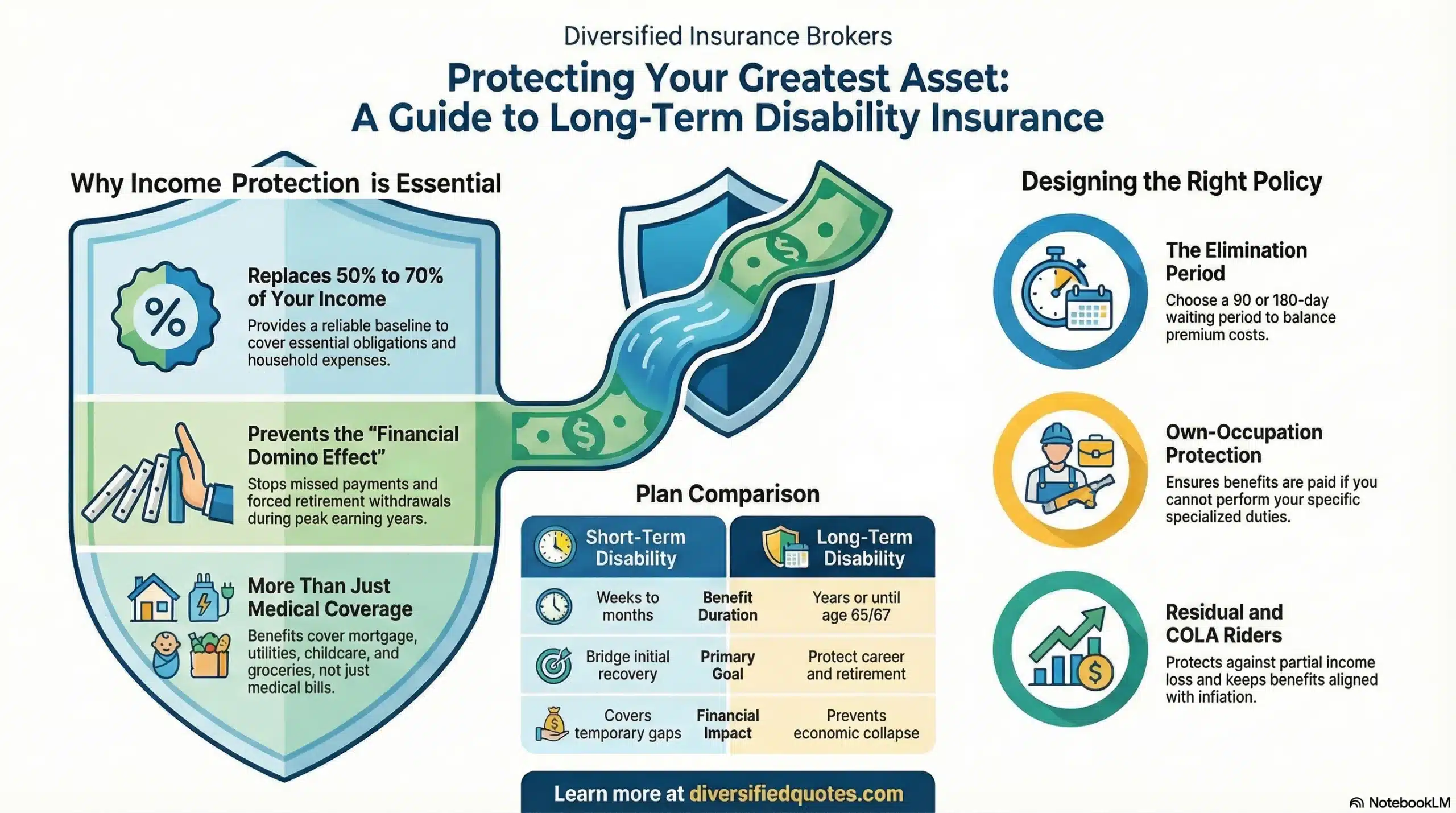
Choosing the right elimination period (waiting period) and benefit duration requires thinking about how entertainment careers actually work. Most entertainers have some savings or short-term income buffers—residuals, royalties, or retainers—that may cover short gaps. A 90-day elimination period is often the right balance between affordability and realistic cash-flow protection. Shorter elimination periods (30-60 days) increase premium meaningfully; longer periods (180 days) reduce cost but require stronger financial reserves to bridge the gap. Review elimination periods explained before making this decision.
Benefit duration is equally important. Most disability policies offer benefits to age 65 or 67, or shorter terms of 2, 5, or 10 years. For entertainers whose peak earning years may be concentrated in their 30s and 40s, a benefit period to age 65 provides the most complete protection for the years when a disability would do the most financial damage. Shorter benefit periods reduce premium but may leave the professional exposed in later career years. The short-term vs. long-term disability comparison explains how the two types interact, and when stacking both makes sense for maximum protection. A future insurability rider is worth adding early in a career—it allows you to increase coverage later without new medical underwriting, which is valuable if income grows substantially after the initial policy is issued.
Tax Treatment of Disability Benefits for Entertainment Professionals
The tax treatment of disability benefits depends on how premiums are paid, and entertainment professionals need to get this right before structuring coverage. When premiums are paid with after-tax personal dollars—which is the standard for individually purchased policies—benefits are received income-tax-free. This means that a $10,000 monthly benefit paid to a personally insured entertainer is $10,000 in net purchasing power, not a gross amount subject to income tax. This tax-free benefit is a significant planning advantage because it means even a 60% income replacement rate translates to higher net income stability than the percentage alone suggests.
Some entertainers operate through loan-out corporations or personal service companies and may consider having the entity pay disability premiums. This can provide business deduction opportunities, but it creates a complication: employer-paid disability premiums make benefits taxable. For entertainers with significant income, paying premiums personally and receiving tax-free benefits is usually the more advantageous approach. The specific tax analysis depends on entity structure and individual circumstances—your tax advisor should be part of the coverage planning discussion. See are disability insurance payments taxable for a full explanation of how premium-payment method and benefit taxation interact.
Building a Complete Protection Plan: Beyond Disability Insurance
Disability insurance is the foundation of income protection for entertainment professionals, but it works best as part of a complete financial plan. Diversified Insurance Brokers helps entertainers think beyond the disability policy itself to consider: how cash reserves and contract income bridge the elimination period, how life insurance coordinates with disability coverage for overall financial security, whether key-person coverage is appropriate if you’re the primary revenue driver for a production company, and how business overhead protection covers operating expenses if your business depends on your ability to perform.
Entertainment professionals who also employ others—tour managers, backup musicians, production staff—may also benefit from understanding how high-income professionals across performance industries approach coverage, as the underlying principles—protecting peak earning years, structuring own-occupation benefits, using specialty markets for high-limit needs—are directly applicable. The goal is a protection architecture that keeps all financial decisions stable even when a career is disrupted.
Entertainment Industry Disability Coverage by Role
Explore occupation-specific coverage for performers, creatives, and entertainment professionals.
Disability Planning Essentials for Variable-Income Professionals
Understand the coverage mechanics, income documentation, and policy design that matter most for non-traditional earners.
Talk With an Advisor Today
Choose how you’d like to connect—call or message us, then book a time that works for you.
Schedule here:
calendly.com/jason-dibcompanies/diversified-quotes
Licensed in all 50 states • Fiduciary, family-owned since 1980
FAQs: Disability Insurance for the Entertainment Industry
Why can’t most entertainers get adequate disability coverage from standard carriers?
Standard disability carriers are built to evaluate consistent W-2 income from a stable employer, then apply a “modified own-occupation” or “any occupation” disability definition that doesn’t account for performance-based earning. Entertainment professionals earn through project contracts, royalties, endorsements, and touring—income that many standard underwriters don’t know how to evaluate. Additionally, standard disability definitions may deny a claim if the person can work in any capacity, even if their actual performing career is permanently over. Specialty programs and Lloyd’s of London Coverholder markets exist specifically to provide proper coverage where standard carriers fall short.
What is an own-occupation definition and why does it matter for entertainers?
A true own-occupation policy pays benefits when you cannot perform the material and substantial duties of your specific occupation—regardless of whether you can work in another role. For entertainers, this is critical. A singer who loses their vocal range due to a medical condition is disabled under an own-occupation definition, even if they can still teach or work in retail. Without own-occupation language, a claim may be denied because the insured is technically capable of doing “some kind of work.” This distinction is the difference between a policy that protects actual career income and one that is effectively useless at claim time for performers and creatives.
Can entertainers get disability coverage for disfigurement or appearance-related income loss?
Yes, through specialty programs. Standard carriers do not cover appearance-based income loss because they define disability in physical or cognitive terms. Specialty markets—particularly through Lloyd’s of London Coverholders—offer disfigurement riders and non-appearance coverage that pays benefits when a qualifying physical change prevents the insured from obtaining work in their entertainment role. These programs are particularly relevant for actors, models, broadcast personalities, and public figures whose income is directly tied to their appearance and presentation.
Can a musician insure their voice or hands specifically?
Yes, through specialty underwriters. Programs like those offered through Petersen International Underwriters allow performers to insure specific body parts—including vocal cords, hands, and fingers—for monthly benefits ranging from $1,000 to $100,000 or more, with lump-sum catastrophic loss options. This type of coverage precisely matches how a musician’s or vocalist’s earning capacity is tied to specific physical assets. Standard disability insurance does not offer this level of precision.
How do carriers calculate benefit amounts for entertainment professionals with variable income?
Specialty programs typically average income over 2-3 years across all verified income streams—project fees, royalties, endorsements, touring guarantees, and retainers. This average becomes the basis for calculating the benefit amount, usually subject to a percentage-of-income cap. The key is working with a broker who understands how to document and present entertainment income properly to maximize the available benefit. Common mistakes include filing with carriers who only recognize W-2 income or failing to include royalty and residual income in the calculation—both of which result in a benefit far below actual income replacement needs.
What is a residual disability rider and why is it especially important for entertainers?
A residual disability rider pays proportional benefits when income is reduced—not eliminated—due to a qualifying disability. For entertainers, this matters enormously because most real-world disability scenarios in entertainment involve reduced capacity rather than total inability to work. An actor with chronic illness may accept fewer roles. A guitarist with carpal tunnel may play reduced hours. The residual rider pays a benefit proportional to the income loss percentage, which means a 40% income reduction triggers approximately 40% of the base benefit. Without this rider, there may be no benefit at all unless the insured is completely unable to perform.
Are disability benefits taxable for entertainment professionals?
When premiums are paid with personal after-tax dollars—the standard approach for individually purchased policies—disability benefits are received income-tax-free. This is a meaningful planning advantage because it means even a 60% income replacement benefit provides stronger net purchasing power than the percentage alone suggests. If an entertainment company or loan-out corporation pays the premiums as a business expense, benefits become taxable when received. For most high-earning entertainers, paying personally and receiving tax-free benefits is the more advantageous structure, though your tax advisor should confirm the right approach for your entity situation.
Can I get disability insurance without a medical exam?
Yes. No-exam and simplified underwriting programs are available and can provide monthly benefits up to $8,000-$10,000 without blood draws or paramedical exams. These programs are well-suited for entertainers with busy schedules or frequent travel who need coverage quickly. For higher benefit amounts—which is often the case for high-earning professionals—a layered approach works well: a simplified issue policy for the base benefit plus a fully underwritten layer for additional coverage. The simplified layer is processed quickly; the fully underwritten layer captures full income replacement.
What elimination period should an entertainer choose?
For most entertainers, a 90-day elimination period is a reasonable balance between premium cost and financial risk. Many entertainment professionals have some short-term income buffers—residuals, royalties, or contractual retainers—that can bridge a 90-day gap. Shorter elimination periods (30-60 days) significantly increase premium; longer periods (180 days) reduce cost but require stronger cash reserves. The right choice depends on your specific financial reserves, any existing short-term disability coverage, and how quickly your income would stop in the event of a disabling condition.
Does entertainment disability coverage work internationally?
Most individually purchased disability policies provide worldwide coverage—meaning benefits are payable regardless of where the disability occurs or where you are located when you become disabled. This is important for entertainment professionals who tour internationally, film abroad, or split time between multiple countries. Confirm the worldwide coverage provision before purchasing, especially with specialty market programs, as some have geographic restrictions. Coverage for an international touring musician is fundamentally different from coverage for a domestic office worker, and policy language should reflect that reality.
What are the most common mistakes entertainers make when buying disability insurance?
The five most consequential mistakes are: (1) Choosing a policy without a true own-occupation definition, which can result in claim denials even when performing is no longer possible. (2) Underinsuring by presenting income only from W-2 sources and ignoring royalties, endorsements, and contract income. (3) Skipping the residual disability rider, which eliminates coverage for partial income loss—the most common scenario in entertainment. (4) Relying solely on accident-only or group coverage, which provides inadequate protection for illness-related disability. (5) Waiting until after a health event or injury to apply, which locks out coverage for pre-existing conditions. Apply early when health is good and options are broadest.
Browse Disability Insurance for Food, Hospitality, Arts & Entertainment
About the Author:
Jason Stolz, CLTC, CRPC, DIA, CAA and Chief Underwriter at Diversified Insurance Brokers (NPN 20471358), is a senior insurance and retirement professional with more than 25 years of real-world experience helping individuals, families, and business owners protect their income, assets, and long-term financial stability. As a long-time partner of the nationally licensed independent agency Diversified Insurance Brokers, Jason provides trusted guidance across multiple specialties—including fixed and indexed annuities, long-term care planning, personal and business disability insurance, life insurance solutions, Group Health, Travel Medical and Evacuation Insurance, and short-term health coverage. Diversified Insurance Brokers maintains active contracts with over 100 highly rated insurance carriers, ensuring clients have access to a broad and competitive marketplace.
His practical, education-first approach has earned recognition in publications such as VoyageATL, and contributions from his agency featured in Kiplinger and GoBankingRates— highlighting his commitment to financial clarity and client-focused planning. Drawing on deep product knowledge and years of hands-on field experience, Jason helps clients evaluate carriers, compare strategies, and build retirement and protection plans that are both secure and cost-efficient. Visitors who want to explore current annuity rates and compare options across multiple insurers can also use this annuity quote and comparison tool.
Explore All Disability Insurance Options: Browse our complete Disability Insurance guide — covering occupations, high risk jobs, medical professionals, self-employed, and planning strategies from 100+ carriers.
Last Reviewed: June 15, 2026 |
Reviewed by: Jason Stolz, CLTC, CRPC, DIA, CAA
Chief Underwriter, Diversified Insurance Brokers, Inc. | NPN: 20471358 | Diversified Insurance Brokers, Inc. — Licensed in all 50 states
Fact Checked by: Tonia Pettitt, CMIP©
Medicare Specialist, Diversified Insurance Brokers, Inc. | NPN: 14374308 | Diversified Insurance Brokers, Inc. — Licensed in all 50 states
Did you find this content helpful? Leave us a Google review — it helps others find trustworthy guidance too.
Editorial Standards: Diversified Insurance Brokers maintains rigorous editorial standards to ensure accuracy, clarity, and independence in all content. Learn more about our editorial standards and commitment to transparency.
