
Disability Insurance for the Food Processing Industry
As an Independent Disability Insurance Broker, we have access to exclusive discounts and negotiated pricing most captive agents can’t offer — see the full breakdown near the end of this page.
Disability Insurance for the Food Processing Industry

Jason Stolz CLTC, CRPC, DIA, CAA
Disability insurance for the food processing industry is essential income protection for workers in one of the most injury-intensive manufacturing sectors in the American economy. Whether you work as a line worker in a meat or poultry processing facility, operate cutting and slicing equipment in a fish or seafood processing plant, perform quality control or packaging duties in a large-scale food manufacturing operation, work in refrigerated cold storage or frozen food processing environments, manage sanitation and cleaning operations in a food processing facility, or operate as a self-employed artisan food producer, specialty food manufacturer, or small-batch food processor — your income depends on your physical capacity to perform demanding, often repetitive manual work in environments that document some of the highest occupational injury and illness rates in American industry.
A study at Emory University found that food industry workers in food production, processing, distribution, storage, and retail have a 60% higher rate of occupational injury or illness than workers in all other industries combined. Meat and poultry processing plants report among the eight-highest numbers of amputations and hospitalizations to OSHA of any industry sector in the nation. Published cross-sectional research has documented a 44.8% prevalence of recent occupational injuries among food industry workers — nearly half of the workforce experiencing an injury within recent reporting periods. These are not statistics from a marginally hazardous industry — they describe one of the most genuinely dangerous manufacturing workplaces in the country, and the workers who staff these facilities deserve income protection that reflects the real financial consequences of the disabilities their work produces.
At Diversified Insurance Brokers, we help food processing workers, food manufacturing employees, artisan food business owners, and food industry professionals structure disability insurance coverage that reflects the genuine occupational hazards of food processing work, the income structure of food manufacturing employment, and the specific conditions most likely to interrupt or end a food processing career.
Protect Your Food Processing Income
Compare disability insurance options designed for food processing workers, food manufacturing employees, artisan food producers, and all food industry professionals.
The Food Processing Industry — A Documented High-Hazard Workplace
Disability insurance for the food processing industry begins with an honest accounting of why income protection is so urgently needed in this sector — because the injury data consistently places food processing among the most hazardous manufacturing environments in the American workforce, yet the workers who staff these facilities are among the least likely to have meaningful individual disability protection in place.
Food processing plants — particularly meat, poultry, and seafood processing facilities — combine the hazards of industrial machinery with the biological demands of processing living tissue under time pressure at high line speeds. Workers stand at processing lines for full shifts, performing the same cutting, deboning, trimming, and packaging motions thousands of times per day at speeds set by the production line rather than by individual worker capacity. The combination of sustained high-speed repetitive motion, sustained awkward hand and wrist postures required by cutting and trimming operations, sustained standing on concrete floors, and the cold and wet physical environment of most processing facilities creates one of the most adverse musculoskeletal loading environments in any manufacturing workplace.
Beyond the dominant repetitive motion injury profile, food processing workers face acute injury risks from industrial cutting and slicing equipment that produce some of the most severe workplace injuries documented by OSHA’s severe injury reporting program — including amputations, crush injuries, and lacerations requiring hospitalization that occur at rates comparable to the most hazardous manufacturing sectors. The 60% elevated injury and illness rate documented by Emory University research for food industry workers confirms what OSHA severe injury data and clinical research have consistently found — food processing is genuinely dangerous work, and the workers who perform it face disability risks that individual income protection directly addresses. The elevated injury profile of food processing has direct parallels in other heavy manual manufacturing environments, including boilermakers and heavy industrial workers managing severe occupational injury risk in manufacturing environments.
Musculoskeletal Disorders — The Dominant Disability Risk in Food Processing
Musculoskeletal disorders — MSDs — are the most prevalent, most documented, and most financially consequential disability category for food processing workers across all facility types. OSHA has published specific guidance on the prevention of musculoskeletal injuries in poultry processing facilities, identifying the repetitive forceful motions, sustained awkward postures, and high-speed line work of processing operations as the primary MSD risk factors for this workforce. The conditions produced by this exposure — carpal tunnel syndrome, tendinitis, trigger finger, De Quervain’s tenosynovitis, rotator cuff injuries, and lumbar spine disorders — represent the injuries that account for the largest share of days-away-from-work cases in the food processing industry.
Carpal tunnel syndrome is the most prominent MSD in food processing, reflecting the sustained wrist and hand loading of cutting, trimming, and packaging operations performed at high line speeds across full eight to twelve-hour shifts. A food processing worker who develops carpal tunnel syndrome severe enough to require surgical treatment faces weeks to months of recovery during which processing line work is medically prohibited. For a worker paid hourly with no sick pay beyond state-mandated workers’ compensation, this recovery period produces an immediate and complete income disruption that workers’ compensation — which typically replaces two-thirds of average weekly wages — only partially addresses.
The BLS has documented that carpal tunnel syndrome historically produced the highest median number of days away from work of any disabling injury or illness — a finding that directly reflects how severely this condition impairs manual work capacity and how long recovery requires. For a food processing worker whose income depends entirely on their physical capacity to perform sustained precision hand operations, carpal tunnel syndrome is not a minor inconvenience — it is a genuine career-disrupting disability. The cumulative musculoskeletal injury burden in food processing parallels that documented in other sustained repetitive manual work environments, including dairy industry workers managing musculoskeletal injury risk from sustained manual agricultural processing work.
Amputation and Severe Machinery Injuries in Food Processing
Among the most alarming aspects of food processing occupational injury data is the frequency of amputation and severe machinery-related injuries. Meat, poultry, and seafood processing facilities use industrial cutting, slicing, grinding, and deboning equipment operating at high speeds — and OSHA’s severe injury reporting program documents meat and poultry processing plants as contributing among the eight-highest amputation and hospitalization rates of any industry sector in the nation.
Processing line machinery — band saws, slicers, deboning equipment, grinding machinery, and high-speed packaging equipment — is capable of producing immediate and catastrophic injury when contact occurs during operation or cleaning. Amputation injuries of fingers, hands, and forearms are the most commonly reported severe machinery injuries in food processing, reflecting the sustained close-hand contact with powered cutting equipment that the work requires. A food processing worker who sustains a partial or complete amputation of a finger or hand has experienced a career-altering disability that may prevent return to processing line work entirely, depending on the severity and the specific hand functions required by their role.
The severe machinery injury risk in food processing extends to sanitation workers — the cleaning crews who work overnight shifts in meat and poultry plants cleaning processing equipment. OSHA has specifically identified sanitation work in meat and poultry plants as one of the most hazardous occupations in the poultry industry, with government accountability office research finding that OSHA has been largely unaware of the full extent of injuries facing these workers due to classification and underreporting issues. A sanitation worker who contacts an inadequately de-energized cutting machine during cleaning can sustain the same severe machinery injury as a production line worker — often with even less institutional awareness of the incident due to the overnight shift timing. The severe machinery injury risk facing food processing workers has parallels in other heavy industrial environments, including crane operators and heavy equipment workers managing catastrophic machinery injury risk.
Cold Environment Exposure — A Distinct Disability Risk in Refrigerated Processing
Many food processing workers — particularly those in frozen food processing, refrigerated meat storage, and cold chain distribution — work in sustained cold environments that create a distinct category of occupational health risk not faced by room-temperature manufacturing workers. Published research on cold exposure among frozen food processing workers documents significantly elevated rates of musculoskeletal pain and impairment, respiratory conditions including cold-induced asthma and chronic respiratory symptoms, episodic finger conditions including Raynaud’s phenomenon, and cardiovascular symptoms compared to workers in temperature-controlled environments.
Raynaud’s phenomenon — episodic vasospasm of the fingers and hands triggered by cold exposure — is specifically documented in cold food processing environments, producing the characteristic blanching, cyanosis, and pain of digital ischemia that reduces the fine motor capacity needed for food processing work. In workers who develop progressive Raynaud’s phenomenon from sustained cold work exposure, the condition can limit or prevent sustained hand and finger work in cold environments — constituting a genuine occupational disability under an own-occupation disability policy even if the worker retains the theoretical capacity to perform work in temperature-controlled settings.
Cold-induced respiratory conditions — occupational asthma triggered by sustained cold air inhalation, chronic bronchitis from years of cold work — represent the long-latency health consequences of sustained cold environment food processing work. A frozen food processing worker who develops occupational asthma from their cold work environment and whose physician advises cessation of cold temperature work has experienced a genuine occupational disability that individual disability insurance is specifically designed to address — covering disability from any occupational illness cause, not just acute injury events. The cold exposure health risk facing refrigerated food processing workers is among the most underappreciated disability categories in the food industry and deserves specific attention in any disability insurance planning conversation for this workforce. The sustained cold work disability risk has parallels in other outdoor and cold industrial environments, including dock workers managing environmental exposure and physical occupational health consequences from sustained outdoor and cold work.
Chemical Exposure in Food Processing — Cleaning Agents and Occupational Illness
Food processing facilities require aggressive sanitation to meet USDA and FDA food safety requirements — and the cleaning compounds used to meet those requirements create meaningful chemical exposure risks for processing workers, particularly those in sanitation and facility cleaning roles. Caustic alkaline cleaners, acidic descaling agents, quaternary ammonium sanitizers, and chlorine-based disinfectants are applied throughout meat, poultry, and seafood processing facilities in concentrations required to achieve regulatory food safety standards. Workers who apply these compounds — particularly sanitation crews working with concentrated cleaning solutions — sustain dermal and inhalation exposure to chemical agents that carry documented respiratory and skin health risks.
Occupational asthma from cleaning agent sensitization is documented across industrial cleaning worker populations, and food processing sanitation workers face comparable exposure risks. A sanitation worker who develops occupational asthma or severe contact dermatitis from food processing cleaning chemicals may find that continued work with concentrated cleaning compounds is medically inadvisable — constituting a genuine occupational disability even if the health consequence does not prevent all types of employment. Individual disability insurance that covers disability from any occupational illness cause — not just acute injuries — provides the income replacement for these gradually developing chemical exposure conditions that workers’ compensation often fails to adequately address for long-latency occupational disease. The chemical exposure disability risk in food processing sanitation parallels that documented in other chemically intensive industrial cleaning contexts, including exterminators and pest control professionals managing occupational chemical illness disability risk.
Workers’ Compensation and Its Limitations for Food Processing Workers
Workers’ compensation is required for food processing facility employees in all states and provides a meaningful baseline of protection for work-related injury events — medical treatment, partial wage replacement, and disability benefits during recovery. But the limitations of workers’ compensation are significant for food processing workers, and understanding where those limitations leave income gaps is essential for appreciating why individual disability insurance matters for this workforce.
Workers’ compensation replaces only a portion of lost wages — typically two-thirds of the worker’s average weekly wage — and excludes overtime pay, production bonuses, and other supplemental earnings that food processing workers may earn during high-production periods. It covers only work-related injuries and occupational illnesses — a food processing worker who becomes disabled from cancer, a cardiovascular event, an off-duty automobile accident, or any condition unrelated to a specific workplace event receives no workers’ compensation benefit. Workers’ compensation also ends at maximum medical improvement — the point at which the worker’s condition is determined not to be improving further — which may occur well before the worker has regained the physical capacity for processing line work.
For self-employed artisan food producers, small-batch food manufacturers, specialty food business owners, and food truck operators who are their own employer and have not elected workers’ compensation coverage for themselves, even this baseline protection may be absent entirely. Individual disability insurance covers disability from any cause regardless of origin, maintains benefits for the full benefit period rather than ending at maximum medical improvement, and covers the full documented income rather than just the workers’ compensation wage base. Our resource on disability insurance for self-employed and independent contractor food professionals provides parallel planning context for food processing workers outside the standard employment structure.
Case Study: Food Processing Worker Earning $48,000 Per Year
Consider a poultry processing line worker earning $48,000 annually — $38,000 in regular wages and $10,000 in overtime from extended production runs. After developing severe bilateral carpal tunnel syndrome from sustained high-speed processing line hand and wrist work, this worker undergoes bilateral carpal tunnel release surgery and faces a seven-month recovery period during which processing line work is medically prohibited.
| Scenario | Workers’ Comp Only | Workers’ Comp + Individual DI |
|---|---|---|
| Monthly Income During Recovery | ~$2,111 (two-thirds of regular wages only) | ~$2,111 workers’ comp + $800–$1,200 individual supplement |
| Overtime Pay Protected | $0 — overtime excluded from workers’ comp wage base | Individual policy calibrated to include documented overtime income |
| 7-Month Total Income | ~$14,777 | ~$20,000–$22,400 |
| Financial Outcome | Significant income shortfall; pressure to return before surgical healing | Recovery fully supported on medical timeline; return protected |
Carpal tunnel syndrome from high-speed repetitive processing line work is among the most predictable occupational outcomes in the food processing industry — OSHA’s specific MSD guidance for poultry processing acknowledges this directly. Disability insurance for food processing workers supplements the workers’ compensation baseline, addresses the overtime and supplemental income gap, and provides income from any disabling cause rather than only work-related events — creating the comprehensive income protection that this high-injury workforce genuinely needs.
Self-Employed Food Processors — Artisan Producers, Small Manufacturers, and Food Business Owners
Beyond the large-scale industrial food processing workforce, a meaningful and growing population of artisan food producers, specialty food manufacturers, food truck operators, cottage food business owners, and small-batch processors operates as self-employed professionals without the employer-sponsored workers’ compensation and disability benefits that large-facility employees access. These self-employed food professionals face the same physical work demands — sustained manual food preparation, heavy lifting of ingredients and supplies, sustained standing and physical kitchen work, equipment operation, and chemical cleaning agent exposure — combined with the complete absence of any employer institutional safety net.
A self-employed artisan food producer who sustains a disabling back injury from supply lifting, develops severe hand conditions from sustained food preparation work, or faces a disabling illness that prevents continued business operations has no workers’ compensation to bridge the income gap. Individual disability insurance is the only meaningful income replacement available — and securing it before any pre-existing health conditions have been established is the most important timing decision in disability insurance planning for any self-employed food professional. The financial vulnerability of self-employed food processors mirrors that of other self-employed physical trade professionals in food-adjacent industries, including farmers and agricultural producers managing self-employment disability risk with complex income documentation challenges.
Key Policy Features for Food Processing Worker Disability Insurance
Disability insurance for the food processing industry should incorporate specific policy provisions that address the realities of manual food manufacturing work. The own-occupation definition is foundational — paying benefits when a condition prevents a food processing worker from performing the specific duties of their processing role regardless of whether they could theoretically perform other less physically demanding work. Our comprehensive resource on own-occupation disability insurance explained covers how this definition protects food processing workers whose specific physical duties define their disability risk.
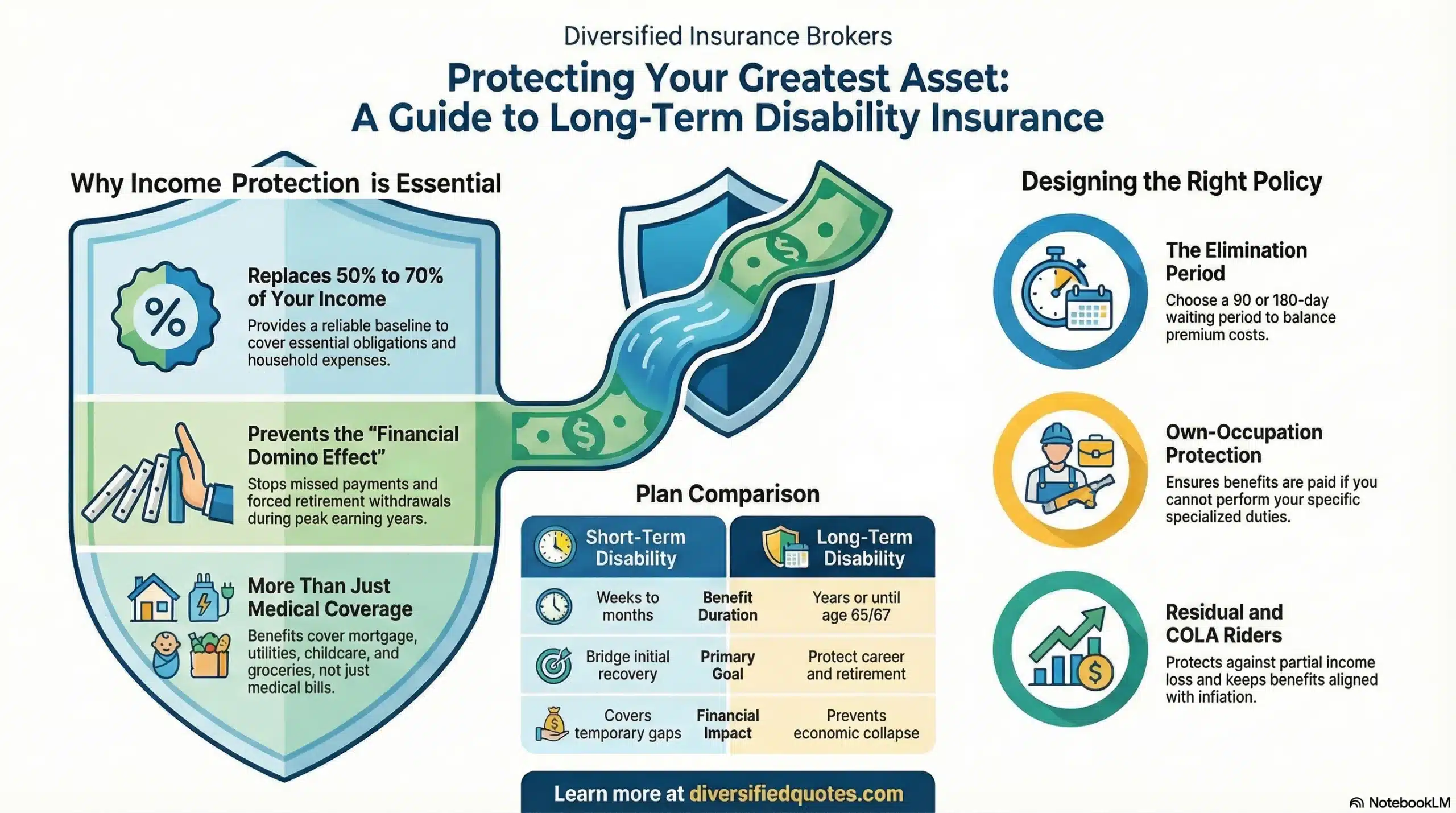
A residual disability rider is particularly important for food processing workers whose conditions — musculoskeletal disorders, cold environment conditions, chemical sensitization — may reduce processing capacity without eliminating it entirely. A worker who can perform limited light-duty food processing work but cannot sustain full production line operations earns reduced income without being totally disabled. Our full resource on how residual disability insurance benefits work explains how partial disability coverage sustains food processing workers through graduated recovery periods. The elimination period should be calibrated to the worker’s financial reserves and workers’ compensation bridge income availability — our guide on how disability insurance elimination periods work provides the full framework. A cost-of-living adjustment rider is valuable for workers facing extended disability from progressive musculoskeletal conditions — our resource on disability income insurance with a COLA rider explains how inflation protection preserves benefit value across extended claims. For food processing workers exploring short-term options alongside long-term coverage, our guide on how to buy short-term disability insurance addresses the complete income protection picture.
The Restaurant and Food Service Connection
Disability insurance for the food processing industry also extends naturally to the broader food service ecosystem — the restaurant workers, catering professionals, and food service staff whose work involves many of the same physical hazards as processing plant work: sustained standing on hard floors, heavy lifting of food supplies, repetitive cutting and preparation motions, hot surface and steam burn risk, slip and fall hazards from wet kitchen floors, and the sustained physical demands of food preparation at high volume and speed. For food service professionals who are self-employed or work without comprehensive group disability benefits, the income protection need is identical to that of food processing plant workers, and the same individual disability insurance solutions apply. Our dedicated resource on disability insurance for restaurant workers and servers provides specific guidance for food service professionals in this extended food industry population.
Why Food Processing Workers Need an Independent Disability Insurance Broker
Disability insurance for the food processing industry involves occupational classification nuances — varying between processing line workers, equipment operators, sanitation staff, cold environment workers, and self-employed artisan producers — income documentation considerations for overtime-dependent earnings, and specific policy feature evaluation that benefits from independent broker expertise. A broker who understands the food processing industry’s injury profile, who can present overtime income documentation effectively to underwriters, and who identifies carriers most favorable for food manufacturing occupational classifications produces materially better coverage outcomes than a standard retail application.
At Diversified Insurance Brokers, we work with food processing workers, food manufacturing employees, and artisan food business owners across all production contexts to structure disability coverage that reflects actual income, addresses the specific physical hazards of food processing work, and identifies the most favorable available policy terms for each individual’s occupational profile and employment structure. Our dedicated resource on why independent disability insurance brokers matter explains the full value of this approach for workers in high-injury industries whose disability protection needs require more than a standard retail solution. And our resource on whether disability insurance is worth the investment provides the foundational financial case that applies with particular force to workers in an industry where the Emory University data confirms a 60% elevated injury and illness rate above all other industries combined.
Final Thoughts on Disability Insurance for the Food Processing Industry
Food processing workers perform essential, demanding work under physical conditions that produce injury and illness at rates documented by academic research and government agencies as among the highest in American industry. The musculoskeletal disorders of sustained repetitive processing line work, the severe machinery injuries of industrial cutting and grinding equipment, the cold environment health consequences of refrigerated processing, and the chemical exposure risks of intensive industrial sanitation all create genuine disability risks that can interrupt or end a food processing career with immediate financial consequences.
Disability insurance for the food processing industry is the financial tool that ensures a workplace injury or occupational illness does not simultaneously become a household financial catastrophe. A well-structured policy — supplementing workers’ compensation, covering the overtime income gap, providing income from any disability cause, and maintaining benefits for the full recovery period rather than ending at maximum medical improvement — provides the comprehensive income protection that every food processing worker deserves.
Related Pages
Talk With an Advisor Today
Choose how you’d like to connect—call or message us, then book a time that works for you.
Schedule here:
calendly.com/jason-dibcompanies/diversified-quotes
Licensed in all 50 states • Fiduciary, family-owned since 1980
Disability Insurance for the Food Processing Industry FAQs
Yes, food processing workers can obtain individual disability insurance. The occupational classification depends on the specific role — processing line workers in meat, poultry, and seafood facilities performing heavy manual cutting and machinery operation duties are classified at lower physical labor occupational tiers reflecting the manual intensity and injury risk of the work, while quality control, supervisory, and administrative roles within food manufacturing facilities may receive more favorable classifications. The most important planning consideration for food processing workers is not whether coverage is available, but whether the benefit amount is structured to reflect total income including overtime pay and production bonuses that workers’ compensation consistently excludes from its wage base calculation. Working with an independent broker who understands food manufacturing employment income structures is essential for securing benefit amounts that reflect genuine earning capacity.
Food processing is among the most hazardous industries in the American workforce. An Emory University study found that food industry workers have a 60% higher rate of occupational injury or illness than workers in all other industries combined — a finding that reflects the genuine and documented danger of food manufacturing work. Meat and poultry processing plants report among the eight-highest numbers of amputations and hospitalizations to OSHA of any industry sector nationally. Published cross-sectional research has documented a 44.8% prevalence of recent occupational injuries among food industry workers — nearly half the workforce experiencing injury within recent reporting periods. OSHA has published specific guidance on musculoskeletal injury prevention in poultry processing, acknowledging the documented MSD burden in this workforce. These statistics reflect a genuinely high-injury industry that produces real and frequent disability events — making individual income protection a genuine financial planning priority for any food processing worker. For parallel context on how elevated industry injury rates translate into disability insurance planning urgency, see our page on disability insurance planning in high-demand occupational categories.
No, and the gaps in workers’ compensation coverage are significant for food processing workers. Workers’ compensation covers only work-related injuries and occupational illnesses — a food processing worker disabled from cancer, a cardiovascular event, an off-duty injury, or any condition unrelated to a specific workplace event receives no workers’ compensation benefit. Workers’ compensation replaces only two-thirds of average weekly regular wages and explicitly excludes overtime pay and production bonuses, leaving a meaningful income gap for workers whose total earnings depend substantially on overtime hours. Workers’ compensation also ends at maximum medical improvement — not when the worker has regained full processing line capacity — which may leave a worker without benefits before they are medically able to return. Self-employed artisan food producers who have not elected workers’ compensation for themselves have no work-related injury protection at all. Individual disability insurance covers disability from any cause regardless of origin and provides benefits for the full benefit period regardless of when maximum medical improvement is reached.
Musculoskeletal disorders are the most prevalent and financially consequential disability category, with carpal tunnel syndrome historically producing the highest median days away from work of any injury or illness per BLS data. Tendinitis, trigger finger, De Quervain’s tenosynovitis, rotator cuff injuries, and lumbar spine disorders from sustained repetitive processing line work round out the MSD profile. Amputations and severe machinery injuries from industrial cutting, slicing, and grinding equipment produce the most acute catastrophic disability events — meat and poultry processing plants report among the eight-highest amputation and hospitalization rates of any industry nationally. Cold environment conditions in refrigerated processing — Raynaud’s phenomenon, cold-induced occupational asthma, musculoskeletal cold sensitivity — create disability risk specific to frozen food and refrigerated processing workers. Chemical exposure from caustic industrial cleaning agents creates respiratory sensitization and contact dermatitis risks for sanitation workers. For parallel context on machinery-related severe injury risk, see our page on disability insurance for workers across complex occupational risk categories.
Own-occupation disability insurance pays benefits when a condition prevents a food processing worker from performing the specific duties of their processing role — sustained repetitive cutting, trimming, packaging, equipment operation, or cold environment work — regardless of whether they could theoretically perform other less physically demanding work. Any-occupation coverage only pays if the worker cannot perform virtually any gainful employment. A food processing worker whose carpal tunnel syndrome prevents sustained processing line hand and wrist operations but who could technically perform sedentary desk work would receive no any-occupation benefits, while an own-occupation policy recognizes the genuine inability to perform processing work and pays accordingly. For workers whose entire income depends on their specific physical capacity for manual food processing duties, the any-occupation definition provides minimal meaningful protection. Own-occupation coverage is the definition that actually protects the specific income that food processing work generates. Our resource on disability insurance for manual trade workers managing the own-occupation definition provides parallel context on how this protection works for physically demanding occupations.
Residual disability coverage pays proportional benefits when a disabling condition reduces a food processing worker’s capacity without completely eliminating the ability to work. A worker recovering from carpal tunnel surgery or a back injury may be medically cleared for limited light-duty food processing tasks months before returning to full production line work. During this graduated return period, income is reduced — either because the worker can only work reduced hours or because they are assigned to lower-paying light-duty roles — without being entirely eliminated. Without a residual disability rider, a total-disability-only policy pays nothing during this partial capacity period. A residual rider supplements reduced earnings proportionally throughout the return-to-full-capacity arc, providing continuous financial support from the onset of disability through complete return to normal production line duties. For food processing workers whose most common disabling conditions follow extended graduated recovery timelines, this rider is essential for the policy to function as genuine income protection across the full recovery period.
Yes, self-employed artisan food producers, specialty food manufacturers, food truck operators, and cottage food business owners can obtain individual disability insurance. For these professionals, individual disability insurance is not a supplement to employer coverage — it is the only meaningful income replacement available when a disability occurs, since self-employed food business owners have no employer sick pay, no group disability plan, and no paid leave. The occupational classification for self-employed food producers depends on the specific physical duties involved — primarily kitchen and food preparation work typically receives a more favorable classification than industrial processing line work. Income documentation from Schedule C business tax returns requires attention to how business expense deductions affect the insurable income base, particularly for food businesses with significant ingredient, equipment, and operational costs. An experienced independent broker who understands self-employed food business income structures is essential for securing benefit amounts that reflect genuine earning capacity rather than tax-minimized net profit figures.
Overtime pay is a significant component of total annual earnings for many food processing workers who regularly work extended shifts during high-production periods. Workers’ compensation wage replacement is typically calculated on average regular wages and may undercount or exclude overtime income, creating a meaningful income gap during disability. Individual disability insurance carriers base benefit amounts on verified total earned income using federal tax returns, and documented W-2 income including overtime earnings can be included in the insurable income calculation — allowing the benefit amount to be calibrated to total annual earnings rather than just regular wage rates. For a food processing worker whose overtime earnings represent 20% or more of their annual income, the difference between a benefit amount based on regular wages only versus total W-2 income including overtime can represent thousands of dollars in annual benefit — a meaningful financial difference during an extended disability recovery period. An independent broker who understands how to document and present overtime income to underwriters effectively is important for food processing workers whose total compensation substantially exceeds their regular hourly wage base. For more context, see our page on disability insurance for construction workers managing overtime income documentation.
The elimination period selection for food processing workers should account for the workers’ compensation bridge income that typically activates for work-related injuries — since most food processing disabilities begin as workers’ comp claims for work-related events. An employed food processing worker with active workers’ compensation coverage providing two-thirds wage replacement from the onset of a work-related disability may comfortably manage a 90-day elimination period for their individual disability policy, using workers’ comp income to bridge the initial waiting period. Workers with limited emergency savings or disabilities that are not work-related — and therefore receive no workers’ comp income — should evaluate shorter 30 or 60-day elimination periods. Self-employed artisan food producers with no workers’ compensation protection should evaluate the shortest available elimination period relative to their emergency financial reserves, since the financial urgency of a self-employment disability begins immediately with no institutional bridge income available. Our full guide on how elimination periods work provides the complete framework for calibrating this decision.
The best time is as early as possible in a food processing career — before the cumulative musculoskeletal conditions of sustained repetitive processing work, cold environment health consequences, or machinery injury history have accumulated in the medical record. Disability insurance premiums are based in part on age and health status at the time of application, and younger food processing workers in good health secure the most comprehensive coverage at the most favorable rates. Carpal tunnel syndrome, tendinitis, back conditions, and cold environment conditions that develop predictably over food processing careers can result in exclusion riders or restricted terms if documented at the time of application. Applying before these occupational health consequences develop ensures they are covered under an existing policy when they eventually emerge. For food processing workers considering the financial value of disability insurance relative to its cost, the 60% elevated industry injury rate provides a compelling foundational argument that coverage is not a remote contingency but a realistic financial planning need given documented industry-wide injury prevalence.
An independent broker has access to multiple disability insurance carriers and can compare occupational class assignments, policy definitions, income documentation approaches for overtime-dependent earnings, and premium structures across the full marketplace. For food processing workers whose income includes meaningful overtime earnings, whose occupational classifications vary significantly between different food processing roles, and who may face carrier-specific exclusion riders on the musculoskeletal conditions most likely to produce disability, the differences between carriers in how they evaluate food manufacturing employment produce meaningfully different real-world coverage outcomes. A captive agent representing a single carrier can only present that company’s approach. At Diversified Insurance Brokers, we evaluate the full competitive landscape for every food industry professional we work with and structure coverage that reflects actual total earnings, addresses the specific physical hazards and injury profile of food processing work, and identifies the carriers whose underwriting guidelines most favorably accommodate food manufacturing occupational classifications and income structures.
About the Author:
Jason Stolz, CLTC, CRPC, DIA, CAA and Chief Underwriter at Diversified Insurance Brokers (NPN 20471358), is a senior insurance and retirement professional with more than 25 years of real-world experience helping individuals, families, and business owners protect their income, assets, and long-term financial stability. As a long-time partner of the nationally licensed independent agency Diversified Insurance Brokers, Jason provides trusted guidance across multiple specialties—including fixed and indexed annuities, long-term care planning, personal and business disability insurance, life insurance solutions, Group Health, Travel Medical and Evacuation Insurance, and short-term health coverage. Diversified Insurance Brokers maintains active contracts with over 100 highly rated insurance carriers, ensuring clients have access to a broad and competitive marketplace.
His practical, education-first approach has earned recognition in publications such as VoyageATL, and contributions from his agency featured in Kiplinger and GoBankingRates— highlighting his commitment to financial clarity and client-focused planning. Drawing on deep product knowledge and years of hands-on field experience, Jason helps clients evaluate carriers, compare strategies, and build retirement and protection plans that are both secure and cost-efficient. Visitors who want to explore current annuity rates and compare options across multiple insurers can also use this annuity quote and comparison tool.
Explore More Disability Insurance Options: Browse our complete guide to Disability Insurance for Food, Hospitality, Arts & Entertainment — covering chefs, musicians, actors, bartenders, hospitality workers & entertainment professionals from 100+ carriers.
Last Reviewed: June 8, 2026 |
Reviewed by: Jason Stolz, CLTC, CRPC, DIA, CAA
Chief Underwriter, Diversified Insurance Brokers, Inc. | NPN: 20471358 | Diversified Insurance Brokers, Inc. — Licensed in all 50 states
Fact Checked by: Tonia Pettitt, CMIP©
Medicare Specialist, Diversified Insurance Brokers, Inc. | NPN: 14374308 | Diversified Insurance Brokers, Inc. — Licensed in all 50 states
Did you find this content helpful? Leave us a Google review — it helps others find trustworthy guidance too.
Editorial Standards: Diversified Insurance Brokers maintains rigorous editorial standards to ensure accuracy, clarity, and independence in all content. Learn more about our editorial standards and commitment to transparency.
