
Disability Insurance for the Dairy Industry
As an Independent Disability Insurance Broker, we have access to exclusive discounts and negotiated pricing most captive agents can’t offer — see the full breakdown near the end of this page.
Disability Insurance for the Dairy Industry

Jason Stolz CLTC, CRPC, DIA, CAA
Dairy farming occupies a unique position in the American agricultural injury landscape — a profession that combines the documented hazard profile of livestock handling with the mechanical risks of large-scale farming equipment, the chemical exposure of sanitation and manure management operations, the biological hazard of zoonotic disease from sustained close-contact animal work, and a mental health burden that multiple peer-reviewed research sources and major agricultural organizations specifically document at rates far above the general population. The Bureau of Labor Statistics documents the agricultural sector’s fatal injury rate at 23.1 deaths per 100,000 workers — more than six times the all-industry rate — and University of Minnesota research specifically examining dairy farm operations documents that two-thirds of all animal-related farm accidents occur on dairy farms, with livestock-related injuries accounting for the highest rate of lost work time of any farm injury category. A landmark American Journal of Industrial Medicine study titled “The Dangers of Dairy Farming: The Injury Experience of 600 Workers Followed for Two Years” — the specific language of which has been cited in occupational safety literature for decades — quantified the sustained injury risk of dairy operations for workers in direct animal contact roles. The American Farm Bureau’s Farm State of Mind initiative, drawing on multiple peer-reviewed studies, documents that farmer suicide rates are two to five times higher than the national average — and the National Rural Health Association’s research documents farmers as 3.5 times more likely to die by suicide than the general population. Purdue Extension’s research on farmer mental health documents that 29 percent of farmers suffer from depression and 35 percent from anxiety — rates that reflect the compound occupational stress of financial pressure, market volatility, weather dependence, isolation, and the physical and emotional demands of daily livestock responsibility. The USDA specifically documents that 41 percent of U.S. dairy farmers have no health insurance coverage whatsoever — a figure that underscores the institutional protection gap that makes individual disability insurance not merely a planning tool but the entire financial safety net for a population that works in one of agriculture’s most demanding environments without the institutional benefit baseline that most American workers assume. Understanding how disability insurance applies across the full agricultural sector is the foundation for any dairy farmer’s income protection planning — and for self-employed dairy farm owners and operators, that foundation is the only income protection structure available when disability eliminates the ability to manage the herd and run the operation.
At Diversified Insurance Brokers, Jason Stolz, CLTC, CRPC, DIA, CAA works with dairy industry professionals across the full range of the sector’s employment and business structures — dairy farm owner-operators who carry the complete two-layer disability exposure of personal income loss and farm overhead obligations, employed dairy workers including milkers, herd managers, and dairy technicians whose employer benefit access is typically minimal or nonexistent and whose daily animal contact creates the sustained injury exposure the University of Minnesota research specifically documents for dairy operations, dairy processing workers at cheese, butter, and fluid milk processing facilities whose machinery, chemical, and repetitive motion exposures create a distinct disability risk profile from the farm side, and family dairy operations where multiple family members working the farm creates the specific key-person disability scenario that can eliminate the operation’s management capacity with a single disability event. The coverage architecture for dairy farmers requires specific attention to the farm overhead dimension — milking equipment financing, feed contracts, hired hand wages, veterinary service obligations, and the fixed costs of maintaining a dairy herd that continue every day regardless of whether the principal operator is working or disabled. Self-employed dairy farm coverage is available through individual disability insurance that uses Schedule F farm income documentation as the benefit calculation basis — the same multi-year income averaging approach that any self-employed professional uses, adapted to the specific income documentation structure of agricultural operations.
Compare Disability Coverage for Dairy Industry Workers
We review coverage options across 100+ carriers and identify the policy structure, farm income documentation approach, and operation overhead coverage that fits your specific dairy role and farm structure.
Request Disability Insurance OptionsDairy Industry Disability Risk — Animal Handling, Equipment, Zoonotic Disease, and the Mental Health Dimension
| Risk Category | Research and Occupational Context | Resulting Disability Risk | Coverage Status | Income Protection Gap |
|---|---|---|---|---|
| Cattle kicks, crush injuries, and large animal handling | University of Minnesota dairy farm accident research documents that two-thirds of all animal-related farm accidents occur on dairy farms; researchers have documented that 12% to 33% of all farm injuries are caused by animals, with livestock-related injuries accounting for the highest rate of lost work time of any farm injury category; Minnesota survey documents dairy workers stepped on, kicked, fallen on, and crushed by cows; cattle kick forward and out — injuries to the head and chest from kicks result in the most severe outcomes; bulls create additional crush and gore risk during routine herd management activities | Rib fractures, spinal injury, and head trauma from cattle kicks during milking; crush injuries from cattle weight during handling and restraint; leg and foot injuries from being stepped on during routine milking parlor operations; any injury requiring extended recovery that prevents daily herd management and milking operations | Workers’ comp for employed dairy workers at documented acute incidents; self-employed dairy farm owners entirely unprotected for their own injuries; individual DI covers qualifying disability from all acute animal handling injury causes | Complete gap for self-employed; significant gap even for employed dairy workers whose employers provide minimal group LTD; individual DI is the primary income protection for the most common and most severe acute dairy injury pathway |
| Zoonotic disease — bacterial, viral, and parasitic transmission | OSHA agricultural hazards documentation specifically identifies zoonotic diseases as a documented occupational hazard for agricultural workers with livestock contact; UC Davis cattle safety resources document multiple zoonotic conditions associated with dairy cattle contact including Highly Pathogenic Avian Influenza (HPAI) — specifically noting dairy cows are at increased risk of HPAI infection; infections can result from direct contact with animals, manure, placenta, raw milk, or animal bites; Brucellosis, Cryptosporidiosis, Q fever (Coxiella burnetii), Listeriosis, and E. coli transmission are documented zoonotic pathways for dairy workers | Acute illness requiring extended recovery and preventing dairy work; chronic health consequences from zoonotic infections that produce long-term disability; serious systemic illness from bacterial or viral zoonotic pathogens requiring hospitalization and extended recuperation | Gradual exposure illness outside workers’ comp incident framework; acute zoonotic illness may qualify for workers’ comp if transmission can be attributed; individual DI covers all illness-based qualifying disability regardless of cause or attribution | Significant gap; individual DI covers the biological illness pathway that workers’ comp attribution requirements leave unprotected for most gradual and difficult-to-attribute zoonotic conditions |
| Farm machinery and equipment accidents | Dairy farm operations involve tractors, skid steers, total mixed ration (TMR) mixers, manure handling equipment, and milking system machinery — each presenting the documented crush, entanglement, and rollover hazard profile that NIOSH identifies as a primary farm injury category; tractor rollover is among the most lethal single-incident farm accident types; equipment entanglement injuries in PTO shafts, augers, and conveyor systems are documented agricultural occupational injury sources; dairy processing facilities add industrial food processing equipment with its own documented injury profile | Tractor rollover producing crush injuries or fatality; PTO shaft or auger entanglement producing severe limb injuries; skid steer accident injuries; milking system equipment injuries; any machinery incident preventing the sustained physical farm operations that dairy management requires | Workers’ comp for employed farm workers at documented incidents; self-employed farm owners entirely unprotected; individual DI or accident-only coverage provides income floor for all acute machinery disability causes | Complete gap for self-employed; individual DI covers qualifying disability from all machinery and equipment injury causes regardless of employment structure |
| Mental health — depression, anxiety, and farmer suicide | American Farm Bureau documents farmer suicide rates as 2-5 times higher than the national average; National Rural Health Association documents farmers 3.5 times more likely to die by suicide than the general population; Purdue Extension research documents 29% of farmers suffer from depression and 35% from anxiety; peer-reviewed research documents that higher farmer stress and anxiety scores are associated with decreased farm productivity, inability to manage operations, and in some cases forcing significant scale-back or exit from farming; USDA documents 41% of U.S. dairy farmers have no health insurance — including mental health coverage | Disabling depression or anxiety preventing the sustained operational capacity, decision-making, and physical demands that dairy farm management requires; occupational burnout producing inability to maintain herd management schedule; mental health conditions compounded by farm financial stress creating disability that eliminates farm management capacity | Workers’ comp does not cover mental health; most dairy farm owners have no group LTD mental health coverage; individual DI with unlimited mental health benefit period provides the only meaningful income protection for this documented primary disability pathway | Complete gap; individual DI with unlimited mental health benefit period is the only coverage that addresses the most statistically significant documented mortality and morbidity risk in American agriculture |
| Chemical exposure — sanitizers, ammonia, and manure gas | Dairy farm sanitation operations require regular use of concentrated caustic cleaning chemicals for milking equipment, parlor surfaces, and bulk tank sanitization; manure storage systems — lagoons, pits, and covered storage — produce hydrogen sulfide and ammonia gases that OSHA identifies as a confined space atmospheric hazard; pesticide and herbicide application for feed crop production adds the documented chemical carcinogen and neurological hazard profile OSHA identifies for all agricultural chemical use; prolonged exposure to ammonia in enclosed barn environments produces respiratory consequences documented in dairy farming occupational health research | Respiratory conditions from sustained ammonia and chemical sanitizer inhalation; acute hydrogen sulfide poisoning from manure pit gas exposure; pesticide-associated cancer and neurological conditions from feed crop chemical application; chemical sensitization preventing continued dairy farm chemical work | Gradual chemical exposure outside workers’ comp incident framework; acute manure gas incidents may qualify for workers’ comp; individual DI covers all illness-based qualifying disability regardless of onset pattern | Significant gap for gradual exposure conditions; individual DI fills where workers’ comp fails for the most common actual illness pathway of sustained chemical exposure in dairy operations |
The table establishes what makes dairy farming disability risk both more extensive and more underprotected than almost any other American occupational category: a full-spectrum hazard profile — physical animal handling, mechanical equipment, biological zoonotic exposure, documented mental health crisis, and chemical exposure — combined with the USDA’s documented finding that 41 percent of dairy farmers have no health insurance coverage at all. Why dairy farmers prioritize disability income protection is answered by the compounding reality of the industry: every risk category the table documents is elevated above the general population baseline, and the institutional protection that most American workers assume exists — workers’ comp, employer benefits, health insurance — is absent or severely limited for the majority of dairy farm operators across the country.
Cattle Handling and the Dairy Injury Record — What the Research Specifically Documents
The University of Minnesota research on dairy farm accidents is one of the most specific pieces of occupational safety literature for the dairy industry — documenting not merely that dairy farms are hazardous in the abstract, but that two-thirds of all animal-related farm accidents in a surveyed population of nearly 2,000 farms occurred specifically on dairy farms. This finding reflects the fundamental structure of dairy operations: unlike beef cattle operations where sustained daily animal contact may be periodic, dairy farming requires multiple daily close-contact interactions with each cow in the herd through the milking process, herd health management, feeding operations, and the movement of animals between barn areas and pasture. A 500-cow dairy operation requires milking twice or three times daily — meaning each milker has thousands of individual cow interactions per week, and the cumulative probability of an adverse animal contact event is substantially higher than in any livestock operation with less frequent required animal interaction.
The occupational medicine literature on cattle behavior documents the specific injury mechanism: cattle kick forward and out, with kicks to the head and chest documented as the most immediately dangerous outcomes. The milking parlor — the close-quarters daily contact environment of a dairy operation — is specifically identified in the Minnesota research as the setting where most animal-related dairy injuries occur. A dairy farmer or milker who sustains a rib fracture, spinal injury, or head trauma from a cattle kick during routine milking operations is in precisely the situation that long-term disability income coverage is designed to address — an injury requiring extended recovery, during which the daily milking schedule continues, the herd requires ongoing management, and the farm overhead obligations accumulate regardless of whether the injured farmer can work. Short-term disability coverage fills the immediate income gap from the first day of disability before long-term coverage activates — particularly critical for a dairy operation where the income from daily milk production stops immediately when the principal operator is incapacitated. Accident-only disability income insurance provides an accessible targeted coverage option for dairy workers who want specific protection for the acute physical injury scenarios — cattle kicks, equipment accidents, falls in the parlor or barn — that dominate the dairy industry’s documented injury statistics.
Farmer Mental Health — The Disability Pathway No One Plans For
The mental health dimension of dairy farming disability is the most extensively researched and least financially protected disability pathway in American agriculture. The American Farm Bureau’s Farm State of Mind initiative draws on multiple peer-reviewed studies to document farmer suicide rates at two to five times the national average — a range that positions farming among the occupations with the most severely elevated suicide mortality of any civilian profession. The National Rural Health Association’s research documents farmers as 3.5 times more likely to die by suicide than the general population. Purdue Extension’s work specifically documents that 29 percent of farmers suffer from depression and 35 percent from anxiety — rates that, in any other profession, would generate extensive workplace mental health programming. Instead, as the USDA documents, 41 percent of dairy farmers have no health insurance coverage of any kind, including the mental health coverage that managing these conditions requires.
The peer-reviewed research on dairy farmer mental health specifically documents that higher farmer stress and anxiety scores are associated with decreased farm productivity, inability to maintain herd management responsibilities, and in serious cases forcing significant scale-back or complete exit from farming. A disabling depression or anxiety disorder that prevents a dairy farmer from maintaining the milking schedule, making herd management decisions, managing feed operations, and sustaining the round-the-clock demands of dairy operations is a genuine occupational disability — one that eliminates farm income as completely as any physical injury. Yet workers’ compensation does not cover mental health conditions, and the standard 24-month mental health benefit cap in most group disability plans is specifically inadequate for a population where the research documents farmer mental health conditions as persistent, serious, and compounded by ongoing financial and occupational stressors that do not resolve with a two-year treatment period. Individual disability insurance with an unlimited mental health benefit period is the only coverage that addresses this documented primary mortality and morbidity risk with financial protection proportional to its actual prevalence and severity among dairy farming professionals. The financial stress dimension is particularly relevant: the connection between farm financial insecurity and mental health outcomes documented in the peer-reviewed literature means that a disability that compounds financial stress — by simultaneously eliminating farm income and leaving overhead obligations unpaid — creates a reinforcing spiral between physical disability, financial crisis, and mental health deterioration that comprehensive disability insurance specifically interrupts by maintaining the income floor.
Dairy Farm Overhead — The Two-Layer Exposure for Owner-Operators
Dairy farm owner-operators carry the most complete disability exposure in the agricultural sector: the documented physical, biological, and mental health risk profile of intensive livestock management, combined with the complete self-employment coverage gap that eliminates every employer benefit, combined with the farm overhead obligations that continue regardless of whether the principal operator is working. A dairy farm with milking equipment under financing, a contracted feed supply, hired milker wages, veterinary service commitments, and a bulk tank lease carries fixed monthly overhead that does not pause because the farmer is disabled. A disability that prevents the owner from operating for two to four months creates both personal income loss — the owner’s earnings from the farm — and unmet farm overhead accumulating against zero or reduced milk production revenue.
Business overhead expense disability coverage specifically addresses the dairy farm’s fixed operating costs during the owner’s qualifying disability — milking system lease or financing, feed contracts, hired hand wages, veterinary obligations, equipment maintenance agreements, and any other fixed farm overhead — preserving the operation’s viability during recovery. The BOE benefit is sized to actual documented monthly fixed farm overhead rather than to milk revenue, covering what the operation costs to maintain. Personal disability income and BOE coverage together create the complete protection architecture for a dairy farm owner — the household income floor and the farm overhead floor, each addressing the distinct financial layer that disability simultaneously threatens. Income documentation for self-employed dairy farm operators uses Schedule F farm income from federal tax returns averaged across two to three years, capturing net farm profit as the personal benefit basis alongside the separately documented farm overhead obligations. Agricultural contractors and seasonal dairy workers who receive 1099 income for milking, herd management, or dairy labor follow the Schedule C or 1099 documentation framework applicable to their specific income structure.
Coverage Options, Occupational Class, and Policy Design for Dairy Industry Workers
Dairy farmers and farm workers receive occupational class assignments in the Class B to Class C range from most disability insurance carriers — reflecting the physical animal handling demands, the machinery hazard exposure, the zoonotic disease risk profile, and the agricultural sector’s documented injury statistics. This produces higher premiums than professional occupations but does not prevent meaningful individual disability insurance coverage. Own-occupation disability coverage for a dairy farm owner should encompass the specific physical and managerial demands of dairy operations — the milking, herd management, feeding operations, and farm management functions that generate the farm’s income — not merely generic inability to perform any physical work. A dairy farmer who cannot manage a milking parlor but could theoretically perform sedentary employment has still lost the specific farm management capacity that the operation depends on.
Residual disability coverage addresses the partial disability scenario realistic for dairy operations — a farm owner managing administrative and managerial functions during recovery from a physical injury while unable to perform the physical milking and animal handling duties, receiving proportional income replacement based on actual income reduction. How short-term and long-term disability structures interact maps the coverage from the first day of any qualifying disability through the full benefit period, filling the income gap that dairy farming’s daily production schedule creates from the moment the operator cannot work. Coverage for dairy farmers with prior back, musculoskeletal, or health conditions from farm work is available through independent broker comparison, typically with partial exclusion riders for documented prior conditions but with full coverage for all other disability causes including the mental health and zoonotic illness pathways the research specifically documents for this population.
How much disability income a dairy farmer needs reflects documented Schedule F net farm income and the household’s actual financial obligations during a disability period — and for most dairy farm families, the BOE calculation of farm overhead obligations is as financially consequential as the personal income calculation. The elimination period should reflect actual financial reserves — a 90-day elimination period for operations with adequate reserves, shorter for those without. The future increase option allows benefit increases as farm income grows without new medical underwriting. Cost of living adjustment protects purchasing power across extended disability periods from the chronic conditions the industry’s zoonotic and mental health exposure profile can produce. Specialty and modified market options extend coverage availability for dairy workers whose occupational classification or health history creates standard underwriting complexity. Guarantee issue disability insurance provides a last-resort access point when individual underwriting produces limited terms.
The timing of purchase matters in dairy farming because zoonotic exposure and animal handling risk begin from the first day of dairy work — and the mental health burden that the research documents for farmers compounds with each year of financial stress, market volatility, and isolation that the occupation produces. Early purchase before any health documentation has developed secures the most comprehensive available coverage. No-exam disability coverage provides streamlined approval for healthy dairy workers and farm owners. Getting the best available rates means independent broker comparison across the full carrier market — carrier variation in how they classify specific dairy farming activities is meaningful enough to produce real differences in premium and coverage quality. Whether disability benefits are taxable for a self-employed dairy farm owner: personally purchased individual policies paid with after-tax income generally produce tax-free benefits. A second opinion on any disability insurance proposal confirms whether the occupational class assignment is competitive, the policy definition encompasses both physical and managerial dairy operations functions, and the farm overhead dimension is addressed appropriately before any premium commitment is made.
Get Your Dairy Industry Coverage Review
We compare occupational class assignments, farm income documentation approaches, and operation overhead structures across 100+ carriers to build the most comprehensive available income protection for your dairy operation.
Request Disability Insurance Options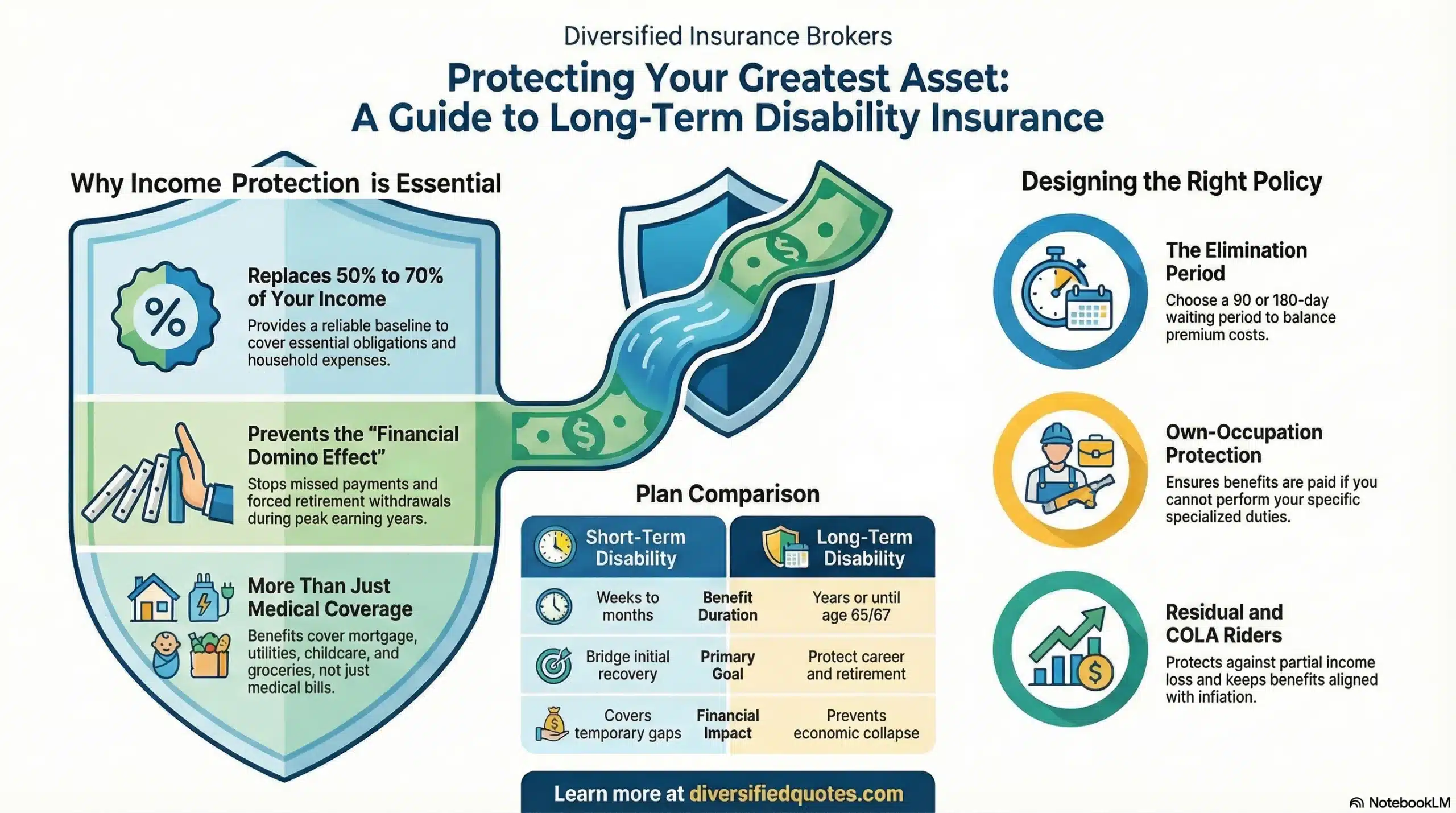
Talk With an Advisor Today
Choose how you’d like to connect—call or message us, then book a time that works for you.
Schedule here:
calendly.com/jason-dibcompanies/diversified-quotes
Licensed in all 50 states • Fiduciary, family-owned since 1980
FAQs: Disability Insurance for the Dairy Industry
I own a dairy farm — what happens to the operation if I’m injured and can’t work?
A dairy farm cannot pause operations the way a consulting business or a retail store can. The herd must be milked on schedule — typically twice or three times daily — regardless of whether the principal operator is working or recovering from an injury. Feed must be delivered, animals must receive veterinary care, and the equipment must be maintained and cleaned. Every one of these obligations continues on its normal schedule from the first day of disability, while the milk production income that funds the operation may drop immediately if the owner’s personal management capacity is what keeps the operation running at full productivity. The financial consequence of even a 60 to 90-day disability for a dairy farm owner without income protection is not merely personal income loss — it is the simultaneous accumulation of milking equipment payments, feed contracts, hired hand wages, and every other fixed farm overhead obligation against a household with no income floor.
The appropriate coverage architecture addresses both financial layers separately. Personal disability income insurance replaces the farm owner’s earned income when disability prevents active farm management — sized to documented net Schedule F farm income averaged across two to three years. Business overhead expense disability coverage addresses the farm’s fixed operating costs during the disability period — equipment financing, feed contracts, hired milker wages, veterinary service obligations, and all other fixed farm overhead — preserving the operation’s viability during recovery. Together they create the complete protection structure that a dairy farm operation actually requires when the principal operator cannot work. BOE disability coverage is sized to actual documented monthly fixed farm overhead, not to milk revenue — covering what the operation costs to maintain rather than what it generates. Without both layers in place, a recoverable disability period can become a farm-threatening financial event.
I got kicked by a cow and injured my back — will disability insurance cover that?
A back injury from a cattle kick is exactly the type of acute, documented, work-related injury that disability insurance is designed to replace income for during the recovery period. For a self-employed dairy farm owner, there is no workers’ compensation for your own injuries — the workers’ comp system that provides wage replacement for employed farm workers specifically excludes the self-employed farm owner as an employee of their own operation. Individual disability insurance is the only income protection available for your own injury, and a back injury from a cattle kick that prevents sustained daily farm operations — milking, animal handling, feeding, equipment operation — is a qualifying disability when your policy’s definition of disability is met.
The coverage is most effective when established before the injury rather than after. A back injury that is now in your medical record creates a potential partial exclusion rider at future underwriting — meaning a new application after the injury may produce coverage that excludes claims attributable to the documented prior back condition, while coverage applications before any such injury produce comprehensive back coverage without restriction. University of Minnesota dairy farm accident research specifically identifies milking parlor cattle contact as the most common setting for dairy worker injuries — the research context that makes early purchase of disability insurance before any injury history develops the most strategically complete income protection approach for any dairy farmer. Coverage for dairy farmers with prior back or musculoskeletal conditions from farm work is still available through independent broker comparison, typically with a partial exclusion for the documented area but with full coverage for all other qualifying disability causes.
Can dairy farmers get disability insurance for mental health conditions like depression?
Yes — and the mental health dimension of dairy farmer disability deserves specific emphasis because the research documenting it is so extensive. The American Farm Bureau draws on multiple peer-reviewed studies to document farmer suicide rates at two to five times the national average. The National Rural Health Association documents farmers as 3.5 times more likely to die by suicide than the general population. Purdue Extension research documents that 29 percent of farmers suffer from depression and 35 percent from anxiety. These are not peripheral statistics — they describe the documented primary mental health burden of an occupation that combines financial uncertainty, market volatility, physical isolation, around-the-clock animal responsibility, and the specific stress of watching a family farm’s financial position respond to factors entirely outside the farmer’s control.
Individual disability insurance purchased personally covers qualifying disability from mental health conditions including depression and anxiety disorders when those conditions prevent the sustained physical and cognitive demands of dairy farm management — milking schedule maintenance, herd health decision-making, operational management, and the daily physical work the operation requires. The critical policy feature for any dairy farmer is the unlimited mental health benefit period — a policy that caps mental health benefits at 24 months, as most employer group LTD plans do, terminates coverage at precisely the point where chronic farm-related depression or anxiety disorders tend to be most persistent and most impactful. For a population where the research documents mental health conditions at roughly 30 to 35 percent prevalence rates, a 24-month cap is not an adequate coverage design. Individual disability insurance with an unlimited mental health benefit period is the only coverage structure that matches the actual documented duration and severity of the mental health burden the dairy farming occupation creates. If you are personally experiencing distress, the Farm State of Mind helpline (1-800-FARM-AID) and the 988 Suicide and Crisis Lifeline are available 24 hours a day.
How is a dairy farmer’s income documented for disability insurance?
Dairy farm income is documented primarily through Schedule F of the federal tax return — the farm profit and loss schedule that captures gross farm income from milk sales and other agricultural revenue alongside farm expenses, producing the net farm profit that forms the disability insurance benefit calculation basis. Most disability insurance carriers use a two to three year average of documented net Schedule F farm income to establish the benefit amount, smoothing the milk price volatility and year-to-year production variability that dairy farming inherently produces rather than penalizing a low milk-price year or rewarding an exceptional production year. A dairy farm generating average net Schedule F income of $80,000 annually over two or three years qualifies for approximately $4,000 to $4,667 per month in disability benefit at standard replacement rates.
The income documentation complexity for dairy farmers has two important dimensions. First, milk price volatility — the dairy market’s documented cycle of price highs and lows — creates meaningful year-to-year income swings that the multi-year averaging approach specifically addresses. Second, the distinction between farm net income and farm cash flow matters for disability insurance documentation: the net Schedule F income after legitimate farm expenses represents the owner’s actual economic benefit from the operation, and maximizing the accuracy and completeness of that documentation — capturing all milk sales revenue, government program payments, and other farm income — produces the most favorable and accurate benefit basis. Dairy farmers who also operate custom heifer-raising operations, sell breeding stock, or generate other agricultural income streams should ensure all earned agricultural income appears in the Schedule F documentation. How much disability income a dairy farmer actually needs reflects both the documented net farm income and the farm’s BOE obligations that run parallel to any disability period.
Are disability insurance benefits taxable for a dairy farm owner?
For dairy farm owners who purchase individual disability insurance personally and pay premiums with after-tax personal income, monthly disability benefits received during a qualifying disability are generally received income-tax-free. The full benefit amount reaches the household without income tax reduction during the disability period when no farm production income is being generated. The full tax treatment of disability insurance benefits matters for sizing the policy correctly: a tax-free individually purchased benefit should cover actual after-tax take-home income from the farm, ensuring genuine replacement of the household income the family depends on rather than a further tax-reduced benefit during a period when financial pressure is already elevated.
For dairy farm operations structured through LLC, S-corporation, or partnership entities where disability insurance premiums may be paid at the entity level, the tax treatment of resulting benefits should be confirmed with a farm tax professional familiar with agricultural entity structures before assuming the standard personal-premium/tax-free-benefit baseline applies. BOE premiums paid by the farm entity are generally deductible as ordinary farm business expenses, but BOE benefits received during disability are typically taxable farm income — creating a roughly neutral net tax impact since the taxable BOE benefits offset the deductible overhead expenses they fund. The personal disability income policy purchased personally with after-tax income delivers its tax-free benefits at the household level independent of the farm entity’s tax position. For the 41 percent of dairy farmers the USDA documents as having no health insurance coverage at all, the tax-free character of personally purchased disability benefits provides an additional financial efficiency advantage — the full monthly benefit reaches the household precisely when income is most needed and no other institutional protection exists.
I’m a young dairy farmer just starting out — when should I get disability insurance?
The beginning of a dairy farming career is the most strategically valuable moment to establish disability insurance — and the dairy industry’s specific risk profile makes the timing argument more urgent than in most occupations. University of Minnesota research documents that dairy farm operations are the setting for two-thirds of all animal-related farm accidents in the surveyed farm population, meaning cattle handling injury risk is present from the first milking shift. Zoonotic disease exposure from daily close-contact animal work begins accumulating from the first day on the dairy. The mental health burden that the research documents — with 29 percent of farmers experiencing depression and 35 percent experiencing anxiety — compounds with financial stress, market volatility, and operational pressure that build with each year of dairy farming responsibility.
A young dairy farmer purchasing disability insurance at 24 or 26 — before any cattle kick injury, any respiratory condition from barn ammonia exposure, any documented mental health treatment, or any other occupational health event — secures the most comprehensive available coverage across all those disability pathways at the lowest age-rated premium that will lock in for the career duration. The future increase option allows benefit increases as farm income grows — from early-career herd development through established operation — without new medical underwriting that any health events developed after purchase might affect. For a young farmer starting with a smaller herd and building toward a larger operation, the FIO rider is specifically the mechanism that bridges from entry-level coverage to the comprehensive protection the mature operation ultimately requires. Every year without coverage is a year in which the daily cattle contact, equipment operation, and farm financial stress that the research specifically documents can produce the health event that narrows future coverage options — and the window to purchase comprehensively before any such event closes with each farming year that passes.
About the Author:
Jason Stolz, CLTC, CRPC, DIA, CAA and Chief Underwriter at Diversified Insurance Brokers (NPN 20471358), is a senior insurance and retirement professional with more than 25 years of real-world experience helping individuals, families, and business owners protect their income, assets, and long-term financial stability. As a long-time partner of the nationally licensed independent agency Diversified Insurance Brokers, Jason provides trusted guidance across multiple specialties—including fixed and indexed annuities, long-term care planning, personal and business disability insurance, life insurance solutions, Group Health, Travel Medical and Evacuation Insurance, and short-term health coverage. Diversified Insurance Brokers maintains active contracts with over 100 highly rated insurance carriers, ensuring clients have access to a broad and competitive marketplace.
His practical, education-first approach has earned recognition in publications such as VoyageATL, and contributions from his agency featured in Kiplinger and GoBankingRates— highlighting his commitment to financial clarity and client-focused planning. Drawing on deep product knowledge and years of hands-on field experience, Jason helps clients evaluate carriers, compare strategies, and build retirement and protection plans that are both secure and cost-efficient. Visitors who want to explore current annuity rates and compare options across multiple insurers can also use this annuity quote and comparison tool.
Explore More Disability Insurance Options: Browse our complete guide to Disability Insurance for Agriculture, Natural Resources & Outdoor Industries — covering farmers, ranchers, fishermen, foresters, miners, oil & gas workers & outdoor industries from 100+ carriers.
Last Reviewed: June 8, 2026 |
Reviewed by: Jason Stolz, CLTC, CRPC, DIA, CAA
Chief Underwriter, Diversified Insurance Brokers, Inc. | NPN: 20471358 | Diversified Insurance Brokers, Inc. — Licensed in all 50 states
Fact Checked by: Tonia Pettitt, CMIP©
Medicare Specialist, Diversified Insurance Brokers, Inc. | NPN: 14374308 | Diversified Insurance Brokers, Inc. — Licensed in all 50 states
Did you find this content helpful? Leave us a Google review — it helps others find trustworthy guidance too.
Editorial Standards: Diversified Insurance Brokers maintains rigorous editorial standards to ensure accuracy, clarity, and independence in all content. Learn more about our editorial standards and commitment to transparency.
