
Disability Insurance for Candle Makers
As an Independent Disability Insurance Broker, we have access to exclusive discounts and negotiated pricing most captive agents can’t offer — see the full breakdown near the end of this page.
Disability Insurance for Candle Makers

Jason Stolz CLTC, CRPC, DIA, CAA
Candle making sits at an unusual crossroads in the disability insurance market: it is a craft-based, small-business occupation that most carriers classify in the middle occupational tiers, yet the day-to-day physical risks — sustained heat exposure, hot wax burns, cumulative repetitive hand and wrist strain, prolonged standing, and daily fragrance oil and volatile organic compound inhalation — are real, documented, and capable of producing disabling conditions that eliminate a maker’s ability to produce inventory and generate revenue. The problem most candle makers face when exploring disability insurance is that the occupation does not carry the name recognition of a trade or profession that underwriters immediately place, which means coverage terms, occupational class assignments, and monthly benefit limits can vary significantly from one carrier to the next. An independent broker who regularly works with artisan craft and small-business production owners will produce meaningfully different results than applying through a carrier’s general online channel.
At Diversified Insurance Brokers, Jason works with candle makers, artisan producers, and small-batch manufacturing business owners to identify the coverage structures that match how their income actually works — whether that is a sole operator running a home studio and selling through Etsy and craft fairs, a small-shop owner with a production space and a few employees, or a growing wholesale brand with substantial overhead and payroll obligations. The framework for income protection for candle makers is not identical to a white-collar office professional, and the policy design decisions that matter most — own-occupation language, business overhead coverage, elimination period selection, and benefit period length — require understanding the financial structure of a production-based artisan business rather than a salaried employee’s income stream.
Compare Disability Insurance for Candle Makers
We review coverage options across 100+ carriers and identify the policy structure that fits your production income, business overhead obligations, and occupational risk profile.
Request Disability Insurance OptionsCandle Making — Occupational Risk, Income Exposure, and the Disability Insurance Gap
| Risk Category | Primary Hazard | Resulting Disability Risk | Workers’ Comp Coverage? | DI Coverage Gap |
|---|---|---|---|---|
| Hot wax and burn exposure | Molten wax at 150–185°F, pouring vessels, double boilers | Hand, forearm, and wrist burns; scarring; grip loss | Covers employees only; owner-operators typically excluded | Full gap for sole proprietors; partial gap for owners with employees |
| Repetitive hand and wrist strain | Pouring, wick-setting, labeling, packaging, jar handling | Carpal tunnel, tendinitis, repetitive stress injury | Covers employees only; not owner in sole-proprietor operations | Full gap for owner-operators producing at volume |
| Fragrance oil and VOC inhalation | Daily exposure to fragrance oils, dyes, paraffin vapors, soy dust | Occupational asthma, chronic respiratory irritation, allergic sensitization | Occupational disease covered for employees in most states | Owner excluded; illness-based disability outside workers’ comp entirely |
| Standing and back strain | Extended production sessions at workbench; lifting wax, containers, inventory | Lower back strain, herniated disc, chronic fatigue conditions | Covers employees for work-related incidents only | Illness-based back conditions fully outside workers’ comp for all workers |
| Fire and equipment incident | Open-flame testing, heating equipment malfunction, flammable materials | Severe burns, respiratory injury from smoke inhalation | Employees covered; owner-operator on their own | Full gap for sole proprietors; DI provides the only income floor |
| Illness-based disability (cancer, heart, neurological) | Non-occupational health events unrelated to daily work hazards | Extended inability to produce, manage orders, or operate the business | Not covered — workers’ comp is injury/occupational disease only | Approximately 90% of long-term disabilities are illness-based; full gap |
The table captures the core structural reality of disability risk for candle makers: the hands-on production nature of the work creates genuine physical exposure every time the maker is active in the studio, while the self-employed or small-business-owner status of most candle making operations means the workers’ compensation system — which covers only employees for work-related injuries — provides little or no protection for the person whose income the entire business depends upon. A candle maker who operates as a sole proprietor, an LLC single-member, or a small-shop owner who has not elected to include themselves in their own workers’ comp policy is entirely exposed to any disability that prevents them from producing inventory, managing customer orders, and fulfilling the physical tasks the business requires. Disability insurance by occupation documents how dramatically occupational structure — not just the name of the job — determines the size of the income protection gap.
The Physical Demands of Candle Making and Why They Matter to Underwriters
Candle making requires a level of sustained physical engagement that is often underestimated by those outside the craft. A production session for a small-batch maker selling through online platforms, wholesale accounts, or craft markets involves heating wax to temperatures between approximately 150 and 185 degrees Fahrenheit depending on wax type, maintaining precise temperature control throughout the pour window, repeatedly lifting and pouring vessels ranging from small four-ounce tins to large multi-pound containers, setting wicks in dozens or hundreds of individual vessels per session, monitoring cure times, and completing secondary tasks including labeling, packaging, and order fulfillment. Each of these tasks involves some combination of heat proximity, repetitive fine motor movement, standing endurance, and material handling — all of which create documented injury pathways that disability insurance underwriters recognize when evaluating the occupational class assignment for a candle making application.
The burn risk is the most acute single hazard. Molten wax at pour temperature carries enough thermal energy to produce significant contact burns within seconds, and the production workflow — moving hot vessels between heating stations, pouring into multiple containers in sequence, and clearing equipment while materials are still warm — creates repeated proximity to that heat source throughout every working session. Burns to the hands and forearms are the most common acute injury documented in candle making operations, ranging from minor contact burns that heal within days to more significant injuries involving skin damage, grip strength loss, and extended recovery periods. A candle maker who sustains a significant hand or forearm burn during a production run faces a recovery timeline that directly maps to their inability to produce — the studio work stops because the hands that do the work are compromised.
The repetitive strain component is less dramatic but actuarially significant from a long-term disability insurance standpoint. Candle making at any meaningful production volume involves thousands of small repetitive movements per session — wick-centering tools, pouring motions, jar handling, label application, and packaging tasks — that cumulatively load the wrist, forearm, and shoulder structures in patterns associated with carpal tunnel syndrome, De Quervain’s tenosynovitis, and rotator cuff strain. A candle maker whose primary income depends on weekly production output cannot absorb a six-week recovery from a repetitive strain surgery with no income replacement plan in place. This is the gap that short-term disability insurance is specifically designed to fill: recoverable conditions that sideline the worker for weeks to months, during which time the business overhead continues and the revenue does not.
The respiratory exposure dimension is one that candle makers frequently underestimate because the effects accumulate gradually rather than presenting as a discrete incident. Daily exposure to fragrance oils — which contain complex mixtures of volatile organic compounds, phthalates, and synthetic aromatic compounds — combined with paraffin wax vapors during heating and pouring, creates a cumulative inhalation burden that occupational health literature has associated with fragrance sensitivity development, occupational asthma, and chronic airway irritation in workers with sustained daily exposure. A candle maker who develops occupational asthma severe enough to require medical management and limit studio time faces a disability that is entirely illness-based — meaning workers’ compensation covers nothing, because the condition developed from cumulative exposure rather than a single discrete incident that a workers’ comp claim requires. This is precisely the category that accounts for approximately 90 percent of all long-term disabling conditions: not dramatic workplace accidents, but health conditions that develop over time and eventually prevent sustained work performance. Disability insurance for high-risk occupations explores how cumulative exposure risk categories are evaluated differently from acute-injury-based occupations.
Why Workers’ Compensation Leaves Candle Makers Exposed
Workers’ compensation is the most commonly misunderstood element of the income protection picture for candle making business owners, because its existence in the marketplace creates a false sense that workplace injuries are covered — when in reality the vast majority of candle makers operate in a structure where workers’ comp provides either no protection at all or protection that is far more limited than assumed. Understanding exactly where workers’ comp stops and where disability insurance must begin is the foundation of an accurate income protection plan for any candle making operation.
Workers’ compensation typically pays approximately two-thirds of wages — roughly 66 percent — up to state-specific maximums, and covers only work-related injuries and occupational diseases. For a candle making employee — someone paid wages to work in someone else’s production studio — workers’ comp provides the baseline it is designed to provide: medical coverage for a workplace burn or injury and partial wage replacement during recovery. But for the candle making business owner, workers’ compensation as a default protection mechanism covers nothing. Sole proprietors are not employees of their own business in the workers’ comp framework and are not covered by the policy their business may carry for employees. An LLC owner who has not specifically elected to include themselves in their own workers’ comp coverage is in the same position. The person whose loss of working capacity would eliminate the business’s revenue stream has zero workers’ comp protection unless they have specifically and deliberately structured their policy to include owner coverage — a step most small-scale candle makers never take because the workers’ comp system’s design does not intuitively prompt it.
The second gap is structural regardless of ownership status: workers’ compensation covers only work-related injuries and occupational diseases. It does not cover disability arising from illness, off-duty injury, or any health condition that is not directly attributable to and caused by workplace exposure. Since approximately 90 percent of long-term disabling conditions are illness-based rather than traumatic-injury-based, the workers’ comp system is structurally incapable of addressing the majority of the disability risk that candle makers — or any worker — actually face. A candle maker who is diagnosed with a cardiac condition, cancer, a neurological disorder, or a serious musculoskeletal illness unrelated to a specific workplace incident faces that event with zero workers’ comp support. SSDI — Social Security Disability Insurance — represents an approximate average benefit of around $1,630 to $1,634 per month, which is far below what a producing candle maker typically requires to maintain business overhead, personal living expenses, and any employees they may have. The practical conclusion is that workers’ comp is at best a partial floor for employees in acute injury scenarios and provides nothing for the owner — and disability insurance is the structure that fills both gaps. Understanding why people buy disability insurance and whether disability insurance is worth it are foundational questions every candle making business owner should work through before concluding the coverage is unnecessary.
Own-Occupation vs. Any-Occupation — The Definition That Determines What Gets Paid
The disability definition in a policy is arguably the most important single contract term for a candle maker to understand, because it determines whether a disabling condition that prevents production work but might theoretically permit a desk job will result in a benefit payment or a claim denial. The difference between own-occupation and any-occupation disability definitions is not a technical distinction — it is a practical, financial, and sometimes devastating real-world outcome difference for a candle maker who experiences a hand, wrist, or respiratory condition that ends production work but does not leave them completely unable to work in any capacity.
An own-occupation disability policy — specifically a true own-occupation definition, not a modified version — pays benefits when the insured cannot perform the material duties of their specific occupation, even if they are capable of working in a different occupation. For a candle maker, this means that a bilateral wrist injury severe enough to prevent the repetitive fine motor production work the craft requires would generate a benefit payment — even if the insured could theoretically work as a customer service representative or a retail sales associate. The own-occupation definition recognizes that a candle maker’s income derives from a specific set of physical skills and that the loss of those skills represents a genuine economic disability regardless of whether the person could theoretically do something else. Own-occupation disability insurance covers how this definition works in practice and why it is particularly important for production-based and craft-based occupations.
An any-occupation definition, by contrast, pays benefits only when the insured cannot perform any gainful occupation for which they are reasonably suited by education, training, or experience. Under an any-occupation standard, a candle maker who can no longer produce candles due to a hand condition but who is capable of working at any desk job earning even a modest wage would likely not receive a benefit payment — despite having lost the specific income-generating capacity their business depends upon. Most group long-term disability plans — if a candle maker even has access to group coverage, which most sole proprietors do not — also impose a transition from own-occupation to any-occupation at 24 months, meaning the benefit standard becomes dramatically more restrictive exactly when the disability has proven itself to be long-term. Individual disability policies with true own-occupation language avoid this transition and maintain the protective definition for the full benefit period. Understanding the difference between short-term and long-term disability insurance is essential context for structuring the complete coverage architecture.
Business Overhead Expense Coverage — The Missing Piece Most Candle Making Owners Don’t Know Exists
When a candle maker becomes disabled and cannot produce, the personal income loss is only one layer of the financial impact. The business overhead obligations — studio rent or mortgage, equipment leasing, utility costs, employee wages if the maker has staff, insurance premiums, supply inventory commitments, and sales platform fees — continue whether the owner is producing or not. A candle maker who has built a production operation with meaningful overhead cannot simply pause those obligations because their disability has halted revenue. Business overhead expense disability insurance — BOE coverage — is the policy structure specifically designed to address this gap, and it is one of the most frequently overlooked elements of an income protection plan for small production business owners.
Business overhead expense insurance pays a monthly benefit intended to cover the fixed and semi-fixed overhead costs of operating a business during the insured owner’s disability. The benefit does not replace the owner’s personal income — that is the function of the individual disability income policy — but it funds the continuation of the business infrastructure during the disability period, preserving the ability to resume operations when the owner recovers. For a candle maker who has invested significantly in studio space, equipment, supply relationships, and brand-building, the ability to keep the business operational during a temporary or extended disability represents a profoundly different recovery trajectory than watching the overhead accumulate against zero revenue until the business collapses. Business overhead disability insurance and the business overhead expense structure are two resources that cover how BOE policies are underwritten, what they cover, and how they coordinate with personal disability income coverage.
The structure of a complete disability protection plan for a candle making business owner therefore typically involves at minimum two policy types working in coordination: a personal disability income policy replacing the owner’s earned income during disability, and a business overhead expense policy covering the fixed costs of the operation. The benefit periods, elimination periods, and benefit amounts for both policies should be determined in relation to the actual financial structure of the specific business — a home studio operator with minimal overhead has very different BOE needs than a production space operator with monthly rent, employees, and equipment obligations. How much disability insurance is needed is a calculation that should include both layers of coverage, not just personal income replacement.
Occupational Class, Monthly Benefit Caps, and What Candle Makers Can Realistically Obtain
The occupational class assigned to candle making directly determines the monthly benefit maximum, the premium rate, and in some cases the policy features available for purchase. Carriers evaluate candle making through the lens of the physical work involved — sustained heat exposure, repetitive motion, standing, lifting, and chemical exposure — which typically places the occupation in the middle tiers of most carriers’ classification schedules rather than at the top tier reserved for office-based white-collar professionals. This is not an arbitrary judgment: it reflects the documented physical demands and injury risk profile of the work, which represent a higher claims probability than a sedentary professional occupation carries.
The practical implication of a middle-tier occupational class is that monthly benefit maximums will be lower than what a physician or attorney could obtain, and the available benefit period options may be more limited at some carriers. Most disability insurers cap individual policy benefits at approximately 60 to 70 percent of earned income as a general principle, and for candle makers documenting income through Schedule C or business financials, that income documentation is the critical input that determines the maximum approvable benefit. Candle makers who have operated their business long enough to show consistent documented income will find more benefit capacity available than those still in early-stage revenue growth. Disability insurance for self-employed individuals covers the income documentation process that applies to sole proprietors and small business owners seeking individual coverage.
One important planning consideration for candle makers who have employees is key person disability insurance — coverage that pays a benefit to the business rather than to the individual, recognizing that when the owner-operator of a production business becomes disabled, the business itself suffers a financial loss beyond the owner’s personal income. A candle making business where the owner’s production skills, customer relationships, and brand identity are irreplaceable for the short term represents a classic key person exposure that the business entity may need to fund through this structure. Key person disability income insurance is the parallel consideration for businesses that have a key non-owner employee whose disability would also represent a significant business disruption.
Policy Design Decisions That Matter Most for Candle Makers
Beyond occupational class and benefit amount, several specific policy design decisions determine whether a disability insurance policy actually delivers meaningful protection for a candle making business owner when a claim occurs. The elimination period — the waiting period between the onset of disability and the first benefit payment — is one of the most consequential decisions because it determines how long the business owner must cover all expenses from savings or other sources before the policy begins paying. Common elimination period options are 30, 60, 90, and 180 days. A 90-day elimination period is often a reasonable balance between premium cost and protection timeline for a candle maker with modest reserves, while a shorter period provides earlier benefit onset at higher premium cost. Disability insurance elimination periods explained covers how this decision interacts with business cash reserves and the overall coverage design.
The benefit period selection — how long the policy will pay benefits during a qualifying disability — represents the other major duration decision. Benefit periods commonly available in individual disability policies range from two years to five years to age 65. For a candle maker who is the primary or sole income generator for the business, a longer benefit period is strongly advisable: the scenario of a chronic back condition, a severe respiratory illness, or a significant hand injury that prevents production for years rather than months is precisely the event that could otherwise eliminate everything the business owner has built. A two-year benefit period covers short-to-medium recovery scenarios but leaves a gap for the conditions most likely to be genuinely catastrophic to an income-dependent small business. Policies extending to age 65 provide the floor most production-based business owners need for genuine long-term protection. The disability insurance riders available — including cost of living adjustment riders, future insurability options, and residual disability benefits — add meaningful flexibility to the core policy structure and are worth evaluating in the context of a growing candle making business whose income is expected to increase over time.
The cost of living adjustment rider, sometimes called a COLA rider, protects the purchasing power of a disability benefit over a multi-year claim by increasing the monthly benefit in proportion to inflation. For a candle maker facing a long-term disability that extends for several years, the real-world purchasing power of a fixed monthly benefit erodes meaningfully — and the COLA rider ensures that the income floor the policy provides does not silently shrink over time during the claim period.
Candle Makers and the No-Exam Disability Insurance Option
Some candle makers — particularly those in early business stages, those with health histories that make the traditional fully underwritten process uncertain, or those who need coverage quickly without waiting for a full underwriting decision — may find that no-exam disability insurance options represent a practical starting point. No-exam DI products use simplified underwriting — health questions without a full paramedical examination — and typically provide benefit amounts up to certain thresholds without requiring blood work, urine analysis, or attending physician statements. The trade-off is that premiums tend to be higher per dollar of benefit than fully underwritten coverage, and the maximum available monthly benefit is capped at levels appropriate for simplified underwriting rather than the full benefit capacity available through traditional underwriting. For a candle maker whose health history is straightforward, the fully underwritten process typically produces the best combination of coverage terms, benefit options, and premium efficiency — but no-exam options exist and serve a genuine purpose for those for whom simplified underwriting is the better starting point.
Candle makers who have pre-existing health conditions — a prior back injury, a respiratory condition, a history of hand or wrist problems — should be aware that disability insurance with preexisting conditions is available through independent broker channels, where the full range of carrier guidelines can be compared rather than relying on a single carrier’s conservative interpretation of a complex history. Some carriers will exclude a preexisting condition while still providing coverage for all other disabling events; others may offer coverage with a waiting period; and some carriers specialize in impaired-risk disability applications that a direct-channel general carrier would decline outright. The high-risk disability insurance options available through an independent broker are substantially broader than what any single carrier’s product line represents.
Get Your Candle Maker Disability Insurance Review
We compare occupational class assignments, benefit structures, and BOE options across 100+ carriers to identify the coverage architecture that fits your production income and business overhead obligations.
Request Disability Insurance Options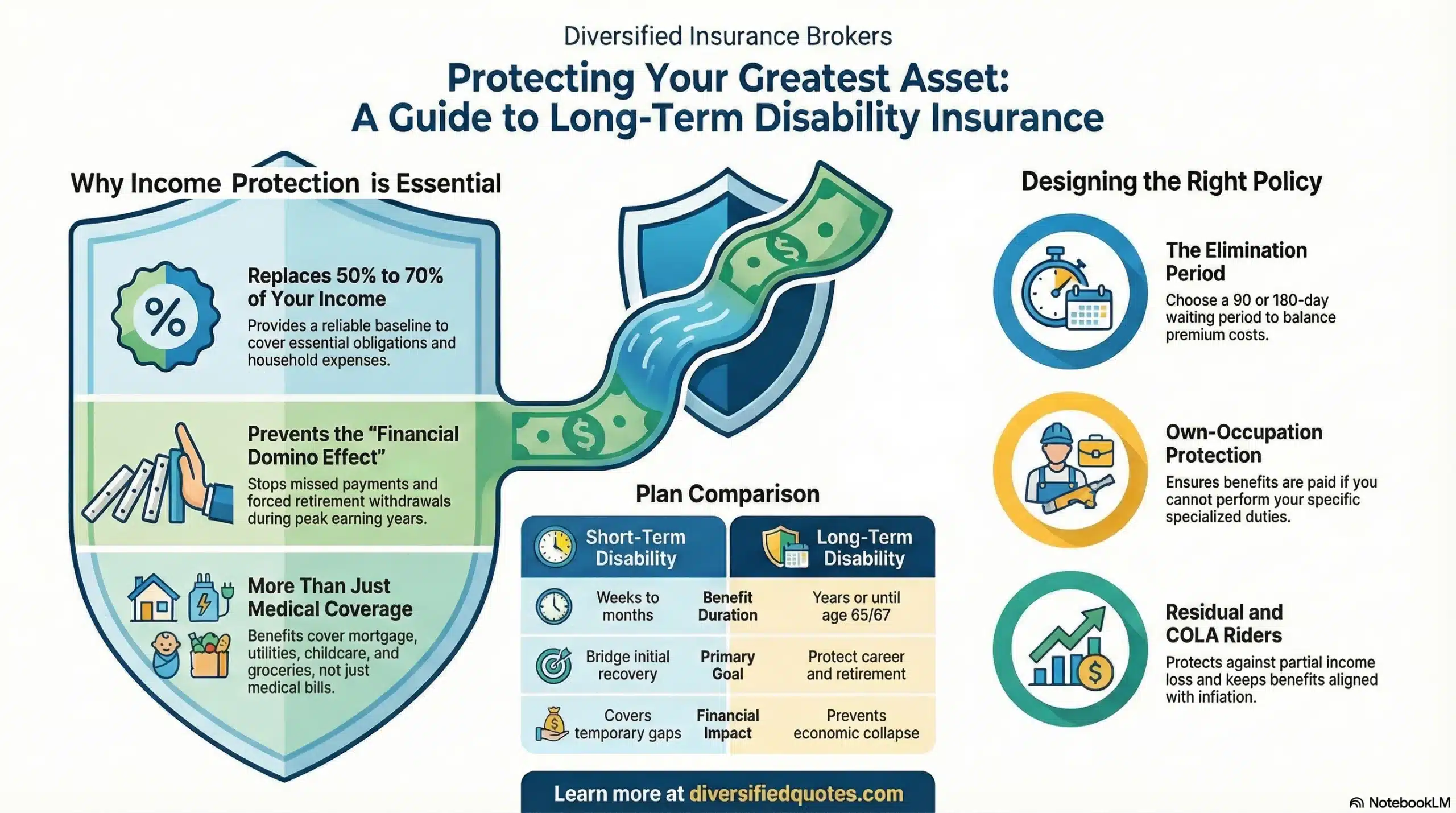
Talk With an Advisor Today
Choose how you’d like to connect—call or message us, then book a time that works for you.
Schedule here:
calendly.com/jason-dibcompanies/diversified-quotes
Licensed in all 50 states • Fiduciary, family-owned since 1980
FAQs: Disability Insurance for Candle Makers
Can candle makers actually qualify for disability insurance?
Yes — candle makers can qualify for individual disability insurance through carriers that underwrite production-based and artisan craft occupations. The occupational class assignment will typically fall in the middle tiers of the carrier’s schedule rather than the top tier reserved for office-based professionals, which affects the available monthly benefit maximum, the premium rate, and in some cases the benefit period options available. However, a middle-tier classification is not a barrier to obtaining meaningful coverage — it is simply the underwriting reality of a hands-on production occupation with documented physical demands. The most important step is working through an independent broker who can compare how multiple carriers classify and price candle making specifically, rather than submitting to a single carrier and accepting whatever terms come back as though they represent the market as a whole.
Income documentation is the other key factor for candle makers who are self-employed. Carriers determine the maximum approvable monthly benefit based on earned income documented through tax returns, Schedule C filings, or business financials. A candle maker who has operated their business for two or more years with consistent documented income will generally have more benefit capacity available than one in early-stage revenue growth. Working with a broker who understands how to present production business income to underwriters — including adjustments for business expenses and owner draw structures — produces stronger underwriting results than a direct application that does not account for these nuances.
Does workers’ compensation cover a candle maker who is injured or becomes ill?
For most candle makers, workers’ compensation provides little or no protection — and understanding exactly why clarifies why individual disability insurance is so important. Sole proprietors and single-member LLC owners are typically not covered by their own workers’ compensation policy unless they specifically elect owner coverage, which most small-scale operators never do. This means the person whose disability would eliminate the business’s revenue is operating entirely outside the workers’ comp system. Even for candle makers who have employees and carry workers’ comp, the owner’s own coverage gap remains unless they have structured it intentionally.
The second issue is structural rather than an ownership question: workers’ compensation covers only work-related injuries and occupational diseases — not illness-based disability, not off-duty injury, not health conditions that develop independently of a specific workplace incident. Since approximately 90 percent of long-term disabling conditions are illness-based rather than traumatic-injury-based, workers’ comp is systemically incapable of addressing the majority of the disability risk any candle maker actually faces. A candle maker diagnosed with a serious illness unrelated to a specific workplace event receives zero workers’ comp benefit regardless of how comprehensive their workers’ comp policy is. Individual disability insurance is the structure that fills this gap because it covers disability from any qualifying cause — illness, injury, or occupational disease — without requiring the condition to originate from a specific workplace incident.
What is business overhead expense insurance and do candle makers need it?
Business overhead expense insurance — BOE coverage — is a disability insurance product specifically designed for business owners that pays a monthly benefit to cover the fixed operating costs of the business when the owner becomes disabled and cannot work. For a candle making business owner, this means studio rent, equipment leasing costs, utility bills, employee wages, supply platform subscriptions, and other overhead obligations that continue whether the owner is producing or not. BOE coverage does not replace the owner’s personal income — that function belongs to the individual disability income policy — but it prevents the business infrastructure from collapsing during the disability period by funding the overhead that the revenue stream has stopped covering.
Whether a candle maker needs BOE coverage depends primarily on the size and structure of their overhead obligations. A home studio operator with minimal fixed costs has a smaller BOE need than a production space operator with monthly rent, employee payroll, and equipment leasing commitments. The key question is: if you could not produce for six months, which costs would continue automatically? That calculation — not a general rule of thumb — drives the appropriate BOE benefit amount. For candle makers who have built meaningful production operations with real overhead exposure, BOE insurance is frequently the difference between a disability that temporarily pauses the business and one that permanently ends it. An independent broker can calculate the appropriate BOE benefit amount based on the actual cost structure of the specific operation.
What specific injuries or conditions are most likely to disable a candle maker?
The disability pathways most relevant to candle makers fall into four categories based on the physical demands of the work. First, burn injuries from hot wax contact — the most acute single risk — can range from minor contact burns to more significant hand and forearm injuries affecting grip strength, fine motor control, and the ability to perform the precision movements that candle making requires. Second, repetitive strain conditions affecting the wrists, forearms, and shoulders from the cumulative effect of hundreds of pouring, wick-setting, labeling, and packaging movements per production session — conditions like carpal tunnel syndrome and tendinitis that develop gradually and require treatment and recovery time that halts production. Third, back and lower extremity conditions from extended standing during production runs and from lifting wax, glass containers, and shipping inventory — conditions that can develop into chronic pain requiring treatment and limiting the sustained standing the work demands.
Fourth, and frequently overlooked, respiratory and airway conditions from sustained daily exposure to fragrance oils, volatile organic compounds, and paraffin vapors during heating and pouring — conditions including occupational asthma and fragrance sensitization that can develop in workers with cumulative inhalation exposure over time. These respiratory conditions are entirely illness-based under the workers’ compensation framework, meaning they generate no workers’ comp benefit even though they arise directly from the conditions of the work itself. Beyond these occupational pathways, the approximately 90 percent of long-term disabilities that are illness-based — cancer, cardiac conditions, neurological disorders, immune conditions — affect candle makers at population-average rates regardless of the work they do, and represent the dominant risk category from a pure probability standpoint.
How does a candle maker document income for disability insurance underwriting?
Income documentation for candle makers follows the standard self-employed underwriting process, which uses tax returns and business financials rather than pay stubs or W-2 forms. For sole proprietors, the primary income documentation is typically two years of personal tax returns including Schedule C, which reports net business profit after deductible expenses. Carriers determine the maximum approvable monthly benefit based on a percentage of this documented net income — typically 60 to 70 percent of earned income — so the documented income level directly caps the available benefit amount.
For candle makers operating as LLCs or S-corporations, business financials including profit and loss statements and K-1 distributions may also be required. One common challenge for small artisan businesses is that aggressive expense deduction strategies — which make excellent tax sense — reduce the documented net income figure that carriers use to calculate benefit capacity. A candle maker who takes every available deduction may find that their documented income is substantially lower than their actual economic production, which in turn limits the disability benefit they can obtain. An independent broker who works regularly with self-employed applicants understands how to navigate this income documentation question and can guide the application process to present the strongest accurate picture of income for underwriting purposes. Planning this documentation process before submitting an application — rather than discovering the income limitation after the fact — produces the best coverage outcomes.
Is disability insurance for candle makers expensive?
The premium for an individual disability insurance policy for a candle maker will depend on several factors: the occupational class assigned by the carrier, the monthly benefit amount selected, the elimination period chosen, the benefit period length, and the rider package added to the core policy. As a general principle, individual disability insurance premiums for middle-tier occupational classifications are higher per dollar of benefit than for top-tier white-collar professionals, because the physical demands and injury probability of production-based work represent a higher claims likelihood that is reflected in the pricing. That said, the cost should be evaluated in proportion to the income being replaced — a policy that provides several thousand dollars per month in disability benefits during a qualifying disability is protecting an asset that the business fundamentally cannot operate without.
The most effective way to assess the true cost of disability insurance for a candle making operation is to compare multiple carrier offerings through an independent broker who can obtain actual quotes based on the specific occupational class, income, age, health history, and coverage structure. Premium differences between carriers for the same coverage terms can be meaningful, and the occupational class one carrier assigns to candle making may differ from another’s — both of which affect the final cost. The question most candle makers should be asking is not simply what the policy costs but what the absence of coverage would cost in the scenario it is designed for: a disability that stops production for six months, a year, or longer, with no income floor in place and full overhead continuing.
About the Author:
Jason Stolz, CLTC, CRPC, DIA, CAA and Chief Underwriter at Diversified Insurance Brokers (NPN 20471358), is a senior insurance and retirement professional with more than 25 years of real-world experience helping individuals, families, and business owners protect their income, assets, and long-term financial stability. As a long-time partner of the nationally licensed independent agency Diversified Insurance Brokers, Jason provides trusted guidance across multiple specialties—including fixed and indexed annuities, long-term care planning, personal and business disability insurance, life insurance solutions, Group Health, Travel Medical and Evacuation Insurance, and short-term health coverage. Diversified Insurance Brokers maintains active contracts with over 100 highly rated insurance carriers, ensuring clients have access to a broad and competitive marketplace.
His practical, education-first approach has earned recognition in publications such as VoyageATL, and contributions from his agency featured in Kiplinger and GoBankingRates— highlighting his commitment to financial clarity and client-focused planning. Drawing on deep product knowledge and years of hands-on field experience, Jason helps clients evaluate carriers, compare strategies, and build retirement and protection plans that are both secure and cost-efficient. Visitors who want to explore current annuity rates and compare options across multiple insurers can also use this annuity quote and comparison tool.
Explore More Disability Insurance Options: Browse our complete guide to Disability Insurance for Food, Hospitality, Arts & Entertainment — covering chefs, musicians, actors, bartenders, hospitality workers & entertainment professionals from 100+ carriers.
Last Reviewed: June 6, 2026 |
Reviewed by: Jason Stolz, CLTC, CRPC, DIA, CAA
Chief Underwriter, Diversified Insurance Brokers, Inc. | NPN: 20471358 | Diversified Insurance Brokers, Inc. — Licensed in all 50 states
Fact Checked by: Tonia Pettitt, CMIP©
Medicare Specialist, Diversified Insurance Brokers, Inc. | NPN: 14374308 | Diversified Insurance Brokers, Inc. — Licensed in all 50 states
Did you find this content helpful? Leave us a Google review — it helps others find trustworthy guidance too.
Editorial Standards: Diversified Insurance Brokers maintains rigorous editorial standards to ensure accuracy, clarity, and independence in all content. Learn more about our editorial standards and commitment to transparency.
