
Long Term Disability Insurance
As an Independent Disability Insurance Broker, we have access to exclusive discounts and negotiated pricing most captive agents can’t offer — see the full breakdown near the end of this page.
Long Term Disability Insurance

Jason Stolz CLTC, CRPC, DIA, CAA
When an unexpected illness or injury prevents you from working, the financial impact can hit fast — and then linger for years. Long-term disability insurance is designed for that exact risk: it replaces a portion of your income when you cannot work for an extended period, helping you maintain your mortgage, bills, and day-to-day obligations without draining retirement accounts or relying on family. At Diversified Insurance Brokers, we compare coverage across 100+ top-rated carriers so self-employed professionals, executives, medical specialists, and families can build a plan that fits their income, occupation, and budget. If you are self-employed or lack strong employer benefits, the disability insurance for self-employed guide covers the income documentation and plan structure considerations specific to independent earners and business owners — this page focuses on LTD design, definitions, and riders across all income types and employment structures.
Most people understand the need for life insurance, but disability risk is often the bigger threat to a financial plan because it can happen during peak earning years and last long enough to disrupt everything from college funding to retirement contributions. The risk is not abstract: approximately one in four workers entering the workforce today will experience a qualifying disability before reaching retirement age, according to Social Security Administration data. That statistic applies equally to the office worker with a back condition, the physician with a neurological disorder, the attorney with a chronic illness, and the contractor whose injury prevents physical work. Long-term disability coverage is not just a policy — it is an income strategy. A complete look at how that strategy fits together starts with the income protection insurance overview, which covers the full framework of disability income planning for both individuals and businesses.
Compare Long-Term Disability Insurance Options
Tell us your income and occupation — we’ll match you to realistic long-term coverage designs based on your specific goals.
Request a Disability QuoteLong-Term Disability Insurance — Key Plan Design Decisions
Two people can both “have long-term disability insurance” and end up with dramatically different real-world protection. The difference comes down to the design decisions inside the policy — the decisions that determine how the policy behaves during a claim, especially when recovery is gradual or a condition affects capacity more than it eliminates work entirely.
| Plan Design Element | Options | What It Controls | Planning Guidance |
|---|---|---|---|
| Definition of disability | Own-occupation; modified own-occupation; any-occupation | Whether benefits pay if you can perform some work but not your specific job; how “disabled” is defined for claim purposes | Own-occupation is most protective for specialized professionals; any-occupation is cheaper but harder to qualify under for high-skill careers; definition matters more than almost any other feature for physicians, dentists, attorneys, and technical specialists |
| Elimination period | 30, 60, 90, 180 days (some plans offer 365 days for lower premium) | How long you must be disabled before benefits begin; functions like a time-based deductible | 90 days is the most common balance between affordability and practicality; the elimination period should not exceed what emergency savings and any short-term disability coverage can bridge; coordinate with employer STD so there is no gap |
| Benefit period | 2 years; 5 years; 10 years; to age 65; to age 67 | How long benefits can continue during an ongoing qualifying disability; determines whether the policy covers a career-ending condition through retirement age | To-age-65 or to-age-67 provides the strongest protection against career-ending disability; 2-year and 5-year periods leave a large gap if disability becomes long-term; for younger professionals the premium difference between 5-year and to-65 coverage is often smaller than expected |
| Monthly benefit amount | Typically 50–70% of pre-disability gross income; carrier-specific maximums by occupation class | How much income is replaced monthly during a qualifying disability; cannot exceed verified earned income; capped at 70% to preserve return-to-work incentive | Size to actual essential monthly expenses rather than maximizing; individually owned policies with after-tax premiums produce tax-free benefits, making 60% gross replacement equivalent to a higher percentage of actual take-home pay |
| Residual / partial disability | Residual disability rider; partial disability provision; recovery benefit | Whether benefits pay when you can work in a reduced capacity but suffer income loss; triggered when income loss exceeds 20-25% of pre-disability earnings | One of the most valuable features in real claims scenarios; many actual disabilities involve reduced capacity and reduced income rather than complete inability to work; especially important for self-employed individuals and professionals whose income directly tracks production |
| Cost-of-living adjustment (COLA) rider | Fixed percentage increase (typically 3%); CPI-linked; simple vs. compound | Increases benefit amount annually during a long-term claim to offset inflation; without COLA, a benefit adequate in year one can feel tight by year five or ten of a disability | More important the younger the policyholder and the longer the potential claim duration; adds meaningful cost but protects long-duration benefit purchasing power; compound COLA structures build value faster than simple structures |
| Future increase option (FIO) | Guaranteed future purchase right without new medical underwriting; typically exercisable every 1-3 years up to a defined age or benefit cap | Allows benefit amount to grow with income over time; if health changes after policy purchase, the FIO preserves the right to buy more coverage regardless of new health status | Critical for early-career professionals and growing business owners; the FIO purchased now protects the right to expand coverage even if a future health event would otherwise prevent it; use it during periods of meaningful income growth |
| Policy form | Non-cancellable and guaranteed renewable; guaranteed renewable; conditionally renewable | Whether the carrier can change premium or definitions after issue; non-cancellable locks both premium and terms; guaranteed renewable locks terms but allows class-rate adjustments; conditionally renewable gives the carrier more flexibility | Non-cancellable and guaranteed renewable is the strongest form and the baseline standard for quality individual LTD policies; confirm policy form before purchase as it determines what can change after issue |
Policy terms, definitions, benefit amounts, and available riders vary by carrier and state. Individual disability income policies are underwritten based on medical history, prescription records, occupational duties, and financial documentation. This table is educational and does not constitute a quote, coverage commitment, or income projection.
Why Long-Term Disability Insurance Matters
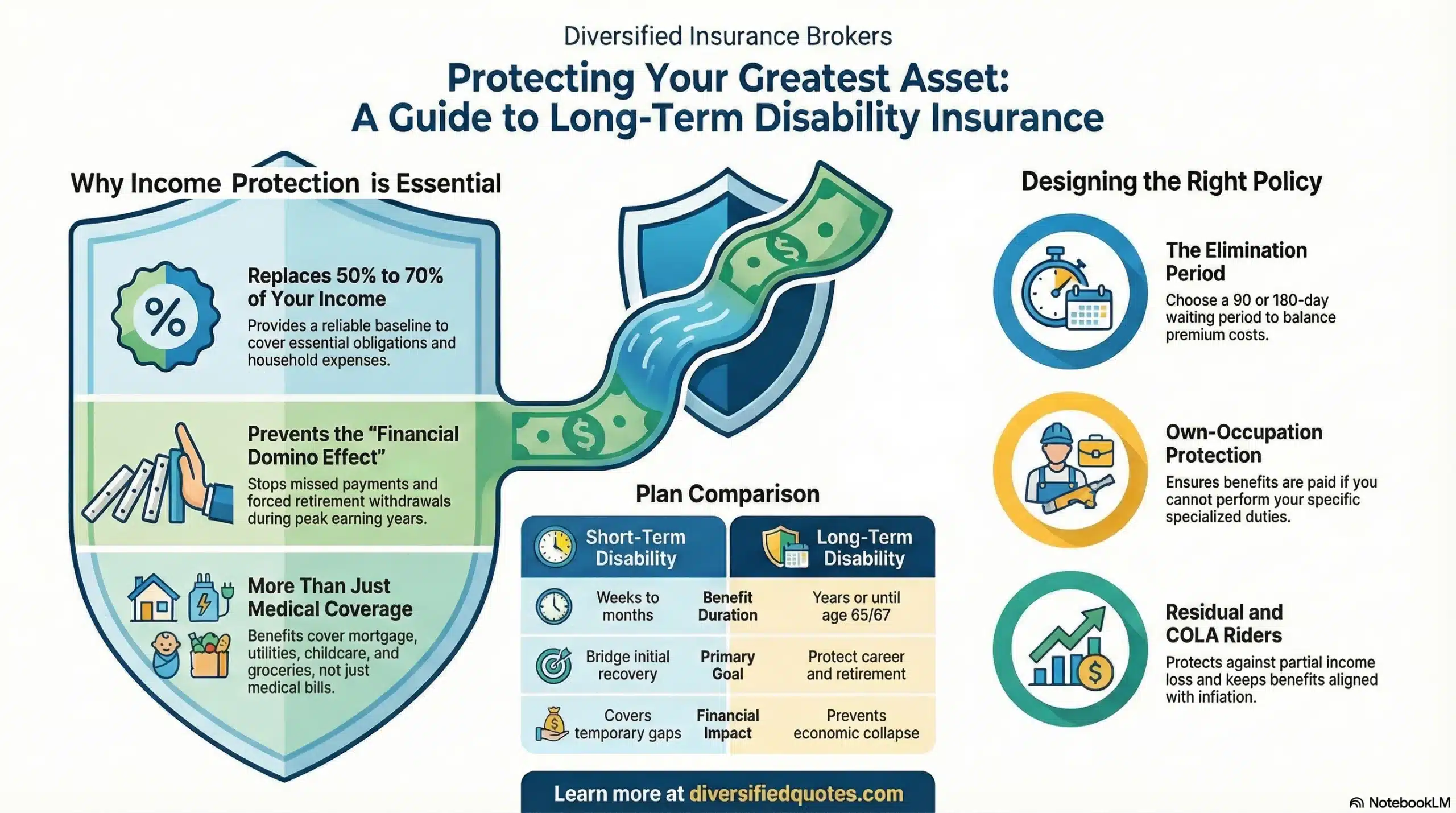
Long-term disability insurance solves one core problem: how does your household and financial plan stay stable if your ability to earn income is interrupted for months or years? The goal is not to replace every dollar — it is to create a reliable baseline of income that covers essential obligations and prevents the financial dominoes that start when a paycheck stops. Expenses rarely drop proportionally when income does. Medical appointments, specialist travel, new prescriptions, or modified work arrangements can add costs at exactly the same time cash flow falls. For high-income earners, the risk extends beyond monthly bills — it threatens the future. A long disability can stall wealth-building, reduce retirement savings, delay a practice expansion, or create a gap that forces rushed financial decisions. Business owners and practice owners face an additional layer: when you stop working, the business overhead does not stop with you. Rent, payroll, equipment leases, and loan payments continue regardless of whether you are in the office. Pairing personal LTD with Business Overhead Expense coverage can keep fixed costs covered while you recover — these two policies address different problems and are commonly structured together for practice owners and business operators. The broader income protection planning context for high earners who carry both personal and business disability exposure is covered at disability insurance for high earners and business owners.
What Long-Term Disability Insurance Actually Covers
A long-term disability policy pays a monthly benefit after the elimination period when you meet the policy’s definition of disability. Benefits continue for a defined period — ranging from a few years to age 65 or 67 — while the qualifying disability continues. Unlike health insurance, which pays providers for medical care, long-term disability pays you directly. Once a claim is approved, benefits can be used for mortgage payments, utilities, food, childcare, health insurance premiums, debt obligations, and any other expenses. There is no restriction on how benefits are spent. The part of the policy that matters most — often more than premium — is the definition of disability. This determines how hard it is to qualify for benefits and whether you can receive benefits if you are still capable of some form of work. Many professionals prioritize an own-occupation disability definition, which pays benefits when you cannot perform the material duties of your specific occupation even if you can work in another capacity. Professionals whose income depends on specialized duties — surgical procedures, technical production, legal representation, precision instrumentation — need this definition because a career-limiting condition may not prevent all work. The stakes of the definition are illustrated clearly in a specialty context: for a dentist with a hand tremor, a cardiologist with a tremor disorder, or an attorney with a cognitive condition, the difference between own-occupation and any-occupation can mean the difference between a compensated claim and a denied one. The disability insurance for physicians page covers this dynamic in a medical practice context where it is most pronounced.
Long-Term vs. Short-Term Disability — Why the Distinction Matters
Short-term disability is designed for the early stage of an interruption — weeks to a few months. Long-term disability is designed for the bigger, longer risk: a health event that persists long enough to threaten your financial plan and long-term stability. The short-term vs. long-term disability insurance comparison covers the structural differences, where each type fits, and how the two coordinate in a complete income protection plan. A short-term plan helps you get through initial recovery. A long-term plan keeps life stable if the condition becomes extended, recurring, or career-altering. For those who want a self-directed purchase option for short-term coverage, how to buy short-term disability insurance online covers available options — and this LTD page addresses what happens when recovery takes longer than short-term coverage spans.
Who Needs Long-Term Disability Coverage
If you rely on earned income — whether from a salary, business revenue, professional fees, or contract work — and your household expenses would become difficult to sustain without that income for an extended period, you are a candidate for long-term disability insurance. The need strengthens when income is higher, expenses are fixed, or the household depends on a primary earner. It becomes more acute when your work requires physical, cognitive, or technical performance that could be impaired by conditions ranging from cancer and cardiovascular events to musculoskeletal injuries and neurological disorders. The argument for coverage does not depend on extreme scenarios — it depends on whether the math of your household still works if your paycheck stops for 12, 24, or 36 consecutive months. Why you need disability insurance even if you are young and healthy addresses the most common objection among early-career earners who assume disability is a distant risk. Self-employed individuals and independent contractors often have the greatest exposure, since there is no employer plan to fall back on and income verification for underwriting requires more documentation — disability insurance for the self-employed covers both the planning and the underwriting dimension. Executives and high-income professionals should pay close attention to benefit caps, whether variable compensation is considered for sizing, and whether existing group coverage is portable — disability insurance for executives covers those specifics. Independent contractors, freelancers, and gig workers without any employer benefits have particular exposure that disability insurance for 1099 workers addresses. For roles with higher physical risk, long-term disability remains available but occupational class affects definitions and pricing — disability income insurance for law enforcement and disability income insurance for firefighters cover how coverage works for higher-risk public service roles. The full occupational class landscape across all professions is covered at disability insurance by occupation.
Plan Design Elements That Change Real-World Outcomes
The elimination period — typically 90 or 180 days for most LTD policies — is the waiting period before benefits begin. Choosing the right one requires honest assessment of what savings, employer coverage, and short-term disability can bridge during that window. The full mechanics of how elimination periods work and how to size the right waiting period are covered at disability insurance elimination periods explained. The residual and partial disability rider is often more valuable in practice than people initially realize — because most real-world disabilities involve reduced capacity and reduced income rather than complete inability to work. A physician who can see patients three days per week instead of five, a consultant whose cognitive effects limit project load, or a contractor whose injury limits physical hours all have partial disability exposures that only residual coverage addresses. How these benefits calculate and trigger is covered at residual disability insurance benefits explained. The cost-of-living adjustment (COLA) rider matters most for long-duration claims — a monthly benefit that felt adequate at claim onset can feel meaningfully different five or ten years into a disability without inflation protection. Disability income insurance with COLA covers how the rider works, the different structures available, and when the added cost is justified. The future increase option allows you to add coverage as income grows without repeating medical underwriting — protecting the right to expand benefits even if health changes after the original policy is issued. This feature is covered at disability insurance future insurability rider. A complete overview of how all riders interact and which ones solve specific claim scenarios is at disability insurance riders explained.
How Much Income Can Long-Term Disability Replace
Long-term disability policies commonly aim to replace 50–70% of pre-disability earned income, but the amount you can purchase depends on carrier guidelines, verified income, and occupation class. The right benefit level is less about maximizing coverage and more about building a benefit that protects essential expenses, keeps savings intact, and coordinates with any existing group coverage. When LTD benefits are paid from an individually owned policy where premiums were paid with after-tax dollars, those benefits are generally received income-tax-free — meaning a 60% gross income replacement functions closer to a higher percentage of actual take-home pay. The tax treatment of disability benefits across individual policies, employer group plans, and business-owned structures is covered at are disability insurance payments taxable. If you already have employer group LTD, it is worth reviewing how much you would actually receive after plan caps, offsets, and the taxability that applies when employers pay the premium. Many group plans have monthly maximums that create a larger gap as income rises, and they do not travel with you if you change jobs. Working through how much disability insurance you need can help frame the decision around actual household expenses and risk windows rather than generic percentage rules. For underwriting, most LTD policies require a medical exam for larger benefit amounts or where health history creates complexity — does disability insurance require a medical exam covers what the process looks like and when simplified underwriting is available instead.
Pricing — What Drives Premium and How to Evaluate Cost
Long-term disability pricing depends on age, health history, occupation class, income level, benefit amount, elimination period, benefit period, and rider selection. In general, the more protective the definition and the longer the benefit duration, the higher the premium — because the insurer is taking on a larger and more valuable risk. What surprises most buyers is that the best cost management strategy is not stripping features down until the policy is cheap. It is selecting the right levers: an elimination period you can genuinely bridge, a benefit level that covers essential obligations, and riders that solve real claim scenarios in your income model. Is disability insurance expensive addresses realistic pricing expectations across income levels and occupation types, and how to choose the right disability insurance policy covers the decision framework for comparing carriers on definition strength, rider availability, and policy form — the factors that matter most in real claims rather than the headline premium. For those who qualify for programs that allow coverage without a full medical application, no-exam disability insurance covers what is available and where the tradeoffs are versus fully underwritten policies.
Special Considerations for Business Owners and Practice Professionals
Business owners need to run two analyses when evaluating disability risk: personal cash flow and business continuity. Personal LTD protects the household. It does not cover rent, payroll, equipment leases, or the fixed obligations the business carries regardless of whether you are working. That is the role of Business Overhead Expense coverage. For companies where one person drives a meaningful share of revenue, client relationships, or operational decisions, the business also needs to evaluate key person disability insurance as a separate tool that funds the cost of the disruption rather than just covering overhead. These three tools — personal LTD, BOE, and key person DI — solve three different problems and are structured together in a complete business disability plan. For dental professionals, whose clinical income depends on fine motor precision and physical endurance in ways that create specific own-occupation claim scenarios, disability insurance for dentists covers the specialty-specific design considerations. For accountants and financial professionals whose work can be disrupted by cognitive conditions that would not qualify under any-occupation definitions, disability income insurance for accountants covers the definition and career-specific underwriting dimensions. The full framework for disability planning as it applies across the income spectrum starts at the disability insurance services hub, and if you have an existing quote or policy you want independently evaluated before committing, get a 2nd opinion on your disability insurance quote covers the review process.
Talk With an Advisor Today
Choose how you’d like to connect—call or message us, then book a time that works for you.
Schedule here:
calendly.com/jason-dibcompanies/diversified-quotes
Licensed in all 50 states • Fiduciary, family-owned since 1980
FAQs: Long-Term Disability Insurance
What is long-term disability insurance?
Long-term disability insurance pays a monthly benefit when a covered illness or injury prevents you from working for an extended period — typically after a waiting period (elimination period) of 90 to 180 days. Benefits can continue for a defined number of years, or potentially until a target age such as 65 or 67, depending on the policy. Unlike health insurance that pays medical providers, LTD pays you directly so you can cover mortgage payments, household expenses, and financial obligations while you recover.
How does long-term disability differ from short-term disability?
Short-term disability covers temporary income loss — typically weeks to a few months — and is often employer-provided. Long-term disability is designed for extended claims, usually beginning after the short-term period ends (commonly after 90 days or more) and potentially lasting years or until retirement age. Many people have both: employer short-term coverage bridges the initial gap, and an individual long-term policy covers the larger, more financially significant risk if recovery takes longer than expected.
What does “own-occupation” mean and why does it matter?
Own-occupation means the policy pays benefits if you cannot perform the material duties of your specific occupation — even if you can work in another capacity. For a surgeon with a hand tremor, an attorney with a cognitive condition, or a dentist with a wrist injury, this definition can be the difference between a paid claim and a denial. Any-occupation definitions are cheaper but require that you be unable to work in any occupation for which you are reasonably suited by education, training, or experience — a much higher bar for claim qualification that can effectively exclude many career-limiting conditions for specialized professionals.
How much of my income can long-term disability replace?
Most long-term disability policies replace 50–70% of pre-disability gross income, with carriers capping benefits at 70% to maintain the incentive to return to work. The right amount is sized to your actual essential monthly expenses rather than maximizing coverage. When benefits come from an individually owned policy paid with after-tax dollars, they are generally income-tax-free — meaning 60% gross replacement effectively covers a higher percentage of take-home pay depending on your tax bracket. If you already have employer group LTD, check the monthly cap and whether the benefits would be taxable, since employer-paid premiums typically make benefits taxable.
What is residual or partial disability coverage?
Residual disability coverage pays proportional benefits when you can still work but at a reduced capacity that causes meaningful income loss — typically triggered when income drops by 20–25% or more from a covered condition. Most people imagine disability as all-or-nothing, but a large share of real claims involve partial return to work where income is reduced but not eliminated. Without a residual rider, a policy only pays during total disability. With it, a professional who can work part-time but cannot maintain full production receives a benefit proportional to the income loss — making residual coverage one of the most practically valuable features in individual LTD policies.
Should I buy long-term disability insurance if I have coverage through work?
Employer group LTD often leaves meaningful gaps worth understanding before assuming coverage is sufficient. Most group plans have monthly benefit caps that leave a significant income gap for higher earners. Many group plans shift from own-occupation to any-occupation definitions after two years, dramatically narrowing claim eligibility. Group plan benefits are typically taxable when the employer pays the premium. Group plans are not portable — they end when employment ends. An individual policy can fill these gaps and follow you through career changes, providing stronger definitions, more customizable riders, and benefits that stay with you regardless of employment status.
About the Author:
Jason Stolz, CLTC, CRPC, DIA, CAA and Chief Underwriter at Diversified Insurance Brokers (NPN 20471358), is a senior insurance and retirement professional with more than 25 years of real-world experience helping individuals, families, and business owners protect their income, assets, and long-term financial stability. As a long-time partner of the nationally licensed independent agency Diversified Insurance Brokers, Jason provides trusted guidance across multiple specialties—including fixed and indexed annuities, long-term care planning, personal and business disability insurance, life insurance solutions, Group Health, Travel Medical and Evacuation Insurance, and short-term health coverage. Diversified Insurance Brokers maintains active contracts with over 100 highly rated insurance carriers, ensuring clients have access to a broad and competitive marketplace.
His practical, education-first approach has earned recognition in publications such as VoyageATL, and contributions from his agency featured in Kiplinger and GoBankingRates— highlighting his commitment to financial clarity and client-focused planning. Drawing on deep product knowledge and years of hands-on field experience, Jason helps clients evaluate carriers, compare strategies, and build retirement and protection plans that are both secure and cost-efficient. Visitors who want to explore current annuity rates and compare options across multiple insurers can also use this annuity quote and comparison tool.
Browse More Resources: Return to our complete Health Insurance, Dental, Vision & Disability guide — covering short term health, dental, vision, group health & disability.
Last Reviewed: June 5, 2026 |
Reviewed by: Jason Stolz, CLTC, CRPC, DIA, CAA
Chief Underwriter, Diversified Insurance Brokers, Inc. | NPN: 20471358 | Diversified Insurance Brokers, Inc. — Licensed in all 50 states
Fact Checked by: Tonia Pettitt, CMIP©
Medicare Specialist, Diversified Insurance Brokers, Inc. | NPN: 14374308 | Diversified Insurance Brokers, Inc. — Licensed in all 50 states
Did you find this content helpful? Leave us a Google review — it helps others find trustworthy guidance too.
Editorial Standards: Diversified Insurance Brokers maintains rigorous editorial standards to ensure accuracy, clarity, and independence in all content. Learn more about our editorial standards and commitment to transparency.
