
Disability Insurance for 1099 Workers
As an Independent Disability Insurance Broker, we have access to exclusive discounts and negotiated pricing most captive agents can’t offer — see the full breakdown near the end of this page.
Disability Insurance for 1099 Workers

Jason Stolz CLTC, CRPC, DIA, CAA
Disability insurance for 1099 workers is one of the most important types of protection a self-employed person can put in place, because your income is not guaranteed by an employer and your bills do not stop if you cannot work. When you earn money as an independent contractor, freelancer, consultant, gig worker, or commission-based professional, your ability to produce is the entire foundation of your financial plan. You may have built a great business, a strong pipeline, and a steady client base — but even one unexpected medical issue can interrupt your income in a way that is hard to recover from quickly. For many 1099 workers, that risk is even higher because there is typically no paid sick leave, no employer-funded long-term disability benefit, and no payroll system supporting income when you are out of work. The disability insurance services available to independent professionals are specifically designed for this situation, and the income protection insurance framework covers how individual policies are structured for workers whose income flows through 1099s and Schedule C rather than a W-2.
The scale of this coverage gap is significant. As of 2025, approximately 70.4 million Americans are freelancing — representing roughly 36% of the entire U.S. workforce. Full-time independent workers more than doubled from 13.6 million in 2020 to 27.7 million in 2024. The freelance workforce is projected to reach 86.5 million — approximately 50% of all U.S. workers — by 2027. A Freelancers Union survey found that nearly 70% of independent workers report feeling financially vulnerable due to inadequate insurance coverage. That vulnerability is concentrated in disability: unlike health insurance, which many 1099 workers purchase individually through the ACA marketplace or other sources, disability income replacement — the benefit that actually replaces your paycheck when illness or injury prevents work — is almost universally absent from the self-employed worker’s protection structure. At Diversified Insurance Brokers, we help 1099 workers nationwide design disability income insurance that fits how contractors actually earn money: through self-employed income structures, variable revenue, and independent contractor arrangements that require a fundamentally different approach to income protection than employer-sponsored group coverage.
Get Disability Options Built for 1099 Income
Compare individual DI designs for contractors, freelancers, and commission-based earners — nationwide.
Request a DI QuoteDisability Insurance for 1099 Workers — How Coverage Design Differs From W-2 Arrangements
| Dimension | W-2 Employee | 1099 / Self-Employed Worker |
|---|---|---|
| Employer disability coverage | Often receives employer-funded group short-term and/or long-term disability; may have 60% income replacement to a monthly cap as an automatic benefit | No employer plan — starts from zero; individual policy is the entire income protection structure, not a supplement to an existing group benefit |
| Income documentation | W-2 and pay stubs verify income; straightforward underwriting process for the employer-provided benefit amount | Tax returns (Schedule C or S-corp K-1) required; 2-year average income used; aggressive deductions that reduce taxable net income also reduce eligible benefit amount |
| Income continuity when disabled | Salary may continue through paid sick time, PTO, FMLA, or short-term disability before LTD activates; meaningful bridge before full income loss | Income typically stops immediately when production stops; no bridge mechanism; elimination period must be sized against actual cash reserves |
| Policy portability | Group coverage ends when employment ends; may lose coverage between jobs or when changing employers | Individually owned policy follows the contractor through all client changes, career transitions, and business structure changes without re-underwriting |
| Business overhead exposure | No business overhead to protect; disability income replaces the entire financial exposure during a disability | Fixed business costs (rent, software, staff, professional licenses, marketing) continue even when income stops; personal LTD plus Business Overhead Expense coverage required for complete protection |
| Tax treatment of benefits | Benefits from employer-paid group LTD are typically taxable income; the 60% replacement further reduced by taxes at claim time | Benefits from individually owned policies with after-tax premiums are generally received income-tax-free; every dollar of benefit is available for use without a tax reduction |
| Benefit sizing control | Group plan sets the benefit amount at a fixed percentage of salary up to a cap; individual has no design input | Individual policy can be designed around actual documented income, household obligations, and existing savings to build the right replacement amount for the specific financial situation |
Why Disability Insurance Matters More for 1099 Workers Than W-2 Employees
One of the biggest differences between 1099 workers and W-2 employees is benefits access. Many W-2 employees receive at least some employer-sponsored disability coverage — even though group LTD often has limitations, the existence of that baseline provides a starting point. When you are a 1099 worker, you typically start from zero. No group plan. No company-funded monthly benefit. No HR department helping you file a claim. That means you are responsible for building your own income protection plan from the ground up.
Another major difference is how quickly income can fall off for contractors. When you are self-employed, income is tied to active production. If you stop producing, you stop earning. A salaried employee might continue receiving income during sick time, PTO, or a short employer leave program. A 1099 worker often has none of that. Even with a strong book of business, recurring revenue, or retainer clients, a personal health issue can still create major financial disruption because you may be unable to manage relationships, close deals, perform physical work, or meet deadlines. Disability insurance for 1099 workers exists to replace a portion of that income so you can keep your life stable while you recover.
We also see many self-employed people underestimate the ripple effects of a disability. A disability does not always mean permanent loss of work capacity — many times it is temporary: surgery recovery, injury, chronic pain flare-ups, complications from an illness, mental health challenges, or a long-term condition can reduce work ability for months. For independent contractors, that creates lost clients, lost referrals, and a longer-term decline in momentum even after you return. The right disability policy can prevent a short-term health situation from becoming a permanent financial setback by maintaining stability throughout the recovery period. How benefits are defined and paid is covered at own-occupation disability insurance, where the definition of disability — not just the benefit amount — determines whether a realistic contractor income interruption triggers a compensable claim.
What Disability Insurance for 1099 Workers Actually Covers
Disability income insurance pays a monthly benefit if you cannot work due to sickness or injury. That benefit helps replace your income during the disability period, subject to the elimination period, definition of disability, and benefit period chosen at application. It is not health insurance — it does not pay for medical care. It is not workers’ compensation — which applies to job-related injuries for employees and may not apply to independent contractors the same way. It is specifically designed to replace earned income when you cannot perform your work duties, regardless of whether the disabling condition is work-related.
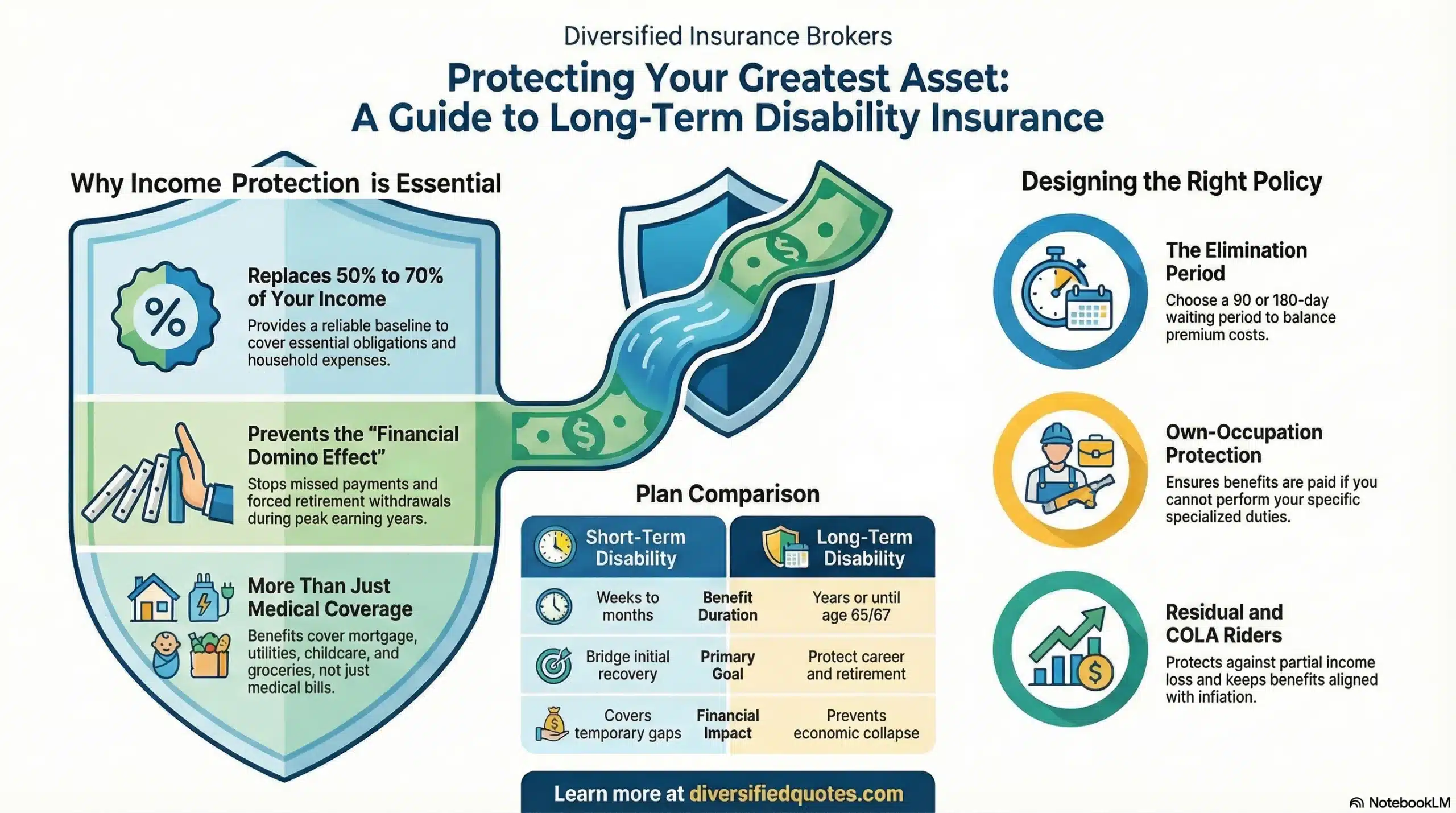
For 1099 workers, the most common type of coverage is an individual disability insurance policy — a personal policy you own and control, not tied to any employer or client relationship. It follows you through career transitions, client changes, and business restructuring. The benefit amount is typically set at 50-70% of documented net earned income, sized to replace the income that covers essential household and business obligations. Long-term disability insurance with a benefit period to age 65 or 67 provides the strongest protection against extended or career-ending conditions. Short-term disability coverage addresses the acute initial recovery phase — and for most 1099 workers without any employer short-term bridge, the elimination period selection on the long-term policy becomes even more critical to match against available savings.
The 1099 Income Documentation Challenge — And How to Design Around It
One of the most important differences with disability insurance underwriting for 1099 workers is that income is verified differently than a W-2 salary. Independent contractor income is documented through tax returns, Schedule C, S-corporation K-1s, and profit-and-loss statements. Most carriers look at a two-year average of earned income, though rules vary by carrier and occupation.
This is where many contractors get surprised. If your tax return shows low net income because you are taking large deductions, your disability benefit eligibility may be lower than you expected. That does not necessarily mean you are doing taxes wrong — it simply means disability insurance is based on documented net earnings. Aggressive deduction strategies that reduce taxable income also reduce the income base for benefit calculations. This is why we help 1099 workers think about disability insurance as part of a broader financial strategy: the goal is not to change your tax approach to buy insurance, but to understand how income documentation impacts underwriting so you can choose a policy design that fits your actual situation.
Many high-performing contractors also have year-to-year income growth. If you are early in your self-employed career or rapidly increasing earnings, you may not want coverage stuck at last year’s income level. The future increase option rider allows you to expand coverage in future years as income grows without repeating full medical underwriting — a meaningful advantage for entrepreneurs and independent professionals building momentum. This is one of the most important riders in a 1099 worker’s policy design, alongside the residual disability rider that pays proportional benefits when income drops from a qualifying condition without meeting total disability criteria. The full rider framework that adds value for self-employed professionals is covered at disability insurance riders explained, and the COLA rider that protects long-duration benefit purchasing power is at disability income insurance with COLA. The application and underwriting process — including when a medical exam is required — is covered at does disability insurance require a medical exam, and simplified underwriting options are at no-exam disability insurance.
How Much Disability Insurance Should a 1099 Worker Carry
There is no single number that applies to every contractor, but the right starting point is your baseline “must-have” monthly expenses: mortgage or rent, utilities, vehicle, food, insurance premiums, debt service, and any other obligations that must be met regardless of whether business is running. These fixed monthly obligations define the floor of what disability benefits need to cover. Layer on top of that any practice or business overhead costs that would continue during a disability. That combined total — household essentials plus business fixed costs — is the real financial exposure that coverage should address. How much disability insurance do I need covers this sizing calculation in practical terms.
For 1099 workers with higher incomes, standard carrier benefit maximums may leave a gap even at full qualification. If your documented income supports more than $10,000-$15,000 per month in potential benefits, you may need to compare carriers that allow higher maximums or coordinate policies across multiple carriers. The high income disability insurance and disability insurance for high earners and business owners pages cover this planning dimension. The occupational class that applies to your specific 1099 work affects what benefit amounts are available and at what premium — the full classification framework is at disability insurance by occupation.
Who Should Consider Disability Insurance as a 1099 Contractor
If your lifestyle depends on your ability to work, you need disability coverage. That sounds obvious, but many self-employed professionals overlook disability insurance because it feels less urgent than health insurance or business liability coverage. The reality is that disability is often the risk that strikes in the middle of life — when income is high, financial responsibilities are expanding, and the loss of earning capacity for even six months can undo years of financial progress.
We commonly help 1099 workers across a wide range of occupations: real estate agents whose commission income stops the moment they cannot show and close properties — the specific coverage considerations for that profession are at disability income insurance for real estate agents; independent consultants whose project revenue depends on active client engagement — disability insurance for consultants covers those specific dynamics; independent financial advisors, mortgage professionals, insurance agents, attorneys in solo practice, independent healthcare providers, and contractors in construction, technology, logistics, and service businesses. The common thread across all of them is the same: 100% of their income is at risk when they cannot work, and there is no employer benefit filling any part of that gap.
Business Overhead Expense — The Second Layer 1099 Workers Often Miss
For independent professionals who have ongoing business overhead costs, disability planning requires two separate coverage layers. Your personal LTD policy replaces household income — the money needed to pay your mortgage, utilities, food, vehicle, and personal debt. It does not cover the costs of running your business. When you are self-employed, your clinic rent, office lease, software subscriptions, professional liability insurance premiums, marketing expenses, staff wages, and licensing fees continue regardless of whether you are actively working. Business overhead disability insurance and the disability business overhead expense page cover this second layer specifically — a BOE policy pays documented fixed business costs during a disability period, keeping the business or practice from deteriorating while you recover. For business owners with partners or key employees whose disability would affect business operations beyond just their own personal income, key person disability insurance provides a business-level funding mechanism separate from personal and overhead coverage.
Tax Treatment — Why Individual Policies Beat Employer Plans for 1099 Workers
When a 1099 worker pays disability insurance premiums with personal after-tax dollars — the standard arrangement for an individually owned policy — benefits received during a disability are generally received income-tax-free. Every dollar of monthly benefit is available for use without a federal income tax reduction. This is a significant advantage compared to employer-paid group LTD arrangements, where the employer’s premium deductibility makes benefits taxable to the recipient at claim time. For 1099 workers who are already paying self-employment tax on earned income and navigating a complex tax picture, the tax-free nature of disability benefits from individually owned policies provides both financial efficiency and planning clarity. The full tax framework for disability income — individual policies, group plans, and business-owned structures — is at are disability insurance payments taxable.
Getting the Right Policy — Independent Comparison Matters
Different carriers evaluate 1099 income differently. Some are more accommodating of variable income patterns, some have better underwriting guidelines for specific 1099 occupations, and some offer more flexible benefit designs for self-employed professionals than others. Submitting to a single carrier produces a single opinion from one underwriting desk. Comparing across the full market — which an independent broker can do — identifies the carrier that classifies your specific occupation and income structure most favorably, producing better terms than a single-carrier submission typically achieves. For 1099 workers who have already received a quote or want an independent evaluation of an existing policy before committing, get a 2nd opinion on your disability insurance quote covers that review.
Talk With an Advisor Today
Choose how you’d like to connect—call or message us, then book a time that works for you.
Schedule here:
calendly.com/jason-dibcompanies/diversified-quotes
Licensed in all 50 states • Fiduciary, family-owned since 1980
FAQs: Disability Insurance for 1099 Workers
Can 1099 workers and independent contractors actually get disability insurance?
Yes — individual disability income insurance is fully available to 1099 workers, independent contractors, and self-employed professionals. There is no requirement to be a W-2 employee to qualify. The underwriting process differs from an employer-sponsored plan: income is verified through tax returns and financial documentation rather than pay stubs, and carriers evaluate the stability and level of documented net earnings. 1099 workers with consistent, documented income across two or more tax years are in a strong position to qualify for meaningful benefit amounts.
How does income verification work for disability insurance when I file Schedule C?
Carriers typically require two to three years of tax returns to establish a consistent income baseline. For Schedule C filers, the net profit line — not gross revenue — is what carriers use to calculate eligible benefit amounts. If your net income is reduced by large business deductions, your eligible benefit amount will be based on that lower figure, even if gross revenues are substantially higher. This is not an error in the system — it is how carriers verify documented earned income. 1099 workers with significant business expenses should understand this relationship before expecting a benefit amount based on gross revenue. A profit-and-loss statement or CPA letter can sometimes supplement tax returns in underwriting.
What elimination period makes sense for 1099 workers with no employer bridge?
The right elimination period depends entirely on how long available savings or other income sources can cover essential monthly expenses after active income stops. W-2 employees may have sick time, PTO, or short-term disability that bridges the first 60-90 days. Most 1099 workers have none of that. For contractors without meaningful emergency reserves, a 30-day or 60-day elimination period may be appropriate even though it costs more in premium — because the alternative is a 90-day gap with no income at all. For contractors with strong savings that can bridge 90+ days comfortably, the standard 90-day elimination period balances cost and practicality well. Choose the elimination period based on actual available liquidity, not on what minimizes premiums.
Do I need both personal disability insurance and business overhead expense coverage?
If you have fixed business overhead costs — rent, staff, software, professional licenses, marketing — that continue when you cannot work, then yes, both layers are worth structuring together. A personal LTD policy replaces household income. It does not cover business operating costs. Using personal disability benefits to cover business expenses compromises both: the household runs short on personal living funds, and the business overhead still may not be fully covered. A Business Overhead Expense policy specifically addresses fixed documented business costs during a disability. For many self-employed contractors with a formal business structure, these two policies solve two completely different financial problems.
Are disability insurance benefits taxable for self-employed workers?
Benefits from individually owned disability policies where premiums were paid with after-tax personal income are generally received income-tax-free. This is a significant advantage over group employer-paid plans, where the employer’s premium deductibility makes benefits taxable to the recipient. For 1099 workers already managing a complex self-employment tax situation, tax-free disability benefits provide an additional financial efficiency that makes the individual policy more valuable in practice than the gross benefit percentage suggests. Each dollar of benefit is available for actual use without a federal income tax reduction at claim time.
About the Author:
Jason Stolz, CLTC, CRPC, DIA, CAA and Chief Underwriter at Diversified Insurance Brokers (NPN 20471358), is a senior insurance and retirement professional with more than 25 years of real-world experience helping individuals, families, and business owners protect their income, assets, and long-term financial stability. As a long-time partner of the nationally licensed independent agency Diversified Insurance Brokers, Jason provides trusted guidance across multiple specialties—including fixed and indexed annuities, long-term care planning, personal and business disability insurance, life insurance solutions, Group Health, Travel Medical and Evacuation Insurance, and short-term health coverage. Diversified Insurance Brokers maintains active contracts with over 100 highly rated insurance carriers, ensuring clients have access to a broad and competitive marketplace.
His practical, education-first approach has earned recognition in publications such as VoyageATL, and contributions from his agency featured in Kiplinger and GoBankingRates— highlighting his commitment to financial clarity and client-focused planning. Drawing on deep product knowledge and years of hands-on field experience, Jason helps clients evaluate carriers, compare strategies, and build retirement and protection plans that are both secure and cost-efficient. Visitors who want to explore current annuity rates and compare options across multiple insurers can also use this annuity quote and comparison tool.
Explore More Disability Insurance Options: Browse our complete guide to Disability Insurance for Legal, Finance & White Collar Professionals — covering attorneys, accountants, bankers, executives, financial planners & business professionals from 100+ carriers.
Last Reviewed: June 6, 2026 |
Reviewed by: Jason Stolz, CLTC, CRPC, DIA, CAA
Chief Underwriter, Diversified Insurance Brokers, Inc. | NPN: 20471358 | Diversified Insurance Brokers, Inc. — Licensed in all 50 states
Fact Checked by: Tonia Pettitt, CMIP©
Medicare Specialist, Diversified Insurance Brokers, Inc. | NPN: 14374308 | Diversified Insurance Brokers, Inc. — Licensed in all 50 states
Did you find this content helpful? Leave us a Google review — it helps others find trustworthy guidance too.
Editorial Standards: Diversified Insurance Brokers maintains rigorous editorial standards to ensure accuracy, clarity, and independence in all content. Learn more about our editorial standards and commitment to transparency.
