
How to Replace My Income After I Retire
How to Replace My Income After I Retire

Jason Stolz CLTC, CRPC, DIA, CAA
One of the most important financial challenges retirees face is replacing the income that once came from a paycheck. During your working years, employment income provides stability and predictability — it arrives on a known date, in a known amount, regardless of what markets are doing. When retirement begins, that paycheck disappears permanently, and in its place must stand a carefully constructed system of income sources capable of sustaining your lifestyle for twenty, thirty, or even forty years. That is a remarkable obligation, and one that requires deliberate planning long before the final day of work arrives.
For many people, the biggest concern is creating a reliable stream of income that lasts throughout retirement. That concern is entirely rational. Market volatility, inflation, longevity risk, and rising healthcare costs can all erode purchasing power and threaten savings if income is not planned with genuine care. The good news is that the financial tools available today — particularly annuities — are more flexible, more competitive, and more effective at solving this challenge than many retirees realize.
This is where annuities often play a central role in retirement planning. Annuities are specifically designed to convert savings into predictable income that can last for a fixed period or even for the rest of your life. Understanding how annuities work and how they fit into a broader retirement strategy can help retirees build a more stable financial future — one where essential expenses are always covered regardless of what markets do or how long retirement ultimately lasts.
This guide walks through the full picture of income replacement in retirement: why the challenge is harder than it appears, what tools are available, and how to combine them into a strategy that is genuinely sustainable from the first year of retirement through the last.
Ensure you are receiving the absolute top rates
Current Fixed Annuity Rates
Compare today’s best fixed annuity rates from top carriers.
Current Bonus Annuity Rates
See which annuities offer the highest upfront bonus today.
Request an Annuity Quote
Submit our annuity request form to get personalized rate options.
Lifetime Income Calculator
Use our calculator to see how much guaranteed income your annuity can provide.
Why Replacing Your Paycheck Is Harder Than It Looks
Most people spend their careers accumulating assets and give comparatively little thought to the mechanics of turning those assets into spendable income. Saving is intuitive — you set aside a portion of what you earn, it grows over time, and the account balance increases. But the process of drawing down that balance in a way that is tax-efficient, inflation-resistant, market-resilient, and unlikely to run out before you do is fundamentally different from the act of saving. It requires an entirely different mental model and a different set of financial tools.
The paycheck you received during your working years had several qualities that made it easy to build a life around. It arrived consistently, in a known amount, on a known date. It did not go down when the stock market fell. It did not disappear when interest rates changed. Recreating that kind of predictability from a portfolio of savings and investments is the central challenge of retirement income planning, and it is precisely the challenge that a well-structured annuity is designed to solve. Social Security provides some of that predictability, but for the vast majority of retirees it covers only a fraction of total living expenses. Pension income is increasingly rare. Withdrawals from a 401(k) or IRA depend entirely on market performance, which means they can and do fluctuate significantly from year to year.
When you combine these realities with the fact that retirement can easily last three decades or more, the need for a deliberate, income-focused strategy becomes unmistakable. The question of how to replace income after retirement is therefore not just a question about money — it is a question about structure, reliability, and the peace of mind that comes from knowing essential expenses will always be covered. Understanding the income gap that most retirees face is the starting point for building a strategy that actually closes it.
Create a Retirement Income Plan
Retirement income planning typically involves identifying multiple sources of income and coordinating them in a way that maximizes stability, minimizes tax exposure, and provides flexibility when unexpected expenses arise. Some retirees also receive pension income, although traditional pension plans have become far less common in the private sector over the past two decades. Because of this structural shift, individuals must rely more heavily on personal savings and retirement accounts to generate income.
Annuities can bridge the gap between what Social Security and pensions provide and what a retiree actually needs to maintain their lifestyle. Many retirees explore options such as a fixed indexed annuity with an income rider to create predictable lifetime income without exposing principal to market losses. Others prefer the simplicity of a fixed rate annuity that guarantees a known return for a defined period. The right choice depends on age, savings balance, income needs, risk tolerance, and the overall structure of existing retirement assets. A retirement income calculator can help establish a baseline before speaking with an advisor. For a deeper understanding of how much income you may actually need, our resource on how much income you need in retirement walks through the planning framework in detail.
Why Income Replacement Matters in Retirement
Replacing employment income is essential because retirement expenses often remain remarkably similar to pre-retirement spending levels — especially in the first decade of retirement, which researchers frequently call the “go-go years,” when travel, leisure, and active living tend to peak. Housing, healthcare, food, entertainment, and insurance costs continue and, in some categories, accelerate even after employment ends. Healthcare costs in particular deserve careful attention. As individuals age, the frequency and cost of medical care typically increases. Medicare covers many expenses but not all of them, and premiums for supplemental coverage can be substantial.
Without a reliable income strategy, retirees may be forced to withdraw money from investments during market downturns, which can accelerate the depletion of retirement savings in ways that are difficult or impossible to recover from. This phenomenon — known as sequence of returns risk — is one of the most insidious threats to retirement security, and it is one that guaranteed income sources like annuities are specifically designed to neutralize. When an income rider or annuitized payment covers essential expenses, a market downturn affects only the discretionary portion of the portfolio, allowing investment assets to recover without being liquidated at depressed prices.
Retirement income planning also matters because spending needs are not static. Many retirees experience a pattern in which spending is highest in early retirement, moderates somewhat in middle retirement, and then increases again in late retirement as healthcare and potential care costs rise. A strategy that accounts for this pattern — rather than assuming a flat expense level throughout — will typically prove both more accurate and more sustainable over a full thirty-year retirement horizon. Reviewing our pre-retirement checklist is a useful starting point for identifying the planning steps involved in building that kind of strategy.
Common Sources of Retirement Income
Most retirement income plans rely on a combination of income sources working together. Each contributes to overall financial stability in a different way, and understanding how they interact helps retirees make better decisions about how to allocate savings and structure withdrawals.
| Income Source | How It Works | Reliability |
|---|---|---|
| Social Security | Government retirement benefit based on earnings history; inflation-adjusted annually | Very reliable |
| Pensions | Employer-provided defined benefit retirement income | Reliable when available; less common today |
| Retirement Accounts | Withdrawals from 401(k)s, IRAs, and similar plans | Variable; depends on market performance |
| Annuities | Contractual income payments from an insurance company | Highly predictable; can be guaranteed for life |
| Investment Income | Dividends, interest, and distributions from a brokerage portfolio | Moderate; fluctuates with markets |
| Rental Income | Income from owned real estate properties | Variable; management-intensive |
The most resilient retirement income plans draw from several of these sources simultaneously. Social Security or pension income handles the baseline, an annuity covers predictable living expenses, and investment assets continue growing to provide for inflation, healthcare, and legacy goals. When one source fluctuates, the guaranteed sources absorb the shock and prevent forced liquidation at inopportune times. How Social Security and annuities work together is an important topic for anyone designing this kind of coordinated income strategy.
Social Security as a Foundation — and Its Limitations
For most American retirees, Social Security represents the most reliable and inflation-adjusted income source in their portfolio. Benefits are backed by the federal government, they adjust for cost of living on an annual basis, and they are not subject to market risk in any form. These are genuinely powerful characteristics, and they make Social Security a valuable cornerstone of any retirement income plan. That said, Social Security was never designed to be a complete retirement income replacement. For many middle-income retirees, Social Security covers somewhere between 40 and 50 percent of pre-retirement income — for higher earners, the replacement rate is lower still.
One important consideration around Social Security is the question of when to claim. Claiming early at age 62 locks in a permanently reduced benefit. Waiting until full retirement age — currently 67 for most people — provides the standard benefit. Delaying until age 70 yields the maximum benefit, which can be meaningfully higher than the full retirement age amount. Understanding the delayed retirement credits available for waiting beyond full retirement age is essential for anyone evaluating the timing decision. It is also worth noting that Social Security benefits can be taxable depending on combined income, and for those with government employment history, the government pension offset can affect how Social Security benefits interact with pension income.
Pensions: A Disappearing Benefit That Still Matters
Traditional defined benefit pension plans were once the standard retirement benefit offered by large employers. Today they are far less common in the private sector, though they remain prevalent in government employment, education, and certain unionized industries. If you have a pension, understanding how to maximize it is an important part of your retirement income strategy. Most pension plans offer a choice at retirement between different payment structures — a single-life option, a joint-and-survivor option, or a lump sum. If you are facing this decision, understanding what to do with your pension after you retire is crucial. The right choice depends on your health, your spouse’s financial situation, your other income sources, and your overall retirement income plan.
For retirees without a pension, the challenge of replacing that steady monthly income falls entirely on personal savings and annuities. Our dedicated resource on pension replacement through guaranteed lifetime income covers how to replicate the predictability of a pension using the annuity products available in today’s market. Annuity options for retirees without pensions provides a focused overview of the strategies most relevant to this growing population. The pension alternative page further explores how fixed indexed annuities with income riders have become the most widely used substitute for the guaranteed monthly income that pensions once provided.
How Annuities Replace the Paycheck You No Longer Receive
Annuities are financial contracts issued by insurance companies that are specifically designed to convert accumulated savings into predictable income. When you purchase an annuity, you provide a lump sum of money — typically from retirement savings, an IRA rollover, or proceeds from the sale of an asset — and the insurance company contractually guarantees to pay you a stream of income according to the terms of the contract. What makes annuities uniquely well-suited to the income replacement challenge is that they can be structured to pay for life. Unlike a savings account or investment portfolio that can run out if you live longer than expected, a lifetime income annuity continues paying as long as you live — even if you receive payments that far exceed the original premium.
Annuities can also be structured to provide income for a fixed period rather than for life, which can be useful when income is needed for a specific number of years — for example, to bridge the gap between early retirement and the start of Social Security or pension income. Many retirees compare strategies involving deferred annuities — where funds grow during an accumulation period before income begins — with immediate annuities — where income begins within a year of purchase. The distinction between immediate and deferred annuities is one of the first decisions to work through when designing a retirement income strategy, and it depends heavily on when you need income to begin and how much deferral growth you can capture before that point.
The best annuities for guaranteed income in retirement are not necessarily the most complex ones. In many cases, a straightforward fixed annuity with clear terms, a strong carrier rating, and a competitive rate is exactly what a retiree needs to anchor their income plan. Understanding how to use an annuity in retirement — including when to start income, how to coordinate it with other sources, and what flexibility provisions to look for — is the practical skill that turns product knowledge into an effective retirement strategy. For retirees who are just beginning this research, how to get an annuity for retirement income provides a step-by-step overview of the process from evaluation through purchase.
Types of Annuities Used for Retirement Income
Not all annuities work the same way, and choosing the right type is an important step in building an effective retirement income strategy. There are several main categories of annuity products, each with distinct characteristics suited to different situations and income timelines.
Fixed Annuities
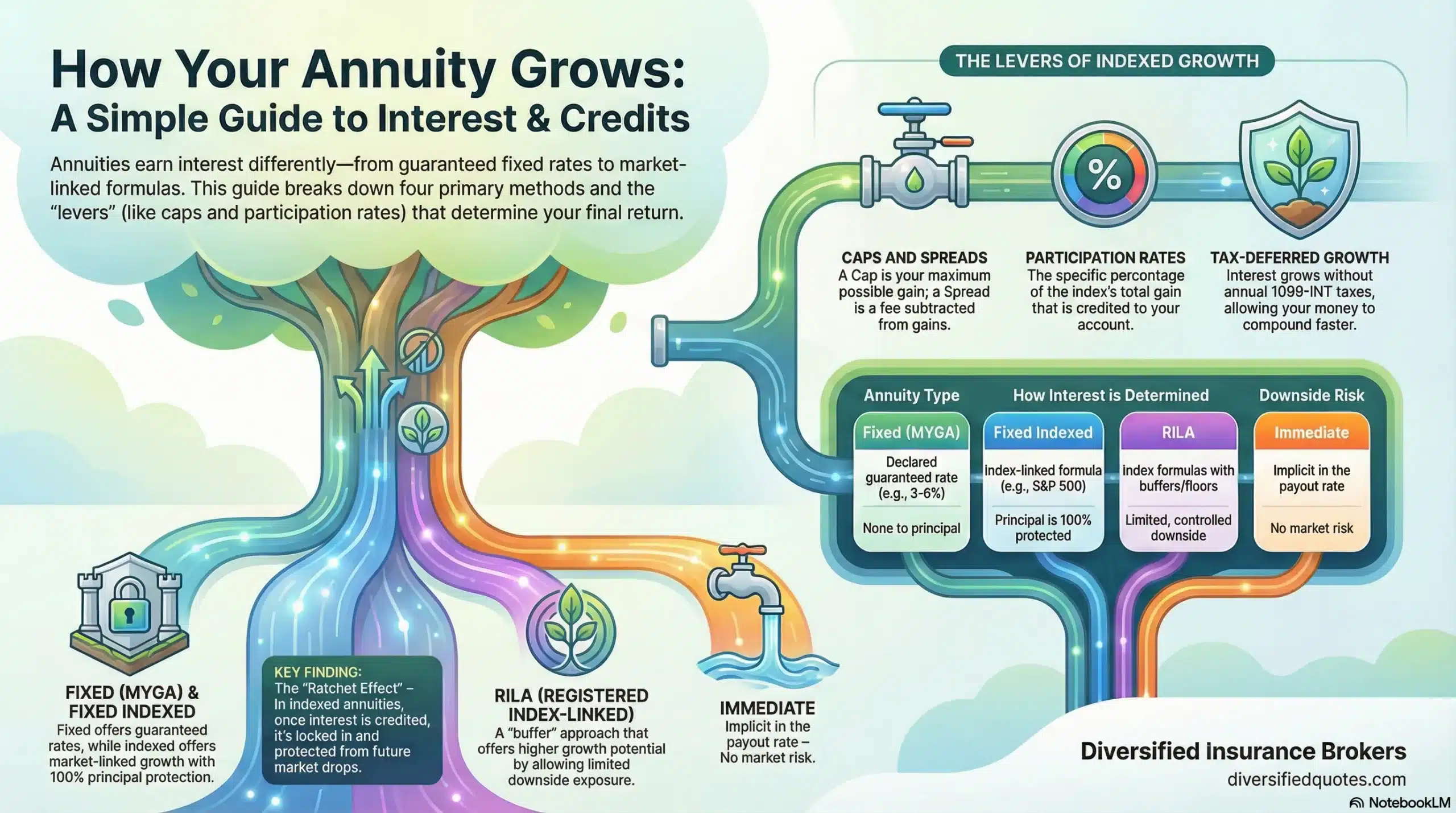
A fixed annuity provides a guaranteed interest rate for a specific period — typically two to ten years. The annuity holder knows exactly what rate they will earn during the contract term, which makes fixed annuities an excellent choice for retirees who prioritize capital preservation and predictability over growth potential. Fixed annuities often offer higher rates than certificates of deposit and provide more favorable tax treatment as well. Reviewing the differences between fixed annuities and CDs can help clarify which makes more sense in a given situation. Products like the Sagicor Milestone Max MYGA exemplify the kind of guaranteed growth and simplicity that makes fixed annuities appealing for conservative retirees who want a predictable accumulation vehicle before transitioning to income.
Fixed Indexed Annuities
Fixed indexed annuities credit interest based on the performance of a market index such as the S&P 500, subject to a cap or participation rate that limits how much of the index’s upside the annuity captures. Crucially, the annuity’s principal is protected — when the index falls, the account value does not decline. This combination of upside participation and downside protection makes fixed indexed annuities one of the most popular choices for retirement income planning. When combined with an income rider, a fixed indexed annuity with an income rider can provide both meaningful accumulation potential and a guaranteed income stream that starts at a time of your choosing. Understanding how fixed indexed annuities protect against market downturns is essential context for anyone evaluating these products as a retirement income foundation.
Immediate Annuities
An immediate annuity converts a lump sum into income that begins almost immediately — typically within 30 days to one year of purchase. This makes immediate annuities suitable for retirees who need income right away and do not want to wait through an accumulation phase. Understanding what an immediate annuity is and how it differs from a deferred contract helps clarify when this structure makes the most sense. For retirees who have separate liquid reserves and want to maximize guaranteed monthly income from a portion of their assets, the best immediate annuity for monthly income can be a powerful anchoring tool in a retirement income plan.
Deferred Income Annuities
Deferred income annuities — sometimes called longevity annuities — are purchased now but do not begin paying income until a future date that can be many years away. This structure makes them particularly effective for addressing late-retirement income needs. By purchasing a deferred income annuity during one’s early or mid-retirement years, a retiree can lock in a high guaranteed income amount to begin at age 80 or 85, effectively insuring against the possibility of living well into advanced age and running short on resources. The deferred annuity calculator provides a useful starting point for understanding how this strategy might work in practice.
The Role of Income Riders in Guaranteed Retirement Income
An income rider is an optional feature that can be added to a deferred annuity contract — typically a fixed indexed annuity — to provide guaranteed lifetime income without requiring the annuity to be annuitized. Understanding how annuity income riders work is essential for anyone evaluating annuities for retirement income. The income rider maintains a separate “income base” that grows at a guaranteed rate and is used solely to calculate the guaranteed income payment when the owner is ready to begin withdrawals.
The income base may grow even in years when the underlying account earns no indexed interest, which means the guaranteed income benefit can increase during market downturns — the exact opposite of what happens with unprotected investment withdrawals. This counter-cyclical characteristic is one of the most powerful arguments in favor of annuities with income riders for retirees who need to close a meaningful income gap. For a deeper understanding of how the benefit base that drives income rider calculations actually works, our resource on what an income annuity benefit base is covers the mechanics in full. Comparing annuitization versus lifetime withdrawals through an income rider is an important analytical step for any retiree trying to determine which income structure best fits their specific situation.
Sequence of Returns Risk and Why It Threatens Retirement Income
Sequence of returns risk refers to the danger that a significant market decline early in retirement will permanently impair a retiree’s ability to sustain income throughout their lifetime, even if markets eventually recover. The reason this matters so profoundly is the asymmetry of gains and losses when withdrawals are involved. If you are drawing income from a portfolio and its value drops by 30 percent in year two of retirement, you have two problems operating simultaneously: the portfolio is worth less, and you are taking out the same dollar amount as before — which now represents a much larger percentage of the reduced portfolio. When markets eventually recover, they are recovering a smaller base, and the withdrawals continue throughout.
Annuities neutralize sequence of returns risk for the portion of retirement income they cover. If a retiree has guaranteed income covering baseline expenses, market downturns affect only the discretionary portion of the portfolio — and the retiree can choose to reduce discretionary spending during downturns rather than being forced to sell investments at depressed prices. This flexibility, made possible by having a guaranteed income floor, is one of the most compelling practical arguments for including annuities in a retirement income strategy. Our insight on the death trap that poorly structured retirement portfolios can fall into illustrates this risk in concrete terms, and our guide on protecting your nest egg covers the broader strategies for building a retirement income plan that is resilient to market volatility.
Inflation and the Purchasing Power Problem
Even a modest level of inflation can significantly erode the purchasing power of a fixed income stream over time. At a 3 percent annual inflation rate — roughly the long-run historical average — a dollar today is worth only about 74 cents in ten years. For a retiree with a 25-year retirement ahead of them, the implications are substantial: fixed income that feels comfortable today may feel increasingly pinched by the middle of retirement and genuinely constraining at the end. Addressing inflation risk in retirement income requires either selecting income sources that grow over time — such as Social Security with its cost-of-living adjustments — or maintaining a portfolio of growth assets that can be drawn on as inflation increases spending needs.
Fixed indexed annuities offer a partial solution to the inflation problem. Because they credit interest based on market index performance, they have the potential to accumulate at rates that outpace inflation during the growth phase — which means the income base available when withdrawals begin can be substantially higher than the original premium. Some annuity products also offer explicit inflation protection features that increase payments over time, and our resource on annuities with inflation protection for seniors covers the options currently available in the marketplace. The principle of why capital preservation has become the new goal for retirees is directly connected to inflation: protecting purchasing power is as important as protecting principal balance.
Building a Multi-Layer Retirement Income Strategy
The most effective retirement income strategies are built in layers, with each layer serving a specific purpose and providing a specific type of protection. The first layer is guaranteed income — Social Security, pension, and annuity income that covers essential living expenses regardless of market conditions. The second layer is moderate-risk income — dividends, interest, and systematic withdrawals from balanced investment accounts that provide additional spending money with some growth potential. The third layer is growth assets — equities and other higher-return investments that grow over time to fund inflation increases, healthcare costs, and legacy goals.
This layered approach — sometimes called a “floor and upside” strategy — ensures that no matter what markets do, the most essential expenses are always covered. It also allows retirees to take more investment risk with the higher layers, because they can afford to ride out market volatility when they know their baseline income is secure. Research consistently shows that retirees who have guaranteed income covering essential expenses report higher levels of financial satisfaction and spend more freely from their overall portfolios — precisely because they are not anxious about running out of money. Our guide on how to protect your funds in retirement and our resource on key retirement considerations both provide useful frameworks for thinking through how these layers fit together in practice.
Coordinating Retirement Accounts With Annuity Income
One of the most important decisions retirees make is how to coordinate existing retirement accounts — 401(k)s, IRAs, 403(b)s, and similar plans — with an annuity income strategy. Many retirees choose to convert a portion of a large IRA balance into an annuity, creating guaranteed income while maintaining the remaining balance in a growth-oriented investment account. Understanding what to do with an IRA after retirement is an important starting point, and the rules governing how inherited IRAs work are relevant for estate planning as well.
Some retirees also have 403(b) accounts from employment in education or healthcare, and understanding what to do with a 403(b) after retirement involves many of the same considerations with some important differences. For those with 401(k)s, our resource on what to do with a 401(k) after retirement covers the rollover, withdrawal, and annuity conversion options in detail. Retirees who want to think through what to do with all their money after retirement more holistically will find that coordinating accounts strategically — rather than treating each in isolation — typically produces meaningfully better after-tax income outcomes over the course of a full retirement.
For retirees who previously compared annuities with investment strategies from providers such as Vanguard, it is worth noting that the comparison is not necessarily either-or. Low-cost investment options serve the growth-oriented layers of a retirement income plan well, while insurance company annuities handle the guaranteed income layer that investment products cannot replicate. The two approaches can coexist productively within a well-structured plan. Our Roth conversion insights — including Roth conversion strategies — are also relevant for retirees who want to reduce the tax burden on future withdrawals while converting a portion of their savings to guaranteed annuity income.
Working With an Independent Annuity Broker
Annuity products vary significantly between insurance companies. Interest rates, income riders, contract terms, surrender schedules, and free withdrawal provisions can differ substantially across carriers — and these differences can mean thousands of dollars per year in retirement income. Working with an independent annuity broker rather than a captive agent or a single-company representative gives you access to the full marketplace of annuity products and recommendations driven by your needs — not by sales quotas or company-specific incentives.
For example, comparing specific products like the Symetra Select Pro Fixed Deferred Annuity against alternatives like the Equitrust MarketForce Bonus Annuity or the Equitrust MarketPower Bonus requires access to rate sheets, income projections, and contract details that are simply not available to consumers shopping on their own. An independent broker can model multiple scenarios side by side and help identify the contract that genuinely delivers the best combination of income, flexibility, and carrier strength for your specific situation. The common annuity myths that sometimes discourage retirees from exploring these products, and the common objections that arise during the research process, are both typically addressable with the right product structure and clear information from an experienced independent advisor.
Diversified Insurance Brokers maintains active contracts with over 100 highly rated insurance carriers, which means clients can compare products across a genuinely broad marketplace. Our annuity rescue plan is specifically designed for retirees who already have annuities that may not be optimally structured. And our second opinion annuity quote review service provides an independent evaluation of any proposal you have received, ensuring that the contract being recommended is genuinely the most competitive and appropriate option for your income goals.
Explore How Long Different Retirement Accounts Can Last
Each retirement plan type works differently, and the longevity of your savings depends heavily on how withdrawals are structured, what the account earns, and how inflation affects your real spending needs over time. Use the calculators below to understand how long your income may last — and how guaranteed income strategies can help extend that timeline indefinitely by covering baseline expenses without drawing down investment assets.
Start Building Your Retirement Income Strategy
Compare Retirement Income Annuities
Related Pages
Explore additional annuity products and retirement income strategies to find the right fit for your plan.
Financial Protection Essentials
Additional resources to help you protect your income, assets, and long-term financial security.
Talk With an Advisor Today
Choose how you’d like to connect—call or message us, then book a time that works for you.
Schedule here:
calendly.com/jason-dibcompanies/diversified-quotes
Licensed in all 50 states • Fiduciary, family-owned since 1980
Frequently Asked Questions
How much income do I need in retirement?
Most financial planners suggest replacing approximately 70 to 80 percent of pre-retirement income, although the exact amount depends heavily on your lifestyle, fixed expenses, debt situation, and planned activities. Retirees who own their homes outright, have minimal debt, and plan to spend modestly on travel and entertainment may find that 65 to 70 percent is sufficient. Those who carry a mortgage into retirement, plan extensive travel, or anticipate significant healthcare costs may need 85 to 90 percent or more.
It is also worth remembering that income needs are not static throughout retirement. Research on retirement spending patterns consistently shows that spending tends to be highest in the first decade — the “go-go years” of active travel and recreation — moderates somewhat in the middle years, and then increases again in the later years when healthcare and potential long-term care costs rise. A retirement income plan that accounts for this spending pattern, rather than assuming a flat expense level, will typically prove more accurate and more sustainable over the full retirement horizon.
Rather than relying on a rule of thumb, the most useful approach is to build a detailed monthly budget that covers essential expenses, discretionary spending, healthcare, and a buffer for unexpected costs. Then match that budget against your expected income sources — Social Security, pension, annuity income, and investment withdrawals — to understand exactly where the gaps are and how to fill them. Our resource on how much income you need in retirement walks through this planning process in detail, and our pre-retirement checklist identifies the planning steps involved in building a complete strategy.
Can annuities provide lifetime income?
Yes. Many annuities include lifetime income riders or annuitization options that guarantee payments for the rest of your life, regardless of how long you live or what happens to financial markets. This is one of the most powerful features annuities offer — the ability to convert a finite savings balance into an income stream that cannot be outlived. For a retiree who lives to age 90 or 95, a lifetime income annuity purchased at 65 may deliver two to three times the original premium in total payments, representing an exceptional long-term financial outcome.
There are two main ways to receive lifetime income from an annuity. The first is traditional annuitization, in which the account value is converted into a stream of payments calculated based on life expectancy, interest rates, and the payment option selected. The second — and increasingly popular — approach is through an income rider attached to a deferred annuity. With an income rider, a separate income base grows at a guaranteed rate during the deferral phase and is then used to calculate guaranteed lifetime withdrawals that continue even if the account value is eventually depleted. Understanding how annuity income riders work in detail is important before choosing between these approaches, as each has different implications for flexibility, heirs, and total income received.
Our lifetime income calculator can help you model how much guaranteed monthly income your current savings might generate under different annuity structures. The income annuity calculator and the annuity payout calculator are also useful tools for understanding how different premium amounts and income start dates translate into monthly guaranteed income amounts before speaking with an advisor.
Are annuities better than withdrawing money from investments?
Annuities and investment withdrawals serve different purposes within a retirement income plan, and the most effective strategies typically use both in a coordinated way rather than treating them as either-or alternatives. Annuities provide guaranteed income that does not fluctuate with market performance — this predictability is enormously valuable for covering essential living expenses, because it means those expenses will be covered no matter what financial markets do. Investment withdrawals, by contrast, depend on portfolio performance and are subject to sequence of returns risk — the danger that poor market performance early in retirement permanently impairs the portfolio’s ability to sustain withdrawals over the long term.
A well-designed retirement income plan typically uses guaranteed income from annuities — and Social Security — to cover baseline expenses, while reserving investment assets for discretionary spending, inflation protection, and legacy goals. This structure means that market volatility affects only the portion of the plan that can tolerate it, while the essential income layer remains secure. Retirees who use this approach consistently report higher levels of financial confidence and tend to spend more freely from their overall portfolio because they know their essential needs are guaranteed.
For retirees researching whether annuities make sense for their specific situation, our resources on whether annuities are a good investment in retirement and what the advantages of annuities are provide a balanced, honest overview of when these products add genuine value and when other approaches may be more appropriate.
Why work with an independent annuity broker?
Working with an independent annuity broker gives you access to the full marketplace of annuity products rather than the limited menu offered by a single insurance company or a captive agent. Because independent brokers are not beholden to any one carrier, their recommendations are driven by your needs and the competitive landscape — not by sales quotas or company-specific incentives. The practical significance of this independence is substantial: annuity rates, income rider terms, surrender schedules, and free withdrawal provisions vary widely across carriers, and two annuities with the same premium can produce dramatically different income amounts depending on which carrier’s product is selected.
An independent broker can model these comparisons side by side and help you identify the contract that genuinely delivers the best combination of income, flexibility, and carrier strength for your situation. Diversified Insurance Brokers maintains contracts with over 100 highly rated carriers, which provides an exceptionally broad basis for comparison. This means that when a new product enters the market with superior income terms, an independent advisor can access it immediately — rather than being constrained by a single company’s product shelf.
Independent advisors also play an important role in helping retirees avoid common mistakes — such as purchasing a product with an excessively long surrender period that limits flexibility, or accepting lower income guarantees because the carrier offering them has a more recognizable brand name. The second opinion annuity quote review service offered by Diversified Insurance Brokers is specifically designed for retirees who have already received an annuity proposal and want to verify whether the terms are truly competitive before committing. Exploring our complete Annuities 101 guide is also a useful step for anyone who wants a thorough educational foundation before evaluating specific products.
What is sequence of returns risk and how does it affect my retirement income?
Sequence of returns risk is the danger that the order in which investment returns occur — rather than the average return itself — can dramatically affect the sustainability of a retirement income plan. Specifically, poor market returns early in retirement, when combined with ongoing income withdrawals, can permanently impair a portfolio in ways that prevent full recovery even after markets rebound. A retiree who experiences a 30 percent portfolio decline in their second year of retirement while simultaneously withdrawing income faces a compounding problem: the portfolio is smaller, but the withdrawals continue at the same dollar amount, representing a now-higher percentage of the reduced balance.
This is why sequence of returns risk is most acute in the early years of retirement. A portfolio that experiences strong returns in the first decade and poor returns later can sustain decades of withdrawals far more effectively than one that experiences the same returns in reverse order. Unfortunately, market timing is not within any retiree’s control — which is precisely why a retirement income strategy that does not depend entirely on market performance provides such powerful protection against this risk.
Annuities neutralize sequence of returns risk for the portion of retirement income they cover. If a retiree has guaranteed income covering baseline expenses, market downturns affect only the discretionary portion of the portfolio — and the retiree can choose to reduce spending from that portfolio during downturns rather than being forced to sell at depressed prices. This flexibility, made possible by having a guaranteed income floor, is one of the most compelling practical arguments for including annuities in any retirement income strategy. Our insight on the death trap that sequence of returns can create illustrates this risk in concrete terms.
How do I transfer retirement savings into an annuity?
Transferring retirement savings into an annuity is typically accomplished through a direct trustee-to-trustee transfer, in which funds move directly from a qualifying retirement account — such as an IRA, 401(k), or 403(b) — to a qualifying annuity contract without passing through your hands. This method avoids the mandatory 20 percent withholding that applies when retirement funds are distributed directly to the account owner, and it ensures that the transfer qualifies as a tax-free rollover under IRS rules. Understanding how to transfer an IRA to an annuity properly is the most important logistical step in this process, and our resource on how to transfer a retirement account to an annuity covers the process for all qualifying account types.
It is also possible to fund an annuity with non-retirement after-tax savings, in which case the annuity is considered a non-qualified contract. The tax treatment differs somewhat — contributions to a non-qualified annuity are made with after-tax dollars, so only the growth portion of distributions is taxable upon withdrawal, not the return of principal. This can make non-qualified annuities an attractive option for retirees who have already maximized their qualified retirement accounts and want additional tax-deferred growth.
Before initiating any transfer, it is important to understand whether your current retirement account has any restrictions on rollovers, whether the receiving annuity has any specific requirements, and what surrender charges — if any — apply to your current holdings. An experienced broker at Diversified Insurance Brokers can coordinate the transfer process, handle the paperwork, and ensure the transaction is completed in a way that maximizes tax efficiency and avoids unnecessary delays or penalties. The in-service 401(k) transfer resource is also relevant for current employees who want to evaluate conversion options before officially retiring.
What role does inflation play in retirement income planning?
Inflation is one of the most significant long-term threats to retirement income security, and it is one that retirees on fixed income streams must take seriously. Even at a modest 3 percent annual inflation rate, the purchasing power of a fixed $5,000 monthly payment drops to roughly $3,700 in ten years and less than $2,750 in twenty years. For a retiree with a 25 to 30 year retirement ahead, this erosion can turn a comfortable income into a constrained one well before the end of life.
The most inflation-resistant income sources in a retirement plan are Social Security — which adjusts annually for cost of living — and inflation-protected annuities that offer built-in payment increases. Social Security’s cost-of-living adjustments have historically tracked inflation reasonably well over time, which reinforces the value of maximizing Social Security benefits by delaying the start date when possible. For income streams that are not inflation-adjusted, the best offset is a portfolio of growth assets whose long-run returns tend to outpace inflation. Our resources on annuities with inflation protection and inflation protection options for seniors cover the specific product structures available in today’s market.
Fixed indexed annuities offer a partial solution to the inflation problem through their index-linked crediting mechanism. Because interest is credited based on market index performance, they have the potential to accumulate at rates that outpace inflation during the growth phase — which means the income base available when withdrawals begin can be substantially higher than the original premium. This growth potential, combined with the guaranteed income floor provided by an income rider, creates a more inflation-resilient income structure than a simple fixed annuity alone. Understanding why capital preservation has become the new goal for retirees provides useful context for thinking about inflation’s long-term impact on retirement purchasing power.
How do I protect against running out of money in retirement?
The most direct protection against running out of money in retirement is establishing guaranteed income that covers at minimum your essential living expenses. When Social Security, pension income, and annuity payments collectively cover your baseline costs, you cannot run out of money for those expenses — regardless of how long you live, how markets perform, or what unexpected events occur. This is the foundational logic behind the income floor approach to retirement planning, and it is why including a guaranteed income stream in your retirement strategy is so widely recommended. Our dedicated resource on how to protect your funds in retirement covers the specific strategies involved in building this kind of durable financial foundation.
Beyond establishing guaranteed income, protecting your nest egg from erosion requires diversification, disciplined withdrawal management, and a plan for handling unexpected expenses without destabilizing the overall income structure. Maintaining a liquid emergency reserve — separate from retirement income investments — prevents the need to liquidate long-term assets at inopportune times. Reviewing our insight on how to protect your nest egg and our resource on key retirement considerations provides a comprehensive framework for the ongoing stewardship of retirement assets.
Working with a knowledgeable advisor who can regularly review your plan, assess whether your income sources remain appropriately sized relative to your expenses, and make adjustments as circumstances change is also an important element of long-term retirement security. Markets change, tax laws change, health situations change, and a static plan built once at retirement may need meaningful adjustment over the course of a 25 to 30 year retirement horizon. The second opinion quote review service at Diversified Insurance Brokers is a practical first step for anyone who wants an independent assessment of whether their current income strategy is as strong as it could be.
About the Author:
Jason Stolz, CLTC, CRPC, DIA, CAA and Chief Underwriter at Diversified Insurance Brokers (NPN 20471358), is a senior insurance and retirement professional with more than 25 years of real-world experience helping individuals, families, and business owners protect their income, assets, and long-term financial stability. As a long-time partner of the nationally licensed independent agency Diversified Insurance Brokers, Jason provides trusted guidance across multiple specialties—including fixed and indexed annuities, long-term care planning, personal and business disability insurance, life insurance solutions, Group Health, Travel Medical and Evacuation Insurance, and short-term health coverage. Diversified Insurance Brokers maintains active contracts with over 100 highly rated insurance carriers, ensuring clients have access to a broad and competitive marketplace.
His practical, education-first approach has earned recognition in publications such as VoyageATL, and contributions from his agency featured in Kiplinger and GoBankingRates— highlighting his commitment to financial clarity and client-focused planning. Drawing on deep product knowledge and years of hands-on field experience, Jason helps clients evaluate carriers, compare strategies, and build retirement and protection plans that are both secure and cost-efficient. Visitors who want to explore current annuity rates and compare options across multiple insurers can also use this annuity quote and comparison tool.
Explore More Annuity Options: Browse our complete guide to Annuities 101 — covering annuity education, planning guides, pros & cons, how to choose & buy from 100+ carriers.
Explore More: Browse our complete Lifetime Income Planning guide — covering retirement income strategies, account transfers & annuity income solutions from 100+ carriers.
Last Reviewed: June 12, 2026 |
Reviewed by: Jason Stolz, CLTC, CRPC, DIA, CAA
Chief Underwriter, Diversified Insurance Brokers, Inc. | NPN: 20471358 | Diversified Insurance Brokers, Inc. — Licensed in all 50 states
Fact Checked by: Tonia Pettitt, CMIP©
Medicare Specialist, Diversified Insurance Brokers, Inc. | NPN: 14374308 | Diversified Insurance Brokers, Inc. — Licensed in all 50 states
Did you find this content helpful? Leave us a Google review — it helps others find trustworthy guidance too.
Editorial Standards: Diversified Insurance Brokers maintains rigorous editorial standards to ensure accuracy, clarity, and independence in all content. Learn more about our editorial standards and commitment to transparency.
