
How to get the Best Disability Insurance Rates
As an Independent Disability Insurance Broker, we have access to exclusive discounts and negotiated pricing most captive agents can’t offer — see the full breakdown near the end of this page.
How to get the Best Disability Insurance Rates

Jason Stolz CLTC, CRPC, DIA, CAA
Knowing how to get the best disability insurance rates requires more than finding the lowest monthly premium. It requires understanding how disability insurance is priced, which factors you can influence as an applicant, and why working with an independent broker who compares multiple carriers is often the most effective path to competitive rates without sacrificing the policy features that actually matter. Disability insurance protects your income — the asset that funds your mortgage, your family’s needs, and your retirement savings — and getting the best disability insurance rates means finding coverage that is both affordable and strong enough to deliver real protection when a claim occurs.
At Diversified Insurance Brokers, we help clients navigate the disability insurance market across 100+ carriers to find rates and policy designs that match their occupation, income, and coverage goals. This guide explains the most important factors that influence disability insurance pricing, the strategies most effective at reducing premiums, and why comparison across carriers consistently produces better outcomes than applying to a single company. If you want to understand what drives the cost of disability coverage before comparing quotes, our companion page on best disability insurance rates covers the full rate analysis in depth.
Request Disability Insurance Quotes
Compare rates across multiple top-rated carriers based on your occupation, income, and benefit goals.
Request Disability Insurance Quotes
Questions? Call 800-533-5969
Why Disability Insurance Rates Vary So Much Between Applicants
Disability insurance premiums are calculated differently than most other types of insurance. Instead of focusing on mortality risk like life insurance, disability insurers evaluate the probability that an applicant will become unable to work due to illness or injury — and the expected duration and cost of that disability if it occurs. That evaluation depends on a combination of factors that can vary dramatically between two applicants who appear similar on the surface. Understanding why rates vary is the first step toward knowing how to get the best disability insurance rates for your specific situation.
Occupation is the single most influential pricing factor in disability insurance. Some professions have significantly higher risk of disability than others. Office-based professionals who work in controlled environments typically receive lower rates and often qualify for stronger policy definitions. Physically demanding occupations with exposure to equipment, heights, unstable environments, or repetitive physical strain carry higher claim probability and typically result in higher premiums and sometimes more restrictive definition language. Age is another major driver — every year of delay typically increases the premium for equivalent coverage because the probability of a claim increases with age and because the insurer has fewer years of premium collection before the period of highest risk begins. Health history, income level, and lifestyle factors also influence how disability insurance is priced and what terms are available.
The Key Factors That Affect Disability Insurance Rates
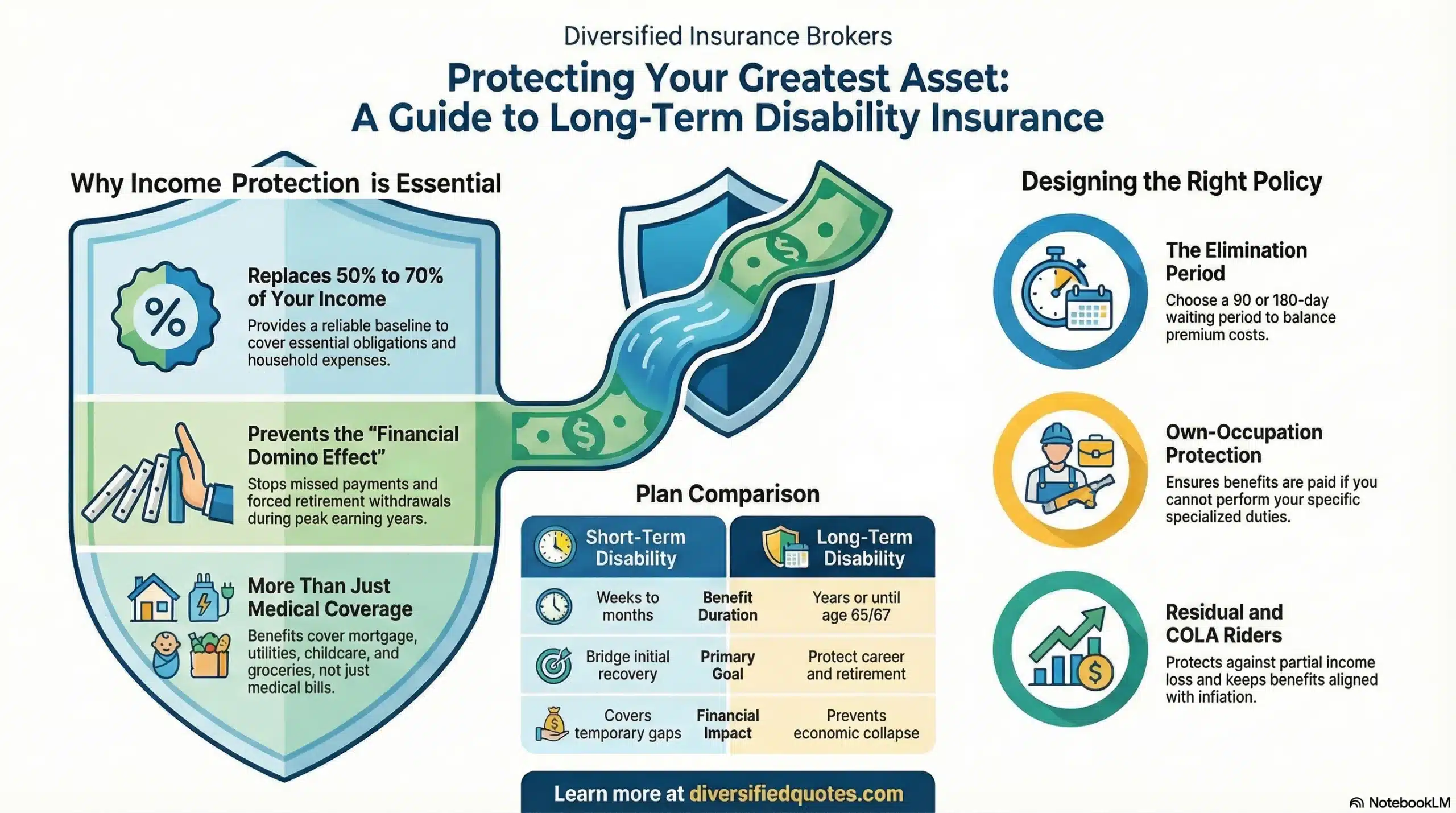
To get the best disability insurance rates, it helps to understand exactly which variables drive pricing and how each one can be influenced or optimized. The elimination period — the waiting period between the start of a qualifying disability and when benefits begin — is one of the most powerful levers available to applicants. Choosing a 90-day elimination period instead of a 30-day period can meaningfully reduce the premium while leaving the long-duration protection that matters most intact. This works best when the household has three to six months of liquid reserves available to self-insure the waiting period, turning a cost reduction into a strategic choice rather than a coverage gap.
The benefit period — how long benefits can be paid if disability continues — is another major pricing lever. Shorter benefit periods produce lower premiums; longer benefit periods to age 65 or 67 cost more but protect against the long-duration events that create catastrophic household financial impact. The disability definition matters significantly as well, and not just for claims — it affects the price. Own-occupation definitions that pay benefits when you cannot perform the specific duties of your job cost more than any-occupation definitions but deliver meaningfully stronger protection for specialized professionals. Residual or partial disability coverage is a feature that many buyers skip to reduce premium, but it can be one of the most valuable components of a policy because it pays proportionate benefits when a disability reduces income without eliminating work entirely. Skipping residual coverage to lower rates creates a gap that often appears exactly when retirees most need it — during a partial recovery that lets them return to work at reduced capacity.
How to Compare Disability Insurance Rates Across Carriers
One of the most effective strategies for getting the best disability insurance rates is comparing multiple carriers rather than applying to a single company. Different disability insurance carriers evaluate occupation risk differently — one insurer may view a particular profession more favorably than another, which can produce meaningfully different rates for the same coverage amount and design. One carrier may be more flexible with certain medical histories. Another may have more favorable underwriting guidelines for a specific income structure or employment type. If you only quote a single company, you might assume that quote represents the market — when in reality a different carrier could provide better contract language at a similar rate, or similar language at a better rate.
The comparison process is most effective when it goes beyond the monthly premium to evaluate what the policy actually delivers: how disability is defined, how residual claims are evaluated, what the benefit period covers, what riders actually do in practice, and what the underwriting process will look like for your specific health and occupational profile. An independent broker who can compare disability insurance rates across multiple carriers simultaneously provides the most objective comparison framework because they are not limited to one company’s products or pricing grid. Our resource on why working with an independent disability insurance broker matters explains the practical advantages of this approach in detail.
Apply Earlier in Your Career to Lock In Better Disability Insurance Rates
Age is one of the most straightforward factors in disability insurance pricing, and it is also one of the few that an applicant can meaningfully influence by acting sooner. Younger applicants typically qualify for lower rates because they have fewer health issues, a longer working horizon, and a lower statistical probability of a near-term claim. Applying earlier also protects insurability — if a medical condition develops later in life, it may affect the ability to obtain coverage at all, or result in higher rates, exclusion riders, or table ratings that increase cost significantly. Many professionals purchase disability insurance early in their careers specifically to lock in coverage before health changes occur, and that decision typically produces long-term premium savings that dwarf any short-term cost convenience of delaying.
For professionals in specialized careers whose income depends on specific skills or physical capability, this timing decision is particularly consequential. A surgeon, dentist, attorney, or engineer who purchases disability insurance in their early 30s at favorable rates and with strong own-occupation definitions is in a fundamentally different position than the same professional who waits until their 40s when health changes, stress injuries, or other conditions may already be part of their record. The compounding advantage of earlier purchase — lower rates for longer, stronger insurability throughout the career — is often the single most impactful thing a professional can do to get the best disability insurance rates over a lifetime. Our page on disability insurance for white-collar professionals covers how earlier purchase affects outcomes for specialized careers specifically.
Design Choices That Reduce Disability Insurance Rates Without Weakening Protection
Getting the best disability insurance rates is not about finding the cheapest policy — it is about finding the best value per premium dollar given your occupation, income, and risk tolerance. The most effective way to reduce disability insurance rates without meaningfully weakening protection is to right-size the design rather than stripping out features that matter. Choosing a 90-day elimination period if liquid reserves support it is the single cleanest premium reduction because it leaves core long-duration protection intact while removing the most expensive early-coverage component. Right-sizing the monthly benefit to actual essential obligations — housing, utilities, food, transportation, insurance, and debt service — rather than targeting gross income replacement produces a lower premium without leaving a coverage gap, because the goal is keeping the household stable, not replacing every dollar.
Prioritizing must-have riders over nice-to-have features is another effective approach. A future increase option rider may be far more valuable early in a career than a cost-of-living adjustment rider, because it protects the ability to increase coverage without new medical underwriting as income grows. A COLA rider may be more valuable for a mid-career professional who wants inflation protection over a long benefit period. Evaluating which riders serve your specific situation rather than selecting every available feature keeps the premium competitive while maintaining the protections that are genuinely most important. For a detailed analysis of how to lower disability insurance rates without sacrificing protection, our companion page on best disability insurance rates covers this framework in full.
Integrating Disability Insurance With Your Broader Financial Plan
Disability insurance works best when integrated with a broader financial plan rather than purchased in isolation. Protecting income ensures that you can continue saving for retirement, paying a mortgage, and supporting your family even if an illness or injury prevents you from working. When disability insurance is part of a coordinated plan, it also becomes easier to calibrate the benefit amount correctly — because you understand what other resources exist to fill the gap, and you can focus the disability benefit on the obligations that truly cannot wait. Many clients who have existing group disability coverage through an employer find that an individual policy layers on top to reach a more realistic income replacement target, particularly when the group plan caps benefits at a monthly maximum that falls short of actual obligations.
The disability insurance rates you pay today are also part of a long-term financial commitment that should remain sustainable. A policy you can keep in force over decades is more valuable than one that costs slightly less but creates pressure to cancel when financial stress arises — which is often precisely when the disability risk is highest. Working with an independent broker who can compare options across multiple carriers and design the policy around your real financial picture consistently produces better long-term outcomes than selecting a policy based on price alone. Our disability insurance services page covers the full range of options available across carriers and occupation types.
Compare Disability Insurance Options
Tell us your occupation and income range and we’ll run a comparison focused on contract quality, design, and value across carriers.
Compare Disability Insurance Options
Questions? Call 800-533-5969
Financial Protection Essentials
Deferred annuity tools, beneficiary planning, travel medical protection, and retirement comparison resources.
Talk With an Advisor Today
Choose how you’d like to connect—call or message us, then book a time that works for you.
Schedule here:
calendly.com/jason-dibcompanies/diversified-quotes
Licensed in all 50 states • Fiduciary, family-owned since 1980
Frequently Asked Questions: How to Get the Best Disability Insurance Rates
The most effective strategies for lowering disability insurance premiums without meaningfully weakening coverage are choosing a longer elimination period if your liquid reserves support it, right-sizing the monthly benefit to actual essential obligations rather than gross income, and comparing multiple carriers rather than accepting the first quote you receive. Moving from a 30-day to a 90-day elimination period typically produces a noticeable premium reduction while leaving the long-duration protection intact — which is usually the most valuable component of any disability policy. This works best when the household has adequate emergency savings to self-insure the waiting period as a deliberate financial choice rather than a forced exposure.
Applying earlier in your career is also one of the most impactful premium-reduction strategies because age is a continuous driver of disability insurance rates. Every year of delay increases the cost for equivalent coverage. A professional who purchases at 32 versus 42 locks in substantially lower rates for the full duration of the policy — a compounding savings that often significantly exceeds any short-term convenience of delaying. Working with an independent disability insurance broker who can compare options across multiple carriers also frequently produces better rates than applying to a single company, because carrier pricing for the same occupation and health profile varies meaningfully across the market.
Disability insurers price policies based on the probability and expected cost of a claim for a specific occupation — and those probabilities vary dramatically between professions. An office-based professional who works in a controlled environment, uses primarily cognitive skills, and faces minimal physical injury risk is assigned a more favorable occupation class than a well driller, construction worker, or other physically demanding role that involves heavy equipment, environmental exposure, and repetitive physical strain. The more favorable the occupation class, the lower the premium and often the stronger the policy definition language available. Occupation is typically the single biggest variable in disability insurance pricing for two applicants at the same age and income level.
The occupation classification also affects which disability definition is available. Carriers are more willing to offer true own-occupation definitions — which pay benefits if you cannot perform the specific duties of your particular job — for white-collar and professional occupation classes. For higher-risk occupations, carriers may offer modified definitions or limit the duration during which own-occupation language applies. This means that for higher-risk occupations, the policy design question and the rate question are intertwined: the occupation class affects both the cost and the contract terms available. Understanding how carriers think about your specific occupational duties at application is one of the most important reasons to work with an advisor who understands disability underwriting across multiple carriers.
For most working professionals, disability insurance is one of the highest-value financial protections available because it protects the income stream that funds everything else in their financial life — the mortgage, the family’s needs, the retirement savings, and the ability to maintain financial momentum during what could be months or years of inability to work. The statistical case for disability insurance is compelling: the probability of experiencing a disability that lasts 90 days or longer during a working career is substantially higher than many people expect, and the financial consequences of an uninsured long-term disability are among the most severe outcomes a household can face. Income that stops can trigger a cascade of financial decisions that damage retirement planning, savings, and long-term stability in ways that are difficult to recover from.
The cost-benefit calculation is most straightforward when you compare the annual premium to the total income that would be at risk over a multi-year disability. For most professionals, the annual premium is a small fraction of a single year’s income — and the policy can replace 60 to 70 percent of that income for years or until retirement age. The real question is not whether disability insurance is worth the cost in the abstract; it is whether the specific policy you are considering is worth its specific cost given its definition, benefit period, residual provisions, and how well the contract actually responds in the realistic scenarios you would face. That is the evaluation our disability insurance services team helps clients conduct across multiple carriers before making a decision.
Working with an independent disability insurance broker consistently produces better outcomes than applying directly to a single carrier, for a straightforward reason: carriers evaluate occupations and health histories differently, and the differences in both rate and policy terms across carriers for the same applicant can be substantial. An independent broker who represents multiple carriers can identify which companies have the most favorable underwriting guidelines for your specific occupation class, compare pricing and policy language side by side, and sequence applications strategically when health history might affect underwriting at certain carriers. A captive agent representing a single company can only present that company’s options — regardless of whether they are the most favorable for your situation.
The independent comparison is especially valuable in situations involving complex occupational duties, variable or self-employment income, a history of prior medical conditions, or a profession where carrier underwriting approaches vary significantly. In these cases, small differences in how an application is presented and which carrier it is submitted to can change the outcome from an approval with favorable terms to a declination or exclusion rider that limits the policy’s value. Even in straightforward situations, the carrier-to-carrier rate variation for equivalent disability insurance coverage is often meaningful enough that the comparison process pays for itself in premium savings over the life of the policy. Our team is structured specifically to provide this independent comparison across the full market.
About the Author:
Jason Stolz, CLTC, CRPC, DIA, CAA and Chief Underwriter at Diversified Insurance Brokers (NPN 20471358), is a senior insurance and retirement professional with more than 25 years of real-world experience helping individuals, families, and business owners protect their income, assets, and long-term financial stability. As a long-time partner of the nationally licensed independent agency Diversified Insurance Brokers, Jason provides trusted guidance across multiple specialties—including fixed and indexed annuities, long-term care planning, personal and business disability insurance, life insurance solutions, Group Health, Travel Medical and Evacuation Insurance, and short-term health coverage. Diversified Insurance Brokers maintains active contracts with over 100 highly rated insurance carriers, ensuring clients have access to a broad and competitive marketplace.
His practical, education-first approach has earned recognition in publications such as VoyageATL, and contributions from his agency featured in Kiplinger and GoBankingRates— highlighting his commitment to financial clarity and client-focused planning. Drawing on deep product knowledge and years of hands-on field experience, Jason helps clients evaluate carriers, compare strategies, and build retirement and protection plans that are both secure and cost-efficient. Visitors who want to explore current annuity rates and compare options across multiple insurers can also use this annuity quote and comparison tool.
Explore More Disability Insurance Options: Browse our complete guide to Disability Insurance Planning & Education — covering how it works, riders, elimination periods, own occupation, costs & buying guides from 100+ carriers.
Last Reviewed: June 11, 2026 |
Reviewed by: Jason Stolz, CLTC, CRPC, DIA, CAA
Chief Underwriter, Diversified Insurance Brokers, Inc. | NPN: 20471358 | Diversified Insurance Brokers, Inc. — Licensed in all 50 states
Fact Checked by: Tonia Pettitt, CMIP©
Medicare Specialist, Diversified Insurance Brokers, Inc. | NPN: 14374308 | Diversified Insurance Brokers, Inc. — Licensed in all 50 states
Did you find this content helpful? Leave us a Google review — it helps others find trustworthy guidance too.
Editorial Standards: Diversified Insurance Brokers maintains rigorous editorial standards to ensure accuracy, clarity, and independence in all content. Learn more about our editorial standards and commitment to transparency.
