
Best Disability Insurance Rates
As an Independent Disability Insurance Broker, we have access to exclusive discounts and negotiated pricing most captive agents can’t offer — see the full breakdown near the end of this page.
Best Disability Insurance Rates

Jason Stolz CLTC, CRPC
Best disability insurance rates are not simply the cheapest quotes you can find online. The best disability insurance rates are the ones that match strong contract language with a plan design that fits your income, your occupation, and your real-life budget. If you are paying for disability insurance, you want it to work when it matters — meaning the definition of disability is clear, the benefit is meaningful, the policy is portable, and the premium feels reasonable for the protection you are actually getting.
At Diversified Insurance Brokers, we help clients evaluate disability insurance pricing the way it should be evaluated: by comparing what you are paying to what you are actually buying. A “low rate” can be the result of a longer waiting period, a shorter benefit duration, weaker definitions, missing residual benefits, or limits that only show up when you read the fine print carefully. A slightly higher premium can be the smarter choice if it provides stronger income protection and reduces the risk of unpleasant surprises in a real claim scenario.
Compare the Best Disability Insurance Rates
Get quotes from multiple top-rated carriers based on your occupation, income, and benefit goals.
Request Disability Insurance QuotesWhat “Best Disability Insurance Rates” Really Means
When someone searches for the best disability insurance rates, they typically mean one of two things: a premium that feels affordable and predictable, and confidence that the policy will deliver stable income replacement if they cannot work. The problem is that most rate comparisons focus on the premium alone without explaining how policy design changes the price. Disability insurance is one of the most “design-sensitive” products in insurance — two policies can look similar at a glance but behave very differently in the details. Instead of asking “What is the cheapest policy I can buy?” a more useful question is “What plan design gives me the best value per premium dollar?” That value is driven by the disability definition, the benefit period, the waiting period, the presence of residual coverage, the ability to increase coverage as income rises, and how the policy coordinates with other coverage already in place. Many people also do not realize how frequently disability insurance is misunderstood. The structure you choose determines the outcome you get — just as it does when evaluating how a deferred compensation plan works or understanding what a life insurance exam involves.
How Disability Insurance Rates Are Determined
Disability insurance pricing is built from several core ingredients, and understanding them allows you to spot why one quote is lower and another is higher. Age influences cost because disability claim probability rises over time. Buying earlier generally means lower rates and fewer underwriting obstacles — which is why much planning guidance encourages people to address disability coverage while younger and healthy. For rate context, our resource on whether disability insurance is expensive frames rate expectations properly across different income and occupation profiles.
Health history significantly affects pricing because carriers evaluate claim probability and claim severity. A history of certain conditions, recent surgeries, medication instability, or mental health history can affect pricing or lead to exclusions. The goal is not to hide anything — it is to present your health profile clearly and choose carriers that are more favorable for your specific situation. Occupation class is one of the biggest pricing drivers across all disability carriers. White-collar jobs with controlled environments typically have lower rates and often qualify for stronger policy language. More physically demanding work can still be insured but rates are higher because injury claim probability is higher and return-to-work can be less predictable. Our resources on disability insurance for law enforcement and disability insurance for firefighters illustrate how definitions and pricing shift by job class for higher-risk occupations. For specific occupations that are frequently underserved by standard carriers, our resources on disability insurance for convenience store owners, the woodworking industry, game wardens, cosmetologists, and the automobile industry show how coverage is structured and priced across a wide range of occupational risk profiles. Income and benefit amount directly affect premium — higher benefits cost more, but “maxing out” is not always the best approach. The better strategy is choosing a benefit that covers essential fixed expenses and protects long-term plans without over-insuring. Our resource on how much disability insurance costs provides useful benchmarks across income ranges.
The Biggest Levers That Control Your Disability Insurance Rate
If you want the best disability insurance rates, focus on the levers that produce the biggest savings without compromising core protections. The elimination period — the time between the start of a qualifying disability and when benefits begin — is one of the most powerful premium levers available. Common waiting periods are 30, 60, 90, 180, or 365 days. Choosing a longer elimination period reduces the premium because you self-insure the first portion of the risk. The key is matching the elimination period to the amount of emergency savings realistically available. A 90-day elimination period creates a strong balance between affordability and practicality for most households. The benefit period determines how long benefits can be paid once a claim is approved. Shorter benefit periods such as two or five years are cheaper. Longer benefit periods to age 65, 67, or 70 are more expensive but offer stronger protection if the disability is severe or long-term. The benefit period is one of the cleanest places to adjust design — the cost difference is measurable, and you can decide how much long-duration protection you genuinely want based on your circumstances.
The definition of disability — own-occupation versus any-occupation — significantly affects how claims are evaluated. Own-occupation language pays benefits when you cannot perform the material duties of your specific occupation, even if you can work in some other capacity. Any-occupation language is less expensive but harder to qualify under in scenarios where you have a specialized skill set. The key is not buying own-occupation reflexively because you heard it is best — it is matching the definition to your actual career risk. For specialized careers where income depends on a specific skill, the definition is usually worth the additional premium. Residual or partial disability coverage is one of the most overlooked value drivers. Many disabilities do not completely stop work — they reduce capacity and income. Residual coverage helps fill that gap when you return to work but earn less due to limitations. Policies without meaningful residual benefits may appear cheaper but underperform in the real-world scenario that occurs most often: partial income loss. Understanding additional riders — such as COLA, future increase options, and catastrophic disability benefits — is also important. Our resource on how to buy short-term disability insurance online covers how layering short-term and long-term coverage can create cost efficiency by allowing a longer elimination period on the long-term policy when short-term protection already exists.
Individual vs. Group Disability Insurance — Why Rates Can Be Misleading
Many people first encounter disability insurance through an employer group plan. Group plans can be valuable, but group rates often hide important limitations. In some cases, the employee premium looks low because the plan has caps that limit how much income it actually replaces. In other cases, the disability definition is broad or residual benefits are absent. Some group plans also reduce benefits if the participant receives certain other income sources — and most importantly, group coverage typically is not portable when employment changes. Individual disability insurance is usually priced higher than a group plan, but it is priced that way because the design can be tailored and because the policyholder owns it. A group policy can change, be reduced, or be eliminated as employer benefits change. An individual policy stays with you and can become one of the most valuable protections you own, especially as income rises and responsibilities grow. Taxation is another important factor. Depending on how premiums are paid, group benefits can be taxable, which reduces the effective value of the benefit. Evaluating “rate value” in net-income terms — what you actually receive rather than what the policy states — is the appropriate comparison framework when evaluating group versus individual disability insurance value.
Best Disability Rates for Self-Employed Individuals and Business Owners
Self-employed individuals, contractors, and business owners often feel disability risk more sharply because they have no employer-provided safety nets. If income stops, the household feels it immediately. The challenge is that self-employed income can be variable, which affects how carriers verify earnings and how they cap benefits. The best rate strategy here is typically a combination of realistic benefit sizing, a waiting period that matches cash reserves, and a policy definition that fits the actual work performed. Business owners also need to decide whether they are insuring personal income only or also protecting the business itself through business overhead expense disability coverage. Broader business continuity risk considerations — including what value would be disrupted if a key person could not work — connect disability planning to concepts like key person insurance, where the planning logic is similar: identify what income or value would be disrupted and structure protection that prevents the disruption from becoming a financial crisis. For a broader view of how insurance company pricing mechanics work across product types, our resource on what insurance companies do with your money provides useful context for why pricing varies by product type and risk class.
How to Avoid the “Cheap Quote Trap”
One of the easiest ways to accidentally buy the wrong disability policy is to compare quotes without comparing what is inside them. A policy can appear cheap because the benefit period is short, the disability definition is restrictive, or the residual provisions are weak. Another policy can appear more expensive because it includes strong residual coverage, better definitions, stronger renewability provisions, and a benefit period that genuinely protects you for the years you need protection most. A practical framework for avoiding this trap is to evaluate three specific questions: First, if you cannot perform your job, will this policy actually pay — which comes down to the definition and claim evaluation criteria. Second, if you can work only partially and earn less, will it still help — which is the residual question. Third, if the disability lasts longer than expected, does the benefit duration still protect the household — which is the benefit period question. Once those are answered, then the premium becomes a meaningful comparison rather than a misleading one. Our resource on how to protect your funds in retirement reflects the same planning mindset — designing a system that handles unexpected disruption without unraveling long-term plans. For those exploring supplemental coverage alongside disability insurance, our resource on how to buy accident insurance online covers how event-based supplemental products complement a primary disability plan.
Why an Independent Agency Finds Better Disability Rate Value
The reason independent comparison matters is that carriers treat occupations and health histories differently. One carrier might price a particular profession favorably while another prices it conservatively. One carrier might be more flexible with certain medical histories while another applies strict exclusions. If you only quote a single company, you might assume “that is just what disability insurance costs,” when in reality a different carrier could provide better contract language at a similar premium — or similar language at a better premium. At Diversified Insurance Brokers, our disability process translates insurance language into practical outcomes: how disability is defined, how residual claims are evaluated, how benefit periods behave, what riders actually do, and what is required for underwriting. Then we fit the design to your budget so you are not paying for features that do not match your needs. Our resources on Assurity Life accident insurance, Assurity Life critical illness insurance, Assurity Life accidental death insurance, and Assurity Life short-term disability insurance provide carrier-level detail on how specific companies approach disability and protection product design. Our resource on life insurance strategies the wealthy use provides broader context on how comprehensive protection planning integrates disability coverage alongside life insurance and other financial protection tools. For a broader view of what it means to work with an agency that compares options across the market, our resource on what makes the best independent insurance agent provides helpful context on the comparison advantage.
Get a Side-by-Side Disability Rate Comparison
We’ll compare definitions, residual benefits, waiting periods, and benefit lengths so you can see exactly what you’re paying for.
Request Your ComparisonRelated Disability & Protection Pages
Financial Protection Essentials
Start Your Disability Insurance Rate Comparison
Tell us your occupation and income range, and we’ll run a clean comparison focused on contract quality and value.
Request Disability Quotes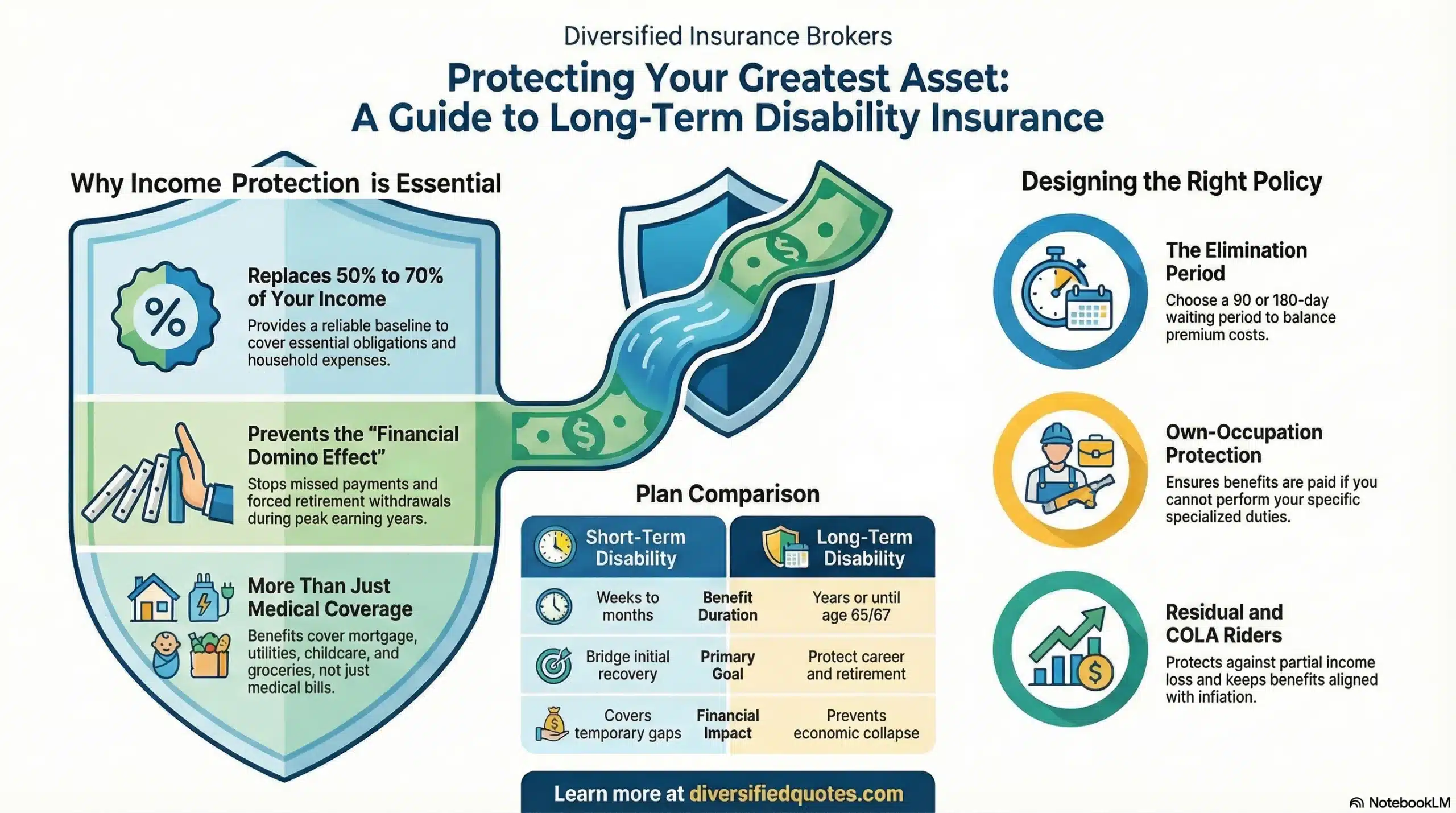
Talk With an Advisor Today
Choose how you’d like to connect—call or message us, then book a time that works for you.
Schedule here:
calendly.com/jason-dibcompanies/diversified-quotes
Licensed in all 50 states • Fiduciary, family-owned since 1980
Best Disability Insurance Rates — FAQs
The best disability insurance rates are those that provide strong, clearly defined income protection at a cost that fits your budget without sacrificing the contract features that determine whether the policy actually performs when you need it. A rate that appears low because the benefit period is short, the disability definition is restrictive, or the residual provisions are absent is not a good rate — it is a price reduction achieved by reducing coverage. The best rate for your situation is determined by identifying what you need the policy to do — cover essential expenses if you cannot perform your specific occupation, protect against partial income loss during recovery, provide benefits long enough to protect your household through the most likely disability scenarios — and then finding the carrier and design combination that delivers those outcomes at the most competitive premium across the market.
Several variables interact to determine the total premium for any disability policy. Age is one of the most significant — buying earlier while healthy typically produces lower rates and simpler underwriting. Occupation class is another major factor because carriers price disability risk according to the probability and severity of claims by job type, with white-collar occupations typically receiving better rates and policy language than physically demanding ones. Health history affects pricing because carriers evaluate the probability of a future claim based on existing and historical conditions. Benefit amount, benefit period, and elimination period all directly influence the premium — higher benefits, longer benefit periods, and shorter elimination periods each add to the cost. The policy’s disability definition — own-occupation versus any-occupation — and the presence of riders like residual disability coverage, COLA, and future increase options also contribute meaningfully to the final premium.
Group disability coverage provided through an employer is a valuable foundation but consistently has structural limitations that make it insufficient as the only source of income protection for most working professionals. Group policies typically cap benefits at a percentage of base salary that excludes bonuses, commissions, and other variable income — meaning actual income replacement can be significantly lower than the stated benefit percentage suggests. The disability definition in most group policies shifts from own-occupation to any-occupation after a period of 24 months, making it harder to collect long-term benefits if you can work in any capacity. Group coverage is usually not portable when employment changes — the protection disappears exactly when a job transition makes financial stability most important. Group benefits paid through employer-paid premiums are also generally taxable, reducing the effective value of the payment. Individual disability insurance complements group coverage by providing portability, stronger definitions, benefit amounts based on total income, and contract terms you own and control regardless of employment changes.
The most effective way to reduce disability insurance premium without compromising core protections is to focus on the elimination period first. Choosing a 90-day or 180-day elimination period instead of a 30-day or 60-day period can meaningfully reduce premium, and it is generally a reasonable tradeoff if you have emergency savings that can sustain expenses during the waiting period. Right-sizing the monthly benefit to cover essential fixed expenses rather than the full gross income is another practical approach — you do not need to replace every dollar of income, only the dollars your household genuinely cannot function without. Selecting a benefit period to age 65 rather than to age 67 or 70 can reduce premium while still providing long-duration protection through most of the working years. Limiting riders to those that match your specific situation — rather than adding every available enhancement — also keeps the premium focused. An experienced independent broker can model the cost impact of each variable so you see exactly what each design choice costs and saves before committing.
Yes — self-employed individuals and business owners can qualify for competitive disability coverage, though the process involves more documentation than for salaried employees. Carriers typically require income verification through business tax returns, profit and loss statements, and sometimes multiple years of documented earnings to establish a stable income baseline for benefit calculation. Self-employed income that is variable can affect how carriers cap available benefits in any given year. Business owners also face the additional consideration of whether they are protecting personal income only or also need business overhead expense disability coverage, which covers fixed business costs such as rent, staff salaries, and equipment payments during a disability period when the owner cannot generate revenue. The benefit of working with an independent broker as a self-employed professional is that different carriers have different underwriting approaches for self-employed income — some are more flexible than others — and carrier selection can meaningfully affect both what is available and at what price.
It depends on the specific health history, and the answer varies meaningfully across carriers. Some conditions result in higher premium rates through occupational or health class adjustments. Others result in policy exclusion riders that exclude claims related to a specific pre-existing condition while covering everything else. Some conditions are insurable at standard rates with documentation of current stability. And some more serious health histories may limit available options to simplified underwriting or lower benefit amounts. The key insight is that “declined by one carrier” does not mean “uninsurable” — different carriers have different underwriting philosophies and different threshold levels for specific conditions. An independent broker who understands how various carriers evaluate specific health situations is significantly more effective at finding coverage for applicants with health complexity than applying to a single carrier directly. Applying while health is good and conditions are under control — rather than waiting — consistently produces better underwriting outcomes and lower premiums than applying after health has deteriorated further.
Disability coverage should be reviewed whenever a significant life or income change occurs — including income increases that have made the current benefit amount insufficient, changes in occupation or employer that affect existing coverage, new household financial obligations such as a mortgage or dependents, or changes in health status that might affect future insurability. Beyond event-driven reviews, a routine review every two to three years is worthwhile to confirm that the benefit amount, benefit period, and policy design still align with your current income and obligations. For individuals who purchased group coverage through an employer several years ago but have since become higher earners, reviewing whether the group benefit cap still provides adequate coverage is often the most immediately actionable insight from a coverage review. Future increase option riders — if they were included at the time of purchase — allow benefit increases as income grows without requiring new medical underwriting, which is a feature worth activating when income increases rather than waiting until health changes make new underwriting difficult.
An own-occupation disability definition is the strongest and most protective form of disability language available in individual disability insurance policies. Under an own-occupation definition, the insurance pays benefits when you cannot perform the material and substantial duties of your specific occupation — even if you are capable of and do perform work in some other occupation or capacity. This is critically important for professionals whose income depends on a specialized skill set. A surgeon with a hand injury may be unable to perform surgery but could theoretically teach or consult. An own-occupation policy would pay full disability benefits in that scenario. An any-occupation policy — which only pays when you cannot perform any gainful work for which you are reasonably suited by education and experience — might not pay benefits because the surgeon can still work in some capacity. For professionals in specialized, high-income occupations, own-occupation language is often worth the additional premium because it protects the income stream most precisely tied to the specific professional skills developed over years of training and experience.
Residual disability coverage — sometimes called partial disability coverage — is the benefit provision that pays when a disability reduces your work capacity and income without completely preventing you from working at all. This is important because most real-world disability events are not binary — they do not produce an immediate and permanent inability to work. Instead, they produce a period where you can work reduced hours, reduced capacity, or in a reduced role, generating income but less than you earned before the disability. Without residual coverage, a policy may pay nothing in those common scenarios if you do not meet the “totally disabled” standard that triggers full benefit payments. With strong residual coverage, the policy supplements your reduced income proportionally to the income loss — which is often the difference between maintaining financial stability and experiencing the cumulative impact of months or years of reduced earnings. When comparing quotes, the presence, trigger conditions, and payment structure of residual disability coverage should be evaluated as a primary feature rather than an add-on, because it determines how the policy performs in the most statistically likely disability scenarios.
About the Author:
Jason Stolz, CLTC, CRPC, DIA, CAA and Chief Underwriter at Diversified Insurance Brokers (NPN 20471358), is a senior insurance and retirement professional with more than 25 years of real-world experience helping individuals, families, and business owners protect their income, assets, and long-term financial stability. As a long-time partner of the nationally licensed independent agency Diversified Insurance Brokers, Jason provides trusted guidance across multiple specialties—including fixed and indexed annuities, long-term care planning, personal and business disability insurance, life insurance solutions, Group Health, Travel Medical and Evacuation Insurance, and short-term health coverage. Diversified Insurance Brokers maintains active contracts with over 100 highly rated insurance carriers, ensuring clients have access to a broad and competitive marketplace.
His practical, education-first approach has earned recognition in publications such as VoyageATL, and contributions from his agency featured in Kiplinger and GoBankingRates— highlighting his commitment to financial clarity and client-focused planning. Drawing on deep product knowledge and years of hands-on field experience, Jason helps clients evaluate carriers, compare strategies, and build retirement and protection plans that are both secure and cost-efficient. Visitors who want to explore current annuity rates and compare options across multiple insurers can also use this annuity quote and comparison tool.
Explore More Disability Insurance Options: Browse our complete guide to Disability Insurance Planning & Education — covering how it works, riders, elimination periods, own occupation, costs & buying guides from 100+ carriers.
Last Reviewed: May 7, 2026 |
Reviewed by: Jason Stolz, CLTC, CRPC, DIA, CAA
Chief Underwriter, Diversified Insurance Brokers, Inc. | NPN: 20471358 | Diversified Insurance Brokers, Inc. — Licensed in all 50 states
Fact Checked by: Tonia Pettitt, CMIP©
Medicare Specialist, Diversified Insurance Brokers, Inc. | NPN: 14374308 | Diversified Insurance Brokers, Inc. — Licensed in all 50 states
Did you find this content helpful? Leave us a Google review — it helps others find trustworthy guidance too.
Editorial Standards: Diversified Insurance Brokers maintains rigorous editorial standards to ensure accuracy, clarity, and independence in all content. Learn more about our editorial standards and commitment to transparency.
