
Disability Insurance for Game Wardens
As an Independent Disability Insurance Broker, we have access to exclusive discounts and negotiated pricing most captive agents can’t offer — see the full breakdown near the end of this page.
Disability Insurance for Game Wardens

Jason Stolz CLTC, CRPC, DIA, CAA
Disability insurance for game wardens is essential income protection for one of the most genuinely dangerous law enforcement professions in the United States — and one whose occupational risk profile is dramatically underestimated by the general public, by many financial planners, and frequently by the game wardens themselves. Whether you serve as a state game warden patrolling wildlife management areas and public hunting lands, work as a federal wildlife law enforcement officer with the U.S. Fish and Wildlife Service, operate as a conservation officer enforcing fishing and hunting regulations across a remote rural district, or serve as a park ranger with law enforcement responsibilities — your income depends on your physical and cognitive capacity to perform the most hazardous work in law enforcement, often alone, in remote terrain, with every person you contact carrying a firearm.
Research published through law enforcement and wildlife management institutions documents that wildlife officers are assaulted with guns or knives up to seven times more often than other kinds of law enforcement officers, and are injured twice as often as other officers. The Department of Justice has specifically identified rangers among the most assaulted law enforcement officers in the country. Fish and game wardens have one of the highest rates of injuries and illnesses among all law enforcement occupations. These are not marginal risk statistics — they describe a genuinely dangerous profession whose physical exposure far exceeds the public’s perception of wildlife work as a benign outdoor career.
At Diversified Insurance Brokers, we help game wardens, conservation officers, wildlife law enforcement officers, and park rangers structure disability insurance coverage that reflects the genuine occupational hazards of wildlife law enforcement, the limitations of government employee group disability and pension plans, and the specific conditions most likely to interrupt or end a game warden’s career and income.
Protect Your Game Warden Income
Compare disability insurance options designed for game wardens, conservation officers, wildlife law enforcement officers, and park rangers.
Why Game Wardens Face the Most Dangerous Law Enforcement Conditions in America
Disability insurance for game wardens begins with an honest account of why wildlife law enforcement is so genuinely dangerous — because the occupational risk profile of a game warden is fundamentally different from urban or suburban law enforcement, and those differences directly define what kind of disability events are most likely and what financial protection is most needed.
Game wardens patrol alone. Unlike virtually every other law enforcement context where officer safety protocols emphasize backup and partner coverage, game wardens routinely work solo across vast geographic districts where backup response time is measured in hours rather than minutes. A game warden who is injured, incapacitated, or involved in a physical confrontation in a remote watershed, a backcountry hunting district, or a rural agricultural area at dawn on a December morning may be genuinely hours from any assistance. This solo patrol reality — combined with the armed nature of virtually every enforcement contact — creates a vulnerability to both violence and accident that is structurally unique to wildlife law enforcement.
Game wardens contact people who are armed as a matter of routine — hunters carry firearms, anglers carry tackle knives, and the outdoor recreation population that game wardens regulate includes a substantially higher baseline of weapon-carrying individuals than any other law enforcement population. Poachers — the specific target of many game warden enforcement actions — have been documented to exhibit unusually high levels of resistance to enforcement because many treat their activities as deeply personal rather than as crime. Research documents that poachers rarely admit guilt and often experience enforcement contact as a profound personal affront — a combination that has contributed directly to the elevated assault and injury rates that wildlife officers experience relative to other law enforcement officers. The remote, solo patrol, heavily armed contact environment that defines game warden work has direct parallels to other isolated outdoor professional contexts, including detectives and investigators working in high-risk field environments.
The Specific Disability Risks Game Wardens Face
Research examining line-of-duty deaths and injuries among game wardens identifies a specific and distinct disability risk profile that reflects the unique combination of law enforcement, outdoor physical work, and remote location that characterizes this profession. Understanding these specific categories is essential for structuring disability insurance coverage that addresses the conditions most likely to produce a career-ending or career-interrupting disability for a working game warden.
Gunfire is documented as the most frequent cause of line-of-duty death for game wardens — and non-fatal gunshot wounds, which produce permanent physical impairments at rates that produce genuine career-ending disability outcomes, occur in the enforcement context of solo patrol and armed poacher contact that is specific to wildlife law enforcement. A game warden who sustains a serious gunshot wound in a remote patrol area faces not just the immediate medical emergency but an evacuation situation where treatment delay compounds the injury severity. Surviving a serious shooting can leave permanent physical impairments — neurological damage, limb function loss, chronic pain — that permanently limit the physical capacity required for active field patrol work.
Vehicle and watercraft accidents — including motor vehicle crashes on remote rural roads and off-road tracks, boat accidents during water patrol, snowmobile accidents during winter patrol, and ATV accidents during backcountry enforcement — represent the second major disability category. Game wardens operate vehicles and watercraft in conditions that are inherently more hazardous than standard law enforcement patrol: unpaved and poorly maintained rural roads at night and in adverse weather, waterways without lane markings or traffic control, and winter terrain that creates constant vehicle stability risk. Line-of-duty death research documents vehicle accidents as a major cause of game warden fatalities — and the non-fatal accidents that produce serious orthopedic injuries, traumatic brain injuries, and spinal trauma represent a correspondingly significant source of career-disrupting disability.
Drowning risk is specific to game wardens in a way that no other law enforcement profession matches. Water patrol — checking fishing licenses and boat safety compliance on lakes, rivers, and coastal waterways — is a core function of game warden work in most states. Capsizing in cold water, falling overboard during enforcement boarding actions, and watercraft collisions all create drowning hazards that, while most often resulting in death when they occur, also produce serious disabling injuries in survivors — particularly hypothermia complications, near-drowning neurological injury, and traumatic injuries from watercraft impact. The extreme remote environment and cold water exposure risks facing game wardens have parallels in other isolated outdoor professional contexts, including commercial fishermen managing occupational disability risk in remote maritime environments.
Wildlife encounter injuries — attacks by bears, mountain lions, feral hogs, and other dangerous wildlife — are a specific occupational hazard for game wardens who work in areas where these animals are present and who may encounter them in context that other law enforcement officers never face. A game warden investigating an illegal bear bait site, tracking a wounded animal, or responding to a wildlife conflict complaint may encounter wildlife at close range in contexts where defensive options are limited. Serious wildlife attack injuries can produce disabling outcomes ranging from severe soft tissue damage and bone fractures to permanent disfigurement and neurological injury. The physical exposure and remote location trauma risk that game wardens face from wildlife encounters and terrain navigation has parallels in other physically demanding outdoor field work, including farmers and agricultural workers managing rural remote environment physical injury risk.
The Physical Demands Beyond Enforcement Encounters
Beyond the violent and accident-related disability risks that define game warden work in law enforcement terms, game wardens also face significant musculoskeletal and physical wear disability risks from the sustained physical demands of daily field work across challenging terrain and in extreme weather conditions. These cumulative physical demands produce the same occupational health consequences over a career that they produce in other physically demanding outdoor professions — but the remote patrol context adds additional risk factors that intensify the consequences.
Game wardens traverse rugged terrain on foot regularly — hiking through dense forest, crossing streams and wetlands, climbing ridgelines to access backcountry hunting districts, and navigating terrain at night and in adverse weather during search and rescue responses. This sustained terrain navigation over a career produces the cumulative lower extremity joint loading — knee, ankle, hip — that generates the chronic joint conditions, meniscal pathology, and degenerative arthritis that eventually limits sustained field patrol capacity. A game warden who develops severe knee or hip arthritis from years of backcountry patrol may find that the sustained off-road walking and terrain navigation of their patrol duties is no longer medically sustainable — constituting a genuine occupational disability even if they retain the capacity for less physically demanding work.
Cardiovascular health is also a specifically documented mortality and disability risk for game wardens. Research examining game warden line-of-duty deaths specifically notes heart attacks and other illnesses contracted on duty as a notable cause of fatality — reflecting the cardiovascular demands of physically strenuous law enforcement work combined with the occupational stress of solo patrol, armed enforcement contacts, and the emotional labor of witnessing wildlife crime and ecological destruction as core professional responsibilities. A cardiovascular event that is career-ending for a game warden whose patrol duties require sustained physical exertion represents exactly the kind of disability scenario that own-occupation disability insurance is designed to address. The sustained outdoor physical exertion and remote location cardiovascular risk that game wardens face has parallels in other extreme outdoor professional contexts, including professional divers managing cardiovascular and physical disability risk in remote and hazardous working environments.
The PTSD and Psychological Disability Dimension
Post-traumatic stress disorder and psychological disability represent a meaningful and specifically under-recognized disability risk for game wardens whose career involves sustained exposure to traumatic content that is distinct from other law enforcement contexts. Game wardens investigate wildlife crimes including illegal killing and poaching — involving repeated exposure to the graphic consequences of illegal hunting activity on wildlife. They respond to hunting accidents, boating accidents, and outdoor recreation fatalities, serving as often the first responder to serious injury and death scenes in remote locations where other emergency response may be slow to arrive. And they regularly face personally threatening enforcement encounters with armed individuals who are actively resistant, sometimes violently so.
The cumulative psychological burden of this sustained trauma exposure, combined with the isolation of solo rural patrol and the stress of carrying law enforcement responsibility in environments where backup support is hours away, creates genuine PTSD and occupational burnout risk that published law enforcement mental health research consistently documents in rural and remote law enforcement populations. A game warden who develops PTSD severe enough to prevent effective field patrol — the hypervigilance, avoidance behaviors, and cognitive disruption of serious PTSD directly impair the alertness and judgment that remote solo enforcement work demands — has a genuine occupational disability. Many individual disability insurance policies provide coverage for mental health conditions including PTSD, and evaluating this coverage dimension before purchasing any policy is an important planning step for game wardens. The psychological disability risk from sustained traumatic occupational exposure has parallels in other high-stress emergency response contexts, including emergency dispatchers managing PTSD and psychological disability risk from sustained trauma exposure.
Government Employee Benefits — What They Cover and Where the Gaps Are
Most game wardens are employed by state fish and wildlife agencies or federal land management agencies as government employees — and they typically have access to group disability coverage through their employer, along with defined benefit pension plans that include disability retirement provisions. These institutional protections are meaningful but they carry the same structural limitations that affect all government employee group disability programs, and understanding those limitations is essential for any game warden assessing their true financial exposure in the event of a career-ending disability.
State government group long-term disability plans typically replace 60% to 66.67% of base salary — excluding any supplemental pay, shift differentials, overtime compensation, or specialty pay that may form a meaningful part of a game warden’s total compensation. For game wardens whose total annual earnings include overtime from extended enforcement seasons, hazard pay, or other supplemental compensation, the group plan benefit may substantially underprotect actual financial need. Group plans also carry own-occupation definitions that frequently shift to any-occupation standards after two years of disability — meaning that a game warden who is permanently disabled from field patrol work but who could theoretically perform sedentary administrative or desk work may see their disability benefits discontinued after the two-year own-occupation period expires.
Disability retirement through state pension systems provides an additional layer of protection but typically requires a qualifying medical determination and produces benefit amounts that reflect reduced pension accrual relative to normal retirement — often leaving a game warden who is disabled mid-career with pension income that is substantially below what normal career completion would have produced. Individual supplemental disability insurance fills these gaps by providing own-occupation income replacement that remains in force regardless of theoretical capacity for other work, covering total compensation rather than base salary alone, and functioning independently of employment status and pension eligibility. The government employee group plan limitation problem facing game wardens mirrors the institutional safety net gap documented for other government and public safety employees, including pilots managing the gap between employer group coverage and actual income protection needs.
Case Study: State Game Warden Earning $68,000 Per Year
Consider a state game warden with twelve years of service earning $68,000 annually in combined base salary and supplemental pay. During a watercraft enforcement stop on a remote lake, the warden is seriously injured when the subject’s vessel strikes the patrol boat, resulting in spinal trauma requiring surgical treatment and fourteen months of rehabilitation during which field patrol duties are medically prohibited.
| Scenario | Group Plan Only | Group Plan + Individual Supplement |
|---|---|---|
| Monthly Benefit During Disability | ~$3,400 (60% of base salary only) | ~$3,400 group + $1,400–$1,800 individual supplement |
| Supplemental Pay Protected | $0 — entirely excluded from group plan calculation | Individual policy calibrated to total compensation |
| 14-Month Total Income | ~$47,600 | ~$67,200–$72,800 |
| Definition of Disability After Year 2 | Shifts to any-occupation — field patrol disability may not qualify | Individual own-occupation definition maintained for full benefit period |
Watercraft accidents during enforcement operations are a documented and recurring source of serious injury for game wardens conducting water patrol. Disability insurance for game wardens ensures that a career-disrupting patrol accident does not simultaneously produce a household financial crisis during what may be a lengthy rehabilitation period — particularly when the injury is severe enough that the timeline to return to field patrol is extended.
Key Policy Features for Game Warden Disability Insurance
Disability insurance for game wardens should incorporate specific policy provisions that address the hazardous occupational profile, the government employment income structure, and the specific disability risks of wildlife law enforcement. The own-occupation definition is foundational — ensuring that a game warden who is permanently unable to perform field patrol duties receives ongoing benefits regardless of whether they could theoretically work in a non-patrol administrative or desk capacity. Our comprehensive resource on own-occupation disability insurance explained covers how this definition protects game warden income from the conditions most likely to end a field patrol career.
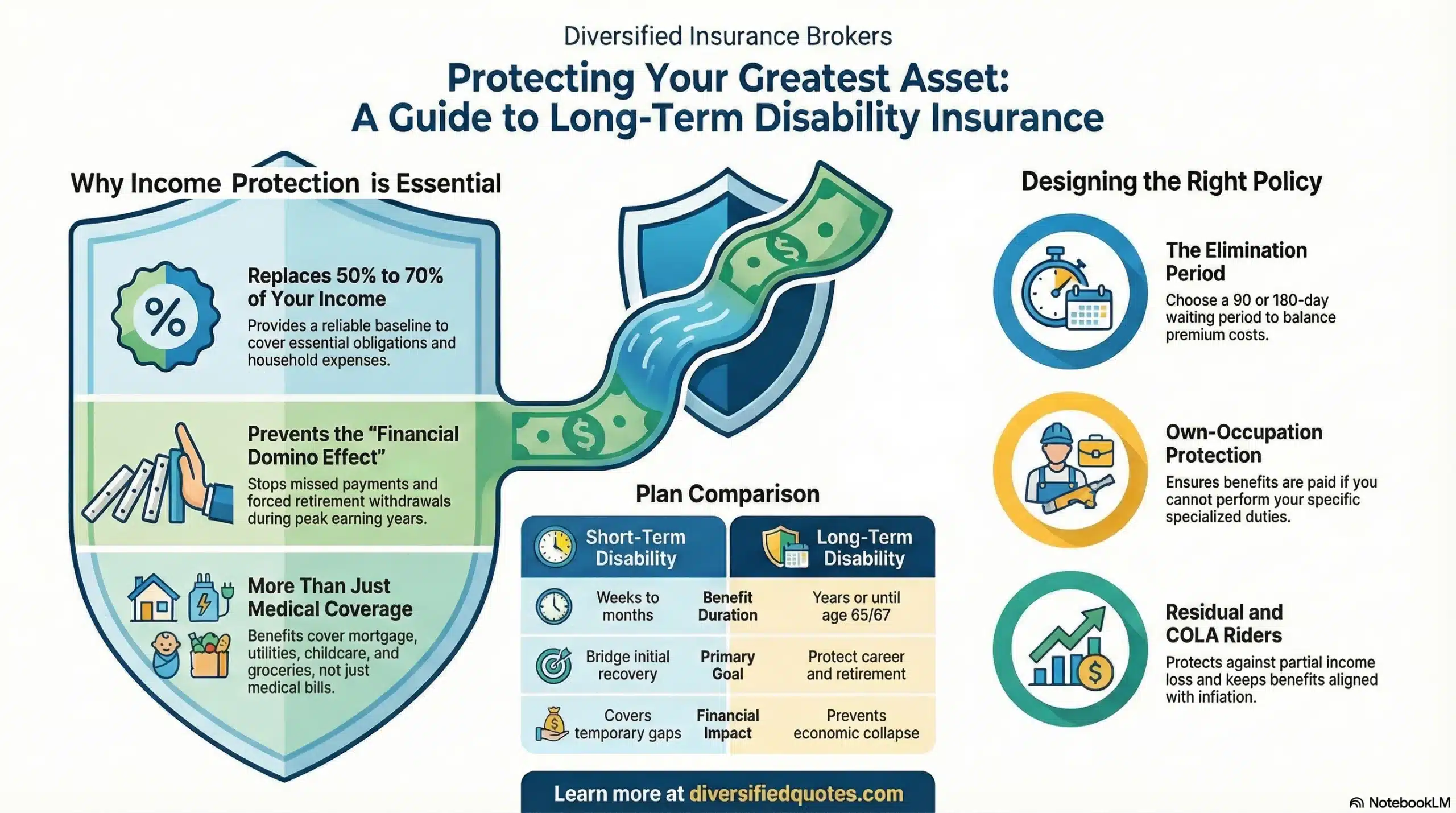
A residual disability rider is particularly important for game wardens whose injuries or conditions may limit patrol capacity without eliminating it entirely — a warden who can perform some field duties at reduced intensity but cannot manage the full physical demands of solo backcountry patrol earns reduced effective compensation without being totally disabled. Our resource on how residual disability insurance benefits work explains how partial disability coverage provides financial support during graduated return-to-duty periods. Mental health coverage provisions should be specifically evaluated — given the documented PTSD risk in wildlife law enforcement — to ensure mental health disability is fully covered for the complete benefit period rather than limited to 24 months.
The elimination period should be calibrated to the game warden’s sick leave accrual, available personal financial reserves, and the group plan coverage that activates during the initial waiting period. Our guide on how disability insurance elimination periods work provides the complete framework. A cost-of-living adjustment rider preserves real benefit value across extended disability periods — our resource on disability income insurance with a COLA rider explains this inflation protection for extended claims. For game wardens exploring short-term coverage options, our guide on how to buy short-term disability insurance covers the initial income protection picture.
Occupational Classification and Specialty Market Access for Game Wardens
Game wardens present a specific occupational classification challenge in the disability insurance marketplace that requires specialized broker knowledge to navigate effectively. The combination of law enforcement duties, remote field patrol, watercraft operation, and armed enforcement contact places game wardens in a hazardous occupational category that some standard retail disability insurance carriers decline to underwrite or underwrite only with significant limitations. Other carriers with specific experience in law enforcement and public safety occupational classifications write game warden disability insurance with terms that are genuinely meaningful and competitively priced.
The difference between carriers in how they classify game warden duties — whether they are treated as general government employment, law enforcement, or a distinct wildlife officer category — can produce meaningfully different policy terms, benefit amounts, and premium structures. For game wardens whose duties include significant administrative, educational, or office-based components alongside field patrol, presenting the full duty profile to underwriters accurately and strategically is essential for achieving the most favorable available classification. This occupational classification complexity is parallel to that facing other high-hazard outdoor professionals, including explosives handlers and high-hazard professionals requiring specialty market disability insurance placement.
Why Game Wardens Need an Independent Disability Insurance Broker
Disability insurance for game wardens requires law enforcement occupational underwriting expertise, knowledge of which carriers write hazardous public safety occupations most favorably, understanding of government employee income documentation and group plan coordination, and the ability to evaluate mental health coverage provisions for law enforcement PTSD risk — all of which require independent broker expertise rather than a standard retail application process.
At Diversified Insurance Brokers, we work with law enforcement and public safety professionals across a wide range of occupational contexts, including game wardens and conservation officers whose hazard profile and employment structure require specific carrier selection and policy design. We evaluate the full competitive marketplace for each individual game warden, identify the carriers whose underwriting guidelines most favorably accommodate wildlife law enforcement occupational classifications, and structure supplemental coverage that accurately fills the specific gaps in government group plan and pension disability protection. Our dedicated resource on why independent disability insurance brokers matter explains the full value of this approach for public safety and law enforcement professionals whose occupational disability planning requires more than a standard retail solution. For game wardens evaluating the foundational financial case for individual supplemental disability coverage, our resource on whether disability insurance is worth the investment provides the complete picture of what is at stake for a public safety professional in one of America’s most genuinely dangerous occupations.
Final Thoughts on Disability Insurance for Game Wardens
Game wardens serve as the primary protectors of America’s wildlife and natural resources — enforcing hunting and fishing laws, investigating wildlife crimes, conducting search and rescue operations, and patrolling vast remote territories that no other law enforcement agency covers. They do this work alone, in some of the most physically demanding and geographically remote environments in the country, with every person they contact armed, and with backup response times that can be measured in hours. The documented injury and assault rates for wildlife law enforcement confirm what experienced game wardens already know — this is genuinely dangerous work.
Disability insurance for game wardens is the financial tool that ensures a career-disrupting injury — from a gunshot wound, a watercraft accident, a wildlife attack, a vehicle crash on a remote patrol road, or the cumulative physical wear of years of backcountry patrol — does not also become a household financial crisis. A well-structured supplemental individual policy that fills the gaps in government group coverage, maintains own-occupation protection for the full benefit period, and addresses the specific disability risks of wildlife law enforcement provides the financial security that every game warden deserves for the dangerous public service they perform.
Related Pages
Talk With an Advisor Today
Choose how you’d like to connect—call or message us, then book a time that works for you.
Schedule here:
calendly.com/jason-dibcompanies/diversified-quotes
Licensed in all 50 states • Fiduciary, family-owned since 1980
Disability Insurance for Game Wardens FAQs
Yes, game wardens can obtain individual disability insurance, though the occupational classification and carrier selection require specialized broker knowledge given the hazardous nature of wildlife law enforcement work. Game wardens are classified based on the full scope of their duties — including field patrol, enforcement contacts, watercraft and vehicle operation, and backcountry terrain work — and the classification determines both the premium rate and the policy features available. Some standard retail disability insurance carriers decline to write law enforcement and public safety occupations or write them only with significant limitations. Other carriers with specific experience in law enforcement occupational classifications write game warden disability insurance with genuinely meaningful terms at competitive premium rates. The most important planning consideration for game wardens is not simply whether coverage is available but whether the benefit amount, the definition of disability, the mental health coverage provisions, and the carrier’s underwriting approach to law enforcement occupations are appropriate for the specific disability risks that wildlife law enforcement creates.
Research and government documentation consistently identify game warden work as among the most dangerous in law enforcement. Wildlife officers are assaulted with guns or knives up to seven times more often than other types of law enforcement officers and are injured twice as often. Fish and game wardens have one of the highest rates of injuries and illnesses among all law enforcement occupations. The Department of Justice specifically includes rangers among the most assaulted law enforcement officers in the country. The primary driver of this elevated risk profile is the combination of solo patrol — game wardens work alone in remote districts without backup — and armed contact environments where virtually every person encountered carries a firearm. Research examining game warden line-of-duty deaths identifies gunfire as the most frequent cause of death, followed by vehicle accidents, drowning, aircraft accidents, and heart attacks on duty. These are not statistical abstractions — they describe the genuine daily occupational reality of wildlife law enforcement and the disability events it produces. For parallel context on disability risk in high-hazard field law enforcement contexts, see our resource on disability insurance planning for professionals in high-risk occupational categories.
In most cases, no — and the gaps are more significant than most game wardens recognize until they examine their coverage specifically. State government group long-term disability plans typically replace 60% to 66.67% of base salary and explicitly exclude supplemental pay, shift differentials, overtime compensation, and specialty pay that may form a meaningful portion of total annual compensation. A game warden earning $68,000 in total compensation who receives a group disability benefit calculated on $54,000 in base salary has a meaningful income gap that individual supplemental coverage addresses. More consequentially, many government group disability plans include own-occupation definitions that shift to any-occupation standards after two years of disability — meaning that a game warden who is permanently disabled from field patrol work but could theoretically perform sedentary administrative work may have their disability benefits discontinued after the two-year own-occupation period. Individual supplemental disability insurance maintains own-occupation protection for the full benefit period, covers total compensation rather than base salary, and remains in force independently of employment status — filling the specific gaps that government group coverage leaves open for wildlife law enforcement professionals.
The disability risk profile for game wardens reflects the unique combination of law enforcement hazards, remote outdoor physical work, and watercraft operation that defines wildlife law enforcement. Gunshot wounds from armed poacher enforcement encounters — research identifies gunfire as the most frequent cause of game warden line-of-duty death — produce serious permanent physical impairments in survivors that can prevent return to active field patrol. Vehicle and watercraft accidents — including crashes on remote rural roads, snowmobile accidents in winter patrol conditions, and boat accidents during water enforcement operations — produce the orthopedic injuries, spinal trauma, and traumatic brain injuries that represent a major source of career-disrupting disability. Wildlife attack injuries from bears, mountain lions, feral hogs, and other dangerous animals are a specific occupational hazard for game wardens working in predator territory. Drowning and near-drowning neurological injuries from water patrol incidents affect game wardens at higher rates than other law enforcement officers. Cumulative musculoskeletal conditions from sustained backcountry patrol produce chronic joint disease over a career. And PTSD from sustained traumatic exposure in solo remote law enforcement contexts is a specifically documented mental health disability risk for wildlife law enforcement officers. For parallel context on disability risk in remote physically demanding law enforcement contexts, see our resource on disability insurance for professionals with complex occupational risk profiles.
Many individual disability insurance policies provide coverage for mental health conditions including PTSD, major depression, and anxiety disorders when those conditions prevent performing occupational duties. For game wardens — whose career involves sustained exposure to violent enforcement encounters with armed poachers, graphic wildlife crime investigation, remote solo patrol stress, and first response to outdoor fatality and serious injury scenes — PTSD is a genuine and documented occupational risk rather than a peripheral concern. Coverage terms vary significantly between carriers: some policies provide full mental health disability benefits throughout the entire benefit period, while others limit mental health claims to 24 months even when the base policy would otherwise pay to age 65. For game wardens whose most likely extended disability scenario may involve PTSD or mental health conditions in addition to physical injury, evaluating the mental health benefit period provision of any disability policy before purchase is an important planning step. At Diversified Insurance Brokers, we specifically assess mental health coverage provisions when structuring disability insurance for law enforcement and public safety professionals whose occupational exposure creates documented psychological disability risk.
Own-occupation disability insurance pays benefits when a disabling condition prevents a game warden from performing the specific duties of their wildlife law enforcement profession — solo field patrol, armed enforcement contacts, watercraft and vehicle operation, backcountry terrain navigation, search and rescue response — regardless of whether they could theoretically perform other less physically demanding work. Any-occupation coverage only pays if the game warden cannot perform virtually any gainful employment. A game warden who sustains a serious spinal injury that prevents the sustained physical demands of backcountry patrol but who could theoretically perform a desk job would receive no any-occupation benefits — while an own-occupation policy recognizes the genuine inability to perform wildlife law enforcement field duties and pays accordingly. This distinction is particularly consequential for game wardens because the specific physical and environmental demands of field patrol work — remote solo patrol, vehicle and watercraft operation in challenging conditions, sustained terrain navigation — are exactly the capabilities that many disabling conditions limit while leaving desk-based work theoretically possible. Own-occupation coverage is the only definition that meaningfully protects game warden field patrol income.
Residual disability coverage pays proportional benefits when a disabling condition reduces a game warden’s field patrol capacity without eliminating it entirely. A game warden recovering from an orthopedic injury may be medically cleared for limited patrol duties — road-based patrol or administrative enforcement functions — months before they can safely return to full backcountry patrol and watercraft enforcement operations. During this graduated return period, effective patrol capacity and any supplemental compensation tied to field duties are significantly reduced without being fully eliminated. Without a residual disability rider, a total-disability-only policy pays nothing during this partial capacity period. A residual rider supplements reduced income proportionally throughout the graduated return to full patrol duty capacity, providing continuous financial support from the onset of disability through complete return to unrestricted field patrol operations. For game wardens whose most likely disabling conditions — orthopedic injuries, spinal trauma, and PTSD — typically follow extended graduated return-to-duty timelines rather than binary on-off incapacity, this rider is essential for the disability policy to function as genuine income protection across the full recovery period. For context on how residual disability riders work for high-demand field professionals, see our resource on disability insurance for professionals requiring comprehensive partial disability protection.
State pension disability retirement provisions and individual disability insurance serve related but distinct financial protection purposes, and understanding how they interact is important for game wardens building a comprehensive disability protection plan. Disability retirement through a state pension system provides an income stream based on the warden’s pension accrual at the time of disability — which for a mid-career game warden may be substantially lower than what normal career completion would have produced. Additionally, disability retirement qualification typically requires a formal medical determination process that can take months to complete, during which income protection depends on other sources. Individual disability insurance activates after the elimination period regardless of the pension disability retirement timeline, providing income protection during the period when pension qualification is pending. Once pension disability retirement is established, individual disability insurance can be structured to supplement the pension income to a target total income replacement level. At Diversified Insurance Brokers, we specifically help game wardens model the interaction between state pension disability provisions, government group disability coverage, and individual supplemental coverage to design a protection structure that provides adequate total income replacement across all disability scenarios without overpaying in premiums for redundant coverage.
The elimination period selection for game wardens should account for the institutional bridge income available from sick leave accrual and the government group disability plan that typically activates after an initial waiting period of fourteen to thirty days. A game warden with a substantial sick leave bank — government employment typically allows meaningful sick leave accrual — can sustain themselves through a 90-day elimination period using accumulated sick time combined with any short-term disability coverage the state provides. Game wardens with limited sick leave accrual, who have recently depleted their sick bank from prior medical events, or who are early in their careers with limited accrual should evaluate whether a 30 or 60-day elimination period is more appropriate. The key question is whether the available sick leave balance can realistically bridge the household through the full waiting period from disability onset to the point where long-term individual disability benefits activate, without requiring significant draws on savings intended for other purposes. For the complete framework on elimination period selection, see our resource on disability insurance elimination period planning for public safety and government employment professionals.
The best time is as early as possible in a game warden career — ideally upon completing training and entering active patrol duty, before any occupational health conditions from field work, vehicle accidents, enforcement incident injuries, or cumulative physical patrol demands have accumulated in the medical record. Disability insurance premiums are based in part on age and health status at the time of application, and younger game wardens in excellent health secure the most comprehensive coverage at the most favorable rates. Orthopedic conditions from backcountry patrol, hearing damage from firearm use, cardiovascular findings, or any PTSD diagnosis or mental health treatment history documented before application can result in exclusion riders or restricted terms that limit coverage for exactly the conditions most likely to produce disability in wildlife law enforcement. Applying before these occupational health consequences develop ensures they are covered under an existing policy when they eventually appear — as they predictably do over a full game warden career. The non-cancelable and guaranteed renewable provision available in the strongest individual disability policies locks in the early-career health rating for the life of the policy, regardless of subsequent health developments during patrol years.
An independent broker with law enforcement and public safety occupational underwriting expertise is not merely preferable for game wardens seeking disability insurance — it is necessary for ensuring the best available outcome. Different carriers classify game warden duties differently — some treat wildlife law enforcement as standard government employment, others apply law enforcement classifications, and others have specific guidelines for outdoor patrol and hazardous public safety occupations — and these classification differences produce meaningfully different premium rates, benefit amounts, and policy feature availability. A captive agent representing a single carrier can only present that company’s approach, regardless of whether it is the most favorable for wildlife law enforcement occupational profiles. At Diversified Insurance Brokers, we evaluate the full competitive landscape for every game warden we work with, identify the carriers whose underwriting guidelines most favorably accommodate wildlife law enforcement occupational classifications, specifically evaluate mental health coverage provisions for PTSD risk, and structure supplemental coverage that accurately coordinates with the government group plan and pension provisions already in place — ensuring that the total disability protection framework is genuinely adequate for the most dangerous law enforcement profession in America.
About the Author:
Jason Stolz, CLTC, CRPC, DIA, CAA and Chief Underwriter at Diversified Insurance Brokers (NPN 20471358), is a senior insurance and retirement professional with more than 25 years of real-world experience helping individuals, families, and business owners protect their income, assets, and long-term financial stability. As a long-time partner of the nationally licensed independent agency Diversified Insurance Brokers, Jason provides trusted guidance across multiple specialties—including fixed and indexed annuities, long-term care planning, personal and business disability insurance, life insurance solutions, Group Health, Travel Medical and Evacuation Insurance, and short-term health coverage. Diversified Insurance Brokers maintains active contracts with over 100 highly rated insurance carriers, ensuring clients have access to a broad and competitive marketplace.
His practical, education-first approach has earned recognition in publications such as VoyageATL, and contributions from his agency featured in Kiplinger and GoBankingRates— highlighting his commitment to financial clarity and client-focused planning. Drawing on deep product knowledge and years of hands-on field experience, Jason helps clients evaluate carriers, compare strategies, and build retirement and protection plans that are both secure and cost-efficient. Visitors who want to explore current annuity rates and compare options across multiple insurers can also use this annuity quote and comparison tool.
Explore More Disability Insurance Options: Browse our complete guide to Disability Insurance for Agriculture, Natural Resources & Outdoor Industries — covering farmers, ranchers, fishermen, foresters, miners, oil & gas workers & outdoor industries from 100+ carriers.
Last Reviewed: June 8, 2026 |
Reviewed by: Jason Stolz, CLTC, CRPC, DIA, CAA
Chief Underwriter, Diversified Insurance Brokers, Inc. | NPN: 20471358 | Diversified Insurance Brokers, Inc. — Licensed in all 50 states
Fact Checked by: Tonia Pettitt, CMIP©
Medicare Specialist, Diversified Insurance Brokers, Inc. | NPN: 14374308 | Diversified Insurance Brokers, Inc. — Licensed in all 50 states
Did you find this content helpful? Leave us a Google review — it helps others find trustworthy guidance too.
Editorial Standards: Diversified Insurance Brokers maintains rigorous editorial standards to ensure accuracy, clarity, and independence in all content. Learn more about our editorial standards and commitment to transparency.
