
Disability Insurance for Divers and Diving Occupations
As an Independent Disability Insurance Broker, we have access to exclusive discounts and negotiated pricing most captive agents can’t offer — see the full breakdown near the end of this page.
Disability Insurance for Divers and Diving Occupations

Jason Stolz CLTC, CRPC, DIA, CAA
Disability insurance for divers and diving occupations is among the most critical — and most complex — income protection decisions a working diver will ever make. Whether you work as a commercial diver on offshore oil and gas platforms, a saturation diver on deep-sea construction projects, a public safety diver in search and rescue operations, a dive instructor at a recreational facility, or an underwater welder on marine infrastructure, your ability to earn is directly and entirely dependent on your physical fitness to dive.
Diving occupations carry some of the highest occupational risk profiles of any profession. The combination of extreme underwater pressure, hyperbaric gas exposure, physical exertion in uncontrolled environments, and the potential for acute medical emergencies creates a level of income vulnerability that is unlike almost any other field. A single decompression event, barotrauma injury, or neurological episode can permanently end a diving career — immediately and without warning.
At Diversified Insurance Brokers, we work with divers across the full spectrum of diving occupations to structure disability insurance coverage that reflects the real risks of underwater work and the genuine complexity of insuring a high-risk profession. This is not a standard desk-job application — it requires expertise, access to specialty carriers, and an understanding of how diving-specific conditions are evaluated at the underwriting level.
Protect Your Income as a Diving Professional
Compare disability insurance options designed for commercial divers, dive instructors, underwater welders, and other diving occupations.
The Spectrum of Diving Occupations
Diving is not a single profession — it encompasses a wide range of roles, each with distinct risk profiles, income structures, and insurance considerations. Understanding where your occupation falls on this spectrum is the first step toward structuring appropriate disability coverage.
Commercial divers are among the highest-risk workers in any industry. They operate on offshore oil and gas platforms, subsea pipeline construction projects, dam inspections, bridge repairs, and marine salvage operations. Many work in saturation diving environments, spending days or weeks living in pressurized chambers to eliminate the need for repeated decompression cycles. The physical demands and pressure-related hazards in this category are extreme.
Underwater welders face all of the risks of commercial diving compounded by the additional hazards of arc welding in a submerged environment — electrical risk, arc flash, molten metal, and the physical demands of precision work under pressure. This combination makes underwater welding one of the most hazardous occupations in existence.
Public safety divers — including police divers, fire department dive teams, and search and rescue divers — operate in low-visibility, high-urgency environments with significant physical demands. Many are employed by municipalities or agencies, but their disability coverage through employer plans is often limited relative to the risk they absorb.
Dive instructors and dive masters at recreational facilities occupy a lower risk tier than commercial divers, but they still face meaningful exposure to pressure-related injury, hearing damage, and musculoskeletal wear from repetitive dives. They are also frequently self-employed or working as independent contractors, which means employer-sponsored disability coverage is often nonexistent. This is a risk profile similar to other self-employed professionals in the water and maritime industries, such as professional boat captains seeking income protection.
Scientific and research divers working for universities, government agencies, or environmental organizations round out the professional diving landscape. Their income and employment structures vary widely, and disability coverage needs to be evaluated individually based on whether they are employees or independent contractors.
The Occupational Health Risks Unique to Divers
No other profession exposes workers to quite the same combination of pressure-induced medical conditions that divers face. These are not theoretical risks — they are documented, well-understood hazards that can result in permanent disability or career-ending injury with little or no warning.
Decompression sickness, commonly known as “the bends,” occurs when a diver ascends too quickly and dissolved nitrogen in the body’s tissues forms bubbles. These bubbles can form in any part of the body — joints, the spinal cord, the brain, or the lungs — and the resulting symptoms range from joint pain and skin rashes at the mild end to paralysis, stroke, and death at the severe end. Even with prompt hyperbaric oxygen treatment, some divers are left with permanent neurological damage that renders them unfit for further diving work.
Barotrauma — physical injury caused by pressure differentials between the body’s air spaces and the surrounding water — is another major source of occupational disability for divers. Middle ear barotrauma is the most common diving injury and can cause permanent hearing loss if severe or repeatedly sustained. Inner ear barotrauma can result in permanent vertigo, tinnitus, and hearing damage. Pulmonary barotrauma, in which lung tissue ruptures due to improper ascent while breathing compressed air, can cause arterial gas embolism — a life-threatening emergency that, even when survived, may leave lasting neurological deficits.
Dysbaric osteonecrosis is a chronic condition in which bone tissue dies as a result of compressed gas exposure over a career of diving. It most commonly affects the humerus, femur, and tibia, and can cause joint destruction that permanently limits mobility and the ability to perform diving duties. Studies of British commercial divers found detectable bone lesions in approximately 6% of the population, with joint-affecting lesions present in over 1% — conditions that, once present, are permanent.
Nitrogen narcosis, oxygen toxicity, and hypercapnia are additional hazards for deep or saturation divers using specialized breathing gas mixtures. Noise-induced hearing loss from equipment and underwater acoustic exposure is a progressive, career-long risk. Hypothermia, marine animal injuries, and entrapment round out an occupational risk profile that is genuinely exceptional in its breadth and severity. These risks are recognized across the maritime industry and are shared, in part, by professions such as construction workers in hazardous environments and workers in confined-space occupations, though the specific medical conditions facing divers are largely unique to the underwater environment.
Why Disability Insurance Is Especially Critical for Divers
The stakes of a disabling event are particularly high for divers because the profession has a binary characteristic that few other careers share: a diver is either medically fit to dive, or they are not. There is very little middle ground.
Medical standards for commercial diving fitness are strict and well-defined. Regulatory bodies and employers require divers to maintain specific health criteria to work. A permanent hearing loss, a neurological residual from decompression sickness, or an abnormality detected on a chest imaging scan following pulmonary barotrauma can disqualify a diver from further work entirely — even if that diver feels subjectively well and can perform other types of physical labor without difficulty.
This creates a situation where an own-occupation disability insurance policy is not merely preferable — it is essential. If you are medically disqualified from diving but could theoretically work in another capacity, a policy with an any-occupation definition of disability would not pay benefits. Only an own-occupation policy protects against the specific scenario most likely to affect a diver’s career: losing medical certification to dive while still being capable of other work.
The financial exposure is compounded by the fact that many commercial divers earn premium wages precisely because of the risk they accept. A saturation diver or offshore commercial diver may earn $100,000 to $300,000 or more annually. Losing that income — even temporarily — has consequences that standard savings cannot absorb for long. For divers in comparable high-risk, high-income maritime roles, the parallel to radiation-exposed workers protecting specialized income is instructive.
How Carriers Evaluate and Underwrite Diving Occupations
Disability insurance underwriting for divers is more nuanced than for most professions, and working with the wrong broker — one without experience in high-risk occupational placements — can result in coverage that contains diving exclusions, leaving you with a policy that does not respond to the very conditions most likely to affect your career.
Carriers evaluate divers based on several key factors. The type of diving matters enormously: recreational dive instructors are generally classified more favorably than commercial saturation divers. The depth at which you regularly work, the type of breathing gas used, whether you work in offshore oil and gas environments, and the frequency and duration of your dives all influence the underwriting outcome.
Some carriers will decline to offer disability coverage to commercial divers at any price, or will issue policies with explicit diving exclusions that eliminate exactly the conditions most relevant to the profession. Other specialty carriers — typically accessed only through experienced independent brokers — offer policies specifically designed for high-risk occupations, including commercial diving, that cover diving-related disability without exclusions.
Medical history is also scrutinized closely. Prior episodes of decompression sickness, any documented barotrauma, hearing test results, and cardiovascular health are all factors that underwriters examine. Divers with clean medical histories who apply early in their careers tend to have the best access to comprehensive, competitively priced coverage. The longer you wait, and the more diving-related health history accumulates, the more difficult it becomes to secure a policy without exclusions.
Case Study: Commercial Diver Earning $140,000 Per Year
Consider a commercial diver earning $140,000 annually working offshore oil and gas inspections. Following a decompression sickness event with residual neurological symptoms, the diver is declared medically unfit for commercial diving by their employer’s medical officer. Recovery is partial, and the diver is unable to return to offshore work for an indeterminate period.
| Scenario | Without Disability Insurance | With Disability Insurance |
|---|---|---|
| Monthly Income | $0 | $7,000–$9,500 |
| 12-Month Income | $0 | $84,000–$114,000 |
| Medical Fitness Reinstatement | Financially devastating if delayed | Income bridge maintained throughout |
| Career Outcome if Permanent | Financial collapse without income replacement | Long-term benefit period preserves financial stability |
This scenario plays out in the commercial diving industry with regularity. Disability insurance does not prevent the injury — but it is the single tool that prevents a career-ending health event from also becoming a financial catastrophe.
Own-Occupation Coverage and Why It Is Non-Negotiable for Divers
The definition of disability in your policy determines everything about how and when you receive benefits. For divers, there is only one acceptable definition: own-occupation.
Own-occupation disability insurance pays benefits when you are unable to perform the material duties of your specific occupation — in this case, professional diving — regardless of whether you are capable of performing other types of work. This matters enormously for divers because the most likely outcome of a serious diving-related injury is not total incapacity, but loss of medical certification to dive. A diver with residual inner ear damage, a neurological deficit, or documented dysbaric osteonecrosis may be perfectly capable of working in a shore-based role — but their diving career is over.
Under an any-occupation policy, that diver would receive no benefits, because they can technically work. Under an own-occupation policy, that diver would receive full benefits because they can no longer perform the specific duties for which they were trained and for which they earned their premium income. For a profession where this distinction is so directly tied to how disabilities actually manifest, own-occupation coverage is the only policy structure worth purchasing.
The Role of Residual Disability Coverage for Divers
Some diving-related conditions result in a partial rather than total loss of work capacity. A dive instructor who develops moderate hearing loss may be able to continue teaching in some formats but is limited in the environments where they can safely operate. A commercial diver recovering from a minor decompression event may return to work at reduced depth limits or reduced frequency before receiving full medical clearance.
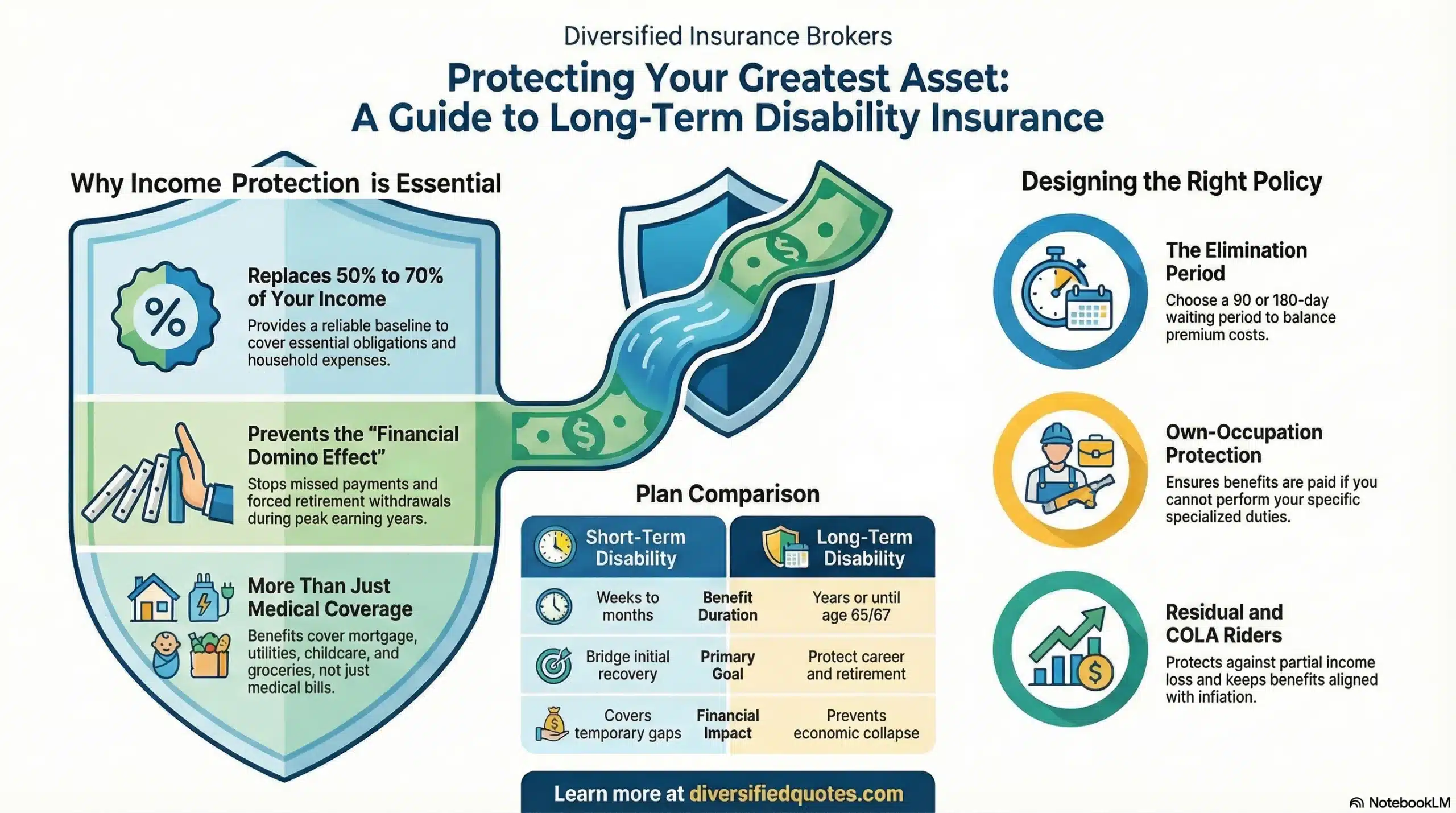
Residual disability coverage — also called partial disability — pays proportional benefits when a health condition reduces your income by a defined threshold without eliminating your ability to work entirely. For divers in recovery or operating under medical restrictions, this rider ensures that reduced earnings are supplemented during the transition back to full capacity.
Without a residual disability rider, a diver who returns to limited diving at 60% of their prior income may receive no benefits at all under a strictly total-disability policy, despite still being significantly impaired in their earning capacity. This is a risk-management gap that a well-structured policy closes entirely. Divers considering their broader financial safety net may also find value in reviewing short-term care and income protection alternatives that complement a primary disability policy.
Income Documentation Challenges for Self-Employed Divers
Many dive instructors, dive masters, and independent commercial divers work on a contract or freelance basis, creating the same income documentation challenges faced by other self-employed professionals. Disability insurance carriers base benefit amounts on verified earned income, typically using two to three years of tax returns. For divers with seasonal income, project-based contracts, or income that fluctuates based on dive frequency, presenting this information effectively to underwriters requires experience and expertise.
Divers who are employees of commercial diving contractors or offshore operators typically have W-2 income that is straightforward to document. However, their employer’s group disability plan — if one exists — may cover only a portion of total compensation, leaving a significant gap between what the employer plan pays and what the diver actually needs to maintain their financial obligations during a disability.
An individual disability policy purchased through an independent broker fills this gap and is fully portable — it belongs to you, not your employer, and follows you across job changes, contract changes, and career evolution. Understanding how to maximize your coverage relative to your documented income is one of the most important services an independent broker provides to working divers.
Saturation Divers and the Unique Challenges of Deep Diving Careers
Saturation divers represent the highest-risk tier of the commercial diving profession. These professionals live in pressurized environments for extended periods — sometimes two to four weeks at a time — breathing specialized gas mixtures while performing precision work at depths that can exceed 1,000 feet below the surface. The physical demands, the cumulative pressure exposure over a career, and the potential for catastrophic acute events are all at their most extreme in saturation diving.
Securing disability insurance as a saturation diver requires access to specialty markets that most standard disability insurance brokers do not reach. Some carriers decline this occupational class entirely. Others apply significant premium loadings or exclusion riders. Working with a broker who has experience placing high-risk occupational disability policies is not a preference for saturation divers — it is a necessity.
Despite the challenges, coverage is obtainable. Saturation divers with clean medical histories and documented safety records can often secure meaningful income protection through the right carrier relationships, even if the premium reflects the elevated risk profile of the occupation.
Comparing Diving Occupations to Other High-Risk Professions
The disability insurance challenges facing divers are shared, in different ways, by other professionals whose work involves extreme physical environments and high occupational hazard. The income protection principles that apply to divers are directly relevant to professionals in roles such as boilermakers working in hazardous industrial environments, well drillers facing underground occupational risk, and basement waterproofers navigating confined-space hazards.
What distinguishes divers is the combination of premium income tied to a medically certified fitness-to-dive standard, and the very specific occupational health conditions — decompression sickness, barotrauma, dysbaric osteonecrosis — that can trigger loss of that certification without necessarily causing total physical incapacity. This combination makes the own-occupation policy definition even more critical for divers than for most other high-risk occupational groups.
Integrating Disability Insurance Into a Diver’s Financial Plan
For divers who earn premium wages, disability insurance is the foundation upon which every other financial goal rests. The savings contributions, mortgage payments, family financial obligations, and retirement planning that characterize a high-earning diving career all depend on that income continuing. When it stops — suddenly and without warning, as diving-related disabilities often do — the financial structure built on top of it is immediately at risk.
Pairing a strong disability insurance policy with complementary financial tools creates a more resilient overall position. Strategies such as fixed annuities as a stable growth vehicle and life insurance covering chronic and critical illness add additional layers of protection. But none of those tools replace the immediate income-replacement function that disability insurance performs when a career-ending event occurs.
Working divers who have accumulated significant income over their careers should also explore wealth protection strategies used by high-income professionals as a complement to income protection planning.
Why Working with an Independent Broker Matters for Divers
Disability insurance for diving occupations is a specialty placement, not a standard retail transaction. The carriers willing to offer coverage to commercial divers, saturation divers, and underwater welders without punishing exclusions are not always the largest or most recognizable names in the market. Finding them, knowing how to present an applicant’s risk profile favorably, and structuring a policy that will actually perform at claim time requires broker expertise that goes well beyond the standard disability insurance sales process.
At Diversified Insurance Brokers, we work across the full spectrum of occupational classifications — from desk-based professionals to the highest-risk physical occupations in the workforce. We have the carrier relationships and underwriting experience to find options for divers that most brokers cannot access, and we structure coverage based on how your income is actually earned and how diving-related disabilities actually manifest.
Final Thoughts
Diving is a profession built on precision, discipline, and the willingness to accept physical risk in exchange for premium compensation. Disability insurance is the financial equivalent of that discipline — the tool that ensures the risks you accept underwater do not cascade into permanent financial damage above the surface.
If you earn your living as a commercial diver, saturation diver, dive instructor, underwater welder, or any other diving professional, protecting your income is the most important financial decision you can make. A well-structured own-occupation disability policy, placed through a broker with expertise in high-risk occupational coverage, is the foundation of that protection.
Related Pages
Talk With an Advisor Today
Choose how you’d like to connect—call or message us, then book a time that works for you.
Schedule here:
calendly.com/jason-dibcompanies/diversified-quotes
Licensed in all 50 states • Fiduciary, family-owned since 1980
Disability Insurance for Divers and Diving Occupations FAQs
Yes, commercial divers can obtain disability insurance, but it requires working with a broker who has access to specialty carriers that cover high-risk occupations. Standard retail disability insurance carriers often decline commercial divers or issue policies with explicit diving exclusions that eliminate coverage for the very conditions most likely to affect a diver’s career. An experienced independent broker can identify carriers that offer genuine coverage — including protection from decompression sickness, barotrauma, and other diving-specific conditions — without exclusions that render the policy ineffective.
Decompression sickness, commonly called “the bends,” occurs when a diver ascends too quickly and dissolved nitrogen in the body’s tissues forms gas bubbles. These bubbles can form in joints, the spinal cord, the brain, or the lungs, producing symptoms that range from joint pain and skin rashes to paralysis and neurological damage. While prompt hyperbaric oxygen treatment resolves many cases fully, some divers are left with permanent residual symptoms — including neurological deficits, hearing loss, or joint damage — that disqualify them from further commercial diving under standard medical fitness standards. For these divers, an own-occupation disability policy is what stands between a career-ending event and financial ruin.
Commercial divers must maintain strict medical fitness standards to work. A diver who loses medical certification due to a hearing loss, neurological residual from decompression sickness, or a pulmonary finding from barotrauma may still be physically capable of other types of work — but their diving career is over. An any-occupation disability policy would deny benefits in this scenario because the diver can technically work elsewhere. Only an own-occupation policy pays benefits based on the inability to perform the specific duties of a professional diver, regardless of whether other employment is theoretically possible. For this profession, own-occupation coverage is not optional — it is the only definition that actually provides meaningful protection.
The primary disabling conditions for divers include decompression sickness with residual neurological damage, inner ear barotrauma resulting in permanent hearing loss or vertigo, pulmonary barotrauma potentially leading to arterial gas embolism, and dysbaric osteonecrosis — a progressive bone disease caused by compressed gas exposure over a diving career. Musculoskeletal injuries from the physical demands of underwater work are also common, as are noise-induced hearing loss from equipment exposure and, over long careers, cumulative damage to lung and nervous system function. The breadth of potential disabling conditions makes comprehensive coverage essential rather than supplemental.
Yes, saturation divers represent the highest-risk tier of the commercial diving profession and face the most significant challenges in securing disability insurance. Saturation divers live in pressurized environments for extended periods — sometimes weeks at a time — at extreme depths, and their cumulative exposure to pressure-related health risks is far greater than that of surface-supplied or recreational divers. Some standard carriers decline this occupational class entirely. Others apply significant premium increases or add exclusion riders. Saturation divers must work with brokers who have specialty market access to find carriers that will write this risk with coverage that includes, rather than excludes, diving-related disability.
Generally yes. Recreational dive instructors and dive masters are classified at a lower risk tier than commercial divers and are more likely to qualify for standard individual disability policies, sometimes without occupational premium loadings or diving-specific exclusions. However, the picture varies based on factors such as the frequency of dives, the depth and environment of typical dives, and whether the instructor is self-employed or working for a facility. Self-employed dive instructors also face the additional challenge of documenting variable income for underwriting purposes. Working with an independent broker helps ensure the right carrier is selected and coverage is structured to reflect actual risk and income.
Residual disability — also called partial disability — coverage pays proportional benefits when a health condition reduces a diver’s income without completely eliminating the ability to work. For example, a commercial diver recovering from a decompression event may return to work under depth restrictions, reducing their available assignments and income by 50% or more before receiving full medical clearance. A residual disability rider ensures the policy supplements that reduced income during the recovery period, rather than requiring total incapacity before any benefit is paid. For divers whose return to work often happens gradually under medical supervision and depth restrictions, this rider is a critical component of a well-structured policy.
A documented history of decompression sickness will be scrutinized carefully during underwriting. Mild cases with full resolution and no residual symptoms may be accepted at standard rates by some carriers. More significant episodes, repeated incidents, or cases with any documented residual neurological or joint effects may result in premium increases, exclusion riders covering diving-related disability, or declination. This is one of the strongest arguments for applying for disability insurance early in a diving career — before any decompression events are on record — to secure the most comprehensive coverage at the most favorable rates.
Yes, and the differences are significant for divers. Group disability plans offered by employers typically replace 60% or less of base salary, often exclude bonuses and hazard pay, and are owned by the employer — meaning coverage ends when employment does. Individual policies are owned by you, are fully portable across employers and contracts, and can be structured to cover a higher proportion of total compensation including variable pay. For commercial divers who move between contractors, work internationally, or whose total compensation includes significant hazard premiums, an individual policy provides protection that a group plan simply cannot match.
The elimination period — the waiting time between the onset of disability and when benefits begin — should be chosen based on your financial reserves and how quickly a diving-related disability could affect your income. Because many commercial divers earn strong incomes, a 90-day elimination period is common and keeps premiums lower for those with adequate savings. However, diving-related disabilities often come with immediate income loss — a diver declared medically unfit cannot return to the water until cleared. Divers with limited emergency savings or those who carry significant fixed financial obligations may be better served by a 60-day or even 30-day elimination period, accepting a higher premium in exchange for faster benefit access.
Most disability insurance policies will replace between 60% and 70% of your verified earned income, up to carrier-specific monthly benefit caps. For a commercial diver earning $150,000 annually, this could translate to a monthly benefit of $7,500 to $9,000. Carriers impose these caps to ensure there remains a financial incentive to return to work where possible. However, because diving income includes hazard pay, offshore allowances, and variable components that can inflate total compensation beyond base salary, it is important to document all income sources accurately when applying. Your broker should review your total compensation structure to identify the most favorable approach to income verification for underwriting.
The best time is early — ideally at the beginning of your diving career, before any diving-related health history has accumulated. Premiums are determined in part by age and health status at the time of application, and the absence of prior decompression sickness episodes, hearing loss findings, or other diving-related conditions gives underwriters the cleanest possible picture of your risk profile. Waiting until mid-career, after years of accumulated dives and potentially a minor DCS episode or two, significantly narrows your options and can result in exclusion riders or higher premiums. The coverage you secure today is the coverage you will have when you need it most.
About the Author:
Jason Stolz, CLTC, CRPC, DIA, CAA and Chief Underwriter at Diversified Insurance Brokers (NPN 20471358), is a senior insurance and retirement professional with more than 25 years of real-world experience helping individuals, families, and business owners protect their income, assets, and long-term financial stability. As a long-time partner of the nationally licensed independent agency Diversified Insurance Brokers, Jason provides trusted guidance across multiple specialties—including fixed and indexed annuities, long-term care planning, personal and business disability insurance, life insurance solutions, Group Health, Travel Medical and Evacuation Insurance, and short-term health coverage. Diversified Insurance Brokers maintains active contracts with over 100 highly rated insurance carriers, ensuring clients have access to a broad and competitive marketplace.
His practical, education-first approach has earned recognition in publications such as VoyageATL, and contributions from his agency featured in Kiplinger and GoBankingRates— highlighting his commitment to financial clarity and client-focused planning. Drawing on deep product knowledge and years of hands-on field experience, Jason helps clients evaluate carriers, compare strategies, and build retirement and protection plans that are both secure and cost-efficient. Visitors who want to explore current annuity rates and compare options across multiple insurers can also use this annuity quote and comparison tool.
Explore More Disability Insurance Options: Browse our complete guide to Disability Insurance for Transportation, Maritime & Hazardous Occupations — covering truck drivers, flight attendants, merchant marines, divers, chauffeurs & drivers from 100+ carriers.
Last Reviewed: June 7, 2026 |
Reviewed by: Jason Stolz, CLTC, CRPC, DIA, CAA
Chief Underwriter, Diversified Insurance Brokers, Inc. | NPN: 20471358 | Diversified Insurance Brokers, Inc. — Licensed in all 50 states
Fact Checked by: Tonia Pettitt, CMIP©
Medicare Specialist, Diversified Insurance Brokers, Inc. | NPN: 14374308 | Diversified Insurance Brokers, Inc. — Licensed in all 50 states
Did you find this content helpful? Leave us a Google review — it helps others find trustworthy guidance too.
Editorial Standards: Diversified Insurance Brokers maintains rigorous editorial standards to ensure accuracy, clarity, and independence in all content. Learn more about our editorial standards and commitment to transparency.
