
Disability Insurance for Basement Waterproofers
As an Independent Disability Insurance Broker, we have access to exclusive discounts and negotiated pricing most captive agents can’t offer — see the full breakdown near the end of this page.
Disability Insurance for Basement Waterproofers

Jason Stolz CLTC, CRPC
Disability insurance for basement waterproofers is one of the most important forms of financial protection available for professionals working in one of the physically demanding sectors of the skilled trades. Basement waterproofing is a profession built entirely on physical capability — the ability to excavate, drill, seal, lift, carry, maneuver in confined spaces, and operate specialized equipment under conditions that most workers never encounter. When that physical capability is compromised by injury, illness, or a degenerative physical condition, income can stop almost immediately with no desk-based alternative, no light-duty transfer, and no employer-sponsored payroll continuation to soften the blow. Disability insurance for basement waterproofers exists specifically to address this reality: converting an unpredictable income risk into a predictable monthly benefit that protects the household during recovery and preserves the financial position that years of demanding physical work helped build. At Diversified Insurance Brokers, we help skilled trades professionals across the country structure disability coverage that reflects the real risk profile of physical construction work — not generic policies built around office-based risk assumptions.
Protect Your Income as a Basement Waterproofer
Compare disability insurance options designed for construction and skilled trade professionals.
Request Disability Insurance OptionsQuestions? Call 800-533-5969
What Basement Waterproofers Actually Do — and Why It Creates Severe Disability Risk
Basement waterproofing is a technically demanding construction specialty that addresses one of the most persistent structural problems in residential and commercial real estate: water intrusion, moisture penetration, and foundation deterioration. The work spans a wide range of services and techniques, but the common thread is that virtually all of them require sustained physical effort in challenging environments. Understanding what basement waterproofers actually do on a daily basis is the foundation for understanding why their disability risk profile is so significant and why a disability event can produce immediate, total, and potentially permanent income loss.
Interior waterproofing work involves breaking up concrete basement floors — either by hand with jackhammers and chisels or with mechanical equipment — to install interior drainage systems such as French drains and channel drains that redirect groundwater to a sump pit. This process requires hours of sustained heavy labor, generating significant physical strain on the back, shoulders, wrists, and knees. Once the drainage trench is cut, workers install perforated drainage pipe, filter fabric, and gravel, then relay the concrete surface. The entire process combines heavy lifting, prolonged kneeling and crouching, concrete breaking, and material handling — a combination that places maximum physical demand on the musculoskeletal system for the duration of each job.
Exterior waterproofing is even more physically intensive. It requires excavating the soil from around the entire foundation — sometimes 8 to 12 feet deep — to expose the foundation walls. This excavation may involve small machinery on accessible sites, but hand digging is frequently required in tight areas near the building. Foundation walls must be cleaned, inspected, and treated with waterproofing membranes, drainage board, and protective materials. The excavated area is then backfilled. This type of work involves not only the excavation and trenching physical demands but also the challenge of working in deep, unstable soil conditions that create real fall and cave-in risks beyond the basic physical strain of the work itself.
Crack injection work, crack stitching, crawl space encapsulation, sump pump installation, and vapor barrier installation round out the scope of services most basement waterproofing crews provide. Crawl space work specifically places workers in the most physically demanding and environmentally challenging conditions in the trade — confined spaces with minimal clearance, damp and potentially contaminated environments, poor lighting, and the inability to stand upright throughout the entire work period. Crawl space encapsulation involves installing thick polyethylene vapor barriers across the floor and walls of spaces that may have less than 30 inches of clearance, requiring workers to drag materials through the confined area while working in postures that the human body is not designed to sustain for extended periods.
Across all of these work types, the physical demands are continuous, load-bearing, and unforgiving. Unlike construction trades that alternate between high-intensity tasks and recovery periods, basement waterproofing often requires sustained high-effort output for the entire working day. The cumulative load on the spine, hip joints, knees, shoulders, and wrists over years of this work creates a documented pattern of occupational health degradation that is well understood by both occupational medicine specialists and disability insurance underwriters.
Why Disability Insurance Is Essential for Basement Waterproofers
The essential case for disability insurance in basement waterproofing rests on a simple and inescapable fact: in this profession, your body is your business. There is no part of the job that can be performed effectively from a chair. There is no administrative function, no design work, no remote consulting role within basement waterproofing that generates anywhere near the income that active field work produces. If a back injury prevents a basement waterproofer from bending, lifting, and sustaining the physical demands of a full work day, their income potential within their trained profession essentially disappears — not partially, but completely and immediately.
This is in stark contrast to many other professions where a disability might reduce productivity or require accommodation but still permits meaningful income generation. An accountant with a broken leg can still work. A software developer with a shoulder injury can still code. A manager with a respiratory condition can still run meetings. A basement waterproofer with any of these same conditions is effectively out of work until they are fully physically recovered — and full physical recovery is not always the outcome. Many of the musculoskeletal conditions that develop in physically demanding trades do not fully resolve with treatment, particularly when they involve disc herniation, rotator cuff tears, or knee joint damage. A partial recovery that leaves a worker operating at 70% of their prior physical capacity may be sufficient for many jobs but insufficient for the full-day physical demands of active waterproofing work.
The disability risk for basement waterproofers is also bidirectional — it encompasses both sudden acute injuries and gradual chronic conditions. A fall on a job site can produce immediate total disability. A vehicle accident traveling between job sites can produce the same. But the more insidious risk is the cumulative physical deterioration that builds over years of repetitive demanding work and eventually reaches a threshold where continuing at full capacity is medically impossible. A waterproofer who has managed a chronic back condition for years through pain management and modified technique may reach a point where the condition has progressed to the point of surgical intervention or permanent activity restriction — creating a disability event that is not a single identifiable incident but the conclusion of a long physical deterioration process. Disability insurance covers both types of disability events when the policy is designed correctly, providing protection against the full spectrum of physical risk this occupation presents. This risk profile is shared by other demanding trades such as electricians, plumbers, and heavy equipment operators, where income is directly tied to physical performance and no meaningful desk-based alternative exists within the profession.
The Specific Physical Hazards of Basement Waterproofing Work
Understanding the specific hazard categories that affect basement waterproofers helps clarify why this occupation carries a higher-than-average disability risk compared to many other construction specialties, and why disability insurance policy design must address the full range of physical risk rather than focusing narrowly on catastrophic injury events.
Musculoskeletal injuries from lifting and manual material handling are the single largest disability risk category for basement waterproofers. The occupation requires repeated lifting and carrying of heavy materials — concrete breakers, drainage pipe sections, gravel bags, sump pump assemblies, vapor barrier rolls, and concrete mixing materials — throughout the working day. Occupational safety research consistently identifies repetitive heavy lifting as the primary driver of lumbar disc injury, lumbar strain, and degenerative disc disease in construction workers. For basement waterproofers, who may lift hundreds or thousands of pounds of material per working day over a career spanning decades, the cumulative spinal load is exceptional. A herniated disc at L4-L5 or L5-S1 — the most common sites for construction worker disc injuries — can produce radiating leg pain, numbness, weakness, and functional limitations that make the physical demands of waterproofing work medically impossible for weeks, months, or permanently depending on the severity and treatment outcome.
Fall and slip hazards are a constant occupational reality in basement waterproofing. Workers operate on wet concrete floors, in freshly excavated trenches, on exterior scaffolding adjacent to deep excavations, and in crawl spaces with uneven and often unstable floor surfaces. The consequences of falls in these environments can be severe — falls into excavations can cause fractures, traumatic brain injury, and spinal injuries. Slips on wet concrete produce ankle fractures, knee injuries, and wrist fractures from protective instinct to brace against impact. Falls in confined crawl spaces produce injuries compounded by the inability to fall freely or protect oneself normally due to space constraints. Any of these fall-related injuries can produce weeks to months of total work incapacity and in serious cases permanent functional limitations.
Chemical exposure risks are distinctive to waterproofing relative to other construction trades. Basement waterproofers regularly work with epoxy injection materials, polyurethane sealants, concrete sealers, solvent-based waterproofing membranes, and various chemical primers and bonding agents. Some of these products produce vapors that, with sustained occupational exposure in poorly ventilated spaces, can cause respiratory sensitization, reactive airway disease, and occupational asthma. Once respiratory sensitization develops, further exposure to even small quantities of the triggering substance can produce severe bronchospasm — effectively ending the ability to work in environments where the substance is present. For a basement waterproofer whose daily work involves applying chemical compounds in poorly ventilated spaces, occupational asthma developed from chemical sensitization can produce a genuine disability scenario even though the underlying health condition might seem manageable for a worker in a different occupation.
Confined space risks create a unique category of hazard that includes oxygen-deficient atmosphere exposure, toxic gas accumulation, and psychological stress from working in extremely restrictive environments for extended periods. While catastrophic confined space incidents are less common than musculoskeletal injuries, their consequences when they do occur — including chemical asphyxiation, hypoxia, and crush injuries — can be immediately and permanently disabling.
Cumulative vibration exposure from operating jackhammers, electric demolition hammers, rotary hammers, and other vibrating tools produces a documented occupational health condition called hand-arm vibration syndrome (HAVS) with prolonged exposure. HAVS produces progressive neurological and vascular damage to the hands and arms, causing tingling, numbness, pain, and loss of grip strength. Advanced HAVS can permanently impair the fine motor control and grip strength needed for tool operation, effectively ending a career in the trades even when no single injury event occurred.
Acute Injury vs. Gradual Onset Disability — Why Both Matter
One of the most important distinctions in disability risk for basement waterproofers — and one that directly affects how disability insurance should be designed — is the difference between acute injury disability and gradual onset disability. Most workers instinctively think about disability in terms of a sudden, identifiable incident: a fall, an accident, a sudden health event that clearly marks the beginning of a disability period. Acute injury disability is real and significant in basement waterproofing, but it is not the only or even the most common pathway to disability claims in physically demanding trades.
Gradual onset disability accounts for a substantial portion of disability claims among construction workers and skilled tradespeople. It develops when cumulative physical wear — accumulated across years or decades of demanding work — reaches a threshold where continued work at full capacity is medically contraindicated or physically impossible. The process is typically gradual: a worker manages increasing back pain with over-the-counter medications and periodic rest, then with prescription medications and physical therapy, then with activity modifications that reduce productivity, until eventually the condition reaches a point where the pain, functional limitation, or medical recommendation creates a genuine inability to perform the essential physical functions of the occupation. At no point in this progression is there a single “incident” — but the disability is real, the income loss is real, and a properly structured disability policy covers it.
This distinction matters for policy design in a specific way: disability policies that require a clearly identifiable injury event or that exclude “pre-existing” conditions documented in prior medical records may fail to cover the gradual onset scenario that is actually the more statistically common disability pathway for long-tenured physical tradespeople. Understanding what the policy’s definition of disability requires — and what documentation supports a claim — is part of the policy selection process that an experienced disability insurance advisor walks through before any application is submitted. For a complete explanation of how disability definitions determine what gets paid in real claim scenarios, our resource on own-occupation disability insurance explains the critical distinction between strong and weak disability definitions and why it matters most for physically demanding occupations.
Income Structure and Financial Exposure for Basement Waterproofers
The income structure of basement waterproofers varies across employment models, but every model shares the core vulnerability: income is directly produced by physical activity on job sites, and if that physical activity stops, income stops. There is no intellectual capital, no institutional position, no management function that generates revenue when the physical work stops. This total income-to-physical-capability linkage creates maximum financial exposure from any disability event.
Employees of waterproofing companies — the largest segment of the workforce — typically earn hourly wages ranging from the mid-teens for entry-level laborers to $25 to $45 or more per hour for experienced crew leads and foremen with specialized skills. Annual income for experienced full-time basement waterproofers commonly falls in the $45,000 to $85,000 range depending on geography, employer, and specialization. These workers may have employer-sponsored group disability coverage, but if it exists, it is typically limited: standard group long-term disability policies cover 60% of base salary with waiting periods, defined benefit periods, and often a disability definition that transitions from own-occupation to any-occupation after 24 months — creating a cliff where meaningful protection may disappear exactly when a long-duration disability requires sustained income replacement.
Self-employed basement waterproofers and independent contractors face the most acute income exposure. There is no employer sick pay, no workers’ compensation that extends beyond the specific incident that triggers a claim, no paid time off, and no group disability coverage to provide any baseline protection. Fixed business costs — equipment financing, vehicle payments, business insurance, supply accounts — continue regardless of whether work is being performed. A self-employed waterproofer who cannot work faces simultaneous income loss and ongoing business expense obligation. For self-employed tradespeople in this situation, our resource on disability insurance for the self-employed covers the specific underwriting and income documentation considerations that apply when no employer-sponsored coverage exists.
Seasonal income variability is another dimension of financial exposure specific to basement waterproofing in many markets. In northern climates, waterproofing work slows significantly or stops during winter months, and annual income is heavily weighted toward spring through fall production. This variability makes emergency reserve accumulation more difficult, reduces the ability to weather a disability event without immediate income replacement, and can complicate the income documentation process for disability insurance applications that require consistent documented earnings. Working with an advisor who understands how carriers evaluate seasonal income patterns is important for basement waterproofers in markets where winter work slowdowns significantly affect annual income averages.
Financial Impact Analysis: The Cost of No Coverage
The financial consequences of disability without income protection in basement waterproofing are immediate, severe, and compounding. Consider a 38-year-old basement waterproofer earning $70,000 annually who suffers a lumbar disc herniation requiring surgery and a 12-month recovery period with permanent work restrictions that prevent return to full waterproofing duties. The direct income loss in the first year alone is $70,000. But the total financial impact extends well beyond that first year: the worker must cover their share of healthcare costs including surgical copays and physical therapy copays, must continue making mortgage payments, auto loan payments, and other fixed household obligations from savings that rapidly deplete, and may face the prospect of career transition — which requires time, retraining investment, and an extended period of reduced income while establishing in a new field. Without disability insurance, the household’s financial position deteriorates rapidly and irreversibly in a timeframe that makes rebuilding exceptionally difficult.
| Scenario | Without Disability Insurance | With Disability Insurance |
|---|---|---|
| Annual Income | $0 | $40,000–$50,000 |
| 5-Year Income | $0 | $200,000–$250,000 |
| Household Stability | Immediate financial crisis | Bills continue, savings preserved |
| Business Continuity | Equipment and vehicle payments continue with zero revenue | Business overhead covered or manageable |
| Long-Term Career Impact | Forced premature career transition under financial duress | Recovery supported, career decisions made without desperation |
The case is even more acute for a disability lasting 5 years. At $70,000 annually, the total income gap over 5 years without insurance is $350,000 in lost earnings — a figure that represents not only household spending but also the retirement savings contributions, investment growth, and financial momentum that those 5 years would otherwise have produced. The compounding effect of a major income interruption during prime earning years extends well beyond the disability period itself, affecting retirement security, debt levels, and wealth accumulation for decades after recovery.
Occupational Classification and What It Means for Basement Waterproofers
Disability insurance carriers classify occupations into risk categories that directly affect both the premium charged and the policy provisions available. Basement waterproofing is classified as a higher-risk occupation due to its combination of physical demands, environmental hazards, and the direct relationship between physical capability and income. Understanding what this classification means in practical terms — and how it affects the available options — helps waterproofers approach the insurance shopping process with realistic expectations rather than being surprised by the differences between what applies to their occupation and what might apply to an office-based professional.
The occupational class system used by most disability insurance carriers ranks occupations from Class 1 (highest risk, most physically demanding) through Class 5 or 6 (professional, sedentary, lowest risk). Basement waterproofers typically fall in the Class 2 to Class 4 range depending on the specific carrier and how the occupation is described — with the physical labor component of the role driving classification toward the higher-risk end of the scale. Higher-risk occupation classes typically have access to shorter maximum benefit periods, fewer available riders, and higher premiums than professional and administrative occupation classes for equivalent benefit amounts.
This classification reality does not mean that disability insurance is unavailable or unaffordable for basement waterproofers — it means that the comparison process across multiple carriers is essential, because carriers vary in how they classify specific trades occupations and what they offer within those classifications. A carrier that classifies basement waterproofing at Class 3 may offer meaningfully better terms than one that classifies it at Class 2, even if their published rates for cleaner occupational classes are similar. An independent broker who has worked with multiple trades occupations and knows which carriers are most favorable for waterproofing and related construction specialties can identify the optimal placement before any application is submitted. Working with an independent disability insurance broker is particularly important for high-risk occupation classes where the difference between carriers is most pronounced.
Designing a Disability Policy for Basement Waterproofers
Disability insurance for basement waterproofers should be designed around the specific income structure, physical risk profile, and financial obligations of the individual professional. A generic policy designed for office-based professionals will not adequately address the occupation-specific needs of a construction tradesperson, and the differences in design go well beyond the premium amount.
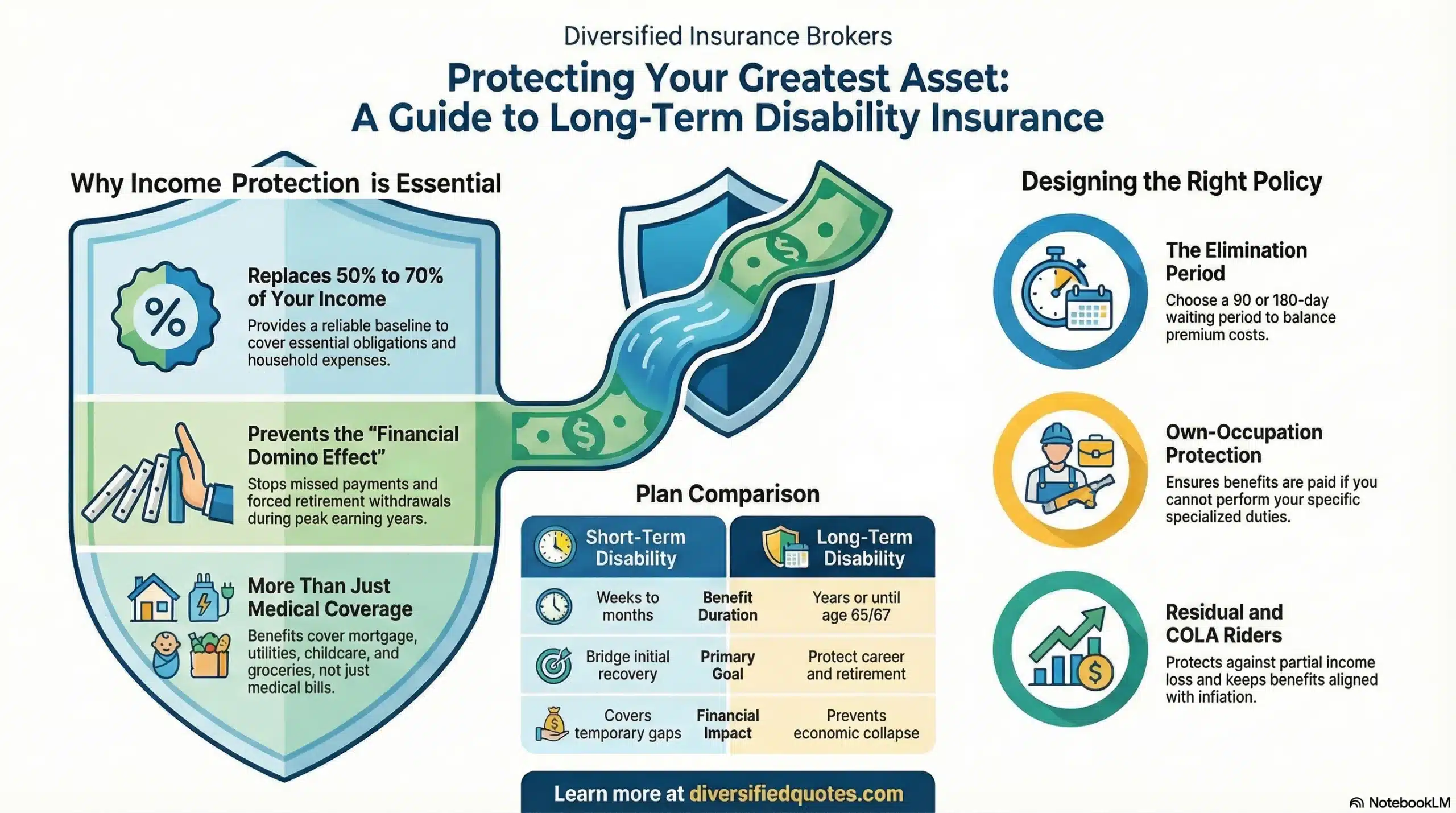
Benefit amount should reflect total documented income — not just base wages for employees, and not just the net income figure that tax minimization produces for self-employed workers. The goal is to identify the maximum insurable benefit the carrier will offer based on actual documented earnings, then select an amount that genuinely replaces enough income to maintain household financial obligations during a disability period. Most policies replace 50% to 70% of pre-disability income; for basement waterproofers with significant household financial obligations and no other income sources, maximizing the available benefit amount is typically the right approach.
Elimination period — the waiting period between the onset of disability and the first benefit payment — should be selected based on the waterproofer’s actual financial reserves and the speed with which a disability event would create financial pressure. Waterproofers who maintain strong emergency reserves of 3 to 6 months of expenses may comfortably select a 90-day elimination period, allowing the lower premium of the longer wait to reduce the overall cost of coverage. Those with thinner reserves, significant ongoing household obligations, or self-employment business overhead should consider a 30 or 60-day elimination period that provides quicker access to benefits despite higher premiums.
Benefit period should extend to age 65 or 67 for comprehensive long-term protection. Shorter benefit periods of 2 or 5 years protect against relatively short disabilities but leave the most financially consequential scenario — a long-duration or permanent disability — completely unprotected. Given the physical nature of basement waterproofing and the documented risk of career-ending injury or chronic condition, a benefit period to age 65 ensures that a disability occurring at any age during the working career is fully addressed rather than providing only temporary relief before benefits terminate.
Residual (partial) disability riders are particularly important for basement waterproofers because many disability scenarios in physical trades involve partial rather than total incapacity. A waterproofer who can work 4 hours per day instead of 10, who can perform supervisory and planning duties but not heavy physical labor, or whose injury limits them to less physically demanding work at lower pay — all of these scenarios involve real income loss that a total-disability-only policy does not address. Residual coverage pays proportionate benefits when income declines by a defined threshold due to a covered disability, supporting the worker through partial recovery without requiring total inability to work before any benefit is paid. Our resource on residual disability insurance benefits explained covers how this rider works in practice and why it is the most practically useful rider for income-variable tradespeople.
Cost-of-living adjustment (COLA) riders protect the purchasing power of benefits during long-duration disability claims by increasing the monthly benefit annually, typically by 3% or linked to a defined inflation measure. Without COLA, a fixed monthly benefit that feels adequate at the start of a 10-year disability claim may be significantly depleted in real purchasing power by year 5 or year 10. For basement waterproofers who might face extended disability periods from chronic conditions developing in their late 40s or early 50s, COLA riders ensure the benefit remains meaningful throughout the full claim period.
The Employer Coverage Gap for Employed Basement Waterproofers
Basement waterproofers employed by waterproofing companies may have access to employer-sponsored group long-term disability coverage as part of their benefits package. Understanding the limitations of this coverage — and how individual disability insurance can supplement it — is essential for any employed waterproofer who intends to rely on group coverage as primary disability protection.
Standard group long-term disability policies typically replace 60% of base salary, subject to a monthly maximum that may not reflect actual compensation including overtime and productivity bonuses. For a waterproofer who regularly works 50-hour weeks and earns significant overtime, the group policy benefit may replace only a fraction of actual weekly income. Group policies are also not portable — if employment ends, the coverage ends, and obtaining individual coverage after leaving employment requires full underwriting at the current age and health status. And most critically for long-duration disabilities, many group policies include a disability definition that transitions from own-occupation (unable to perform the duties of the current occupation) to any-occupation (unable to perform any occupation for which reasonably suited) after 24 months. Under any-occupation language, a basement waterproofer who cannot perform waterproofing duties but could theoretically perform a sedentary job may have their benefits terminated at the 24-month mark even though their actual income remains substantially lower than pre-disability levels.
Individual disability insurance supplements the group policy by filling these gaps: extending coverage when group benefits terminate, covering income components excluded from the group policy calculation, maintaining portable coverage that follows the worker regardless of employment changes, and providing own-occupation protection that continues for the full benefit period rather than transitioning to the weaker any-occupation standard. For employed waterproofers evaluating whether to supplement their group coverage, the 24-month any-occupation transition is typically the most important risk to address with individual coverage.
When to Apply and Why Earlier Is Always Better
The timing of a disability insurance application is one of the most consequential decisions a basement waterproofer can make, and the consistent finding across every professional and trade category is that earlier is always better — for multiple interacting reasons that compound significantly over time.
Premium is the most obvious reason. Disability insurance premiums increase continuously with age because the statistical probability of a disability claim increases with age. A basement waterproofer who applies at age 30 and a waterproofer who applies at age 45 for identical coverage will pay dramatically different premiums for the rest of their working life, with the older applicant paying premiums that may be 2 to 3 times higher for equivalent benefits. Every year of delay locks in a permanently higher premium for the duration of the policy.
Health is the second and often more consequential reason. Disability insurance applications are medically underwritten — carriers review health history, current medications, prior injuries, and documented conditions to determine eligibility and premium. For basement waterproofers, the physical wear that accumulates over years of demanding work frequently produces documented musculoskeletal conditions — back conditions, knee conditions, shoulder conditions — that appear in medical records well before they create functional limitations. Once these conditions are documented in medical records, subsequent disability insurance applications may exclude coverage for the specific body regions affected, producing a policy with exclusion riders that carve out exactly the most likely disability scenarios. Applying before these conditions are documented produces a comprehensive policy without these exclusions.
Insurability is the third reason. Once a serious injury or diagnosis occurs — a herniated disc requiring surgery, a knee injury requiring repair, a respiratory condition from chemical exposure — applying for new disability insurance coverage becomes substantially more difficult or impossible. The physical nature of basement waterproofing creates a real and ongoing risk that a qualifying disability event will occur, after which disability insurance is no longer obtainable at any price. A waterproofer who waits until they feel they “need” coverage may find they can no longer qualify for it. Applying while healthy and actively working ensures the protection is in place before it is needed rather than discovered to be unavailable precisely when a disability makes it most urgent.
How Diversified Insurance Brokers Helps Basement Waterproofers
As an independent agency, Diversified Insurance Brokers compares disability insurance options across multiple carriers to find the combination of coverage terms, definition strength, and premium that best fits each individual applicant’s occupation, income, and risk profile. For basement waterproofers, whose occupation classification and physical risk profile create meaningful carrier-to-carrier variation in both what is available and what it costs, this independent comparison process is particularly valuable.
We help basement waterproofers understand what their occupation classification means for coverage design, what income documentation is required and how to present variable or seasonal income most effectively for maximum benefit, which carriers have the most favorable underwriting positions for construction trade occupations, and how to structure the combination of benefit amount, elimination period, benefit period, and riders that creates the most complete income protection within a sustainable premium budget. We also help identify the right time to apply — before health changes create exclusion riders — and guide the application process to minimize the friction that often makes busy tradespeople delay or abandon the coverage process entirely.
Get Disability Insurance Quotes for Basement Waterproofers
We compare options across carriers for construction and skilled trade professionals to find the right coverage and value.
Get Disability Insurance QuotesQuestions? Call 800-533-5969
Financial Protection Essentials
Talk With an Advisor Today
Choose how you’d like to connect—call or message us, then book a time that works for you.
Schedule here:
calendly.com/jason-dibcompanies/diversified-quotes
Licensed in all 50 states • Fiduciary, family-owned since 1980
Disability Insurance for Basement Waterproofers FAQs
Yes — basement waterproofing is classified in a higher-risk occupation category by most disability insurance carriers because of the physical demands, confined workspace conditions, and exposure to hazardous materials involved in the work. The combination of heavy lifting, repetitive motion, awkward positioning in tight spaces, chemical exposure, and unpredictable ground conditions creates meaningful statistical risk of both sudden injuries and cumulative conditions that develop over a career. This classification directly affects both the premium level and, in some cases, the disability definition language available — which is why comparing multiple carriers through an independent broker produces better outcomes than applying to a single company.
The higher-risk classification does not mean coverage is unavailable — it means the premium reflects the actual risk, and the carrier selection process matters more than it would for a lower-risk occupation. Different carriers have different underwriting philosophies for physically demanding trades, and some are more favorable than others for specific occupations. The goal is finding the carrier that offers the best combination of coverage terms and competitive premium for basement waterproofing specifically, rather than simply accepting the first quote received.
Yes — basement waterproofers can qualify for disability insurance, although coverage terms and premium will reflect the physically demanding nature of the profession. The underwriting process evaluates your specific occupational duties, your income level, your health history, and the type of coverage being requested. For self-employed waterproofers and independent contractors, carriers will typically require income documentation such as tax returns to verify the level of earnings being insured, and the maximum monthly benefit available is based on documented income rather than estimated earnings.
The most important factor in the qualification process is accurate occupational description — carriers evaluate not just the job title but the actual physical duties performed, including the types of equipment operated, the environments worked in, and the physical demands involved. An independent broker who understands how carriers classify basement waterproofing specifically can help ensure the application is presented in a way that maximizes the likelihood of approval with favorable terms. Applying while healthy and actively working is the single most effective step a basement waterproofer can take to secure better rates and broader coverage before health changes occur.
The most common injuries and conditions affecting basement waterproofers include back strain and herniated discs from heavy lifting and awkward positioning, knee and shoulder injuries from kneeling and reaching in confined spaces, hand and wrist injuries from tool operation and repetitive motion, slips and falls on wet or uneven surfaces, and respiratory or skin conditions from chemical exposure during sealing and waterproofing applications. These risks are compounded by the nature of working in tight, damp, and often poorly lit basement environments where standard ergonomic positioning is difficult to maintain and emergency response can be slower.
Over time, cumulative wear from years of physical labor can produce chronic conditions — back degeneration, joint deterioration, and reduced range of motion — that develop gradually and eventually limit the ability to maintain a full workload. This is why disability insurance for basement waterproofers needs to address both sudden acute injuries and the slower-developing occupational health conditions that commonly affect professionals in physically intensive trades over the course of a career. Residual disability coverage is particularly important for the gradual conditions, as it provides proportionate benefits during periods of reduced capacity rather than requiring complete inability to work before any benefit is triggered.
Yes — residual or partial disability coverage provides income support when a disability reduces but does not eliminate your ability to work. For basement waterproofers, this is one of the most practically important features in any disability policy because many occupational injuries and conditions do not result in complete inability to work — they reduce capacity, limit the type of work that can be safely performed, or restrict working hours. A back condition that prevents heavy lifting may still allow some site supervision or lighter-duty activity. Residual coverage pays a benefit proportionate to the income loss, providing financial support during recovery and transition without requiring total inability to work.
Without residual disability coverage, a policy that only triggers on complete inability to work may fail to respond in the most common real-world disability scenarios for physically demanding occupations. This is a significant coverage gap that is easy to overlook when comparing policies based primarily on premium. When evaluating disability insurance options as a basement waterproofer, confirming the residual disability provision — how income loss is calculated, what minimum percentage is required to trigger the benefit, and how long residual benefits can be paid — is as important as confirming the base monthly benefit amount.
Yes — disability insurance is often more critical for self-employed basement waterproofers and independent contractors than for employees because there is typically no employer-sponsored group disability coverage, no paid sick leave, and no employer-funded income protection of any kind. When income stops due to injury or illness, it stops completely and immediately, while business expenses and household obligations continue. For a self-employed waterproofer, individual disability insurance is often the only meaningful income protection available, which makes the benefit amount, policy design, and carrier selection decisions especially consequential.
The underwriting process for self-employed applicants requires income documentation — typically two years of tax returns and potentially business financial statements — because carriers need to verify the income level being insured. If tax minimization strategies have significantly reduced reported income, this can limit the maximum monthly benefit available even when actual earnings are higher. This relationship between income documentation and benefit eligibility is an important planning consideration for self-employed basement waterproofers. Applying through an independent broker who works specifically with self-employed skilled trades professionals helps ensure the application is structured to produce the best available coverage given the specific income documentation situation.
The best time to apply for disability insurance as a basement waterproofer is while you are healthy and actively working — before any occupational injuries, chronic conditions, or health changes occur that could affect eligibility or result in exclusion riders, higher premiums, or declined applications. Age is a continuous driver of disability insurance rates, and every year of delay increases the cost for equivalent coverage. A professional who purchases coverage in their early working years locks in lower rates for the full duration of the policy and preserves insurability before the physical wear of a demanding career begins to accumulate in ways that are visible to underwriters.
The risk of delaying disability insurance is not hypothetical for basement waterproofers — it is directly tied to the occupational reality of the profession. Back problems, joint issues, and other musculoskeletal conditions that are common in physically intensive trades can appear in medical records before a professional expects them to cause a significant income disruption. Once those conditions are documented, coverage may be available but with exclusion riders that remove the very conditions most likely to cause a claim. Applying before those conditions appear in your medical history produces a policy without those limitations — which is why early application is one of the most consistently valuable decisions a basement waterproofer can make for long-term income protection.
About the Author:
Jason Stolz, CLTC, CRPC, DIA, CAA and Chief Underwriter at Diversified Insurance Brokers (NPN 20471358), is a senior insurance and retirement professional with more than 25 years of real-world experience helping individuals, families, and business owners protect their income, assets, and long-term financial stability. As a long-time partner of the nationally licensed independent agency Diversified Insurance Brokers, Jason provides trusted guidance across multiple specialties—including fixed and indexed annuities, long-term care planning, personal and business disability insurance, life insurance solutions, Group Health, Travel Medical and Evacuation Insurance, and short-term health coverage. Diversified Insurance Brokers maintains active contracts with over 100 highly rated insurance carriers, ensuring clients have access to a broad and competitive marketplace.
His practical, education-first approach has earned recognition in publications such as VoyageATL, and contributions from his agency featured in Kiplinger and GoBankingRates— highlighting his commitment to financial clarity and client-focused planning. Drawing on deep product knowledge and years of hands-on field experience, Jason helps clients evaluate carriers, compare strategies, and build retirement and protection plans that are both secure and cost-efficient. Visitors who want to explore current annuity rates and compare options across multiple insurers can also use this annuity quote and comparison tool.
Explore More Disability Insurance Options: Browse our complete guide to Disability Insurance for Trades, Construction & Industrial — covering contractors, electricians, plumbers, welders, roofers, machinists & skilled trades from 100+ carriers.
Last Reviewed: May 12, 2026 |
Reviewed by: Jason Stolz, CLTC, CRPC, DIA, CAA
Chief Underwriter, Diversified Insurance Brokers, Inc. | NPN: 20471358 | Diversified Insurance Brokers, Inc. — Licensed in all 50 states
Fact Checked by: Tonia Pettitt, CMIP©
Medicare Specialist, Diversified Insurance Brokers, Inc. | NPN: 14374308 | Diversified Insurance Brokers, Inc. — Licensed in all 50 states
Did you find this content helpful? Leave us a Google review — it helps others find trustworthy guidance too.
Editorial Standards: Diversified Insurance Brokers maintains rigorous editorial standards to ensure accuracy, clarity, and independence in all content. Learn more about our editorial standards and commitment to transparency.
