
Disability Insurance for Plumbers
As an Independent Disability Insurance Broker, we have access to exclusive discounts and negotiated pricing most captive agents can’t offer — see the full breakdown near the end of this page.
Disability Insurance for Plumbers

Jason Stolz CLTC, CRPC, DIA, CAA
Licensed plumbers — journeymen, master plumbers, and pipefitter-plumbers across residential and commercial work — carry one of the most comprehensively documented occupational hazard profiles of any skilled trade in the American construction sector. The Bureau of Labor Statistics specifically documents that plumbers, pipefitters, and steamfitters sustain common injuries including cuts from sharp tools, burns from hot pipes and soldering equipment, and falls from ladders, while also documenting that these professionals lift heavy materials, climb ladders, and work in tight spaces — a physical hazard description that only partially captures the full occupational health picture the industry safety literature documents. OSHA safety standards for plumbing specifically enumerate the hazard categories that licensed plumbers navigate on every working day: confined space entry with atmospheric testing requirements for oxygen levels, explosive limits, and hydrogen sulfide from decomposing sewage; biological hazard exposure from sewage-borne pathogens including bacteria such as E. coli and Salmonella, viruses including Hepatitis A and Norovirus, and parasites including Giardia; chemical exposure from PVC cement and primer fumes containing tetrahydrofuran and acetone, soldering flux and lead-free solder fumes, drain cleaners containing sodium hydroxide or sulfuric acid, thread sealants with petroleum distillates, and asbestos potentially found in older building insulation; electrocution risk from proximity to live electrical lines in common utility channels; and the sustained awkward postures of under-sink, crawl space, and trench work that produce the cumulative musculoskeletal loading documented for physical tradespeople broadly. Bureau of Labor Statistics wage data documents the median annual wage for plumbers, pipefitters, and steamfitters at $62,970 in recent years. with experienced journeymen and master plumbers earning $38 to $50 or more per hour depending on location and specialization — and Illinois plumbers earning a documented median of $96,200. The disability income protection gap for plumbers is as complete as for any self-employed trade professional: plumbing sits within the tier of high-risk trades where workers’ compensation covers acute incidents for employed plumbers but where cumulative musculoskeletal conditions, biological illness, and chemical exposure disabilities fall through the workers’ comp gap — and where self-employed master plumbers and independent plumbing contractors carry zero employer benefit baseline of any kind.
At Diversified Insurance Brokers, Jason Stolz, CLTC, CRPC, DIA, CAA works with plumbers across the full range of employment and business structures in the plumbing trade — journeyman plumbers employed by plumbing contractors who may have workers’ comp access but minimal or no employer group LTD, master plumbers who have established their own plumbing businesses with trucks, inventory, and the meaningful overhead that makes business overhead expense disability coverage as important as personal income protection, and independent plumbing contractors operating as self-employed sole proprietors who carry no employer benefit of any kind and for whom individual disability insurance is the entire income protection system. The coverage architecture for a journeyman plumber with union access and some group benefit baseline differs from what a self-employed master plumber with a one-truck operation and a residential service route needs — but both share the foundational reality that individual disability insurance for self-employed plumbers is either the supplemental or the primary protection, and the trade’s documented hazard profile makes that protection both consequential and urgent.
Compare Disability Coverage for Plumbers
We review coverage options across 100+ carriers and identify the policy structure, income documentation approach, and business overhead coverage that fits your specific plumbing role and employment structure.
Request Disability Insurance OptionsPlumber Disability Risk — Confined Spaces, Chemical Exposure, Biological Hazards, and the Self-Employment Gap
| Risk Category | OSHA, BLS, and Industry Context | Resulting Disability Risk | Coverage Status | Income Protection Gap |
|---|---|---|---|---|
| Musculoskeletal disorders from awkward postures and heavy lifting | BLS documents plumbers lift heavy materials, climb ladders, and work in tight spaces as core work requirements; residential plumbing specifically requires sustained awkward postures under sinks, in crawl spaces, and in confined mechanical rooms; commercial plumbing adds heavy pipe handling, trench work, and sustained overhead work; cumulative spinal and joint loading from these postures produces the MSD conditions documented across all physically demanding trades | Lumbar disc conditions, cervical spine disease, shoulder tendinopathy, and knee degeneration from sustained awkward plumbing postures — progressive musculoskeletal conditions that eventually prevent continued trade work | Workers’ comp for acute documented incidents for employed plumbers; cumulative conditions disputed; self-employed plumbers entirely unprotected | Significant gap for cumulative MSD conditions; individual DI covers qualifying disability without incident attribution requirement |
| Biological hazard exposure from sewage and contamination | OSHA plumbing safety documentation specifically lists sewage-borne pathogens — E. coli, Salmonella, Hepatitis A, Norovirus, Giardia — as documented biological hazards requiring bloodborne pathogen training; industry safety resources document that contaminated soil and raw sewage exposure can cause hepatitis, E. coli diarrhea, and gastroenteritis; septic, drain, and sewer work creates regular biological exposure that even careful protective practices cannot eliminate entirely | Hepatitis A infection requiring extended illness and recovery; serious gastrointestinal disease from sewage pathogen exposure; chronic health consequences from sustained biological exposure across a plumbing career | Workers’ comp for documented acute exposure incidents; gradual exposure illness poorly covered; individual DI covers all illness-based qualifying disability regardless of cause | Significant gap for biological illness; individual DI fills where workers’ comp incident attribution fails for gradual exposure conditions |
| Chemical exposure — solvents, fumes, and asbestos | OSHA plumbing safety documentation specifically lists PVC cement and primer fumes (tetrahydrofuran and acetone), soldering flux and solder fumes, drain cleaners (sodium hydroxide or sulfuric acid), thread sealants (petroleum distillates), and asbestos in older building insulation as documented plumbing chemical hazards; industry safety resources document that chemicals including solder, adhesives, and solvents can cause severe skin irritation or occupational dermatitis; asbestos exposure risk remains in pre-1980 construction stock | Occupational asthma from sustained solvent and fume inhalation; chemical sensitization; respiratory conditions from flux and adhesive exposure; asbestos-related conditions from older building plumbing work — illness-based disabilities with gradual onset | Gradual chemical exposure conditions outside workers’ comp incident framework; self-employed plumbers entirely unprotected; individual DI covers all illness-based qualifying disability | Full gap for gradual chemical exposure; individual DI specifically covers illness-based disability that workers’ comp’s incident attribution leaves unprotected |
| Confined space hazards — atmospheric and structural | OSHA specifically documents confined spaces as one of the most dangerous plumbing hazards — permit-required confined space entry requires atmospheric testing for oxygen, explosive limits, and hydrogen sulfide gas from decomposing sewage; industry safety resources document that confined spaces kill faster than almost any other plumbing hazard; crawl space, trench, and mechanical pit work creates the confined space exposure documented as requiring specialized safety protocols | Hydrogen sulfide poisoning, oxygen deprivation, or toxic gas exposure producing neurological consequences or acute illness requiring extended disability; structural collapse in trench or excavation work; confined space emergency events producing disability-causing injuries | Workers’ comp for employed plumbers at documented acute incidents; self-employed entirely unprotected; individual DI covers all qualifying disability causes | Full gap for self-employed; individual DI or accident-only coverage provides the income floor for confined space disability events |
| Burns, electrocution, and acute physical injury | BLS specifically documents burns from hot pipes and soldering equipment as a common plumber injury category; OSHA and industry safety resources document electrocution risk from live electrical lines sharing utility channels with plumbing systems, especially when utility lines are improperly labeled; steam line burns, hot water releases, and torch injuries add to the acute burn profile of the trade | Serious burn injuries requiring extended treatment and recovery; electrocution producing cardiac effects or nerve damage; acute injuries requiring multiple weeks or months of disability before return to trade work is possible | Workers’ comp for documented acute incidents for employed plumbers; self-employed plumbers entirely unprotected | Full gap for self-employed; individual DI covers qualifying disability from all acute injury causes including burns and electrical incidents |
The table documents what makes the plumber’s disability risk profile more complex than even the trade’s documented physical hazard reputation suggests: the chemical, biological, and confined-space exposure categories add illness-based disability pathways that accumulate gradually rather than producing single datable incidents — precisely the disability pathways that workers’ compensation is least equipped to address and that individual disability insurance specifically covers. Why plumbers prioritize income protection is answered by both the BLS injury documentation and the financial reality: at a median of $62,970 annually, even a four-month disability period without any income floor produces severe household financial disruption for any plumber without disability insurance in place.
The Confined Space and Biological Hazard Dimension — Why Workers’ Comp Falls Short for Plumbing
The most important disability protection insight for any plumber is the specific inadequacy of workers’ compensation for the most characteristic long-term disability pathways of the plumbing trade. Workers’ comp is designed around acute, datable, work-related incidents — the fall from a ladder on a specific Tuesday, the burn from a steam line on a documented Wednesday. It handles these scenarios reasonably well for employed plumbers who report promptly and document thoroughly. What it fails to cover is the occupational disease category that OSHA’s own plumbing safety documentation specifically identifies as a primary plumbing hazard: the hepatitis A infection from sustained sewage work, the occupational asthma developing from years of PVC cement and soldering fume inhalation, the respiratory sensitization from flux and adhesive chemical exposure, and the progressive musculoskeletal disc condition accumulating from a career of awkward plumbing postures.
These conditions — gradual, cumulative, often without a single identifiable incident that workers’ comp can attribute to an employer — are precisely the illness-based disability pathways that represent approximately 90 percent of all long-term disabling conditions across all professions. Individual disability insurance covers qualifying disability from any cause — illness or injury, gradual or acute, occupationally related or not — without requiring the incident attribution documentation that workers’ comp demands. Long-term disability income coverage provides the income floor during extended recovery from any qualifying disability event, including the gradual biological and chemical exposure conditions that workers’ comp specifically fails to address. Short-term disability coverage addresses the immediate income gap from the first day of disability through long-term coverage activation. Accident-only disability income insurance provides an accessible lower-cost entry point for plumbers who want targeted coverage for the acute physical injury scenarios — falls, burns, cuts, electrical incidents — while building toward comprehensive illness-inclusive coverage. The broader construction sector disability landscape provides context for how plumbing disability protection fits within the trade sector’s overall approach to income protection. How short-term and long-term structures interact maps the complete coverage architecture from the first day of a qualifying disability through the benefit period.
Self-Employed Master Plumbers — The Business Overhead Layer
Master plumbers who operate their own plumbing businesses carry the same two-layer disability exposure as any service trade business owner. A plumbing business with service vehicles, pipe and material inventory, tool and equipment investments, liability insurance premiums, licensed employee wages, and the fixed costs of a small service business creates overhead obligations that continue during a disability regardless of whether any service calls are being completed. A disability that prevents the owner-plumber from performing field work for two to four months creates both personal income loss — the owner’s compensation from the business — and unmet overhead obligations continuing against reduced or zero revenue. For small plumbing operations where the owner is the primary field technician, a disability produces meaningful revenue reduction alongside fixed overhead, creating the two-layer financial exposure that threatens the business’s survival during a disability that would otherwise be recoverable.
Business overhead expense disability coverage specifically addresses the plumbing business’s fixed operating costs during the owner’s qualifying disability — vehicle payments, tool and equipment financing, insurance premiums, employee wages, and any other fixed overhead — preserving the business infrastructure during recovery. The BOE benefit is sized to actual documented monthly fixed overhead rather than to service revenue. Together, personal disability income and BOE coverage create the complete protection architecture for a self-employed master plumber. Income documentation for self-employed plumbing contractors uses Schedule C net self-employment income averaged across two to three years. 1099-earning plumbing contractors who provide services to larger operations follow the same documentation framework.
Policy Design and Planning for Licensed Plumbers
Plumbers receive Class A to Class B occupational class assignments from most disability insurance carriers — reflecting the significant physical demands, the documented hazard categories, and the trade’s injury rate profile. This classification produces higher premiums than white-collar professional occupations but does not prevent meaningful individual disability insurance coverage from the carriers serving trade professional classifications. Own-occupation disability coverage for a plumber should encompass the specific physical and technical demands of licensed plumbing work — pipe fitting, soldering, confined space installation, system testing — not merely generic inability to perform any physical work. Residual disability coverage addresses the partial disability scenario — a plumber managing lighter service calls or supervisory work during recovery from a back injury while unable to handle the full physical work scope. How much disability income a plumber needs reflects documented trade income and household obligations. The elimination period reflects actual reserves. The future increase option is valuable for apprentice and journeyman plumbers whose income will grow with licensure advancement. Cost of living adjustment protects purchasing power across extended disability periods. Coverage for plumbers with prior back, knee, or respiratory conditions is available through independent broker comparison. Specialty and modified options address plumbers whose documented history creates standard underwriting complexity. No-exam disability coverage provides streamlined approval for healthy plumbers at appropriate benefit amounts. Getting the best available rates as a plumber means comparing across the full carrier market — carrier variation in trade classification guidelines is meaningful for plumbing, and independent broker access produces the most favorable occupational class and premium terms. Why apprentice and journeyman plumbers need coverage from career start is answered by the cumulative nature of the trade’s chemical and biological exposure pathways — the window to purchase comprehensive coverage before any exposure-related health history develops is early, before the plumbing career has had time to produce respiratory, biological, or musculoskeletal health documentation that generates exclusion riders at underwriting. Early-career plumbing professionals entering apprenticeship programs should establish disability insurance from career start, when coverage is most comprehensive and premiums are lowest. Whether disability insurance is worth the cost for a plumber is answered by the BLS injury documentation and a simple calculation: the annual premium against the income the household would lose during a four-month disability without any protection. Whether disability benefits are taxable for a self-employed plumber: personally purchased individual policies paid with after-tax income generally produce tax-free benefits. High-earning self-employed master plumbers with established operations may need layered coverage structures to adequately replace income at upper compensation levels. A second opinion on any disability insurance proposal for a plumber confirms whether the occupational class, the policy definition, and the business overhead dimension are all addressed appropriately before any premium commitment is made.
Get Your Plumbing Trade Coverage Review
We compare occupational class assignments, chemical and biological exposure underwriting approaches, and business overhead structures across 100+ carriers to build the most comprehensive available coverage for your plumbing career.
Request Disability Insurance Options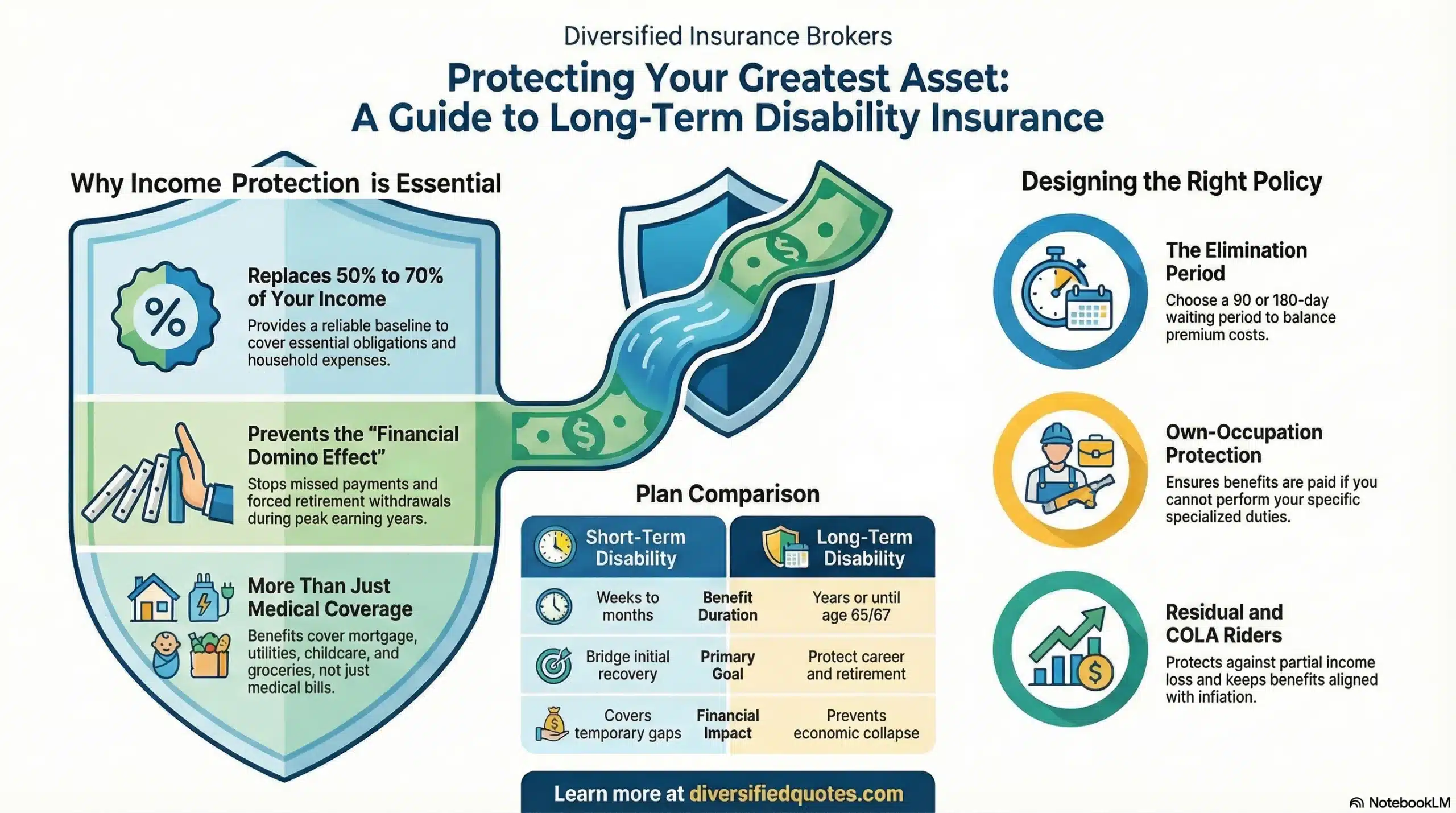
Talk With an Advisor Today
Choose how you’d like to connect—call or message us, then book a time that works for you.
Schedule here:
calendly.com/jason-dibcompanies/diversified-quotes
Licensed in all 50 states • Fiduciary, family-owned since 1980
FAQs: Disability Insurance for Plumbers
I’m employed by a plumbing contractor — doesn’t workers’ comp cover me if I get hurt?
Workers’ compensation covers acute, documentable, work-related incidents for employed plumbers — a fall from a ladder at a specific documented jobsite, a burn from a steam line on a specific day, a back injury from a specific documented heavy lift. These acute incidents are exactly what workers’ comp is designed to address, and filing a workers’ comp claim when an acute incident occurs is the right approach for any employed plumber. Workers’ comp is worth using when it applies.
Where workers’ comp specifically fails plumbers is in the disability categories that OSHA’s own plumbing safety documentation identifies as primary plumbing hazards: the occupational asthma developing from years of PVC cement, flux, and solvent fume inhalation without a single datable exposure incident; the hepatitis infection or gastrointestinal disease from sustained sewage and biological pathogen exposure; the progressive lumbar disc condition accumulating from a career of awkward crawl space and under-sink postures; and the respiratory sensitization from chemical exposure across multiple jobsites over multiple years. These conditions — gradual, cumulative, and without a single employer incident to attribute — are precisely what workers’ comp fails to cover, and they represent the illness-based disability pathways that the occupational health literature documents as the most financially significant long-term disability category for physical trade workers. Individual disability insurance covers qualifying disability from any cause regardless of whether it arose from a specific incident or gradual cumulative exposure — filling the gap that workers’ comp leaves for the most characteristic long-term disability pathways in the plumbing trade. A second opinion from an independent broker who works with trade professionals maps these gaps specifically against what supplemental individual coverage needs to address for your specific employment and health situation.
I’m a self-employed master plumber with one truck and two employees — what disability coverage do I need?
As a self-employed master plumber with employees and a service operation, your disability exposure has two distinct layers. Personal disability income insurance replaces your earned compensation from the plumbing business when a qualifying disability prevents you from performing field work and managing operations — sized to your documented net self-employment income from Schedule C averaged across two to three years. Business overhead expense disability coverage addresses the business’s fixed operating costs: truck payment, tool and equipment financing, employee wages, liability insurance premiums, and any other fixed overhead that continues regardless of whether you are performing service calls. These two coverage layers protect different financial obligations during the same disability period, and together they create the complete protection architecture for a self-employed plumbing business.
A disability that prevents you from plumbing for three months creates immediate personal income loss alongside the continued accumulation of truck payments, employee wages, and insurance premiums against zero or reduced service revenue. Without business overhead expense coverage, the overhead obligations accumulate against the disability period’s income loss — potentially forcing business decisions during recovery that permanently damage the operation’s capacity. BOE disability coverage pays the documented fixed monthly overhead of your plumbing operation during qualifying disability, preserving the business during recovery. The BOE benefit is sized to actual documented monthly fixed overhead — not to service revenue — covering what the operation costs to maintain rather than what it generates. For a one-truck operation with two employees, the BOE policy specifically covers the truck payment, the employee wages, the insurance premiums, and the fixed business costs that your recovery period would otherwise leave unpaid.
Are disability insurance benefits taxable for a self-employed plumber?
For self-employed plumbers who purchase individual disability insurance personally and pay premiums with after-tax personal income, monthly disability benefits received during a qualifying disability are generally received income-tax-free. The full benefit amount reaches the household without income tax reduction during the disability period when no service revenue is being generated. Understanding the tax treatment of disability insurance benefits matters for sizing the policy correctly: a tax-free individually purchased benefit should cover actual after-tax take-home income from the plumbing business, ensuring genuine income replacement rather than a further tax-reduced benefit on top of the income disruption.
At the BLS-documented median of $62,970, and higher for experienced master plumbers in strong markets, the difference between a taxable group benefit and a tax-free individual benefit represents meaningful real purchasing power during a disability period when the household needs the income most. For self-employed plumbing business owners who pay disability insurance premiums through the business entity — whether an LLC, S-corp, or partnership — the tax treatment of both the personal income DI and the BOE policy should be confirmed with a tax professional, as entity-level premium payments create complexity in the standard personal-premium/tax-free-benefit baseline. BOE premiums paid by the business entity are generally deductible as business expenses, but resulting BOE benefits are typically taxable — creating a roughly neutral net tax impact since taxable benefits offset deductible overhead expenses.
I have a prior back condition from years of plumbing — can I still get disability insurance?
Yes. For most documented prior back conditions that are currently stable — a prior lumbar strain treated and resolved, a managed disc condition stable under current care with documented functional plumbing capacity — the standard underwriting outcome is a partial exclusion rider specifically for that documented back condition, providing full coverage for all other disability causes: acute fall injuries, chemical exposure illness, biological pathogen illness, burns, electrocution injuries, and all other qualifying conditions outside the excluded back area. The policy with a lumbar exclusion rider still provides genuine and meaningful disability protection for the majority of the plumbing trade’s documented disability pathways.
The practical implication for plumbers is clear: the back is the body part most specifically at risk from the sustained awkward postures that define plumbing work — a back exclusion rider limits coverage precisely where the occupation’s most characteristic cumulative MSD risk is concentrated. This reinforces the timing argument for early purchase: an apprentice or journeyman plumber who establishes disability insurance before any back condition has been documented can secure comprehensive lumbar coverage without exclusion that the prior-condition route cannot replicate. Coverage for plumbers with prior back conditions is available through independent broker comparison across carriers whose guidelines for trade occupation musculoskeletal histories vary meaningfully — some carriers take a narrower, disc-level-specific exclusion approach that is less restrictive than the broad spinal exclusions others apply for the same documented history. Specialty and modified options address plumbers whose documented history creates complexity beyond a simple partial exclusion rider.
I’m an apprentice just entering the plumbing trade — when should I get disability insurance?
Career start — during the apprenticeship period before any field exposure has had time to produce occupational health documentation — is the most strategically advantageous time to purchase disability insurance as a plumber. The cumulative chemical, biological, and musculoskeletal health consequences that the plumbing trade’s documented hazard profile produces accumulate from the first day of field work. An apprentice beginning field rotation who purchases disability insurance immediately has no respiratory, musculoskeletal, or biological illness history from plumbing work — and can secure comprehensive coverage including full back, respiratory, and illness coverage without any exclusion riders that mid-career purchase after the trade has produced its health record would generate.
Premium rates are age-rated and lock in at policy issuance on non-cancellable, guaranteed renewable policies. An apprentice purchasing at 20 or 22 locks in substantially lower annual premiums than the same coverage would cost at 32 after ten years of plumbing field exposure. The future increase option allows benefit increases as journeyman and master plumber income grows without new medical underwriting — preserving the clean-health underwriting terms established during apprenticeship through the full income trajectory of the licensed plumbing career. For an apprentice whose initial benefit is modest at apprenticeship-level income, the FIO rider specifically bridges from the entry benefit to the journeyman and eventually master plumber benefit levels as documented income grows, all without surrendering the favorable health-based terms established at career start. Every year of plumbing work is a year during which chemical, biological, and physical exposure accumulates — the window to purchase comprehensively before any occupational health history develops closes with each working year.
My plumbing income varies by season and project volume — how does that affect my disability benefit?
Plumbing income variability — from seasonal demand patterns in residential service, from project-based commercial work pipelines that fluctuate with construction market activity, and from the self-employed plumber’s business development cycle — is addressed through the multi-year averaging approach that disability insurance carriers apply to all self-employment income documentation. A two to three year average of documented net Schedule C income smooths seasonal and cyclical variability rather than penalizing a slower winter quarter or rewarding a peak commercial project year, producing a sustainable average that reflects the career’s economic profile rather than any single period’s performance.
For employed plumbers paid hourly through union or non-union arrangements, W-2 documentation from two to three years of employment provides the income basis — with the documented hourly rate and annual hours producing the average income figure. For self-employed master plumbers, capturing all service revenue, project fees, and any other earned plumbing income consistently and completely in Schedule C records across multiple years produces the most favorable and accurate income basis for the disability insurance benefit calculation. The residual disability benefit provision is particularly valuable for self-employed plumbers because realistic disability scenarios — a back condition allowing some light service work but not crawl space or heavy installation work — produce income reduction rather than complete cessation; a residual benefit pays proportionally based on actual income reduction, matching the realistic partial-disability trajectory of many plumbing trade physical injuries.
About the Author:
Jason Stolz, CLTC, CRPC, DIA, CAA and Chief Underwriter at Diversified Insurance Brokers (NPN 20471358), is a senior insurance and retirement professional with more than 25 years of real-world experience helping individuals, families, and business owners protect their income, assets, and long-term financial stability. As a long-time partner of the nationally licensed independent agency Diversified Insurance Brokers, Jason provides trusted guidance across multiple specialties—including fixed and indexed annuities, long-term care planning, personal and business disability insurance, life insurance solutions, Group Health, Travel Medical and Evacuation Insurance, and short-term health coverage. Diversified Insurance Brokers maintains active contracts with over 100 highly rated insurance carriers, ensuring clients have access to a broad and competitive marketplace.
His practical, education-first approach has earned recognition in publications such as VoyageATL, and contributions from his agency featured in Kiplinger and GoBankingRates— highlighting his commitment to financial clarity and client-focused planning. Drawing on deep product knowledge and years of hands-on field experience, Jason helps clients evaluate carriers, compare strategies, and build retirement and protection plans that are both secure and cost-efficient. Visitors who want to explore current annuity rates and compare options across multiple insurers can also use this annuity quote and comparison tool.
Explore More Disability Insurance Options: Browse our complete guide to Disability Insurance for Trades, Construction & Industrial — covering contractors, electricians, plumbers, welders, roofers, machinists & skilled trades from 100+ carriers.
Last Reviewed: June 8, 2026 |
Reviewed by: Jason Stolz, CLTC, CRPC, DIA, CAA
Chief Underwriter, Diversified Insurance Brokers, Inc. | NPN: 20471358 | Diversified Insurance Brokers, Inc. — Licensed in all 50 states
Fact Checked by: Tonia Pettitt, CMIP©
Medicare Specialist, Diversified Insurance Brokers, Inc. | NPN: 14374308 | Diversified Insurance Brokers, Inc. — Licensed in all 50 states
Did you find this content helpful? Leave us a Google review — it helps others find trustworthy guidance too.
Editorial Standards: Diversified Insurance Brokers maintains rigorous editorial standards to ensure accuracy, clarity, and independence in all content. Learn more about our editorial standards and commitment to transparency.
