
Are Disability Insurance Payments Taxable
As an Independent Disability Insurance Broker, we have access to exclusive discounts and negotiated pricing most captive agents can’t offer — see the full breakdown near the end of this page.
Are Disability Insurance Payments Taxable

Jason Stolz CLTC, CRPC, DIA, CAA
Are disability insurance payments taxable? The answer usually comes down to one simple detail: how the premiums were paid. Disability insurance is designed to replace lost income if an injury or illness prevents you from working, but the tax treatment of those payments depends on whether premiums were paid with after-tax dollars, pre-tax payroll deductions, or by an employer. If you don’t know how your premiums are being handled today, you may not know what your after-tax take-home benefit would be if you ever needed to file a claim. At Diversified Insurance Brokers, Jason Stolz CLTC, CRPC, DIA, CAA, helps individuals, executives, business owners, and specialized professionals understand not only what disability coverage they have, but how the policy design fits into their overall protection plan. The tax treatment of benefits can change the real value of coverage in a significant way — especially when you’re trying to protect a specific monthly lifestyle or a business cash-flow target. If you’re comparing plan structures, it can also help to understand cost drivers, starting with how disability insurance is priced and why employer plans often look cheaper on paper. In this guide, we walk through when disability benefits are tax-free, when they’re taxable, how partially employer-paid premiums work, and what business owners should know. We also cover how Social Security Disability and workers’ compensation are taxed, because many people assume those benefits follow the same rules as individual disability policies — they don’t. For professionals who deal with tax planning for clients and want to understand how DI taxation intersects with that work, our dedicated resource on disability insurance for tax professionals covers the product considerations most relevant to that occupation alongside the tax framework covered here.
Protect Your Paycheck With the Right Disability Insurance
Our advisors help you compare disability coverage and design a plan that matches your occupation, income, and tax priorities.
Request a Disability Insurance Quote Call 800-533-5969The Quick Rule
After-tax premiums → benefits are usually tax-free. Employer-paid or pre-tax premiums → benefits are usually taxable. Split premiums → benefits are partially taxable.
Disability Insurance Tax Treatment — Quick Reference by Payment Source
The single most useful framework for evaluating disability insurance taxation is a clear map of how each premium funding scenario translates to benefit taxability. The table below covers every common situation from individual policies to employer plans to government and business structures.
General reference only. Tax treatment may vary based on individual circumstances, plan structure, employer elections, and applicable state law. Consult a qualified tax professional for guidance specific to your situation. This is not tax advice.
| Payment Source | Who Pays the Premium | Premium Tax Treatment | Benefit Tax Treatment | Key Planning Notes |
|---|---|---|---|---|
| Individual policy, personally funded (most common best practice) | Individual pays from personal after-tax income | Not deductible for individuals; premiums paid from after-tax income | Tax-free — benefits received are generally not includable in gross income | The preferred structure for income protection because the full benefit is available at claim time without income tax erosion; especially valuable for high earners |
| Employer-paid group plan (employer pays 100%) | Employer pays entire premium as part of benefits package | Employer deducts premium as a business expense; not reported as taxable income to employee while working | Taxable — benefits included in employee’s gross income as ordinary income; subject to federal and state income tax | Most employer-paid STD and LTD plans use this structure; the gross benefit on the HR brochure is not the net take-home amount at claim time |
| Employee-pays-all group plan (after-tax payroll deduction) | Employee pays via payroll deduction using after-tax dollars | After-tax payroll deduction — no pre-tax benefit; same as paying personally | Tax-free — same result as individually funded policy; benefits not included in gross income | Often overlooked — some employer plans allow after-tax election that preserves tax-free benefit status; employees frequently don’t know which election is in effect for their plan |
| Employee-pays-all group plan (pre-tax / cafeteria plan Section 125) | Employee pays via pre-tax payroll deduction under Section 125 cafeteria plan | Pre-tax benefit reduces taxable wages; employee saves on income and FICA taxes during premium payment period | Taxable — IRS treats pre-tax funding the same as employer funding; benefits included in gross income at claim time | This surprises many employees who believe “I paid the premium” = tax-free benefit; the distinction is pre-tax vs. after-tax, not who literally wrote the check |
| Split: employer pays portion, employee pays remainder (after-tax) | Employer contributes (e.g., 60%) and employee pays remainder with after-tax dollars | Employer portion deductible as business expense; employee portion is after-tax | Partially taxable — proportional to premium contribution; if employer paid 60%, then 60% of benefit is taxable; 40% funded after-tax is tax-free | The most common structure in mid-size employer plans; “proportional benefit taxation” applies — the same proration formula applies each plan year |
| Split: employer pays portion, employee pays remainder (pre-tax) | Employer contributes and employee pays remainder via pre-tax cafeteria plan deduction | Both portions provide tax benefit during premium period — employer deducts, employee uses pre-tax | Fully taxable — because both portions were funded with pre-tax dollars, the entire benefit is includable in gross income at claim time | Less favorable at claim time than it appears during enrollment; the upfront tax savings on the premium come at the cost of full taxability on benefits received |
| Social Security Disability Insurance (SSDI) | FICA taxes fund SSDI; both employee and employer contribute | FICA taxes are payroll taxes; not the same structure as insurance premiums | Potentially taxable — follows Social Security income thresholds; up to 50% may be taxable at lower combined income levels; up to 85% may be taxable at higher combined income levels | Household combined income determines taxability; other income sources (spouse earnings, investment income, other pensions) push SSDI benefits toward higher taxable tier |
| Workers’ Compensation | Employer-funded statutory system; workers do not pay premiums | Employer pays into workers’ comp system as a cost of doing business | Generally tax-free — workers’ compensation benefits for on-the-job injuries or illness are generally excluded from gross income under IRC Section 104 | Interactions with SSDI can create offset situations; workers’ comp payments that effectively substitute for SSDI may affect overall benefit tax position in complex cases |
| Business-paid (key person or BOE disability coverage) | Business pays premium for owner or key employee disability coverage | Generally not deductible as a business expense when premiums are paid on an owner or key person (because deductibility would make benefits taxable) | Generally tax-free — if premiums are not deducted as a business expense, the corresponding benefits are typically received tax-free | This is the general rule for individually-owned business DI; S-corp and C-corp owner treatment can have nuances depending on how compensation and premiums are reported on W-2 |
When Disability Insurance Benefits Are Not Taxable
In many common situations, disability insurance payments are not taxable. The IRS generally treats the benefit as tax-free when the insured person paid the premiums with after-tax dollars. In plain language, that means you paid the premium out of money that was already included in your taxable income. This typically applies when you purchase an individual disability insurance policy on your own and pay the premiums personally. It can also apply when your employer offers disability coverage but you pay 100% of the cost yourself with after-tax payroll deductions — not pre-tax. The details matter because two payroll deductions can look identical on a paycheck while being treated very differently for tax purposes. If you have an individual policy, the logic is straightforward: you funded the policy with money that was already taxed, so the benefits are treated as a return of that after-tax contribution. This is one reason individuals with higher incomes often prefer personally owned policies over employer plans — because the tax-free nature of benefits can make the coverage far more effective when you need it most. It’s also worth noting that many people assume “my employer offers it, so it must be taxable.” That’s not always true. If the plan is structured so the employee pays the premium with after-tax dollars, then the benefit can remain tax-free. The problem is that employees often don’t know which structure they’re enrolled in, and they find out only after a claim begins. Medical professionals who rely heavily on their earned income — such as radiologists and physical therapists — often benefit most from understanding this distinction early, because the difference between taxable and tax-free benefits at their income level can represent thousands of dollars per month in a claim scenario.
When Disability Insurance Benefits Are Taxable
Disability benefits are often taxable when the premiums were paid with pre-tax dollars or by an employer. The IRS’s position is straightforward: if you didn’t pay taxes on the money used to fund the premium, you’ll pay taxes on the benefit when it’s received. This situation is common with employer-sponsored group disability plans. Many employers pay the premium as part of a benefits package. When that happens, disability payments are usually treated as taxable income to the employee if a claim occurs. This can surprise people because the monthly benefit they see on the HR brochure is typically shown as a gross amount — not as a net, after-tax amount. Another common taxable scenario is when the employee pays premiums through a payroll deduction that is pre-tax, often under a cafeteria plan. In that case, even though the employee “paid,” the IRS treats it as pre-tax funding and therefore benefits may be taxable. This is similar to the way many retirement plan contributions work: you get the tax benefit up front, and then you pay taxes later when you receive distributions. If you’re trying to understand pre-tax versus after-tax mechanics across different benefit systems, this can feel familiar to concepts discussed in how a 401(a) plan works. If you have an employer plan, you can often determine the taxability by asking a very specific question: “Are my disability premiums paid with pre-tax dollars, after-tax dollars, or by the employer?” The words matter. “Payroll deduction” alone is not enough information. Healthcare workers in occupational therapy — who often have a mix of employer-provided benefits and individually purchased coverage — face exactly this question when reviewing their protection plan. Our resource on disability insurance for occupational therapists covers how those professionals typically structure coverage to maximize net benefit.
The Tax Swap Strategy — Converting Employer Plan Taxability
One of the most actionable insights from understanding disability insurance taxation is the possibility of restructuring employer plan participation to improve after-tax outcomes. Some employers allow employees to elect whether their group disability premiums are deducted pre-tax or after-tax. When the option exists, choosing after-tax deduction sacrifices a modest current-year tax savings (typically $10-$50 per month depending on the premium and the employee’s tax bracket) in exchange for fully tax-free benefits if a claim ever occurs. For most employees — particularly those with moderate-to-high income — this is a favorable trade. The “tax swap” effectively converts a taxable disability benefit into a tax-free benefit by slightly increasing current-year taxable income. The result is that a $5,000 per month disability benefit that would have been $3,300 net after taxes (assuming a 34% combined federal and state tax rate) becomes the full $5,000 net when received after-tax-funded premiums. Not every employer plan allows this election, and the administrative flexibility varies by group carrier and plan design. But for employees who have this option, it deserves deliberate consideration rather than defaulting to the pre-tax election that appears on most enrollment forms without explanation. For professionals who are specifically navigating tax planning decisions in their financial and insurance choices — like the professionals served by our disability insurance for tax professionals resource — this election decision is particularly relevant because the downstream income tax implications are well within their professional framework.
Taxation Depends on Who Pays the Premium
The IRS rule is conceptually simple but can get messy in practice when premiums are shared. The cleanest way to think about it is this: benefits are taxed in proportion to how premiums were funded. If you paid the premium with after-tax dollars, that portion of the benefit is generally tax-free. If an employer paid the premium (or it was paid pre-tax), that portion is generally taxable. That’s why split-premium scenarios lead to partially taxable benefits. People often assume benefits are either 100% taxable or 100% tax-free, but that’s not always true. Many employer plans are structured with a partial employer contribution and a partial employee contribution, which means the benefit can be partially taxable. When you’re evaluating disability coverage, it’s not enough to ask “How much does it pay?” A better question is: “How much does it pay after taxes?” Because a policy that pays 60% of income but is taxable may net out closer to what a 50% tax-free benefit would provide, depending on the person’s tax bracket. For clients who do gig work, contract services, or operate in industries where employment status is variable — such as videographers, creative professionals, and similar workers in our disability insurance for videographers resource — the question of whether DI is employer-based or individually purchased is especially relevant because independent contractors almost never have employer-sponsored DI, making individual ownership the norm and tax-free benefits the default outcome.
How Partial Premium Payments Affect Taxes
Here’s a common example: an employer pays 60% of the premium and the employee pays 40% with after-tax dollars. In that scenario, if a claim occurs, roughly 60% of the benefit is taxable and 40% is tax-free. This proportional taxation approach aligns the tax treatment of benefits with the tax treatment of the premium dollars used to fund the coverage. In real life, the payroll details can be more complicated, particularly if the employer contribution changes over time or if the employee changes elections during open enrollment. But the concept stays the same: the portion funded with pre-tax dollars tends to create taxable benefits later. This is why we frequently recommend that employees who rely heavily on disability coverage review their plan elections carefully. A slightly higher after-tax premium cost can sometimes deliver a meaningfully higher net benefit during a claim — especially for high earners. For workers in physically demanding occupations where the probability of a disability claim is higher — such as the tradespeople and service workers discussed in resources like our disability insurance for nail salon occupations guide — the net benefit calculation carries immediate practical weight because the income replacement need in a claim scenario is real and near-term rather than theoretical.
Taxation of Group Short-Term vs. Long-Term Disability
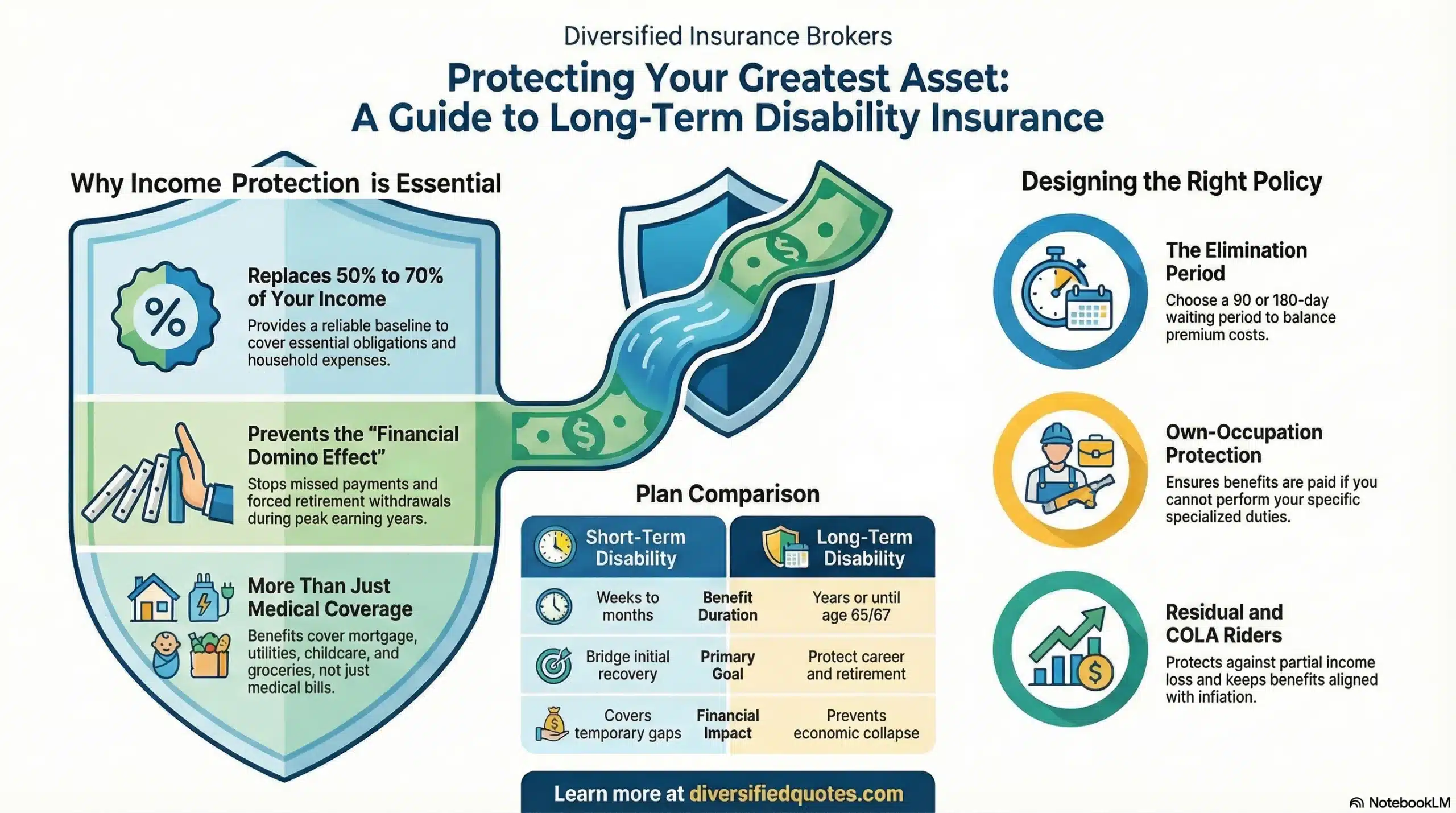
Short-term disability (STD) and long-term disability (LTD) benefits follow the same basic tax rule: taxability depends on who paid the premiums and whether those premiums were paid pre-tax or after-tax. However, in practice, STD is more often employer-paid, which means STD benefits are commonly taxable. LTD is sometimes employee-funded, which can make LTD benefits tax-free if paid after-tax. This is also where people get confused: they assume “short-term is tax-free because it feels like sick pay,” or they assume “long-term is tax-free because it’s insurance.” Neither assumption is reliable. The payment duration doesn’t control the tax outcome — the funding method does. If you’re unsure how your employer plan is funded, and you want to compare it to individual coverage, it can help to understand the broader marketplace and how costs vary by occupation and benefit design. Our dedicated resource on short-term disability insurance covers the STD product landscape and how group STD typically intersects with the taxability rules. Our resource on long-term disability insurance covers the LTD framework in detail — including how benefit periods, elimination periods, and definition of disability affect the overall protection strategy alongside the tax considerations covered here. Start with how much disability insurance costs and then compare what you’re paying today versus the net benefit you’d actually receive after factoring in the applicable tax treatment.
Do Business Owners Pay Taxes on Disability Benefits?
Business owners often have the most to lose from a disability claim, but they also have the most opportunities to structure coverage intentionally. The tax outcome depends on whether the business pays the premium, whether the premium is treated as a deductible business expense, and how benefits are received. In many cases, if a business pays premiums for an employee and deducts them as a business expense, the benefits may be taxable to the employee if a claim occurs. For owners — especially S-corp owners — the details can be nuanced because payroll treatment matters. Some owners choose to pay premiums personally to help preserve the tax-free nature of benefits, but the “best” structure depends on how the business is set up and what the owner is trying to accomplish. The general principle for individually-owned business disability coverage is that if the premium is not taken as a tax deduction (not run through the business as an expense), then the corresponding benefit is typically received tax-free. This is the trade-off inherent in disability insurance planning for owners: deducting the premium creates taxable benefits; not deducting the premium creates tax-free benefits. For most owners protecting personal income rather than corporate cash flow, the tax-free benefit is more valuable than the premium deduction. Disability planning for business owners often overlaps with other protection concepts, including continuity planning and key-person risk. Disability planning for businesses sometimes extends to overhead expense coverage — protecting the fixed costs of running the business while the owner cannot work — discussed in our resource on overhead expense disability insurance. Our resource on disability insurance for executives covers how high-income executives structure both individual coverage and executive carve-out plans alongside the business owner considerations. If you’re looking at disability coverage from a business lens, it can also be helpful to review related protection planning topics like key person insurance, because many businesses need both income replacement and business stability protection running in parallel. The practical takeaway: if you’re a business owner, don’t assume the standard employee rules apply cleanly to you. The way premiums are paid and reported is what determines tax treatment.
The Self-Employed Owner — A Special Case
Self-employed individuals — including sole proprietors, freelancers, independent contractors, and single-member LLC owners — face a unique disability planning landscape because they have no employer providing group benefits. Every dollar of disability protection must be purchased individually, and there is typically no employer to split the cost. The upside is that individually owned coverage funded with after-tax dollars produces tax-free benefits at claim time — the cleanest outcome possible in the disability tax framework. The challenge is that self-employed individuals cannot deduct disability insurance premiums as a business expense for individual income replacement policies (unlike health insurance premiums, which have a self-employed deduction available). For self-employed individuals, the tax planning question is less about converting employer-funded benefits to tax-free status (that conversion already exists by default) and more about ensuring the coverage amount is sized to the after-tax income rather than gross business revenue. Our dedicated resource on disability insurance for the self-employed covers the unique product selection, benefit sizing, and policy design considerations that apply when no group plan exists. For self-employed professionals using a Keogh or other retirement plan structure alongside their disability coverage, understanding how a disability event affects both income and retirement contributions is important — our resource on how a Keogh plan works provides context on those retirement plan mechanics. For self-employed workers in personal service occupations — such as independent nail technicians, freelance videographers, or sole-proprietor service providers — disability coverage is entirely individually purchased, meaning all benefits default to tax-free status as long as premiums are paid from personal after-tax income.
Are Social Security Disability Payments Taxable?
Yes, they can be. Social Security Disability Insurance (SSDI) benefits are taxed under the same general framework used for Social Security retirement benefits. Whether SSDI is taxable depends on your “combined income” and other income sources in the household. This is an area where many people are surprised. They assume disability benefits from Social Security are always tax-free. But if your household has other income — such as a spouse’s earnings, investment income, or other taxable benefits — some portion of SSDI may become taxable depending on total income. If combined income (adjusted gross income plus nontaxable interest plus half of SSDI benefits) falls below the base threshold ($25,000 for individuals or $32,000 for married couples filing jointly), SSDI benefits are fully tax-free. If combined income falls between the lower and upper thresholds, up to 50% of benefits may be taxable. Above the upper threshold ($34,000 for individuals or $44,000 for married couples filing jointly), up to 85% of SSDI benefits may be taxable. If you want to understand how Social Security taxation works more broadly — and how different income sources stack on top of it — our guide on reducing taxes on Social Security benefits covers the same general framework as it applies when disability benefits are involved.
Are Workers’ Compensation Payments Taxable?
In general, workers’ compensation payments are not taxable when they are paid due to an on-the-job injury or illness. Workers’ comp is typically treated differently from disability insurance because it’s a statutory benefit system tied to workplace injury rules. Workers’ compensation benefits paid under workers’ comp acts or similar statutes are specifically excluded from gross income under Internal Revenue Code Section 104. However, there can be interactions between workers’ comp and Social Security disability benefits in certain situations, where one benefit offsets the other. Those offsets can affect how much you receive, and in some cases may influence tax reporting. But as a core rule, workers’ comp itself is typically not taxable. For workers in physically demanding or higher-risk occupations — such as the sanitation, construction, or food service workers covered in our occupation-specific disability insurance resources — workers’ compensation represents a baseline protection layer, but it typically covers only on-the-job injuries. An off-the-job disability event creating long-term income loss requires separate disability insurance because workers’ comp does not apply to illnesses or injuries that occur outside the workplace.
Can Disability Insurance Affect Other Benefits?
Disability insurance can interact with other benefits, depending on the policy design. Some employer LTD plans have offsets if the insured receives SSDI or workers’ comp, which is one reason the “gross benefit amount” can be misleading. The policy may promise a certain percentage of income, but the net payment can change if other benefits are received. It generally doesn’t affect retirement accounts directly, but a disability event can indirectly affect retirement planning because contributions stop, savings may be tapped, and long-term goals can be delayed. This is why disability coverage is often considered a retirement protection tool as much as an income tool — because it helps prevent a forced drawdown of long-term assets. Understanding whether disability insurance is worth its cost relative to these protection goals — beyond just the tax efficiency question — is covered in our resource on whether disability insurance is worth it. For professionals evaluating the elimination period and benefit period design alongside the tax implications — specifically how long they’d wait for benefits and for how long those benefits would continue — our resources on disability insurance elimination periods covers those structural design elements that interact with the tax planning framework. If your income strategy includes retirement plan distributions and you want to understand how different plan types work, our retirement plan guides can provide context. Many self-employed individuals use specialty plans and later roll them into other structures; reviewing how a Keogh plan works as part of a broader planning picture helps ensure the disability plan and retirement plan complement rather than complicate each other.
Why Understanding Taxation Matters
The reason taxation matters is that it changes the amount of income you can actually rely on during a claim. A taxable benefit may be significantly smaller than expected once federal and state taxes are withheld, especially for high earners. That difference affects your ability to pay fixed expenses, maintain insurance coverage, continue retirement contributions, and avoid taking on debt. Taxability also affects how much disability coverage you should target. If you’re planning around a monthly budget, you should base your coverage need on the net amount you want, not the gross amount on a brochure. This is also why we encourage people to understand cost drivers and plan design together, using resources like disability insurance cost guidance and then validating what your employer plan really provides. As a practical example, someone might think a $4,000 per month disability benefit will cover their essentials. But if that benefit is taxable and subject to a 32% combined federal and state tax rate, the take-home amount is closer to $2,720 — potentially $1,280 per month less than expected. The result is that the plan may not cover the expenses it was intended to cover unless it was designed with taxes in mind from the start.
Design a Disability Plan Around After-Tax Income
Our advisors compare individual and group DI options, identify how your current plan is funded, and help you maximize the net benefit available at claim time.
Request a Disability Insurance Quote Call 800-533-5969Related Pages to Explore
More planning guides and comparisons that connect to disability, benefits design, and broader protection strategy.
Financial Protection Essentials
Core strategies to protect retirement income, prepare for healthcare costs, and build long-term financial stability.
Talk With an Advisor Today
Choose how you’d like to connect—call or message us, then book a time that works for you.
Schedule here:
calendly.com/jason-dibcompanies/diversified-quotes
Licensed in all 50 states • Fiduciary, family-owned since 1980
FAQs: Are Disability Insurance Payments Taxable?
Are individual disability insurance benefits taxable?
No — if you paid the premiums with after-tax dollars, your disability benefits are generally tax-free. This applies when you purchase an individual disability policy personally and pay the premiums from income that was already subject to income tax. The IRS treats the benefit as a return of the after-tax premium contributions rather than as taxable income. This is one of the most compelling reasons high-income earners purchase individually owned DI policies: the full monthly benefit is available at claim time without income tax withholding reducing the actual amount received. Even if your employer offered the policy through a group plan, if you elected to pay the full premium yourself using after-tax payroll dollars — not pre-tax — the benefits should still be tax-free.
Are employer-paid disability benefits taxable?
Yes — if your employer pays the premiums for your disability coverage, the benefits you receive during a claim are taxable as ordinary income. The IRS treats employer-paid premiums as a non-taxable fringe benefit during the premium-paying period, but it taxes the corresponding benefit when received. This means the gross benefit amount shown on your HR enrollment materials is not the net amount you would actually take home during a disability. After federal income tax, state income tax, and any applicable payroll taxes are applied, the actual monthly cash flow can be meaningfully lower than the stated benefit. Many employees do not discover this until they are already in a claim period — which is why proactively evaluating the after-tax benefit is an important step before a disability event occurs.
Are short-term disability payments taxable?
Short-term disability benefits follow the same fundamental tax rule as any disability insurance: taxability depends on how the premium was funded, not on the benefit duration. In practice, most employer-sponsored short-term disability plans are either fully employer-paid or paid through pre-tax payroll deductions, which means STD benefits are commonly taxable. When an employee pays STD premiums with after-tax dollars, the benefits are generally tax-free. The distinction matters most for employees transitioning from fully employer-paid STD to individual LTD coverage — understanding that the STD benefit has been taxable helps calibrate expectations for the overall income replacement strategy during a recovery period. For more on how short-term disability products are structured, our short-term disability insurance resource covers both product design and premium structure.
Are long-term disability benefits taxable?
Long-term disability benefits follow the same premium-funding rule: taxable if premiums were paid pre-tax or by the employer; tax-free if premiums were paid with after-tax dollars. Because LTD benefits often extend for years or decades — potentially to age 65 — the cumulative tax impact is significant. A $5,000 per month LTD benefit that is taxable may produce only $3,000-$3,500 per month net over a 10-year claim, compared to the full $5,000 if the benefit were tax-free. This long-term tax compounding is exactly why financial advisors who work with executives and high-income professionals typically recommend individually owned, after-tax-funded LTD coverage rather than relying on group employer plans for the bulk of income replacement. The higher up-front premium cost of individually owned LTD is frequently offset by the superior net benefit during a claim.
Are Social Security disability payments taxable?
They can be — SSDI benefits are taxed under the same framework as Social Security retirement benefits, using a “combined income” test. For individuals with combined income (AGI plus nontaxable interest plus half of SSDI) below $25,000, SSDI benefits are generally fully tax-free. Between $25,000 and $34,000, up to 50% of benefits may be taxable. Above $34,000, up to 85% of benefits may be taxable. For married couples filing jointly, the thresholds are $32,000 and $44,000. The most common scenario where SSDI becomes partially or fully taxable is when a disabled individual continues to have household income from a working spouse, investment income, or other pension or annuity distributions alongside the SSDI benefit. Social Security disability recipients should factor potential SSDI taxation into their income planning, particularly when other income sources push combined income above the lower threshold.
What is the “tax swap” strategy for employer disability coverage?
The tax swap refers to an employee electing to pay their employer-sponsored disability insurance premiums with after-tax rather than pre-tax dollars. Many employer plans allow this election during open enrollment. The trade-off: the employee gives up the small current-year tax savings from the pre-tax premium deduction (typically $10-$50 per month depending on premium and bracket) in exchange for receiving fully tax-free disability benefits if a claim occurs. For employees in the 30-35% combined federal and state tax bracket, a $5,000 per month benefit that becomes fully tax-free rather than fully taxable represents roughly $1,500-$1,750 per month more in actual take-home income during a claim. When evaluated over a multi-year disability event, the tax swap often delivers far more value than the pre-tax premium deduction it replaces.
How does partial employer contribution affect disability benefit taxation?
When an employer pays a portion of disability premiums and the employee pays the remaining portion with after-tax dollars, the resulting benefits are partially taxable. The taxability is proportional to the premium funding: if the employer paid 70% of the premium, then 70% of the disability benefit is taxable as ordinary income. The remaining 30% — funded by the employee with after-tax dollars — is received tax-free. This proportional rule applies each plan year. If the employer contribution percentage changes year to year (for example, because the employer increases benefits or changes cost-sharing), the taxable fraction of the benefit adjusts accordingly. For employees in these split-funded plans, tracking the premium split is important both for tax planning and for understanding the true net benefit available if a claim occurs.
How should business owners structure disability insurance to maximize after-tax benefits?
The general framework for business owners is: do not run individually owned disability insurance premiums through the business as a tax-deductible expense if the goal is to receive tax-free benefits. When a C-corp or S-corp pays DI premiums for an owner and deducts them as a business expense, the IRS treats that as pre-tax funding — making the corresponding benefits taxable. When the owner pays premiums personally from after-tax income and takes no deduction, the benefits are generally tax-free. For most business owners protecting personal income, this trade-off favors the personal-pay, no-deduction approach: the premium deduction saves a fraction of the premium each year, while the tax-free benefit at claim time provides the full monthly income replacement without ongoing income tax erosion. S-corp and C-corp nuances around W-2 treatment and premium reporting require case-by-case evaluation with a CPA or tax advisor familiar with disability insurance premium treatment.
Are disability benefits from a Keogh or self-employed retirement plan affected by DI benefits?
Disability insurance benefits themselves do not directly affect the tax treatment of Keogh, SEP-IRA, or other self-employed retirement plan distributions. The two income streams are evaluated separately for income tax purposes. However, a disability event that interrupts self-employment income will typically stop contributions to a Keogh or SEP-IRA, since these plans require earned income as the basis for contribution eligibility. The loss of contribution capacity during a long-term disability is one of the indirect costs that disability insurance helps offset by preserving income — allowing the insured to continue funding retirement plans if they are able to return to work or use the benefit for living expenses while managing other assets. Some specialty disability policies include retirement plan contribution riders that fund contributions directly to qualified plans during a disability event, addressing this indirect retirement saving interruption.
Can I deduct disability insurance premiums on my federal tax return?
Generally no — disability insurance premiums paid for individual income replacement coverage are not deductible as a personal expense on federal income tax returns. This is by design: the IRS allows the premium to be paid with after-tax dollars so that the resulting benefit is received tax-free. One exception is overhead expense disability insurance (also called business overhead expense or BOE coverage), which protects the fixed expenses of running a business during a disability. BOE premiums paid by a business may be deductible as a business expense, though the corresponding benefits used to pay business overhead may be taxable to the business owner. Another exception is for disability policies that specifically protect business continuation obligations rather than personal income replacement. For individual income protection, the tax-free benefit structure is the trade-off for the non-deductible premium.
What should I ask my HR department to determine the tax status of my disability benefits?
The most direct question to ask HR is: “Are my disability insurance premiums deducted from my paycheck before or after taxes?” If the answer is “before taxes” (pre-tax) or “the company pays the full premium,” your benefits are likely taxable at claim time. If the answer is “after taxes” (post-tax) and you pay the full premium yourself, your benefits are likely tax-free. If the answer is that the company pays part and you pay part, the follow-up question is: “Is the portion I pay taken before or after taxes?” Because terminology is often imprecise in HR contexts, it can be worth reviewing your actual pay stub to look for the disability insurance deduction and checking whether it appears in the pre-tax or post-tax deduction section. Some payroll systems label this clearly; others require a conversation with payroll to clarify. Knowing the answer before a claim occurs gives you the opportunity to evaluate whether switching to after-tax elections (if offered) would improve your net benefit position.
How does the taxability of disability benefits affect how much coverage I should buy?
Taxability directly affects coverage sizing. The common benchmark of “disability insurance replaces 60-70% of gross income” was designed around a world where most benefits were taxable and the post-tax take-home would be roughly equivalent to the insured’s household budget. When benefits are tax-free, 50-60% of gross income in coverage often produces a monthly net that closely matches the after-tax take-home from working. When benefits are taxable, 60-70% of gross may still fall short after taxes, particularly for high earners in combined federal/state brackets of 35-45%. The sizing decision should be made around the monthly budget number you need to maintain essential expenses — not around a percentage of gross income. Work backward from the monthly cash flow target, determine whether your coverage will be taxable or tax-free, and then select a benefit amount that delivers the required net amount after applying the applicable tax rate. This approach often reveals that people need either more coverage than they thought (if benefits are taxable) or that current coverage is already adequate (if benefits are tax-free).
About the Author:
Jason Stolz, CLTC, CRPC, DIA, CAA and Chief Underwriter at Diversified Insurance Brokers (NPN 20471358), is a senior insurance and retirement professional with more than 25 years of real-world experience helping individuals, families, and business owners protect their income, assets, and long-term financial stability. As a long-time partner of the nationally licensed independent agency Diversified Insurance Brokers, Jason provides trusted guidance across multiple specialties—including fixed and indexed annuities, long-term care planning, personal and business disability insurance, life insurance solutions, Group Health, Travel Medical and Evacuation Insurance, and short-term health coverage. Diversified Insurance Brokers maintains active contracts with over 100 highly rated insurance carriers, ensuring clients have access to a broad and competitive marketplace.
His practical, education-first approach has earned recognition in publications such as VoyageATL, and contributions from his agency featured in Kiplinger and GoBankingRates— highlighting his commitment to financial clarity and client-focused planning. Drawing on deep product knowledge and years of hands-on field experience, Jason helps clients evaluate carriers, compare strategies, and build retirement and protection plans that are both secure and cost-efficient. Visitors who want to explore current annuity rates and compare options across multiple insurers can also use this annuity quote and comparison tool.
Explore More Disability Insurance Options: Browse our complete guide to Disability Insurance Planning & Education — covering how it works, riders, elimination periods, own occupation, costs & buying guides from 100+ carriers.
Last Reviewed: September 12, 2026 |
Reviewed by: Jason Stolz, CLTC, CRPC, DIA, CAA
Chief Underwriter, Diversified Insurance Brokers, Inc. | NPN: 20471358 | Diversified Insurance Brokers, Inc. — Licensed in all 50 states
Fact Checked by: Tonia Pettitt, CMIP©
Medicare Specialist, Diversified Insurance Brokers, Inc. | NPN: 14374308 | Diversified Insurance Brokers, Inc. — Licensed in all 50 states
Did you find this content helpful? Leave us a Google review — it helps others find trustworthy guidance too.
Editorial Standards: Diversified Insurance Brokers maintains rigorous editorial standards to ensure accuracy, clarity, and independence in all content. Learn more about our editorial standards and commitment to transparency.
