
Disability Insurance for Tax Professionals
As an Independent Disability Insurance Broker, we have access to exclusive discounts and negotiated pricing most captive agents can’t offer — see the full breakdown near the end of this page.
Disability Insurance for Tax Professionals

Jason Stolz CLTC, CRPC, DIA, CAA
Tax professionals — CPAs, enrolled agents, tax attorneys, tax preparers, and bookkeepers — have built careers on a foundation of intellectual precision, regulatory mastery, and client trust. The major disability insurance carriers recognize this: all five of the leading individual disability income carriers (Guardian, MassMutual, Principal, Standard, and Ameritas) classify CPAs among the highest occupational classes available to any non-medical profession. That favorable classification translates directly into lower premiums, access to the most comprehensive policy provisions, and the ability to secure true own-occupation protection — the strongest available definition of disability — at rates that most other professions cannot achieve.
But favorable classification does not mean disability is unlikely. CPA work follows extreme seasonal patterns — tax practitioners routinely work 60 to 80 or more hours per week from January through April, and audit professionals face similar peaks around year-end and quarterly reporting periods. Sustained high-intensity work under deadline pressure creates elevated risk for stress-related conditions, burnout, cognitive fatigue, and musculoskeletal injuries from prolonged desk work. And the occupational risk that disables most tax professionals is invisible to the naked eye: the research shows that almost all accountant disability clients are disabled due to cognitive difficulties that are secondary to a physical diagnosis. MS, Parkinson’s disease, chronic pain conditions, and a range of other medical diagnoses produce as their most functionally significant consequence the inability to maintain the concentration, memory, and executive function that precise tax and accounting work demands.
At Diversified Insurance Brokers, we help tax professionals at every career stage — from early-career CPAs establishing their first policy to practice owners building comprehensive income and business protection strategies — understand what they are actually buying and why specific provisions matter for their specific work. Our independent disability insurance brokerage gives us access to more than 100 carriers across the full market so comparisons are never limited to a single company’s product.
Compare Disability Insurance for Tax Professionals
We specialize in income protection for CPAs, enrolled agents, tax attorneys, and accounting practice owners across all practice structures.
Request a Disability Insurance QuoteCall 800-533-5969
What Disables Tax Professionals — and Why the Policy Definition Matters
The most important and least understood fact about disability claims for accountants and tax professionals is that cognitive impairment — not physical injury — is the primary mechanism. Disability carriers often characterize accounting as a sedentary, low-stress occupation and assume that all it takes to be an accountant is to sit at a desk four hours a day. This simplistic view fails completely to capture what tax professionals actually do. A CPA spending peak season reviewing complex multi-entity returns, advising on tax strategy under significant financial consequences for errors, managing client relationships, and maintaining regulatory compliance under deadline pressure is engaging in sustained, high-demand cognitive and professional work where even moderate cognitive impairment can make the job impossible to perform safely and accurately.
Any cognitive impairment — whether from neurological conditions, head injuries, or side effects from chronic illnesses — can significantly impair a CPA’s ability to fulfill these duties. Even physical disabilities can have cognitive consequences, particularly when pain, medication, or fatigue affect concentration and executive functioning. A CPA who cannot maintain the concentration required to accurately prepare a complex return, who experiences memory lapses that cause material mistakes, or who cannot process the level of regulatory detail their work demands has experienced a genuine professional disability — regardless of whether they can perform basic daily activities unimpaired.
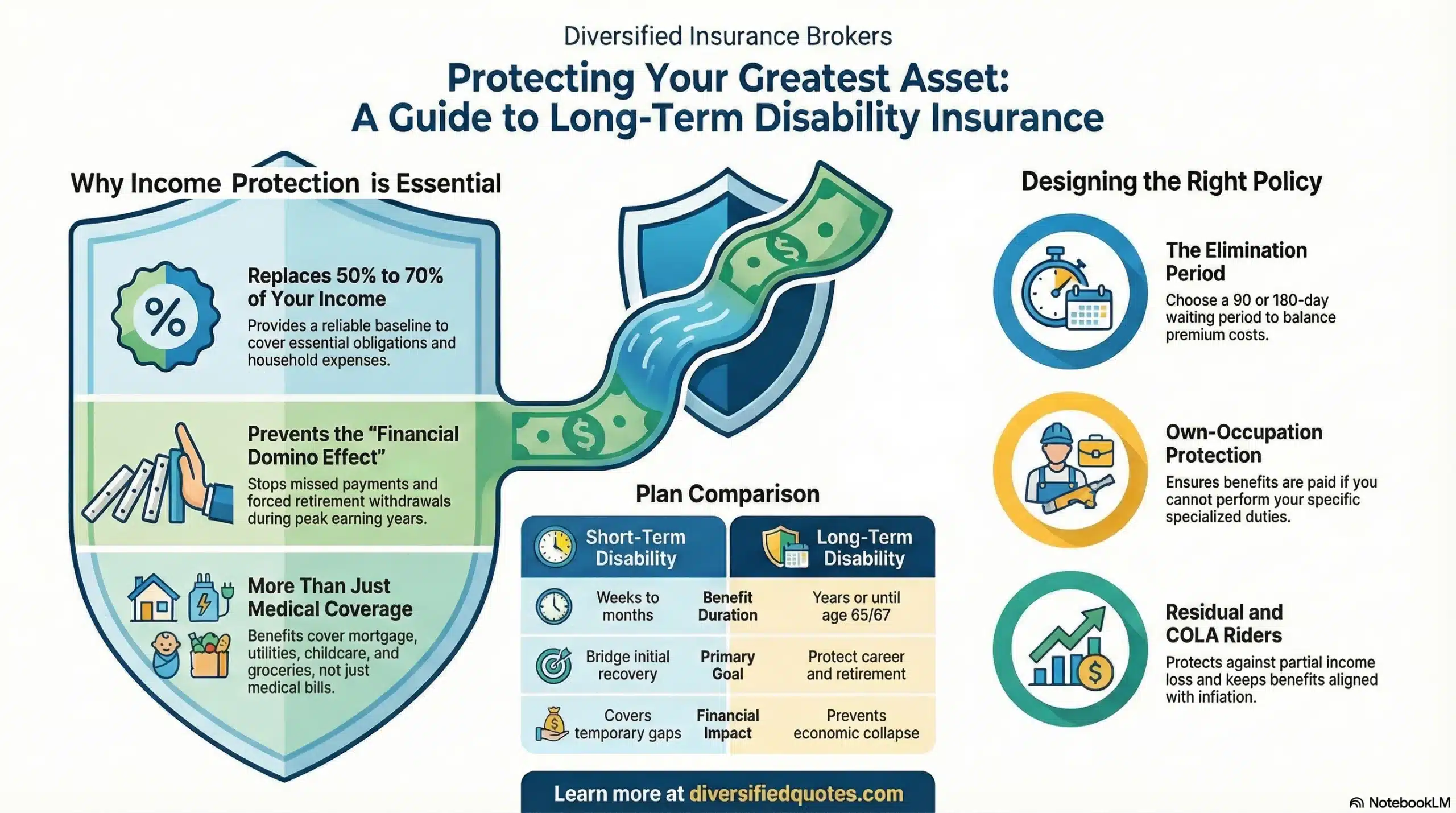
This cognitive dependency is precisely why the occupational definition in the disability policy is the most important feature for tax professionals to evaluate. True own-occupation disability insurance pays benefits when a covered condition prevents the insured from performing the material and substantial duties of their specific occupation — even if they can still work in another capacity and earn income from a completely different role. A tax attorney who develops a progressive neurological condition affecting concentration and working memory but who could theoretically work as a consultant receives full disability benefits under a true own-occupation policy, because tax law practice is what the policy insures. Weaker definitions — modified own-occupation or any-occupation — could deny that same claim if another form of work remains theoretically possible.
The CPA’s Occupational Classification Advantage
All five major disability carriers rate CPAs and fee-for-service accounting professionals in the highest available occupational classes — typically Class 5 or Class 5A depending on the carrier’s scale. This is the occupational classification “holy grail,” as industry professionals describe it: lower premiums per dollar of benefit, access to the longest available benefit periods (to age 65, 67, or in some cases 70), the most comprehensive own-occupation definitions, non-cancelable guaranteed renewable provisions, and the broadest available rider selections including future increase options, residual disability riders, COLA, and unlimited own-occupation benefit periods.
Accountants without a CPA designation or four-year degree typically receive slightly less favorable classifications — still above many other occupations, but not at the highest class level that full CPA credentialing produces. Early-career CPAs who want to lock in favorable classification before health conditions develop should strongly consider applying before any health issues arise, because the non-cancelable provision locks in both the premium rate and the policy terms permanently once issued. A policy purchased at age 28 with 28-year-old health retains that pricing and those provisions at age 45, regardless of any health changes in between. Our resource on best disability insurance rates provides current market context for what CPAs are paying at different ages and benefit amounts.
Group Coverage Through the AICPA: What It Provides and Where It Falls Short
The American Institute of CPAs offers a group long-term disability plan to its members, primarily underwritten by Prudential. For early-career accountants and those with health conditions that complicate individual applications, the AICPA plan provides genuine value as a coverage foundation. It offers own-occupation coverage (though not the true specialty-specific definition available in individual policies), portability as long as membership and CPA status are maintained, and up to $12,000 per month for qualifying members.
However, the AICPA plan uses broad accounting definitions rather than distinguishing between audit, tax, advisory, and forensic specialties. An audit partner directing complex multi-entity audits performs materially different work than a tax preparer handling individual returns. The AICPA plan does not distinguish between these specialties. For a CPA partner who can no longer manage complex audit engagements but could theoretically perform simpler accounting tasks, this definitional limitation can create claim denial scenarios that a properly structured individual policy would not produce. For a CPA earning $250,000 annually with a $10,000 AICPA plan benefit, individual coverage should target $8,000-$10,000 monthly — combined coverage of $18,000-$20,000 replaces roughly 60-70% of gross income, the standard protection ratio.
There is also a critical limitation regarding policy continuity: under the AICPA plan, coverage is limited to individuals working in the capacity of a CPA. If a policyholder transitions into another role — even a closely related one such as CFO — they may forfeit coverage eligibility. Individual disability policies do not carry this restriction; the coverage travels with the individual regardless of how their career evolves. Our resource on disability insurance for accountants explains how to layer group and individual coverage for the strongest total protection structure.
Key Policy Features Tax Professionals Should Prioritize
| Policy Feature | Why It Matters for Tax Professionals | What to Look For |
|---|---|---|
| True Own-Occupation Definition | Pays when a cognitive or physical condition prevents tax/accounting work specifically — even if other work remains possible | Language referencing inability to perform “the material and substantial duties of your occupation” without any-occupation crossover |
| Residual Disability Rider | Critical for seasonal earners and practice owners — pays proportional benefit when partial disability reduces client load or practice revenue | Income comparison trigger at 20% or less income loss; recovery benefit provision; 12-month own-earnings lookback |
| Non-Cancelable / Guaranteed Renewable | Locks in premium and all policy terms permanently — carrier cannot change terms, raise rates, or alter provisions as the professional ages | Non-cancelable preferred to guarantee both provisions and rates; guaranteed renewable as minimum acceptable |
| Future Increase Option | Allows coverage to grow with income without new medical underwriting — most strategically valuable for early-career tax professionals | Maximum available FIO at initial application; exercise schedule aligned with career income trajectory |
| COLA Rider | Increases benefit during long-duration disability to preserve purchasing power against inflation over a potentially decades-long claim | 3% compound COLA is strongest; 3% simple is common; CPI-linked options vary by carrier |
| Mental/Nervous Provision | The most common disability triggers for tax professionals — cognitive conditions from stress, burnout, depression, anxiety — require unlimited benefit period treatment | Avoid policies that cap mental/nervous claims at 24 months; the standard benefit period should apply to cognitive conditions |
Seasonal Income and the Residual Disability Rider
Tax work follows some of the most pronounced seasonal income patterns in any professional field. January through April filing season can account for 50% to 60% of a solo tax practitioner’s annual income in a matter of four months. The residual disability rider is not optional for tax professionals — it is the provision most likely to pay in the realistic scenarios a tax professional would actually face. A condition that limits a CPA to 50% of their normal working capacity during tax season doesn’t meet the total disability threshold but produces devastating income loss during the highest-revenue period of the year.
A residual, or partial, disability insurance policy is especially important for accountants who run their own firm. Even if you’re able to work after a disability, you may not be able to work as often as you did before. For those who are sole proprietors or have a small firm that works on referrals, that has a direct impact on earnings. The residual rider pays proportional benefits based on actual income loss — if a tax professional’s income drops 40% due to disability, they receive 40% of the monthly benefit while continuing to work at reduced capacity. Without this rider, a policy that looks comprehensive on paper provides nothing during the partial disability scenarios most likely to occur. Our resource on residual disability insurance benefits explained covers the calculation mechanics in full.
Practice Owners: Personal Disability Plus Business Overhead
Tax professionals who own practices face a two-layer disability risk that employed CPAs do not. Personal disability insurance replaces the owner’s household income during a disability. Business overhead expense (BOE) disability insurance reimburses the fixed costs of keeping the practice operational during the disability — staff wages, office rent, software subscriptions (tax preparation platforms, practice management systems, professional liability insurance premiums), and other fixed overhead that continues regardless of whether the owner is working. Without BOE coverage, a disabled practice owner must choose between depleting personal savings to maintain the business or allowing it to deteriorate — and for a tax practice built on recurring client relationships, that deterioration can be permanent within a single filing season.
Practice owners with partners should also evaluate buy-sell disability insurance to fund ownership transitions if a partner becomes permanently disabled. A disabled partner who retains ownership rights but cannot contribute to the practice creates a financial conflict between the active and disabled partners’ interests that a properly funded disability buy-sell resolves through a defined purchase mechanism. Our resource on disability income insurance for key person employees addresses scenarios where a key CPA staff member — not the owner — becomes disabled and the practice needs to fund replacement or revenue recovery.
The Self-Employed Income Documentation Challenge
Solo practitioners and small practice owners must document insurable income through tax returns — typically two years of personal returns and Schedule C or K-1 forms depending on business entity structure. Carriers calculate insurable income from reported net taxable income, which means tax professionals who legitimately minimize taxable income through deductions, retirement contributions, and business expense strategies may find their available benefit amount limited relative to actual economic income.
This creates a specific planning consideration for every self-employed tax professional: the timing and structure of disability insurance applications relative to income documentation directly affects the benefit amount available. Applying during a year when taxable income is higher — or understanding which income components the specific carrier includes in their insurable income calculation — produces better coverage outcomes than applying without this understanding and discovering the limitation after the fact. Our resources on disability insurance for the self-employed and disability insurance for 1099 workers cover the documentation mechanics and strategic timing considerations in depth. For white-collar professionals generally, our resource on disability insurance for white-collar professionals provides the broader occupational class and feature comparison context.
How to Compare Policies Effectively
The disability insurance market for CPAs and tax professionals is legitimately competitive — there are multiple strong carriers offering excellent products at favorable rates for this occupational class. The comparison that matters is not which policy costs the least, but which policy pays in the specific scenarios most likely to affect a tax professional’s career. Evaluating the occupational definition language, the mental and nervous provision benefit period, the residual rider trigger and calculation method, the future increase option schedule, and the elimination period options against realistic career and income projections produces a comparison that reflects actual income protection rather than just premium comparison.
As an independent agency working with more than 100 carriers, Diversified Insurance Brokers pulls side-by-side illustrations across the relevant competing products rather than being limited to a single carrier’s menu. For tax professionals who have already received a quote from another source, our 2nd opinion disability insurance quote review evaluates the offer against the full market. Our resource on disability insurance by occupation also provides the framework for understanding how occupational classification affects available provisions across different professional roles.
Build a Disability Plan That Fits Your Tax Practice
We compare own-occupation policies across 100+ carriers for solo practitioners, practice owners, CPAs, enrolled agents, and tax attorneys.
Compare Disability Options for Tax ProfessionalsCall 800-533-5969
Related Disability Insurance Pages
Income protection resources for tax and accounting professionals, practice owners, and white-collar professionals.
Financial Protection Essentials
Income protection tools, business continuity strategies, and life insurance resources for professionals and business owners.
Talk With an Advisor Today
Choose how you’d like to connect—call or message us, then book a time that works for you.
Schedule here:
calendly.com/jason-dibcompanies/diversified-quotes
Licensed in all 50 states • Fiduciary, family-owned since 1980
FAQs: Disability Insurance for Tax Professionals
What occupational class do CPAs and tax professionals receive?
All five major individual disability carriers — Guardian, MassMutual, Principal, Standard, and Ameritas — classify CPAs among the highest occupational classes available to any non-medical profession, typically Class 5 or the equivalent highest tier on each carrier’s scale. This favorable classification produces lower premiums per dollar of benefit, access to the longest available benefit periods including to age 65, 67, or 70, the strongest available occupational definitions, and the broadest rider selection. Tax preparers and bookkeepers without CPA credentials typically receive slightly less favorable classifications but still above many other professional occupations. Early-career CPAs benefit most from applying before any health conditions develop, since the non-cancelable provision locks in both premium rate and policy terms permanently at the health status and age of initial application.
What usually disables a CPA or tax professional?
Cognitive impairment — not physical injury — is the primary mechanism behind the vast majority of disability claims among tax and accounting professionals. The research and claims data are consistent: most accountants who file disability claims are disabled due to cognitive difficulties that are secondary to a physical diagnosis such as multiple sclerosis, Parkinson’s disease, chronic pain conditions, or other medical diagnoses whose most professionally significant consequence is impaired concentration, memory, and executive function. A CPA whose cognitive function prevents accurate complex return preparation, regulatory analysis, or client advisory work has experienced a genuine professional disability — the career-ending consequence for tax work — even if they appear functional in basic daily life. This is why the mental and nervous provision benefit period in the policy matters: a policy that limits mental health and cognitive condition claims to 24 months may be inadequate for conditions with long-duration disability timelines.
Is the AICPA group disability plan enough on its own?
For most CPAs, no — particularly at senior professional and partner income levels. The AICPA plan provides genuine value as a first coverage layer, offering up to $12,000 per month with own-occupation language and portability as long as AICPA membership and CPA status are maintained. But it uses broad accounting definitions that do not distinguish between audit, tax, advisory, and forensic specialties, which can create definitional gaps for specialists whose disability prevents their specific practice area even if simpler accounting tasks remain theoretically possible. For a CPA earning $250,000 annually, the $10,000 AICPA benefit cap leaves significant income unprotected without individual supplemental coverage. The plan also limits benefits if the insured transitions to a different role — even a related one like CFO — potentially eliminating coverage at the moment a career change occurs.
The standard recommendation is to use the AICPA plan as a base layer and supplement it with individual coverage targeting the remaining 60-70% gross income replacement gap. Our resource on disability insurance for accountants explains the layering strategy in full.
Why is the residual disability rider especially important for tax professionals?
Tax work is among the most seasonally concentrated professional income structures in any field — January through April can represent 50-60% of a solo practitioner’s annual income in a four-month window. A partial disability that limits a CPA to 50% of normal working capacity during peak season produces devastating income loss that does not meet the total disability threshold. Without a residual rider, this scenario produces zero benefit from the policy despite significant financial harm. The residual rider pays proportional benefits based on actual income loss when disability reduces income by 20% or more — so a 40% income reduction produces 40% of the monthly benefit, regardless of whether the CPA continues working at reduced capacity. For practice owners who run on referral-based client relationships, the residual rider also addresses the “client erosion” risk — income that remains depressed well after the disability resolves because client relationships atrophied during the partial disability period. Our resource on residual disability insurance benefits explains the calculation mechanics in detail.
How does being self-employed affect disability underwriting for a CPA?
Self-employed CPAs and tax practitioners must document insurable income through two years of personal and business tax returns, with carriers calculating the benefit base from net taxable income. The primary challenge: tax strategies that legitimately minimize reportable taxable income also reduce the documented insurable income available for benefit calculation. A self-employed CPA generating $300,000 in gross practice revenue who reports $180,000 in net taxable income after deductions and retirement contributions may find their maximum available monthly benefit calculated on the $180,000 figure rather than actual economic income. This makes the timing of disability insurance applications relative to income documentation strategically significant — applying during or shortly after a year with higher reported taxable income produces a higher available benefit amount than applying after a low-income year or without understanding the carrier’s specific income calculation methodology. Our resource on disability insurance for the self-employed covers these mechanics in full.
About the Author:
Jason Stolz, CLTC, CRPC, DIA, CAA and Chief Underwriter at Diversified Insurance Brokers (NPN 20471358), is a senior insurance and retirement professional with more than 25 years of real-world experience helping individuals, families, and business owners protect their income, assets, and long-term financial stability. As a long-time partner of the nationally licensed independent agency Diversified Insurance Brokers, Jason provides trusted guidance across multiple specialties—including fixed and indexed annuities, long-term care planning, personal and business disability insurance, life insurance solutions, Group Health, Travel Medical and Evacuation Insurance, and short-term health coverage. Diversified Insurance Brokers maintains active contracts with over 100 highly rated insurance carriers, ensuring clients have access to a broad and competitive marketplace.
His practical, education-first approach has earned recognition in publications such as VoyageATL, and contributions from his agency featured in Kiplinger and GoBankingRates— highlighting his commitment to financial clarity and client-focused planning. Drawing on deep product knowledge and years of hands-on field experience, Jason helps clients evaluate carriers, compare strategies, and build retirement and protection plans that are both secure and cost-efficient. Visitors who want to explore current annuity rates and compare options across multiple insurers can also use this annuity quote and comparison tool.
Explore More Disability Insurance Options: Browse our complete guide to Disability Insurance for Legal, Finance & White Collar Professionals — covering attorneys, accountants, bankers, executives, financial planners & business professionals from 100+ carriers.
Last Reviewed: May 18, 2026 |
Reviewed by: Jason Stolz, CLTC, CRPC, DIA, CAA
Chief Underwriter, Diversified Insurance Brokers, Inc. | NPN: 20471358 | Diversified Insurance Brokers, Inc. — Licensed in all 50 states
Fact Checked by: Tonia Pettitt, CMIP©
Medicare Specialist, Diversified Insurance Brokers, Inc. | NPN: 14374308 | Diversified Insurance Brokers, Inc. — Licensed in all 50 states
Did you find this content helpful? Leave us a Google review — it helps others find trustworthy guidance too.
Editorial Standards: Diversified Insurance Brokers maintains rigorous editorial standards to ensure accuracy, clarity, and independence in all content. Learn more about our editorial standards and commitment to transparency.
