
High Income Disability Insurance
As an Independent Disability Insurance Broker, we have access to exclusive discounts and negotiated pricing most captive agents can’t offer — see the full breakdown near the end of this page.
High Income Disability Insurance

Jason Stolz CLTC, CRPC, DIA, CAA
High income disability insurance is built for professionals earning $250,000 to $1,000,000 or more per year whose financial lives depend on consistent, ongoing income. At higher income levels, the risk is not simply whether you have disability coverage — it is whether the coverage actually scales to match your real financial obligations. Mortgages, tuition, payroll, taxes, investment contributions, and long-term savings goals do not shrink because income temporarily stops. But most standard disability insurance was never designed to protect income at this level, and the gap between what standard coverage provides and what high earners actually need can be enormous.
For physicians, surgeons, executives, attorneys, partners, and high-earning 1099 professionals, income is the foundation that supports everything else. When that income is interrupted by illness or injury — even for a limited period — most traditional disability plans reveal a serious structural weakness: they cap out long before a high earner’s real financial exposure does. A plan that replaces 60% of income sounds adequate until you calculate what 60% of a $15,000-per-month benefit cap (YES, many carriers have a cap on benefits. As an independent disability broker, we have some that do not) actually delivers for someone earning $600,000 a year.
At Diversified Insurance Brokers, we help high earners nationwide design layered disability strategies that combine employer group coverage, individual disability insurance, and high-limit supplemental policies into one coordinated income protection system. The goal is not just to have disability insurance — it is to have disability insurance that actually works at your income level when you need it most. Our resource on how to choose the right disability insurance policy provides the foundational framework, and our team’s work with independent disability insurance brokerage across 100+ carriers ensures the comparison is complete rather than limited to a single company’s product menu.
Protect High-Earning Income the Right Way
Compare high-limit disability options built for physicians, executives, partners, and business owners.
Request a High-Income Disability QuoteQuestions? Call 800-533-5969
Why Standard Disability Coverage Fails High Earners
The most common mistake high earners make is assuming that employer-sponsored group long-term disability coverage is adequate. It rarely is — and the gap between what group LTD provides and what a high earner actually needs becomes more severe as income grows. Most group long-term disability plans replace around 60% of base salary, but only up to a fixed monthly benefit cap. That cap is typically $10,000 to $15,000 per month, which is often set by the employer’s plan design or the group carrier’s underwriting limits.
For someone earning $400,000 annually, 60% income replacement equals approximately $20,000 per month. A $10,000 monthly benefit cap leaves a $10,000 monthly gap — meaning the employer’s disability plan is replacing only 30% of actual income, not 60%. For someone earning $600,000 or more, the math is even more stark. A $15,000 monthly cap against a $30,000+ monthly income need represents less than 50% income replacement despite the plan’s nominal 60% benefit formula. Understanding how how much disability insurance you actually need at your income level is the starting point for identifying how large your real coverage gap is.
Group LTD also has structural limitations beyond the benefit cap. Most group plans calculate benefits based on base salary only, excluding bonuses, commissions, equity compensation, K-1 distributions, and production pay. For an executive whose total compensation is $800,000 but whose base salary is $250,000, the group plan may only cover the $250,000 base component — meaning more than 60% of their total compensation is entirely unprotected. Partners in law firms, accounting firms, and medical practices often face this exact scenario, where the variable compensation that drives their lifestyle is structurally excluded from group disability protection.
Taxation is another dimension that reduces the real-world benefit from employer-paid group LTD. When the employer pays group disability premiums without imputing the cost to the employee as taxable income, the disability benefits received during a claim are taxable as ordinary income. A $15,000 monthly gross benefit can easily become $10,000 to $11,000 in after-tax income depending on tax rates — creating an even larger gap between what the plan pays and what the household actually needs. Our resource on whether disability insurance payments are taxable explains the full tax treatment framework for both group and individual disability benefits.
Finally, group disability coverage is not portable. A physician, attorney, or executive who changes employers, transitions to private practice, reduces employed hours, or retires early loses the group coverage at the exact moment when new individual coverage applications require full underwriting review — which may produce significantly worse terms if health has changed since the original group plan was established.
The Coverage Cliff: Where High-Earner Income Exposure Begins
The most dangerous risk point for high earners is what we describe as the coverage cliff — the income threshold at which standard coverage structures become genuinely inadequate and the gap between coverage and real financial exposure begins to widen rapidly. That cliff typically begins around $250,000 to $300,000 of annual income and becomes more severe at each income level above that threshold.
The mechanics of the cliff are straightforward. Standard individual disability policies from the major disability carriers — Ameritas, Guardian, Mass Mutual, Principal, Assurity, and others — have per-policy benefit limits and aggregate benefit limits that cap at specific amounts. Individual policy limits for most standard retail products are typically in the $15,000 to $20,000 per month range for favorable occupational classes. Adding group LTD to an individual policy can sometimes push total available coverage to $25,000 to $30,000 per month — still well below the income replacement needed for a physician earning $500,000, a surgeon earning $700,000, or an executive earning $1,000,000 or more.
When that cliff is ignored, the financial consequences are predictable and compounding. Retirement contributions pause or stop during a disability event. Emergency savings are depleted within months rather than quarters. Investment positions are liquidated at unfavorable times to meet current obligations. Long-term financial plans — college funding, business succession, estate planning — are disrupted or permanently reset. The purpose of a properly designed disability strategy is not just to replace income during recovery. It is to prevent a temporary medical event from producing permanent damage to the long-term financial architecture that took years to build.
The Layered Coverage Strategy: How High-Limit Protection Works
Designing high income disability insurance that actually closes the coverage cliff requires a layered approach — stacking multiple coverage sources so the total monthly benefit genuinely reflects the income being protected. The three primary layers are group LTD (when available), individual disability insurance, and high-limit or excess supplemental disability coverage.
The table below illustrates how layered coverage works for a physician earning $600,000 annually ($50,000 per month) with a 60% income replacement target of $30,000 per month:
| Coverage Layer | Monthly Benefit | Tax Treatment | Notes |
|---|---|---|---|
| Group LTD (employer plan) | $10,000–$15,000 | Typically taxable if employer pays premium | Capped; base salary only; not portable |
| Individual DI policy | $10,000–$15,000 | Tax-free (personally paid premiums) | Own-occupation; portable; non-cancelable |
| High-limit supplemental DI | $5,000–$20,000+ | Tax-free (personally paid premiums) | Excess/surplus market; fills gap above standard limits |
| Total combined benefit | $25,000–$50,000+ | Mixed — structure determines net | Actual target for $500K–$1M+ earners |
Illustrative only. Actual benefit amounts depend on individual income documentation, occupational class, health history, carrier underwriting limits, and applicable aggregate maximums. Individual results will vary.
The high-limit or excess disability layer is the component that most high earners are missing entirely. These policies are designed specifically to fill the benefit gap above what standard group and individual policies can provide. They are typically issued through specialty carriers or surplus lines markets, often require simplified or streamlined underwriting relative to standard individual policies, and can add $5,000 to $20,000 or more in additional monthly benefit depending on income level and occupational class. For physicians and surgeons specifically, our resource on disability insurance for physicians covers the specific layering strategy, occupational class considerations, and the future increase options that allow coverage to grow with rising income.
Own-Occupation Definition: The Policy Provision That Matters Most
For high earners whose income is tightly linked to specialized skills, professional credentials, or specialty-specific duties, the occupational definition in a disability policy is more important than the benefit amount. A large monthly benefit that does not pay in the scenarios most likely to affect your career provides false protection — and discovering that the definition is inadequate at claim time is one of the most costly surprises in disability insurance.
True own-occupation disability insurance pays benefits when a covered condition prevents the insured from performing the material and substantial duties of their specific occupation — even if they can still work in another capacity and earn income elsewhere. A surgeon who develops a hand tremor that prevents surgical practice can still teach, consult, or work in hospital administration. Under a true own-occupation policy, that surgeon receives full disability benefits despite working and earning in another role, because it is the specific surgical practice that is insured — not the ability to work generally.
Weaker policy definitions produce very different outcomes in exactly these scenarios. A modified own-occupation policy reduces or eliminates benefits when the insured becomes gainfully employed in another occupation. An any-occupation policy only pays when the insured cannot perform virtually any work for which they are reasonably suited — a standard that most specialists can never meet even after a career-ending disability in their specific practice area. For high earners whose income is tied to specific professional skills or credentials, the own-occupation definition is not a premium upgrade — it is the foundation that makes the policy meaningful. Our resource on own-occupation disability insurance explains the full spectrum of definitions and their practical consequences at claim time.
How Income Structure Affects Underwriting for High Earners
High-earner disability insurance placement involves financial underwriting that goes beyond what standard individual policies require — because the income being insured is larger, the documentation is more complex, and carriers apply aggregate benefit maximums that interact across multiple policies. Understanding how income is earned and documented is essential before any application is submitted.
Employed professionals with base salaries have the most straightforward income documentation — W-2 wages or salary verification provides the insurable income base from which the benefit amount is calculated. But many high earners receive significant additional compensation that complicates this picture: production bonuses, performance incentives, equity compensation, deferred compensation, or call pay that may or may not be included in a carrier’s insurable income calculation depending on their specific underwriting guidelines.
Partners, practice owners, and high-earning self-employed professionals face the additional complexity of K-1 income, business distributions, and in some cases multiple income streams from different entities. Two years of personal and business tax returns are typically required to document income for these arrangements, and carriers calculate insurable income from reported taxable income rather than actual economic cash flow — which means aggressive tax strategies that reduce reportable income can limit the available benefit amount. Our resource on disability insurance for the self-employed addresses the income documentation challenge in depth, including the specific tension between tax minimization strategies and insurable income maximization.
Aggregate benefit limits are another critical underwriting consideration for high earners stacking multiple policies. Carriers impose maximum total monthly benefit limits across all disability coverage in force — meaning that adding a third policy layer does not always produce the full face amount of that third policy if the aggregate limit has already been approached through the group and individual layers. Working with an independent broker who knows each carrier’s aggregate limits, how they interact across policy types, and which carriers are most favorable for specific income levels and occupational classes prevents the discovery of these limits at claim time rather than before application.
High-Income Disability Insurance by Professional Profile
Physicians and surgeons represent the most common and most complex high-earner disability insurance placement scenario. Specialty-specific income, the critical importance of true own-occupation definitions that reference the specific surgical or procedural specialty, the opportunity to establish coverage during residency training at the most favorable available terms, and the potential to access future increase options that grow with attending-level income all create a planning landscape that rewards early, thoughtful action. A surgeon who establishes a strong disability foundation during residency — at young-age pricing and training-period health — and builds in future increase options retains the right to grow coverage to attending-level income without new medical underwriting, regardless of any health changes that occur between training and practice. Our resource on disability insurance for doctors and physicians covers the specialty-specific considerations in full. For more coverage on the surgical perspective specifically, our disability insurance for physicians resource addresses own-occupation depth and the residency/fellowship planning window.
Executives and corporate officers face a different version of the high-income disability challenge. Total compensation at the executive level frequently includes base salary plus annual bonus plus equity awards plus deferred compensation — a complex multi-component structure where only the base salary may be covered by a group LTD plan, leaving the majority of actual compensation unprotected. Our resource on disability insurance for executives explains why income protection at this compensation level is non-negotiable and addresses the specific underwriting approaches that accommodate complex executive compensation structures.
Attorneys and law firm partners carry unique disability risk dimensions from both the physical and financial perspectives. Partner-level compensation at major firms frequently includes substantial origination and client relationship revenue that disappears entirely during a disability, base draw that continues only while the partner is active, and capital accounts that represent illiquid equity in the firm. Disability insurance for attorneys addresses the specific income documentation requirements, the definition considerations for attorneys whose practice focuses on courtroom or negotiation work requiring specific cognitive and communication functions, and how firm-level disability arrangements can complement individual coverage.
Dentists and dental specialists face disability risk concentrated in fine motor function, hand-eye coordination, and sustained precision under physical and cognitive demands that are not replicable in any other professional context. A dentist who can no longer perform clinical work but could theoretically work in dental education or administration faces the same definitional challenge that surgeons face — making own-occupation language that specifically references clinical dental practice the critical coverage provision. Our resource on disability insurance for dentists covers the clinical-specific disability risk profile and policy design for dental professionals.
Entertainment industry professionals — actors, producers, directors, athletes, musicians, and other high-earning creative and performance professionals — present some of the most specialized disability insurance placements in the market. Income documentation for entertainment professionals is often variable and project-based rather than stable and salaried, and the specific functional abilities that generate income (voice, physical performance, cognitive creativity) create own-occupation disability scenarios that require specialty market expertise rather than standard retail underwriting. Our resource on disability insurance for the entertainment industry addresses these specific placement challenges.
Key Policy Features for High-Income Earners
Beyond the benefit amount and the own-occupation definition, several specific policy provisions are particularly important for high-income earners and deserve explicit evaluation before any coverage is placed.
The future increase option (FIO) — sometimes called the guaranteed insurability rider or future purchase option — allows the insured to increase the monthly benefit amount at defined future dates without submitting to additional medical underwriting. Only financial verification of income growth sufficient to support the higher benefit is required; health history is not re-evaluated. For high earners in income-growth phases, this provision is often the most strategically valuable feature to include at initial application because it locks in the right to increase coverage as income grows regardless of any health changes that occur after the policy is issued. Our resource on the disability insurance future insurability rider explains how this provision functions and why timing of the initial application matters for maximizing future increase capacity.
The residual (partial) disability rider is one of the most practically important provisions for high earners whose disability risk is as likely to produce partial income loss as total incapacity. A surgeon who can still operate but at reduced hours or reduced complexity produces real income loss without producing total disability. An executive who returns to partial duties during recovery may generate reduced production or bonus without meeting the total disability threshold. Without a residual rider, the policy pays nothing during these partial disability periods regardless of how significant the income reduction is. Our resource on residual disability insurance benefits explains how this rider is calculated and why it is typically the most frequently claimed provision in professional disability insurance.
The cost-of-living adjustment (COLA) rider increases the monthly benefit during an active disability claim each year, preserving the real purchasing power of the benefit against inflation. For a high earner who becomes disabled at 45, a benefit that is adequate today represents significantly less purchasing power 15 years later without COLA protection — and the absence of inflation adjustment can create a progressive shortfall over a long-duration claim. Our resource on disability income insurance with COLA covers how this rider works and the financial impact of different adjustment structures over time.
The non-cancelable and guaranteed renewable provision locks in both the premium rate and the policy’s definitions, terms, and riders for the life of the policy. The carrier cannot raise premiums, change the disability definition, or alter rider provisions as the insured ages or accumulates health history. This contractual permanence is the foundation that makes disability insurance reliable as a long-term income protection strategy — without it, the carrier could theoretically revise the policy at renewal in ways that reduce coverage quality or increase cost at the least convenient time.
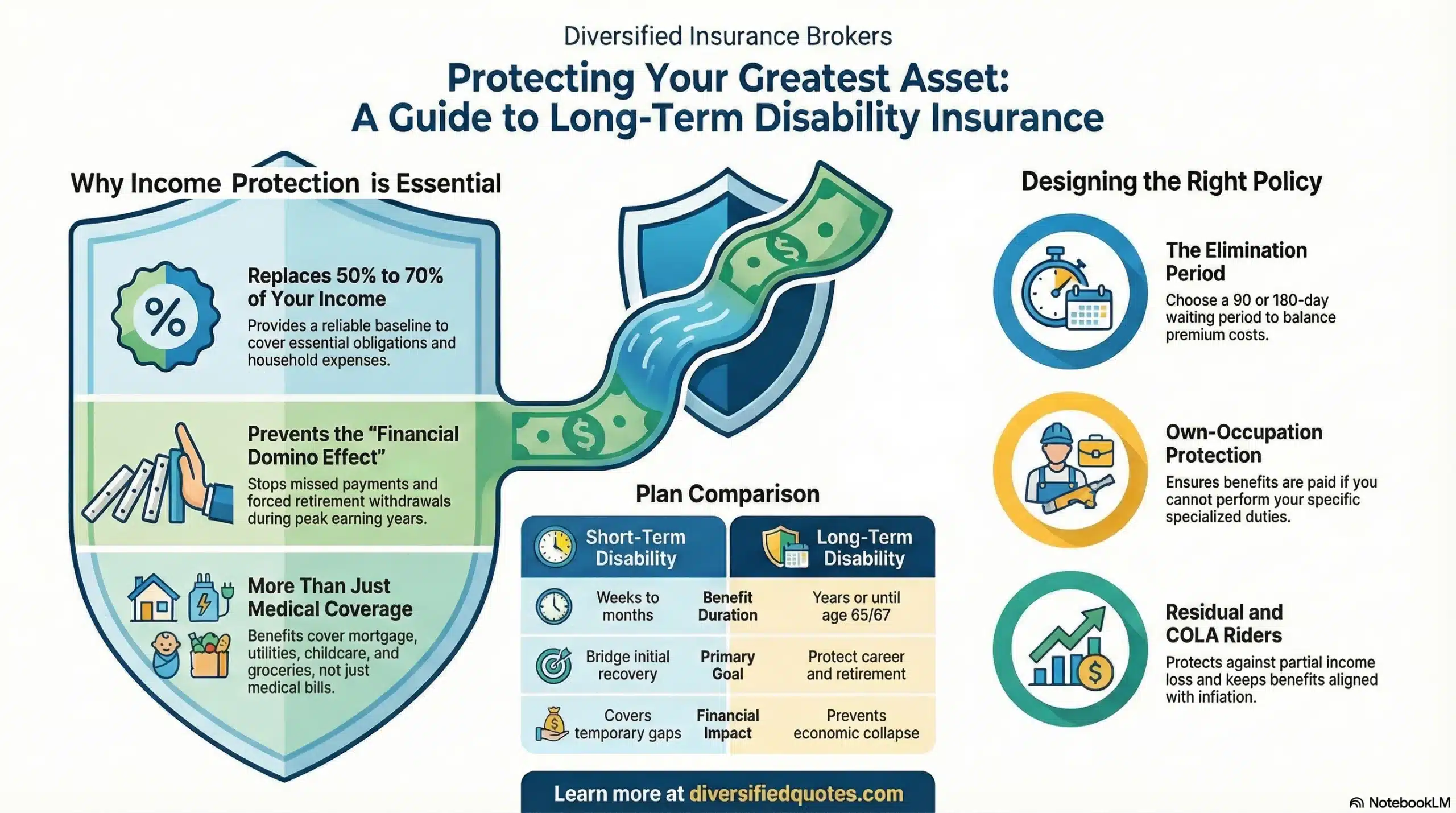
The elimination period — the waiting period between disability onset and first benefit payment — is a cost control lever that high earners can use strategically. A 90-day elimination period is the most common choice, requiring approximately three months of accessible savings to bridge the gap. High earners with strong liquidity can extend to 180 days or longer to reduce premium while maintaining adequate reserves. Our resource on disability insurance elimination periods covers the decision framework for selecting the right waiting period based on actual liquidity and income sensitivity.
Group and Firm-Based Programs: When They Help
High earners who work within large firms, health systems, or professional groups may have access to association or employer group disability programs that provide benefits beyond what standard individual underwriting would produce — particularly for individuals with complex health histories where full individual underwriting might result in exclusions, ratings, or limits on available benefit amounts.
Guaranteed issue disability programs — available when a minimum number of employees participate and the program meets the carrier’s group underwriting requirements — allow eligible participants to receive a defined benefit amount without individual medical underwriting. No medical exam, no health history review, and no risk of exclusion riders or table ratings. Guaranteed issue disability insurance through group programs can be particularly valuable for high earners who have developed health conditions after establishing their careers that would otherwise complicate or limit individual disability coverage. Our resource on guaranteed issue group disability insurance explains how these programs work and what participation requirements typically apply. For professionals who prefer to avoid the paramedical exam process for individual coverage, no-exam disability insurance options are also available through simplified underwriting programs for qualifying occupational classes and income levels.
Business Owners: The Two-Policy Solution
High-earning business owners face a two-layer disability risk that employed professionals do not: loss of personal income and the continuation of fixed business expenses that persist regardless of whether the owner is working. A practice owner who is disabled for six months faces both the loss of their personal income stream and the obligation to continue paying staff wages, rent, equipment leases, malpractice premiums, and other fixed operating costs from whatever reserves exist.
The standard solution is to coordinate personal disability insurance with business overhead expense (BOE) disability insurance. Personal disability insurance replaces the owner’s household income. BOE reimburses eligible fixed business expenses for a defined period — typically 12 to 24 months — keeping the practice infrastructure intact through the disability so the owner returns to a functioning operation rather than a collapsed one. For partners in multi-owner businesses, a separate buy-sell disability policy addresses the ownership transition trigger — providing a lump-sum benefit that funds the buyout of a disabled partner’s ownership interest, preventing the operational and financial conflict that arises when a disabled owner retains ownership rights without contributing to the business.
The key person dimension also applies for high-earning executives whose disability would cause measurable financial harm to the business beyond their own income loss. Key person disability insurance compensates the business for revenue loss, replacement costs, and productivity disruption associated with a key executive’s disability — serving a distinctly different function from the executive’s personal disability coverage, though both are needed in a complete business protection plan.
The Cost of Waiting — and Why Timing Matters
Disability insurance is typically easiest to secure, most comprehensively structured, and most affordable earlier in a career — before health accumulation, before occupational health exposure compounds, and before the income growth that increases the financial stakes of being underinsured. The most important planning mistake high earners make is not having no disability coverage — it is having inadequate coverage that was established at a point when income was lower and never updated as income grew.
Locking in coverage at a younger age produces two compounding advantages. First, the premium rate established at issue is locked in for the life of the policy under non-cancelable provisions — meaning a policy purchased at age 32 retains its 32-year-old pricing at age 45, regardless of what has happened to the insured’s health in the interim. Second, the future increase options established at initial application protect the right to increase coverage as income grows without new medical underwriting — which means a health change at age 40 does not prevent coverage from growing to match the income that exists at age 40, because the increase right was secured at age 32 before the health change occurred. Our resource on best disability insurance rates and how to get the best disability insurance rates provide context for the variables that affect pricing across the market.
Find and Fill Your Disability Coverage Gap
We coordinate group LTD, individual DI, and high-limit layers into one complete plan built around your actual income and occupation.
Compare High-Limit Disability OptionsQuestions? Call 800-533-5969
How Diversified Insurance Brokers Designs High-Income Disability Strategies
Our process begins with clarity about the income being protected. That means reviewing any existing group LTD coverage — benefit caps, offset provisions, taxation, and definition of disability — to understand the actual net benefit available from existing coverage before identifying what needs to be added. Many high earners discover during this review that their group coverage is worth meaningfully less in real terms than the headline benefit amount suggests, once taxation and offsets are accounted for.
Next, we analyze how income is earned. Base salary, bonuses, commissions, K-1 distributions, equity, production pay, and other income components are treated differently by different carriers in their insurable income calculations. We identify which carriers’ underwriting guidelines most favorably accommodate the specific income structure — because the carrier whose guidelines produce the highest insurable income for a physician with base plus production pay may not be the same carrier that is most favorable for a partner receiving primarily K-1 distributions.
We then model after-tax income replacement needs — not just gross monthly benefit targets — because disability insurance is ultimately about what reaches the household to cover real obligations. Two strategies with identical gross monthly benefits can produce materially different net income depending on how premiums are paid and how benefits are taxed, and optimizing for after-tax income rather than gross benefit is consistently the better planning outcome.
Finally, we align policy definitions with how the client actually works. For high earners, the occupational definition, the residual rider trigger and calculation, the future increase option structure, the COLA provision, and the benefit period selection are all as important as the monthly benefit amount. A policy that looks large on paper but fails to pay in the most probable disability scenarios is not income protection — it is a false sense of security. We help you avoid that outcome by reading and comparing the actual policy language, not just the marketing summaries.
Build a Disability Strategy That Scales With Your Income
Designed for physicians, executives, partners, and business owners nationwide.
Request High-Income Disability OptionsQuestions? Call 800-533-5969
Related Disability Insurance Pages
Explore supplemental strategies, underwriting paths, and business-focused disability solutions.
Financial Protection Essentials
Employer health planning, high-risk life insurance guidance, retirement transitions, and long-term care comparison tools.
Talk With an Advisor Today
Choose how you’d like to connect—call or message us, then book a time that works for you.
Schedule here:
calendly.com/jason-dibcompanies/diversified-quotes
Licensed in all 50 states • Fiduciary, family-owned since 1980
FAQs: High Income Disability Insurance
How much monthly disability benefit can high earners get?
With a properly layered strategy combining group LTD, individual disability insurance, and high-limit supplemental coverage, many high earners can structure total monthly benefits in the $30,000 to $75,000+ range depending on income level, occupational class, and carrier underwriting limits. The specific maximum available depends on documented earned income — carriers apply benefit-to-income ratios typically in the 60% to 70% range — and on the aggregate maximums applied across all policies in force simultaneously. A physician earning $600,000 annually targeting 60% income replacement needs $30,000 per month in total coverage, which is achievable through the layered approach but cannot be accomplished through a single group or individual policy alone.
The key variables that determine the upper limit are income documentation quality, occupational class, the specific carriers selected for each layer, and how the aggregate limits across those carriers interact. Working with an independent broker who knows each carrier’s limit structure — and which carriers are most favorable for specific income levels and occupational profiles — is essential for designing the highest achievable benefit structure. Our resource on how much disability insurance you need provides the underlying framework for setting the right benefit target before carrier selection begins.
What does “own-occupation” mean for high-earning specialists?
True own-occupation disability insurance pays benefits when a covered condition prevents the insured from performing the material and substantial duties of their specific occupation — even if they can still work in another role and earn income elsewhere. For a specialist, “their occupation” means the specific clinical, procedural, professional, or leadership duties that generate their income — not employment generally or medicine broadly. A surgeon who can no longer operate but continues working as a medical educator receives full disability benefits under a pure own-occupation policy, because surgical practice is what the policy insures.
The distinction between true own-occupation and weaker definitions — modified own-occupation (which reduces benefits if the insured becomes employed elsewhere) or any-occupation (which only pays when the insured cannot perform virtually any work) — produces completely different outcomes in exactly the scenarios most likely to affect specialists. A specialist who carefully builds a high-limit disability strategy on policies with modified or any-occupation definitions has a plan that looks comprehensive on paper but provides far less protection in reality. Our resource on own-occupation disability insurance explains the full definitional spectrum and the claim-time consequences of each tier.
Are high-income disability benefits taxable?
Tax treatment depends on who pays the premium and how. For individual disability insurance policies where the insured pays premiums personally with after-tax dollars, the monthly benefits received during a claim are generally income-tax-free. This is a significant financial advantage for high earners — a $20,000 monthly tax-free benefit is worth considerably more in real terms than a $20,000 monthly taxable benefit at high marginal rates. For group LTD where the employer pays premiums without imputing the cost to the employee as income, benefits received during a claim are fully taxable as ordinary income. For high earners, this means the real after-tax value of an employer-paid group LTD benefit can be substantially lower than the stated monthly benefit.
The practical implication for layered disability strategy design is that the individual and supplemental layers — paid with personal after-tax dollars — produce tax-free benefits that are more valuable per dollar of monthly benefit than the employer-paid group layer. This after-tax calculation should drive benefit targeting and layering decisions, not just the gross monthly benefit comparison. Our resource on whether disability insurance payments are taxable covers the full tax framework for each coverage type.
Do I need additional coverage if I already have group LTD?
Almost certainly yes, if you are a high earner. Group LTD plans typically cap monthly benefits at $10,000 to $15,000 — a fraction of the income replacement needed by professionals earning $300,000 or more annually. Even the best group LTD plan that exists covers only base salary, excludes bonuses and variable compensation, and produces taxable benefits when employer-paid. For a physician, attorney, or executive with total compensation well above the benefit cap threshold, the group plan is a foundation — not a complete solution. Individual and supplemental layers are needed to close the coverage gap between what the group plan provides and what the household actually requires to maintain financial stability during a disability.
The fastest way to understand your specific coverage gap is to calculate: (a) what your gross monthly income replacement target is at 60% of current earnings, (b) what your group LTD actually pays net of taxes, and (c) the difference between those two numbers. That difference is your disability coverage gap — the amount that individual and supplemental policies need to fill. Most high earners who perform this calculation for the first time discover the gap is significantly larger than they assumed.
Can I get coverage without a medical exam?
Often yes — several underwriting pathways exist for high earners who want to avoid or minimize the paramedical exam process. Accelerated underwriting programs at many carriers use algorithmic review of prescription history, MIB records, and driving records to make approval decisions without an in-person exam for qualifying ages and benefit amounts. Simplified issue programs provide streamlined underwriting for specific occupational classes. Group or firm-based guaranteed issue programs allow eligible participants to receive defined benefit amounts with no medical questions at all, when sufficient group participation requirements are met. Our resources on no-exam disability insurance and guaranteed issue disability insurance cover both pathways in detail, including eligibility requirements and benefit limits for each approach.
What if I’m part of a group practice or professional firm?
Groups and professional firms can often unlock underwriting advantages that are not available for individually placed coverage. Multi-life programs — where a disability carrier agrees to provide coverage to multiple members of a practice, firm, or organization — can produce unisex pricing, reduced premiums, higher per-participant limits, or streamlined underwriting depending on the size and composition of the group. When a minimum participation threshold is met, guaranteed issue group disability programs allow eligible participants to receive defined benefit amounts without medical underwriting — making group-based programs particularly valuable when one or more partners have developed health conditions that would complicate or limit individual underwriting.
Evaluating whether the firm or practice qualifies for a group or multi-life program, what the participation requirements are, and how the group benefits coordinate with individual and supplemental coverage is a standard part of our high-income disability planning process. The combination of a group program for the base layer and individual and supplemental coverage for the gap layers frequently produces the most comprehensive total coverage structure available for a professional group.
How do BOE and personal DI work together for business owners?
Personal disability insurance and business overhead expense (BOE) disability insurance address different financial obligations and are not substitutes for each other — they are complementary policies designed to work simultaneously. Personal DI replaces the owner’s household income during a disability — the funds that pay the mortgage, living expenses, children’s tuition, and personal obligations. BOE reimburses eligible fixed business expenses — rent, staff wages, equipment leases, utilities, malpractice premiums, recurring service contracts — that continue accruing regardless of whether the owner is working. Without both, a disabled business owner either depletes personal savings to keep the business open or allows the business to deteriorate while focusing personal reserves on household obligations.
BOE benefit periods are typically 12 to 24 months — designed to keep the business infrastructure intact through a recovery and return-to-work period, not to fund the business indefinitely. The combination of personal DI (for household income) and BOE (for business overhead) is the complete two-policy solution for owner-operated practices and businesses. Our resource on disability business overhead expense covers the specific eligible expense categories, benefit period options, and how BOE integrates with personal disability coverage.
Can I increase benefits as my income grows?
Yes — the future increase option (FIO), also called the guaranteed insurability rider or future purchase option, allows the monthly benefit to be increased at defined future dates without new medical underwriting. The only requirement for future increases is financial verification that income has grown sufficiently to support the higher benefit amount. Health history at the time of the increase is not re-evaluated. This means a professional who establishes a strong disability base policy while healthy retains the contractual right to increase coverage as income grows — regardless of any health changes that occur between initial policy issue and the future increase date.
For high earners in income-growth phases, the FIO is often the most strategically valuable provision in the initial policy design. A physician who establishes a $10,000 monthly benefit with a $15,000 future increase option during residency has effectively secured the right to reach $25,000 in coverage at attending-level income and health — without new underwriting scrutiny at attending rates or health. Our resource on the disability insurance future insurability rider explains the mechanics and strategic importance of this provision in full detail.
How long should my benefit period be?
High earners — particularly those with long professional training paths, high lifetime earnings potential, and income that reflects decades of specialized skill development — should strongly consider benefit periods extending to age 65 or 67, aligned with a realistic retirement age. A physician who becomes permanently disabled at age 40 faces 25 years of income replacement need — a 5-year benefit period addresses 20% of that exposure, leaving 80% of the financial risk unprotected. The premium differential between a 5-year and a to-65 benefit period is real but should be weighed honestly against the financial catastrophe of a long-duration disability that exhausts a short benefit period before the insured can retire on accumulated savings.
Some carriers offer benefit periods extending to age 70 for certain favorable occupational classes, which may be worth evaluating for younger professionals whose retirement planning extends beyond 65. Shorter benefit periods — 2 or 5 years — may be appropriate as a supplemental layer coordinated with a to-65 base policy, or in specific planning contexts where shorter-term income replacement is a defined goal, but they should not replace the comprehensive benefit period coverage that protects lifetime earning potential for high-earner professionals.
How does the 1099 or self-employed income structure affect disability underwriting?
Self-employed and 1099 income creates specific underwriting documentation challenges that W-2 employed professionals do not face. Carriers calculate insurable income from documented taxable income — typically two years of personal and business tax returns — rather than from actual revenue or economic cash flow. Self-employed professionals who use aggressive tax strategies to minimize reportable taxable income may find their maximum insurable benefit limited by the reported taxable figure rather than by their actual earning capacity. A consultant generating $400,000 in revenue who reports $220,000 in net taxable income after deductions may find their available benefit capped based on the $220,000 figure.
This tension between tax minimization and insurable income maximization is one of the most consequential and least discussed disability insurance planning considerations for self-employed high earners. The timing of disability insurance applications relative to the income documentation available — applying in a year when reported income is at or near the sustained average rather than after a low-income year — and working with carriers whose underwriting guidelines are most favorable for self-employed income structures both affect the maximum benefit achievable. Our resources on disability insurance for the self-employed and disability insurance for 1099 workers cover the documentation requirements and underwriting approaches for self-employed income structures in detail.
About the Author:
Jason Stolz, CLTC, CRPC, DIA, CAA and Chief Underwriter at Diversified Insurance Brokers (NPN 20471358), is a senior insurance and retirement professional with more than 25 years of real-world experience helping individuals, families, and business owners protect their income, assets, and long-term financial stability. As a long-time partner of the nationally licensed independent agency Diversified Insurance Brokers, Jason provides trusted guidance across multiple specialties—including fixed and indexed annuities, long-term care planning, personal and business disability insurance, life insurance solutions, Group Health, Travel Medical and Evacuation Insurance, and short-term health coverage. Diversified Insurance Brokers maintains active contracts with over 100 highly rated insurance carriers, ensuring clients have access to a broad and competitive marketplace.
His practical, education-first approach has earned recognition in publications such as VoyageATL, and contributions from his agency featured in Kiplinger and GoBankingRates— highlighting his commitment to financial clarity and client-focused planning. Drawing on deep product knowledge and years of hands-on field experience, Jason helps clients evaluate carriers, compare strategies, and build retirement and protection plans that are both secure and cost-efficient. Visitors who want to explore current annuity rates and compare options across multiple insurers can also use this annuity quote and comparison tool.
Last Reviewed: July 16, 2026 |
Reviewed by: Jason Stolz, CLTC, CRPC, DIA, CAA
Chief Underwriter, Diversified Insurance Brokers, Inc. | NPN: 20471358 | Diversified Insurance Brokers, Inc. — Licensed in all 50 states
Fact Checked by: Tonia Pettitt, CMIP©
Medicare Specialist, Diversified Insurance Brokers, Inc. | NPN: 14374308 | Diversified Insurance Brokers, Inc. — Licensed in all 50 states
Did you find this content helpful? Leave us a Google review — it helps others find trustworthy guidance too.
Editorial Standards: Diversified Insurance Brokers maintains rigorous editorial standards to ensure accuracy, clarity, and independence in all content. Learn more about our editorial standards and commitment to transparency.
