
Best Long Term Care Insurance Rates
As an Independent Long Term Care Insurance Broker, we compare traditional, hybrid, and partnership-qualified policies across dozens of carriers to find the structure that actually fits your situation.
Best Long Term Care Insurance Rates

Jason Stolz CLTC, CRPC
The search for the best long term care insurance rates almost always starts in the wrong place — with premium comparison. The instinct is natural: you want to know what this is going to cost, and comparing numbers across carriers feels like due diligence. But long term care insurance rates cannot be meaningfully compared without comparing the designs behind them, because a $180/month premium and a $290/month premium can be quoting entirely different levels of protection with different inflation assumptions, different benefit pool sizes, different elimination period requirements, and different underwriting standards for what triggers the benefit. The cheapest rate on the page may be cheap because it is buying something you would not actually want when care is needed — too small a benefit, too restrictive a trigger, too little inflation protection to matter 20 years from now.
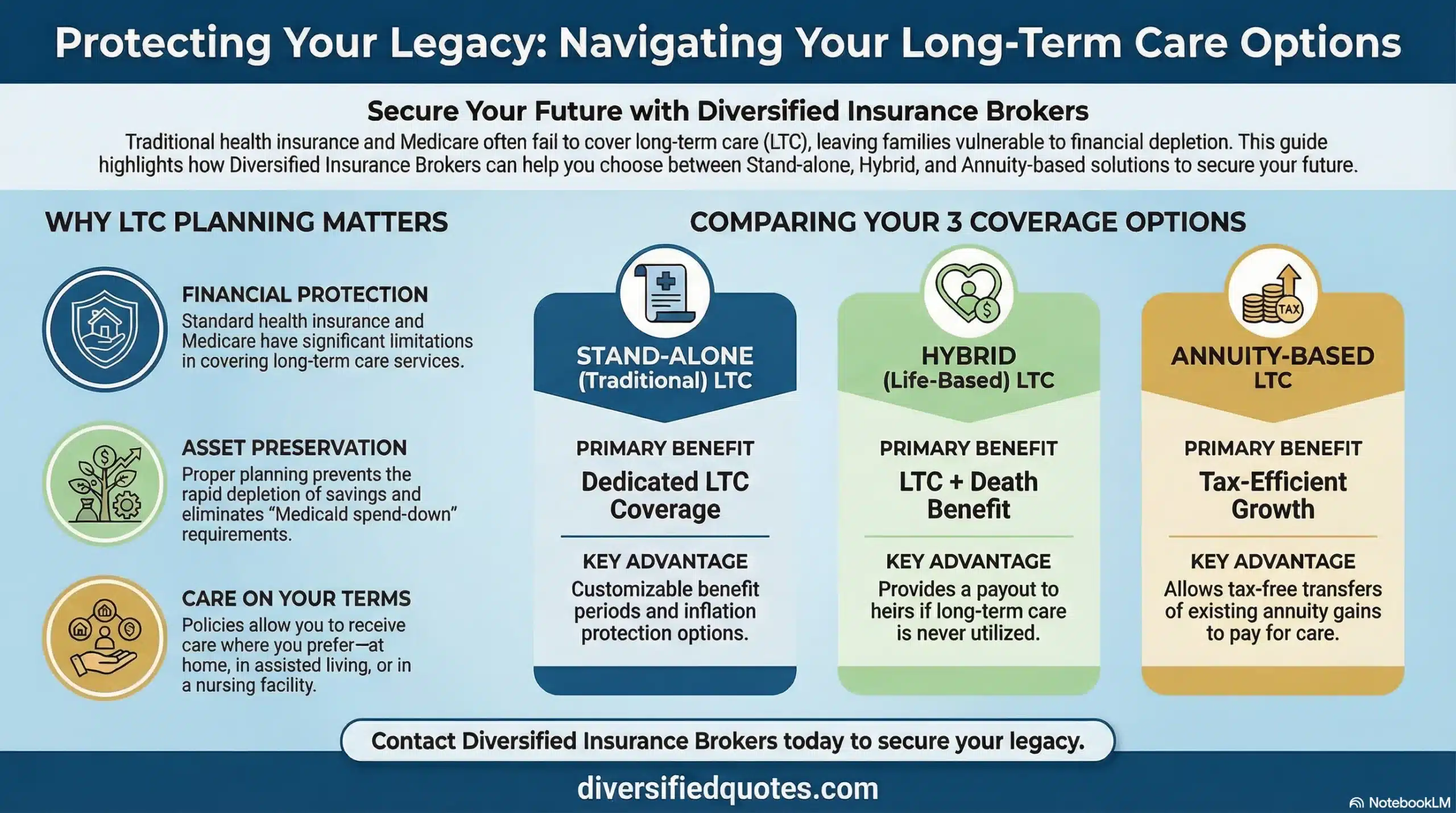
At Diversified Insurance Brokers, we define “best long term care insurance rate” the way a physician defines a “good medication dose” — as the amount that produces the intended outcome at the lowest effective cost, not the smallest dose on the shelf. The best rate is the premium that buys durable, well-designed protection aligned with your actual goals, at a cost you can sustain for the years or decades the policy needs to remain in force. This page explains what actually drives long term care insurance pricing, what rate benchmarks look like by age and profile, how to compare designs rather than just premiums, and what distinguishes carriers who have maintained rate stability from those whose policies have become expensive problems for their policyholders over time. We work with clients nationwide across traditional LTC, hybrid life/LTC, and annuity-based LTC designs, and our long term care insurance services page provides the full menu of options we evaluate in the comparison process.
Compare the Best LTC Rates for Your Age and State
We’ll show which carriers price your profile best and which benefit design delivers the strongest value — not just the lowest number on a spreadsheet.
Request LTC QuotesQuestions? Call 800-533-5969
What “Best Rate” Actually Means in Long Term Care Insurance
The phrase “best rate” means three different things to three different people shopping for long term care insurance — and understanding which definition applies to your situation is the first step toward a genuinely good outcome.
For some people, “best rate” means lowest monthly premium. This is the most common initial frame, and it is the one most likely to produce a poor outcome if applied without the context of what the lower premium is actually buying. A lower premium can reflect genuinely competitive pricing from a carrier whose underwriting model is efficient. It can also reflect a smaller benefit amount, a stripped-down design without inflation protection, a longer elimination period that shifts initial cost responsibility to the policyholder, or an older policy form from a carrier that has exited the active LTC market and is no longer writing new competitive business. Identical premiums can produce radically different outcomes depending on the design behind them.
For other people, “best rate” means best value — the highest quality protection per premium dollar. This is a more sophisticated and more useful frame. A policy that costs $30 more per month than the cheapest option but includes 3% compound inflation protection, a shorter elimination period, and a stronger benefit trigger definition may be the significantly better value over a 20-year horizon. A policy without inflation protection that looks attractive today is guaranteed to cover a smaller share of actual care costs each year as time passes — which means it needs to look attractive not just today, but at the point it is actually used.
For the most strategically minded buyers, “best rate” means best risk-adjusted outcome — the premium structure that produces the most reliable protection through the entire duration of the policy, including the possibility of future rate actions by the carrier. This frame requires evaluating not just current pricing but carrier historical rate action behavior, financial strength, and the structural predictability of the policy type. Traditional LTC policies on some policy forms have been subject to significant rate increases over the past two decades; other carriers and policy forms have been more stable. Hybrid and asset-based designs often offer greater rate predictability because the premium is fixed or limited-pay rather than ongoing. This dimension of “best rate” is invisible in a simple premium comparison but can be the most financially consequential variable over a 25-year policy duration.
Why Long Term Care Insurance Rates Vary So Much
Long term care insurance rates vary more than in almost any other insurance category because the actuarial variables that drive claims are complex, long-horizon, and genuinely uncertain even with modern modeling tools. A term life insurance policy covers a defined event (death) over a defined period (the term) with well-established mortality tables. A long term care insurance policy covers a multidimensional set of possible events (different types and durations of care, in different settings, triggered by different conditions) across an open-ended future period — with claims experience that depends on healthcare technology advances, caregiver availability, inflation in care costs, policyholder behavior, and regulatory environments that may change over the entire policy’s duration.
This uncertainty is why carriers price LTC insurance cautiously, why the pricing philosophy differs significantly across carriers, and why the same applicant can receive quotes that vary by 30% to 50% from different carriers for what appears to be similar coverage. Some of that variation reflects genuine competitive efficiency differences. Some reflects different judgments about future claims costs and investment returns. Some reflects different underwriting philosophies about which health profiles represent acceptable risk. And some reflects different assessments of what benefit design features are actuarially sustainable long-term versus which features sound appealing but are difficult to price predictably.
Understanding this variation at a structural level helps contextualize why “the cheapest option” deserves scrutiny. A carrier pricing significantly below the market average is either being more efficient (possible), taking on more risk than their premium supports (common in the history of LTC pricing), or writing different underlying benefits than the more expensive proposals (common and worth examining closely). An independent broker who tracks carrier pricing histories and who understands which carriers have maintained rate stability versus which have needed large rate increases can identify which end of the range a given quote sits on.
Rate Benchmarks by Age: What to Expect When Comparing
While specific rates depend on health profile, state, benefit design, carrier, and the specific policy form, general benchmark ranges help calibrate whether a quote you’ve received is in a reasonable range for your situation or warrants closer examination. All figures below represent rough benchmarks for a healthy individual with a moderate benefit design — a $150 to $200 daily benefit, a 3-year benefit period or equivalent pool, a 90-day elimination period, and 3% compound inflation protection. Actual rates will vary based on specific health history, state of residence, carrier selection, and current market conditions.
For a healthy 50-year-old female, traditional standalone LTC insurance with this benefit design typically ranges from approximately $1,500 to $2,500 annually. A male of the same age typically pays somewhat less due to the historical gender pricing differential — approximately $1,200 to $2,000 annually — though some carriers have moved to gender-neutral pricing. For a couple applying together, spousal discounts typically reduce per-person premiums by 5% to 30% depending on the carrier.
At age 55, annual premiums for the same benefit design increase meaningfully — typically $2,000 to $3,500 for a healthy woman and $1,600 to $2,800 for a healthy man on traditional standalone LTC. At age 60, the range shifts to approximately $2,800 to $5,000 for women and $2,200 to $4,000 for men. At age 65, rates increase further — approximately $4,000 to $7,000 for women and $3,000 to $5,500 for men for a comparable design. By age 70, rates for traditional LTC have escalated substantially — $6,000 to $12,000 or more annually depending on health and state — and some carriers become less competitive or unavailable entirely at older ages.
These benchmarks illustrate two important patterns. First, the premium advantage of buying earlier is significant and compounds with each year of delay — the annual premium differential between applying at 55 versus 65 can easily represent $2,000 to $4,000 per year in cost savings for equivalent protection. Second, the absolute dollar amounts, while not trivial, need to be evaluated relative to what they are protecting. A $3,000 annual premium protecting against potential care costs of $80,000 to $120,000 per year represents a cost-to-protection ratio that most financial risk analyses would find compelling for a risk with 70% incidence probability across the population over 65.
Hybrid life/LTC policies have a fundamentally different pricing structure — they are typically quoted as a single premium or limited-pay premium rather than annual ongoing premiums. A single premium hybrid for a 60-year-old healthy female might range from $75,000 to $150,000 to create a meaningful LTC benefit pool of $200,000 to $450,000 depending on the carrier and design. This is not comparable to a traditional LTC annual premium on a dollar basis — it is a fundamentally different financial transaction where existing assets are repositioned rather than an ongoing insurance expense is incurred. Our resource on affordable hybrid long term care policies explains how hybrid pricing is structured and what different funding amounts produce in benefit terms.
The Seven Variables That Most Directly Drive LTC Premium Levels
Understanding the specific variables that control LTC premium allows a buyer to make intentional design tradeoffs — accepting a higher cost for the features that matter most and reducing cost in areas where the tradeoff is genuinely acceptable for the household’s situation.
Age at application. Age is the single largest pricing driver in traditional LTC insurance because it directly determines the actuarial risk — older applicants have higher probability of a near-term claim, shorter premium collection periods, and less time for the policy reserve to build before benefits might be needed. The pricing advantage of earlier application is not linear — the premium increase accelerates with age, particularly beyond age 60. For a buyer who is genuinely motivated to purchase LTC insurance and is comparing applying now versus in two to three years, the premium savings from applying now typically outweigh any argument for delay.
Health classification. LTC carriers underwrite to multiple health classes — preferred, standard, and sometimes substandard — with preferred classification typically available to applicants with clean health histories and no significant chronic conditions. The premium difference between preferred and standard classification can be 20% to 40% or more depending on the carrier. Applicants with health complexity may receive standard rates, modified policies with exclusions or limitations, or declines depending on the carrier and the specific condition. Because health classification differs across carriers — a profile that receives standard rates at one carrier might qualify for preferred at another — carrier selection based on underwriting philosophy for the specific health profile is one of the most reliable ways to improve both availability and cost. Our resource on how to qualify for long term care insurance explains what underwriters evaluate and how health classification decisions are made.
Benefit amount (daily or monthly maximum). The daily or monthly benefit maximum is the most visible premium control lever. A plan with a $300/day maximum costs more than a plan with a $150/day maximum because the carrier assumes more liability in any claim scenario. The right benefit amount is not the highest available — it is the amount that meaningfully closes the gap between care costs and what the household can manage from other resources. Many clients achieve better rate-to-protection ratios by sizing the benefit to their actual care funding gap rather than defaulting to a “maximum benefit” design that overbuys insurance coverage relative to the household’s self-funding capacity. Our resource on how much long term care insurance you need provides the framework for this calculation.
Benefit period or pool size. The benefit period determines how long the policy can pay benefits once a qualifying claim begins. Common options include 2-year, 3-year, 5-year, and unlimited benefit periods, with pool-based designs that express the benefit as a total dollar amount (e.g., $300,000 total benefit pool) rather than a time-limited benefit. Longer benefit periods cost more because the carrier assumes greater total liability. The right benefit period depends on the household’s self-funding capacity for extended claims and what risks they are specifically trying to protect against — most families focus on the extended-duration claims (dementia, stroke recovery, Parkinson’s progression) that represent the largest financial risks rather than shorter acute care events. Our resource on what is a LTC benefit period explains the structural options, and our resource comparing limited term vs. lifetime benefits addresses the most significant benefit period decision most buyers face.
Inflation protection design. Inflation protection is one of the most consequential design decisions in traditional LTC insurance and one of the most impactful on premium. The standard options are 3% compound annual inflation, 5% compound annual inflation, simple inflation at various rates, and no inflation protection. At 3% compound inflation, a $150/day benefit purchased at age 55 grows to approximately $270/day by age 75 — meaningfully preserving purchasing power over the most likely claim window. At 5% compound inflation, the same benefit grows to approximately $397/day by age 75 — better protection but at substantially higher premium cost. No inflation protection leaves the benefit at $150/day regardless of when the claim occurs, which becomes increasingly inadequate as years pass between purchase and claim. The premium difference between no inflation protection and 3% compound can be 40% to 80% depending on the buyer’s age — a significant cost, but one that may be the difference between a policy that adequately covers care when needed and one that covers a fraction of actual costs.
Elimination period. The elimination period — the time between benefit trigger and first benefit payment — is a direct premium control lever. A 30-day elimination period costs more than a 90-day elimination period because the carrier begins paying benefits sooner. A 90-day elimination period costs more than a 180-day elimination period for the same reason. The practical planning question is whether the household has liquid reserves sufficient to fund the elimination period without financial stress. A 90-day elimination at current care costs might require $15,000 to $25,000 in liquid reserves for home care scenarios and $25,000 to $40,000 for facility care scenarios. If those reserves exist comfortably, the longer elimination period is a genuine premium-reduction opportunity. If they don’t, a shorter elimination period is appropriate even at higher premium. Our resource on LTC elimination periods explained provides the full mechanics.
State of residence. LTC insurance premiums are state-regulated, and the rate environment varies significantly by state. States with higher LTC oversight and more active rate review processes tend to have more competitive pricing environments. States with lower oversight may have more rate variability and less predictable premium trajectories over time. Additionally, some states participate in the LTC Partnership program — which adds asset protection features to qualifying policies — in ways that affect the design and pricing of partnership-qualified policies in those states. Our resource on partnership-qualified long term care insurance explains how the partnership program works and which states participate.
Rate Stability Over Time: The Dimension That Doesn’t Appear in a Quote
One of the most important and least visible dimensions of LTC insurance rate comparison is the historical rate action behavior of the carrier being considered. Traditional long term care insurance has a well-documented history of rate increases at some carriers — in some cases, substantial increases that significantly changed the economics of policies that policyholders had relied on for years. Understanding why these rate increases occurred and how to evaluate the current rate stability risk of any carrier being considered is essential for a complete rate comparison.
The wave of LTC rate increases that occurred from the 2000s through the 2010s was primarily driven by actuarial miscalculations in the early LTC market: persistency rates were higher than assumed (policyholders kept their policies longer than expected), investment returns were lower than assumed (the interest rate environment declined substantially), and claims experience was more adverse than modeled (people were living longer with disabilities requiring sustained care). Carriers that priced their early LTC blocks based on more optimistic assumptions needed to file for rate increases to keep the blocks solvent.
The LTC market has responded to this history in several ways. Carriers actively writing new traditional LTC business today have generally revised their pricing assumptions to be more conservative. Some have stopped writing traditional LTC entirely and shifted focus to hybrid designs where the pricing is more predictable. The carriers that remain active in traditional LTC have varying track records on rate actions — some have maintained relatively stable pricing on newer policy forms, others have had additional rate actions even on more recently issued business. An independent broker who tracks carrier rate action history provides information that a consumer researching online cannot easily access.
Hybrid and single-premium LTC designs largely address the rate stability concern by fixing the premium at policy issue — a single premium or a limited-pay structure means there are no ongoing premium billing cycles and therefore no mechanism for future premium increases on the policyholder’s specific policy. This rate certainty is one of the primary reasons many buyers who are concerned about premium stability choose hybrid designs even when the initial cost is higher than comparable traditional LTC coverage. Our resource on single pay long term care insurance explains how single-premium structures work and what they guarantee.
The True Cost of Not Buying: Rate Comparison Includes the Self-Funding Alternative
No comparison of LTC insurance rates is complete without evaluating the cost of the alternative — the cost of self-funding care when it is needed without insurance coverage in place. Many people frame the LTC rate question as “is this premium worth paying?” without framing the comparison the correct way: “is this premium worth paying compared to paying the full cost of care from my own assets when the time comes?”
The national median cost of a private room in a skilled nursing facility now exceeds $9,000 per month — approximately $108,000 per year. Assisted living costs average over $5,500 per month — approximately $66,000 per year. Home health aide care at 44 hours per week (the national median hours for people receiving home care) costs approximately $30,000 to $45,000 annually depending on geography. These are not projections — they are current costs that will continue to increase. For the approximately 70% of people over 65 who will need some form of long-term care in their lifetime, the cost of that care is a near-certainty that actuarially should be planned for.
Against these care cost benchmarks, an annual traditional LTC premium of $2,500 to $4,000 represents approximately 2.3% to 3.7% of one year’s nursing home cost — for a benefit that, depending on the design, could cover 2 to 5 years or more of that care. The actuarial math of LTC insurance is compelling for most buyers when the comparison is made explicitly to the alternative. Our resource on self-insured long term care examines this comparison in detail — what self-funding actually costs when care is measured in years rather than weeks, and what the household financial impact looks like across different care duration scenarios. Our resource on whether LTC insurance is worth it provides the value framework across different household types and planning objectives.
Tax Treatment of LTC Premiums: The Rate Reduction Most Buyers Miss
The effective cost of long term care insurance premiums is often lower than the quoted premium for buyers who are eligible to deduct some or all of their LTC insurance costs for federal income tax purposes. This tax benefit is frequently overlooked in premium comparisons and can meaningfully reduce the net cost of coverage.
Premiums paid for a tax-qualified long term care insurance policy may be deductible as medical expenses under IRC Section 213, subject to age-based annual limits that the IRS adjusts periodically. The deduction is available to the extent that total qualifying medical expenses exceed 7.5% of adjusted gross income. For many retirees whose total medical expenses are significant, LTC premiums can push total medical expenses above the AGI threshold and generate a meaningful deduction.
For self-employed individuals — sole proprietors, partners, S-corporation shareholders owning more than 2% — the deduction is more straightforward: qualified LTC premiums up to the age-based annual limit may be deducted as a business expense without the 7.5% AGI threshold that limits deductibility for employees. For C corporations, LTC premiums for employees including owner-employees are deductible as business expenses without the age-based limits, making employer-sponsored LTC coverage through a C corporation one of the most tax-efficient structures available. Our resource on tax benefits of long term care insurance covers the premium deductibility framework in full, and our resource on tax advantages of long term care insurance addresses both premium deductibility and the tax-free treatment of benefits received.
The net effect of tax treatment on LTC premium cost can be meaningful. A self-employed buyer in the 24% federal income tax bracket paying $4,000 annually in LTC premiums that are fully deductible as a self-employment health insurance deduction saves $960 in federal income tax on that premium — reducing the effective cost of the premium to $3,040. At a 32% bracket, the same premium costs effectively $2,720 after-tax. These savings are not trivial and should be factored into any realistic premium cost comparison.
How Carrier Selection Affects Rate Quality: Independence Matters
Rate comparison in LTC insurance is carrier-neutral only when the comparison is conducted by an advisor who has no financial preference among the carriers being evaluated. A captive agent — an agent who works for one insurance company and can only offer that company’s products — cannot give you a market comparison. They can only tell you what their company charges, which may or may not represent competitive pricing for your specific health profile, age, and state.
An independent broker with active contracts across multiple LTC carriers can run a genuine comparison — submitting the same applicant profile to multiple carriers simultaneously and comparing the rates that come back against the specific benefit designs those rates are buying. This comparison process consistently surfaces meaningful differences that a single-carrier quote cannot reveal. One carrier’s preferred underwriting may accommodate a health history that another carrier declines. One carrier’s inflation protection pricing may be significantly more competitive than another’s at a given age. One carrier’s elimination period mechanics may favor the household’s financial situation better than another’s. These differences are real, they compound over the duration of a long-term policy, and they are only visible through a genuine multi-carrier comparison.
At Diversified Insurance Brokers, our rate comparisons evaluate traditional standalone LTC, hybrid life/LTC, and annuity-based LTC options where appropriate, using consistent benefit assumptions across carriers to produce a genuinely comparable picture. We also track carrier rate action histories and financial strength assessments as part of the carrier selection process — because the best rate today that becomes a significantly worse rate in five years due to an aggressive rate increase is not actually a good rate. Our LTC insurance second opinion service provides an independent review of any existing LTC proposal against the full current marketplace at no cost, which is the most direct way to confirm whether an existing quote represents competitive pricing and appropriate design.
Practical Steps to Get the Best LTC Rate for Your Situation
Moving from general understanding to a specific, actionable LTC rate comparison involves a sequence of decisions that build on each other. Working through them in order produces a better outcome than jumping directly to premium comparison without establishing the design context.
The first step is defining your planning goals. What is the coverage primarily designed to protect? Common goals include protecting the healthy spouse’s retirement income and lifestyle, preventing rapid asset liquidation from a retirement portfolio, preserving a legacy or estate plan, maintaining the ability to receive care at home rather than in a facility, or reducing the likelihood that adult children will need to become informal caregivers. Each goal produces different design priorities — a goal of protecting a spouse’s retirement income emphasizes benefit duration and spousal protection features, while a goal of remaining at home emphasizes home care benefit richness and caregiver flexibility provisions.
The second step is sizing the benefit to the gap. Calculate the realistic monthly care cost in your area for your preferred care setting, then subtract the amount you could comfortably fund from retirement income and liquid savings without disrupting other financial planning. The difference is the gap the insurance benefit should cover. This calculation usually produces a benefit amount lower than “maximum” and higher than “minimum” — which is precisely the sweet spot where premium efficiency is highest. Our resource on how much LTC insurance you need provides the structured framework for this calculation.
The third step is choosing the inflation protection approach that matches your planning horizon. A 55-year-old buying coverage they expect to use in 20 to 25 years needs inflation protection that will meaningfully grow the benefit over that period — 3% compound is generally the minimum appropriate for this profile. A 70-year-old buying coverage they may use in 5 to 10 years has less inflation exposure and may find that simple inflation or a shorter-duration compound option is more cost-effective relative to the actual benefit growth needed.
The fourth step is selecting the elimination period that matches your financial reserves. A 90-day elimination period is the most common choice and is appropriate when liquid reserves of $20,000 to $40,000 exist to fund early care costs. A longer elimination period makes sense if reserves are larger and the premium savings are meaningful. A shorter elimination period makes sense if reserves are limited and the early phase of care cannot be funded without stress. This is a design lever that should be calibrated to actual financial capacity rather than defaulted to the market standard.
The fifth step — where an independent broker adds the most tangible value — is submitting the designed benefit to multiple carriers simultaneously and comparing the rates that come back, accounting for carrier health classification differences, state-specific pricing, and rate stability history. This comparison step is what transforms a premium quote into a genuine market evaluation and what identifies the best rate — not just the lowest number — for the specific household’s situation and goals.
See “Best Rate” Options Side by Side
We’ll compare traditional vs. hybrid designs and show how inflation protection, elimination periods, and benefit amounts change the long-term value picture across carriers.
Request My LTC ComparisonQuestions? Call 800-533-5969
Related Long Term Care Pages
Explore plan design, qualification, self-funding comparisons, and hybrid alternatives.
Related Retirement Planning Pages
Helpful context for coordinating LTC planning with retirement protection strategies.
Financial Protection Essentials
Family-focused riders, college planning options, and carrier reviews to support long-term financial protection.
Talk With an Advisor Today
Choose how you’d like to connect—call or message us, then book a time that works for you.
Schedule here:
calendly.com/jason-dibcompanies/diversified-quotes
Licensed in all 50 states • Fiduciary, family-owned since 1980
FAQs: Best Long-Term Care Insurance Rates
Why do LTC premiums vary so much between carriers?
Long term care insurance rates vary more than in almost any other insurance category because the actuarial variables that drive claims are complex, long-horizon, and uncertain in ways that differ significantly across carriers. Each carrier brings different assumptions about future claims experience, policyholder persistency, investment returns, and care cost inflation. Carriers also have different underwriting philosophies — what one carrier prices as a preferred health risk, another may price as standard. And carriers have made different design tradeoffs between competitive current pricing and long-term actuarial sustainability.
The practical consequence is that the same applicant with the same benefit design can receive quotes from different carriers that vary by 25% to 50% or more. Some of that variation reflects genuine competitive efficiency. Some reflects different assessments of the applicant’s risk profile. And some reflects different design assumptions built into what appear to be “similar” policies — inflation protection, elimination period mechanics, benefit trigger definitions, and pool structure details that affect both cost and usefulness but are not visible in a simple premium comparison. Working with an independent broker who can identify which carriers price specific profiles most competitively produces better outcomes than accepting the first or second quote received from a limited-access agent.
Does buying LTC earlier really result in lower premiums?
Yes — and the premium advantage of earlier application is larger than most people expect. Age is the primary driver of LTC premium because it directly determines the actuarial risk: older applicants have higher probability of a near-term claim and shorter premium collection periods before benefits might begin. The premium increase from one year to the next is not linear — it accelerates with age, particularly beyond 60. A policy that might cost $2,500 annually at age 55 for a healthy woman might cost $4,000 annually at 62 for the same benefit design — a 60% increase for 7 years of delay. By 65, the same design might cost $5,500 to $6,500 depending on carrier and state.
The calculation that makes early application compelling is not just the lower premium — it is the cumulative premium advantage across decades of coverage. If early application saves $2,000 per year in premium for a policy that remains in force for 25 years, the cumulative premium savings is $50,000 — plus the compounding investment return on that $2,000 annual difference. Against that context, delay is not conservative. It is expensive.
What’s better: traditional LTC or hybrid/asset-based LTC?
Neither is universally better — the right choice depends on what the household values most. Traditional LTC often offers the most care protection per premium dollar because the entire premium funds care risk rather than life insurance or annuity components. For buyers whose primary goal is maximum LTC leverage per dollar and who are comfortable with the ongoing premium structure, traditional LTC is often the most efficient choice. The potential for future rate actions on some traditional LTC forms is a real consideration, but the rate action risk varies significantly by carrier and policy form.
Hybrid LTC policies — combining life insurance or annuity components with LTC benefits — offer rate certainty (fixed or limited-pay premiums with no future adjustment risk), value preservation if care is never needed (death benefit or return of premium), and predictable long-term cost. For buyers who are uncomfortable with ongoing premium uncertainty or who want a benefit structure regardless of whether care is ever needed, hybrid designs often make more sense even at a higher initial cost. Our resource on affordable hybrid long term care policies explains the design options across current carriers.
Does inflation protection make LTC premiums much more expensive?
Yes — inflation protection adds meaningfully to premium, typically 40% to 80% more than the same policy without inflation protection depending on the buyer’s age and the type of inflation rider selected (3% compound, 5% compound, or simple inflation). For buyers in their 50s or early 60s who are likely 15 to 25 years away from their most probable claim window, inflation protection can be the most important design decision in the policy. Without inflation protection, a $150/day benefit purchased at 55 remains $150/day at 75 — covering a significantly smaller share of actual care costs than it would today.
The practical approach is not to skip inflation protection to reduce premium but to adjust other levers — lower the starting benefit amount, choose a longer elimination period, or select a slightly shorter benefit period — to keep the overall premium within the target range while retaining the inflation protection that preserves long-term value. A policy with a $150/day benefit and 3% compound inflation typically produces better actual protection at claim time than a policy with a $200/day benefit and no inflation protection — the former grows to approximately $270/day by year 20, while the latter remains at $200/day. The higher starting benefit looks better today; the inflation-protected benefit is better when it matters.
Can I reduce LTC rates by increasing the elimination period?
Yes — increasing the elimination period is one of the most effective premium control levers in traditional LTC design, and unlike reducing the benefit amount or removing inflation protection, it does not necessarily reduce the long-term value of the policy. A longer elimination period shifts some early-care cost responsibility to the policyholder rather than to the carrier — which is an acceptable tradeoff when the household has liquid reserves sufficient to fund the elimination period without financial stress.
The premium difference between a 30-day and a 90-day elimination period can be 10% to 20% depending on the carrier. The difference between a 90-day and a 180-day elimination period may be an additional 10% to 15%. For a buyer paying $4,000 annually, choosing a 90-day rather than 30-day elimination period might save $400 to $800 per year — meaningful cumulative savings over the life of the policy. The critical question is whether $15,000 to $40,000 in liquid reserves exist to fund the elimination period without disrupting the retirement income plan when care begins. Our resource on LTC elimination periods explained covers the mechanics and the financial planning framework for this decision.
Should couples buy joint or shared LTC policies?
For many couples, shared-benefit designs produce better value than two fully independent maximum policies, but the right choice depends on the specific household’s risk profile and goals. Shared benefit designs allow one spouse to access unused benefits from the other’s policy pool — creating a larger effective benefit pool for the couple combined without buying maximum duration policies for each individual. This design is particularly valuable when one spouse is statistically at higher risk of a long-duration claim (cognitive conditions, for example, tend to run in families and have gender-based incidence patterns) while the other may have lower duration exposure.
Couple applications also commonly qualify for spousal discounts — reductions of 5% to 30% per person when both spouses apply together with the same carrier. These discounts alone can make joint applications significantly more economical than sequential individual applications. Our resources on LTC insurance for couples, shared care riders in LTC, and LTC insurance with shared spousal benefits explain the design options and value tradeoffs for couples planning together.
What happens if I never need long-term care?
With traditional standalone long term care insurance, if you never need care, the premiums paid do not return — it is pure insurance coverage, similar to homeowner’s insurance that you hope never to use. Some traditional policies offer return-of-premium riders that partially address this concern at additional cost. Our resource on LTC insurance with return of premium explains how these riders are structured.
With hybrid life/LTC or asset-based LTC designs, there is typically a benefit if care is never needed — either a life insurance death benefit that passes to beneficiaries or a return of premium structure that ensures the assets repositioned into the hybrid policy are not simply lost if no claim occurs. This “either/or” value structure is one of the primary reasons hybrid designs have grown in popularity — they address the psychological barrier of paying for something that may not be used by ensuring there is always a benefit, either care protection during life or a legacy benefit at death. For buyers for whom the “use it or lose it” concern is primary, hybrid designs often represent the most psychologically comfortable and financially sound approach.
Browse LTC Insurance Costs, Rates & Planning
About the Author:
Jason Stolz, CLTC, CRPC, DIA, CAA and Chief Underwriter at Diversified Insurance Brokers (NPN 20471358), is a senior insurance and retirement professional with more than 25 years of real-world experience helping individuals, families, and business owners protect their income, assets, and long-term financial stability. As a long-time partner of the nationally licensed independent agency Diversified Insurance Brokers, Jason provides trusted guidance across multiple specialties—including fixed and indexed annuities, long-term care planning, personal and business disability insurance, life insurance solutions, Group Health, Travel Medical and Evacuation Insurance, and short-term health coverage. Diversified Insurance Brokers maintains active contracts with over 100 highly rated insurance carriers, ensuring clients have access to a broad and competitive marketplace.
His practical, education-first approach has earned recognition in publications such as VoyageATL, and contributions from his agency featured in Kiplinger and GoBankingRates— highlighting his commitment to financial clarity and client-focused planning. Drawing on deep product knowledge and years of hands-on field experience, Jason helps clients evaluate carriers, compare strategies, and build retirement and protection plans that are both secure and cost-efficient. Visitors who want to explore current annuity rates and compare options across multiple insurers can also use this annuity quote and comparison tool.
Explore All Long Term Care Insurance Options: Browse our complete Long Term Care Insurance guide — covering hybrid policies, traditional LTC, costs, tax advantages & partnership plans from top carriers.
Last Reviewed: May 17, 2026 |
Reviewed by: Jason Stolz, CLTC, CRPC, DIA, CAA
Chief Underwriter, Diversified Insurance Brokers, Inc. | NPN: 20471358 | Diversified Insurance Brokers, Inc. — Licensed in all 50 states
Fact Checked by: Tonia Pettitt, CMIP©
Medicare Specialist, Diversified Insurance Brokers, Inc. | NPN: 14374308 | Diversified Insurance Brokers, Inc. — Licensed in all 50 states
Did you find this content helpful? Leave us a Google review — it helps others find trustworthy guidance too.
Editorial Standards: Diversified Insurance Brokers maintains rigorous editorial standards to ensure accuracy, clarity, and independence in all content. Learn more about our editorial standards and commitment to transparency.
