
LTC with Limited-Term Benefits vs. Lifetime Benefits
As an Independent Long Term Care Insurance Broker, we compare traditional, hybrid, and partnership-qualified policies across dozens of carriers to find the structure that actually fits your situation.
LTC with Limited-Term Benefits vs. Lifetime Benefits

Jason Stolz CLTC, CRPC, DIA, CAA
Long-term care insurance with limited-term benefits versus lifetime benefits represents the most consequential design choice in any LTC plan — not because one option is universally superior, but because the choice directly determines what happens in the scenario that causes the most financial damage: care that lasts far longer than anyone planned for. Most LTC policies are built around a defined benefit period — 2, 3, 5, 6, or 10 years — during which the carrier pays qualifying care costs up to the monthly benefit amount. Once that period expires or the benefit pool is fully consumed, the policy stops paying regardless of whether care is still needed. Lifetime benefit designs work differently: once the insured qualifies for benefits and the elimination period is satisfied, coverage can continue for as long as care is needed without a benefit period clock running out.
Both structures are legitimate planning tools. The right choice depends on what problem the LTC plan is designed to solve, how much financial exposure the household can absorb if care extends beyond a defined period, what the premium commitment is relative to available budget, and whether hybrid or alternative structures change the calculus. At Diversified Insurance Brokers, Jason Stolz, CLTC, CRPC, DIA, CAA helps families evaluate limited-term and lifetime benefit structures through the lens of the complete retirement income plan — not the insurance product in isolation. The foundation of any LTC evaluation is understanding the care cost landscape for your state and situation: our resource on cost of long-term care by state provides the care cost benchmark, and our comprehensive resource on long-term care insurance covers the full framework for building an LTC plan around the right benefit design.
Compare Limited-Term vs. Lifetime LTC Benefits Side by Side
We model both structures against your care cost assumptions, budget, and retirement income plan — so the decision reflects your actual situation rather than a generic rule of thumb.
Limited-Term vs. Lifetime LTC Benefits — Comprehensive Planning Comparison
Most LTC planning conversations start with care cost projections and benefit amounts. The benefit duration decision deserves equal attention because it determines whether the plan holds up in the scenario that most threatens household finances — care that continues well beyond an expected recovery window.
| Planning Dimension | Limited-Term Benefits | Lifetime Benefits |
|---|---|---|
| Coverage duration | Defined benefit period — typically 2, 3, 5, 6, or 10 years; policy stops paying when the benefit pool is exhausted or the period ends, even if care continues | Unlimited — coverage continues as long as the insured meets benefit triggers; no benefit period clock limits coverage |
| Premium cost | Lower — defined duration allows carrier to price more precisely; 3-year designs often 30–50% less expensive than lifetime at same benefit level | Higher — unlimited duration transfers more risk to the carrier; premium reflects the possibility of long-duration claims |
| Remaining financial exposure | Meaningful — if care continues beyond the benefit period, out-of-pocket costs resume fully; household must have resources or income to self-fund extended care | Minimal — the carrier assumes the long-duration financial risk; policy continues regardless of how long care is needed |
| Cognitive impairment / dementia protection | Partial — covers the early years of memory care needs; risk that dementia-related care outlasts the benefit period is real, since dementia progression can span many years | Strong — dementia is the most common reason for long-duration care claims; lifetime benefits specifically protect against the multi-year progression that exhausts limited benefit pools |
| Healthy spouse financial protection | Time-limited — policy protects for the defined period; if care extends beyond, the healthy spouse’s income and assets become the funding source for ongoing care costs | Extended — the healthy spouse’s retirement assets are protected from ongoing depletion regardless of how long care continues |
| Family history alignment | Appropriate when family history suggests shorter care durations or when longevity concerns are less central to the planning picture | Preferred when family history includes extended cognitive impairment, progressive chronic conditions, or long-duration nursing home stays |
| Flexibility in benefit design | High — premium savings from limited duration allow for higher monthly benefits, stronger inflation protection, or shorter elimination periods within the same budget | Lower — lifetime duration commitment consumes more premium budget, which may require tradeoffs elsewhere in the benefit design |
| Self-funding supplement required | Yes — if care exceeds the benefit period, additional funding must come from savings, income, family support, or Medicaid transition | No — policy continues to fund qualifying care regardless of duration |
| Hybrid policy compatibility | Many hybrid life/LTC and annuity/LTC designs use defined benefit pools that function similarly to limited-term designs; some offer extension of benefits riders | Some hybrid designs offer unlimited or extended benefit options; typically requires either a larger initial funding amount or higher ongoing cost within the hybrid structure |
| Best suited for | Households that want meaningful protection against the most common and disruptive care scenarios within a manageable premium budget; those with assets or income available to supplement if care extends beyond the benefit period | Households that want maximum protection against the “tail risk” of extended care; those for whom ongoing care costs would permanently impair the healthy spouse’s financial security regardless of how long care continues |
The table’s most important contrast is the “remaining financial exposure” row — because it represents what happens after the LTC policy stops and care continues. For limited-term designs, that gap is funded entirely by the household: savings withdrawals, retirement account distributions, reduced lifestyle for the healthy spouse, or eventually Medicaid transition when assets are exhausted. For lifetime designs, that gap does not exist: the policy continues regardless of duration. Our resource on self-insured long-term care covers the alternative approach of not purchasing LTC insurance at all — which is the realistic comparison for households with very large asset bases — and our resource on is long-term care insurance worth it covers the complete value framework for evaluating whether transferring LTC risk to a carrier produces better outcomes than retaining it.
What This Decision Is Really About — Duration Risk
When families compare limited-term and lifetime LTC benefits, they are comparing their exposure to one specific and quantifiable risk: care that lasts significantly longer than average. Most care events end within a few years — due to recovery, death, or transition to settings where the care need is managed differently. But a meaningful portion of care events, particularly those driven by cognitive impairment and progressive chronic conditions, can continue for many years. That long-duration scenario is what the benefit period comparison is ultimately about.
A short care event — one to three years — is typically expensive but manageable for households with moderate retirement assets and stable income. The policy pays its benefits, the care event ends, and the household’s financial picture is disrupted but not devastated. A long-duration care event changes the calculation fundamentally: if one spouse requires five, seven, or ten years of care, the combination of care costs and ongoing household expenses can deplete assets that were expected to support both spouses throughout retirement. The household’s sequence-of-returns risk is compounded by the forced withdrawals that care funding requires — assets are liquidated at whatever the market is doing, retirement plans are abandoned, and the healthy spouse’s financial security is fundamentally altered.
Duration risk is most severe in two clinical scenarios. First, Alzheimer’s disease and related dementias — where the progression can span 10–20 years from diagnosis to end of life, with increasing care intensity throughout. Second, progressive chronic conditions like Parkinson’s disease, multiple sclerosis, or post-stroke syndrome — where a stable-seeming condition gradually escalates to require full-time professional care over many years. In both scenarios, a limited-term benefit plan designed around a 3- or 5-year benefit period can be significantly exhausted before the care need has run its course. Lifetime benefits specifically protect against these extended-duration outcomes by removing the benefit period clock from the equation entirely. Our resource on what is a skilled nursing facility covers the care settings where long-duration claims most commonly occur and the cost structure that makes extended facility care particularly expensive.
Limited-Term Benefits — What They Provide and When They Work Best
A limited-term long-term care policy defines a maximum benefit period — the amount of time during which the carrier will pay for qualifying care — and often also defines a maximum benefit pool equal to the monthly benefit multiplied by the benefit period. Common benefit periods include 2, 3, 5, 6, or 10 years depending on the carrier and plan design. Once the insured meets the benefit triggers (typically the inability to perform two or more of the six activities of daily living, or a cognitive impairment requiring supervision), the benefit period clock begins. The policy pays qualifying care costs up to the monthly benefit amount until the benefit period expires or the benefit pool is exhausted — whichever comes first.
Limited-term benefits work best when the goal is covering the most financially disruptive years of a care event without requiring the premium commitment that lifetime designs demand. For many households, the first three to five years of care are the most critical from a financial disruption standpoint — when a sudden significant care cost is added to an otherwise stable retirement budget. If the household has meaningful assets or retirement income that could sustain self-funding after the policy benefit period, a limited-term design can protect the critical early window while leaving the extended-duration scenario as a manageable retained risk. Limited-term designs also allow premium savings to be redirected toward stronger inflation protection, a higher monthly benefit, or a shorter elimination period — improving the policy’s quality during the covered period in exchange for accepting the duration limit. Our resource on best long-term care insurance rates covers the current carrier rate landscape, and our resource on how to get the best long-term care insurance rates covers the design optimization strategies that produce competitive pricing within any benefit period choice.
Lifetime Benefits — What They Provide and When They’re Worth the Premium
A lifetime benefit long-term care policy removes the benefit period clock from the protection equation. Once the insured qualifies for benefits and the elimination period is satisfied, the policy can continue paying for qualifying care indefinitely — as long as the insured continues to meet the benefit triggers and the care is delivered through covered care settings. The premium for lifetime benefits is higher than for equivalent limited-term designs because the carrier is assuming an open-ended financial obligation with no predefined termination point.
Lifetime benefits are most compelling in three situations. First, when family history specifically includes extended cognitive impairment or long-duration chronic conditions — where the clinical context suggests that a defined benefit period is likely to be fully consumed before the care need resolves. Second, when the healthy spouse’s financial security depends on the care costs being fully covered regardless of duration — because the household does not have sufficient assets or income to self-fund extended care without materially reducing the healthy spouse’s retirement standard of living. Third, when the primary fear driving LTC planning is not “what if I need care for three years” but “what if I need care for fifteen years” — and the peace of mind value of eliminating that concern entirely justifies the premium difference. Our resource on LTC insurance with lifetime benefits covers the specific policy designs, carrier options, and underwriting requirements for lifetime benefit programs in the current market.
Benefit Triggers — The Same Foundation Either Way
Whether a policy has limited-term or lifetime benefits, the eligibility framework for receiving benefits is essentially the same across standard long-term care policies. Most policies require that the insured either be unable to perform two or more of the six activities of daily living (bathing, dressing, eating, toileting, transferring, or continence) without substantial assistance, or have a qualifying cognitive impairment — such as Alzheimer’s disease or another form of dementia — that requires ongoing supervision to protect the insured’s health and safety.
These benefit triggers are the “when” of the claim — the conditions that must be met before the policy begins paying. The elimination period (the waiting period between the onset of care need and the first benefit payment) is also the same regardless of whether the policy has limited-term or lifetime benefits — it represents the deductible period the insured must self-fund before the carrier begins paying. Understanding these triggers and the elimination period mechanics is essential for evaluating any LTC policy, because the definition of “qualifying care” and the elimination period structure determine the practical claim experience just as much as the benefit amount and duration. Our resource on tax advantages of long-term care insurance covers the tax-qualified policy requirements that also affect which care costs and settings qualify for benefits, which is directly relevant to the benefit trigger framework.
The Five Decision Questions That Clarify the Right Choice
Most families can resolve the limited-term versus lifetime benefit decision by working through five specific questions that force honest evaluation of what the LTC plan is designed to protect and how much retained risk is acceptable.
What is the household trying to protect? If the primary goal is preventing a care event from forcing a financial reset — liquidating retirement accounts, selling the home, abandoning retirement income plans — the focus should be on the financial severity of the care scenarios that are most likely to occur and whether the benefit period is long enough to cover them. If the primary goal is eliminating the possibility of a financially catastrophic outcome entirely, regardless of care duration, lifetime benefits are the direct answer to that goal.
How much tail risk can the balance sheet absorb? Some households have sufficient retirement assets that self-funding extended care beyond a limited benefit period would reduce lifestyle but not eliminate financial security. For these households, limited-term benefits can function as a meaningful first layer with retained exposure on the extended duration. Households where a prolonged care event would require exhausting investment accounts, abandoning planned bequeathals, or fundamentally altering the surviving spouse’s retirement — these households have less tail-risk capacity and often need lifetime benefits to genuinely transfer that risk to the carrier.
What does family history suggest about care duration? While individual outcomes vary, family patterns offer relevant context. A family history that includes multiple relatives with Alzheimer’s, extended nursing home stays, or long-duration progressive conditions is meaningful information for benefit period planning. A family history characterized by shorter acute care needs followed by relatively quick death or recovery suggests a different statistical context for the benefit period decision.
Which care settings matter most? Home care and assisted living serve earlier and mid-stage care needs; skilled nursing facility care typically represents the highest-cost and most intensive care need. If the primary concern is maintaining home care during early-stage needs, a shorter benefit period may be adequate. If the concern extends through the full continuum from home care through potential skilled nursing facility care, a longer or unlimited benefit period becomes more important.
What premium structure is sustainable long-term? The best LTC policy is not the one with the most impressive benefit design on paper — it is the one the policyholder will keep in force for decades. A lifetime benefit policy that pushes premium to an uncomfortable level creates the risk of lapse when premium becomes burdensome, which produces the worst possible outcome: years of premium paid with no benefit when care is eventually needed. A limited-term policy that is comfortably affordable and kept in force throughout the insured’s lifetime provides materially better protection than a lifetime policy that lapses. Our resource on long-term care insurance with pre-existing conditions covers the underwriting considerations that affect premium access for applicants with health histories that require careful carrier placement.
Hybrid Options — How They Change the Duration Conversation
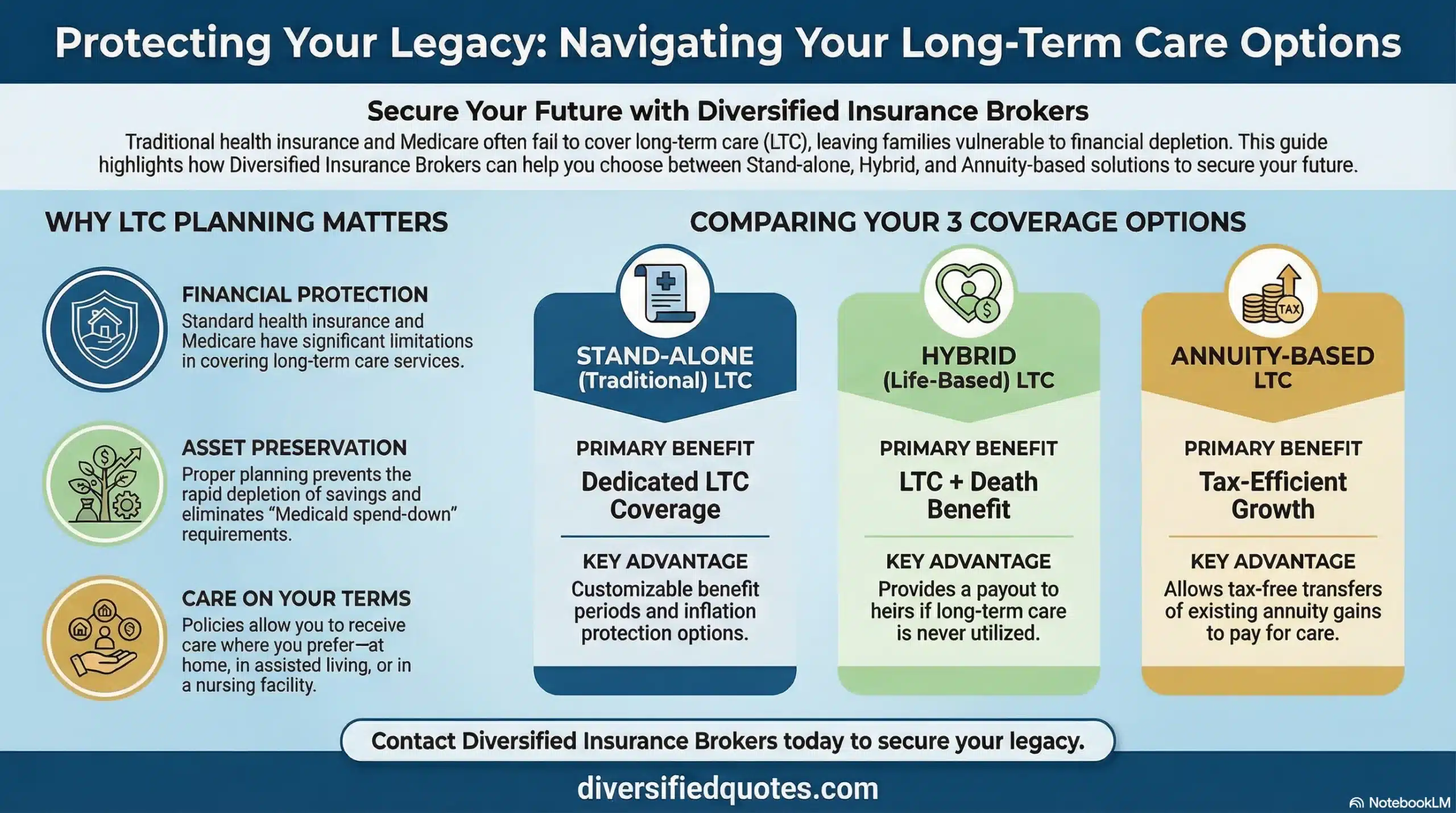
Hybrid life/LTC and annuity/LTC policies approach the duration question differently from traditional stand-alone LTC insurance because the benefit pool mechanics and funding structure work differently. In a typical hybrid design, a lump sum or series of premium payments funds both a death benefit and a long-term care benefit pool. The long-term care benefit pool — often expressed as a multiple of the initial premium — provides a defined amount of LTC coverage, and if the pool is exhausted, care costs must be self-funded unless an extension of benefits rider is attached.
The extension of benefits rider is where hybrid designs most directly intersect with the limited-term versus lifetime question. An extension of benefits rider on a hybrid policy allows LTC benefits to continue after the core benefit pool is exhausted, often for an additional defined period (such as two or four more years) or, in some designs, on a lifetime basis. The rider’s cost and availability vary significantly by carrier and product design. For families who want hybrid funding with meaningful duration protection, evaluating the extension of benefits rider as a core component — not an afterthought — is essential to ensuring the hybrid design actually addresses duration risk. Our resource on affordable hybrid long-term care policies covers the hybrid product landscape including how extension of benefits options are priced and structured across different carriers. Our resource on annuity with nursing home care rider covers the annuity-based LTC structure specifically — a design that some families prefer for its liquidity characteristics and the guaranteed income component that runs alongside the care benefit.
Medicare, Medicaid, and the Coverage Gap LTC Insurance Fills
A common misconception about long-term care planning is that Medicare will cover extended care needs. Medicare covers specific rehabilitative care following a qualifying hospital stay — but it does not cover ongoing custodial care, which is the care that most people need when they have LTC needs. A Medicare patient admitted to a skilled nursing facility following a qualifying hospitalization can receive Medicare-covered care for up to 100 days under specific conditions, but day 101 and beyond is not covered by Medicare regardless of care needs. This is the gap that long-term care insurance — whether limited-term or lifetime — is designed to fill. Our resource on the Medicare playbook covers Medicare’s actual coverage limitations in detail, making clear why Medicare is not a substitute for LTC coverage planning.
Medicaid does cover extended custodial care, but it requires the applicant to spend down most of their assets to eligibility levels before coverage begins. Medicaid-funded care typically means reliance on facilities that accept Medicaid payment rates — which often limits the choice of facilities and the quality of care settings available. Long-term care insurance — at either benefit duration — is designed to provide the financial resources to access private-pay care options and preserve assets that would otherwise be depleted through the Medicaid spend-down process. The choice between limited-term and lifetime benefits affects how long this private-pay coverage window lasts before a potential Medicaid transition would become necessary.
Coordinating LTC Coverage With the Retirement Income Plan
Long-term care insurance does not exist in isolation — it is one component of a retirement plan that also includes Social Security income, portfolio withdrawals, pension or annuity income, and the household’s complete asset picture. The benefit duration decision is most effectively made in the context of how the rest of the plan responds to a care event, not as a standalone insurance product comparison.
A household with strong guaranteed retirement income from Social Security, pensions, and annuities may find that the income floor those sources provide significantly reduces the need for extended benefit duration — because care costs can be funded partly from income that continues regardless of care need. Our resource on lifetime income planning covers the income floor that can partially offset LTC cost exposure, and understanding how guaranteed income reduces the household’s net out-of-pocket care cost is important context for sizing the LTC benefit appropriately. A household without strong guaranteed income — relying primarily on portfolio withdrawals — is more vulnerable to the compounding effect of forced withdrawals during a care event, making LTC insurance’s benefit duration more consequential because portfolio assets are more fragile without an income floor to support them.
Ready to Model Both Options With Real Numbers?
We compare limited-term, lifetime, and hybrid alternatives side by side — so you see the tradeoffs clearly before any policy is chosen.
Related Long-Term Care Resources
Compare benefit structures, funding approaches, and hybrid alternatives for LTC planning.
Financial Protection Essentials
LTC cost tools, hybrid policy resources, rate comparison guides, and pre-existing condition coverage options.
Talk With an Advisor Today
Choose how you’d like to connect—call or message us, then book a time that works for you.
Schedule here:
calendly.com/jason-dibcompanies/diversified-quotes
Licensed in all 50 states • Fiduciary, family-owned since 1980
FAQs: LTC Insurance — Limited-Term vs. Lifetime Benefits
What is a limited-term LTC benefit period?
A limited-term long-term care benefit period defines the maximum duration during which the carrier will pay qualifying care costs after the insured meets the policy’s benefit triggers. Common benefit periods are 2, 3, 5, 6, or 10 years, though the available options vary by carrier and product. Many policies express the benefit period as a maximum benefit pool — the monthly benefit multiplied by the benefit period — which allows the benefit to be used at varying rates rather than strictly clock-based. For example, a policy with a $5,000 monthly benefit and a 5-year period creates a benefit pool of $300,000. If care costs only $3,000 per month, the benefit pool would last longer than 5 years. If care costs the full $5,000 monthly, the pool exhausts at exactly 5 years. Once the benefit period or pool is fully consumed, the policy stops paying even if care continues. Our resource on long-term care insurance covers the complete benefit structure framework including how benefit periods, benefit pools, and elimination periods interact in practice.
What does lifetime LTC coverage mean in practice?
Lifetime benefits in a long-term care policy mean that once the insured qualifies for benefits (by meeting the ADL or cognitive impairment triggers) and satisfies the elimination period, coverage can continue for as long as care is needed without a benefit period clock limiting the coverage. There is no maximum duration or benefit pool that can be exhausted. In practical terms, this means a policyholder who develops Alzheimer’s disease and requires care for 12 years would receive policy benefits throughout that entire duration — the policy would not stop paying simply because a benefit period expired. The carrier assumes the full financial risk of extended care duration, which is why lifetime benefits are priced higher than equivalent limited-term designs. “Lifetime” in this context is subject to the policy’s terms and definitions — the insured must continue to meet benefit triggers, must receive care in covered settings, and the care must be provided by qualified caregivers as defined in the policy. Our resource on LTC insurance with lifetime benefits covers the specific designs and carrier programs that offer unlimited duration coverage.
Which option is more budget-friendly?
Limited-term coverage is consistently less expensive than lifetime benefits at the same monthly benefit level, inflation protection design, and elimination period — because the defined duration limits the carrier’s maximum financial exposure. The premium difference between a 3-year benefit period and a lifetime benefit period for the same monthly benefit can range from approximately 30% to 60% or more depending on the applicant’s age, health class, state, and the specific carrier. This premium difference is itself a planning variable: some families use the premium savings from choosing limited-term coverage to improve other design elements — purchasing a higher monthly benefit, stronger inflation protection, or a shorter elimination period — within the same total budget. For others, the premium savings free up cash flow for other retirement planning priorities. The right approach depends on which benefit design elements matter most for the specific household’s situation. Our resource on best long-term care insurance rates covers the current pricing landscape across carriers for both limited-term and lifetime benefit structures.
What is the biggest risk with a limited-term policy?
The primary risk of a limited-term LTC policy is that the benefit period ends while care is still needed — leaving the household responsible for ongoing care costs without insurance coverage. This risk is most concrete in two clinical scenarios: cognitive impairment from Alzheimer’s disease or other dementias, which can progress over many years with increasing care needs; and progressive chronic conditions like Parkinson’s disease or advanced stroke-related disability, which can require sustained high-cost care over an extended period. If care outlasts a 3-year benefit period in either of these scenarios, the household must fund continuing care from savings, retirement account withdrawals, income, family contributions, or eventually Medicaid once assets are exhausted. For households without sufficient financial resources to sustain this self-funding, the limited-term policy’s benefit expiration can effectively undo much of the protection the policy was meant to provide. Understanding this risk — and assessing honestly whether the household can absorb it — is the core of the benefit duration decision. Our resource on self-insured long-term care covers the financial requirements of self-funding an extended care need.
Does inflation protection affect the limited vs. lifetime decision?
Yes — inflation protection affects both the cost and the value of either benefit structure, and it interacts with the duration decision in important ways. Inflation protection increases the policy’s monthly benefit over time at a defined rate (commonly 3% compounded or 5% compounded) to help keep pace with rising care costs. For longer-duration policies — particularly lifetime designs — inflation protection is essential because a $5,000 monthly benefit purchased today may cover only a fraction of care costs in 20 or 30 years if long-term care costs continue to rise. Without inflation protection, the real purchasing power of a lifetime benefit policy degrades significantly over time, potentially eliminating much of its long-duration protection advantage. For limited-term policies with shorter benefit periods, the case for inflation protection is also strong if purchase is being made many years before care is expected — but the horizon is shorter, which affects how much cumulative benefit is gained from inflation compounding. The tradeoff is that inflation protection adds premium cost, which creates budget pressure that may influence the duration choice: adding strong inflation protection to a limited-term policy may be more affordable than adding the same protection to a lifetime policy within the same budget.
Can hybrid LTC policies provide lifetime coverage?
Some hybrid life/LTC and annuity/LTC policies offer lifetime coverage options through extension of benefits riders, though the design and cost vary significantly by carrier and product. A standard hybrid policy typically creates a defined benefit pool — a set maximum dollar amount that will be paid for qualifying care — which functions similarly to a limited-term stand-alone LTC policy. When an extension of benefits rider is added, the carrier agrees to continue paying for qualifying care after the core benefit pool is exhausted for an additional period (such as two or four additional years in a limited extension, or indefinitely in a lifetime extension). The extension of benefits rider adds cost to the hybrid policy and its availability depends on the specific product and carrier. For families considering hybrid designs with meaningful duration protection, evaluating the extension of benefits rider as a required component rather than an optional add-on is important — without it, most hybrid policies are effectively limited-term LTC coverage funded through a life or annuity chassis. Our resource on affordable hybrid long-term care policies covers the hybrid market including extension of benefits options across carriers.
What happens if LTC benefits run out and care is still needed?
When a limited-term LTC benefit period expires and care continues, the ongoing cost becomes entirely the household’s responsibility — funded through whatever financial resources remain available at that point. The options families typically navigate include: continued funding from investment portfolio withdrawals, which can accelerate asset depletion particularly if markets are performing poorly at the same time; use of home equity through reverse mortgage or home sale; reliance on family caregivers who may provide unpaid care to reduce the cost of professional care; community-based programs and services that provide lower-cost alternatives to facility care; and eventually Medicaid, which covers nursing facility care for individuals who have spent down assets to Medicaid eligibility levels and meet the clinical criteria. The Medicaid path typically means transferring care to facilities that accept Medicaid rates, which may limit choices and quality of care settings. None of these alternatives is as financially efficient or care-quality protective as ongoing LTC insurance coverage. The value of the limited-term policy is not diminished by benefit exhaustion — it provided valuable coverage during the benefit period — but the household must be genuinely prepared for the post-benefit reality. Our resource on sequence of returns risk covers how forced portfolio withdrawals during a care event interact with market performance to create compounding financial damage.
How do I decide between limited-term and lifetime LTC benefits?
The decision between limited-term and lifetime LTC benefits comes into focus when you work through five honest questions: What is the household protecting — the first layer of risk, or the entire duration of possible care? How much tail-risk can the balance sheet absorb if care continues beyond a defined period? What does family history suggest about likely care duration and conditions? What care settings and scenarios are most important to cover? And which premium structure is sustainable long-term without creating the risk of future lapse? For households where a prolonged care event would fundamentally impair the healthy spouse’s retirement security, lifetime benefits may be the right answer regardless of the premium difference. For households where meaningful assets or income could sustain self-funding after a defined benefit period, limited-term benefits designed around the most disruptive common scenarios may deliver excellent protection at a more manageable cost. The honest version of this decision is not about finding the “better” product in the abstract — it is about matching the product’s risk transfer to the household’s actual financial vulnerability. Our advisors model both structures against real care cost assumptions and the complete retirement income plan so the comparison reflects the family’s actual situation rather than generic benchmarks. Our resource on is long-term care insurance worth it covers the comprehensive value framework for this decision, and our resource on tax advantages of long-term care insurance covers the premium deductibility and benefit tax treatment that affect the net cost comparison across both designs.
About the Author:
Jason Stolz, CLTC, CRPC, DIA, CAA and Chief Underwriter at Diversified Insurance Brokers (NPN 20471358), is a senior insurance and retirement professional with more than 25 years of real-world experience helping individuals, families, and business owners protect their income, assets, and long-term financial stability. As a long-time partner of the nationally licensed independent agency Diversified Insurance Brokers, Jason provides trusted guidance across multiple specialties—including fixed and indexed annuities, long-term care planning, personal and business disability insurance, life insurance solutions, Group Health, Travel Medical and Evacuation Insurance, and short-term health coverage. Diversified Insurance Brokers maintains active contracts with over 100 highly rated insurance carriers, ensuring clients have access to a broad and competitive marketplace.
His practical, education-first approach has earned recognition in publications such as VoyageATL, and contributions from his agency featured in Kiplinger and GoBankingRates— highlighting his commitment to financial clarity and client-focused planning. Drawing on deep product knowledge and years of hands-on field experience, Jason helps clients evaluate carriers, compare strategies, and build retirement and protection plans that are both secure and cost-efficient. Visitors who want to explore current annuity rates and compare options across multiple insurers can also use this annuity quote and comparison tool.
Explore More Long Term Care Insurance Options: Browse our complete guide to LTC Insurance Costs, Rates & Planning — covering how much it costs, best rates, calculators, planning strategies & is it worth it from top carriers.
Explore More: Browse our complete Long Term Care Insurance guide — covering traditional LTC, hybrid policies & partnership plans from top carriers from 100+ carriers.
Last Reviewed: May 27, 2026 |
Reviewed by: Jason Stolz, CLTC, CRPC, DIA, CAA
Chief Underwriter, Diversified Insurance Brokers, Inc. | NPN: 20471358 | Diversified Insurance Brokers, Inc. — Licensed in all 50 states
Fact Checked by: Tonia Pettitt, CMIP©
Medicare Specialist, Diversified Insurance Brokers, Inc. | NPN: 14374308 | Diversified Insurance Brokers, Inc. — Licensed in all 50 states
Did you find this content helpful? Leave us a Google review — it helps others find trustworthy guidance too.
Editorial Standards: Diversified Insurance Brokers maintains rigorous editorial standards to ensure accuracy, clarity, and independence in all content. Learn more about our editorial standards and commitment to transparency.
