
Tax Advantages of Long Term Care Insurance
As an Independent Long Term Care Insurance Broker, we compare traditional, hybrid, and partnership-qualified policies across dozens of carriers to find the structure that actually fits your situation.
Tax Advantages of Long Term Care Insurance

Jason Stolz CLTC, CRPC, DIA, CAA
Understanding the tax advantages of long term care insurance can make LTC planning significantly more affordable when you know how premiums and benefits are treated under current tax rules — and how different policy structures interact with those rules differently. The goal of LTC planning is rarely just “buy a policy and hope you use it.” The goal is to create a plan that protects retirement income and assets from the real cost of home care, assisted living, memory care, or skilled nursing care, while also capturing whatever tax-favored treatment may apply to reduce the net cost of that protection. At Diversified Insurance Brokers, we help clients in all 50 states compare traditional LTC policies, hybrid life and LTC designs, and annuity-based LTC strategies so they can understand the after-tax cost and the real-world tradeoffs before committing to a structure.
Long term care planning does not happen in a vacuum. A large care event can force accelerated taxable withdrawals from retirement accounts, create Medicare premium surcharges through IRMAA as income spikes, and change how Social Security and investment income are taxed in ways that compound the financial impact well beyond the direct care cost. The more tax-efficient your LTC strategy is, the more effectively it protects the rest of your retirement plan — not just by paying for care, but by reducing the reactive financial decisions that a care event can otherwise trigger. If you are still in the early stages of deciding which type of coverage to explore, our resource on long term care planning strategies provides a comprehensive framework before the tax layer becomes the primary focus.
See Your LTC Plan After Taxes
We’ll compare traditional and hybrid designs and show how deductions, HSA funding, and 1035 exchanges may reduce your net cost.
Why Long Term Care Insurance Can Be Tax-Favored
Long term care insurance occupies a unique position in the federal tax framework because qualified LTC coverage is treated more like health insurance than like a financial or investment product. That distinction is the foundation of the tax advantages available to LTC policyholders. It is the reason certain premium payments can potentially qualify for medical expense deductions under the right circumstances, and it is why qualified LTC benefits are generally paid tax-free when care is needed — because the policy is providing a medical and health-related benefit rather than a purely financial return. In straightforward terms, the tax treatment is designed to make it easier for families to plan proactively for a common, expensive, and often underinsured risk without having to deplete other assets first or face an unplanned tax burden at the moment care becomes necessary.
However, “tax-favored” does not mean “uniformly simple.” The exact treatment varies considerably depending on the policy structure selected and how the premiums are funded. A traditional stand-alone LTC policy behaves differently under the tax rules than a hybrid life insurance policy with LTC benefits, and both differ from an annuity-based LTC design that repositions existing non-qualified assets. These are not merely marketing differences — they create meaningfully different tax outcomes for premiums, for benefits, and for how the strategy interacts with retirement income planning over time. Understanding how these product types differ structurally before comparing tax treatment prevents applying the wrong framework to the wrong product. Our resource on hybrid life vs. traditional long term care insurance provides a clear structural comparison that helps establish the right baseline before the tax analysis begins.
| Tax Advantage | Who It Applies To | How It Works | Key Limit or Condition | Policy Type Required |
|---|---|---|---|---|
| Individual premium deduction | Individuals who itemize deductions on federal returns | Eligible premiums count as medical expenses deductible to the extent total medical expenses exceed 7.5% of AGI | Age-based eligible premium limits adjust annually; only the IRS-defined eligible premium amount counts toward the deduction, not the full premium if it exceeds the limit | Tax-qualified (TQ) policy only |
| Self-employed premium deduction | Self-employed individuals, partners, and S-Corp shareholders owning more than 2% | Eligible LTC premiums deductible as a self-employed health insurance deduction — not subject to the 7.5% AGI floor that applies to individual itemizers | Deduction limited to age-based eligible premium amount; cannot exceed net self-employment income; not available if eligible for employer-sponsored coverage through a spouse | Tax-qualified (TQ) policy only |
| C-Corporation employer deduction | C-Corporations providing LTC coverage as an employee benefit | Corporation deducts 100% of premiums paid as a business expense; employee does not recognize premium payment as taxable income | Must be offered on a nondiscriminatory basis or structured under a specific executive benefit plan design; different rules apply for owner-employees vs. non-owner employees in some structures | Tax-qualified (TQ) policy only |
| HSA premium payment | Individuals with an active Health Savings Account and an eligible high-deductible health plan | LTC insurance premiums can be paid from HSA funds on a tax-free basis up to the age-based eligible premium limit | Withdrawals limited to the age-based eligible premium amount annually; HSA balance must be sufficient; premiums for a spouse can also be paid from the same HSA up to their own age-based limit | Tax-qualified (TQ) policy only |
| Tax-free benefit payments | All policyholders receiving qualifying LTC benefits during a claim | Benefits received are excluded from gross income up to the greater of the IRS per-diem limit or actual qualified LTC expenses incurred | Per-diem limit adjusts annually; benefits exceeding the per-diem limit may be partially taxable unless actual LTC costs equal or exceed the benefit received; only applies to reimbursement and per-diem policies meeting TQ criteria | Tax-qualified (TQ) policy only |
| Hybrid life/LTC benefit exclusion | Owners of life insurance policies with qualified LTC riders receiving accelerated LTC benefits | LTC benefits paid from a life insurance policy’s accelerated benefit rider are generally excluded from income under IRC Section 7702B, consistent with standalone TQ LTC policy treatment | Rider must meet the definition of a tax-qualified LTC insurance contract; exchange of a life or annuity policy for a hybrid LTC policy via 1035 exchange can be completed tax-free, preserving the original policy’s tax basis | Life policy with qualified LTC rider (IRC 7702B compliant) |
Premium Deductions: How They Actually Work
Premium deductibility is the tax advantage most frequently discussed and most frequently misunderstood in LTC planning conversations. The clearest way to understand it is that traditional LTC premiums may qualify as eligible medical expenses in specific circumstances — but the deductibility is not automatic, is not available at the full premium amount in most cases, and depends significantly on how the policyholder files taxes and what other medical expenses they have. The most common pathway for individual policyholders is through the itemized deduction for medical expenses, where qualified LTC premiums — up to IRS-established age-based limits that adjust annually — may be counted as part of medical expenses subject to the 7.5% of Adjusted Gross Income (AGI) threshold. Only expenses above that threshold become deductible, which means the effective deduction for many individuals is smaller than the full premium amount or zero depending on total medical expenses and AGI level.
Self-employed individuals, including sole proprietors, partners, and shareholders in S-corporations, may be able to deduct eligible LTC premiums as a business expense up to the applicable age-based limits without needing to exceed the itemized deduction threshold — which can make the deduction more accessible and more valuable for this group. C-corporation owners in certain arrangements may receive the most favorable treatment, with the potential for full premium deductibility as an employee benefit, though the rules for this structure involve careful compliance considerations. The specifics of premium deductibility are highly fact-dependent — the right structure depends on how income is earned, how the policy is owned, and how benefits are designed — which is why modeling LTC costs in after-tax terms with a tax professional alongside the insurance comparison produces better planning outcomes than applying general rules that may not fit a specific situation. If preserving premium value in a worst-case scenario where care is never needed matters alongside the deduction question, our resource on long term care insurance with return of premium explains how return provisions affect both value and tax treatment.
Tax-Free Benefits: The Advantage Most Families Underestimate
For most families, the most financially significant tax advantage in LTC insurance is not the premium deduction — it is what happens when a claim occurs. When qualified LTC benefits are paid for qualified care expenses, they are generally received income-tax free. That matters enormously in the real-world context of a care event, because a long-duration care situation is frequently the exact moment when families are under the most financial stress and making the most consequential financial decisions under time pressure. Without LTC coverage, the cost of care must be paid from other sources — typically taxable portfolio withdrawals, accelerated IRA distributions, or liquidation of non-qualified investment accounts — each of which creates taxable income at exactly the moment when the household’s financial picture is already strained. When LTC benefits replace those withdrawals, the tax consequence of the care event is substantially reduced, stabilizing the tax picture and preserving more of the retirement assets that were intended for long-term income and legacy purposes.
The tax-free nature of qualified LTC benefits also interacts favorably with IRMAA Medicare premium calculations, Social Security taxation thresholds, and tax bracket management — because the benefit payments do not count as income for these purposes. A household that might otherwise cross a Medicare IRMAA bracket or push more Social Security benefits into the taxable range through large care-related withdrawals may avoid those consequences when LTC benefits cover the care cost instead. Understanding what triggers LTC benefits and how the qualified care definition applies is important context for appreciating this advantage: our resource on who qualifies for long term care insurance explains how benefit triggers and care definitions work in practice.
HSA Funding: Using Pre-Tax Dollars to Reduce Net LTC Cost
Health Savings Accounts offer one of the most structurally clean pathways for reducing the net cost of LTC premiums, because HSA dollars are inherently tax-advantaged at every stage — contributions are pre-tax or tax-deductible, growth is tax-deferred, and qualified distributions for health expenses are tax-free. In many circumstances, HSA funds can be used to pay traditional LTC insurance premiums up to the IRS age-based annual limits that apply to LTC premium deductibility. When HSA funds are used for this purpose, the effective result is that part of the LTC premium cost is converted into a pre-tax expense — without relying on itemized deductions, without the 7.5% AGI threshold hurdle, and without the complexity of other deduction strategies. This can be one of the most accessible premium reduction pathways for individuals who have accumulated meaningful HSA balances and who are planning LTC coverage in the years before Medicare eligibility.
From a planning perspective, HSA use for LTC premiums is most effective when it is coordinated with the benefit design choices being made simultaneously — not as an afterthought to a decision already made. The HSA funding strategy interacts with benefit level choices, inflation protection options, and elimination period decisions in ways that affect the total net cost calculation. For couples who are planning LTC coverage jointly, HSA funding also interacts with shared benefit pool structures: our resource on long term care insurance with shared benefits explains how couples often structure coverage differently than individuals and how HSA coordination fits into joint planning.
1035 Exchanges: Repositioning Existing Assets Without Triggering Tax
A 1035 exchange is one of the most practically powerful tax tools available in LTC planning because it can allow repositioning of existing policy value — from a life insurance policy or a non-qualified annuity — into a different contract type without triggering immediate income tax on embedded gains. Many families hold older life insurance policies they no longer need in their current form, or non-qualified annuities that are underperforming, no longer aligned with retirement income goals, or simply sitting without a clear plan. In the right circumstances, a 1035 exchange can redirect that accumulated value into a hybrid life or Annuity and LTC design, creating a structured long term care benefit pool from assets that were already in the estate without adding new premium from cash flow.
This approach is especially common and especially valuable for families who want LTC protection but are resistant to the idea of paying new ongoing premiums without a guaranteed return if care is never needed. By repositioning an existing asset through a 1035 exchange, the premium concern is reframed: the assets are already committed, they are simply being reorganized into a structure that serves the LTC planning objective while retaining a death benefit if care is never needed. The 1035 exchange must be structured correctly — it is an insurance-to-insurance exchange that must be properly documented and executed directly between carriers rather than as a personal distribution — but the tax benefit of avoiding immediate recognition of accumulated gains can be substantial for policies with significant cost basis differences. For families who prefer the single-premium approach to LTC planning rather than ongoing premiums from cash flow, our resource on single-pay long term care insurance explains how lump-sum funded LTC strategies are structured and when they fit best.
Traditional vs. Hybrid vs. Annuity-Based LTC: Different Tax Logic
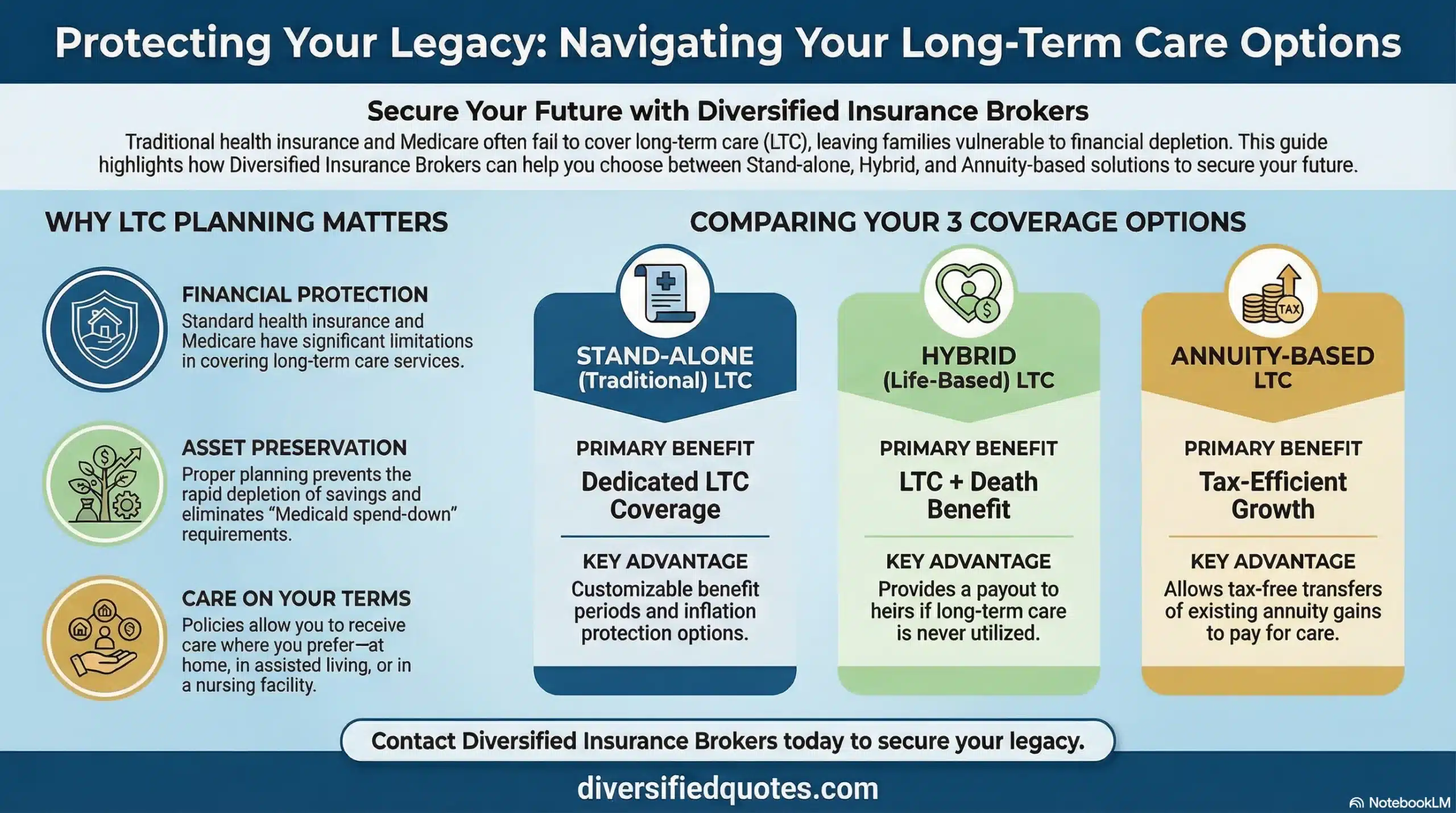
Families often assume the tax advantages of LTC insurance are identical across all product types, when in fact the tax treatment differs meaningfully because the underlying product structure differs. Traditional long term care insurance is pure care coverage with no life insurance or investment component — it is the product type most directly associated with premium deductibility conversations because its premiums are straightforwardly care insurance premiums rather than a blend of coverage types. Qualified benefits from traditional LTC policies are generally tax-free when paid for qualified care expenses, and the policy has no other financial value beyond the care benefit itself.
Hybrid life and LTC policies combine life insurance death benefit value with LTC benefit access, typically funded with a lump sum or structured premium payments. The tax treatment is more complex: the life insurance chassis means that death benefits are generally paid income-tax free to beneficiaries when the LTC benefit is not fully used, and LTC benefits for qualified care are generally tax-free. Premiums for hybrid policies may not carry the same deductibility treatment as traditional LTC premiums in all situations, and the specific tax treatment depends on how the policy is classified and structured. The exchange of an existing non-qualified annuity or life policy for a hybrid LTC design through a 1035 exchange can defer the tax consequence of repositioning gains, which is a meaningful planning advantage when the exchanged asset has appreciated significantly.
Annuity-based LTC designs typically pair an annuity accumulation value with a benefit multiplier or enhanced payout mechanism for qualified care costs. The underlying annuity accumulation value grows tax-deferred, and distributions for qualified LTC care are generally received tax-free up to applicable limits. Withdrawals for non-care purposes follow standard annuity taxation rules. For families with non-qualified annuity assets they want to reposition into a care planning structure, our resource on non-qualified long term care annuity covers how this structure works and when it fits most effectively in a comprehensive retirement income and care planning approach. For planning purposes, the interaction between the annuity value and long-term income planning also benefits from context on how annuity benefits integrate with a retirement portfolio: our resource on annuity benefits provides that broader framing.
Why Tax Advantages Must Be Modeled With the Full Retirement Income Picture
Long term care planning that is evaluated only on premium cost and benefit design — without integrating the tax dimension into the analysis — frequently produces a suboptimal result, because the after-tax cost of different LTC strategies can differ substantially from the pre-tax premium comparison. A traditional LTC policy with meaningful premium deductibility may have a lower after-tax net cost than a hybrid policy with no deductibility, even when the hybrid’s before-tax premium is lower. A 1035 exchange that avoids triggering tax on significant embedded gains may produce a better total outcome than using new cash flow for premium, even when the premium from cash flow appears lower in isolation.
The tax advantages also interact with retirement income structure in ways that extend beyond the LTC decision itself. A care event that occurs without coverage typically forces reactive taxable income — large IRA withdrawals, accelerated required minimum distributions, liquidation of appreciated non-qualified assets — that creates cascading tax consequences across Medicare premiums, Social Security taxation, and income bracket exposure. A well-structured LTC plan that produces tax-free benefit payments when care is needed can prevent those cascading consequences, protecting not just the direct care cost but the broader tax efficiency of the retirement plan through the care period. Modeling LTC planning in the context of total retirement income — including Social Security, RMDs, investment income, and potential care cost scenarios — is the approach that produces the most accurate comparison between doing nothing, self-insuring, and purchasing various LTC structures.
State Incentives and Partnership Planning
Federal tax rules establish the baseline for LTC planning, but many states provide additional financial advantages through state-level premium deductions or tax credits that layer additional savings on top of the federal framework. The availability, amount, and eligibility requirements for state-level LTC tax incentives vary considerably — some states provide relatively generous deductions, some provide modest credits, and some provide nothing beyond the federal treatment. For families in states with meaningful state-level LTC incentives, incorporating those incentives into the net cost calculation can make LTC planning more accessible than the federal analysis alone suggests.
LTC Partnership programs exist in most states and create an important additional planning dimension. Partnership-qualified LTC policies provide dollar-for-dollar asset protection for Medicaid eligibility purposes — meaning that for every dollar of LTC benefits paid by a qualifying policy, a dollar of assets can be protected from Medicaid spend-down requirements when and if Medicaid eligibility becomes relevant. This is not a tax advantage in the strict sense, but it functions as a significant financial planning advantage that often influences how much coverage families choose to purchase and how they structure benefit amounts, elimination periods, and inflation options. Understanding how Partnership qualification interacts with planning across state lines — particularly for families who have lived in multiple states or who may relocate in retirement — is important context: our resource on LTC Partnership reciprocity covers how Partnership benefits follow policyholders across state lines and where reciprocity applies. The long term care insurance calculator can help model benefit sizing, inflation options, and elimination periods as a starting point for the overall planning conversation.
How We Help You Apply the Tax Advantages Correctly
There is a meaningful difference between “tax advantages exist” and “your specific plan captures them effectively.” The gap between those two statements is where most families leave value on the table — either by selecting the wrong product structure for their funding method and tax situation, by missing HSA opportunities, by not evaluating 1035 exchanges for existing assets, or by purchasing coverage at a premium level that is not sustainable long-term and that therefore fails to deliver the tax advantage because the policy lapses before care is needed.
The correct planning sequence starts with product selection — determining whether traditional, hybrid, or annuity-based design fits the household’s goals, risk tolerance, and financial structure — then moves into benefit design with specific benefit amounts, inflation protection choices, and elimination periods sized appropriately for the risk being addressed. From there, funding strategy is evaluated: whether premiums will come from cash flow, HSA funds, or a 1035 exchange from existing assets. Finally, the plan is reviewed in the context of retirement income coordination — how it interacts with Social Security, RMD obligations, investment withdrawals, Medicare premium exposure, and legacy goals. The correct plan is not the one with the most features. It is the plan that balances leverage, predictability, and affordability while genuinely fitting the household’s real tax situation and retirement income structure. For additional context on how to size coverage appropriately before the tax layer is optimized, our resource on how much long term care insurance do I need provides the benefit sizing framework that supports this sequence.
Compare Traditional vs. Hybrid LTC With Net Cost
We’ll show how benefit design and funding method may affect your taxes now and your retirement cash flow later.
Next Steps
If you want to use the tax advantages of long term care insurance effectively, the next step is not to pick a carrier based on a brochure. The next step is to identify which policy structure aligns with your goals, funding method, and tax situation — then model the plan in after-tax terms so you understand what you are genuinely paying and what you are genuinely protecting. Once the structure is clear, comparing carriers becomes tractable because you are comparing appropriate designs for your situation rather than random premium quotes across incompatible product types. We help clients through this process from benefit design through funding strategy through carrier comparison, using a transparent after-tax modeling approach that produces decisions based on realistic financial outcomes rather than pre-tax headline numbers.
Get Your Tax-Efficient LTC Plan
Answer a few questions about age, health, and goals. We’ll respond with options and the smartest way to structure them.
Related Long Term Care Pages
Continue learning with these focused resources.
Financial Protection Essentials
Long term care planning, hybrid coverage, asset protection, and retirement coordination resources.
Talk With an Advisor Today
Choose how you’d like to connect—call or message us, then book a time that works for you.
Schedule here:
calendly.com/jason-dibcompanies/diversified-quotes
Licensed in all 50 states • Fiduciary, family-owned since 1980
Frequently Asked Questions: Tax Advantages of Long Term Care Insurance
Benefits paid from qualified long term care insurance policies are generally received income-tax free when used to pay for qualified long-term care services — whether structured as a reimbursement for actual care costs or as an indemnity payment up to a per-diem limit. This tax-free treatment applies regardless of how the premiums were funded, as long as the policy qualifies as a “qualified long term care insurance contract” under Internal Revenue Code Section 7702B and the care being paid for constitutes “qualified long-term care services” — typically personal care services required because of a chronic illness that causes the inability to perform a defined number of activities of daily living, or substantial cognitive impairment requiring supervision. Indemnity policies that pay a fixed daily amount may have a per-diem exclusion limit that adjusts annually with inflation; amounts paid above that limit for indemnity policies may be partially taxable if they exceed actual qualified care costs. For most policyholders in a genuine long term care situation, benefits will fall comfortably within the exclusion limits and will be fully tax-free.
Traditional long term care insurance premiums may be deductible as medical expenses, but the deductibility is subject to important limitations that reduce the practical benefit for many individual policyholders. Eligible premiums are limited to an annual age-based amount that the IRS adjusts for inflation each year and that increases with age — older policyholders have higher eligible premium limits. The eligible premium amount can then be included in the total medical expense deduction for itemizers, but only the portion of total medical expenses that exceeds 7.5% of Adjusted Gross Income (AGI) is deductible. For many taxpayers, this threshold means the practical value of the LTC premium deduction is smaller than the full eligible premium amount, or potentially zero if other medical expenses are low relative to AGI. Self-employed individuals have a more favorable pathway: eligible LTC premiums up to the annual age-based limits may be deductible as a business expense without itemizing or meeting the AGI threshold. The most favorable treatment is typically available to C-corporation owners under specific employer-employee benefit arrangements. The correct approach always depends on individual circumstances and should be confirmed with a tax professional.
Often yes — business owners, particularly those with certain business structures, may have access to more favorable LTC premium deduction pathways than individual non-business policyholders. Self-employed individuals, including sole proprietors and partners in partnerships, may deduct eligible LTC premiums up to the annual age-based IRS limits as a business deduction without needing to itemize or exceed the 7.5% AGI medical expense threshold. S-corporation shareholder-employees may receive similar treatment, though the specific mechanics depend on how compensation and benefits are structured within the corporation. C-corporations can often provide the most favorable treatment — potentially deducting 100% of LTC premiums paid as an employee benefit with no age-based cap limits applying to the corporation, making employer-sponsored LTC plans particularly cost-effective for closely held C-corporations. The appropriate structure depends on the type of entity, compensation arrangements, benefit plan design, and compliance requirements specific to each business situation. A tax advisor familiar with both small business tax strategy and insurance benefit design can identify the most efficient structure for a specific business owner’s circumstances.
Yes — Health Savings Account funds can be used to pay qualified long term care insurance premiums, and this can be one of the most tax-efficient pathways for reducing the net cost of LTC coverage. The amount that can be paid from HSA funds is limited to the same annual age-based IRS limits that apply to LTC premium deductibility generally, and those limits increase with age. When HSA funds are used for LTC premiums within these limits, the entire payment is effectively pre-tax — contributions to the HSA were deducted or excluded from income, the funds grew tax-deferred inside the account, and the distribution for LTC premiums is tax-free as a qualified health expense. This triple tax advantage makes HSA funding one of the cleanest mechanisms for LTC premium cost reduction, particularly for individuals who have accumulated meaningful HSA balances in high-deductible health plan years and who are now planning LTC coverage in the years approaching Medicare eligibility. Once Medicare enrollment begins, HSA contribution eligibility ends, so the window for accumulating HSA funds for future use on LTC premiums is typically the working years before age 65.
Hybrid life and LTC policies offer several tax advantages that differ from traditional LTC policies. LTC benefits paid from a hybrid policy for qualified care expenses are generally tax-free, providing the same income-tax-free benefit payment that traditional LTC policies offer. The death benefit component of the life insurance chassis is also generally paid income-tax free to beneficiaries when care benefits are not used or not fully used, providing tax-efficient legacy value alongside the care benefit. One of the most significant tax advantages specific to hybrid policies is the ability to fund them through a 1035 exchange from an existing non-qualified annuity or life insurance policy. A 1035 exchange allows the accumulated gains in the existing policy to be transferred into the hybrid LTC design without triggering immediate income tax on those gains. For policyholders with significant embedded gains in existing policies — gains that would create substantial taxable income if the policy were surrendered for cash — the 1035 exchange can produce a meaningful tax savings while simultaneously converting an underutilized asset into a structured LTC benefit plan. The premium deductibility treatment for hybrid policies is generally less favorable than for traditional LTC policies in most individual filing situations.
LTC Partnership programs — available in most states — do not change the federal income tax treatment of premiums or benefits, but they provide a significant financial planning advantage that complements the tax benefits: dollar-for-dollar asset protection for Medicaid eligibility purposes. Under a Partnership-qualified policy, for every dollar of LTC benefits paid by the policy, a dollar of personal assets can be protected from Medicaid spend-down requirements if Medicaid eligibility later becomes relevant. This asset protection feature is particularly valuable for individuals with moderate to significant assets who want to protect a defined estate value while ensuring access to Medicaid as a backstop against catastrophic long-duration care costs that exceed policy benefit limits. The asset protection benefit is an indirect financial advantage — it does not reduce current-year taxes, but it can substantially reduce the long-term financial exposure of a care event by converting a Medicaid spend-down risk into a protected asset. Partnership policies must meet specific benefit design requirements including inflation protection provisions, which influences how coverage is structured when the Partnership qualification is a planning priority.
Yes — many states provide additional deductions or tax credits for qualified LTC insurance premiums that layer on top of the federal framework. The availability, generosity, and specific eligibility requirements of state-level LTC tax incentives vary considerably across states. Some states allow a full deduction for qualified LTC premiums regardless of whether the policyholder itemizes on the state return. Others provide a percentage credit against state tax liability for a portion of premiums paid. Some states conform closely to federal rules, providing deductibility only for the same eligible amounts and through the same medical expense deduction threshold that applies federally. A few states provide no additional benefit beyond what the federal rules allow. For residents of states with meaningful LTC tax incentives, incorporating the state-level benefit into the after-tax cost calculation can materially improve the economics of LTC planning. Because state rules change and interact with residency in ways that require current-year verification, confirming the specific tax treatment in your state of residence — particularly if you have recently moved or may relocate in retirement — with a tax professional is the most reliable approach to capturing available state-level incentives.
About the Author:
Jason Stolz, CLTC, CRPC, DIA, CAA and Chief Underwriter at Diversified Insurance Brokers (NPN 20471358), is a senior insurance and retirement professional with more than 25 years of real-world experience helping individuals, families, and business owners protect their income, assets, and long-term financial stability. As a long-time partner of the nationally licensed independent agency Diversified Insurance Brokers, Jason provides trusted guidance across multiple specialties—including fixed and indexed annuities, long-term care planning, personal and business disability insurance, life insurance solutions, Group Health, Travel Medical and Evacuation Insurance, and short-term health coverage. Diversified Insurance Brokers maintains active contracts with over 100 highly rated insurance carriers, ensuring clients have access to a broad and competitive marketplace.
His practical, education-first approach has earned recognition in publications such as VoyageATL, and contributions from his agency featured in Kiplinger and GoBankingRates— highlighting his commitment to financial clarity and client-focused planning. Drawing on deep product knowledge and years of hands-on field experience, Jason helps clients evaluate carriers, compare strategies, and build retirement and protection plans that are both secure and cost-efficient. Visitors who want to explore current annuity rates and compare options across multiple insurers can also use this annuity quote and comparison tool.
Explore More Long Term Care Insurance Options: Browse our complete guide to Tax, Medicare & Special Situations — covering tax advantages, Medicare vs LTC, seniors, couples, diabetics & age-specific coverage from top carriers.
Last Reviewed: June 17, 2026 |
Reviewed by: Jason Stolz, CLTC, CRPC, DIA, CAA
Chief Underwriter, Diversified Insurance Brokers, Inc. | NPN: 20471358 | Diversified Insurance Brokers, Inc. — Licensed in all 50 states
Fact Checked by: Tonia Pettitt, CMIP©
Medicare Specialist, Diversified Insurance Brokers, Inc. | NPN: 14374308 | Diversified Insurance Brokers, Inc. — Licensed in all 50 states
Did you find this content helpful? Leave us a Google review — it helps others find trustworthy guidance too.
Editorial Standards: Diversified Insurance Brokers maintains rigorous editorial standards to ensure accuracy, clarity, and independence in all content. Learn more about our editorial standards and commitment to transparency.
