
How to Use a Roth Conversion with an Annuity for Tax-Free Retirement Income
How to Use a Roth Conversion with an Annuity for Tax-Free Retirement Income
Using a Roth conversion with an annuity creates one of the most structurally efficient tax-free retirement income strategies available — combining the IRS’s permission to eliminate future taxation on retirement assets with the insurance carrier’s contractual guarantee of principal protection, structured growth, and lifetime income. The Roth conversion addresses the tax problem: pre-tax IRA dollars that would otherwise generate taxable income in perpetuity — including taxable RMDs that grow larger each year as the account value increases — are converted into Roth IRA assets that never again generate ordinary income taxes for the original owner or, on qualified distributions, for the beneficiaries who ultimately inherit them. The annuity addresses the income problem: Roth funds sitting in a standard brokerage or money market account earn unstructured returns with no guarantees; Roth funds allocated into a fixed or fixed indexed annuity grow at contractually defined rates with principal protection, and can be converted at any future point into guaranteed lifetime income payments that arrive predictably regardless of what markets are doing. The combination — Roth conversion with an annuity — creates what amounts to a private tax-free pension: income that is guaranteed, inflation-protected through cost-of-living adjustment eligibility, tax-free, and cannot be outlived.

Ensure you are receiving the absolute top rates
Current Fixed Annuity Rates
Compare today’s best fixed annuity rates from top carriers.
Current Bonus Annuity Rates
See which annuities offer the highest upfront bonus today.
Request an Annuity Quote
Submit our annuity request form to get personalized rate options.
Lifetime Income Calculator
Use our calculator to see how much guaranteed income your annuity can provide.
At Diversified Insurance Brokers, Jason Stolz, CLTC, CRPC, DIA, CAA integrates Roth conversion strategy with annuity product selection across 100+ carriers — modeling the conversion timing, projected tax cost, annuity growth assumptions, and lifetime income projections before the strategy is implemented rather than discovering the tradeoffs after the fact. Our comprehensive resource on Roth conversions covers the conversion mechanics, timing, and tax bracket management framework that determines how large a conversion is appropriate in each calendar year. Our resource on how to transfer a Roth IRA to an annuity covers the mechanics of moving converted Roth funds into the specific annuity structure that best serves the accumulation or income objective.
Roth IRA + Annuity vs. Traditional IRA + Annuity — Tax Treatment at Every Stage
The decision to fund an annuity with Roth dollars rather than traditional IRA dollars is not primarily about which product to choose — it is about how the tax treatment at every stage of the annuity’s life changes when the source of funds is Roth rather than pre-tax. The table below makes that difference concrete across the full lifecycle from contribution through estate transfer.
| Planning Dimension | Roth IRA + Annuity | Traditional IRA + Annuity |
|---|---|---|
| Tax on contributions / conversion | Conversion triggers ordinary income tax in the year of conversion — the price paid for eliminating all future taxation | No current tax on direct IRA-to-annuity transfer — tax deferred until distribution |
| Taxation during annuity accumulation | No annual taxation — interest and gains grow without any tax friction inside the Roth annuity | No annual taxation — tax deferral inside qualified annuity applies; same accumulation efficiency |
| Required Minimum Distributions | No lifetime RMDs for original owner — Roth IRA assets have no forced distribution requirement during the owner’s lifetime | Mandatory RMDs beginning at age 73 — distributions required regardless of income need; growing taxable income as account value increases |
| Income tax on withdrawals and income | Tax-free on qualified distributions (5-year rule satisfied + age 59½+) — both lump-sum withdrawals and annuity income payments are income-tax-free | All withdrawals and income payments are fully taxable as ordinary income — every dollar distributed from a traditional IRA annuity adds to taxable income |
| Medicare IRMAA surcharge impact | Qualified Roth withdrawals do not count toward IRMAA provisional income — tax-free distributions do not trigger Medicare Part B and D surcharges | All distributions count as income for IRMAA calculation — large RMDs or income rider payments from traditional IRA annuities can trigger or escalate IRMAA surcharges |
| Social Security benefit taxation | Qualified Roth distributions are excluded from provisional income calculation — do not trigger or increase the taxation of Social Security benefits | All distributions count as provisional income — can push up to 85% of Social Security benefits into taxation |
| Estate transfer to heirs | Beneficiaries inherit income-tax-free — subject to 10-year distribution rule for non-spouse beneficiaries but qualified distributions remain tax-free throughout the 10-year window | Beneficiaries pay ordinary income tax on all inherited distributions — a fully taxable IRA inherited under the 10-year rule can produce significant taxable income for beneficiaries in high-earning years |
| Best suited for | Retirees in a low-income window who can convert pre-tax dollars at favorable rates; anyone concerned about future tax rate increases; those wanting RMD-free guaranteed income; heirs who will benefit from tax-free inheritance | Those who cannot afford the current conversion tax cost; those whose tax rates are lower in retirement than during the conversion window; anyone needing to fund an annuity without current tax impact |
The table makes the structural argument for a Roth conversion with an annuity compelling: across five of the seven planning dimensions, the Roth-funded annuity produces a strictly better outcome than the traditional IRA-funded equivalent. The only dimension where the traditional IRA structure is initially superior is the absence of a conversion tax — and that single upfront cost is precisely what purchases all the downstream tax-free advantages. The question is never whether Roth is “better in the abstract” — it is whether the current tax cost of conversion, at the specific marginal rate the conversion would trigger this year, is worth the future tax savings that result. That calculation requires modeling the complete picture: the conversion year’s tax impact, the projected growth inside the annuity, the tax that would have applied to future traditional IRA distributions, and the estate planning advantage for heirs. Our resource on RMD rules under SECURE 2.0 covers how the updated distribution framework affects both the urgency and the modeling of Roth conversion decisions for IRA holders who have not yet reached the RMD triggering age.
The Roth Conversion Mechanics — What the IRS Requires
A Roth conversion is the deliberate transfer of pre-tax retirement assets — traditional IRA funds, rollover IRA funds, SEP IRA funds, or in many cases 401(k) funds following separation from employment — into a Roth IRA. The converted amount is treated as ordinary income in the year of conversion, taxed at the owner’s applicable marginal rate for that year, and then permanently housed in the Roth structure with no future ordinary income tax on qualified distributions. There is no income limit restricting who can execute a Roth conversion — the income limits that apply to direct Roth IRA contributions do not restrict conversions, which is why high-income earners who cannot contribute directly to a Roth can still access the Roth structure through conversion.
The five-year rule applies specifically to conversions: each converted amount has its own five-year clock for determining whether the conversion itself (not the earnings) can be withdrawn without the 10% early distribution penalty. However, for retirement-age owners who are 59½ or older and whose overall Roth IRA has been established for at least five years, all qualified distributions — including income from a Roth-funded annuity — are both income-tax-free and penalty-free. The interaction between the five-year rule, the owner’s age, and the annuity’s distribution mechanics requires careful sequencing to ensure the qualification conditions are met before distributions are planned to begin. Our resource on Roth conversions covers the complete rules including the five-year period calculation, penalty exceptions, and how the qualification rules interact with annuity income payments specifically.
The Conversion Window — When a Roth Conversion With an Annuity Works Best
The ideal Roth conversion window is a period during which taxable income is temporarily lower than it will be in the future — creating an opportunity to recognize conversion income at a lower marginal rate than will apply to future distributions from the unconverted account. For most retirees, the most valuable conversion window occurs in the years after retirement income from wages has stopped but before Social Security benefits begin, before age-73 RMDs begin forcing taxable distributions from large traditional IRA balances, and potentially before any pension income that hasn’t yet started adds to the taxable income base.
During this conversion window, the retiree may have significantly lower income than during their peak earning years — which means conversions can be executed at 12%, 22%, or 24% marginal rates that would have required 32% or 37% rates during employment. Each dollar converted and moved into a Roth annuity at a lower rate today eliminates the higher-rate tax that would have applied to that dollar when forced out as an RMD at a later date. The annuity amplifies this benefit: rather than sitting in a Roth IRA account earning market-variable returns, the converted funds are immediately deployed into a contractually protected structure that grows at declared or index-linked rates. Our resource on guaranteed income at age 65 covers the income picture that typically frames the early-retirement conversion window, and our resource on guaranteed income at age 70 covers the post-conversion income activation that the Roth annuity is designed to support.
Which Annuity Types Work Best With Roth Funds
The annuity type that best pairs with a Roth conversion depends entirely on the strategic objective: whether the converted funds are being positioned for protected accumulation over a defined horizon, for immediate or near-term guaranteed lifetime income, or for a combination of both. Each of the primary annuity structures — MYGAs, fixed indexed annuities, and fixed indexed annuities with income riders — serves a specific purpose when funded with Roth dollars, and the selection should follow the objective rather than the product’s headline rate.
Multi-year guaranteed annuities (MYGAs) are the most appropriate structure when the Roth conversion objective is protected accumulation at a guaranteed rate for a specific timeframe. A MYGA funded with Roth dollars earns a declared interest rate for the contract term — three, five, seven, or ten years depending on the product — with the full interest accumulating tax-free inside the Roth structure. Because the interest is already tax-free due to the Roth wrapper, the MYGA’s tax deferral adds no additional tax benefit (Roth earnings are already tax-deferred and then tax-free on distribution). What the MYGA adds is the contractual principal guarantee and the declared rate certainty that a standard Roth IRA money market or bond allocation cannot provide. Our resource on best MYGA annuity rates covers the current competitive landscape for declared fixed rates, providing the benchmark for evaluating whether a MYGA’s guaranteed rate justifies the surrender period commitment relative to liquid Roth IRA alternatives.
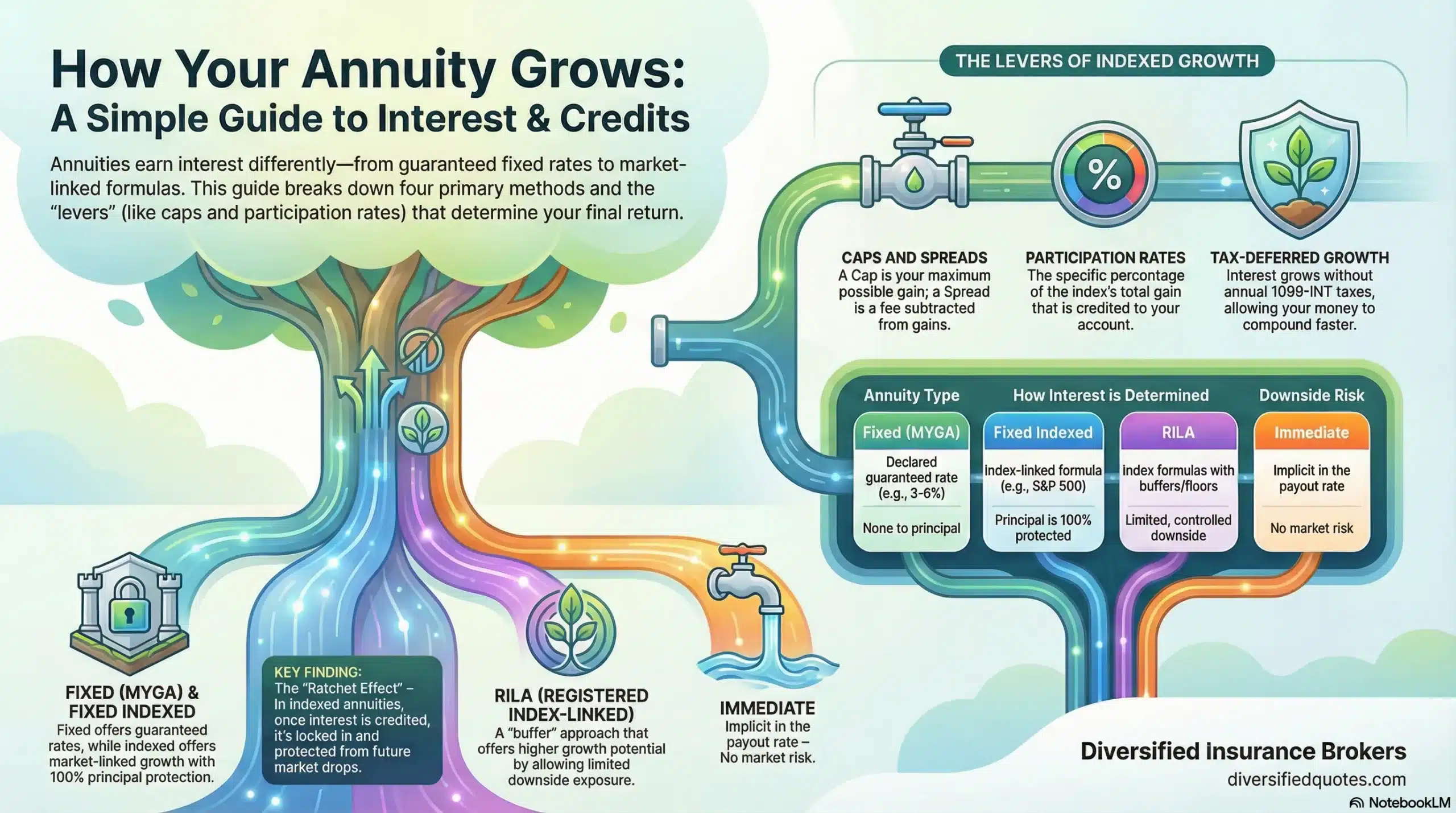
Fixed indexed annuities without income riders are appropriate when the Roth conversion objective is accumulation with upside potential linked to index performance, principal protection from market loss, and a longer accumulation horizon before income is needed. The FIA’s index-linked crediting — capped or participation-rate-based depending on the product design — provides more growth potential than a MYGA over multi-year periods with positive index performance, while the zero-floor protection ensures the Roth principal cannot decline due to market performance. The tax-free environment of the Roth wrapper eliminates the annual tax drag that would otherwise apply to FIA interest in a non-qualified account, making the FIA’s compounding more efficient inside Roth than in a taxable context. Our resource on what is a fixed indexed annuity covers the crediting mechanics and our resource on fixed annuities vs. fixed indexed annuities compares the structural tradeoffs for Roth-funded accumulation. Our deferred annuity calculator provides the modeling tool for projecting what a Roth-funded FIA would grow to under different growth rate assumptions before income is activated. Our resource on simple vs. compound interest in annuities covers how the interest crediting mechanism affects long-term accumulation differently across product types — important context for evaluating FIA growth projections inside a Roth.
Income Riders and Roth Annuities — Creating Tax-Free Lifetime Paychecks
Fixed indexed annuities with guaranteed lifetime withdrawal benefit (GLWB) income riders represent the most powerful application of the Roth conversion with an annuity strategy for retirees whose primary objective is guaranteed lifetime income rather than accumulation. The income rider adds a separately tracked benefit base — often growing at a contractually defined roll-up rate during the deferral period — that determines the amount of guaranteed lifetime income the rider will pay when activated. When the annuity is funded with qualified Roth funds and the rider’s lifetime income is activated after the five-year and age-59½ qualification conditions are met, every income payment arrives as a qualified Roth distribution: tax-free, invisible to provisional income calculations, and irrelevant to IRMAA surcharge determinations.
The income rider’s mechanics — the roll-up rate, the payout percentage at activation age, and the interaction between the benefit base and the account value — determine how much lifetime income the Roth annuity will produce. Our resource on what is an income rider covers the fundamental mechanics. Our resource on roll-up vs. payout rate covers the specific evaluation framework for comparing income rider designs across carriers — which matters because the product that offers the highest roll-up rate does not necessarily produce the most income at the activation age due to differences in payout percentages. Our resource on do income riders have fees covers the rider charge structure that reduces the account value growth rate in exchange for the income guarantee — a trade-off that must be evaluated in the context of the Roth-funded income objective. Our resource on how does a GLWB work covers the full mechanics of how the guaranteed withdrawal benefit protects lifetime income even after the account value is depleted. And our annuity payout calculator provides the income projection tool for modeling how different account values and activation ages translate to monthly tax-free income.
RMD Elimination — The Structural Advantage That Changes the Retirement Income Architecture
The elimination of Required Minimum Distributions for Roth IRA owners during their lifetime is not just a technical feature — it is a fundamental restructuring of the retirement income architecture. Traditional IRA annuities force distributions beginning at age 73 regardless of whether the owner needs the income, regardless of market conditions at the time, and regardless of the tax consequence of adding that income to the year’s total. Those forced distributions add to taxable income, potentially pushing Social Security benefits into higher taxability percentages, potentially triggering or escalating Medicare IRMAA surcharges, and potentially generating tax liability that the retiree has no cash available outside the IRA to pay.
A Roth annuity eliminates all three of these forced-distribution problems simultaneously. No RMDs means the annuity continues to grow or accumulate tax-free on the owner’s schedule rather than the IRS’s schedule. No RMDs means Social Security provisional income is not inflated by mandatory distributions the owner doesn’t need. No RMDs means Medicare IRMAA calculations are not pushed upward by IRA withdrawals that were compulsory rather than chosen. And no RMDs means the estate that passes to heirs is larger than it would have been under a traditional IRA that has been partially depleted by years of mandatory distributions, even when the owner had other income sources that made those distributions unnecessary for living expenses. Our resource on does inheritance affect RMDs covers the distribution rules that do apply to inherited Roth accounts — including the 10-year rule for non-spouse beneficiaries — which defines how heirs manage the tax-free Roth annuity inheritance.
Surrender Charges, Liquidity, and Roth Annuity Planning
Every annuity — whether Roth-funded or traditionally funded — operates under a surrender schedule during which full or partial withdrawals beyond the free withdrawal provision trigger carrier-imposed surrender charges that reduce the distributed amount below the account value. The Roth wrapper does not change the annuity’s contractual surrender structure: a five-year MYGA funded with Roth dollars has the same surrender schedule as a five-year MYGA funded with traditional IRA dollars. The difference is that distributions from the Roth annuity — including free withdrawals during the surrender period — are tax-free on qualification, while the same free withdrawals from a traditional IRA annuity generate ordinary income.
For Roth conversion planning combined with annuity selection, the surrender period and the free withdrawal provision must be evaluated alongside the conversion timeline. A retiree who converts funds in Year 1, places them in a seven-year MYGA, and plans to activate GLWB income at year eight needs both the Roth five-year clock and the annuity’s seven-year surrender period to have expired before full access to the account value is available without restriction. Coordinating these timelines — the Roth qualification period, the annuity surrender period, and the planned income activation date — is one of the more intricate planning elements that distinguishes a well-designed Roth + annuity strategy from an improvised one. Our resource on annuity surrender charges explained covers the surrender schedule mechanics, and our resource on annuity free withdrawal rules covers how the free withdrawal provision provides partial liquidity during the surrender period — important for the Roth annuity owner who may need some access to funds before the surrender period fully expires.
IRMAA Management — Why Tax-Free Income Changes Medicare Cost Planning
Medicare IRMAA (Income-Related Monthly Adjustment Amount) surcharges add meaningfully to Medicare Part B and Part D premiums for retirees whose modified adjusted gross income exceeds specified thresholds — thresholds that are adjusted annually and that can trigger hundreds of additional monthly premium costs per person per year for retirees in the higher income bands. The IRMAA calculation uses income from two years prior, which means income decisions made at age 71 affect Medicare premiums at age 73. For retirees who receive mandatory RMDs from large traditional IRA accounts, those distributions can push MAGI above IRMAA thresholds regardless of whether the retiree needed or wanted the income.
Qualified Roth IRA withdrawals — including annuity income payments from a Roth-funded annuity — are excluded from the IRMAA income calculation. A retiree who replaces $40,000 of annual traditional IRA RMD income with $40,000 of annual Roth annuity income may find that their MAGI drops by the exact amount of the Roth conversion that was executed earlier — and that the IRMAA surcharges triggered by the traditional IRA distributions disappear entirely. For some retirees, the annual Medicare premium savings from IRMAA reduction alone can justify a meaningful portion of the Roth conversion’s upfront tax cost, making the strategy economically compelling even before accounting for the broader income tax savings over a long retirement. This IRMAA interaction is one of the most commonly underappreciated financial planning advantages of a well-designed Roth conversion with an annuity strategy. Our resource on guaranteed income from annuities covers the income activation structures that allow Roth-funded annuity income to serve as the IRMAA-invisible replacement for RMD-driven income, and our resource on pension alternative covers the broader framework for using annuity-based guaranteed income to replicate the predictability of pension income without the tax disadvantages of traditional IRA distributions.
Estate Planning Advantages of Roth + Annuity
The estate planning advantage of a Roth IRA — that beneficiaries inherit the funds income-tax-free — extends to the annuity funded with those Roth dollars. A beneficiary who inherits a traditional IRA annuity receives a fully taxable asset: every distribution during the 10-year distribution window required for most non-spouse beneficiaries adds to the beneficiary’s ordinary income for the year. A beneficiary who inherits a Roth IRA annuity receives a tax-free asset: qualified distributions during the 10-year window arrive without income tax regardless of the beneficiary’s own income level or tax bracket. For high-earning heirs — such as adult children in peak earning years — this distinction between inheriting a taxable traditional IRA annuity and a tax-free Roth IRA annuity can represent a difference of hundreds of thousands of dollars in effective inheritance after taxes, even when the pre-tax account values are identical.
The annuity’s own beneficiary provisions — which govern how the death benefit is paid and whether a surviving spouse can continue the annuity contract — interact with the Roth’s tax-free inheritance benefit to create particularly efficient estate outcomes. Our resource on how annuities earn interest covers the accumulation mechanics that determine how large the Roth annuity’s account value will be at the time of the owner’s death, and our resource on what is a deferred income annuity covers the specific annuity structure that some retirees use to pre-schedule tax-free income for a defined future date — with the beneficiary provisions designed to protect the remaining benefit when the owner dies before the full income period has elapsed. Our resource on sequence of returns risk covers the market timing vulnerability that makes the Roth annuity’s principal protection particularly valuable in the years immediately before and after retirement — when a market-linked account’s value is most vulnerable to the irreversible damage that poor early-year returns can inflict on long-term income sustainability.
Coordinating the Strategy — Conversion Years, Annuity Selection, and Income Timing
The Roth conversion with an annuity strategy works best when the three major decisions — conversion timing, annuity product selection, and income activation date — are coordinated around the same planning horizon rather than made sequentially without reference to each other. A retiree who decides to convert in Year 1, selects an annuity with a ten-year income rider deferral, and expects income activation at Year 10 has a completely different planning picture than a retiree who converts in Year 1, selects a five-year MYGA, and plans to activate income at Year 6. Each scenario requires a different approach to bridge income during the deferral period, a different tax cost estimate for the conversion year, and a different product design.
The bridge income question — how will living expenses be covered during the conversion and annuity deferral period — is often what determines whether the strategy is feasible. Some retirees have pension income that covers expenses while Roth conversion and annuity deferral proceeds. Others draw from taxable brokerage accounts during the conversion window, using up low-basis assets at favorable capital gains rates while simultaneously converting traditional IRA assets to Roth at favorable ordinary income rates. Some use annuity free withdrawals from the Roth annuity itself during the deferral period — a strategy that requires careful coordination with the annuity’s free withdrawal provision and the planned income rider mechanics. And some use a separate non-Roth income bridge — such as a deferred income annuity funded from non-Roth assets — to cover the deferral period while the Roth annuity accumulates. Our resource on common annuity myths covers the misconceptions that most often derail otherwise sound strategies during the implementation phase — including the mistaken belief that tax-free Roth income means no planning is required after conversion, when in fact the annuity selection, surrender period management, and income timing decisions remain as important after conversion as before.
Model Your Roth + Annuity Strategy With Real Carrier Rates
We model conversion timing, projected tax cost, annuity growth assumptions, and lifetime income projections before implementation — so every piece of the strategy is coordinated before a single dollar moves.
Request Your Roth + Annuity Analysis Call 800-533-5969Related Pages
Annuity taxation, income rider mechanics, and guaranteed lifetime income planning resources.
Financial Protection Essentials
Annuity guarantees, interest rate examples by investment size, and retirement income strategies in practice.
Talk to an Advisor or Request Your Annuity Quote
Ready to explore this annuity in more detail—or compare it with other carriers to see if even higher rates are available? With guaranteed income, principal protection, and long-term growth potential on the line, making the right choice is essential. The experienced advisors at Diversified Insurance Brokers will guide you through the options and design a strategy tailored to your retirement goals.
Schedule here:
calendly.com/jason-dibcompanies/diversified-quotes
Licensed in all 50 states • Fiduciary, family-owned since 1980
FAQs: Roth Conversion With an Annuity
Is a Roth IRA conversion always a good idea before buying an annuity?
Not always — and the decision requires modeling the complete picture before committing. A Roth conversion triggers ordinary income tax in the conversion year, which means the strategy works best when the current year’s marginal tax rate is lower than the expected future marginal rate that would apply to traditional IRA distributions. For most retirees, the best conversion window is after wages stop but before Social Security or RMDs begin — a period during which taxable income is temporarily lower than it will be once those sources activate. If the conversion would push the current year’s income into a significantly higher bracket, or if it would trigger IRMAA surcharges for Medicare two years later, the timing may be wrong even if the long-term Roth + annuity strategy is sound. The annuity selection also affects the calculation: converting into a product with a long surrender period that prevents access to funds for many years creates a different planning picture than converting into a more liquid structure. The right answer requires modeling conversion size, projected tax cost, annuity growth assumptions, and lifetime income projections for the specific household — not a generic rule about whether conversion “always” helps. Our resource on Roth conversions covers the timing and bracket management framework in detail.
Are annuity payments tax-free if funded with Roth IRA money?
Yes, if the Roth IRA has met the five-year rule and the owner is age 59½ or older, qualified distributions — including annuity income payments — are income-tax-free. The five-year clock for a Roth IRA begins January 1 of the tax year for which the first Roth IRA contribution or conversion is made. For conversion-funded Roth IRAs, there is technically a separate five-year holding period for each converted amount’s principal, but once the owner reaches age 59½, the penalty concern that the per-conversion five-year rule addresses no longer applies. The practical result for retirement-age owners who converted five or more years ago is that all qualified distributions — including the periodic income payments from a Roth-funded annuity with a GLWB rider — arrive completely income-tax-free. This tax-free character extends to IRMAA calculations (Roth withdrawals don’t count toward provisional income) and to Social Security benefit taxation (excluded from the provisional income that determines how much Social Security is taxed). Our resource on how to transfer a Roth IRA to an annuity covers the mechanics of moving qualified Roth funds into the annuity structure without triggering any tax event.
Do Roth IRAs have Required Minimum Distributions?
No — unlike traditional IRAs, Roth IRAs do not impose lifetime Required Minimum Distributions on the original account owner. This RMD exemption is one of the most structurally important advantages of the Roth + annuity combination, because it allows the Roth annuity to grow and accumulate on the owner’s schedule rather than the IRS’s schedule. A traditional IRA annuity begins generating mandatory taxable distributions at age 73 regardless of whether the owner needs the income — distributions that add to taxable income, can push Social Security benefits into higher taxability thresholds, and can trigger or escalate Medicare IRMAA surcharges. A Roth IRA annuity never generates mandatory lifetime distributions for the original owner. Note that beneficiaries who inherit a Roth IRA — including one held in an annuity — are subject to the 10-year distribution rule under SECURE 2.0 for most non-spouse beneficiaries. However, those inherited Roth distributions remain qualified and income-tax-free during the 10-year distribution period, providing a tax-free inheritance rather than the fully taxable traditional IRA inheritance that most heirs would otherwise receive. Our resource on RMD rules under SECURE 2.0 covers how the updated framework affects both traditional IRA RMD planning and the inherited Roth distribution rules that apply to beneficiaries.
What type of annuity works best with a Roth conversion?
The annuity type that best pairs with converted Roth funds depends entirely on the objective. For protected accumulation at a guaranteed rate over a defined time horizon — often used when the conversion is executed several years before income is needed — a MYGA (multi-year guaranteed annuity) provides the most predictable growth: a declared interest rate guaranteed for the contract term, with principal protection and full tax-free access on qualification. For accumulation with upside growth potential linked to index performance and principal protection from market loss — often used when a longer deferral period is planned and some growth premium over a guaranteed rate is acceptable — a fixed indexed annuity without an income rider is the appropriate structure. For the ultimate objective of guaranteed lifetime tax-free income — the most compelling application of the Roth + annuity strategy — a fixed indexed annuity with a GLWB income rider converts the accumulated Roth value into lifetime income payments that arrive tax-free, without market risk, and without ever being depleted. The combination of income guarantee and tax-free character creates income that is both certain and invisible to the tax calculations that govern IRMAA, Social Security taxation, and ordinary income bracket management. Our resources on what is a fixed annuity and what is a fixed indexed annuity cover the structural differences, and our resource on what is an income rider covers the specific GLWB mechanics that produce guaranteed lifetime income payments.
Can a Roth annuity help reduce future tax risk from legislative changes?
Yes — and this is one of the most compelling long-term arguments for the Roth conversion with an annuity strategy. Federal income tax rates are set by Congress and can be changed by future legislation. The provisions of the Tax Cuts and Jobs Act that reduced marginal rates in 2017 are scheduled to sunset, and future rate increases are a genuine planning concern for retirees who expect to live through multiple legislative cycles. A traditional IRA — whether held in an annuity or not — is exposed to whatever ordinary income tax rate applies at the time of each distribution. A Roth IRA annuity, assuming the conversion was executed and the qualification conditions were met under current law, locks in the tax-free treatment of qualified distributions regardless of what rates apply in the future. The annuity layer adds contractual income security on top of this legislative insulation: guaranteed lifetime income payments that cannot be reduced by market performance or legislative action, and that remain tax-free under the qualified Roth distribution rules. The combination of protected income and legislative insulation addresses two of the most common sources of retirement income uncertainty simultaneously. Our resource on common annuity myths covers the misconceptions that can lead people to undervalue this dual-protection feature of the Roth + annuity combination.
How does IRMAA interact with a Roth-funded annuity income strategy?
Medicare IRMAA (Income-Related Monthly Adjustment Amount) surcharges are calculated based on modified adjusted gross income from two years prior. Qualified Roth IRA distributions — including annuity income payments from a Roth-funded annuity — are excluded from MAGI for IRMAA calculation purposes, which means they do not trigger or escalate Medicare Part B and Part D premium surcharges. In contrast, distributions from a traditional IRA annuity — including mandatory RMDs — count fully toward MAGI and can push retirees into higher IRMAA tiers, potentially adding hundreds of dollars per month to Medicare premiums per person. For a retiree who is generating $40,000 or more annually from traditional IRA distributions, eliminating those distributions through Roth conversion and replacing them with tax-free Roth annuity income can reduce MAGI below the IRMAA threshold — potentially saving thousands of dollars annually in Medicare surcharges. Over a retirement that spans 20 to 30 years, these annual Medicare savings can represent a significant component of the Roth conversion’s total economic benefit — one that must be included in any comprehensive evaluation of whether the conversion’s upfront tax cost is justified.
What are the surrender charge implications of placing Roth funds in an annuity?
Annuity surrender charges apply to the Roth-funded annuity exactly as they would to any other annuity funding source — the Roth wrapper does not change or eliminate the carrier’s contractual surrender schedule. Most annuities allow penalty-free withdrawals of up to 10% of the account value annually during the surrender period (some carriers offer cumulative free withdrawal provisions), but withdrawals beyond this allowance trigger the carrier’s declining surrender charge schedule that reduces to zero at the end of the surrender period. For Roth + annuity planning, the surrender period must be coordinated with the planned income activation date, the Roth five-year clock, and any anticipated liquidity needs during the deferral period. A retiree who converts at 62, places funds in a seven-year MYGA, and needs partial access at age 66 must plan for the fact that the five-year Roth clock (satisfied at 67) and the seven-year surrender period (ending at 69) both constrain full tax-free, penalty-free access until those respective windows close. Our resource on annuity surrender charges explained covers the surrender schedule mechanics, and our resource on annuity free withdrawal rules covers the partial access provisions that allow liquidity during the surrender period.
How does the Roth + annuity strategy interact with Social Security claiming timing?
The Roth + annuity strategy interacts with Social Security claiming timing in two important ways. First, during the Roth conversion window — typically the period between retirement and Social Security activation — the lower income environment that makes conversions most tax-efficient overlaps with the period that also allows maximum delayed retirement credits to accumulate. A retiree who converts pre-tax IRA dollars to Roth between ages 63 and 70 while delaying Social Security is simultaneously reducing future taxable RMD income (through Roth conversion) and increasing the future guaranteed Social Security benefit (through delayed retirement credits). The resulting retirement income architecture — higher tax-free Roth annuity income plus a higher tax-partially-free Social Security benefit — is more tax-efficient than either strategy executed in isolation. Second, because qualified Roth distributions are excluded from Social Security provisional income, a retiree drawing tax-free income from a Roth annuity keeps a lower percentage of their Social Security benefit subject to income tax compared to a retiree drawing the same amount from a traditional IRA annuity. Our resource on sequence of returns risk covers the market timing vulnerability that makes the combination of guaranteed Roth annuity income and maximized Social Security benefits particularly valuable for retirees in the critical early years of retirement when portfolio losses are most damaging.
About the Author:
Jason Stolz, CLTC, CRPC, DIA, CAA and Chief Underwriter at Diversified Insurance Brokers (NPN 20471358), is a senior insurance and retirement professional with more than 25 years of real-world experience helping individuals, families, and business owners protect their income, assets, and long-term financial stability. As a long-time partner of the nationally licensed independent agency Diversified Insurance Brokers, Jason provides trusted guidance across multiple specialties—including fixed and indexed annuities, long-term care planning, personal and business disability insurance, life insurance solutions, Group Health, Travel Medical and Evacuation Insurance, and short-term health coverage. Diversified Insurance Brokers maintains active contracts with over 100 highly rated insurance carriers, ensuring clients have access to a broad and competitive marketplace.
His practical, education-first approach has earned recognition in publications such as VoyageATL, and contributions from his agency featured in Kiplinger and GoBankingRates— highlighting his commitment to financial clarity and client-focused planning. Drawing on deep product knowledge and years of hands-on field experience, Jason helps clients evaluate carriers, compare strategies, and build retirement and protection plans that are both secure and cost-efficient. Visitors who want to explore current annuity rates and compare options across multiple insurers can also use this annuity quote and comparison tool.
Explore More Annuity Options: Browse our complete guide to Annuity Strategies & Retirement Income — covering tax strategies, retirement income planning, lifetime income & annuity comparisons from 100+ carriers.
Last Reviewed: August 3, 2026 |
Reviewed by: Jason Stolz, CLTC, CRPC, DIA, CAA
Chief Underwriter, Diversified Insurance Brokers, Inc. | NPN: 20471358 | Diversified Insurance Brokers, Inc. — Licensed in all 50 states
Fact Checked by: Tonia Pettitt, CMIP©
Medicare Specialist, Diversified Insurance Brokers, Inc. | NPN: 14374308 | Diversified Insurance Brokers, Inc. — Licensed in all 50 states
Did you find this content helpful? Leave us a Google review — it helps others find trustworthy guidance too.
Editorial Standards: Diversified Insurance Brokers maintains rigorous editorial standards to ensure accuracy, clarity, and independence in all content. Learn more about our editorial standards and commitment to transparency.
