
Disability Income Insurance for General Contractors
As an Independent Disability Insurance Broker, we have access to exclusive discounts and negotiated pricing most captive agents can’t offer — see the full breakdown near the end of this page.
Disability Income Insurance for General Contractors

Jason Stolz CLTC, CRPC, DIA, CAA
General contractors occupy a unique position in the construction industry — responsible for orchestrating complex projects that require managing subcontractors, coordinating materials and timelines, ensuring code compliance, maintaining client relationships, and often carrying personal liability for project outcomes. The income generated from this work is meaningful, but it is also entirely dependent on the contractor’s ability to actively participate in their business. A disability that prevents a GC from supervising sites, meeting with clients, managing bid schedules, or overseeing subcontractor performance can interrupt income completely — while the business overhead structure of a construction operation continues regardless of whether the owner is working. The disability insurance services available to self-employed construction professionals address both layers of this financial exposure, and the broader income protection insurance framework covers how individual policies are structured for business owners whose personal income and business operations are intertwined.
Most general contractors working as business owners have no employer-sponsored disability coverage. Unlike employees who may have group LTD through a workplace plan, self-employed GCs and construction business owners must independently secure their own income protection. When a health event or injury prevents work, income stops immediately — while employee payroll, equipment lease payments, insurance premiums, vehicle costs, licensing fees, and other business overhead continue. At Diversified Insurance Brokers, we help general contractors and construction business owners structure disability coverage that addresses both the personal income replacement need and the business overhead exposure that most owners underestimate until it becomes a crisis.
Compare Disability Insurance for General Contractors
We compare options across 100+ carriers and structure coverage around your specific duties, business structure, and overhead obligations.
Disability Income Insurance for General Contractors — Occupational Class, Risk Factors, and Coverage Design
| Coverage Dimension | The General Contractor Reality | What the Right Design Looks Like |
|---|---|---|
| Occupational class — the most variable factor | GC occupational class depends heavily on how the work is actually performed; primarily management-oriented GCs (estimating, project management, site supervision, client relationships) qualify for higher classes than GCs who regularly perform hands-on physical trade work; the split between management and physical labor on the application significantly affects the assigned class and available definitions | Accurately describe actual daily duties on the application — the proportion of time spent managing, estimating, and supervising versus performing physical work; GCs whose business primarily runs through project management, bidding, and subcontractor coordination should describe those duties clearly to support the highest available class |
| Own-occupation definition | A GC who cannot manage job sites, supervise crews, conduct client meetings, or coordinate subcontractors due to a back condition, mobility limitation, or health issue is genuinely unable to perform their occupation — but may still be capable of office-based work; any-occupation language would deny this claim because other work is possible | True own-occupation coverage that pays benefits when you cannot perform the material duties of general contracting — project management, site supervision, client coordination, bid management — even if other types of work remain theoretically possible; essential for preventing the “you can do desk work” denial argument |
| Income documentation | GC income is project-based and fluctuates with construction cycles, economic conditions, and project pipeline; self-employed contractors document income through Schedule C, S-corp K-1, or business tax returns; gross revenue can be very high while net income after payroll, materials, equipment, and overhead costs is the figure carriers use for benefit calculation | Two to three years of business tax returns establishing average net income; benefit sized to documented net income that reflects actual personal spendable earnings; income variability across boom and slow construction cycles is typically averaged rather than using peak-year income as the sole basis |
| Business overhead exposure | Construction businesses carry significant fixed overhead that does not stop during a disability — employee wages and payroll taxes, equipment lease payments, vehicle costs, contractor licensing fees, general liability and workers’ compensation insurance premiums, office or storage costs, and ongoing project obligations to clients | Personal LTD policy covering household income replacement needs; separate Business Overhead Expense policy covering documented fixed business costs during disability; these address two distinct financial problems and must be structured as separate layers — personal disability benefits should not be stretched to cover business overhead |
| Physical risk profile | Falls on job sites, equipment accidents, back and musculoskeletal injuries from physical site work and material handling, vehicle accidents from daily travel between multiple project sites, and cumulative physical strain from years of construction-related activity all contribute to a disability risk profile that is more elevated than office-based professions | Coverage for disability from any cause — not just on-the-job injuries; 90% of disabling conditions are from illness, not accidents; workers’ compensation typically does not cover self-employed GC owners, meaning all non-work-related disability causes (illness, off-site injury) require individual coverage for any protection at all |
| Key person and business continuity | In most GC businesses, the owner is the key person holding contractor licenses, client relationships, bonding capacity, and project knowledge; a disability that incapacitates the owner does not just interrupt personal income — it may make ongoing projects unmanageable, client relationships unserviceable, and new business impossible to generate | Personal LTD + BOE policy address the owner’s income and business overhead; key person disability coverage addresses what happens to the business itself when the licensed contractor who drives revenue cannot perform; for multi-owner or partnership-structured construction businesses, buy-sell disability coverage funds ownership transition if a disability triggers a buyout |
Why Occupational Class Is the Most Critical Variable for GCs
General contractor disability insurance is one of the most carrier-variable occupational placements in the industry. Unlike software developers who universally receive the highest class or heavy laborers who consistently receive lower classes, general contractors span a wide range depending on what they actually do. A GC who primarily works as a project manager — reviewing bids, managing subcontractor relationships, coordinating with architects and engineers, conducting client meetings, and visiting sites primarily for inspections rather than physical work — qualifies for a significantly higher occupational class than a GC who regularly performs framing, finishing, or other physical trade work alongside their crews. The occupational class affects not only premium pricing but also the definitions available, the maximum monthly benefit allowed, the benefit period length, and the rider options accessible. Correctly describing actual day-to-day duties — rather than defaulting to a general “construction contractor” job title — is the most important step in the application process for a GC seeking disability coverage. The full occupational class framework is at disability insurance by occupation, and the risk context for physical construction roles is at disability insurance for high-risk occupations.
Physical Risks and the Disability Exposure GCs Underestimate
General contractors often underestimate their disability risk because they think of their work as primarily managerial. But most GC operations involve frequent physical site presence — climbing to elevated surfaces for inspections, navigating active construction environments with uneven terrain and equipment hazards, lifting and moving materials to demonstrate or verify work quality, and extensive daily driving between multiple project sites. Falls and musculoskeletal injuries from site visits are among the most common acute disability causes for construction professionals. Back conditions, knee problems, and shoulder injuries from the cumulative physical demands of years of site work affect a meaningful share of construction business owners in their 40s and 50s. Vehicle accidents from the significant daily mileage between project sites represent a consistent occupational risk that is often overlooked. These physical exposure patterns closely parallel the disability profiles of trade subcontractors who work under GC direction — construction superintendents and workers, electricians, plumbers, and carpenters who face similar physical risk from the same site environments. Roofers and home and building inspectors face overlapping site-visit physical exposure. Beyond physical injury, illness — heart disease, cancer, neurological conditions, and other health events — represents approximately 90% of all disabling conditions and is equally real for construction business owners as for any other profession. Own-occupation disability coverage ensures that conditions preventing GC-specific duties produce benefits regardless of whether some other type of work remains theoretically possible.
Why Workers’ Compensation Does Not Fill the Gap
Self-employed general contractors are typically excluded from workers’ compensation coverage or may elect out of it. Even for those with some workers’ comp coverage, the limitation is fundamental: workers’ compensation covers only work-related injuries and occupational illnesses — approximately 5% of disabling conditions. The other 95% — including the illnesses that account for the vast majority of long-term disability events — receive nothing under workers’ compensation. For self-employed GCs, the individual disability policy is the only income protection against health conditions, off-site accidents, and illness-related disabilities. Disability insurance for 1099 workers and disability insurance for independent contractors cover the coverage structure for construction professionals operating outside traditional employer-employee arrangements.
Residual Disability and the Partial Recovery Pattern
Many GC disabilities do not follow a clean all-or-nothing pattern. A back condition that prevents extended site walking may still allow client meetings and project management from an office or vehicle. A knee injury that prevents climbing may allow supervision of accessible ground-level work. A recovery from cardiac surgery may allow a reduced workload before full return. In each scenario, income drops meaningfully — project throughput declines, client service suffers, new bid capacity is reduced — without meeting a total disability threshold. The residual disability rider pays proportional benefits when income drops 20-25%+ from a qualifying condition, covering the partial recovery phase that often spans months in construction-related injury rehabilitation. For GC business owners whose project revenue directly tracks their personal capacity to manage those projects, the residual rider is frequently the feature that delivers the most real-world financial support during the most common type of disability event.
Business Overhead Expense — The Layer Most GC Owners Miss
A personal LTD policy replaces household income. It does not pay employee wages, equipment lease payments, contractor licensing fees, or general liability insurance premiums. For a GC business with two to three employees, a fleet of vehicles, and active equipment leases, the monthly fixed overhead costs that continue during a disability can easily exceed $10,000-$20,000 per month — obligations that a personal disability benefit is not designed to address. Business overhead disability insurance and the companion disability business overhead expense coverage specifically address documented fixed business costs during a disability period, preventing the business from deteriorating financially while recovery occurs. For GC businesses where the owner is also the licensed contractor whose license makes the business operationally functional, a disability that prevents the owner from managing operations raises the additional question of what happens to ongoing project commitments and client relationships. The key person disability insurance framework addresses how the business itself is funded during a key operator’s disability, separate from the personal income and overhead coverage layers. For multi-owner construction partnerships or businesses where ownership transitions might be triggered by disability, disability insurance for high earners and business owners covers the full planning architecture. The tax advantage of individually owned policies — benefits generally received income-tax-free when premiums are paid personally after-tax — is covered at are disability insurance payments taxable.
Policy Design — Sizing Coverage for Project-Based Income
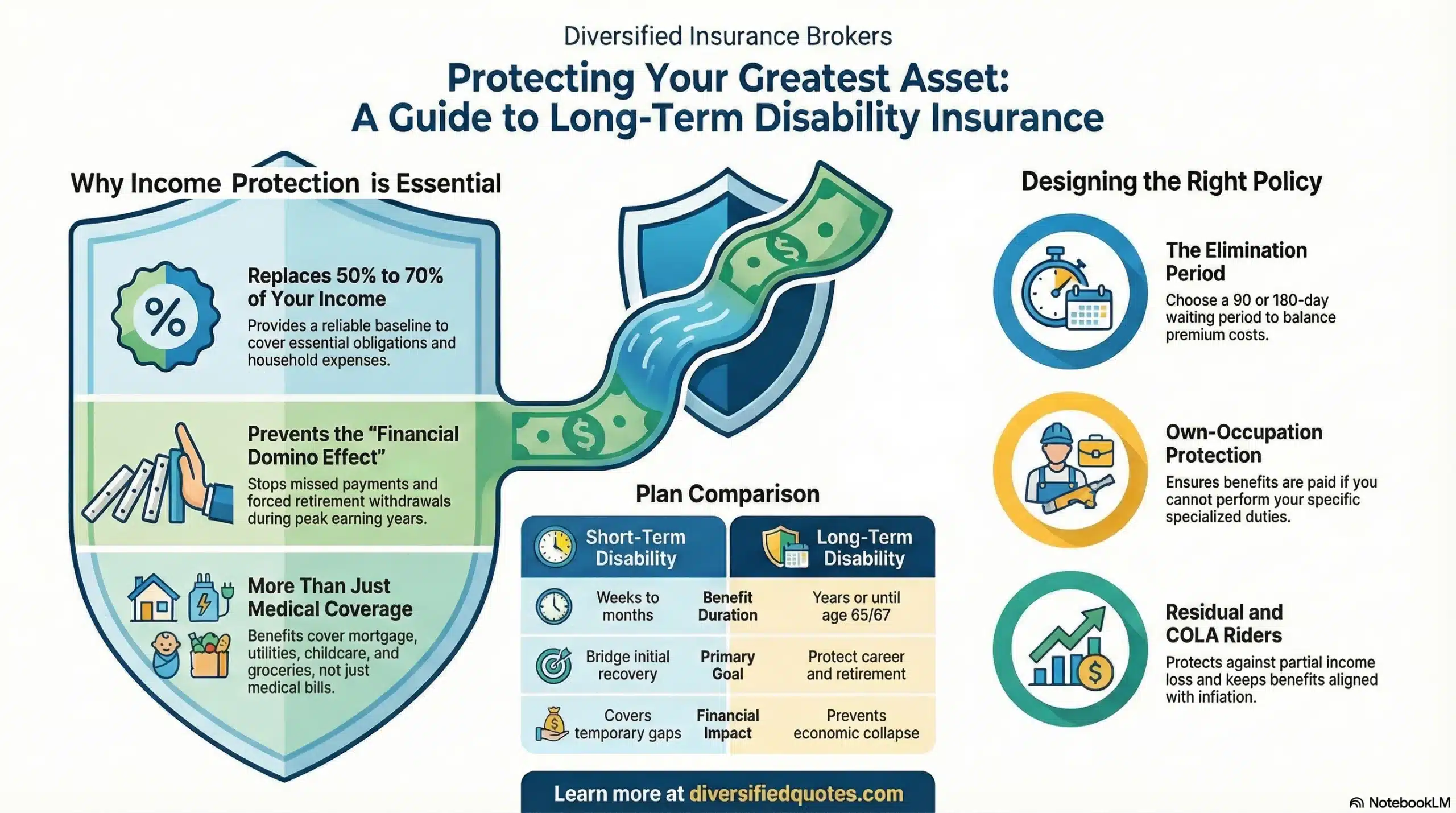
The elimination period should be calibrated against available business and personal emergency reserves — the gap before the policy activates must be bridged from savings without depleting retirement accounts or taking on debt. For GC business owners with meaningful cash reserves and active project cash flow that may continue briefly after disability onset, a 90-day elimination period is often practical. For newer or smaller operations with limited liquidity, shorter elimination periods reduce the financial risk during the initial gap. The benefit period should extend to retirement age — long-term disability insurance with a to-age-65 or to-age-67 benefit period protects against career-ending conditions that leave decades of earning potential at risk. The benefit sizing framework — based on net documented personal income rather than gross project revenue — is at how much disability insurance do I need. For an independent review of any existing or proposed disability policy, get a 2nd opinion on your disability insurance quote covers the evaluation process.
Talk With an Advisor Today
Choose how you’d like to connect—call or message us, then book a time that works for you.
Schedule here:
calendly.com/jason-dibcompanies/diversified-quotes
Licensed in all 50 states • Fiduciary, family-owned since 1980
FAQs: Disability Income Insurance for General Contractors
What occupational class do general contractors typically qualify for?
General contractor occupational class varies more than almost any other construction occupation because it depends directly on what the GC actually does. GCs whose work is primarily project management — estimating, bidding, supervising subcontractors, client meetings, and site inspections — qualify for higher occupational classes that produce better definitions and more competitive premiums. GCs who regularly perform hands-on physical trade work alongside their crews receive lower classifications reflecting the higher physical risk. Most carriers evaluate GC applications individually based on the described duty breakdown rather than assigning a single class to the entire occupation. Accurately describing the actual proportion of management versus physical work is the most important step in the application process.
Does workers’ compensation cover general contractors who become disabled?
For most self-employed general contractors, no — or only to a very limited extent. Self-employed GC owners are typically exempt from mandatory workers’ compensation or may elect out of coverage. Even where workers’ comp applies, it covers only work-related injuries and occupational illnesses — approximately 5% of disabling conditions. The other 95%, including all illness-based disabilities (cancer, heart disease, neurological conditions, diabetes complications), off-site injuries, and mental health conditions, receive no workers’ compensation protection. Individual disability income insurance covers disability from any cause, regardless of whether it is work-related.
Do general contractors need Business Overhead Expense coverage in addition to personal LTD?
For GC businesses with employees, equipment, vehicles, or ongoing fixed business costs — yes. A personal LTD policy replaces household income only; it does not cover employee wages, equipment lease payments, licensing fees, or insurance premiums that continue during a disability. Business Overhead Expense insurance specifically covers documented fixed business costs during a disability period. For a GC business with two to three employees and active equipment obligations, monthly overhead can easily exceed $10,000-$20,000 — obligations that would rapidly deplete personal disability benefits if BOE coverage is not in place as a separate layer.
How is disability benefit amount calculated for self-employed general contractors?
Carriers base disability benefit amounts on net income — the personal income generated after business expenses, not gross project revenue. A GC with $800,000 in annual project revenue may have net personal income of $120,000-$180,000 after payroll, materials, equipment costs, insurance, and other business expenses are deducted. The benefit is sized to the net income figure because that is the income supporting the owner’s personal financial obligations. Two to three years of tax returns are typically required, and variable income across construction cycles is usually averaged to establish the baseline for benefit calculation.
What happens to a GC’s business if the owner is disabled and cannot manage projects?
In most GC businesses, the owner holds the contractor license, client relationships, bonding capacity, and project knowledge that make the business operationally functional. A disability that incapacitates the owner does not just interrupt personal income — it may make ongoing projects unmanageable, new bid activity impossible, and existing client obligations difficult to fulfill. Personal LTD and BOE coverage address the financial dimensions. Key person disability coverage addresses what happens to the business itself — funding that can be used to hire interim management, complete projects, or wind down operations in an orderly way. For GC businesses with partners or co-owners, buy-sell disability coverage funds an ownership buyout if a permanent disability triggers a transition.
Browse Disability Insurance for Trades, Construction & Industrial
About the Author:
Jason Stolz, CLTC, CRPC, DIA, CAA and Chief Underwriter at Diversified Insurance Brokers (NPN 20471358), is a senior insurance and retirement professional with more than 25 years of real-world experience helping individuals, families, and business owners protect their income, assets, and long-term financial stability. As a long-time partner of the nationally licensed independent agency Diversified Insurance Brokers, Jason provides trusted guidance across multiple specialties—including fixed and indexed annuities, long-term care planning, personal and business disability insurance, life insurance solutions, Group Health, Travel Medical and Evacuation Insurance, and short-term health coverage. Diversified Insurance Brokers maintains active contracts with over 100 highly rated insurance carriers, ensuring clients have access to a broad and competitive marketplace.
His practical, education-first approach has earned recognition in publications such as VoyageATL, and contributions from his agency featured in Kiplinger and GoBankingRates— highlighting his commitment to financial clarity and client-focused planning. Drawing on deep product knowledge and years of hands-on field experience, Jason helps clients evaluate carriers, compare strategies, and build retirement and protection plans that are both secure and cost-efficient. Visitors who want to explore current annuity rates and compare options across multiple insurers can also use this annuity quote and comparison tool.
Explore All Disability Insurance Options: Browse our complete Disability Insurance guide — covering occupations, high risk jobs, medical professionals, self-employed, and planning strategies from 100+ carriers.
Last Reviewed: June 7, 2026 |
Reviewed by: Jason Stolz, CLTC, CRPC, DIA, CAA
Chief Underwriter, Diversified Insurance Brokers, Inc. | NPN: 20471358 | Diversified Insurance Brokers, Inc. — Licensed in all 50 states
Fact Checked by: Tonia Pettitt, CMIP©
Medicare Specialist, Diversified Insurance Brokers, Inc. | NPN: 14374308 | Diversified Insurance Brokers, Inc. — Licensed in all 50 states
Did you find this content helpful? Leave us a Google review — it helps others find trustworthy guidance too.
Editorial Standards: Diversified Insurance Brokers maintains rigorous editorial standards to ensure accuracy, clarity, and independence in all content. Learn more about our editorial standards and commitment to transparency.
