
Disability Insurance for Home and Building Inspectors
As an Independent Disability Insurance Broker, we have access to exclusive discounts and negotiated pricing most captive agents can’t offer — see the full breakdown near the end of this page.
Disability Insurance for Home and Building Inspectors

Jason Stolz CLTC, CRPC, DIA, CAA
Disability insurance for home and building inspectors is income protection built around a career that depends entirely on physical mobility, stamina, and sensory acuity. Home inspectors and building inspectors earn their income by crawling through crawlspaces, navigating attics with low clearance and limited ventilation, climbing onto roofs, descending into electrical panels, and moving through structures of every age and condition — often alone, often in extreme temperatures, and often in the physical positions that most commonly produce disabling musculoskeletal injuries. When an inspector cannot physically perform that work, income stops. Unlike a desk professional whose employer may offer sick days, group disability benefits, or the ability to work modified duties, most home and building inspectors are self-employed or own small inspection businesses with no meaningful financial safety net behind them other than what they have personally arranged.
At Diversified Insurance Brokers, we help home inspectors and building inspectors across all specializations — residential home inspection, commercial building inspection, structural and foundation inspection, radon and environmental testing, and code compliance inspection — structure disability insurance coverage that reflects the genuine physical demands and occupational risks of their work. A well-structured policy provides income replacement from any qualifying disability, whether it originates from a fall on a job site, a chronic musculoskeletal condition that develops over years of physically demanding inspection work, or a medical event that has nothing to do with the job at all.
Get Disability Insurance Quotes for Home and Building Inspectors
We compare carriers, explain occupational class ratings, and structure policies built for the real physical risks of inspection work.
Request Disability Insurance OptionsWhat Home and Building Inspectors Actually Do — and Why It Creates Real Disability Risk
The physical profile of inspection work is far more demanding than most outsiders — and most insurance underwriters without specific occupational knowledge — tend to recognize. A typical residential home inspection involves dozens of distinct physical tasks: climbing exterior ladders to access roof surfaces, navigating attic spaces with limited headroom that require sustained crawling and kneeling, descending into basement crawlspaces with restricted clearance, moving through tight utility areas around HVAC equipment, electrical panels, and plumbing systems, testing windows and doors throughout the structure, and documenting conditions across every accessible area of the property. A single inspection can involve several ladder climbs, extended periods of sustained kneeling and crouching, overhead work reaching into panel boxes and around ductwork, and significant time on hard or uneven surfaces.
Commercial building inspectors face similarly demanding conditions with additional scale: larger structures, more complex mechanical and electrical systems, more extensive roof surface areas to navigate, and in some cases construction-site conditions with active hazards. Inspectors who specialize in older buildings or those undergoing renovation face the additional exposure of potentially unstable structures, deteriorated materials, and close contact with substances that carry health risks including asbestos, lead, and mold. Every inspection type shares the same fundamental characteristic: the income comes only when the inspector can physically be present and physically perform the inspection. There is no remote substitute and no cognitive workaround for the mobility limitations that characterize the most common disabling conditions in this type of work.
The Most Common Disabling Conditions for Inspectors
Musculoskeletal injuries are the dominant disability risk for home and building inspectors, and the specific physical mechanics of inspection work create a predictable pattern of vulnerability. Knee injuries are among the most common, developing from repeated ladder climbing, sustained kneeling on hard surfaces during crawlspace and attic inspections, and the frequent transitions between standing, kneeling, and crouching that characterize a full inspection. Meniscus damage, cartilage deterioration, and ligament injuries can develop gradually from accumulated wear, or acutely from a single incident — a missed step on a ladder, an unstable surface in a crawlspace, or an unexpected fall navigating uneven terrain around the exterior of a structure. Either pathway can produce a condition that prevents an inspector from safely performing the physical work an inspection requires.
Back injuries follow a similar pattern. The combination of sustained awkward positioning — reaching into electrical panels overhead, crawling through low-clearance spaces, navigating tight corners around equipment — with the weight of inspection tools and equipment creates significant lower back and spinal loading. Herniated discs, lumbar strain, and degenerative spinal conditions are all documented occupational outcomes for workers who routinely perform the type of sustained positional work that inspection requires. Shoulder injuries from overhead reaching, hand and wrist conditions from repetitive testing and documentation work, and respiratory conditions from exposure to mold, dust, and other materials in older or damaged structures round out the occupational health risk profile for inspectors. Falls represent the most acute injury risk — falls from ladders, falls through weakened flooring or decking, and falls from rooftops are recurring serious injury events in inspection work that can produce fractures, head injuries, and spinal damage requiring months of recovery or producing permanent functional limitations. For comparable occupational injury profiles in physically demanding service trades, our resources on disability insurance for the woodworking industry and disability insurance for the automobile industry provide useful context on how physical service occupations with similar risk profiles are evaluated across carriers.
Why Most Home Inspectors Have No Disability Safety Net
The majority of home and building inspectors are self-employed or operate as sole proprietors of small inspection businesses. That employment structure creates a direct and immediate financial vulnerability: when the inspector cannot work, revenue stops entirely. Unlike employees of larger organizations who may have access to group disability plans, sick leave accrual, or modified duty assignments, a self-employed inspector has no institutional buffer between a disabling event and a financial crisis. Workers’ compensation covers only work-related injuries — and even then, only events that are clearly documented as occurring during a specific work task. It does not cover disabling conditions that develop gradually from cumulative occupational wear, it does not cover medical events unrelated to the job — cardiovascular events, cancer, non-occupational accidents — and it does not cover partial disability where an inspector can work reduced hours or a modified schedule but earns significantly less than normal.
Social Security Disability Insurance exists as a federal safety net, but the qualification standard requires demonstrating inability to perform virtually any gainful employment — an extremely high bar — and the application and approval process typically spans many months to years. During that period, no income replacement is provided. The financial consequences of waiting for SSDI while medical bills accumulate and business overhead continues are serious and often irreversible. Individual disability insurance fills this gap with a defined benefit amount, a defined waiting period, and a coverage structure that pays when the inspector cannot perform the specific physical duties of their occupation — not just when they cannot perform any work at all. Understanding how workers’ compensation’s narrow coverage scope leaves inspection professionals exposed to a much wider range of disabling events is foundational for any inspector evaluating their real financial vulnerability. For those also evaluating how income protection tools beyond disability insurance fit into their overall planning, our resource on income protection insurance covers the full spectrum of protection tools available alongside individual disability insurance.
How Disability Insurance Carriers Classify Home and Building Inspectors
Disability insurance carriers assign occupational class ratings that reflect the estimated disability risk of each profession. These ratings directly affect premium costs, the maximum benefit amounts available, and the specific policy features — including the strength of the disability definition — that a carrier will offer. Home and building inspectors are generally classified in the lower occupational class tiers because the physical demands, ladder and roof access, crawlspace work, and fall exposure that characterize the profession place it in a meaningfully different risk category than desk-based professional occupations. Within the inspection category, how an individual inspector’s duties are actually described to underwriters can matter significantly. An inspector who performs primarily residential home inspections with regular roof and attic access will typically be classified differently than a commercial building code compliance officer who spends substantial time reviewing plans and documents in an office environment. Presenting occupational duties accurately — including the percentage of time spent on physically demanding field work versus administrative, reporting, and client communication functions — is an area where working with an experienced independent broker produces meaningfully better classification outcomes than applying to a single carrier directly.
For inspectors who have begun building multi-inspector firms and who spend meaningful time supervising other inspectors, managing client relationships, and reviewing reports rather than personally performing every inspection, the supervisory and administrative component of the role may support a more favorable occupational classification. This is precisely the kind of nuance that an experienced independent broker identifies and presents to underwriters effectively. Our guide on how disability insurance elimination periods work provides essential context on how waiting period selection affects both premium cost and the financial planning implications of a disability for self-employed inspectors who need to understand exactly when benefits begin relative to when income stops. Comparing occupational classification considerations across related physically demanding service professions — including our resource on disability insurance for game wardens and disability insurance for convenience store owners — provides useful perspective on how occupational class ratings interact with premium structure across different physically active service occupations.
Case Study — Self-Employed Home Inspector, Knee Injury
Consider a self-employed home inspector completing twelve to fifteen inspections per week and generating approximately $85,000 per year in revenue. After developing a significant meniscus tear during a crawlspace inspection — crawling through a low-clearance space and landing awkwardly on a knee — this inspector requires surgery and a minimum of three months of recovery during which kneeling, ladder climbing, and sustained crouching are medically contraindicated. The table below illustrates the financial difference disability insurance makes in this specific scenario.
| Scenario | Without Disability Insurance | With Disability Insurance |
|---|---|---|
| Monthly Income During Recovery | $0 | $3,500–$4,500 |
| 3-Month Income Total | $0 | $10,500–$13,500 |
| Client Relationships | Agents and buyers referred elsewhere during absence | Financial stability allows planned return without desperation |
| Overhead During Recovery | Software, E&O insurance, vehicle costs continue regardless | Monthly benefit offsets ongoing business costs |
| Return-to-Work Pressure | Forced early return before full recovery, risk of re-injury | Full recovery supported on medical timeline |
Meniscus injuries from crawlspace access and repeated ladder climbing are among the most commonly documented occupational outcomes for home inspectors — the combination of hard landing surfaces, confined spaces, and awkward body mechanics during inspections creates exactly the mechanical loading that produces knee damage. Disability insurance for home and building inspectors ensures that this predictable occupational health event does not simultaneously become a financial emergency that forces premature return to work and risks career-ending re-injury. For additional occupational disability context across related physically demanding service professions, our resource on disability insurance for cosmetologists covers how similar physical service occupations with repetitive strain and positioning risks are evaluated and structured.
Key Policy Features That Matter Most for Inspectors
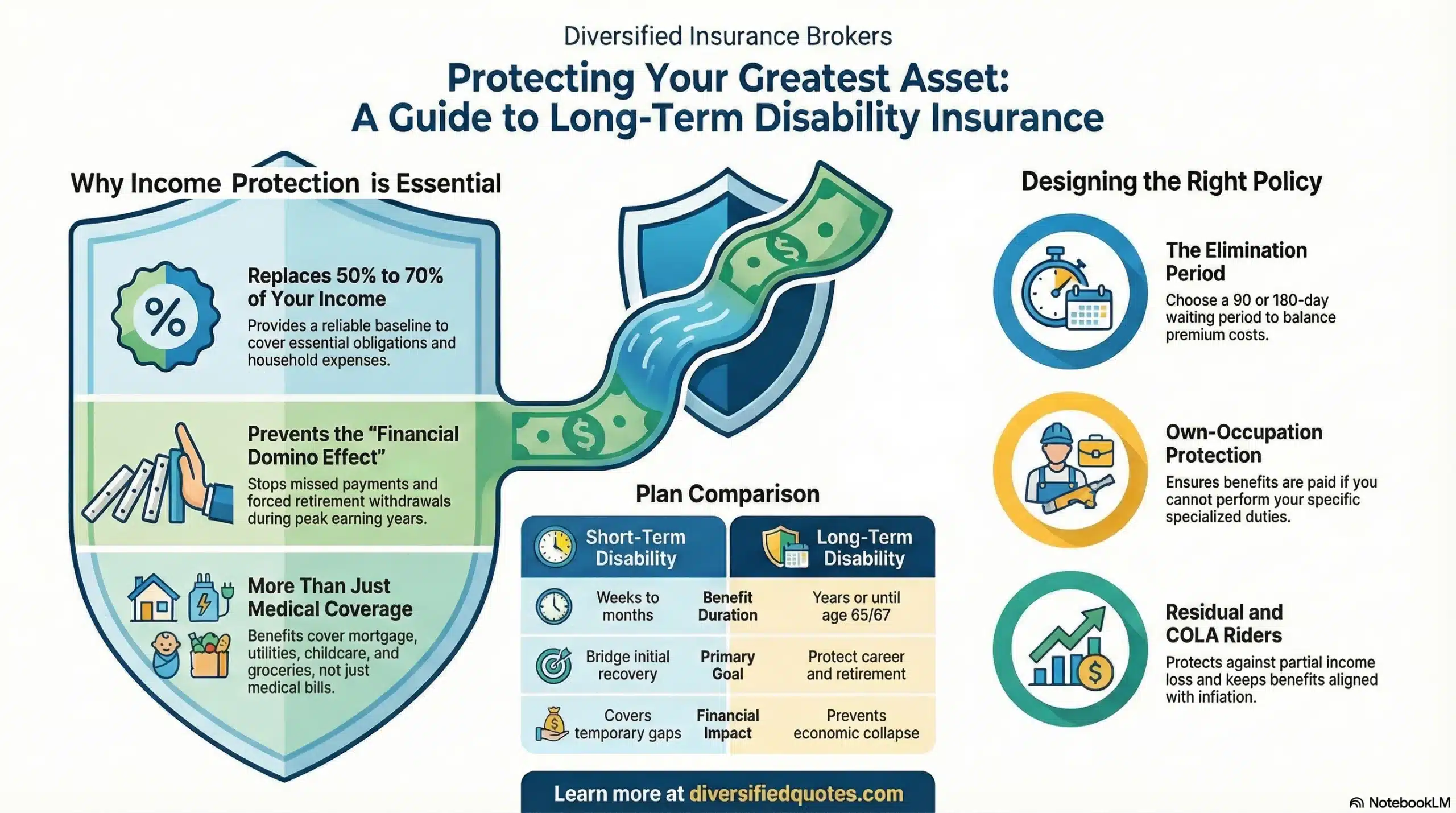
The own-occupation definition of disability is the most important policy feature for home and building inspectors. Under an own-occupation definition, the policy pays benefits when a condition prevents the inspector from performing the specific physical duties of their occupation — climbing ladders, navigating crawlspaces, accessing rooftops, conducting systematic physical examination of structures — regardless of whether they could theoretically perform other types of lighter or desk-based work. A home inspector whose knee injury prevents safe ladder climbing and sustained kneeling may technically be able to perform a sedentary desk job, but an own-occupation policy recognizes the genuine inability to work as an inspector and pays benefits accordingly. Without an own-occupation definition, benefits would only be paid if the insured could not perform virtually any gainful employment — a standard that would deny benefits to an injured inspector who could hypothetically answer phones or perform data entry, even though those activities bear no relationship to their actual profession or income. Our dedicated resource on own-occupation disability insurance explained covers how this definition protects inspection professionals in real disability scenarios and why the precise policy language around disability definition matters more than almost any other feature.
A residual disability rider is equally critical for inspection professionals whose conditions may reduce work capacity without eliminating it entirely. An inspector recovering from a back injury may be able to complete eight inspections per week instead of their normal fifteen — earning significantly reduced income without being totally disabled. Without residual disability coverage, a total-disability-only policy would provide no benefits during this partial recovery period, even though the inspector is earning far less than normal and is still dealing with a genuinely disabling condition. A residual disability rider supplements reduced earnings proportionally, providing continuous financial support from the onset of disability through to full return to normal inspection volume. For inspection business owners rebuilding their client base and referral network gradually after a disability, this rider is essential protection across the entire recovery arc. Our resource on how residual disability benefits work covers exactly how proportional benefit calculations function in practice and why self-employed inspection professionals almost universally benefit from having this rider in place. A cost-of-living adjustment rider adds further protection for inspectors facing long-term or permanent disability by maintaining the real purchasing power of the monthly benefit over years of sustained claim payment. Our resource on disability income insurance with a COLA rider explains how inflation protection works and when it is most valuable.
Self-Employment Income Documentation and Business Overhead Coverage
Because most home and building inspectors are self-employed, disability insurance underwriting involves specific income documentation requirements that differ from W-2 employee applications. Carriers base benefit amounts on verified earned income using federal tax returns — typically two to three years of Schedule C net profit for self-employed applicants. For inspection professionals who deduct significant business expenses — vehicle costs, errors and omissions insurance premiums, inspection software subscriptions, equipment, and continuing education — the reported net profit may understate the inspector’s actual financial need during a disability period, when household expenses continue regardless of what the tax return shows as net business income. Working with an experienced broker who understands how to document inspection income accurately and present the full financial picture to underwriters is an important step in securing a benefit amount that meaningfully replaces actual income rather than just the number that appears after all business deductions are taken.
Self-employed inspection business owners should also consider business overhead expense coverage alongside personal income replacement disability insurance. Business overhead expense policies cover the fixed costs of keeping the business operational during a disability — errors and omissions insurance premiums, professional licensing fees, software subscriptions, vehicle lease or loan payments, and any employee or subcontractor costs for inspectors who have begun building teams. These fixed costs continue regardless of whether the owner can work, and a business that stops paying them during a disability loses its ability to resume operation after recovery. For an inspector who has invested years building a client base and referral network with real estate agents and mortgage brokers, allowing the business to lapse during a disability and rebuilding from zero is often a worse outcome than the disability itself. Our resource on how to purchase short-term disability coverage provides context for inspectors evaluating their immediate income protection options alongside longer-term individual policies.
Why Independent Broker Access Matters for Inspection Professionals
Not every disability insurance carrier writes inspection occupational classifications equally. Some carriers approach inspection work with conservative restrictions — particularly around roof and ladder access — that result in exclusion riders eliminating the most relevant coverage categories for the inspector’s actual disability risk. Others write inspection professionals more comprehensively, offering coverage without specific occupational exclusions when the health profile and income documentation support a clean underwriting outcome. Identifying the carriers that offer the most comprehensive coverage for inspection work without exclusions that gut the policy’s real value requires independent access to the full carrier marketplace — not the product lineup of a single company. At Diversified Insurance Brokers, we evaluate options across multiple carriers for every home inspector and building inspector we serve. We understand how to present inspection occupational duties accurately to underwriters, how to navigate self-employment income documentation, and how to structure policy provisions — own-occupation definitions, residual disability riders, cost-of-living adjustment protection, and elimination period selection — in ways that produce genuinely comprehensive income protection rather than a generic policy that falls short when a claim actually occurs. Our dedicated resource on why independent disability insurance brokers matter explains the full value of this approach for service and trade professionals navigating the disability insurance marketplace.
When to Apply for Coverage
The best time for a home or building inspector to apply for disability insurance is as early as possible in their inspection career — before occupational health conditions have accumulated in the medical record. Disability insurance premiums are based in part on age and health status at the time of application, and younger applicants in good health secure the most comprehensive coverage at the most favorable rates. Conditions that develop over years of inspection work — knee deterioration, back conditions, shoulder problems — can result in exclusion riders that specifically eliminate coverage for those conditions, or in higher-rated premiums, if they are present and documented in the medical record at the time of application. An exclusion rider that eliminates coverage for knee conditions is a particularly significant problem for an inspector whose most plausible disability scenarios involve exactly those conditions. Applying before any inspection-related conditions are documented is the most important timing decision available to an inspector evaluating disability coverage. The coverage secured early in a career is the comprehensive coverage that remains in place when conditions develop later — and that is precisely when comprehensive coverage matters most.
Request Disability Insurance Quotes for Home and Building Inspectors
We compare carriers, explain how inspection work is classified, and structure policies that protect the income your inspection career depends on.
Get Disability Insurance QuotesRelated Disability Insurance Pages
Talk With an Advisor Today
Choose how you’d like to connect—call or message us, then book a time that works for you.
Schedule here:
calendly.com/jason-dibcompanies/diversified-quotes
Licensed in all 50 states • Fiduciary, family-owned since 1980
Disability Insurance for Home and Building Inspectors — FAQs
Yes — home inspectors and building inspectors can obtain individual disability insurance, though the occupation is typically classified in the lower physical labor tiers that reflect the hands-on, physically demanding nature of inspection work. The occupational class rating affects the premium cost and the specific policy features available, but disability insurance is obtainable from carriers that write service industry and field inspection occupational classifications. The most important variable in securing favorable terms is how inspection duties are presented to underwriters — specifically distinguishing the percentage of time spent on physically demanding field work versus administrative, reporting, and client-facing functions — and selecting carriers whose underwriting guidelines are most favorable for the inspection profession. Working with an independent broker who has experience placing inspection occupational classifications produces consistently better outcomes than applying to a single carrier directly.
Musculoskeletal injuries are the most prevalent disabling conditions for home and building inspectors, and they follow a predictable pattern based on the specific physical mechanics of inspection work. Knee injuries — including meniscus tears, ligament damage, and cartilage deterioration — are among the most commonly reported, developing from repeated ladder climbing, sustained kneeling on hard surfaces during crawlspace and attic inspections, and the frequent transitions between body positions that a comprehensive inspection requires. Back injuries including lumbar disc herniation, muscle strains, and progressive spinal conditions develop from the sustained awkward positioning, overhead reaching, and load-bearing that inspection work demands. Shoulder injuries from overhead access work, falls from ladders or rooftops, and respiratory conditions from exposure to mold, asbestos, and dust in older structures are additional documented disability risks specific to the inspection profession. The distinguishing characteristic of inspection-related musculoskeletal injuries is that they prevent the exact physical activities — ladder climbing, kneeling, crawling, overhead reaching — that the job requires, making an own-occupation disability definition particularly important for this profession.
Own-occupation disability insurance pays benefits when a condition prevents the insured from performing the specific physical duties of their own occupation, regardless of whether they could theoretically perform a different type of work. For a home inspector, this means benefits are paid when conditions prevent safe ladder climbing, sustained kneeling, crawlspace navigation, roof access, and the other physical activities that a thorough inspection requires — even if the inspector could hypothetically perform sedentary work like answering phones or reviewing documents. Under an any-occupation or modified any-occupation definition, benefits would only be paid if the insured could not perform virtually any gainful employment at all — which would deny benefits to an injured inspector who retains any capacity for light work, regardless of the gap between that light work and their actual professional income. For inspection professionals whose entire income depends on the ability to physically access and examine structures, the own-occupation definition is the most consequential single feature in any disability policy. Without it, the policy may provide little practical protection in the scenarios most likely to occur.
No — and the gaps in workers’ compensation coverage are significant for inspection professionals. Workers’ compensation covers injuries that are directly and demonstrably work-related and occur during a specific work event. It does not cover disabling conditions that develop gradually from cumulative occupational wear — which includes many of the chronic knee, back, and shoulder conditions that inspection work produces over time. It does not cover medical events with no occupational connection: a cardiovascular event, a cancer diagnosis, a non-work automobile accident, or any other disability that does not originate from a specific documented workplace incident. Workers’ compensation also provides limited partial disability income replacement for conditions that reduce but do not eliminate work capacity. Individual disability insurance covers disability from any cause regardless of how or where it originates, providing comprehensive protection across the full range of events that could prevent an inspector from working — not just the narrow subset of directly work-related acute injuries.
Residual disability coverage pays proportional benefits when a disability reduces earning capacity without eliminating the ability to work entirely. An inspector recovering from surgery who can safely complete eight inspections per week instead of their normal fifteen earns significantly reduced income without being totally disabled. A total-disability-only policy would provide no benefits during this period, even though the inspector is earning far less than normal and is still managing a genuinely disabling condition. A residual disability rider pays a proportional benefit based on the percentage reduction in earnings — ensuring continuous income support from the onset of disability through to full return to normal inspection volume. For self-employed inspectors who typically rebuild their referral network and client base gradually after a disability rather than returning immediately to full volume, this rider is essential protection across the entire recovery arc. Without it, a policy that looks comprehensive may provide no benefits during the most financially vulnerable phase of recovery — the period when the inspector can work somewhat but cannot yet generate full income.
The appropriate benefit amount for a home inspector is generally 60 to 70 percent of gross monthly earned income, which reflects the standard underwriting guideline most disability insurance carriers apply. For a self-employed inspector, this is calculated based on net earned income from Schedule C after business deductions, which can sometimes understate the inspector’s actual financial need — particularly when business deductions are significant relative to gross revenue. The practical question is not just what benefit amount the carrier will issue, but whether that amount would actually support the inspector’s household obligations during a disability. Fixed personal expenses — housing, utilities, food, insurance, loan payments — do not decrease during a disability simply because business income has decreased. Ensuring the benefit amount is calibrated to actual household financial need, and supplementing with a business overhead expense policy if fixed business costs are also a concern, produces a more complete and functional protection structure than simply accepting the default benefit amount a single carrier initially offers.
The elimination period — the waiting period between the onset of disability and when benefits begin — is a critical planning decision for self-employed inspectors who have no employer sick pay and typically no organizational income buffer. Inspectors with limited emergency savings and household expenses that depend on consistent weekly inspection revenue should strongly consider a 30 or 60-day elimination period, which reduces the amount of time between the onset of a disabling event and the arrival of benefit payments. The shorter the elimination period, the higher the premium — but for an inspector whose income stops immediately when they cannot perform an inspection, the financial cost of a 90-day wait without income can be severe. Inspectors with stronger cash reserves or a working spouse whose income covers essential household expenses may comfortably accept a 90-day elimination period to reduce the premium cost, particularly when paired with a business overhead expense policy that covers ongoing fixed business costs during the waiting window. The right choice depends on the specific household financial situation and how long the inspector could realistically sustain expenses without income replacement.
Yes — health history affects both eligibility and the terms of coverage offered. Disability insurance underwriting evaluates the full health picture alongside the occupational risk profile: blood pressure, cholesterol, BMI, musculoskeletal history, chronic conditions, and any documented history of the types of injuries or conditions most likely to produce a disability claim. For inspectors, this means that existing knee conditions, back problems, shoulder injuries, or other musculoskeletal issues documented in the medical record at the time of application can result in exclusion riders that specifically eliminate coverage for those conditions going forward. An exclusion rider removing coverage for knee conditions is a particularly significant problem for an inspector whose most probable disability scenarios involve exactly those joints. This is one of the most important reasons to apply for coverage as early as possible in an inspection career — before the physical wear of inspection work has produced documented conditions that underwriters will exclude. Applying while healthy and before any inspection-related conditions are on record secures comprehensive coverage that remains in place as conditions develop over subsequent years of work.
Yes — for self-employed inspection business owners who have fixed ongoing business costs, business overhead expense coverage is a meaningful complement to personal income replacement disability insurance. Business overhead expense insurance covers the fixed operating costs of the inspection business during a disability period when the owner cannot generate revenue: errors and omissions insurance premiums, professional licensing renewal fees, inspection software subscriptions, vehicle payments, and any costs associated with employees or subcontractors if the inspector has begun building a team. These costs continue regardless of whether the owner can perform inspections, creating a financial obligation on top of the personal income loss. A personal disability income policy replaces the inspector’s income for living expenses. A business overhead expense policy preserves the business infrastructure so the inspector can return to a functioning operation after recovery — rather than returning to find the business has effectively ceased during the disability and needing to rebuild from scratch. For inspectors who have invested years building a referral network with real estate agents and lenders, preserving that infrastructure during a disability is often as important as replacing personal income.
The best time is as early as possible in an inspection career, ideally before any occupational health conditions from the physical demands of inspection work have appeared in the medical record. Premiums are based in part on age and health status at the time of application — younger, healthier applicants secure the most comprehensive coverage at the most favorable rates. Conditions that develop over time from inspection work — knee deterioration from repeated ladder climbing and kneeling, back conditions from sustained awkward positioning, shoulder problems from overhead access work — can result in specific exclusion riders or higher rated premiums if they are already documented at the time of application. An inspector who applies before these conditions are recorded receives comprehensive coverage that continues to protect against those very conditions as they develop in future years. Waiting until conditions are already present often means buying coverage that specifically excludes the most likely disability scenarios, which significantly undermines the practical value of the policy. The coverage secured early is the comprehensive coverage available when it matters most — and that timing advantage cannot be recaptured once conditions have been documented.
About the Author:
Jason Stolz, CLTC, CRPC, DIA, CAA and Chief Underwriter at Diversified Insurance Brokers (NPN 20471358), is a senior insurance and retirement professional with more than 25 years of real-world experience helping individuals, families, and business owners protect their income, assets, and long-term financial stability. As a long-time partner of the nationally licensed independent agency Diversified Insurance Brokers, Jason provides trusted guidance across multiple specialties—including fixed and indexed annuities, long-term care planning, personal and business disability insurance, life insurance solutions, Group Health, Travel Medical and Evacuation Insurance, and short-term health coverage. Diversified Insurance Brokers maintains active contracts with over 100 highly rated insurance carriers, ensuring clients have access to a broad and competitive marketplace.
His practical, education-first approach has earned recognition in publications such as VoyageATL, and contributions from his agency featured in Kiplinger and GoBankingRates— highlighting his commitment to financial clarity and client-focused planning. Drawing on deep product knowledge and years of hands-on field experience, Jason helps clients evaluate carriers, compare strategies, and build retirement and protection plans that are both secure and cost-efficient. Visitors who want to explore current annuity rates and compare options across multiple insurers can also use this annuity quote and comparison tool.
Explore More Disability Insurance Options: Browse our complete guide to Disability Insurance for Trades, Construction & Industrial — covering contractors, electricians, plumbers, welders, roofers, machinists & skilled trades from 100+ carriers.
Last Reviewed: June 8, 2026 |
Reviewed by: Jason Stolz, CLTC, CRPC, DIA, CAA
Chief Underwriter, Diversified Insurance Brokers, Inc. | NPN: 20471358 | Diversified Insurance Brokers, Inc. — Licensed in all 50 states
Fact Checked by: Tonia Pettitt, CMIP©
Medicare Specialist, Diversified Insurance Brokers, Inc. | NPN: 14374308 | Diversified Insurance Brokers, Inc. — Licensed in all 50 states
Did you find this content helpful? Leave us a Google review — it helps others find trustworthy guidance too.
Editorial Standards: Diversified Insurance Brokers maintains rigorous editorial standards to ensure accuracy, clarity, and independence in all content. Learn more about our editorial standards and commitment to transparency.
