
How to Buy Short Term Disability Insurance Online
As an Independent Disability Insurance Broker, we have access to exclusive discounts and negotiated pricing most captive agents can’t offer — see the full breakdown near the end of this page.
How to Buy Short Term Disability Insurance Online

Jason Stolz CLTC, CRPC, DIA, CAA
Buying short-term disability insurance online is now a fully digital, self-directed process for most working adults — no agent appointments, no paper forms, no waiting weeks for underwriting decisions that take days through traditional channels. The online path exists because the need is immediate and practical: when an illness, injury, or surgical recovery temporarily keeps you from working, income stops. Bills do not. Rent or mortgage, utilities, childcare, car payments, and groceries continue on their normal schedule regardless of what is happening medically. Short-term disability insurance is the coverage specifically designed to bridge that gap — replacing a portion of income during the weeks or months of a qualifying disability so that a temporary medical event doesn’t become a permanent financial setback. This guide covers the complete process for buying short-term disability coverage online: what decisions you are making, how the application works, how to size the coverage correctly, and what to know after the policy is in place. For applicants who want to apply immediately, the Assurity online application below is available now with no agent involvement required.
Short-term disability is a more specific and more urgent protection category than most people realize before they’ve experienced income disruption firsthand. The common assumption is that disability means something dramatic and permanent — a career-ending accident or catastrophic illness. The statistical reality of short-term disability claims is far more ordinary: back surgery with a longer-than-expected recovery, a cardiac event requiring several weeks of restricted activity, a cancer diagnosis with chemotherapy that reduces capacity to work for months, a mental health episode that a physician certifies prevents normal work function, a high-risk pregnancy requiring early medical restriction from employment. These are the scenarios that generate the most short-term disability claims, and they are common enough that the financial exposure is real for virtually any working household that depends on a paycheck arriving on schedule. The online application process through Assurity is designed to be completed in a single session — answering health and employment questions accurately, selecting benefit design choices that fit your situation, and putting coverage in force typically within one to two business days. For applicants who want guidance alongside the self-service process, our disability insurance services overview covers our full approach to income protection.
The purpose of this page is to make the online buying process transparent and well-understood before you start — so the decisions you make in the application reflect your actual household needs rather than defaults you clicked through without a clear framework. The three core design decisions in any short-term disability application — elimination period, benefit amount, and benefit duration — each involve a meaningful trade-off between coverage quality, premium cost, and realistic protection value. Understanding those trade-offs before the application begins produces a better policy outcome than learning them after the fact. For context on the broader disability landscape and why income protection is the correct framing for this coverage, our resource on is disability insurance worth it covers the full “why” case, and our guide on why you need disability insurance even if you’re young and healthy addresses the most common objections before experience changes the perspective.
Buy Short-Term Disability Insurance Online
Apply securely through the Assurity online platform — no appointments, no agent interaction required, fast approval decisions.
Start Your Online ApplicationWhat Short-Term Disability Insurance Actually Does — The Core Purpose
Short-term disability insurance has one job: to replace a portion of your income for a defined period when a qualifying medical condition prevents you from working. It is not health insurance — it doesn’t pay your doctors or hospitals. It is not life insurance — it doesn’t pay a death benefit. It is income replacement in the form of a monthly or weekly benefit that you receive while you are medically unable to work, starting after the elimination period ends and continuing through the benefit period or until you return to work, whichever comes first. The benefit you receive can be spent on anything — mortgage or rent, utilities, food, childcare, car payments, debt service, or whatever else the household needs to stay stable while you recover.
The distinction between short-term and long-term disability is primarily one of timing. Short-term disability protects the early window of income disruption — the first days, weeks, and months — which is when household financial stress is typically most acute. Income stops immediately but the bills due this month don’t wait for a situation to resolve. Most short-term disability policies have elimination periods of seven to thirty days, after which benefits begin and continue for a defined benefit period that typically ranges from three to six months. Long-term disability coverage picks up after a longer elimination period — typically 90 to 180 days — and can continue for years or through retirement. The two are designed to work sequentially, not to duplicate each other. Our resources on short-term disability and long-term disability insurance cover each category in depth for applicants evaluating both.
What qualifies as a disability under a short-term disability policy depends on the carrier and policy definition — typically a physician-certified inability to perform the material duties of your occupation due to a covered illness or injury. Most non-occupational conditions qualify — illnesses, injuries, surgical recovery, maternity restrictions, and mental health conditions certified by a treating physician. Workers’ compensation is a different program that covers only work-related injuries and occupational illnesses; short-term disability covers disabilities arising from everyday life, not the workplace. For working adults who have limited sick leave, no employer-provided disability benefits, or a paycheck structure that stops immediately when they stop working, this distinction is the practical reason short-term disability coverage exists.
The Three Design Decisions That Shape Every Short-Term Disability Policy
Every short-term disability application — whether purchased online, through an employer, or through an agent — involves three core decisions that collectively define what the policy does, when it pays, and how much it costs. These decisions are made by the buyer, not preset by the carrier. Understanding the trade-offs before entering the application is the single most valuable preparation step for anyone buying online, because the application will present these choices sequentially and the premium will respond to each selection in real time.
The elimination period is the waiting period between the onset of a qualifying disability and the first benefit payment. For short-term disability, common elimination periods are seven days, fourteen days, and thirty days — measured from the date the disability begins, not the date the claim is filed. An elimination period of seven days means benefits can begin on day eight of a qualifying disability. Fourteen days means day fifteen. Thirty days means day thirty-one. The elimination period functions like a time-based deductible: the shorter it is, the sooner benefits arrive, and the higher the premium. Shorter elimination periods are appropriate for applicants with minimal sick leave or liquid savings. Longer elimination periods reduce premium cost and are appropriate for applicants who have sufficient coverage for the initial days and want to focus protection on a longer absence. Our disability insurance elimination periods guide covers this decision framework in depth for both short-term and long-term applications.
The benefit amount is the monthly income the policy replaces during a qualifying claim. For short-term disability, benefit amounts are typically set as a percentage of gross income — commonly 50% to 70% — up to carrier-defined monthly maximums. The correct benefit amount is the one that keeps the household stable during the disability, not the highest amount available. For most households, the essential metric is: what are the non-negotiable monthly obligations that cannot be deferred or reduced during a disability? Mortgage or rent, utility minimums, car payment, health insurance premium, childcare, debt payments, and basic food are the core. Sizing the benefit to cover those essentials — without over-insuring discretionary spending that can genuinely be deferred — produces the most cost-efficient protection design. Our resource on how much disability insurance do I need covers the income replacement calculation framework that applies equally to short-term and long-term coverage decisions.
The benefit period is how long the policy will continue paying benefits during a continuous qualifying disability. For short-term disability, benefit periods typically range from three months to six months, with some carriers offering up to twelve months or longer for certain products. The right benefit period is the one that addresses the realistic duration of concern for the applicant. For most working adults, the highest-stress window of a temporary disability is the first three to six months — before savings are fully depleted, before a disability qualifies for long-term coverage, and before a household starts making the irreversible financial decisions that compound the damage. Matching the benefit period to that window — rather than defaulting to the minimum available — produces the most complete short-term protection.
| Design Choice | Shorter / Lower | Longer / Higher | Key Consideration |
|---|---|---|---|
| Elimination Period | 7 days — benefits start quickly; higher premium | 30 days — longer wait; lower premium | Match to your sick leave and available savings |
| Benefit Amount | 50% replacement — covers essentials only | 70% replacement — covers more lifestyle | Size to essential non-deferrable monthly obligations |
| Benefit Period | 3 months — covers initial income gap | 6–12 months — covers extended recovery | Match to recovery risk tolerance; layer with LTD for longer tail |
How the Online Application Process Works — Step by Step
The Assurity online short-term disability application is a self-directed digital process that most applicants can complete in a single session. No agent interaction is required from start to finish. The application collects information, presents coverage options, quotes the premium based on your selections, and allows you to accept and bind coverage electronically. Understanding the general sequence before starting allows you to prepare the information you’ll need and make more deliberate design choices as the application progresses.
The application begins with basic eligibility and employment information. Occupation, employment status, and income are the foundational inputs — the benefit amount you can purchase is tied to your earned income, and occupational class affects both eligibility and premium. Most standard professional and administrative occupations qualify for online application without manual underwriting. Certain high-risk occupations — physically intensive manual labor, some construction categories, and others with elevated injury exposure — may encounter limitations in the online application or may be referred for manual review. If your occupation is in a higher-risk category, our broader how to buy disability insurance online guide covers how occupational class affects both eligibility and the carrier options available, and our disability insurance for high-risk occupations resource covers specialty underwriting for more complex occupation profiles.
Health history questions follow the occupational section. The health questionnaire for short-term disability is typically more streamlined than for long-term disability — reflecting the shorter benefit exposure the carrier is taking on — but accuracy remains essential. Disclose existing conditions honestly and completely. Pre-existing conditions may create benefit limitations or exclusion periods, but inaccurate disclosure can create claim denial at the worst possible time. The purpose of accurate disclosure is not just compliance — it is ensuring that the policy you purchase will actually pay when you need it, rather than creating a claim dispute based on undisclosed conditions that were present before the coverage began.
After the health and occupational sections, the application presents coverage choices — the three design decisions discussed above. This is where you select your elimination period, benefit amount, and benefit period, and where the premium adjusts in real time to reflect your selections. Take the time to model a few combinations: if the seven-day elimination period premium feels high, compare it to the fourteen-day version and consider whether you have enough sick leave or savings to bridge the additional week. If the six-month benefit period premium feels high compared to the three-month version, consider whether three months genuinely covers the risk window you’re trying to protect. These small deliberate comparisons during the design phase produce better coverage for the same or similar premium rather than defaulting to the cheapest structure without evaluating what that structure actually covers.
The final stages involve reviewing the offer, confirming your details, setting up premium payment, and electronically signing the application. Coverage typically becomes effective according to the policy’s stated effective date — confirming this date and retaining the policy documents immediately after purchase is an important post-purchase step.
How to Size Your Benefit Amount Correctly
The benefit amount is the monthly income replacement the policy provides — and sizing it correctly is more valuable than any other design decision because it determines whether the policy actually stabilizes the household when income stops. The most common mistake buyers make is choosing a benefit amount based on what feels comfortable to pay rather than what the household actually needs during a disability. A benefit that is too small fails the household at precisely the moment it was purchased to protect. The correct sizing approach starts with monthly obligations, not with a percentage.
The starting framework is to identify all non-deferrable monthly obligations — the payments that must continue during a disability without exception. Housing (mortgage or rent payment), essential utilities, health insurance premiums, vehicle payments, required debt minimums, childcare, and basic food represent the core category. These are the obligations where default or non-payment creates compounding financial damage — missed mortgage payments affect credit and can trigger late fees and eventual foreclosure proceedings, missed car payments create repossession risk, missed health insurance premiums can cause coverage to lapse during a period when medical care is most needed. Adding these essential obligations together establishes the minimum benefit amount that prevents immediate household instability. The appropriate benefit amount is at or above this floor — potentially higher if retirement contributions, savings goals, or other ongoing commitments are also important to protect during a disability period. Our guide on how much disability insurance do I need provides the full calculation framework for this exercise.
Employer Group Coverage vs. Individual Short-Term Disability
Many employed workers assume their employer’s benefits package includes short-term disability coverage — and many are correct in that assumption while being wrong about what the coverage actually provides. Employer group short-term disability is a real and valuable benefit when structured well, but it has three common characteristics that often leave employees with less protection than they expect. First, many employer group plans use sick-leave bank or salary continuation models for the first days or weeks, which means the “short-term disability” benefit often doesn’t begin until a specific number of sick days have been exhausted — which may not align with your actual sick leave balance. Second, group short-term disability benefits are typically funded with pre-tax employer dollars when employer-paid, which means benefits received during a claim are generally taxable as ordinary income — reducing the effective replacement percentage. Third, group coverage ends with employment, is not portable, and often has limited benefit amounts relative to higher-income earners.
Purchasing an individual short-term disability policy online supplements or replaces group coverage in ways that address each of these limitations. An individual policy is owned by you, not your employer — it remains in force regardless of employment changes as long as premiums are paid. Benefits from individually purchased policies with after-tax premiums are generally income-tax-free, improving effective replacement versus group benefits. And the individual policy’s design choices — elimination period, benefit amount, benefit period — are made by you based on your household’s specific needs, not by an HR department choosing a standard configuration for a diverse workforce. Even for employees who have some employer-provided short-term disability benefit, an individual policy can fill timing gaps, benefit amount gaps, or portability gaps that group coverage doesn’t address. The online buying process makes this supplemental coverage accessible without requiring an extended agent engagement for what is often a straightforward protection addition.
Self-Employed and Independent Contractors — The Strongest Use Case
For self-employed individuals, independent contractors, freelancers, and business owners, short-term disability insurance is not just a gap-filler — it is the only income protection available, because there is no employer to fall back on and no group benefit to supplement. When a self-employed professional stops working due to a disability, income typically stops immediately and completely. There is no paid sick leave, no salary continuation, no employer-funded short-term disability benefit, and no payroll to fund ongoing business expenses. The economic exposure of disability for a self-employed worker is often more severe than for an employed worker with equivalent income, precisely because the protection infrastructure that most employees take for granted simply does not exist.
Online buying is particularly well-suited to self-employed applicants because the self-service nature of the process matches the independent working style of most entrepreneurs and contractors. There is no employer HR department to coordinate with, no group enrollment period to wait for, and no eligibility requirement tied to employment status at a particular company. The self-employed applicant simply enters income information, answers occupation and health questions, selects their benefit design, and puts coverage in force on their own timeline. For self-employed applicants who also have business continuity concerns — protecting the business itself when the owner is unable to work — our resource on disability income insurance for key person employees covers the business ownership dimension of disability planning beyond personal income replacement.
State-Mandated Short-Term Disability — Are You Already Covered?
Five states currently operate mandatory short-term disability insurance programs for employees: California, Hawaii, New Jersey, New York, and Rhode Island. In these states, most employees are covered by a state-run or state-regulated short-term disability program as a condition of employment, funded through payroll deductions. If you live and work in one of these states, you likely have some baseline short-term disability protection already — though the benefit amount, waiting period, and duration may be different from what an individual policy would provide. The state benefit may be sufficient for some workers in these states, particularly those with lower income replacement needs or higher savings buffers. For workers with higher incomes whose benefit needs exceed state program maximums, or for self-employed workers in these states who are not covered by the mandatory program, individual coverage supplements or replaces the state benefit.
Workers in the remaining 45 states have no state-mandated short-term disability protection — the only income protection during a non-occupational disability is whatever the employer chooses to provide through their benefits package, or whatever the individual purchases on their own. For workers in these states with limited or no employer short-term disability benefit, the income risk of a temporary disability is entirely unmanaged without individual coverage. The online buying process makes this gap addressable quickly and without significant process overhead.
Pregnancy and Maternity Leave — The Most Common and Most Underplanned Use Case
Pregnancy-related disability is one of the most common short-term disability claim types — and one of the most poorly planned for, despite being one of the few foreseeable disability scenarios. A normal, uncomplicated delivery typically qualifies for a short-term disability benefit covering approximately six weeks of recovery for a vaginal birth and eight weeks for a cesarean section in most standard policy designs, though this varies by carrier. Pregnancy-related complications — gestational diabetes requiring medical restriction from work, preterm labor requiring bed rest, high-risk conditions requiring early cessation of employment — can extend the disability period significantly and may qualify for additional benefit coverage depending on the policy’s terms and the physician’s certification.
The critical planning consideration is that pregnancy-related disability coverage through individual short-term disability policies typically requires that the policy be purchased before conception — meaning coverage must be in force prior to becoming pregnant for pregnancy to be covered under most individual product designs. Pre-existing condition provisions in short-term disability policies vary by carrier, but applying for coverage after a pregnancy is already established typically means that pregnancy-related claims will be excluded from that policy’s coverage. This is one of the strongest arguments for not waiting to purchase short-term disability coverage — the timing of life events that create the greatest claim probability is not always predictable, and coverage purchased before a need arises is the only coverage that functions when the need occurs.
When to Layer Short-Term and Long-Term Disability Coverage
Short-term and long-term disability are designed to work together in sequence, not as alternatives. Short-term disability covers the early window — the first weeks and months of income disruption. Long-term disability activates after a longer elimination period, typically 90 to 180 days, and continues for years or through retirement. For working adults whose income is genuinely essential to their household’s financial plan, the complete protection picture includes both layers — short-term to handle immediate disruption, long-term to handle extended or permanent capacity reduction. The risk of relying only on short-term coverage is that any disability that extends beyond the short-term benefit period creates a gap: benefits have ended but long-term coverage’s elimination period hasn’t been met. For households where that gap period would create forced financial decisions — retirement account withdrawals, debt accumulation, credit damage — both layers are worth evaluating simultaneously.
The elimination period of a long-term disability policy can be set to coordinate with the end of a short-term benefit period. A six-month short-term disability benefit period paired with a 180-day long-term disability elimination period creates seamless sequential protection — short-term benefits run through month six, long-term benefits begin at month seven. This coordination requires that both policies be in place before any disability occurs and requires consistent application of the definitions and documentation standards of both policies during a claim. Our resource on long-term disability insurance covers how to structure the LTD layer, and our how much does disability insurance cost guide covers how the combined premium of both layers relates to the income risk being protected. For applicants who want to evaluate whether the combined investment is appropriate for their situation, our is disability insurance expensive resource provides that cost context directly.
Common Mistakes When Buying Short-Term Disability Online
The online buying process reduces friction — which is mostly a benefit, but occasionally produces decisions made too quickly without adequate deliberation. The most consequential mistakes are those that result in a policy that doesn’t protect what it was supposed to protect when a claim actually occurs. Understanding these patterns in advance makes them avoidable.
Choosing the lowest premium without understanding what was sacrificed is the most common mistake. The premium adjusts with every design choice — a longer elimination period, a lower benefit amount, and a shorter benefit period each reduce premium independently. A combination of all three produces a very low premium for a policy that may provide minimal actual protection. A seven-day elimination period for an applicant who has sufficient sick leave to cover the first two weeks is paying for a feature they won’t need. A benefit amount that covers only half of essential obligations means the household is still scrambling financially even with benefits in payment. A three-month benefit period for a disability that lasts five months means two months of zero income regardless of having bought a policy. The goal is not the cheapest policy — it is the most cost-effective protection for the realistic risk.
Inaccurate health disclosure is both a legal violation and a practical claim risk. Short-term disability policies have pre-existing condition provisions that define how recently disclosed conditions interact with coverage. Disclosing honestly allows the underwriter to apply the correct terms — which may include an exclusion or a limited benefit period for specific conditions, but which is far better than a claim denial after premiums have been paid. An applicant who fails to disclose a back condition and then files a claim for back surgery is creating a situation where the claim will be investigated, the prior condition will be identified, and the claim may be denied as a pre-existing condition exclusion applies to an undisclosed history. Accurate disclosure produces a policy that works as expected. Inaccurate disclosure produces a policy that fails at the worst moment.
Failing to read the policy document after purchase is a near-universal mistake that occasionally has significant consequences. The policy document confirms all specifications — benefit amount, elimination period, benefit period, covered conditions, exclusions, and claim procedures. If there is any discrepancy between what you selected during the application and what the policy document states, identifying it immediately allows for straightforward correction. Understanding how to file a claim before you need to — what documentation is required, what physician certification language the carrier needs, how to contact the claims department — means the claim process runs smoothly if an event occurs.
After Purchase — What to Know Before a Claim Occurs
Disability claims function very differently from health insurance claims. There is no simple card to swipe and no automatic billing relationship between your insurer and your healthcare providers. A disability claim is an income replacement mechanism — to file, you need a physician’s certification of your qualifying condition, documentation of your inability to perform work duties, and employer or income verification depending on your employment status. Understanding the claims process before a disability occurs is the most practical post-purchase preparation step, because disability events by definition often arrive when organizational capacity is reduced — which is not the optimal time to be learning the claims process for the first time.
After purchase, store the policy document and carrier contact information in a location where you and any relevant family members can access it. Confirm the claims phone number and the preferred claim initiation method — most carriers offer online claim filing, phone initiation, or both. Note any provisions in your policy that are relevant to realistic scenarios for your situation — pregnancy provisions if applicable, recurrent disability provisions that affect how a return-to-work followed by a re-occurrence is handled, and partial or residual disability provisions if the policy includes them. These provisions often define the difference between a claim that pays exactly as expected and one that requires additional documentation or clarification. Our broader disability insurance services overview covers how we support clients through the claims coordination process in addition to the initial coverage placement.
Related Disability Insurance Resources
Prefer to Review Options First?
Request a disability insurance review and we’ll help you evaluate elimination period, benefit amount, and benefit period choices against your specific income, occupation, and savings situation. No obligation.
Request a Disability Review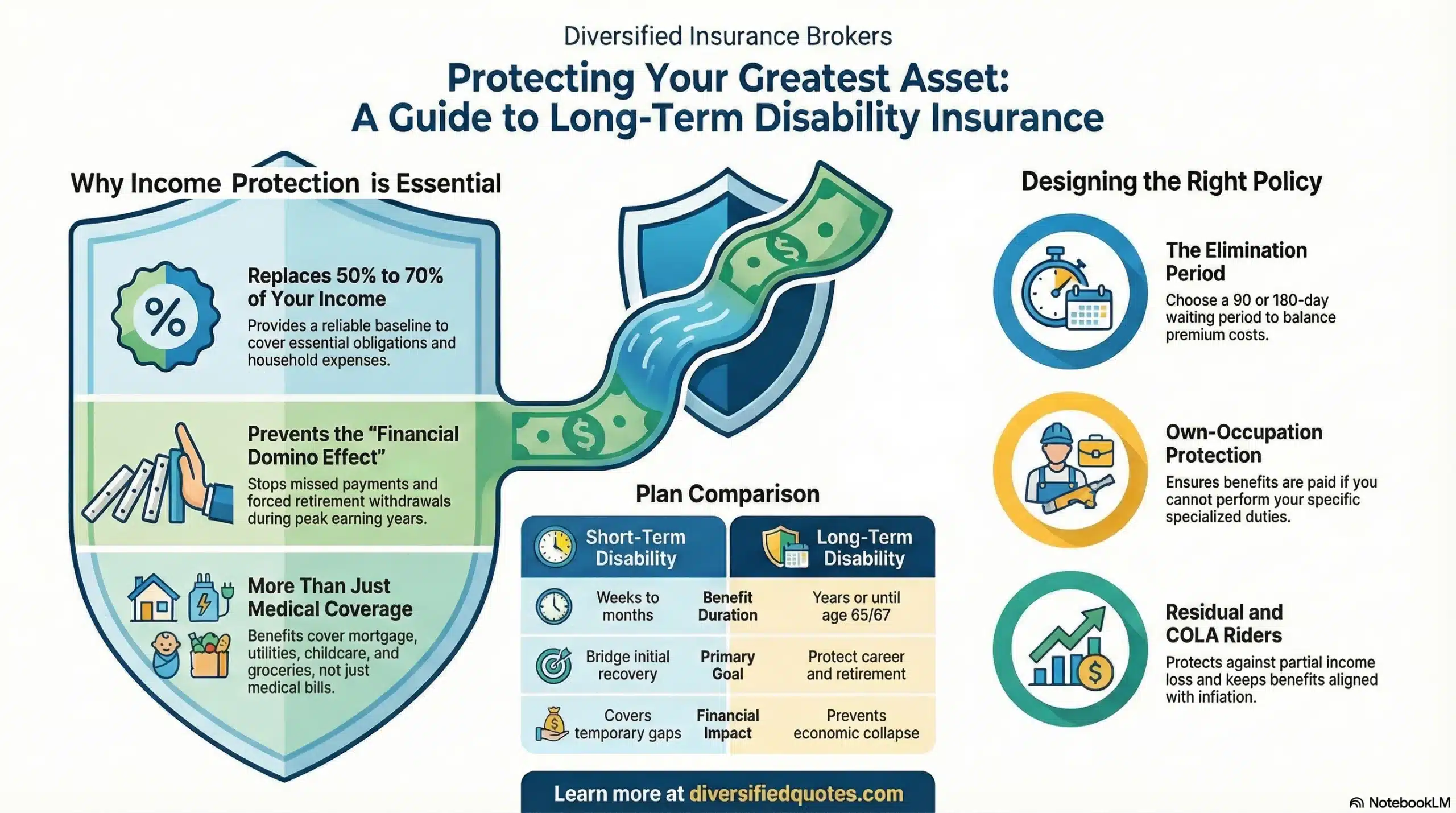
Talk With an Advisor Today
Choose how you’d like to connect—call or message us, then book a time that works for you.
Schedule here:
calendly.com/jason-dibcompanies/diversified-quotes
Licensed in all 50 states • Fiduciary, family-owned since 1980
FAQs: How to Buy Short-Term Disability Insurance Online
Can I buy short-term disability insurance entirely online?
Yes. The Assurity online application at quickstart.assurity.com/dib is a fully self-directed digital process — no agent appointments, no paper forms, and no phone calls required unless you choose to request guidance. The application collects your occupation, income, and health history, presents coverage design choices including elimination period, benefit amount, and benefit period, quotes the premium in real time, and allows you to bind coverage through electronic signature. Many applicants receive fast eligibility decisions. Some cases may require brief additional review before final approval. Either way, the process is substantially faster than traditional agent-mediated applications and allows you to maintain complete control of the timeline and design decisions.
What is an elimination period and how should I choose mine?
The elimination period is the waiting period between when a qualifying disability begins and when benefits start — a time-based deductible. For short-term disability, common elimination periods are seven, fourteen, and thirty days. The right elimination period matches your available sick leave and liquid savings — not the shortest available period, which maximizes premium cost, but the length of time you can genuinely bridge before needing benefit payments. If you have two weeks of accrued sick leave, a fourteen-day elimination period lets you exhaust sick leave and seamlessly transition to disability benefits on day fifteen. If you have limited sick leave and minimal savings, a seven-day elimination period provides faster benefit access. Longer elimination periods reduce premium but require more personal coverage for the initial days.
How long does short-term disability insurance pay?
The benefit period — how long benefits can be paid for a continuous qualifying disability — typically ranges from three to six months in standard short-term disability products, with some carriers offering up to twelve months. The right benefit period matches your actual risk tolerance: how long a disability could realistically last before you would either return to work or begin drawing on long-term disability coverage. For most working adults, the three-to-six-month window covers the highest-risk financial exposure period. Applicants who want protection beyond six months should evaluate both a longer short-term benefit period and a coordinated long-term disability policy that activates when short-term benefits end.
Do I need a medical exam to buy short-term disability online?
No. Most short-term disability online applications do not require a medical exam. Health history is evaluated through the application questionnaire — disclosing existing conditions, current medications, recent diagnoses, and recent treatment history. The carrier evaluates this information alongside occupational and income data to determine eligibility and policy terms. Pre-existing conditions may result in exclusion periods or limited benefit provisions for those specific conditions, but most applicants with stable, disclosed health histories are approved for coverage. Honest disclosure is both legally required and practically important — it ensures the policy’s terms align with your actual situation so coverage performs as expected when a claim occurs.
Is pregnancy covered by short-term disability insurance?
Yes — pregnancy-related disability is one of the most common short-term disability claim types. A normal uncomplicated delivery typically qualifies for a benefit covering approximately six weeks for vaginal birth and eight weeks for cesarean section in most standard products. Pregnancy complications requiring medical restriction from work, bed rest, or early cessation of employment can qualify for additional coverage. The critical planning point: most individual short-term disability policies require that coverage be purchased before conception — pregnancy is typically excluded as a pre-existing condition if coverage is applied for after pregnancy is established. This is one of the strongest arguments for purchasing short-term disability coverage before a specific need is foreseeable.
What if I already have employer disability coverage — do I still need individual short-term disability?
It depends on what your employer plan actually provides — and most employees don’t know until they need it. Employer group short-term disability benefits vary widely in elimination period length, benefit amount, and benefit duration. When funded with pre-tax employer dollars, the benefits are typically taxable as ordinary income — reducing the effective replacement percentage. Group coverage also ends with employment and is not portable. Individual short-term disability coverage supplements or replaces group coverage by providing additional benefit capacity, a better elimination period match, tax-free benefits with after-tax personal premiums, and portability that continues regardless of employment status. Even employees with some group coverage often benefit from an individual policy to address gaps in amount, timing, or portability.
Can self-employed people buy short-term disability insurance online?
Yes, and the online buying process is particularly well-suited to self-employed applicants. Self-employed individuals have no employer disability benefits, no paid sick leave, and no payroll safety net — their income stops immediately when they stop working. Individual short-term disability coverage is the only income protection available to them during a qualifying disability. The online application accepts self-employment income as the basis for benefit sizing and does not require employer verification in the traditional sense. Self-employed applicants provide income documentation or attestation according to the carrier’s requirements. The process is entirely self-directed and can be completed without any employer coordination.
About the Author:
Jason Stolz, CLTC, CRPC, DIA, CAA and Chief Underwriter at Diversified Insurance Brokers (NPN 20471358), is a senior insurance and retirement professional with more than 25 years of real-world experience helping individuals, families, and business owners protect their income, assets, and long-term financial stability. As a long-time partner of the nationally licensed independent agency Diversified Insurance Brokers, Jason provides trusted guidance across multiple specialties—including fixed and indexed annuities, long-term care planning, personal and business disability insurance, life insurance solutions, Group Health, Travel Medical and Evacuation Insurance, and short-term health coverage. Diversified Insurance Brokers maintains active contracts with over 100 highly rated insurance carriers, ensuring clients have access to a broad and competitive marketplace.
His practical, education-first approach has earned recognition in publications such as VoyageATL, and contributions from his agency featured in Kiplinger and GoBankingRates— highlighting his commitment to financial clarity and client-focused planning. Drawing on deep product knowledge and years of hands-on field experience, Jason helps clients evaluate carriers, compare strategies, and build retirement and protection plans that are both secure and cost-efficient. Visitors who want to explore current annuity rates and compare options across multiple insurers can also use this annuity quote and comparison tool.
Explore More Disability Insurance Options: Browse our complete guide to Disability Insurance Planning & Education — covering how it works, riders, elimination periods, own occupation, costs & buying guides from 100+ carriers.
Last Reviewed: June 2, 2026 |
Reviewed by: Jason Stolz, CLTC, CRPC, DIA, CAA
Chief Underwriter, Diversified Insurance Brokers, Inc. | NPN: 20471358 | Diversified Insurance Brokers, Inc. — Licensed in all 50 states
Fact Checked by: Tonia Pettitt, CMIP©
Medicare Specialist, Diversified Insurance Brokers, Inc. | NPN: 14374308 | Diversified Insurance Brokers, Inc. — Licensed in all 50 states
Did you find this content helpful? Leave us a Google review — it helps others find trustworthy guidance too.
Editorial Standards: Diversified Insurance Brokers maintains rigorous editorial standards to ensure accuracy, clarity, and independence in all content. Learn more about our editorial standards and commitment to transparency.
