
Why You Need Disability Insurance—Even If You’re Young and Healthy
Why You Need Disability Insurance—Even If You’re Young and Healthy
Ask any 30- or 40-year-old professional what their most valuable asset is and you will often hear “my home,” “my investment portfolio,” or “my 401(k).” But in reality, your single greatest financial asset is not something you have already accumulated — it is your future earning power. Over the course of a 20- or 30-year career, your ability to generate income can be worth millions of dollars. That income funds your mortgage, retirement savings, college plans for your children, business investments, travel goals, and long-term financial independence. Yet most people insure their homes, vehicles, and even their smartphones while leaving their income completely exposed. Disability insurance exists to protect that future income stream. If illness or injury prevents you from working, it replaces a portion of your paycheck so your financial life does not collapse at the exact moment you are physically or emotionally vulnerable.

Why Disability Risk Is Higher Than Most Professionals Assume
| Feature | Individual Disability Insurance | Employer Group DI | Self-Insuring (No Coverage) |
|---|---|---|---|
| Occupation Definition | True own-occupation available — benefits pay if you cannot perform your specific occupational duties, even if capable of working in another field. Critical for surgeons, dentists, attorneys, engineers, and other specialized professionals. | Typically “any occupation” or modified definition after 24 months — benefits stop if you can work in any capacity the insurer deems reasonable. Specialists most at risk of having claims denied under this standard. | No benefit paid — all lost income must be replaced from savings, investments, or debt. A 6-month disability at a $200,000 salary means $100,000 in lost income with no replacement mechanism. |
| Portability | Fully portable — the policy belongs to you, not your employer. Changing jobs, going independent, or starting a business does not affect coverage. Premiums and benefits remain as specified in the contract. | Non-portable in most cases — coverage typically ends when employment ends. New employer’s group plan may have different terms, lower benefits, or a waiting period before coverage begins. Health changes during the gap create re-enrollment risk. | Not applicable — no coverage to maintain or lose. Financial exposure is permanent and grows with income as savings requirements increase over time. |
| Premium Stability | Non-cancelable and guaranteed renewable provisions lock premiums and contract terms for the policy life — the insurer cannot increase premiums or reduce benefits as long as you pay on time. Available to young healthy applicants purchasing individually. | Employer-controlled — the employer can change carriers, reduce benefits, or eliminate the group plan at any time. Premium sharing arrangements can change with each benefit year without individual consent. | No premium — but the “cost” of a disability claim is entirely self-funded. The financial impact of a 2-year disability on a professional earning $250,000 exceeds $500,000 in lost income alone. |
| Benefit Taxation | Tax-free if purchased with after-tax personal dollars — a meaningful advantage, because the full benefit amount is spendable income. A $10,000 monthly benefit from an individually owned policy delivers $10,000 in spendable income. | Typically taxable — if the employer paid the premium (or the employee paid with pre-tax dollars), benefits are ordinary income in the year received. A $10,000 monthly group benefit may net $6,500–$7,500 after tax depending on the bracket. | Not applicable — any income replacement must come from investment liquidation or debt, both of which carry their own tax and financial consequences. |
| Coverage Amount | Up to 60%–70% of gross income, with options to stack individual coverage on top of group benefits. Future purchase options allow increasing coverage as income grows without new medical underwriting. | Typically 50%–60% of base salary only — bonuses, commissions, profit distributions, and business income are usually excluded. Caps may limit benefits well below 60% for high earners. | No replacement — full income shortfall is borne entirely by the individual. For professionals in wealth-building years, a long-term disability has the most severe financial impact of any insurable risk. |
Why Young and Healthy Is the Best Time to Buy
At Diversified Insurance Brokers, we regularly speak with physicians, business owners, executives, engineers, consultants, and skilled professionals who assume they are “too young” or “too healthy” to worry about disability coverage. The truth is that youth and health are precisely why now is the smartest time to secure it. Premiums are lower, underwriting is more favorable, and you can often qualify for stronger contract provisions such as own-occupation definitions and non-cancelable guarantees. Waiting until after a medical diagnosis, back injury, anxiety disorder, or chronic condition develops can permanently change your eligibility — or make coverage impossible to obtain. Even short-term disabilities such as cancer treatments, surgeries, pregnancy complications, orthopedic injuries, or stress-related conditions can interrupt income for months. Without protection, that lost income can derail savings momentum, force liquidation of investments, trigger debt accumulation, and permanently alter long-term goals. Disability insurance is not about fear; it is about financial stability, preserving optionality, and protecting the foundation that supports every other financial decision you make.
What Disability Insurance Actually Covers — and How It Pays
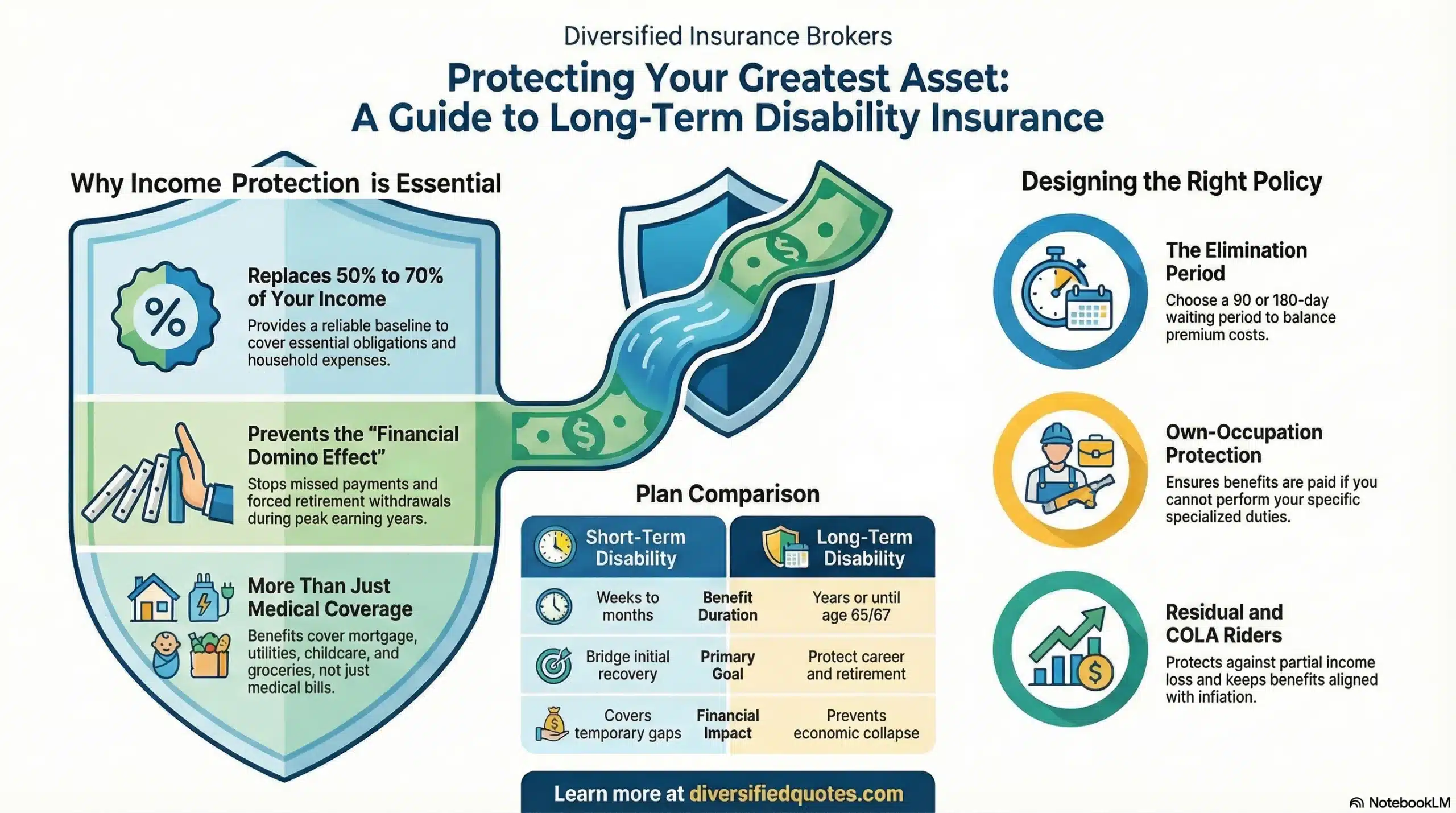
When structured correctly, disability insurance can replace up to 60% of your gross income, providing monthly benefits during a covered disability. Those funds can be used to maintain mortgage payments, utilities, groceries, insurance premiums, tuition, retirement contributions, and business obligations. For self-employed individuals or partners in a firm, coverage can be paired with Business Overhead Expense insurance to help cover rent, payroll, and fixed costs while you recover. Professionals in specialized fields — surgeons, dentists, attorneys, or consultants — often benefit from true own-occupation coverage, meaning you can collect benefits if you cannot perform the specific duties of your occupation, even if you are capable of working in another capacity. This distinction is critical. A cardiologist who develops a hand tremor may no longer be able to operate but could technically teach. Without a strong own-occupation definition, benefits could be denied. Young professionals building wealth should also consider residual or partial disability riders that pay benefits if income drops due to reduced capacity rather than total disability.
Protect Your Income Before It’s Too Late
Apply for customized disability coverage designed around your occupation, income level, and long-term financial goals.
Why Group Coverage Alone Falls Short
A common misconception is that employer group disability coverage is “enough.” In many cases, group plans replace a limited percentage of base salary, cap monthly benefits, exclude bonuses or commissions, and may not be portable if you change jobs. Benefits are often taxable if the employer paid the premium. Individually owned policies provide stronger contract language, portability, and the ability to layer coverage on top of employer benefits. Additionally, locking in non-cancelable and guaranteed renewable provisions ensures that premiums cannot be increased and coverage cannot be altered as long as you pay on time. Younger professionals also benefit from future purchase options, allowing benefit increases later without additional medical underwriting as income rises. This is especially important for physicians in residency, attorneys in early practice, engineers in fast-growth sectors, and entrepreneurs scaling a business. Income trajectories change — your coverage should evolve with you.
The Most Common Causes of Disability — Not Just Accidents
Disability risk is not confined to catastrophic accidents. Musculoskeletal disorders, cardiovascular conditions, cancer, mental health challenges, and chronic illnesses account for a significant share of long-term disability claims. Planning for these realities does not mean expecting the worst — it means respecting probability. The earlier coverage is secured, the more predictable and affordable it tends to be over the long term. At Diversified Insurance Brokers, we compare top carriers and contract provisions to design coverage tailored to your profession, income level, and long-term trajectory. If you are self-employed, underwriting will typically require tax returns or profit-and-loss statements to verify income stability. If you are employed, carriers may evaluate W-2 earnings and occupational risk class. In either case, securing coverage while healthy provides leverage. As part of a comprehensive plan, disability protection works alongside retirement planning, life insurance, and guaranteed income strategies such as fixed and indexed annuities. Disability insurance safeguards the income that funds those future retirement vehicles — while annuities protect the principal you accumulate through those retirement contributions. Reviewing the current annuity rate environment alongside an income protection strategy ensures both the earning years and the retirement years are covered — income protection during your working years plus guaranteed income in retirement creates financial symmetry that self-insurance cannot provide. You can explore our full approach to disability coverage on the Disability Insurance services page. Income protection is not a standalone product — it is a core pillar of risk management that stabilizes everything else in the financial plan.
Get Personalized Disability Coverage Options
Our specialists will compare top-rated carriers and design a plan tailored to your occupation and income goals.
Talk With an Advisor Today
Choose how you’d like to connect—call or message us, then book a time that works for you.
Schedule here:
calendly.com/jason-dibcompanies/diversified-quotes
Licensed in all 50 states • Fiduciary, family-owned since 1980
How much disability insurance do I actually need?
The standard benchmark for disability insurance benefit sizing is 60% of gross income, which is the typical maximum insurers will approve for individually owned policies. The 60% cap exists because carriers want to preserve an economic incentive to return to work — 100% income replacement would remove that incentive entirely. For most working professionals, 60% of gross income in a tax-free monthly benefit covers essential fixed expenses: mortgage or rent, utilities, food, insurance premiums, loan payments, and minimum retirement contributions. The calculation begins with your monthly gross income. Multiply that by 0.60 to establish the maximum benefit you would qualify for. Then subtract any existing disability coverage — employer group plan benefits, association group coverage, or prior individual policies — to determine the gap that needs to be filled by a new individually owned policy. For high-income professionals where 60% of gross income still represents a very large monthly benefit, carriers may impose a benefit maximum (often $15,000 to $25,000 per month depending on the carrier), which is why some high earners stack multiple policies from different carriers to approach the full 60% target. For self-employed individuals, qualifying income is typically determined by the last two years of net Schedule C or K-1 income, which can reduce the available benefit if the business has variable profit margins or significant business deductions. Reviewing the best disability insurance rates across carriers also involves comparing the benefit amount each carrier will approve for your specific income documentation, not just the premium cost for a given benefit level.
What is own-occupation disability insurance and why does it matter for specialists?
The disability definition is the single most important contract provision in a disability insurance policy — and the distinction between “own-occupation” and “any occupation” definitions can determine whether a claim is paid or denied in the most financially consequential moments. Own-occupation disability insurance pays benefits if you cannot perform the material and substantial duties of your specific occupation, regardless of whether you are able to work in a different occupation. For a neurosurgeon who develops essential tremor, this means benefits are paid even if that physician could technically teach, consult, or perform administrative medicine. For an attorney who develops severe carpal tunnel, benefits are paid even if that attorney could work in a different field entirely. Under an any-occupation definition — which is common in group plans and some individual policies — benefits are only paid if you cannot work in any occupation for which you are reasonably suited by education, training, or experience. That standard can deny benefits to specialists who still have functional work capacity outside their primary specialty. True own-occupation definitions are available to professionals in Class 5A and 4A occupational risk categories: physicians, dentists, attorneys, engineers, architects, accountants, executives, and similar high-income knowledge workers. Manual or trade occupations typically do not qualify for true own-occupation definitions because their disabilities are more likely to be total and occupationally specific by nature. If you are a specialist, confirming the specific disability definition in any policy under consideration — and verifying that it remains own-occupation for the full benefit period rather than converting to any-occupation after 24 months — is the most important due diligence in disability insurance evaluation.
Are disability insurance benefit payments taxable?
Whether disability insurance benefits are taxable depends entirely on who paid the premium. The general rule: if you paid the premium with after-tax personal dollars — as is typical for individually owned disability insurance policies — the benefits are received income-tax-free. If your employer paid the premium on your behalf, or if you paid the premium using pre-tax salary reduction dollars through an employer’s cafeteria plan, the benefits are taxable as ordinary income in the year received. For more detail on the specific tax treatment rules and exceptions, our resource on whether disability insurance payments are taxable covers the applicable IRS guidelines. The practical implication for benefit sizing: if you know your benefits will be tax-free, a $10,000 monthly benefit replaces $10,000 in spendable income. If benefits are taxable, a $10,000 monthly benefit may net $6,500 to $7,500 after federal and state taxes — meaning you may need a higher nominal benefit to achieve the same spendable income. This is one reason why individually owned policies — purchased with after-tax premium dollars to ensure tax-free benefits — are often the more efficient structure for high-income professionals even when group coverage is available at lower apparent cost. The net after-tax benefit comparison, not the gross benefit comparison, is the correct metric for evaluating whether group coverage is adequate or whether individual coverage is needed to fill the gap.
Can I get disability insurance if I am self-employed or a business owner?
Yes — self-employed individuals and business owners can and should obtain individual disability insurance, and doing so is arguably more critical for the self-employed than for W-2 employees because self-employed people typically have no employer group disability plan as a baseline. For details on the underwriting, income documentation, and policy design considerations specific to self-employment, our resource on getting disability insurance when self-employed covers the full landscape. The underwriting process for self-employed applicants typically requires the last two years of tax returns to verify income stability — net Schedule C income for sole proprietors, K-1 distributions for partners and S-corporation shareholders. Income averaging across the two most recent tax years is common to determine the qualifying benefit amount. For self-employed professionals whose business income varies significantly year to year, underwriting may use the lower of the two years or an average, which can reduce the available benefit below what a W-2 employee earning the same average income would qualify for. Beyond personal income replacement, business owners should also evaluate Business Overhead Expense insurance — a separate policy that pays the fixed costs of the business (rent, payroll, equipment leases, utilities) while the owner is disabled and not generating revenue. This combination of personal income replacement and business overhead protection ensures both the owner’s household and the business can survive a disability period without permanent financial damage.
What is the elimination period and how do I choose the right one?
The elimination period is the waiting period between the onset of a qualifying disability and the date the carrier begins paying benefits. The most common elimination periods are 30 days, 60 days, 90 days, 180 days, and 365 days. A longer elimination period produces lower premiums; a shorter elimination period produces higher premiums but faster benefit activation. The elimination period is essentially the self-insurance deductible of the disability policy — you are agreeing to fund your own expenses during the elimination period in exchange for lower ongoing premiums. The right elimination period depends on your liquid reserves and how long you could sustain your lifestyle without income. The most commonly selected elimination period for working professionals is 90 days, which balances affordability against the risk of depleting liquid reserves. Many professionals maintain 3 to 6 months of liquid emergency reserves precisely to self-fund the elimination period of a disability policy — making the 90-day period appropriate for anyone with that level of liquid savings. Professionals with minimal liquid reserves may benefit from a shorter 60-day elimination period despite the higher premium, while those with substantial liquid savings and high incomes may elect a 180-day period to reduce ongoing premium cost. Working with an independent disability insurance broker who can model the premium difference across elimination period options — and compare that to the actual cost of self-funding different waiting periods — helps identify the elimination period that makes the most economic sense for your specific liquid reserve and income profile.
About the Author:
Jason Stolz, CLTC, CRPC, DIA, CAA and Chief Underwriter at Diversified Insurance Brokers (NPN 20471358), is a senior insurance and retirement professional with more than 25 years of real-world experience helping individuals, families, and business owners protect their income, assets, and long-term financial stability. As a long-time partner of the nationally licensed independent agency Diversified Insurance Brokers, Jason provides trusted guidance across multiple specialties—including fixed and indexed annuities, long-term care planning, personal and business disability insurance, life insurance solutions, Group Health, Travel Medical and Evacuation Insurance, and short-term health coverage. Diversified Insurance Brokers maintains active contracts with over 100 highly rated insurance carriers, ensuring clients have access to a broad and competitive marketplace.
His practical, education-first approach has earned recognition in publications such as VoyageATL, and contributions from his agency featured in Kiplinger and GoBankingRates— highlighting his commitment to financial clarity and client-focused planning. Drawing on deep product knowledge and years of hands-on field experience, Jason helps clients evaluate carriers, compare strategies, and build retirement and protection plans that are both secure and cost-efficient. Visitors who want to explore current annuity rates and compare options across multiple insurers can also use this annuity quote and comparison tool.
Explore More Disability Insurance Options: Browse our complete guide to Disability Insurance Planning & Education — covering how it works, riders, elimination periods, own occupation, costs & buying guides from 100+ carriers.
Last Reviewed: June 25, 2026 |
Reviewed by: Jason Stolz, CLTC, CRPC, DIA, CAA
Chief Underwriter, Diversified Insurance Brokers, Inc. | NPN: 20471358 | Diversified Insurance Brokers, Inc. — Licensed in all 50 states
Fact Checked by: Tonia Pettitt, CMIP©
Medicare Specialist, Diversified Insurance Brokers, Inc. | NPN: 14374308 | Diversified Insurance Brokers, Inc. — Licensed in all 50 states
Did you find this content helpful? Leave us a Google review — it helps others find trustworthy guidance too.
Editorial Standards: Diversified Insurance Brokers maintains rigorous editorial standards to ensure accuracy, clarity, and independence in all content. Learn more about our editorial standards and commitment to transparency.
