
When Fixed Annuities Outperform Market-Based Investments
As an Independent Annuity Broker, we compare rates across 100+ carriers and 1,000 different annuities— not just one company’s product offerings — to find the best fit for your goals.
When Fixed Annuities Outperform Market-Based Investments
We often hear the phrase “no risk, no reward” when discussing investing, but for retirees and conservative savers that philosophy can become financially destructive at exactly the wrong time. During your accumulation years, volatility is often tolerated because time is on your side. In retirement — or within five to ten years of it — time is no longer your shock absorber. Losses are no longer just numbers on a screen; they directly impact income sustainability, legacy goals, and lifestyle flexibility. This is where fixed annuities separate themselves from traditional market-based strategies. In specific interest rate environments, a properly structured fixed annuity can outperform a balanced portfolio on a risk-adjusted basis — not because it chases higher returns, but because it eliminates the variables that quietly erode retirement plans: market timing, emotional decision-making, and sequence-of-returns risk.

Ensure you are receiving the absolute top rates
Current Fixed Annuity Rates
Compare today’s best fixed annuity rates from top-rated insurance carriers.
Current Bonus Annuity Rates
See which annuities are offering the highest upfront bonus credits today.
Request an Annuity Quote
Get personalized annuity rate options based on your goals and timeline.
Lifetime Income Calculator
Use our calculator to estimate how much guaranteed income your annuity could provide.
Fixed Annuity vs. 60/40 Portfolio — The Risk-Adjusted Comparison
| Dimension | Fixed Annuity (MYGA) | 60/40 Balanced Portfolio | Fixed Indexed Annuity |
|---|---|---|---|
| Principal Risk | None — principal and declared interest guaranteed contractually for the full term. Zero exposure to equity or bond market movements. No mark-to-market pricing. | Significant — the 60% equity allocation loses value in bear markets. The 40% bond allocation loses value when rates rise. In 2022, the 60/40 portfolio produced one of its worst calendar-year returns in decades as both fell simultaneously. | None from market — 0% floor prevents index-related losses. Account value cannot decline due to negative index performance. Growth is capped by crediting parameters but the downside is eliminated. |
| Return Mechanism | Declared rate compounded for the full term — known on day one. Tax-deferred compounding applies the full rate without annual tax reduction. No advisory fees, expense ratios, or management costs. | Market-dependent — equity returns vary with price appreciation and dividends; bond returns depend on yield and price. Advisory fees, fund expense ratios, and tax drag on dividends and realized gains reduce net return. | Index-linked credits — positive index years credit a portion of gains (subject to cap or participation rate); negative years credit zero. Optional GLWB income rider builds guaranteed income base during deferral. |
| Tax Treatment | Tax-deferred — no annual 1099 on credited interest. Full declared rate compounds without annual tax reduction. Gains taxable as ordinary income at withdrawal; basis returned tax-free for non-qualified contracts. | Taxable annually in brokerage accounts — dividends and realized gains generate a 1099 each year. Tax drag reduces net compounding even in “buy and hold” strategies. Qualified accounts defer but do not eliminate taxation. | Tax-deferred — same annual compounding advantage as the MYGA. Index credits accumulate without annual taxation. Gains taxable as ordinary income when distributed; basis returned tax-free for non-qualified contracts. |
| Liquidity | 10% annual free withdrawal on most contracts. Surrender charges on excess during the term. Health waivers typically available. Full access at maturity with no charge. | Fully liquid — stocks and bonds can be sold at any time at market value, which may be below purchase price. Full access but potential realized losses when accessing during market downturns. | 10% annual free withdrawal — same as MYGA structure. Surrender charges apply to excess withdrawals during the contract period. Health waivers available on most carriers. |
| Behavioral Risk | Eliminated — no daily price fluctuation means no panic-driven decisions, no urge to rebalance during volatility, and no temptation to abandon strategy at market lows. Fixed annuity holders are structurally protected from their own worst financial impulses. | High — daily market prices create ongoing temptation to react emotionally. Most behavioral finance research shows that average investor returns significantly underperform fund returns due to market-timing decisions made at the worst moments. | Low — no daily price to monitor or react to. The 0% floor eliminates the portfolio’s worst-case outcome, which is the primary trigger for panic-driven selling during downturns. |
| Best Scenario | Outperforms on a risk-adjusted basis during bear markets, flat markets, and rising rate environments that damage bond portfolios. Maximum value when the comparison period includes a significant market decline during which the portfolio must fund withdrawals. | Outperforms in sustained bull markets over long time horizons where no significant drawdown occurs. Weakest when a bear market strikes during the early years of retirement when withdrawals are already underway. | Outperforms on a risk-adjusted basis when the index has mixed performance — capturing upside in positive years, crediting zero in negative years. Strongest for mid-term income building with GLWB rider activation at planned retirement date. |
When Predictability Beats Market Returns
Consider a straightforward example. If $500,000 is placed into a 5-year fixed annuity paying 5.40% with annual compounding, the outcome is contractually defined from day one. At the end of the term, the value grows to approximately $651,968 — over $150,000 in guaranteed interest — regardless of what happens in equities, bonds, geopolitical markets, interest rate cycles, or recession headlines. There are no advisory management fees draining performance, no panic selling during downturns, and no need to hope the market cooperates during a specific five-year window. You know exactly what your money will be worth at maturity. That clarity allows for intelligent planning around retirement transitions, pension start dates, real estate decisions, and the strategy of delaying Social Security benefits to maximize lifetime payouts. Predictability does not eliminate growth; it eliminates uncertainty about growth.
By contrast, a traditional 60/40 portfolio depends heavily on sustained performance across both asset classes. Over the last two decades, investors have experienced multiple “lost periods” where stocks corrected sharply and bonds failed to provide meaningful ballast. When you are no longer reinvesting dividends but instead withdrawing income, volatility becomes a compounding enemy. A 20% decline requires a 25% recovery just to break even. If withdrawals occur during that drawdown, the capital base shrinks permanently. That mathematical reality is why many retirees begin exploring alternatives after asking whether annuities are worth it or whether annuities are a good investment compared to market portfolios. The answer depends on objective, but for principal protection combined with steady growth, fixed annuities provide a structural advantage: they remove the possibility of loss due to market decline.
Tax Deferral, Behavioral Protection, and the Overlooked Advantages
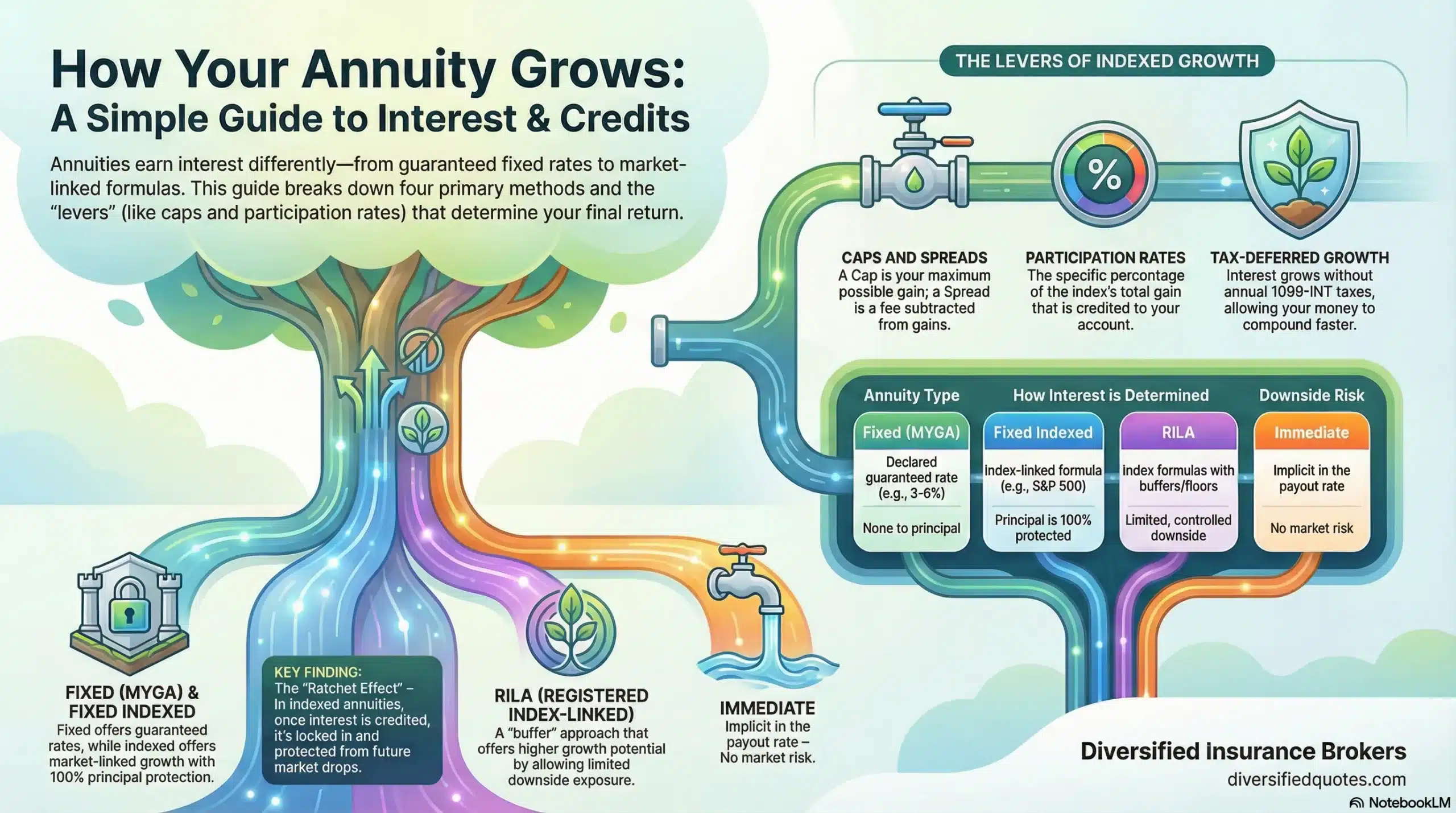
Interest inside a fixed annuity compounds on a tax-deferred basis, which improves efficiency relative to taxable brokerage accounts. Because you are not receiving annual 1099 interest statements, your entire balance compounds uninterrupted until withdrawal. Understanding how annuities are taxed — gains as ordinary income at distribution, basis returned tax-free for non-qualified contracts — ensures the net after-tax comparison against taxable alternatives is modeled correctly. For many clients, this makes fixed annuities an effective bridge strategy: capital can grow safely while waiting to activate guaranteed lifetime income or while coordinating other retirement income sources. If your objective is to understand how annuities actually generate returns, our breakdown of how annuities earn interest explains the mechanics in detail. The key takeaway is simple: the insurance company assumes the investment risk; you receive the contractual rate.
Another overlooked advantage is behavioral protection. Even disciplined investors struggle to stay invested during volatility. A fixed annuity eliminates daily valuation anxiety. There is no red number flashing on a statement, no urge to rebalance in a panic, and no temptation to abandon strategy at the worst moment. In retirement, psychological stability matters almost as much as mathematical performance. When markets fall, retirees with protected principal make clearer decisions in other financial areas. For those comparing fixed annuities with other safe-money options, it is important to distinguish between traditional bank products and insurance-based contracts. Unlike CDs, multi-year guaranteed annuities typically offer higher yields for comparable terms, and they allow tax deferral until withdrawal. Reviewing the differences between stocks, bonds, and annuities clarifies how each plays a distinct role: stocks for growth with volatility, bonds for income with interest-rate sensitivity, fixed annuities for principal protection with defined growth. For conservative investors, this structural clarity is one of the most important factors in product selection.
Liquidity, Laddering, and the Role of Fixed Annuities in a Complete Plan
Liquidity considerations also matter. Fixed annuities include surrender schedules, but most contracts allow penalty-free withdrawals up to a specified percentage annually. Understanding annuity free withdrawal rules ensures expectations are aligned before purchase. Structured correctly, annuities should complement — not replace — liquid reserves. Many retirees allocate a portion of assets to protected growth while keeping sufficient liquidity in cash or short-term instruments. This layered strategy reduces exposure to forced selling during downturns. The power of laddering fixed annuities takes this a step further — staggering multiple fixed annuities across different maturities creates rolling liquidity access while capturing competitive rates at each term. Our full guide on the fixed annuity ladder strategy covers how to build this structure for different income timing needs.
Income planning is another area where predictability wins. While a fixed annuity can simply grow for a term and mature, it can also be converted into structured income. Some investors compare standard fixed annuities to deferred income structures when evaluating future payout timing. If income guarantees are your primary objective, reviewing what constitutes the best retirement income annuity clarifies the trade-offs between growth-focused and income-focused contracts. For existing annuity holders whose contracts may have rolled to low renewal rates or no longer serve the original purpose, our annuity rescue plan resource covers how to evaluate whether repositioning into a more competitive structure makes sense. Ultimately, the conversation is not about “beating the market.” It is about eliminating unnecessary exposure once the objective changes from accumulation to preservation and income reliability. For retirees, avoiding a large loss can be more powerful than capturing a marginally higher gain.
Ready to evaluate fixed annuity options for your specific retirement timeline?
Request Your Personalized Annuity Comparison
Financial Protection Essentials
Explore annuity interest examples and retirement planning insights to understand how different investment sizes can affect income potential.
Talk With an Advisor Today
Choose how you’d like to connect—call or message us, then book a time that works for you.
Schedule here:
calendly.com/jason-dibcompanies/diversified-quotes
Licensed in all 50 states • Fiduciary, family-owned since 1980
FAQs: When Fixed Annuities Outperform Market-Based Investments
When exactly does a fixed annuity outperform a market-based portfolio?
Fixed annuities tend to outperform market-based portfolios on a risk-adjusted basis in three specific scenarios. The first is during periods of sustained market volatility or decline — because a fixed annuity earns its contractual rate regardless of equity or bond market performance, while a portfolio suffering a 20% decline requires a 25% recovery just to break even. The second is in the years immediately surrounding retirement, when sequence-of-returns risk is most damaging — a portfolio that experiences early losses while you are simultaneously taking withdrawals shrinks the capital base permanently in ways that a fixed annuity simply cannot. The third is in high-interest-rate environments where competitive MYGA rates can match or exceed what a diversified bond portfolio might reasonably be expected to produce, without the interest-rate sensitivity that causes bond values to decline when rates rise. The fixed annuity’s structural advantage is not that it earns more in every scenario — it is that it eliminates downside exposure that, at certain life stages, is more financially destructive than any foregone upside.
Is a fixed annuity the same as a CD from a bank?
No — they share some surface similarities but differ in three important ways that typically favor the fixed annuity for retirement planning purposes. First, multi-year guaranteed annuities (MYGAs) typically offer higher yields than bank CDs for comparable terms, because insurance companies can deploy premium capital in longer-duration bond portfolios that generate higher yields than bank reserve requirements allow. Second, interest inside a fixed annuity grows tax-deferred — meaning you pay no tax on accumulating interest until withdrawal, allowing the full compounding balance to work uninterrupted. A bank CD generates a 1099 each year whether you receive the interest or not, creating a tax drag that reduces effective yield in taxable accounts. Third, fixed annuities can be converted into guaranteed income streams or rolled into other annuity products through 1035 exchanges without triggering immediate taxation. CD maturity generally triggers a taxable event. For current rate comparisons, current fixed annuity rates provide the market context for evaluating how today’s MYGA rates compare to bank alternatives.
What is sequence-of-returns risk and why does it make fixed annuities more attractive?
Sequence-of-returns risk is the mathematical reality that the order in which investment returns occur — not just the average return — determines retirement portfolio sustainability when withdrawals are being taken. A portfolio that earns -15%, -10%, +25%, +20% over four years produces a very different outcome than one that earns +20%, +25%, -10%, -15% in the same four years with the same average return — because withdrawals taken during the early negative years permanently reduce the capital base before the recovery years can restore it. The damage compounds: a smaller capital base earns less in recovery years, and if withdrawals continue, the base may never fully recover. Fixed annuities eliminate this risk entirely because there is no negative year to sequence. The contractual rate applies in every year of the accumulation period, making the growth trajectory linear and predictable regardless of what market conditions occur. For retirees who are simultaneously accumulating and distributing — or who are within five to ten years of needing income — this structural elimination of sequence risk is often the most compelling argument for allocating a portion of retirement assets to a fixed annuity. Our resource on sequence-of-returns risk explains the math and the planning mechanics in full.
Do fixed annuities provide enough growth to keep up with inflation?
This is the most legitimate concern about fixed annuities, and it deserves an honest answer. Multi-year guaranteed annuities do not automatically adjust for inflation — the contractual rate is fixed at purchase for the term, and if inflation rises above that rate, purchasing power erodes in real terms. However, this concern must be evaluated in context. In rate environments where competitive MYGAs offer 5% or higher rates for 5-year terms, the real return after moderate inflation is still positive. The inflation risk of a fixed annuity must also be compared to the inflation risk of the alternative: a 60/40 portfolio that experiences a 20% drawdown during an inflationary period loses purchasing power in both the nominal and real sense simultaneously, while the fixed annuity’s guaranteed rate maintains nominal growth even if real purchasing power is modestly eroded. For retirees whose primary concern is not outliving their money rather than maximizing real returns, the fixed annuity’s guaranteed growth is typically superior to an uncertain real return from a volatile portfolio. Fixed indexed annuities, which offer principal protection with index-linked upside potential, represent a middle path that addresses inflation more directly — our resource on whether annuities are a good investment compares these structures in the context of inflation and return expectations.
Are fixed annuities liquid? Can I access my money if I need it?
Fixed annuities include surrender periods — typically 3 to 10 years depending on the contract — during which withdrawals above a defined annual limit are subject to surrender charges. However, most fixed annuity contracts include penalty-free withdrawal provisions that allow access to a specified percentage of account value — typically 10% per year — without any surrender charge. This means an annuity is not completely illiquid; it is structured for intentional, planned access rather than arbitrary liquidity. The practical planning approach is to allocate only the portion of assets that you genuinely do not need immediate access to during the surrender period, while maintaining sufficient liquid reserves in cash or short-term instruments outside the annuity. Structured this way, the surrender period is rarely a problem in practice because the fixed annuity portion is not the liquidity reserve — it is the protected growth layer. For full details on how withdrawal provisions work across different annuity designs, our resource on annuity free withdrawal rules explains the mechanics and planning considerations.
How does tax deferral improve fixed annuity performance compared to taxable investments?
Tax deferral compounds in two ways that improve fixed annuity performance relative to a taxable savings or brokerage account earning a comparable pre-tax rate. First, the full balance compounds uninterrupted — there is no annual tax payment reducing the base that would otherwise continue earning interest. A $500,000 annuity earning 5.40% compounds on the full $500,000 each year; a taxable CD at the same rate loses a portion of each year’s interest to income tax, leaving a smaller base for the following year’s compounding. Second, you control the timing of taxation — withdrawals can be timed to align with lower-income years, retirement tax rates, or other income planning events that reduce the marginal rate at which the deferred income is eventually taxed. Over a 5- to 10-year accumulation period, the difference between tax-deferred and currently taxable compounding at a 22% or 24% marginal rate can represent thousands of dollars in additional after-tax wealth. Understanding how annuities earn interest and how that interest interacts with tax deferral mechanics is essential for comparing annuities to taxable alternatives on a true after-tax basis.
What does the 60/40 portfolio comparison actually mean for retirees?
The 60/40 portfolio — 60% equities and 40% bonds — has been the standard “balanced” allocation model for decades and has produced strong historical average returns. The problem for retirees is that historical averages are not what individual retirees experience during their specific decade of retirement. Retirees experience the actual sequence of returns that occurs in their specific years — which may include a significant equity correction, a period of rising interest rates that reduces bond values, or both simultaneously as occurred in 2022. When both components of a 60/40 portfolio decline concurrently and withdrawals are ongoing, the portfolio’s capital base shrinks faster than average return projections would suggest. A fixed annuity eliminates this variable entirely: the contractual rate applies in year one and in year five regardless of whether the equity market rose 20% or fell 20%. For retirees who cannot afford to wait for a market recovery — because withdrawals continue regardless of portfolio performance — the fixed annuity’s predictability is not just a conservative preference; it is often the mathematically superior strategy for capital preservation during a defined term. Our resource on the difference between stocks, bonds, and annuities explains how each plays a distinct role in a complete retirement income plan.
How do I know if a fixed annuity is right for my retirement plan?
A fixed annuity tends to be the right tool when at least one of the following is true: you are within five to ten years of retirement and want to protect a portion of accumulated savings from a poorly timed market decline; you are already in retirement and want a defined-growth component that funds specific future income needs or expenses with certainty; you have more money in equities than you would need to liquidate during a market downturn and want to rebalance some of that exposure to a protected growth structure; or you want the behavioral benefit of not watching a portion of your savings fluctuate in market value. It is rarely the right tool for money you will need in the next one to three years, money you want maximum market upside from with full liquidity, or money better suited for equity growth over a 15-plus year horizon. The most useful planning approach is to think about your total assets in layers: liquid reserves, protected growth, market-growth assets, and income generation — and identify which layer a fixed annuity serves best in your specific situation. Our resource on how to protect your funds in retirement provides the full strategic framework, and our resource on whether annuities are worth it addresses the value comparison directly.
About the Author:
Jason Stolz, CLTC, CRPC, DIA, CAA and Chief Underwriter at Diversified Insurance Brokers (NPN 20471358), is a senior insurance and retirement professional with more than 25 years of real-world experience helping individuals, families, and business owners protect their income, assets, and long-term financial stability. As a long-time partner of the nationally licensed independent agency Diversified Insurance Brokers, Jason provides trusted guidance across multiple specialties—including fixed and indexed annuities, long-term care planning, personal and business disability insurance, life insurance solutions, Group Health, Travel Medical and Evacuation Insurance, and short-term health coverage. Diversified Insurance Brokers maintains active contracts with over 100 highly rated insurance carriers, ensuring clients have access to a broad and competitive marketplace.
His practical, education-first approach has earned recognition in publications such as VoyageATL, and contributions from his agency featured in Kiplinger and GoBankingRates— highlighting his commitment to financial clarity and client-focused planning. Drawing on deep product knowledge and years of hands-on field experience, Jason helps clients evaluate carriers, compare strategies, and build retirement and protection plans that are both secure and cost-efficient. Visitors who want to explore current annuity rates and compare options across multiple insurers can also use this annuity quote and comparison tool.
Browse More Resources: Return to our complete MYGA & Fixed Annuity Products guide — covering MYGA and fixed annuity products from top carriers.
Last Reviewed: June 26, 2026 |
Reviewed by: Jason Stolz, CLTC, CRPC, DIA, CAA
Chief Underwriter, Diversified Insurance Brokers, Inc. | NPN: 20471358 | Diversified Insurance Brokers, Inc. — Licensed in all 50 states
Fact Checked by: Tonia Pettitt, CMIP©
Medicare Specialist, Diversified Insurance Brokers, Inc. | NPN: 14374308 | Diversified Insurance Brokers, Inc. — Licensed in all 50 states
Did you find this content helpful? Leave us a Google review — it helps others find trustworthy guidance too.
Editorial Standards: Diversified Insurance Brokers maintains rigorous editorial standards to ensure accuracy, clarity, and independence in all content. Learn more about our editorial standards and commitment to transparency.
