
Are Annuities Good or Bad?
As an Independent Annuity Broker, we compare rates across 100+ carriers and 1,000 different annuities— not just one company’s product offerings — to find the best fit for your goals.
Are Annuities Good or Bad?

Jason Stolz CLTC, CRPC, DIA, CAA
The question “Are annuities good or bad?” is one of the most common topics people research when evaluating retirement strategies. The reality is that annuities are neither inherently good nor inherently bad. Like any financial product, their value depends on how they are used, the type of annuity chosen, and whether the contract aligns with the individual’s financial goals. When structured properly, annuities can provide reliable income, tax advantages, and principal protection. However, when misunderstood or mismatched with an investor’s needs, they can create unnecessary costs or restrictions. The most accurate answer to the question is not a verdict on annuities as a category — it is a framework for understanding when they serve retirement goals well and when other strategies may be more appropriate. Our companion resource on whether annuities are a good investment in retirement addresses the investment comparison dimension specifically, while this page focuses on the honest evaluation of what makes annuities work well or poorly depending on the situation. For the balanced side-by-side analysis of specific advantages and disadvantages across annuity types, our resource on annuity pros and cons covers both dimensions with equal rigor.
Ensure You Are Receiving the Absolute Top Rates
Current Fixed Annuity Rates
Compare today’s best fixed annuity rates from top carriers.
Current Bonus Annuity Rates
See which annuities offer the highest upfront bonus today.
Request an Annuity Quote
Submit our annuity request form to get personalized rate options.
Lifetime Income Calculator
Use our calculator to see how much guaranteed income your annuity can provide.
When Annuities Work Well vs. When They May Not — A Decision Framework
Rather than asking whether annuities are universally good or bad, the more useful question is: does this annuity fit this person’s situation? The table below maps common retirement planning scenarios to the conditions under which annuities serve those goals effectively versus when they may create friction.
General reference only. Individual circumstances vary. Consult a financial advisor before making annuity decisions. Annuity features vary significantly by carrier and product type.
| Situation / Goal | Annuity Generally Works Well When… | Annuity May Not Be the Best Fit When… | Best Annuity Type to Consider |
|---|---|---|---|
| Retirement income need | Essential expenses need to be covered by predictable income that cannot run out; the retiree has no pension and needs to replicate that structured paycheck | The retiree already has sufficient guaranteed income (Social Security + pension) to cover all essential expenses and needs only growth from remaining assets | Fixed indexed annuity with GLWB income rider; Single premium immediate annuity (SPIA) for maximum current income per dollar |
| Market volatility concern | The retiree is within 5-10 years of or in early retirement, where sequence-of-returns risk is most acute; market losses cannot be recovered before withdrawals are needed | Long time horizon (20+ years) and high risk tolerance means market downturns are recoverable; annuity growth limits may cost more in upside than the protection is worth | Fixed indexed annuity (accumulation focus) for principal protection with index-linked growth; MYGA for complete certainty during defined period |
| Liquidity needs | The portion allocated to the annuity is specifically intended for income or growth and separate liquid reserves exist for emergencies; the 10% free withdrawal provision is adequate for expected needs | All or most retirement savings are in the annuity with no separate liquid reserve; major expenses are anticipated in the near term that exceed the free withdrawal provision | Shorter-term MYGAs (3-5 year) for more frequent access; FIAs with stronger free withdrawal provisions; avoid annuities with penalty-heavy early surrender schedules if liquidity is paramount |
| Tax situation | The retiree has maxed other tax-advantaged accounts and benefits from additional tax-deferred growth; income will be taken in lower-tax retirement years; non-qualified assets benefit from tax deferral | Inside an IRA/401(k) that already provides tax deferral — adding a non-qualified annuity’s tax deferral adds a cost-layer without a meaningful additional benefit for qualified accounts | Non-qualified fixed or indexed annuity for tax-deferred accumulation outside existing retirement accounts; qualified annuity for IRA/401k rollover to add income guarantee layer |
| Estate planning objective | Beneficiary designation allows assets to pass outside probate; death benefit provides legacy while also generating lifetime income; joint life or period certain structures protect surviving spouse | Estate tax minimization is the primary objective — annuities do not reduce estate tax value like irrevocable trusts or certain life insurance structures do; complex multi-generational estate plans may have better tools | Joint life or period-certain income annuity structures for spousal protection; enhanced death benefit riders on FIAs for legacy alongside income |
| Time horizon and age | Age 55-75 approaching or in retirement; surrender period length aligns with income start timeline; income rider deferral period matches when income will actually be needed | Very short life expectancy may reduce lifetime income value vs. lump sum alternatives; very young investors (under 40) may benefit more from equity growth over a long accumulation horizon | Deferred income annuity (DIA) for long-deferral strategies; SPIA for immediate income start; FIA with income rider when 5-10 year deferral before income is the plan |
Understanding the Role of Annuities in Retirement
Annuities are insurance contracts designed to provide income, protect principal, or accumulate savings on a tax-deferred basis. Many retirees use annuities as part of a broader retirement income strategy because they can generate predictable income that may last for life. In fact, one of the reasons annuities remain popular is their ability to help address longevity risk — the possibility of outliving retirement savings. Understanding whether annuities are good or bad requires examining how they work and what role they play within a retirement plan. Some individuals prioritize growth and market exposure, while others focus on income stability and capital preservation. Annuities often appeal to the latter group because they can provide guaranteed income streams that supplement Social Security, pensions, and other retirement savings. Many people researching annuities begin by exploring educational resources such as questions to ask when researching annuities. Asking the right questions helps investors understand product features, fees, surrender periods, and income options before making any decisions. For the comprehensive treatment of every objection commonly raised against annuities — and the accurate context that addresses each one — our resource on common annuity myths covers the full spectrum of concerns that often prevent people from giving annuities fair consideration. Our companion resource on what most people get wrong about annuities focuses on the five most persistent misunderstandings with direct factual responses.
The Pension Gap — Why Annuities Have Surged in Relevance
The context for understanding why annuities are increasingly discussed in retirement planning is the disappearance of traditional defined benefit pensions from the private sector. Decades ago, a large proportion of American workers could expect a monthly pension check in retirement — a predictable, lifetime income that eliminated the need to manage withdrawal rates or worry about outliving assets. That system has largely been replaced by defined contribution plans like 401(k)s and IRAs, which transfer both the responsibility and the risk of income planning from employers to individuals. Annuities fill the pension gap. They are the mechanism through which an individual can convert accumulated savings into a predictable income stream that cannot be outlived — the exact function a pension provided. When evaluating whether annuities are good or bad in this context, the more precise question is whether having a guaranteed income floor is good or bad for a specific retiree. For the vast majority of people who lack a pension and face 20-30 years of retirement ahead of them, the answer is clear: some form of guaranteed income is better than complete dependence on portfolio withdrawal rates that history shows can fail in adverse market conditions. Our resource on sequence-of-returns risk explains the mathematical vulnerability that pure portfolio withdrawal creates — the specific problem that annuity income most directly solves. Our dedicated guide on how to use an annuity in retirement translates the pension replacement concept into specific structural strategies for how annuity income is positioned within a broader retirement plan.
Income Stability and Retirement Security
One of the strongest arguments in favor of annuities is income stability. Traditional pensions are far less common today than they were decades ago, leaving retirees responsible for creating their own income systems. Annuities can replicate some pension-like characteristics by providing guaranteed income payments for a specific period or for life. When retirees combine annuities with other retirement resources, they can create a structured income stream designed to cover essential expenses. For individuals who prioritize retirement income planning, understanding how to use an annuity in retirement can help clarify the role annuities may play within a larger financial strategy. Many retirees allocate a portion of their savings to guaranteed income while leaving other assets invested for growth. For the question of whether annuities ultimately justify their tradeoffs — the value per dollar committed relative to the alternatives — our resource on whether annuities are worth it addresses that cost-benefit framework directly.
The Good — What Annuities Do Best
Fixed and fixed indexed annuities excel in five specific areas that no other commonly available financial product replicates. Lifetime income is the most distinctive — a guaranteed withdrawal benefit rider or immediate annuity structure can contractually commit to paying income for as long as you live, regardless of account value. This eliminates longevity risk more completely than any portfolio withdrawal strategy. Principal protection prevents loss from market downturns — the zero-floor on fixed indexed annuities means no negative credits in down market years, making them ideal for the pre-retirement and early retirement years when sequence-of-returns risk is most acute. Tax-deferred growth outside of contribution limits allows savers who have maxed their IRAs and 401(k)s to continue deferring taxation on additional retirement savings in a non-qualified annuity — compounding interest that would otherwise be taxed annually. Contractual certainty provides defined rules for what the product will do — unlike mutual funds whose returns are unknown, fixed annuities specify the exact interest rate credited for a defined period, eliminating uncertainty about accumulation outcomes. Estate simplicity allows beneficiary designations that bypass probate, passing the contract value directly to named beneficiaries without the delays and costs of estate administration. For the detailed resource on how death benefits work in annuity contracts — how beneficiary designations function and what surviving heirs actually receive — our guide on annuity beneficiary death benefits covers the specific mechanics of legacy planning within annuity structures. For the most important feature of any specific annuity — how its surrender charge schedule is structured — our resource on annuity surrender charges explained covers exactly how to read, compare, and evaluate surrender provisions before any purchase decision.
Tax Deferral and Long-Term Growth
Another potential advantage of annuities is tax deferral. Earnings inside many annuity contracts grow without being taxed annually, which allows interest to compound more efficiently over time. This tax-deferred growth can be especially beneficial for individuals who have already maximized other retirement accounts such as 401(k) plans or IRAs. For investors with additional savings beyond IRA and 401(k) contribution limits, a non-qualified fixed or indexed annuity offers a tax-efficient vehicle for continued accumulation. The effective yield advantage of tax deferral increases with time horizon and tax bracket — a 30-year accumulation in a tax-deferred annuity versus the same investment in a taxable CD can produce meaningfully different outcomes when the annual tax drag on CD interest is factored across the full period. For a thorough understanding of how annuities are taxed — including how withdrawals are treated, what portion constitutes taxable income, and how the exclusion ratio works for income annuities — our resource on whether annuities are taxable covers the complete tax treatment framework that affects both accumulation and distribution decisions.
Principal Protection for Conservative Investors
Principal protection is another feature that attracts conservative investors. Certain types of annuities — particularly fixed and fixed indexed annuities — offer protection from market losses. Unlike stocks or mutual funds, these annuities typically do not lose value due to market volatility. Instead, they credit interest according to the terms of the contract. The zero floor in fixed indexed annuities is one of the most misunderstood features in the annuity marketplace — it means that in a year when the linked index declines, the annuity credits zero interest rather than reflecting the loss. No principal is lost, and no recovery from a previous loss is required before growth resumes. Investors who prioritize capital preservation often explore strategies discussed in resources such as why capital preservation has become a major goal for retirees. These strategies often include annuities as a way to stabilize a portion of retirement assets. For MYGA strategies designed specifically for conservative investors with moderate to larger premium amounts — where the goal is to lock in guaranteed rates for defined periods — our resource connects the principal protection goal to the specific product structures that best achieve it.
The Bad — When Annuities Create Problems
The legitimate criticisms of annuities are not about the concept of guaranteed income — they are about specific product mismatches, overselling, unnecessary complexity, and poor design selection. The most valid criticism is that some annuities are sold to people who should not own them: individuals who need unrestricted access to their capital, who are too young to benefit from income guarantees, who already have sufficient guaranteed income, or who would be better served by simpler products. A 45-year-old who puts all retirement savings into a 10-year surrender annuity has a liquidity problem that the product did not create but also did not prevent — the issue is suitability. Variable annuities draw the most legitimate criticism for fee structure — annual insurance charges, investment subaccount fees, and optional rider costs can add up to 2-4% annually, which is a high hurdle for the underlying investments to overcome. These concerns are largely product-specific and do not apply to fixed or fixed indexed annuities, which typically have no ongoing management fee on the base contract. Complex product designs — layered riders, multiple crediting strategies, and long surrender periods — can make annuities genuinely difficult to evaluate without professional guidance. For applicants who want to understand the full honest picture of every disadvantage alongside each advantage — presented without marketing bias — our annuity pros and cons resource covers both sides with equal detail. The short-term fixed indexed annuity alternative — for people who want protection features with shorter commitment windows — is covered in our resource on short-term fixed indexed annuity options, which addresses the liquidity concern directly by showing how 2-5 year structures reduce the primary drawback that makes longer-surrender annuities inappropriate for some buyers.
Product Complexity and Surrender Periods
Despite their advantages, annuities are sometimes criticized because they can be complex. Contracts may include multiple features, riders, and surrender schedules that can make them difficult to evaluate without professional guidance. Some annuities also include fees associated with optional benefits such as lifetime income riders. Surrender periods are another factor that can influence whether an annuity is appropriate for a particular investor. Many annuities include surrender charges if funds are withdrawn beyond certain limits during the early years of the contract. These provisions are designed to support long-term planning, but they may reduce flexibility for individuals who need immediate access to their savings. Understanding the specific surrender charge schedule in any contract under consideration is essential before commitment — the surrender period length, the percentage charged in each year, and the free withdrawal provisions all determine the real-world cost of accessing funds during the surrender window. A thorough treatment of how surrender charges work across different annuity designs — including market value adjustment provisions that affect the surrender calculation in certain interest rate environments — is covered in our dedicated resource on annuity surrender charges explained.
Growth vs. Stability — Understanding the Real Trade-Off
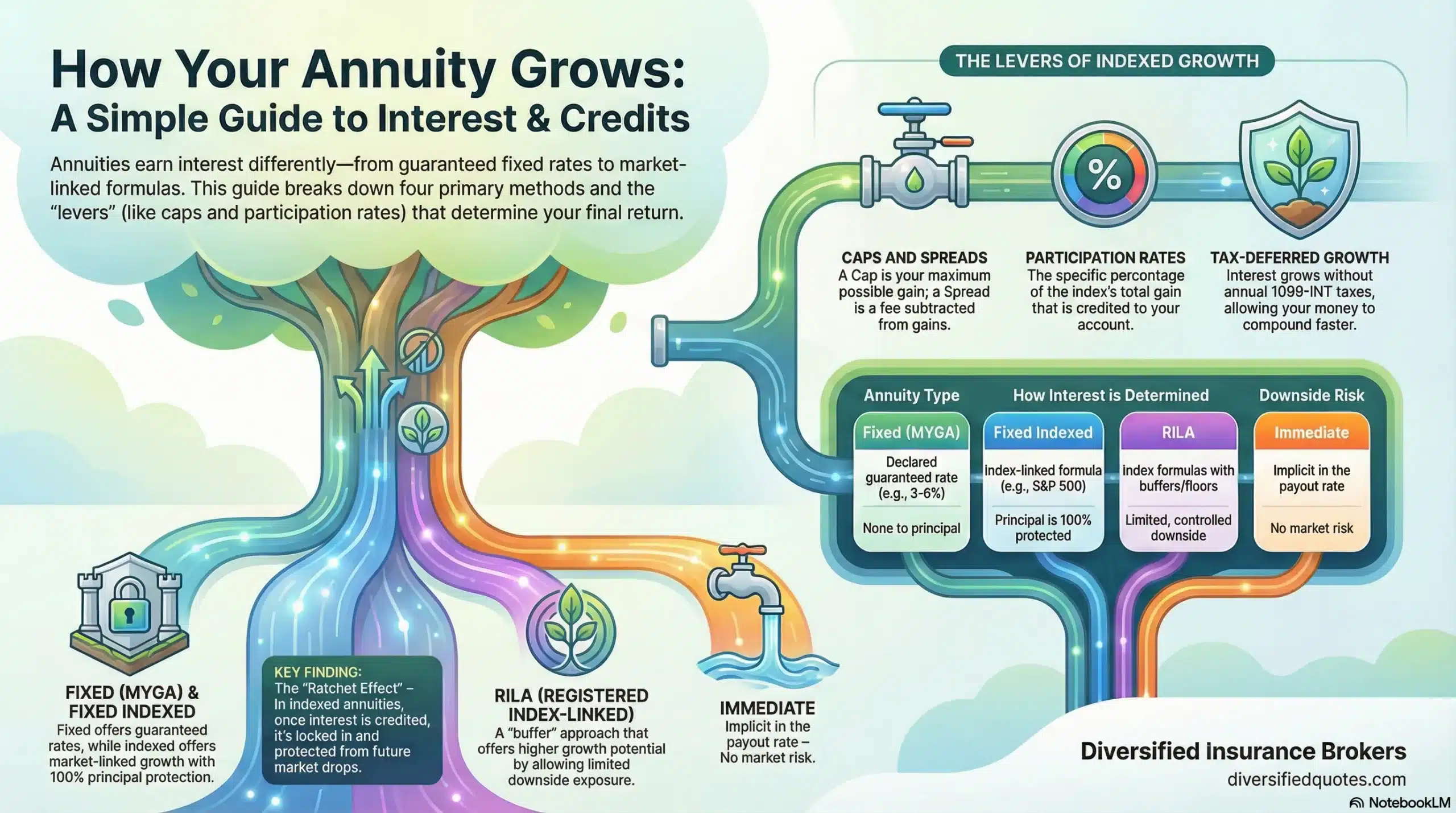
Some critics argue that annuities can limit investment growth compared with traditional market investments. While this may be true for certain annuity types, it is important to remember that annuities are designed for stability and income rather than aggressive growth. Many investors intentionally allocate only a portion of their portfolio to annuities while keeping other assets invested in equities. The honest answer on growth is this: fixed annuities are not designed to compete with stock market returns, and they should not be evaluated as if they were. They are most accurately compared against other conservative alternatives — CDs, bonds, stable value funds, and money market accounts — where their combination of competitive yields, tax deferral, principal protection, and income options often makes them superior choices. Fixed indexed annuities offer a middle ground — no upside is unlimited (participation rates and caps apply) and no downside exists (zero floor). Over a full market cycle, many FIA strategies produce returns competitive with balanced stock-bond portfolios while eliminating the down years that portfolios must recover from. For the specific mechanics of how fixed indexed annuity interest crediting works — the caps, participation rates, and spread methods that determine how much of any market index gain the contract credits — our resource on how a fixed indexed annuity works covers that in full. For the coordinated strategy that combines annuity income security with other assets to fund life insurance premium obligations — turning the guaranteed income from an annuity into a self-sustaining coverage strategy — our resource on whether annuity payments can fund life insurance premiums covers that financial integration approach.
Modern Annuity Products and Flexibility
In recent years, insurance companies have introduced new annuity products designed to provide greater flexibility. Modern contracts such as income-focused fixed indexed annuities offer growth potential linked to market indexes while still protecting principal from losses. Another consideration when evaluating annuities is how they fit within estate planning. Many annuities allow policyholders to name beneficiaries who receive remaining contract value after the owner’s death. This can make annuities useful tools for individuals who want to balance income generation with legacy planning. Individuals researching retirement planning strategies sometimes compare annuities with other long-term financial planning tools. Topics such as deferred annuities with lifetime payout options often appear in discussions about how guaranteed income can complement investment portfolios. For applicants who want a structured framework for choosing the right annuity type — rather than evaluating annuities as a single category — our resource on how to pick the right annuity provides the decision methodology that leads to appropriate product selection based on actual retirement goals.
Are Annuities Good or Bad? The Final Perspective
Ultimately, whether annuities are good or bad depends on the context. For retirees seeking predictable income and reduced market volatility, annuities can be extremely valuable tools. For investors focused primarily on aggressive market growth, other investment vehicles may be more appropriate. Rather than viewing annuities as universally good or bad, it is more helpful to evaluate them based on how well they support specific financial goals. When used thoughtfully as part of a diversified retirement strategy, annuities can provide income stability, tax advantages, and financial security. Because annuity products vary significantly across insurance companies, comparing multiple carriers is often the best approach. Working with independent brokers who have access to numerous insurance providers helps investors identify contracts that align with their financial objectives while avoiding unnecessary fees or restrictive provisions. In the end, annuities are simply financial tools. When used correctly, they can provide meaningful benefits for retirement income planning. The key is understanding the contract, evaluating how it fits into your financial strategy, and selecting a product that aligns with your long-term goals.
Request Personalized Annuity Comparisons
Compare Today’s Best Annuity Options
Evaluate fixed, indexed, and income annuity options across top carriers.
View Current Fixed Rates
See today’s strongest guaranteed yield annuities from top-rated carriers.
Request Personalized Annuity Analysis
Get a customized annuity comparison matched to your retirement income goals.
Related Pages
Additional annuity education and retirement planning resources.
Financial Protection Essentials
Additional protection strategies covering retirement planning, insurance protection, and long-term financial security.
Talk With an Advisor Today
Choose how you’d like to connect—call or message us, then book a time that works for you.
Schedule here:
calendly.com/jason-dibcompanies/diversified-quotes
Licensed in all 50 states • Fiduciary, family-owned since 1980
FAQs: Are Annuities Good or Bad?
Are annuities a good investment for retirement?
Annuities can be a good option for retirement when the goal is predictable income and protection from market volatility. The most important evaluation criterion is not whether annuities as a category are good or bad, but whether a specific annuity matches specific retirement goals. For individuals who need guaranteed income to cover essential expenses, want protection from sequence-of-returns risk in early retirement, or want to ensure they cannot outlive their savings regardless of how long they live, annuities are often the most direct solution available. For investors whose priority is maximum market participation and growth with no concern about income certainty or capital protection, other vehicles may be more appropriate. Many retirees use annuities to supplement Social Security by covering the gap between guaranteed government income and total essential expenses — leaving remaining portfolio assets invested for growth and discretionary spending.
Why do some financial advisors criticize annuities?
Some advisors criticize annuities for legitimate reasons — certain products can include complex features, surrender periods, or optional rider fees that create unnecessary cost or restriction for buyers who do not need those features. Variable annuities draw the most valid criticism because their internal fee structure (mortality and expense charges plus investment subaccount fees) can add 2-4% annually, making them expensive relative to alternatives. Fee-based advisors who are compensated by advisory fees rather than commissions sometimes avoid annuities because they earn no revenue from recommending them. Some advisors who focus primarily on investment portfolios prefer market-based strategies and view guaranteed income as philosophically at odds with growth-oriented planning. The important distinction is that valid criticisms of specific annuity types or misaligned products are not the same as a blanket indictment of the entire category. Fixed and indexed annuities are structurally different from variable annuities and are not subject to the same fee criticisms.
What are the disadvantages of annuities?
Potential disadvantages include surrender charges during the early years of a contract that limit liquidity if funds are needed beyond the free withdrawal provision; the complexity of some modern annuity designs that make product comparison difficult without professional guidance; optional rider fees that reduce accumulation value annually (typically 0.75-1.5% for income riders); upside limitations in fixed indexed annuities that prevent capturing the full return of strong market years; tax treatment on withdrawals that is less favorable than qualified retirement account distributions for some investors; and the need for a long-term perspective that does not suit everyone’s planning horizon. It is also worth noting that criticisms of annuity disadvantages vary significantly by annuity type — the disadvantages of a variable annuity are substantially different from those of a simple fixed annuity, and evaluating annuities as a monolithic category based on one type’s disadvantages creates a misleading picture.
What are the advantages of annuities?
Annuities can provide guaranteed lifetime income that cannot be outlived regardless of how long the policyholder lives; principal protection from market losses in fixed and indexed structures; tax-deferred growth that allows compounding without annual taxation on credited interest; competitive guaranteed yields that often exceed bank CD rates for comparable terms; simplified estate transfer through direct beneficiary designation that bypasses probate; contractual certainty about what the product will do — unlike market investments whose outcomes are unknown; and behavioral protection from impulsive financial decisions during market volatility because the annuity income base is separate from market performance. The advantages of an annuity are most meaningful for individuals who lack pension income, who face longevity risk from long life expectancy in their family history, who are in or near retirement, or who want to reduce the psychological stress of managing a portfolio that fluctuates with market conditions.
Are annuities safe?
Annuities are issued by insurance companies and backed by the financial strength of the issuing insurer — regulated by state insurance commissioners — rather than by FDIC deposit insurance or market performance. Fixed annuities protect principal contractually, meaning the account value does not decline due to market volatility. State insurance guaranty associations provide a safety net for policyholder protection up to statutory limits (typically $250,000 per carrier in most states, though limits vary by state) in the event an insurer becomes insolvent. Evaluating the financial ratings of the issuing insurance company — AM Best, S&P, and Moody’s all provide carrier financial strength ratings — is an important step before any annuity purchase. Variable annuities are not in this same principal-protected category, as they are invested in market subaccounts and can lose value. For the safety question specifically, fixed and indexed annuities should be viewed alongside the issuing carrier’s financial strength and state guaranty protection, not as equivalently risky to market investments.
Do annuities provide income for life?
Many annuities offer lifetime income options. Single premium immediate annuities (SPIAs) and the income from guaranteed lifetime withdrawal benefit (GLWB) riders on fixed indexed annuities provide income that continues for as long as the insured lives — even if the account value has been depleted by the income payments themselves. This feature addresses longevity risk more completely than any portfolio withdrawal strategy, because a portfolio can be depleted by a combination of withdrawals and poor returns, while an annuity with a lifetime income guarantee pays regardless of market conditions and regardless of how long the insured survives. Joint life income structures extend the lifetime guarantee to two lives — both spouses receive income for as long as either survives. For the specific mechanics of how lifetime income annuities work — how the guarantee is structured, what payout rates look like, and when income can begin — our dedicated resource on whether annuities pay income for life covers this in detail.
Are annuities better than stocks?
Annuities and stocks serve fundamentally different purposes in a financial plan, and comparing them directly as if they are alternatives for the same goal creates a misleading framework. Stocks provide market-based growth with full upside participation and full downside exposure — appropriate for long-term accumulation when the time horizon allows recovery from market corrections. Annuities provide principal protection, tax deferral, and income guarantees — appropriate for retirement income planning and capital preservation when a market correction at the wrong time would be irreversible. The better question is not “annuities or stocks” but “what portion of retirement assets should be in each.” Most retirement income plans benefit from both — growth assets for long-term appreciation and discretionary spending, and guaranteed income structures for essential expense coverage and behavioral stability during market downturns. The combination protects against sequence-of-returns risk while preserving long-term growth potential.
Who should consider an annuity?
Annuities are most appropriate for individuals who are within 10 years of or already in retirement and want to create guaranteed income to supplement Social Security; for those who lack a pension and need to replicate structured monthly income from accumulated savings; for investors who have experienced significant anxiety during market downturns and want a portion of their assets protected from volatility; for those with family history of longevity who face the real possibility of a 30-year retirement; and for conservative investors who prioritize capital preservation over maximum growth potential. Annuities are less appropriate for individuals under age 50 who have a long accumulation horizon ahead of them; for those who need unrestricted access to all of their assets without surrender charge constraints; for investors whose primary objective is maximum market participation and aggressive growth; and for retirees who already have sufficient guaranteed income from pensions and Social Security to cover all essential expenses without any additional income guarantee.
What makes an annuity a poor choice?
An annuity becomes a poor choice in specific circumstances: when it is purchased for assets that will likely be needed within the surrender period, forcing early withdrawal and triggering surrender charges; when it is purchased inside an IRA or 401(k) primarily for tax deferral (which already exists in the qualified account), creating an unnecessary cost layer for a benefit that is already present; when a complex variable annuity with high annual fees is selected when a simpler, lower-cost fixed or indexed annuity would serve the same income objective; when more than 70-80% of retirement assets are committed to annuities, eliminating the liquidity and growth potential that most retirement plans require; or when surrender periods are too long relative to the buyer’s timeline, creating a mismatch between the contract commitment and the investor’s actual needs. Appropriate sizing, correct product type selection, and realistic liquidity planning resolve most of the scenarios that create poor annuity outcomes.
How do surrender charges affect the “good or bad” evaluation?
Surrender charges are one of the most commonly cited concerns in the “are annuities bad?” conversation — and they are a legitimate consideration when sizing and timing an annuity purchase. Most fixed and indexed annuities include surrender periods ranging from 3-12 years during which withdrawals beyond the free withdrawal provision (typically 10% annually) trigger a surrender charge that reduces the amount received. These charges are not penalties for using the product as designed — they reflect the carrier’s need to recoup initial costs and manage the duration match between policyholder assets and carrier investments. The problem arises when an annuity is purchased with funds that turn out to be needed during the surrender period. Proper planning addresses this by ensuring adequate liquid reserves exist outside the annuity before committing any assets to a contract with surrender provisions. For the complete explanation of how surrender charges are calculated, how they decline over the surrender period, and what market value adjustment (MVA) provisions add to the surrender charge calculation, our detailed resource provides the framework needed to evaluate this feature in any specific contract.
What is the most important question to ask before buying an annuity?
The most important question is: what specific problem does this annuity solve that I cannot solve another way? Guaranteed lifetime income that cannot be outlived is something no portfolio withdrawal strategy can replicate with certainty. Principal protection from market losses while earning competitive returns is something bank CDs do not offer alongside tax deferral. If the answer to the question identifies a genuine need that the annuity addresses better than alternatives, the purchase is likely appropriate. If the answer is vague or cannot identify a specific planning gap, the purchase may be driven by sales pressure rather than genuine need. The second most important question is: do I fully understand the surrender schedule, the income calculations, and every fee in this contract? Annuities that cannot be explained clearly by the selling advisor — in specific numbers for the specific policyholder’s situation — should not be purchased until those details are clear. Our resource on the right questions to ask when researching annuities provides the complete framework for this due diligence process.
How does an annuity compare to keeping money in a CD or bond?
Fixed annuities (MYGAs) compete most directly with bank CDs and bonds, and they typically offer competitive or superior yields for comparable terms. CDs offer FDIC insurance up to $250,000 per depositor per institution; annuities offer state guaranty association protection up to statutory state limits. CD interest is taxed annually; annuity interest is tax-deferred until withdrawal. CD rollovers require action at maturity; annuity contracts continue under agreed terms without rollover risk. Bonds held in a fund lose market value when interest rates rise; fixed annuities are not subject to mark-to-market price changes regardless of rate movements. The combination of competitive yield, tax deferral, and absence of mark-to-market volatility makes fixed annuities a compelling alternative to CDs and bonds for conservative retirement savers, particularly in the accumulation phase before income is needed. The primary advantage of a CD or bond over a fixed annuity is potentially higher FDIC/SIPC coverage certainty and somewhat greater liquidity (CDs can be broken with a penalty smaller than annuity surrender charges in some cases).
About the Author:
Jason Stolz, CLTC, CRPC, DIA, CAA and Chief Underwriter at Diversified Insurance Brokers (NPN 20471358), is a senior insurance and retirement professional with more than 25 years of real-world experience helping individuals, families, and business owners protect their income, assets, and long-term financial stability. As a long-time partner of the nationally licensed independent agency Diversified Insurance Brokers, Jason provides trusted guidance across multiple specialties—including fixed and indexed annuities, long-term care planning, personal and business disability insurance, life insurance solutions, Group Health, Travel Medical and Evacuation Insurance, and short-term health coverage. Diversified Insurance Brokers maintains active contracts with over 100 highly rated insurance carriers, ensuring clients have access to a broad and competitive marketplace.
His practical, education-first approach has earned recognition in publications such as VoyageATL, and contributions from his agency featured in Kiplinger and GoBankingRates— highlighting his commitment to financial clarity and client-focused planning. Drawing on deep product knowledge and years of hands-on field experience, Jason helps clients evaluate carriers, compare strategies, and build retirement and protection plans that are both secure and cost-efficient. Visitors who want to explore current annuity rates and compare options across multiple insurers can also use this annuity quote and comparison tool.
Explore More Annuity Options: Browse our complete guide to Annuities 101 — covering annuity education, planning guides, pros & cons, how to choose & buy from 100+ carriers.
Last Reviewed: May 31, 2026 |
Reviewed by: Jason Stolz, CLTC, CRPC, DIA, CAA
Chief Underwriter, Diversified Insurance Brokers, Inc. | NPN: 20471358 | Diversified Insurance Brokers, Inc. — Licensed in all 50 states
Fact Checked by: Tonia Pettitt, CMIP©
Medicare Specialist, Diversified Insurance Brokers, Inc. | NPN: 14374308 | Diversified Insurance Brokers, Inc. — Licensed in all 50 states
Did you find this content helpful? Leave us a Google review — it helps others find trustworthy guidance too.
Editorial Standards: Diversified Insurance Brokers maintains rigorous editorial standards to ensure accuracy, clarity, and independence in all content. Learn more about our editorial standards and commitment to transparency.
