
What is Self Funded Group Health Insurance
As an Independent Group Health Insurance Broker, we compare fully insured, level-funded, and self-funded options across carriers to find the lowest cost coverage for your business.
What is Self Funded Group Health Insurance

Jason Stolz CLTC, CRPC, DIA, CAA
Self-funded group health insurance — also called self-insured group health — is a healthcare funding structure where an employer pays employee medical claims directly from company funds rather than paying fixed monthly premiums to an insurance carrier that then pays claims on the employer’s behalf. The financial logic is straightforward: instead of paying a carrier’s premium that includes their administrative margin, risk premium, and profit, the employer retains those dollars and pays only the actual claims their employees generate. When claims are lower than the carrier’s premium assumption, the employer keeps the savings rather than contributing to carrier profits. When claims are higher than expected, stop-loss insurance provides protection against the excess exposure.
While the definition sounds simple, modern self-funded group health insurance has evolved into a highly engineered financial and operational strategy that combines actuarial modeling, stop-loss risk transfer, third-party administration, pharmacy benefit management, network contracting, and population health analytics. For many employers, moving to self-funded group health insurance represents a fundamental shift in how they think about healthcare cost — from a fixed expense paid to an insurer and largely forgotten to an actively managed business cost that can be understood, optimized, and improved year over year as the employer accumulates real claims data and builds strategic relationships with vendors who are aligned with cost reduction rather than premium collection. Employers evaluating this approach typically compare it to traditional group health insurance and the hybrid approach of level-funded employer health plans — each model representing a different position on the spectrum of employer control, financial risk, and cost transparency.
Evaluate If Self-Funded Group Health Insurance Lowers Long-Term Costs
See multi-year employer cost projections using real claims modeling, stop-loss scenarios, and pharmacy trend forecasting tailored to your workforce.
Request Employer Cost StudyQuestions? Call 800-533-5969
How Self-Funded Group Health Insurance Actually Works: The Full Mechanics
Understanding how self-funded group health insurance works requires following the claim dollar from its origin to its final destination — because the path is genuinely different from fully insured plans in ways that create both the financial advantages and the operational requirements of self-funding.
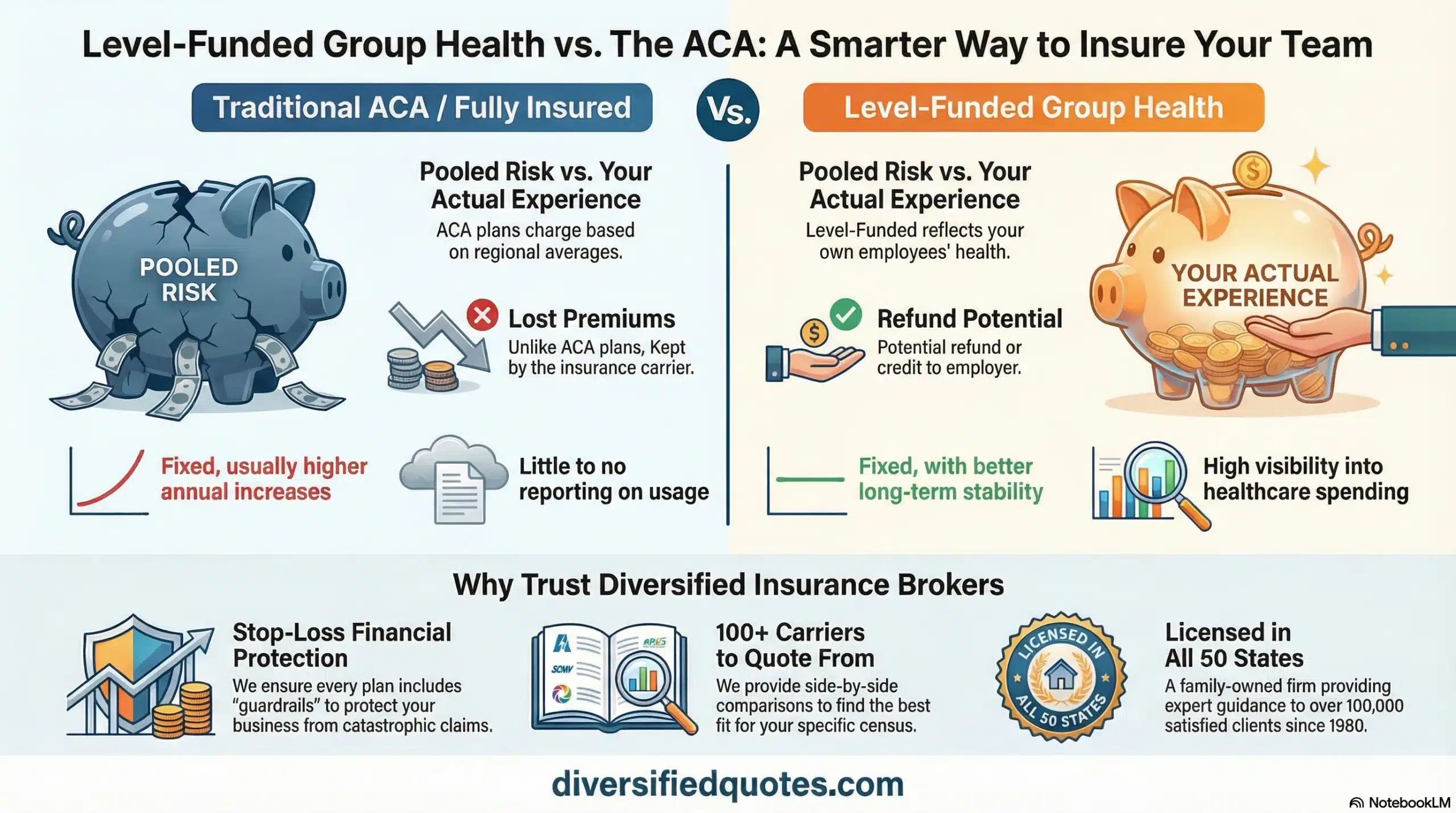
In a fully insured plan, the employer pays a fixed monthly premium to an insurance carrier regardless of actual claims. The carrier collects premiums from all employers in its risk pool, pays claims from the pooled premium, retains a margin for administrative costs and profit, and prices future renewals based on the pool’s aggregate loss experience. The employer’s premium may not directly reflect their own claims experience — particularly for smaller employers who are heavily influenced by the broader risk pool’s performance. An employer with an exceptionally healthy workforce may pay the same premium as an employer with a chronically ill population if their group is too small to be experience-rated individually. The carrier assumes all risk and keeps all savings when the pool performs favorably.
In a self-funded plan, the employer sets aside claims reserves in a funding account — typically based on actuarial projections of expected monthly claims for the covered population. When an employee (or their covered dependent) uses medical services, the claim flows through the plan’s network and is processed by a third-party administrator (TPA) who handles claims adjudication, network repricing, coordination of benefits, and payment processing. The employer funds claims payments from the claims reserve as they are processed — typically on a weekly or bi-weekly claims funding cycle. The employer is directly responsible for paying claims up to the stop-loss deductible amounts, and stop-loss insurance reimburses claims above those thresholds. At the end of the plan year, any unused claims reserves are retained by the employer rather than surrendered to an insurance carrier.
This fundamental difference — employer retention of unused claims funds — is one of the primary financial arguments for self-funding. A fully insured employer whose claims run significantly below the carrier’s projected cost has essentially made a donation to the carrier’s profit; the premium dollars are not returned regardless of how favorably the group performed. A self-funded employer whose claims run below the actuarial projection retains those dollars and can use them to improve reserves, reduce the following year’s funding requirement, invest in wellness programs, or simply retain as working capital. Over a multi-year time horizon, this structural difference produces the cost savings that make self-funding attractive to employers who are willing to engage strategically with their healthcare spend rather than treating it as a fixed cost of doing business.
Stop-Loss Insurance: The Risk Management Foundation
Stop-loss insurance is the mechanism that makes self-funded group health insurance accessible to employers who cannot absorb unlimited claims exposure — which is essentially all employers. Without stop-loss protection, a single catastrophic claim (a premature birth, a transplant, a rare cancer diagnosis, a major trauma case) could produce claims costs of $500,000 to several million dollars that would devastate a smaller or medium-sized employer’s finances. Stop-loss insurance converts the open-ended risk of self-funding into a defined maximum exposure that the employer can budget for and absorb.
Specific stop-loss (also called individual stop-loss) protects against large claims from a single covered individual — employee or dependent. The employer selects a specific deductible — called the specific attachment point — which represents the maximum the employer will pay for any single individual’s claims during the plan year. When a covered individual’s claims exceed the specific attachment point, the stop-loss carrier reimburses the employer for the excess. Common specific attachment points range from $25,000 to $100,000 or more depending on the employer’s size, risk tolerance, and premium budget. A lower attachment point provides more protection and costs more in stop-loss premium; a higher attachment point means the employer retains more risk and pays lower stop-loss premium.
The stop-loss carrier’s underwriting of specific stop-loss is the most critical component of self-funded plan evaluation, because the specific attachment point is where the largest financial risk concentrates. Stop-loss underwriters review the employer’s existing claims experience, workforce demographics, any known high-cost members (often disclosed through an “individual disclosure” process), and the group’s industry and geographic profile. Groups with known high-cost members may receive “lasered” stop-loss — where specific individuals are excluded from stop-loss protection or assigned a higher individual deductible than the group’s standard attachment point. Understanding the laser provisions before committing to a self-funded plan is essential for groups with known high-cost claimants.
Aggregate stop-loss protects against total plan claims exceeding a defined threshold for the entire group during the plan year. The aggregate attachment point is typically calculated as a percentage — commonly 120% to 125% — of the actuarially projected annual claims for the covered population. When total plan claims exceed the aggregate corridor, the stop-loss carrier pays the excess up to the aggregate stop-loss limit. Aggregate stop-loss provides protection against an entire group performing significantly worse than projected — a scenario that might occur if a cluster of large claims coincides in the same plan year, or if the population’s health status deteriorates materially from one year to the next.
Together, specific and aggregate stop-loss create a defined maximum net exposure framework: the employer knows its worst-case per-member cost (the specific attachment point times the number of covered members, roughly) and its worst-case total cost (the aggregate corridor), allowing financial planning with defined boundaries rather than open-ended risk. Our resource on understanding stop-loss insurance in level-funded plans provides additional context for how stop-loss mechanics work across both level-funded and self-funded plan structures.
The Financial Architecture Behind Self-Funded Plans
Modern self-funded group health insurance programs are built around multiple financial protection and cost management layers working together. At the foundation is actuarial claims forecasting — estimating expected claims based on workforce demographics, prior claims experience when available, geographic healthcare costs, industry utilization trends, and any known high-cost medical situations in the covered population. This forecast becomes the basis for the monthly claims funding requirement — the amount the employer needs to set aside each month to cover expected claims as they are submitted and adjudicated.
The claims funding mechanism is one of the most practically important aspects of self-funded plan cash flow management. Unlike fully insured premiums that are a fixed monthly obligation, self-funded claims funding follows actual claims volume — which is lumpy rather than smooth. Months with lower claims generate less funding activity; months with high-claim events generate larger funding demands. Employers typically maintain a claims reserve — several months of projected claims — as a buffer against volatile months. The sizing of this reserve is a financial planning decision that affects the employer’s working capital requirements and the plan’s practical financial resilience.
Above the expected claims layer, stop-loss insurance provides the risk management boundary that converts open-ended financial exposure into defined maximum liability. Above the stop-loss layer, employer governance and vendor management create the operational infrastructure that determines how efficiently the plan runs — how accurately claims are adjudicated, how effectively pharmacy costs are managed, and how well population health trends are identified and addressed before they generate large claims.
The financial argument for self-funding against fully insured plans is most clearly expressed over multi-year time horizons. In any single year, a fully insured employer can experience lower total cost than a self-funded employer if claims are significantly worse than the self-funded plan’s actuarial projection. Over three, five, or ten years, however, the structural removal of carrier margin, premium tax, and risk loading from the cost base typically produces meaningful savings for employers whose claims experience is reasonably predictable and whose population health management is at least adequate. The crossover point — where self-funding’s structural cost advantage begins to outweigh the cash flow and risk management complexity — varies by employer size, but for most employers with 100 or more covered lives, the multi-year financial case for self-funding is compelling.
The Third-Party Administrator: The Operational Engine
The third-party administrator is the operational core of any self-funded group health insurance plan. While the employer assumes financial responsibility for claims, the TPA handles the complex administrative machinery that makes claims payment, network access, regulatory compliance, and employee service function. Understanding the TPA’s role — and evaluating TPA quality carefully before committing to a self-funded structure — is one of the most important aspects of self-funded plan due diligence.
The TPA’s primary functions include claims adjudication — verifying that submitted claims are for covered services, applying the plan’s cost-sharing rules (deductibles, copays, coinsurance), applying coordination of benefits rules, processing network repricing, and issuing payment instructions to the employer’s claims funding account. For a self-funded plan with 200 covered lives, this may involve adjudicating thousands of claims annually across dozens of providers in multiple geographic markets.
The TPA typically also provides network access — most self-funded employers access major national PPO networks (such as BCBS, Aetna, Cigna, or independent networks) through the TPA, which has contracted network access arrangements that provide the employer’s covered employees with in-network provider access and negotiated pricing. The network relationship is crucial because most employees make provider decisions based on in-network status — a self-funded plan that cannot offer competitive network access will struggle with employee satisfaction and potentially with plan utilization patterns.
TPA analytics capabilities have become increasingly important as employers become more sophisticated about using claims data for cost management. Advanced TPAs provide near-real-time claims dashboards that allow employers to monitor plan performance, identify emerging trends, flag high-cost cases for care management programs, and track specialty pharmacy utilization. Over time, this data becomes one of the most strategically valuable assets the employer accumulates — because it provides the foundation for increasingly targeted cost management interventions that are only possible when the employer can see and understand their own claims experience at a granular level.
ERISA Preemption: The Regulatory Advantage That Enables Customization
One of the most significant structural advantages of self-funded group health insurance is federal ERISA preemption — the legal principle that self-funded ERISA plans are governed by federal law rather than state insurance mandates, giving employers substantially more plan design flexibility than fully insured plans that are subject to state insurance regulation.
Fully insured plans must comply with every state insurance mandate in the states where the employer operates — requirements to cover specific conditions, specific treatments, specific provider types, or specific benefit structures that the state legislature has mandated. These mandates vary significantly across states and add meaningful cost to fully insured plans operating in high-mandate states. Self-funded ERISA plans are largely exempt from state insurance mandates — they must comply with federal requirements (ERISA, ACA, HIPAA, and others) but are not subject to the patchwork of state-level mandated benefits that drive up fully insured plan costs.
This ERISA preemption creates plan design flexibility that is genuinely valuable for employers who want to tailor their benefit structure to their specific workforce rather than paying for mandated benefits their employees do not heavily use. Employers can design benefit structures that prioritize the care categories most relevant to their population, implement value-based plan designs that incentivize high-quality/lower-cost care pathways, and eliminate or restructure benefits that state mandates require of fully insured plans but that the employer’s specific population does not need.
ERISA also imposes fiduciary responsibilities on the employer as plan sponsor — the employer is legally responsible for making plan design decisions in the best interests of plan participants, selecting and monitoring vendors with appropriate due diligence, and governing the plan in compliance with ERISA’s reporting and disclosure requirements. Most employers address these fiduciary responsibilities by building formal plan governance structures and engaging experienced ERISA counsel and compliance vendors as part of the TPA relationship.
PBM Strategy and Pharmacy Cost Engineering
Pharmacy costs represent one of the fastest-growing healthcare expense categories for self-funded employers, and the strategic management of pharmacy benefits is increasingly one of the most important cost levers in the entire self-funded plan structure. In many fully insured plans, pharmacy benefits are bundled into carrier pricing, limiting employer visibility into actual drug costs, rebate structures, and formulary economics. Self-funded group health insurance allows employers to carve out pharmacy benefit management and engage directly with pharmacy benefit managers (PBMs) or specialty pharmacy vendors on terms that may be substantially more favorable than what is available through a bundled carrier arrangement.
PBM carve-outs allow employers to control rebate pass-through structures — ensuring that manufacturer rebates from pharmaceutical companies flow back to the plan rather than being retained by the PBM as additional margin. The rebate pass-through question is one of the most consequential economics issues in pharmacy benefit management: PBMs earn rebates from pharmaceutical manufacturers for formulary placement, and the extent to which those rebates are passed through to the employer versus retained by the PBM affects the plan’s net pharmacy cost substantially. Transparent, pass-through PBM arrangements typically produce meaningfully lower net pharmacy costs than opaque bundled arrangements where rebate retention practices are unclear.
Specialty drug management is the highest-stakes dimension of pharmacy benefit strategy. Specialty drugs — biologics, gene therapies, high-cost injectable medications for conditions like rheumatoid arthritis, multiple sclerosis, cancer, and inflammatory conditions — often represent 40% to 60% or more of total pharmacy spend while being used by a very small percentage of covered members. Strategic interventions in specialty drug management — prior authorization requirements, biosimilar substitution programs, step therapy protocols, specialty pharmacy steering to lower-cost dispensing channels, and international drug sourcing programs where legally available — can produce significant cost reductions in this high-impact category. Our resource on understanding stop-loss in level-funded plans provides additional context for how catastrophic pharmacy events interact with stop-loss protection.
Reference-Based Pricing and Direct Provider Contracting
Reference-based pricing (RBP) has emerged as one of the most powerful cost control tools available within self-funded group health insurance — and one that is simply unavailable to fully insured employers operating within fixed carrier network structures. Instead of paying provider-billed charges or negotiated network discounts, RBP programs establish maximum reimbursement rates tied to Medicare-based benchmarks or other predetermined reference points. The employer pays a defined percentage of Medicare rates — commonly 120% to 200% depending on service type and market — rather than the hospital’s negotiated rate under a traditional PPO arrangement.
The financial case for RBP is compelling: hospital facility charges are often 300% to 500% or more of Medicare rates under traditional network arrangements, and even “negotiated network discounts” may result in payments of 200% to 300% of Medicare. An RBP program paying 150% to 200% of Medicare for facility services can produce meaningful savings relative to traditional network pricing — particularly for high-cost facility utilization like inpatient hospitalizations and outpatient surgical procedures.
Employers implementing RBP typically pair it with member advocacy programs that help employees navigate the billing and claims process, particularly when providers bill patients for the difference between what the RBP plan pays and what the provider requested (known as balance billing). Member advocacy programs proactively negotiate on behalf of plan members to resolve balance billing situations, reducing the practical friction that would otherwise undermine employee satisfaction with the RBP approach.
More advanced employers extend direct contracting strategies beyond RBP — negotiating bundled payment arrangements with local hospitals for high-volume surgical procedures, establishing direct primary care (DPC) relationships that provide unlimited primary care access for a fixed monthly per-member fee, and engaging centers of excellence (COEs) for complex cases like cancer treatment, spinal surgery, or cardiac procedures where quality variation and cost variation are both significant. These strategies represent the most sophisticated end of the self-funded cost management spectrum and are typically developed over multiple years as the employer accumulates claims data and builds confidence in their healthcare cost management approach.
Population Health Analytics and Multi-Year Cost Strategy
One of the most powerful long-term advantages of self-funded group health insurance is the claims data transparency that accumulates over time. Fully insured employers typically receive limited, aggregated claims data — often not detailed enough to identify specific cost drivers or evaluate the impact of targeted interventions. Self-funded employers have access to detailed, member-level claims data (subject to appropriate HIPAA privacy protections at the individual level) that allows them to understand exactly what is driving their healthcare costs and what interventions are most likely to reduce those costs.
Population health analytics from TPA data can identify the prevalence of chronic conditions in the covered population, the utilization patterns for high-cost specialties, the concentration of claims among specific high-cost members, the effectiveness of disease management and wellness programs, and the pharmaceutical patterns that are creating the largest pharmacy cost burden. Over time, this data becomes the foundation for increasingly targeted cost management — identifying which chronic conditions to prioritize for disease management programs, which care pathways are generating avoidable emergency or inpatient utilization, and which vendor relationships are producing genuine value versus those that are consuming administrative resources without commensurate benefit.
The compounding nature of population health improvement over multiple years is one of the most compelling arguments for sustained commitment to self-funded healthcare management. An employer who identifies a cohort of pre-diabetic employees and invests in a targeted diabetes prevention program today may not see the full cost benefit until year three or four — when the avoided diabetes diagnoses, related comorbidities, and medication costs begin to reduce the claims baseline. Short-term thinking about self-funded healthcare — evaluating the decision based on year-one cost comparisons alone — systematically undervalues the multi-year strategic return that well-managed self-funded programs generate.
Who Is a Good Fit for Self-Funded Group Health Insurance
Self-funded group health insurance is not the right structure for every employer — and being clear about the profile of employers for whom self-funding is most appropriate helps organizations make better funding structure decisions rather than being drawn to self-funding for reasons that do not reflect their actual situation.
Employers with 100 or more covered lives are the most natural fit for traditional self-funding. At this size, the actuarial credibility of the group’s own claims experience is sufficient to support meaningful claims projections, the administrative infrastructure of TPA management is economically justified, and the stop-loss market provides competitive pricing for specific and aggregate coverage. Employers with 50 to 100 covered lives can self-fund with appropriate stop-loss protection and TPA support, but the claims volatility risk is higher and the financial resilience requirements are more demanding.
Employers with relatively stable and predictable workforce demographics benefit most from self-funding’s structural cost advantages. High employee turnover, volatile headcount growth, or sudden demographic changes can destabilize actuarial projections and make self-funding more financially uncertain. Stable employers with modest turnover and predictable headcount accumulate credible claims data over time in ways that make each successive year’s planning more accurate and more strategically actionable.
Organizations with financial capacity to maintain claims reserves and absorb stop-loss attachment point exposure are better positioned for self-funding than organizations operating on thin financial margins with limited working capital. The upfront reserve requirement — typically two to four months of projected claims — and the ongoing cash flow dynamics of claims funding require a financial capacity that some smaller organizations simply cannot sustain comfortably.
Employers genuinely committed to active healthcare cost management — who will engage with TPA analytics, invest in wellness and disease management programs, evaluate pharmacy strategy, and treat healthcare as a strategic financial priority rather than a compliance obligation — extract the most value from self-funding’s transparency advantages. Employers who want a hands-off approach may be better served by level-funded or fully insured structures that provide more predictability at the cost of some control and transparency.
For employers whose size, financial capacity, or engagement level does not fit traditional self-funding, the level-funded employer health plan structure provides many of the transparency and potential savings advantages of self-funding within a more predictable, fixed monthly payment framework that is more accessible for smaller employers or those not yet ready for full self-funding complexity. Our resource comparing the pros and cons of self-funded group health provides a balanced evaluation of where self-funding creates genuine value and where the complexity or risk may not be warranted.
The Transition: Moving from Fully Insured to Self-Funded
The transition from a fully insured plan to a self-funded structure is a process that benefits from careful planning, appropriate vendor selection, and realistic expectations about the timeline for realizing the full financial and strategic benefits of self-funding. Most employers do not achieve the maximum benefits of self-funding in year one — the first year is largely about establishing operational infrastructure, accumulating baseline claims data, and calibrating the funding and stop-loss structure to the group’s actual risk profile.
The typical implementation timeline spans three to six months from the decision to self-fund through plan effective date, covering TPA selection and contracting, stop-loss carrier selection and underwriting, network contracting arrangement, PBM arrangement if carving out pharmacy, benefit design development, plan document drafting and legal review, employee communication, and operational readiness testing. The most common mistake in self-funding transitions is rushing the implementation timeline — particularly the stop-loss underwriting process, which requires detailed claims history disclosure and thorough evaluation of any known high-cost members that could affect the specific stop-loss structure.
Year two and beyond typically produce the more compelling financial outcomes as the employer begins accumulating credible claims data, can negotiate stop-loss renewal terms with actual experience rather than actuarial estimates, and can begin implementing targeted cost management interventions informed by the first year’s utilization analytics. Multi-year commitment to the self-funded approach — rather than retreating to fully insured at the first sign of a bad claims year — is one of the most important factors in achieving the full long-term benefit of the model. Our resource on level-funded health insurance tax benefits provides context for how the tax efficiency arguments that apply to level-funded plans also extend to self-funded structures.
Model PBM, RBP, and Stop-Loss Cost Scenarios
Run advanced cost simulations across pharmacy management, claims volatility, and catastrophic exposure layers for your specific workforce profile.
Run Advanced Cost ModelQuestions? Call 800-533-5969
Design Your Employer Healthcare Cost Strategy
Build a multi-year plan combining stop-loss structure, PBM optimization, claims analytics, and population health interventions.
Request Strategic Healthcare PlanQuestions? Call 800-533-5969
Advanced Employer Healthcare Funding Education
Explore deeper employer funding strategy, risk modeling, and stop-loss design.
Financial Protection Essentials
Core group health resources for employers evaluating funding structure, ACA alternatives, and healthcare cost optimization.
Talk With an Advisor Today
Choose how you’d like to connect—call or message us, then book a time that works for you.
Schedule here:
calendly.com/jason-dibcompanies/diversified-quotes
Licensed in all 50 states • Fiduciary, family-owned since 1980
FAQs: Self-Funded Group Health Insurance
Is self-funded group health insurance legal for small businesses?
Yes. Self-funding is permitted under ERISA for employer groups of essentially any size when paired with appropriate stop-loss insurance. Historically, self-funding was most common among large employers (500+ covered lives) because the actuarial credibility of larger groups allowed more predictable claims forecasting. However, the combination of modern stop-loss insurance structures, sophisticated TPAs, and level-funded plan designs has extended the practical accessibility of self-funding concepts down to groups as small as 10 to 25 covered lives — particularly through level-funded plans that apply self-funding mechanics within a fixed monthly payment framework.
For traditional fully self-funded arrangements, groups of 50 to 100 covered lives can effectively self-fund with appropriate stop-loss protection and disciplined reserve management. Groups of 100 or more covered lives are typically the most natural fit for traditional self-funding because the claims volume provides actuarial credibility for projections, the administrative overhead is economically justified relative to plan size, and the stop-loss market provides the most competitive pricing at these group sizes. Our resource on small employer group health options addresses the funding structure options available to the smallest employer groups, and our resource on level-funded employer health plans covers the hybrid structure that brings self-funding advantages to smaller groups through a more predictable monthly payment framework.
What happens if claims exceed expectations?
This is the question that stop-loss insurance is specifically designed to answer. When an individual covered member’s claims exceed the specific stop-loss attachment point — the per-individual deductible chosen at plan design — the stop-loss carrier reimburses the employer for the excess claims above that threshold. This means the employer’s maximum out-of-pocket exposure for any single individual is capped at the specific attachment point regardless of how large that individual’s total claims become — whether $200,000 or $5 million for an extraordinarily high-cost case like a transplant, gene therapy, or complex neonatal case.
At the aggregate level, if the group’s total claims for the plan year exceed the aggregate stop-loss attachment point — typically set at 120% to 125% of actuarially projected annual claims — the stop-loss carrier reimburses the employer for aggregate claims above that corridor. Together, specific and aggregate stop-loss convert open-ended claims risk into defined maximum net exposure. The stop-loss structure must be sized and selected carefully, however — particularly with respect to laser clauses that may exclude known high-cost members from standard specific stop-loss protection, creating potentially unlimited exposure for those individuals. Our resource on understanding stop-loss insurance explains these mechanics in detail.
Do self-funded plans still use provider networks?
Yes — most self-funded employers access major national or regional PPO networks through their TPA’s network arrangement, providing covered employees with in-network provider access and negotiated pricing. The network structure functions the same way for employees as it does in a fully insured plan: employees see in-network providers, pay their in-network cost-sharing, and receive care at network-negotiated rates. The difference is that the employer, not an insurance carrier, is paying the actual claim costs — but from the employee’s perspective, the care experience is essentially identical to a fully insured plan using the same network.
Some advanced self-funded employers go beyond standard PPO network access to implement reference-based pricing (RBP), direct provider contracting, or center-of-excellence arrangements that can provide better cost control than standard network pricing. These alternative network strategies are generally only available in self-funded structures — fully insured employers cannot typically access these approaches because the carrier controls the network contracting relationship. RBP and direct contracting strategies require member advocacy programs and careful employee communication to manage the practical challenges of non-standard provider payment arrangements.
Are self-funded plans subject to state mandates?
No — this is one of the most significant structural advantages of self-funded ERISA plans. Self-funded employer health plans are governed primarily by federal ERISA law, not by state insurance regulations. This means self-funded plans are largely exempt from state insurance mandates — requirements to cover specific conditions, specific treatments, specific provider types, or specific benefit structures that state legislatures have required of fully insured plans operating in that state. Fully insured plans operating in states with many insurance mandates pay meaningfully higher premiums to fund those mandated benefits. Self-funded employers can design benefits around what their specific workforce actually uses rather than what state legislators have mandated, eliminating the cost of covering mandated benefits that may not be relevant to their employee population.
Self-funded employers do remain subject to federal benefit requirements — ACA essential health benefit requirements apply somewhat differently to self-funded plans, ERISA’s reporting and disclosure requirements apply, HIPAA privacy and portability requirements apply, and non-discrimination testing requirements apply. ERISA also imposes fiduciary responsibilities on the employer as plan sponsor. Most employers address these compliance requirements through their TPA and external ERISA counsel relationships, which handle the ongoing compliance management so the employer can focus on strategic healthcare cost decisions rather than regulatory administration.
What’s the difference between level-funded and self-funded?
Level-funded plans and self-funded plans share the same foundational mechanic — the employer is ultimately responsible for paying the actual claims of their covered workforce rather than transferring all risk to an insurance carrier — but they differ in how that responsibility is structured, funded, and presented to the employer. Level-funded plans bundle the claims funding, stop-loss insurance, and administrative costs into a single fixed monthly payment, making the plan look and feel more like a traditional fully insured plan from a budgeting standpoint while preserving the self-funding mechanics underneath.
The practical advantages of level-funded plans for smaller employers are the predictable monthly cash flow (no volatile claims funding swings), the typically more accessible stop-loss underwriting (often group underwriting rather than individual disclosure), and the potential year-end surplus return if actual claims are significantly below the plan’s projected cost. The advantage of traditional self-funded plans for larger employers is more granular control — the ability to separately optimize stop-loss structure, TPA selection, PBM carve-out, and network strategy as independent vendor relationships rather than as a bundled package. Level-funded plans are generally more appropriate for groups of 10 to 100 covered lives; traditional self-funding becomes more compelling and more customizable as group size grows. Our resource on level-funded employer health plans explains the level-funded structure in full detail.
What role does the third-party administrator play?
The third-party administrator (TPA) is the operational engine of a self-funded plan — handling the complex administrative machinery that makes claims payment, network access, regulatory compliance, and employee service function in the absence of a traditional insurance carrier. The TPA adjudicates claims, applies cost-sharing rules, processes network repricing, coordinates benefits, and issues payment instructions for the employer’s claims funding. The TPA typically also provides the network access arrangement that gives covered employees in-network provider access, and increasingly provides analytics dashboards that allow the employer to monitor claims trends, identify high-cost patterns, and evaluate the effectiveness of wellness and disease management programs.
TPA selection is one of the most important decisions in self-funded plan implementation — and one that is often underestimated relative to stop-loss carrier selection and plan design. A TPA with poor claims adjudication accuracy, inadequate customer service for employee inquiries, limited analytics capability, or weak provider network relationships undermines the entire self-funded structure regardless of how well the stop-loss is structured or how the benefit design is configured. Evaluating TPA quality on multiple dimensions — operational accuracy, technology platform, analytics capability, and service model — before committing to a TPA relationship is part of responsible self-funded plan due diligence.
How long does it take to see financial benefits from self-funding?
Year one of self-funding is largely about establishing operational infrastructure and accumulating baseline claims data — the financial benefits are typically more modest in the first year and grow as the employer builds claims data history and implements increasingly targeted cost management interventions. Most employers see the most compelling financial performance in years two through five of a well-managed self-funded program, as stop-loss renewal negotiations are based on actual experience rather than actuarial estimates, population health interventions begin reducing chronic disease progression, pharmacy strategy refinements reduce specialty drug costs, and the employer develops a more sophisticated understanding of their specific claims drivers.
The multi-year compounding nature of self-funded cost management is one of the most important arguments for sustained commitment rather than retreating to a fully insured structure after a difficult year-one experience. Short-term thinking about self-funded healthcare — evaluating the decision based on year-one cost comparisons alone — systematically undervalues the multi-year strategic return that well-managed programs generate. Employers who stay committed through year-two and year-three typically begin to see the structural cost advantages that the self-funded model is designed to produce.
What are the biggest risks in self-funded group health insurance?
The primary financial risk in self-funded group health insurance is claims volatility — particularly the risk of multiple large claims coinciding in the same plan year, or a single catastrophic claim that, while covered by specific stop-loss above the attachment point, still requires the employer to fund the attachment point amount. This risk is managed through appropriate stop-loss structure and adequate claims reserves, but it requires the employer to have financial capacity and discipline that some organizations lack.
The primary operational risk is vendor mismanagement — selecting a TPA that performs poorly, a stop-loss carrier whose underwriting includes onerous laser provisions, or a PBM arrangement that lacks adequate rebate pass-through. These vendor relationships determine the operational quality and financial efficiency of the self-funded program, and poor vendor selection can undermine the cost advantages that motivated the self-funding decision. Engaging an experienced benefits advisor who understands self-funded plan architecture and has relationships across the TPA, stop-loss, and PBM markets is the most effective mitigation for this operational risk. Our resource on the pros and cons of self-funded group health provides a balanced evaluation of both the risks and advantages of the self-funded approach.
Browse Level Funding & ACA Alternative Guides
About the Author:
Jason Stolz, CLTC, CRPC, DIA, CAA and Chief Underwriter at Diversified Insurance Brokers (NPN 20471358), is a senior insurance and retirement professional with more than 25 years of real-world experience helping individuals, families, and business owners protect their income, assets, and long-term financial stability. As a long-time partner of the nationally licensed independent agency Diversified Insurance Brokers, Jason provides trusted guidance across multiple specialties—including fixed and indexed annuities, long-term care planning, personal and business disability insurance, life insurance solutions, Group Health, Travel Medical and Evacuation Insurance, and short-term health coverage. Diversified Insurance Brokers maintains active contracts with over 100 highly rated insurance carriers, ensuring clients have access to a broad and competitive marketplace.
His practical, education-first approach has earned recognition in publications such as VoyageATL, and contributions from his agency featured in Kiplinger and GoBankingRates— highlighting his commitment to financial clarity and client-focused planning. Drawing on deep product knowledge and years of hands-on field experience, Jason helps clients evaluate carriers, compare strategies, and build retirement and protection plans that are both secure and cost-efficient. Visitors who want to explore current annuity rates and compare options across multiple insurers can also use this annuity quote and comparison tool.
Explore All Group Health Insurance Options: Browse our complete Group Health Insurance guide — covering small business, company size options, industry-specific plans, level funding & ACA alternatives.
Last Reviewed: June 19, 2026 |
Reviewed by: Jason Stolz, CLTC, CRPC, DIA, CAA
Chief Underwriter, Diversified Insurance Brokers, Inc. | NPN: 20471358 | Diversified Insurance Brokers, Inc. — Licensed in all 50 states
Fact Checked by: Tonia Pettitt, CMIP©
Medicare Specialist, Diversified Insurance Brokers, Inc. | NPN: 14374308 | Diversified Insurance Brokers, Inc. — Licensed in all 50 states
Did you find this content helpful? Leave us a Google review — it helps others find trustworthy guidance too.
Editorial Standards: Diversified Insurance Brokers maintains rigorous editorial standards to ensure accuracy, clarity, and independence in all content. Learn more about our editorial standards and commitment to transparency.
