
Best Group Health Insurance Options for 2-Person Businesses
Best Group Health Insurance Options for 2-Person Businesses

Jason Stolz CLTC, CRPC, DIA, CAA
A two-person business can qualify for group health insurance — but the path to coverage is narrower than most small business owners expect, and the documentation requirements are more specific than at larger group sizes. Carriers issuing group health plans to micro-groups need to confirm that the business is legitimate, that both individuals meet the definition of eligible employees, that payroll records support W-2 employment, and that the employer’s contribution structure meets minimum participation thresholds. None of these are impossible hurdles, but any of them can derail an application when the setup is not correct before quoting begins. The most common and costly mistake two-person businesses make in group health is choosing a plan before confirming eligibility — spending time on quotes, employee census forms, and carrier applications, only to discover that the group structure does not qualify under that carrier’s rules. Confirming eligibility first, then comparing plan structures, is the correct sequence. Our resources on how to set up group health insurance for employees and best independent group health broker cover the foundational steps of building a group health plan from scratch for small employers.
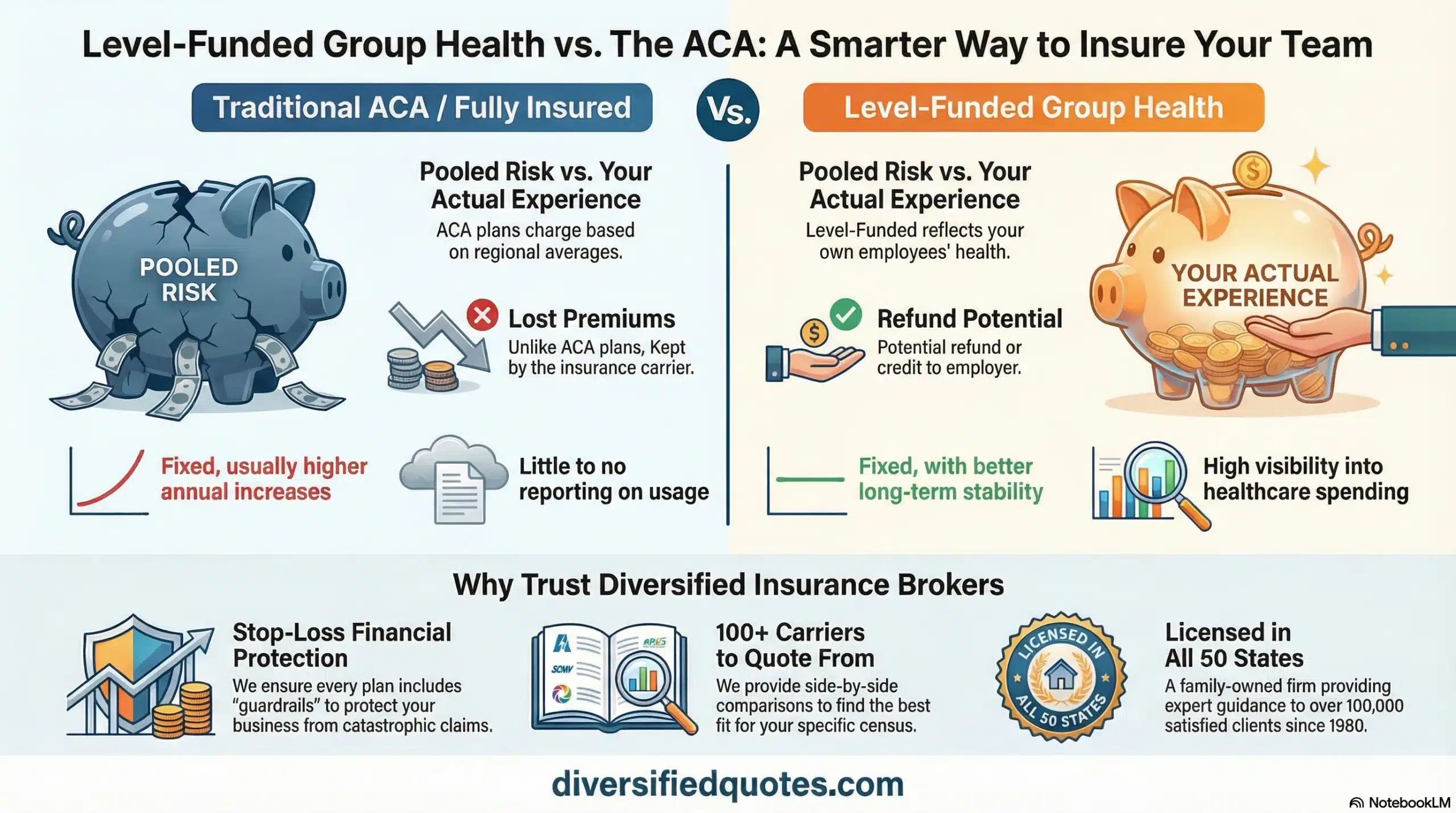
For two-person businesses that can qualify for traditional group coverage, two primary plan structures dominate: fully insured small-group plans and level-funded designs. Fully insured plans offer fixed monthly premiums, carrier-assumed claim risk, and the simplest administration framework — the right choice for employers who prioritize budget predictability and minimal administrative involvement. Level-funded designs separate the cost components (administrative costs, stop-loss premiums, and estimated claims funding) and allow the employer to potentially receive a surplus credit when claims run below projections — the right choice for employers who want more cost transparency, potential upside when their group is healthy, and a more strategic multi-year relationship with their health plan cost. Understanding how these two structures compare on total cost, risk exposure, and administrative requirements — not just first-month premium — is the foundation of a sound plan selection decision. Our resource on what is self-funded group health insurance provides the foundational mechanics of the level-funded model, and our resource on why choose group level funding covers the strategic case for level-funded designs as a long-term employer benefits strategy.
For two-person businesses where traditional group eligibility is complicated — owner-only arrangements, businesses where one person is a contractor rather than a W-2 employee, newly formed businesses with limited payroll history, or businesses that prefer not to commit to a group plan structure — Health Reimbursement Arrangements (HRAs) provide a legitimate and IRS-recognized alternative. An ICHRA (Individual Coverage Health Reimbursement Arrangement) allows employers of any size to reimburse employees tax-free for the cost of individual health insurance they purchase on their own, with no IRS-imposed contribution limit and significant flexibility in plan design. A QSEHRA (Qualified Small Employer HRA) provides similar functionality with specific rules: it is available only to employers with fewer than 50 full-time equivalent employees, requires uniform offering to all eligible employees, and caps annual employer contributions at IRS-defined limits (adjusted annually). These alternatives are not workarounds or second-tier options — they are formal, IRS-governed benefit structures that give very small employers meaningful options when group eligibility is out of reach or when individual coverage better fits the employees’ specific healthcare situations.
Request a Group Health Comparison for Your 2-Person Business
We confirm eligibility first, then compare fully insured, level-funded, ICHRA, and QSEHRA designs based on your business structure, documentation, and budget goals.
Four Coverage Structures for a 2-Person Business — Side by Side
The table below compares the four primary coverage structures available to two-person businesses across the dimensions that matter most for this group size: eligibility requirements, cost structure, risk exposure, administration burden, and best-fit scenario. No single structure is right for every two-person business — the correct choice depends on your documentation, business structure, budget goals, and risk tolerance.
| Dimension | Fully Insured Small-Group | Level-Funded Small-Group | ICHRA | QSEHRA |
|---|---|---|---|---|
| Group Eligibility Required? | Yes — must qualify as a bona fide group under carrier and state rules; both individuals must be W-2 employees meeting eligibility definitions | Yes — same eligibility requirements as fully insured small-group; additional stop-loss underwriting applies | No traditional group eligibility required — available to employers of any size; no W-2 group requirement | No traditional group eligibility required — available to businesses with fewer than 50 FTE employees; cannot be offered alongside a group health plan |
| Employer Cost Structure | Fixed monthly premium — same amount every month regardless of claims; simplest budget structure; no surplus when claims run low | Fixed monthly payment covering admin costs + stop-loss premium + estimated claims funding; potential surplus credit when claims run below projections | Employer sets own reimbursement amount — no IRS contribution cap; employer funds only what is used (reimbursement model, not pre-funding) | Employer contributes up to IRS annual limits — $6,450/individual, $13,100/family (2026 limits); can set less than the maximum; reimbursement model only |
| Claim Risk Exposure | Zero — carrier assumes all claim risk; employer premium is fixed regardless of how large or frequent claims are | Limited by stop-loss protection — employer participates in claims funding but stop-loss caps exposure above defined thresholds | Zero — employer reimburses employees for individual policies they purchase; no direct claim risk to employer | Zero — same as ICHRA; employer reimburses for individual coverage costs; no direct claim exposure |
| Tax Treatment | Employer contributions to premiums are generally tax-deductible; employee premium contributions made through payroll deductions are pre-tax | Similar tax treatment to fully insured; admin and stop-loss costs generally deductible; some level-funded designs provide additional tax benefit context — review with a tax advisor | Employer reimbursements are tax-deductible; employee reimbursements received are generally tax-free; employees offered affordable ICHRA may not be eligible for ACA marketplace premium tax credits | Employer reimbursements are tax-deductible; employee reimbursements are generally tax-free; employees may still receive ACA premium tax credits, reduced dollar-for-dollar by QSEHRA amount |
| Administration Burden | Lowest — carrier manages the plan; employer manages enrollment and premium payment; minimal ongoing admin | Moderate — employer needs to understand stop-loss terms and claims account mechanics; more engaged administration than fully insured | Moderate — employer must set up the ICHRA, track reimbursement claims, and verify that employees have qualifying individual coverage before reimbursing | Moderate — requires written employee notice, 90-day advance notice before effective date, and consistent reimbursement documentation; simpler than ICHRA in some ways because uniform rules apply |
| Best Fit For | Two-person businesses that qualify for group coverage and prioritize fixed costs and minimal administration over potential savings | Two-person businesses that qualify for group coverage, have healthy members, and want transparency plus potential claims surplus credit | Businesses that do not qualify for group health OR prefer to let employees choose their own individual plans; growing businesses or those with very varied employee health needs | Very small businesses (under 50 FTE) that cannot or do not want to offer group health and want a simple, uniform HRA benefit within IRS contribution limits |
Tax treatment, eligibility rules, contribution limits, and carrier-specific terms vary. ICHRA and QSEHRA contribution limits are adjusted annually by the IRS — verify current limits at IRS.gov before establishing any HRA plan. Consult a qualified tax advisor before making structural decisions about employer-sponsored health benefits. This table reflects general patterns; actual plan terms and qualification rules must be confirmed before any enrollment decision.
How Two-Person Group Eligibility Actually Works
Carriers issue group health plans to bona fide employee groups — not to individuals who happen to be associated with a business entity. For a two-person business to qualify, both individuals generally need to meet the carrier’s definition of an eligible employee: W-2 employees of an active, legitimate business, working a minimum number of hours (typically 30+ hours per week), and receiving compensation that is documented through regular payroll. The carrier wants evidence that the group is real — that the business is operational, that payroll is consistent, and that the employer intends to maintain minimum contribution and participation standards. State rules add another layer: many states have specific small-group rules that govern how owner-spouses are treated, whether owner-only groups qualify, and what minimum group sizes different carriers require to issue a policy.
Three eligibility configurations come up most often in two-person group applications. In the first, two co-owners are both on W-2 payroll from the same business entity — this is the most straightforward configuration and most carriers will consider it if documentation is clean. In the second, one owner and one non-owner employee are both on W-2 payroll — also straightforward and often the configuration carriers most readily approve because it clearly demonstrates an employer-employee relationship that is not owner-only. In the third, one owner and a spouse are the only two people — this is the most variable configuration, with some carriers accepting owner/spouse groups in certain states and others requiring at least one non-owner employee. Carriers are explicit about which of these configurations they will consider, which is why understanding the specific carrier’s rules before submitting an application prevents wasted time and frustration. Our resource on creditable coverage by employer size covers how group size rules interact with ACA requirements in ways that affect what options are available to micro-groups. Our resource on group health insurance cost for small business covers the cost framework for evaluating what group health looks like financially at the micro-group level.
Documentation — What Carriers Actually Check
The underwriting process for a two-person group health application is documentation-intensive relative to what most business owners expect. Carriers typically want to verify that the business is active and legally formed (articles of organization, EIN documentation, business bank account), that both employees are genuinely employed on W-2 payroll (payroll reports, quarterly wage filings, or payroll service confirmation), that employment is full-time and consistent (not a recently started or irregular payroll arrangement), and that the employer is contributing a defined minimum percentage of the premium for covered employees (typically 50–75% of employee-only premium, depending on the carrier). Some carriers also request the business’s most recent quarterly payroll tax return to verify employment, which means a business that just started running payroll last week may face more scrutiny than a business with two to three quarters of consistent payroll history. The most efficient path through underwriting is treating documentation assembly as part of the benefits strategy rather than a last-minute checklist: organize business formation documents, payroll records, and census data before starting the quoting process so nothing delays issuance after a carrier decision. Our resource on top questions employers ask about group health insurance covers the documentation and process questions that come up most frequently from small employers during quoting and underwriting.
Fully Insured Small-Group Plans — Simplicity and Fixed Cost
A fully insured small-group plan transfers all claim risk to the carrier in exchange for a fixed monthly premium. The employer pays the same amount every month regardless of whether the two covered members used the health plan heavily or not at all. This is the simplest structure administratively: the employer manages enrollment and premium payment; the carrier manages claims, plan administration, and network access. For two-person businesses where the owners prioritize budget predictability and minimal ongoing engagement with plan mechanics, fully insured is often the right first choice. The trade-off is that the fixed premium includes carrier margin and risk pooling assumptions — the employer is paying for the certainty of a fixed cost, and in years when claims run low relative to projections, none of that margin comes back. For many two-person businesses in year one, when documentation is being established and plan administration familiarity is low, fully insured offers the lowest friction path to getting covered and staying covered. Re-evaluating level-funded options at renewal — once payroll records are well-established and the business owners have experience with how their health plan actually gets used — is a reasonable strategy.
Level-Funded Plans — Transparency and Potential Upside
A level-funded plan pays the same fixed monthly amount as a fully insured plan — but the mechanics underneath are different. The fixed monthly payment covers three components: administrative and management costs, stop-loss insurance premiums, and an estimated claims funding contribution. Claims are paid from a designated claims account funded by the employer’s monthly contributions. When the plan year ends and total claims have run below the funded amount, many level-funded designs return a surplus credit to the employer based on plan terms. This creates the potential for the employer to benefit from favorable health utilization — a possibility that fully insured plans structurally eliminate. The employer does not absorb catastrophic claim risk directly because stop-loss insurance provides a ceiling on per-claim or total-year claims exposure. Our resource on understanding stop-loss insurance in level-funded plans covers how the stop-loss layer works and what attachment point decisions affect the balance between premium cost and risk exposure. Our resource on level-funded health insurance tax benefits explained covers how the funding structure intersects with employer tax planning. Our resource on can small groups get health insurance refunds covers how surplus credit mechanics typically work and what terms govern whether a group receives a year-end credit.
For two-person businesses, level funding appeals most when both covered members are relatively healthy and the employer wants more visibility into where health spending is going. The monthly payment is the same as fully insured from a budgeting standpoint, but the employer knows what is driving cost within the plan year rather than simply receiving a renewal premium increase without context. This transparency is one of the most consistent reasons small employers move from fully insured to level-funded at renewal. Our resource on ACA alternatives for company healthcare covers the broader landscape of alternative plan designs and how they compare to ACA-governed small-group coverage for employers evaluating options beyond the standard fully insured path.
ICHRA and QSEHRA — When Group Eligibility Isn’t Feasible or Preferred
Health Reimbursement Arrangements provide a path to tax-advantaged health benefits for employers who cannot qualify for group health insurance or who prefer a more flexible alternative. These are not informal arrangements — they are IRS-recognized benefit structures with specific rules, contribution treatment, and employee notification requirements. An ICHRA (Individual Coverage HRA) allows employers of any size to reimburse employees tax-free for the cost of individual health insurance they purchase on their own in the individual or marketplace market. There are no IRS-imposed contribution limits on ICHRA — the employer sets its own reimbursement amounts per employee class. The employer reimburses employees after they provide proof of qualifying individual coverage and eligible medical expense documentation. An important note for employees: if an employer offers an affordable ICHRA, the employee generally cannot simultaneously use ACA marketplace premium tax credits. If the ICHRA is unaffordable by IRS standards, the employee can opt out and may qualify for marketplace tax credits instead.
A QSEHRA (Qualified Small Employer HRA) is the ICHRA’s narrower, simpler sibling. It is available only to businesses with fewer than 50 full-time equivalent employees, must be offered uniformly to all eligible employees with the same terms (though contributions can vary by age and family status), and is subject to IRS annual contribution limits — currently $6,450 per year for individual coverage and $13,100 per year for family coverage (verify current year limits at IRS.gov, as these are adjusted annually). Unlike ICHRA, QSEHRA cannot be offered alongside any group health plan. Employees offered QSEHRA may still access ACA marketplace premium tax credits, but the credits are reduced dollar-for-dollar by the QSEHRA amount. For a two-person business that does not meet group eligibility requirements, or for one whose employees prefer to shop their own individual market coverage rather than join a group plan, ICHRA or QSEHRA can provide meaningful employer-paid health benefit support within a manageable administrative framework. The employer saves money relative to group plan premiums while still providing a tax-advantaged benefit, and employees gain the flexibility to select the individual plan that best fits their specific healthcare situation and provider preferences.
Contractor Eligibility — The Most Common Group Qualification Mistake
The most common eligibility error for two-person businesses attempting to establish group health is counting a 1099 independent contractor as the “second person” needed to meet group minimum requirements. In virtually all carrier situations, this does not work: group health eligibility requires W-2 employees, and a 1099 contractor does not meet that definition regardless of how central they are to the business’s operations. A business owner who has one W-2 employee and one regular contractor cannot typically form a qualifying two-person group based on that contractor’s participation. If the contractor relationship needs to be restructured into W-2 employment for other business reasons and that transition is properly documented, the group eligibility question changes — but the paperwork and payroll history need to support the reclassification legitimately, not simply to create group eligibility on paper. Our resource on can 1099s get group level funding covers this nuance specifically and explains the distinction between W-2 employee eligibility and contractor inclusion in group health designs.
Three Realistic Scenarios — How Two-Person Businesses Land on a Coverage Structure
Understanding coverage options in the abstract is less useful than seeing how real two-person business configurations typically resolve. Three common scenarios illustrate the range of outcomes and how structure determines which path is available. In the first scenario, two co-founders both operate as W-2 employees of an S-corporation with consistent quarterly payroll. Both meet group eligibility definitions. The business compares fully insured and level-funded designs. The level-funded option is selected because both owners are healthy and want the potential for year-end surplus credit. Stop-loss attachment points are selected conservatively to limit catastrophic claim exposure. In the second scenario, one owner and one administrative assistant who is a full-time W-2 employee apply for group health. The business qualifies cleanly. The employer chooses fully insured in year one for simplicity and reviews level-funded options at the first renewal once payroll documentation is well-established. In the third scenario, a sole proprietor has one part-time helper who works under a 1099 arrangement. The business does not qualify for group health because neither person meets the eligible full-time W-2 employee definition in the right combination. The sole proprietor establishes a QSEHRA and contributes toward the part-time helper’s individual coverage cost while also using the QSEHRA framework to manage their own health coverage costs as an eligible sole proprietor under the applicable rules — confirming the specific eligibility treatment with a tax advisor first.
Year One vs. Long-Term Strategy — Choosing Sustainable Coverage
For very small businesses, the most sustainable group health strategy is rarely the one that tries to optimize every cost dimension in year one. Group health renewal behavior is one of the most important factors in a two-person plan — a plan that is slightly less expensive in month one but renews with a 30% increase at year two is a worse outcome than a slightly higher initial plan that renews predictably and aligns with the business’s long-term structure. Evaluating potential renewal sustainability — not just entry-year cost — is one of the most useful questions a two-person business owner can bring to a group health broker conversation. Fully insured designs renew based on market conditions and carrier experience adjustments. Level-funded designs can provide better renewal transparency because claims data from the current year informs the following year’s pricing. HRA designs (ICHRA and QSEHRA) renew implicitly as the employer adjusts contribution levels annually — giving the most direct employer control over benefit cost trajectory. Our resource on why work with an independent group health insurance broker covers how independent broker access to multiple carriers prevents the year-two surprise of discovering that the only renewal option is the carrier that just raised rates significantly, and our resource on getting a second opinion on your group health insurance quote covers how the comparison process works for businesses already in a plan that is up for renewal.
Talk With an Advisor Today
Choose how you’d like to connect—call or message us, then book a time that works for you.
Schedule here:
calendly.com/jason-dibcompanies/diversified-quotes
Licensed in all 50 states • Fiduciary, family-owned since 1980
FAQs: Group Health Insurance for 2-Person Businesses
Can a 2-person business actually qualify for group health insurance?
Often yes — but the answer depends on your state’s rules, the carrier’s specific eligibility definitions, and whether both individuals meet the definition of eligible full-time W-2 employees. Carriers need to confirm the business is active and legitimate, both individuals are genuinely employed on payroll, minimum employer contribution requirements are met, and the group has participation that satisfies underwriting thresholds. The most common eligibility configurations that qualify are two co-owners both on W-2 payroll from the same entity, or one owner and one full-time non-owner employee. Owner-plus-spouse configurations vary by carrier and state. The most important step before quoting is confirming eligibility — not after.
Can a 1099 contractor count as the second person for group health eligibility?
No — in virtually all carrier situations, group health eligibility requires W-2 employees, not 1099 contractors. A 1099 contractor does not meet the “eligible employee” definition that carriers use for group health underwriting regardless of how consistently or centrally they work for the business. A business with one W-2 owner and one 1099 contractor typically cannot form a qualifying two-person group. If restructuring the contractor relationship into legitimate W-2 employment makes sense for other business reasons and is properly documented, the eligibility picture changes — but the transition must be real, not just on paper to create group eligibility. An ICHRA or QSEHRA may be a better option if the staffing structure cannot support traditional group eligibility.
Does a spouse count as the second employee for a two-person group plan?
It depends on the carrier and the state. Some carriers will consider an owner/spouse configuration as a qualifying two-person group if both are on W-2 payroll, the business entity and documentation support the arrangement, and minimum contribution requirements are met. Other carriers require at least one non-owner, non-spouse employee to approve a group application. There is no universal rule — which is why confirming the specific carrier’s spouse-eligibility position for your state before submitting an application is important. An experienced group health broker can identify which carriers are most likely to approve your specific configuration before you invest time in an application that will be declined.
What is the difference between a fully insured and a level-funded group health plan?
A fully insured plan charges a fixed monthly premium and transfers all claim risk to the carrier. The employer pays the same amount regardless of whether claims were high or low that year. A level-funded plan also charges a fixed monthly payment, but the payment covers three components: administrative costs, stop-loss insurance premiums, and an estimated claims funding contribution. Claims are paid from the claims account. When the year ends and total claims ran below the funded amount, many level-funded designs return a surplus credit to the employer based on plan terms. Stop-loss insurance protects the employer from catastrophic individual or total-year claims above defined thresholds. The key trade-off: fully insured offers simpler administration and zero employer claim risk; level-funded offers potential upside when the group is healthy and more cost transparency, but requires understanding stop-loss mechanics and some engagement with claims account performance.
What is an ICHRA and is it an option for a 2-person business?
An ICHRA (Individual Coverage Health Reimbursement Arrangement) is an IRS-recognized employer benefit that allows employers of any size to reimburse employees tax-free for the cost of individual health insurance they purchase on their own. There are no IRS-imposed contribution limits on ICHRA — the employer sets its own reimbursement amounts. For a two-person business, ICHRA is a legitimate alternative to group health when the business cannot qualify for group coverage, when employees prefer to choose their own individual market plans, or when the business wants predictable employer health spending without the group underwriting and participation requirements. Employees offered an affordable ICHRA generally cannot simultaneously use ACA marketplace premium tax credits; if the ICHRA is unaffordable by IRS standards, employees can opt out and may qualify for tax credits instead. ICHRA requires that employees have qualifying individual coverage before reimbursements are made.
What is a QSEHRA and how does it differ from ICHRA?
A QSEHRA (Qualified Small Employer HRA) is an employer-funded health reimbursement arrangement available only to businesses with fewer than 50 full-time equivalent employees. Like ICHRA, it reimburses employees tax-free for individual health insurance and eligible medical expenses. Key differences: QSEHRA has IRS annual contribution limits — $6,450 for individual coverage and $13,100 for family coverage in 2026 (verify current year limits at IRS.gov); must be offered uniformly to all eligible employees with the same terms; and cannot be offered alongside any group health plan. Employees receiving QSEHRA may still access ACA marketplace premium tax credits, but credits are reduced dollar-for-dollar by the QSEHRA amount. ICHRA offers no contribution caps and more flexibility in structuring benefit classes but requires more administrative setup. QSEHRA is often the simpler starting point for very small businesses wanting a defined, straightforward HRA benefit within known cost boundaries.
What documentation does a 2-person business typically need for group health underwriting?
Carriers typically require business formation documents (articles of organization, EIN documentation), proof of active payroll (recent payroll reports, quarterly wage filings, or payroll service confirmation), documentation confirming full-time W-2 employment status for both covered individuals, a completed employee census, and confirmation of the employer’s contribution strategy. Some carriers also request the most recent quarterly payroll tax return. The most common application delays come from incomplete payroll documentation, inconsistent compensation records, or unclear ownership structures (especially S-corps where owners take distributions rather than W-2 wages). Preparing and organizing documentation before starting the quoting process keeps underwriting on track and prevents repeated document requests that slow issuance.
Should a 2-person business start with fully insured or level-funded health coverage?
The right starting point depends on administrative readiness, risk tolerance, and whether both covered members are healthy. Fully insured is typically the better year-one choice for businesses that are new to group health, want the simplest possible administration, and prioritize fixed costs over potential upside. It also provides the cleanest on-ramp when payroll documentation is newer and the carrier relationship is being established. Level-funded is the better choice when both members are healthy, the employer wants transparency into health spending and potential surplus credits, and the employer understands stop-loss mechanics. Many two-person businesses start fully insured and migrate to level-funded at the first or second renewal after building a track record and gaining comfort with plan administration. Starting with either structure is not a permanent commitment — renewal is an opportunity to reassess the optimal design based on the prior year’s experience.
About the Author:
Jason Stolz, CLTC, CRPC, DIA, CAA and Chief Underwriter at Diversified Insurance Brokers (NPN 20471358), is a senior insurance and retirement professional with more than 25 years of real-world experience helping individuals, families, and business owners protect their income, assets, and long-term financial stability. As a long-time partner of the nationally licensed independent agency Diversified Insurance Brokers, Jason provides trusted guidance across multiple specialties—including fixed and indexed annuities, long-term care planning, personal and business disability insurance, life insurance solutions, Group Health, Travel Medical and Evacuation Insurance, and short-term health coverage. Diversified Insurance Brokers maintains active contracts with over 100 highly rated insurance carriers, ensuring clients have access to a broad and competitive marketplace.
His practical, education-first approach has earned recognition in publications such as VoyageATL, and contributions from his agency featured in Kiplinger and GoBankingRates— highlighting his commitment to financial clarity and client-focused planning. Drawing on deep product knowledge and years of hands-on field experience, Jason helps clients evaluate carriers, compare strategies, and build retirement and protection plans that are both secure and cost-efficient. Visitors who want to explore current annuity rates and compare options across multiple insurers can also use this annuity quote and comparison tool.
Explore More Group Health Insurance Options: Browse our complete guide to Small Business Group Health Insurance — covering getting started, costs, how to set up, best rates & working with a broker from 100+ carriers.
Last Reviewed: June 4, 2026 |
Reviewed by: Jason Stolz, CLTC, CRPC, DIA, CAA
Chief Underwriter, Diversified Insurance Brokers, Inc. | NPN: 20471358 | Diversified Insurance Brokers, Inc. — Licensed in all 50 states
Fact Checked by: Tonia Pettitt, CMIP©
Medicare Specialist, Diversified Insurance Brokers, Inc. | NPN: 14374308 | Diversified Insurance Brokers, Inc. — Licensed in all 50 states
Did you find this content helpful? Leave us a Google review — it helps others find trustworthy guidance too.
Editorial Standards: Diversified Insurance Brokers maintains rigorous editorial standards to ensure accuracy, clarity, and independence in all content. Learn more about our editorial standards and commitment to transparency.
