
Group Health Insurance for 500 Employees
As an Independent Group Health Insurance Broker, we compare fully insured, level-funded, and self-funded options across carriers to find the lowest cost coverage for your business.
Group Health Insurance for 500 Employees

Jason Stolz CLTC, CRPC, DIA, CAA
Group health insurance for 500 employees operates at an enterprise level where healthcare benefits are no longer an HR expense — they are a core financial system that materially affects profitability, cash flow, and long-term corporate strategy. At this size, insurers price coverage almost entirely on your organization’s own claims data, utilization trends, and risk management practices rather than market averages. A handful of plan design assumptions — how the network is built, how pharmacy is managed, how care navigation works, and whether Centers of Excellence are utilized — can create or eliminate significant annual spend at this scale. The organizations that consistently outperform benchmarks are those that treat healthcare like a managed operating system: with inputs, outputs, and levers that can be adjusted. A broad starting point for understanding how employer plans are structured is our guide to group medical insurance pricing and plan types. For a complete view of how plan strategy evolves across all workforce sizes, see our group health insurance overview by company size. At Diversified Insurance Brokers, we help organizations with 500 employees restructure group health insurance to improve cost predictability, increase transparency, and support sustainable enterprise growth without compromising benefit quality or disrupting the workforce.
Compare Enterprise Group Health Options for 500 Employees
We’ll evaluate your current plan structure, claims performance, and renewal exposure to identify enterprise-level cost control opportunities.
Self-Funded Plans
Full claims transparency, maximum vendor control, and experience-based pricing for enterprise employers.
ACA & Alternative Structures
Explore how enterprise compliance and alternative funding strategies work together at scale.
Request an Enterprise Analysis
We’ll review your current structure and show enterprise-scale alternatives built for cost control and transparency.
Why Enterprise Group Health Requires a Different Management Framework
At 500 employees, group health insurance is fully experience-rated in every practical sense. Underwriters examine multiple years of claims data, chronic condition prevalence, pharmacy utilization, specialty drug exposure, and year-over-year trend with precision. Your company’s utilization patterns are the primary pricing input — not a pooled market assumption. That shift creates both opportunity and accountability. The opportunity is leverage: you have the data, scale, and vendor relationships to design a plan that actively controls costs. The accountability is that passive plan management becomes progressively more expensive. When the plan is left untouched year after year, small inefficiencies compound — pharmacy costs drift upward, networks become misaligned with employee geography, and plan design creates behaviors that increase downstream claims without anyone noticing until renewal. For context on how plan strategy develops at earlier growth stages, see our guide to group health insurance for 250 employees — the prior scale where enterprise disciplines begin to take shape — and our resource on the top questions employers ask about group health insurance as they move through mid-market into enterprise territory.
What Enterprise Group Health Plans Manage Differently at 500 Employees
| Management Dimension | Mid-Market Approach (50–200) | Enterprise Approach (500+) | Why It Matters at Scale |
|---|---|---|---|
| Pharmacy Management | Bundled PBM through carrier; limited rebate visibility | Independent PBM; full rebate transparency; specialty drug management; biosimilar programs | Rebate transparency and specialty management shift significant spend at enterprise claims volume |
| High-Cost Procedure Strategy | Standard network access; no designated high-value providers | Centers of Excellence for cardiac, oncology, orthopedic, and transplant procedures | COE programs reduce complications, readmissions, and total procedure cost at 500+ |
| Stop-Loss Structure | Standard specific and aggregate; carrier-driven terms | Customized attachment points; group captive consideration; multi-year rate commitments | Stop-loss optimization produces meaningful premium reduction without increasing risk exposure |
| Population Health Analytics | Basic claims reporting; trend identification is reactive | Actuarial cohort analysis; predictive risk stratification; proactive intervention programs | Identifying high-risk cohorts before they become high-cost claimants shifts trend before renewal |
| Vendor Governance | Annual broker review; limited performance benchmarking | Quarterly SLA reviews; contractual performance standards; peer benchmarking | Vendor accountability produces measurable outcomes; underperformance has contractual consequences |
| Multi-State Compliance | Single-state or limited geography; carrier handles compliance | Multi-state network design; state benefit mandate analysis; ERISA preemption review | Multi-state complexity creates both compliance risk and network optimization opportunity |
Group Health Insurance Funding Options at 500 Employees
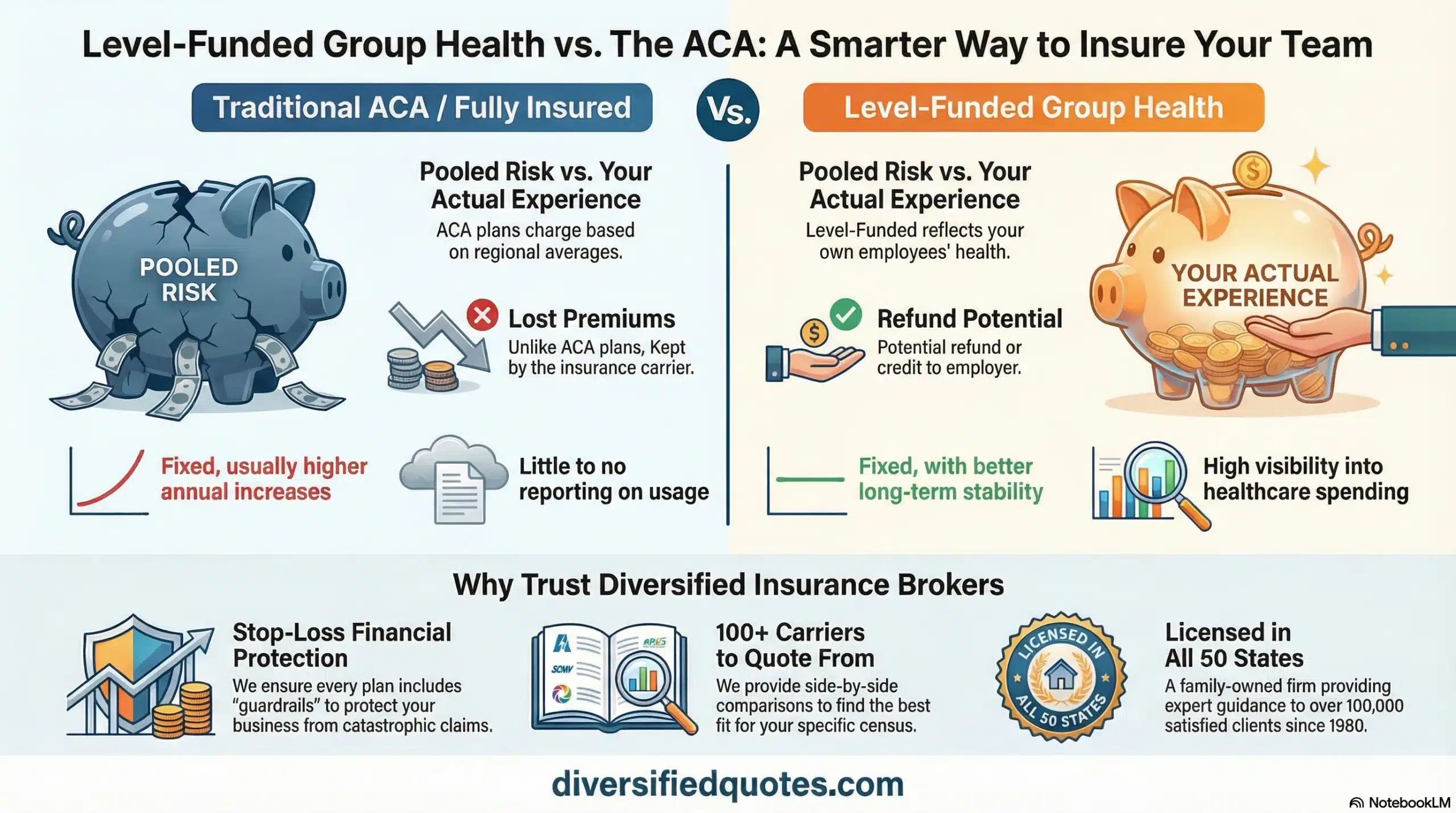
Employers with 500 employees qualify for every major group health funding model. Fully insured plans remain available but are rarely the most efficient choice due to carrier margins, embedded risk loads, and limited transparency. Most organizations at this size operate in or are moving toward self-funded structures because the claims volume is large enough to produce credible data and the leverage is strong enough to negotiate meaningful vendor terms. For employers earlier in this progression, our resource on minimum employee requirements for group health insurance helps contextualize how funding eligibility evolves across employer sizes. The inflection point for enterprise-caliber self-funding is typically around 100 employees, when claims credibility is strong enough to support fully experience-rated pricing — and by 500 employees, the organization has well past that threshold. For employers who haven’t yet formally evaluated their options, our guide to how to set up group health insurance for employees covers the structural decisions that shape enterprise plan governance from the ground up.
Self-Funded Group Health Insurance for 500 Employees
Self-funded group health insurance is the dominant structure at 500 employees because it replaces prepaid premium pricing with a system that reflects real plan performance. The employer pays medical claims as they occur rather than prepaying fixed premiums. Stop-loss insurance protects against large individual claims and excessive aggregate exposure. The employer controls predictable costs, transfers catastrophic risk to stop-loss, and pays closer to the real cost of healthcare rather than an insurer’s conservative worst-case assumptions. At enterprise scale, self-funding is not a risk-taking exercise — it is the structure through which large employers gain control over one of their largest operating expenses. The primary advantage is full transparency: visibility into claims drivers, pharmacy performance, network utilization, and vendor outcomes that transforms healthcare from a mystery into a manageable, improvable system. For employers evaluating this transition, understanding what self-funded group health insurance is provides clarity on how risk controls work in practice. Reviewing the full pros and cons of self-funded group health helps assess whether the model aligns with your organization’s financial structure and internal HR capacity before committing to the transition.
Center of Excellence Programs: The High-Impact Strategy at Enterprise Scale
Centers of Excellence (COE) programs designate specific high-quality, high-value healthcare facilities as preferred providers for complex, high-cost procedures: cardiac surgery, cancer treatment, orthopedic joint replacement, spinal surgery, bariatric surgery, and transplants. Employees who use COE facilities receive enhanced benefits — waived deductibles, no cost-sharing, and travel and lodging assistance — in exchange for choosing a provider the plan has evaluated for quality, outcomes, and cost efficiency. The financial case for COE programs at 500 employees is compelling. Complex procedures are outlier claims that individually can exceed stop-loss attachment points. When these procedures occur at high-quality, efficiently priced facilities, the plan pays less for better results: fewer complications, shorter hospital stays, lower readmission rates, and less post-procedure care required. COE programs also create a positive employee experience — employees going to designated facilities receive better clinical coordination alongside financial benefit, not just cheaper care. Professional service firms including law firms, consulting firms, and accounting firms at enterprise scale have been among the early adopters of COE programs, given their high-earning workforces and strong employee expectation for access to quality specialized care.
Group Captive Arrangements: Enterprise Stop-Loss With Long-Term Stability
Group captive insurance is a risk-sharing structure where multiple employers pool their stop-loss risk into a captive insurance company they collectively own. Instead of buying commercial stop-loss at market pricing, captive members share the layer of risk between their specific stop-loss attachment points and an aggregate threshold, with traditional reinsurance covering the captive’s shared layer. The appeal at 500 employees is long-term stability: captive members who manage their plans well see better pricing over time because the captive’s experience reflects its participants rather than the broader commercial stop-loss market. Captives are not appropriate for every employer — they require organizational commitment, governance participation, and typically multi-year membership. But for 500-employee organizations with stable workforces and effective plan management, captives can produce meaningful long-term savings compared to commercial stop-loss. They also create a community of well-managed employers who share best practices around plan design and pharmacy management. Our resource on why group level funding works explains the spectrum of risk-sharing structures that connect traditional fully insured plans with captive arrangements at enterprise scale.
Population Health Management: Shifting From Reactive to Predictive
At 500 employees, the claims base is large enough to support meaningful population health analytics — identifying patterns in the plan’s data that predict future high-cost events before they occur. Risk stratification models analyze claims history, pharmacy utilization, chronic condition diagnoses, and care gap patterns to flag employees at elevated risk: unmanaged diabetes trending toward hospitalization, cardiac risk factors without appropriate medication adherence, musculoskeletal conditions trending toward surgery. When the plan identifies these individuals early, proactive outreach — nurse coaching, disease management support, care navigation, and medication adherence programs — can change the clinical trajectory before it becomes a catastrophic claim. This shift from reactive (analyzing last year’s claims at renewal) to predictive (using current patterns to influence future outcomes) is one of the most significant structural advantages of enterprise healthcare management. At 80 employees, for example, claims reporting is useful but populations are too small for risk stratification to produce statistically meaningful cohort analysis. At 500 employees, the population is large enough that predictive analytics are genuinely actionable at the program level rather than just directionally interesting.
Multi-State Complexity at 500 Employees
Many organizations with 500 employees have employees distributed across multiple states, sometimes many. That geographic spread creates complexity across three dimensions: network access, benefit mandates, and plan governance. Network quality varies significantly by geography: a network that is excellent in one region may be thin in another, and employees who cannot access quality in-network providers produce worse outcomes and higher plan costs through avoidable out-of-network utilization. Designing a network that serves employees well across all locations — or building location-specific network solutions within a single plan — requires active geographic analysis rather than annual auto-renewal. The ACA compliance framework for large employers adds a compliance layer that self-funded ERISA plans can generally preempt at the state level, giving enterprise employers more flexibility than fully insured plans to maintain consistent benefit design across state lines. However, the specific preemption analysis is nuanced and requires legal review when entering new states or when state mandate environments change. As a reminder, the ACA employer mandate itself — the requirement to offer minimum essential coverage to full-time employees — has been a firm obligation since the organization crossed the 50 full-time equivalent employee threshold, and at 500 employees that compliance infrastructure should be fully established and documented.
Stop-Loss Strategy at Enterprise Scale
Stop-loss selection at 500 employees is a design decision rather than a commodity purchase. The organization has actuarial credibility to negotiate customized terms that mid-market employers cannot access. Higher specific stop-loss attachment points can reduce premiums meaningfully when the claims distribution supports it — and at 500 employees, actuarial analysis can provide reasonable confidence about where catastrophic claim clusters are likely to form in a given year. Stop-loss markets at this size are genuinely competitive, with multiple reinsurance carriers actively pursuing the segment and experienced brokers having real negotiating leverage on both attachment points and multi-year rate commitments. The captive alternative described above is also most economically viable at this premium volume. Employers growing toward the next scale should understand that as headcount reaches 750 employees, stop-loss structures become even more sophisticated, with captive leverage and reinsurance market access expanding further.
Form 5500 Reporting for Large Plan Filers
Employers sponsoring health benefit plans with 100 or more participants are required to file an annual Form 5500 with the Department of Labor. At 500 employees, this is a firmly established annual obligation. Large plan filers must include audited financial statements prepared by an independent qualified public accountant — a requirement that does not apply to small plan filers. The Form 5500 is also the primary mechanism through which the DOL monitors ERISA fiduciary compliance for self-funded plans, and errors or omissions can trigger DOL inquiries and penalties. This obligation begins well before 500 employees — by 150 employees, it is well established — but at 500 employees the filing carries more complexity because larger plans often have audited financial statements, multiple benefit options, and more detailed compliance documentation requirements. Ensuring that the TPA, financial team, and benefits broker coordinate effectively on Form 5500 preparation — and that the plan’s records throughout the year are organized to support the filing — is an important annual governance commitment.
Pharmacy Strategy: Enterprise-Level Management
Pharmacy is often the single largest controllable driver of long-term trend at 500 employees. Specialty drugs used by a small number of employees can represent a disproportionate share of total annual plan spend. At this size, the plan’s volume is large enough to support independent PBM arrangements with full rebate transparency, specialty carve-out programs, and biosimilar substitution opportunities that bundled carrier PBMs typically cannot match on terms. Independent PBM negotiations at 500 employees can include contractual rebate pass-through guarantees, clinical management program requirements, and biosimilar step-therapy protocols that reduce specialty drug spend without restricting clinically appropriate access. Industries with physically demanding workforces — including construction firms and similar — tend to have higher musculoskeletal-related pharmacy exposure, while knowledge-work industries often face higher specialty drug concentration in oncology and autoimmune categories. Understanding the pharmacy profile specific to your workforce is the starting point for designing a strategy that addresses your group’s actual cost drivers rather than generic market assumptions.
Voluntary Benefits: Building a Total Compensation Platform
At 500 employees, voluntary benefits evolve from individual policy add-ons into a coordinated total compensation strategy. Life insurance, disability income coverage, accident insurance, critical illness coverage, hospital indemnity, legal services, and identity theft protection can each be offered on a voluntary employee-paid basis with group rates employees cannot access individually. These benefits complement the core health plan by addressing financial exposure that group health does not cover — income replacement during a disability, lump-sum cash for a critical illness diagnosis, and benefits during hospitalization that bridge deductible and out-of-pocket costs. A well-designed voluntary platform improves overall benefits satisfaction without increasing employer cost, and employees who engage with multiple voluntary benefits experience the employer’s program as a comprehensive financial protection system — not just a health card. For employees interested in critical illness and supplemental coverage, our resource on what critical illness insurance is explains the basics. For dental and vision, which remain among the most requested employee benefits at every scale, see our guides on dental and vision insurance for employee groups and best dental insurance rates for employer groups.
Claims Analytics and Vendor Accountability
At enterprise scale, data is a competitive advantage when acted upon. With proper reporting, employers can identify cost trends early, evaluate vendor performance against contractual benchmarks, and implement targeted interventions before trends become renewal problems. Enterprise governance benefits from structured dashboards tracking high-level trend, category-level spend, pharmacy drivers, network utilization patterns, and population health metrics — reviewed quarterly rather than annually. The point is not to micromanage individual claims but to manage the system that produces them. Vendor accountability is one of the most valuable and underutilized tools available to 500-employee employers: TPAs, PBMs, care navigation vendors, and disease management programs all have measurable outputs that can be compared to contractual commitments and peer benchmarks. When vendors know they will be measured and that underperformance has consequences, outcomes improve. Employers who want to confirm whether their current plan structure and vendor relationships are competitive can start with a second opinion on their group health insurance quote to see whether better alternatives and vendor terms exist in the current market.
Renewal Strategy: From Annual Reaction to Year-Round Governance
At 500 employees, renewals should not be a once-per-year event. A strong renewal strategy is a year-round governance system with checkpoints. Large-claim trend review in month three, pharmacy performance assessment in month six, network utilization analysis in month nine, and a structured comparison of alternatives in month ten or eleven — this cadence prevents the organization from being cornered into reactive decisions when the renewal arrives with 60 days’ notice. Employers who treat renewal as a year-round process consistently produce better cost outcomes than those who treat it as an annual negotiation under time pressure. The goal is not to change carriers constantly — it is to make changes when they are genuinely justified by data, with enough lead time to implement them well and communicate them clearly to employees. For employers transitioning into enterprise plan governance for the first time, our guide on how to set up group health insurance for employees covers the foundational governance framework that makes year-round plan management practical.
Planning for Growth Beyond 500 Employees
The enterprise group health strategy built at 500 employees becomes more valuable — not less — as headcount grows. Self-funded structures gain more actuarial stability as populations increase. COE programs produce greater aggregate savings as complex procedure volume grows. Captive arrangements become more efficient as premium volume increases. Population health analytics produce richer insight as the data pool deepens. Vendor accountability frameworks strengthen as the employer’s buying leverage grows. Organizations that build enterprise-grade healthcare management infrastructure at 500 employees are consistently better positioned at 750, 1,000, and beyond than those who delay. For context on how enterprise strategy continues to evolve at the next scale, see our guides on group health insurance for 750 employees — where captive leverage and reinsurance access expand further — and group health insurance for over 1,000 employees, where enterprise benefits governance reaches its full operational and financial maturity.
Ready to Build an Enterprise Group Health Strategy for 500 Employees?
We’ll compare self-funded structures, identify your highest-impact cost levers, and build an enterprise plan designed to improve year over year.
Get a 2nd Opinion
Already have a renewal or plan in place? We’ll show you where enterprise-scale alternatives could outperform.
Group Travel Coverage
Enterprise-level travel medical and evacuation coverage for employees traveling on company business.
Request an Enterprise Analysis
We’ll model your current plan against enterprise alternatives and identify your highest-impact cost levers.
Not the Right Headcount?
Use the options below to jump to the group health page that matches your workforce size.
750 Employees
Scaled cost-control with deeper data visibility and targeted interventions.
Enterprise Group Health Insurance Resources
Industry-specific plans, self-funding guides, and enterprise compliance resources for large employers.
Voluntary Benefits and Ancillary Coverage
Build a comprehensive total compensation platform with voluntary benefits, dental, vision, and supplemental coverage.
Talk With an Advisor Today
Choose how you’d like to connect—call or message us, then book a time that works for you.
Schedule here:
calendly.com/jason-dibcompanies/diversified-quotes
Licensed in all 50 states • Fiduciary, family-owned since 1980
FAQs: Group Health Insurance for 500 Employees
What funding structure is most common for 500-employee organizations?
Self-funded (ASO) arrangements are the dominant structure at 500 employees. At this size, the organization’s claims experience is fully credible—pricing reflects actual performance rather than pooled market assumptions—and the claims volume is large enough to support the reporting, vendor management, and governance infrastructure that makes self-funding effective. Partially self-funded and level-funded hybrid structures are also used, typically as transitional approaches for organizations moving from fully insured toward full self-funding. Fully insured plans remain available but are rarely the most cost-efficient option for well-managed 500-employee organizations because of the embedded carrier margins, limited transparency, and lack of performance-based pricing alignment.
What is a Center of Excellence program and how does it reduce costs?
A Center of Excellence (COE) program designates specific high-quality, high-value healthcare facilities as preferred providers for complex, high-cost procedures: cardiac surgery, cancer treatment, orthopedic joint replacement, spinal surgery, bariatric surgery, and transplants. Employees who use COE facilities receive enhanced benefits—waived deductibles, no cost-sharing, and travel and lodging assistance—in exchange for choosing a provider the plan has evaluated for quality and cost efficiency. COE programs reduce total cost by directing complex procedures to facilities with better outcomes: fewer complications, shorter hospital stays, lower readmission rates, and less post-procedure care. At 500 employees, the claims volume justifies the administrative investment, and even preventing a single significant post-surgical complication in a plan year can more than cover the program’s cost.
What is a group captive and is it appropriate at 500 employees?
A group captive is a risk-sharing structure where multiple employers pool their stop-loss risk into a captive insurance company they collectively own. Instead of buying commercial stop-loss at market pricing, captive members share the layer of risk between their specific stop-loss attachment points and an aggregate threshold, with traditional reinsurance covering above the captive’s shared layer. Members who manage their plans well see better pricing over time because the captive’s experience reflects its participants rather than the broader commercial stop-loss market. Captive arrangements require organizational commitment, governance participation, and typically multi-year membership. At 500 employees, the organization has sufficient premium volume to make captive participation economically meaningful—and captive membership creates peer connections among well-managed employers who share best practices around plan design and pharmacy management.
What is population health management and how does it apply at this size?
Population health management uses claims history, pharmacy utilization, chronic condition diagnoses, and care gap patterns to identify employees at elevated risk for high-cost episodes before those events occur. Risk stratification models analyze the plan’s data to flag individuals with unmanaged diabetes, cardiac risk factors without appropriate medication adherence, or musculoskeletal conditions trending toward surgery. Proactive outreach—nurse coaching, disease management programs, care navigation support, and medication adherence assistance—can change the trajectory before it becomes a catastrophic claim. At 500 employees, the population is large enough for risk stratification models to be statistically meaningful and for the interventions to produce measurable aggregate savings. Organizations that consistently outperform peers in long-term cost management typically invest in population health infrastructure and treat employee health data as a strategic planning tool.
What are the Form 5500 filing requirements for a 500-employee plan?
Plans with 100 or more participants are required to file an annual Form 5500 with the Department of Labor. At 500 employees, this is a firmly established obligation with specific attachment requirements. Large plan filers must include audited financial statements prepared by an independent qualified public accountant—a requirement that does not apply to small plan filers. The Form 5500 is also the primary mechanism through which the DOL monitors plan compliance and fiduciary conduct for self-funded ERISA plans. Errors or omissions can trigger DOL inquiries and penalties. Ensuring that the TPA, financial team, and benefits broker coordinate effectively on preparation—and that the plan’s records throughout the year are organized to support the filing—is an important annual governance priority for 500-employee plan sponsors.
How does multi-state workforce complexity affect group health plan design?
Multi-state employers at 500 employees face complexity across three dimensions: network access, benefit mandates, and plan governance. Network quality varies significantly by geography—a network that is excellent in one region may be thin in another, creating out-of-network utilization and worse outcomes in underserved locations. Self-funded ERISA plans can generally preempt state benefit mandates (a significant advantage for maintaining consistent benefit design across states), but the specific preemption analysis requires legal review when entering new states. Designing a network that adequately serves employees in every location—not just the headquarters state—requires active management and periodic geographic coverage analysis. An independent broker with multi-state experience can identify gaps in the plan’s geographic coverage and recommend network or design changes that address them cost-effectively.
How should stop-loss be structured for a 500-employee self-funded plan?
At 500 employees, stop-loss selection is a design decision rather than a commodity purchase. The organization has enough actuarial credibility to negotiate customized attachment points and structures that mid-market employers cannot access. Higher specific stop-loss attachment points can reduce premiums meaningfully when the plan’s claims distribution supports it—and actuarial analysis can provide confidence about where catastrophic claims are likely to cluster. Stop-loss markets for 500-employee groups are competitive, with multiple reinsurers actively pursuing this segment. Multi-year commitments—locked rates for two or three years in exchange for volume—can provide additional pricing stability. The group captive alternative is also most viable at this size, where premium volume makes captive participation economically meaningful compared to commercial stop-loss.
Why does pharmacy require its own governance track at 500 employees?
Pharmacy—particularly specialty medications—is often the single largest controllable driver of long-term trend at enterprise scale. A small number of specialty drugs used by a handful of employees can represent 30-40% or more of total annual plan spend. At 500 employees, the plan’s volume supports independent PBM arrangements with full rebate transparency, specialty carve-out programs, and biosimilar substitution opportunities that bundled carrier PBMs often don’t offer on comparable terms. Pharmacy strategy should have its own reporting cadence (at least quarterly), its own vendor performance benchmarks, and its own annual review separate from the broader medical benefit renewal. When pharmacy is managed as a distinct discipline with dedicated oversight, total plan cost is consistently better controlled than when it is treated as a line item in the broader benefit renewal.
How should a 500-employee employer approach vendor accountability?
Vendor accountability at 500 employees requires contractual performance standards—Service Level Agreements (SLAs) with measurable outcomes—that are established at contract negotiation rather than added after the fact. TPAs, PBMs, care navigation vendors, and disease management programs all have measurable outputs that can be compared to commitments and peer benchmarks. Quarterly performance reviews should track each vendor’s results against contractual standards. Underperforming vendors should face consequences defined in the contract—fee adjustments, remediation plans, or transition rights. Building this accountability structure into agreements from the outset is the right governance approach. An experienced broker with peer benchmarking data can help establish what reasonable performance expectations look like across each vendor category and what contract language protects the employer’s interests when performance falls short.
How do voluntary benefits complement the core health plan at 500 employees?
At 500 employees, voluntary benefits evolve from individual add-ons into a coordinated total compensation strategy. Life insurance, disability income, accident coverage, critical illness, hospital indemnity, legal services, and identity theft protection can each be offered on a voluntary employee-paid basis with group rates employees cannot access individually. These benefits address financial exposure the health plan doesn’t cover: income replacement during disability, lump-sum payments for critical illness diagnoses, and cash benefits during hospitalization that help bridge deductible and out-of-pocket costs. A well-designed voluntary platform improves overall benefits satisfaction without increasing employer cost, and employees who access multiple voluntary benefits experience the employer’s program as a comprehensive protection system—which improves perceived value and supports retention.
Will an enterprise plan built for 500 employees scale as the company grows?
Yes—enterprise-grade infrastructure becomes more valuable, not less, as headcount grows. Self-funded structures gain more actuarial stability with larger populations. COE programs produce greater aggregate savings as the volume of complex procedures increases. Captive arrangements become more efficient as premium volume grows. Population health analytics produce richer insight as the data pool deepens. Vendor accountability frameworks strengthen as the employer’s buying leverage increases. Organizations that build enterprise-grade healthcare management infrastructure at 500 employees are consistently better positioned at 750, 1,000, and beyond than those who delay. Each increment of growth builds on an existing foundation rather than requiring disruptive restructuring at a later, more expensive stage.
About the Author:
Jason Stolz, CLTC, CRPC, DIA, CAA and Chief Underwriter at Diversified Insurance Brokers (NPN 20471358), is a senior insurance and retirement professional with more than 25 years of real-world experience helping individuals, families, and business owners protect their income, assets, and long-term financial stability. As a long-time partner of the nationally licensed independent agency Diversified Insurance Brokers, Jason provides trusted guidance across multiple specialties—including fixed and indexed annuities, long-term care planning, personal and business disability insurance, life insurance solutions, Group Health, Travel Medical and Evacuation Insurance, and short-term health coverage. Diversified Insurance Brokers maintains active contracts with over 100 highly rated insurance carriers, ensuring clients have access to a broad and competitive marketplace.
His practical, education-first approach has earned recognition in publications such as VoyageATL, and contributions from his agency featured in Kiplinger and GoBankingRates— highlighting his commitment to financial clarity and client-focused planning. Drawing on deep product knowledge and years of hands-on field experience, Jason helps clients evaluate carriers, compare strategies, and build retirement and protection plans that are both secure and cost-efficient. Visitors who want to explore current annuity rates and compare options across multiple insurers can also use this annuity quote and comparison tool.
Explore More Group Health Insurance Options: Browse our complete guide to Group Health Insurance by Company Size — covering plans for 2, 10, 20, 50, 100, 250, 500, 750 & 1,000+ employees from 100+ carriers.
Last Reviewed: June 1, 2026 |
Reviewed by: Jason Stolz, CLTC, CRPC, DIA, CAA
Chief Underwriter, Diversified Insurance Brokers, Inc. | NPN: 20471358 | Diversified Insurance Brokers, Inc. — Licensed in all 50 states
Fact Checked by: Tonia Pettitt, CMIP©
Medicare Specialist, Diversified Insurance Brokers, Inc. | NPN: 14374308 | Diversified Insurance Brokers, Inc. — Licensed in all 50 states
Did you find this content helpful? Leave us a Google review — it helps others find trustworthy guidance too.
Editorial Standards: Diversified Insurance Brokers maintains rigorous editorial standards to ensure accuracy, clarity, and independence in all content. Learn more about our editorial standards and commitment to transparency.
