
Group Health Insurance for 50 Employees
Group Health Insurance for 50 Employees

Jason Stolz CLTC, CRPC, DIA, CAA
Group health insurance for 50 employees is not just a bigger version of what worked at 20 or 30. At exactly this headcount, the entire regulatory landscape shifts. Fifty full-time equivalent employees is the federal threshold under the Affordable Care Act where an employer becomes an Applicable Large Employer — and with that designation come legally enforceable obligations: the employer mandate to offer coverage, affordability and minimum value standards the plan must meet, and annual IRS reporting requirements. These are not optional. For companies that have been growing toward 50 employees, the transition from being below the threshold to crossing it is one of the most consequential moments in a company’s benefits history. At the same time, 50 employees is also where group health insurance begins to function more like a large-group financial system, with broader carrier options, stronger leverage, and more tools to manage cost and claims behavior over time. At Diversified Insurance Brokers, we help 50-employee organizations understand both sides of this transition: what the law now requires and how to build a plan structure that meets those requirements cost-effectively, with transparency and scalability built in from the start.
Compare Group Health Options for 50 Employees
We’ll evaluate your ALE status, current plan structure, and cost drivers — then identify options that control costs while meeting your compliance obligations.
Level-Funded Plans
Predictable monthly cost, refund potential, and experience-based renewal pricing.
Learn MoreSelf-Funded Options
Full claims transparency and cost alignment backed by stop-loss protection.
Learn MoreRequest a Group Health Review
We’ll compare funding models and ACA-compliant plan designs for your 50-employee group.
Get a ReviewThe ACA Employer Mandate: What Crossing 50 FTEs Means
The single most important fact about group health insurance at 50 employees is this: the ACA’s employer mandate applies. Once a company averages 50 or more full-time equivalent employees over the prior calendar year, it becomes an Applicable Large Employer (ALE) subject to the Employer Shared Responsibility provisions under Internal Revenue Code Section 4980H. This creates enforceable legal requirements—not suggestions—that affect both plan design and tax liability. Most companies approaching 50 employees don’t have this conversation with their benefits broker until it’s already an issue. That’s a mistake, because the penalties for non-compliance are significant and entirely avoidable with proper planning.
As an ALE, the employer must offer minimum essential coverage to at least 95% of full-time employees (those averaging 30 or more hours per week, or 130 or more hours per month) and their dependent children up to age 26. The coverage offered must meet two additional standards: it must provide “minimum value” (covering at least 60% of expected plan costs), and it must be “affordable” (the employee’s required contribution for self-only coverage cannot exceed a defined percentage of their household income under applicable IRS safe harbors). Failure to satisfy any of these requirements can trigger substantial per-employee penalties, assessed annually and reported through IRS filings. Understanding the minimum employee requirements for group health insurance and the ALE calculation methodology is essential before the plan year begins—not after the company has already crossed the threshold.
ACA Penalty Structure: What’s at Stake if the Plan Falls Short
| Penalty Type | Trigger | How It’s Calculated | How to Avoid It |
|---|---|---|---|
| Section 4980H(a) — “Penalty A” | Employer fails to offer minimum essential coverage to at least 95% of full-time employees | Annual penalty per full-time employee (minus first 30), regardless of how many employees received a subsidy | Offer minimum essential coverage to 95%+ of full-time employees and their dependent children |
| Section 4980H(b) — “Penalty B” | Coverage offered is not affordable or does not meet minimum value, and at least one employee receives a marketplace subsidy | Annual penalty for each full-time employee who receives a premium tax credit; capped at the Penalty A amount | Ensure offered coverage meets affordability and minimum value standards using IRS safe harbor methods |
| ACA Reporting Failure | Failure to file Forms 1094-C and 1095-C or furnish 1095-C to employees | Per-form penalties; can accumulate quickly if reporting is not set up correctly from the first ALE year | Implement ACA reporting processes before the first plan year as an ALE; confirm payroll and HR systems can track required data |
Affordability and Minimum Value: Plan Design Requirements at 50 Employees
Two plan design tests apply to every ALE’s coverage offer. The first is minimum value: the health plan must be designed to cover at least 60% of the total allowed cost of benefits provided under the plan. This is roughly equivalent to a Bronze-level ACA plan. Most standard employer-sponsored group plans meet this threshold, but it’s worth confirming—particularly for plans with unusually high deductibles or limited coverage—because a plan that technically exists but doesn’t meet minimum value still triggers Penalty B.
The affordability test is more nuanced. The employee’s required contribution for self-only coverage (not family coverage) cannot exceed a defined percentage of their household income. Because employers don’t typically know each employee’s actual household income, the IRS provides three safe harbor methods for demonstrating affordability without needing that information: the W-2 wages safe harbor, the rate-of-pay safe harbor, and the federal poverty line safe harbor. Employers use one of these methods to confirm that their contribution strategy passes the affordability test. This interacts directly with plan design and contribution decisions—the contribution structure isn’t just an employee relations decision, it’s a compliance variable. Any major change to employee contribution levels should be evaluated against the applicable safe harbor to confirm affordability is maintained. This is a conversation that belongs between the benefits broker, HR, and the company’s tax advisor before open enrollment, not after.
ACA Reporting: Forms 1094-C and 1095-C
ALEs must file Form 1094-C (a transmittal form) and Form 1095-C (individual employee statements) with the IRS annually, and furnish Form 1095-C to each full-time employee. These forms document which employees were offered coverage, what type of coverage was offered, and whether it was affordable. The IRS uses this data to verify employer compliance with the mandate and to determine whether employees who received marketplace subsidies should trigger penalties. Errors in these filings can create audit exposure and penalty assessments. Companies crossing the 50-FTE threshold for the first time often underestimate how important it is to have payroll and HR systems configured to track the required data throughout the year—monthly tracking of full-time employee hours is required, not just an end-of-year snapshot. If you’re growing toward 50 employees and haven’t confirmed that your systems can support ACA reporting, building that infrastructure before you cross the threshold is significantly easier than retrofitting it after.
The Small Group to Large Group Market Transition
In many states, 50 employees also marks the point where a company transitions from the small-group insurance market (typically defined as 1-50 employees) to the large-group market (51 and above). This transition changes nearly everything about how plans are underwritten and priced. Small-group plans in most states operate under community rating rules, which limit how much carriers can vary premiums based on group-specific health factors. Large-group plans shift to experience rating, where the group’s own claims history becomes a more direct driver of pricing. This can be a significant advantage for healthy groups—and a notable disadvantage for groups with higher-than-average utilization.
The transition also opens new carrier relationships, new plan design flexibility, and often more favorable stop-loss terms that make alternative funding more practical. Understanding how group medical insurance is structured differently in the large-group market helps employers negotiate more effectively and avoid assuming small-group dynamics still apply. The large-group market generally requires more active plan management—but it also rewards that effort with better cost outcomes for groups that engage with their data and make intentional plan decisions.
Funding Model Comparison at 50 Employees
| Feature | Fully Insured | Level-Funded | Partially Self-Funded |
|---|---|---|---|
| Monthly Cost Structure | Fixed premium regardless of actual claims | Predictable monthly amount (claims + admin + stop-loss) | Variable—employer funds actual claims as incurred |
| Claims Visibility | None; carrier owns all data | Reporting typically available; trend visibility improves | Full transparency; employer sees all cost drivers |
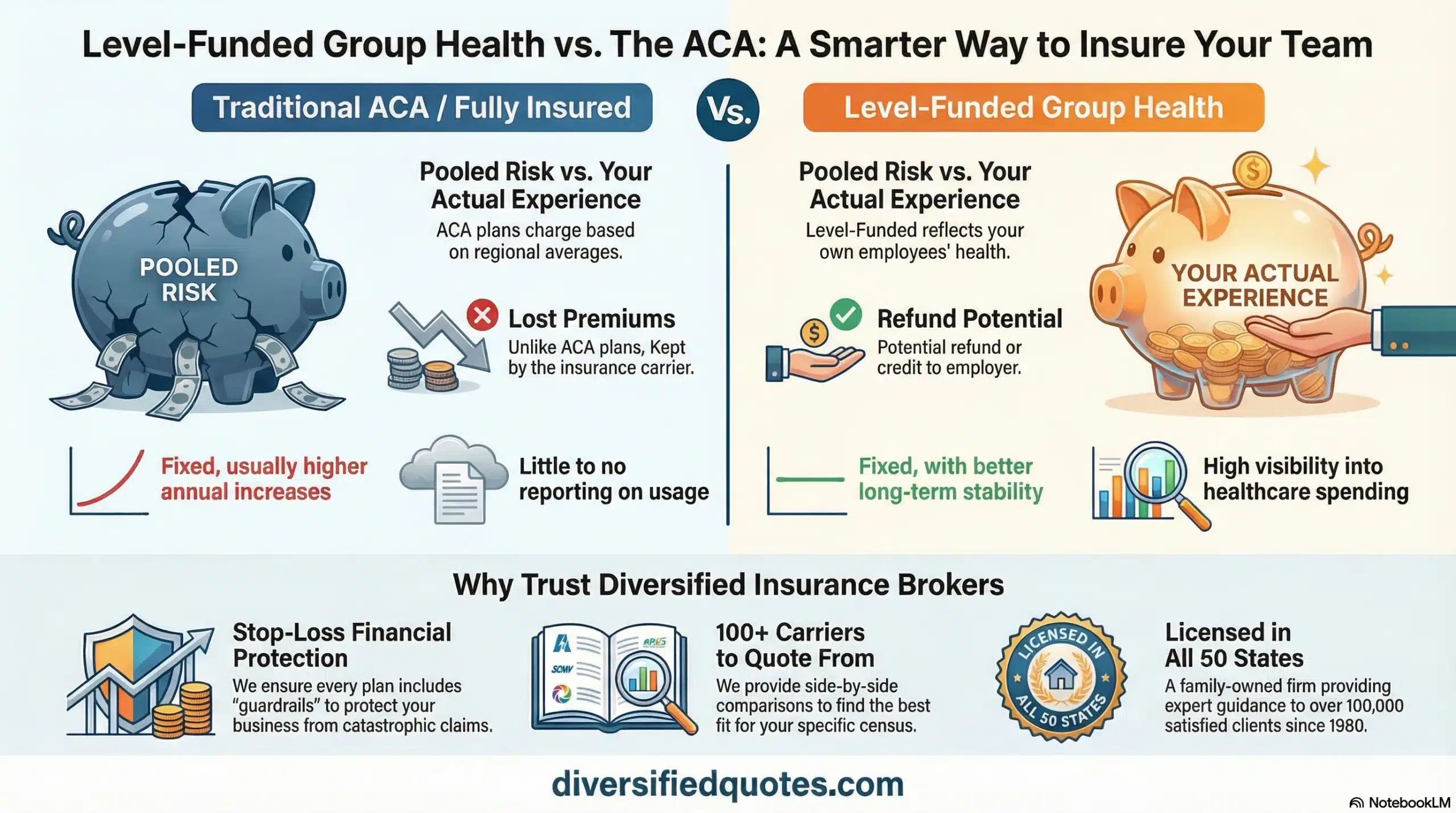
| Refund Potential | None; carrier retains unused premiums | Yes—unused claim dollars may be returned at year-end | Yes—employer pays actual claims, not padded estimates |
| ACA Compliance | Carrier typically handles MEC, MV, and affordability within plan design | Employer confirms MEC, MV, and affordability; reporting obligations remain | Employer confirms MEC, MV, and affordability; full ACA reporting obligations apply |
| Best For | Groups prioritizing simplicity and minimal internal engagement | Most 50-employee groups seeking cost control with predictable budgeting | Stable groups with leadership comfortable with higher engagement and transparency |
Why Group Health Insurance Behaves Differently at 50 Employees
At 50 employees, group health insurance has enough participation that utilization patterns emerge and become measurable. A group of 15 or 20 can feel unpredictable because one high-cost claim can dominate the year. At 50, the plan is large enough that patterns appear—how employees access care, whether they rely on primary care or emergency rooms, how often they use specialists, and how prescription utilization is trending. That shift creates both risk and opportunity. If the plan design is inefficient, waste becomes expensive faster. If the plan design is intentional, employers can stabilize spending without reducing benefits. Understanding the full picture of the pros and cons of self-funded group health helps determine which approach best matches your organization’s risk tolerance and administrative capacity.
Level-Funded Group Health Insurance for 50 Employees
Level-funded plans are often the most practical upgrade for 50-employee groups moving away from fully insured coverage. The employer pays a predictable monthly amount that covers estimated claims, administrative costs, and stop-loss protection. From a budgeting standpoint, this feels similar to fully insured. The difference emerges at year-end: if claims are lower than projected, unused claim dollars may be returned based on program reconciliation terms. That refund potential allows employers to benefit financially from healthier utilization and effective plan design—something fully insured plans structurally cannot offer. Explore our guide on why group level funding works to understand how these programs are built and what makes them particularly well-suited to groups at this size and above.
From a compliance standpoint, level-funded plans still require the employer to confirm that coverage meets ACA minimum value and affordability standards—the carrier does not automatically handle this in the same way a traditional fully insured small-group plan does. This is a manageable process, but it’s one more reason to work with a broker who understands both the funding mechanics and the compliance requirements. The combination of level-funded structure and proper ACA compliance planning creates a plan that is both cost-efficient and legally sound.
Partially Self-Funded Plans and Cost Transparency
For 50-employee groups whose leadership wants maximum visibility into claims data, partially self-funded arrangements provide the deepest level of insight into where healthcare dollars are going. The employer pays claims as they occur rather than prepaying fixed premiums. Stop-loss insurance limits exposure for large individual claims and total annual spend. With this structure, leadership can see which categories are driving cost—pharmacy, imaging, specialist visits, ER utilization—and make targeted adjustments rather than accepting a renewal increase with no explanation.
At 50 employees, the claims base is large enough that this transparency is genuinely actionable. There’s enough data to see trends, identify outliers, and evaluate whether specific plan design changes would reduce waste. That actionability is what makes partial self-funding valuable as a long-term management tool, not just a cost-reduction mechanism. As with level funding, ACA compliance remains the employer’s responsibility under partial self-funding—minimum value, affordability, and ACA reporting all apply and must be actively managed.
Stop-Loss Strategy: The Guardrails That Make Alternative Funding Work
Stop-loss is what makes level-funded and partially self-funded strategies practical at 50 employees. The employer funds expected claims; stop-loss protects against the surprises. Most programs include specific stop-loss (limits exposure for a single high-cost individual) and aggregate stop-loss (limits exposure for total annual claims). Setting attachment points that match the company’s financial comfort level is one of the most important design decisions in alternative funding. Too aggressive and the plan creates volatility; too conservative and you pay pricing that behaves like fully insured without receiving the transparency benefits. At 50 employees, the best stop-loss strategy is one that leadership can maintain consistently over multiple years, because plan stability is what allows improvements to compound. Constantly changing funding models resets the learning curve and prevents the data from becoming useful.
Reducing Costs Without Cutting Benefits
Sustainable cost reduction at 50 employees rarely comes from raising deductibles or shifting large premium increases to employees. That approach reduces participation, lowers morale, and encourages delayed care, which generates more expensive claims downstream. Savings at this size are typically driven by plan architecture and utilization strategy: smarter network selection, pharmacy management, deductible and copay alignment with actual utilization patterns, and employee navigation improvements that reduce inappropriate care site selection. When employees understand where to go for care, how to use telemedicine, and how to manage prescriptions efficiently, total spend often improves materially without reducing a single benefit.
Pharmacy Costs at 50 Employees: The Hidden Renewal Driver
For many organizations at 50 employees, pharmacy becomes the category that most dramatically shapes renewal outcomes—often without leadership fully understanding the mechanism. A small number of specialty prescriptions can account for a disproportionate share of total annual spend. Specialty drugs, brand utilization when generics are available, and lack of visibility into where prescriptions are filled can each push plan costs in ways that show up as renewal increases with minimal explanation. Pharmacy strategy does not mean restricting needed medications. It means designing the plan so prescriptions are filled efficiently, with clinical management for high-cost categories and employee education that reduces unnecessary waste. In level-funded and partially self-funded models, pharmacy reporting is typically stronger, which makes it possible to identify and address trend early rather than discovering the problem only at renewal.
Planning Beyond 50 Employees
The group health insurance strategy built at 50 employees typically sets the foundation for efficient scaling as the company grows. Employers that introduce transparency, cost accountability, and proper ACA compliance processes at this stage scale more smoothly into 75, 100, and 150-employee territory. Those that delay often find their options narrowing as costs compound and compliance gaps become more expensive to remediate. When the plan structure is stable and well-documented, incremental improvements over time—network refinements, pharmacy enhancements, contribution strategy adjustments, and preventive care engagement—can each contribute to a lower long-term cost trend without disrupting the workforce. For context on what becomes available as you grow, see how strategy evolves at 100 employees—a milestone where large-group plan design options expand significantly and claims credibility creates even more leverage.
Ready to Compare Group Health Plans for 50 Employees?
We’ll evaluate your ALE status, plan compliance, and funding options — and show you side-by-side how costs and renewal behavior differ across structures.
ACA Alternatives
Explore how employer mandate requirements interact with your plan design and funding options.
Learn MoreGet a 2nd Opinion
Already have a plan or renewal proposal? We’ll tell you if it’s competitive and ACA-compliant.
Get 2nd OpinionRequest a Side-by-Side Comparison
We’ll build options across funding models with compliance and cost control in mind.
Request ComparisonNot the Right Headcount?
Use the options below to jump to the group health page that matches your workforce size.
100 Employees
Major transition point: funding options expand and plan design matters more.
View OptionsGroup Health Insurance Resources for Growing Employers
Explore ACA compliance, funding strategies, and coverage options for employers at and around the 50-employee threshold.
Employee Benefits and Supplemental Coverage
Round out your group health plan with dental, vision, critical illness, and ancillary benefits.
Talk With an Advisor Today
Choose how you’d like to connect—call or message us, then book a time that works for you.
Schedule here:
calendly.com/jason-dibcompanies/diversified-quotes
Licensed in all 50 states • Fiduciary, family-owned since 1980
FAQs: Group Health Insurance for 50 Employees
Does the ACA employer mandate apply at 50 employees?
Yes. The ACA employer mandate applies to Applicable Large Employers—organizations averaging 50 or more full-time equivalent employees over the prior calendar year. At 50 FTEs, the company must offer minimum essential coverage to at least 95% of full-time employees (those averaging 30+ hours/week) and their dependent children, and the coverage must meet both minimum value and affordability standards. Failure to do so can trigger per-employee penalties assessed by the IRS. This is one of the most important transitions in a growing company’s benefits history, and it requires proactive planning before the threshold is crossed, not after.
What is the difference between Penalty A and Penalty B under the employer mandate?
Penalty A (Section 4980H(a)) applies when an ALE fails to offer minimum essential coverage to at least 95% of full-time employees. It’s assessed per full-time employee (minus the first 30) regardless of how many actually received a marketplace subsidy. Penalty B (Section 4980H(b)) applies when the employer offers coverage but that coverage is either not affordable or does not meet minimum value, and at least one employee receives a premium tax credit on the marketplace. Penalty B is assessed only for the employees who actually received a subsidy but is often larger on a per-employee basis. Avoiding both requires offering qualifying coverage and setting contributions within IRS affordability safe harbors.
What does “affordable” coverage mean under the ACA at this size?
Affordability under the ACA means the employee’s required contribution for self-only coverage cannot exceed a defined percentage of their household income. Since employers don’t typically know each employee’s actual household income, the IRS provides three safe harbor methods: the W-2 wages safe harbor (based on prior year W-2 wages), the rate-of-pay safe harbor (based on the employee’s hourly rate or monthly salary), and the federal poverty line safe harbor (based on a fixed amount regardless of individual income). Most employers use the W-2 or rate-of-pay method. The contribution level is confirmed at plan design—meaning the affordability safe harbor must be evaluated before setting employee premium contributions, not after.
What ACA reporting is required at 50 employees?
ALEs must file Form 1094-C (a transmittal form) and Form 1095-C (individual employee statements) with the IRS annually, and furnish Form 1095-C to each full-time employee. These forms document which employees were offered coverage, what type of coverage was offered, and whether it was affordable. The IRS uses this data to verify compliance and determine whether employees who received marketplace subsidies should trigger penalties. Monthly tracking of full-time employee hours is required throughout the year—not just an end-of-year snapshot. Payroll and HR systems must be configured to capture this data before the first ALE plan year begins.
Does crossing 50 employees change which insurance market the company uses?
In many states, yes. Most states define “small group” as 1-50 employees and “large group” as 51 and above. Crossing this threshold moves the company from the small-group market (subject to community rating rules that limit how much carriers can vary premiums based on health factors) to the large-group market (where experience rating applies and the group’s own claims history drives pricing more directly). This opens new carrier relationships, new plan design flexibility, and often better stop-loss terms for alternative funding. It can be an advantage for healthier groups and a factor to plan around for higher-utilization groups. Confirming your state’s market definitions is an important early step at this size.
Are refunds possible with group health plans at 50 employees?
Refunds are possible under level-funded and partially self-funded plans when claims run lower than expected. In level-funded arrangements, unused claim dollars above the program’s retention may be returned at year-end based on reconciliation terms. In partially self-funded plans, the employer pays actual claims rather than padded premiums, so efficient utilization directly reduces net cost. Refund potential depends on the specific program’s terms and the group’s actual claims performance—it’s not guaranteed, but it creates a meaningful incentive to invest in good plan design, employee navigation, and pharmacy management.
Is self-funding risky at 50 employees?
Risk is managed through stop-loss insurance, which caps exposure for individual large claims (specific stop-loss) and total annual plan costs (aggregate stop-loss). At 50 employees, the group is large enough that utilization patterns are measurable and stop-loss structures can be designed with appropriate attachment points that make risk manageable without eliminating the cost and transparency advantages. The question is not whether self-funding is risky—it’s whether the stop-loss design is appropriate for the group’s size, industry, and demographics. Partial self-funding is generally more suitable for stable groups with consistent enrollment and leadership willing to engage with plan performance data.
What does “minimum value” coverage mean?
Minimum value means the health plan is designed to cover at least 60% of the total allowed costs of benefits provided under the plan—roughly equivalent to a Bronze-level ACA marketplace plan. Most standard employer-sponsored group plans meet this threshold, but plans with unusually high deductibles or limited coverage may fall short. A plan that exists but doesn’t meet minimum value still triggers Penalty B if an employee goes to the marketplace and receives a subsidy. Carriers typically confirm minimum value status during the plan design process, but verifying this explicitly is part of ACA compliance due diligence at 50 employees.
Can a company close to 50 employees delay growth to avoid the employer mandate?
The IRS has indicated that artificial workforce manipulation to stay below the 50-FTE threshold may be scrutinized. Beyond the compliance risk, deliberately constraining growth to avoid the mandate is rarely a sound business decision—the cost of the mandate is typically less than the value of the growth it would prevent. The better approach is to plan for the transition: understand the ALE calculation methodology (which uses prior-year FTE averages), build the right plan structure before crossing the threshold, and ensure payroll systems are ready for ACA reporting from the first ALE year. Proactive planning makes the transition manageable; avoidance strategies typically don’t.
How long does implementation take for a 50-employee group health plan?
Most plans can be implemented within 3-6 weeks once underwriting and enrollment requirements are complete. Groups at 50 employees that are entering the large-group market for the first time may need additional lead time to confirm market eligibility, gather claims experience data if moving to alternative funding, and set up ACA reporting infrastructure. Starting the process 90 days before the desired effective date is the right target—60 days minimum if the timeline is compressed. For companies approaching 50 FTEs and not yet there, beginning to evaluate options before crossing the threshold is always preferable to scrambling to implement a compliant plan retroactively.
Will a plan designed for 50 employees scale as the company grows?
Yes, when designed with scalability in mind. Plans built around transparency, experience-based pricing, and stop-loss protection typically scale smoothly as headcount grows to 75, 100, and beyond. The fundamental structures—level funding or partial self-funding—become more advantageous as the group grows because larger claims pools produce more predictable utilization patterns and stronger stop-loss terms. ACA compliance frameworks established at 50 employees carry forward and can often be maintained with minor adjustments as headcount increases. The alternative—staying on a fully insured plan and re-evaluating at each size milestone—tends to produce less predictable outcomes and more frequent disruptive transitions for employees.
About the Author:
Jason Stolz, CLTC, CRPC, DIA, CAA and Chief Underwriter at Diversified Insurance Brokers (NPN 20471358), is a senior insurance and retirement professional with more than 25 years of real-world experience helping individuals, families, and business owners protect their income, assets, and long-term financial stability. As a long-time partner of the nationally licensed independent agency Diversified Insurance Brokers, Jason provides trusted guidance across multiple specialties—including fixed and indexed annuities, long-term care planning, personal and business disability insurance, life insurance solutions, Group Health, Travel Medical and Evacuation Insurance, and short-term health coverage. Diversified Insurance Brokers maintains active contracts with over 100 highly rated insurance carriers, ensuring clients have access to a broad and competitive marketplace.
His practical, education-first approach has earned recognition in publications such as VoyageATL, and contributions from his agency featured in Kiplinger and GoBankingRates— highlighting his commitment to financial clarity and client-focused planning. Drawing on deep product knowledge and years of hands-on field experience, Jason helps clients evaluate carriers, compare strategies, and build retirement and protection plans that are both secure and cost-efficient. Visitors who want to explore current annuity rates and compare options across multiple insurers can also use this annuity quote and comparison tool.
Explore More Group Health Insurance Options: Browse our complete guide to Group Health Insurance by Company Size — covering plans for 2, 10, 20, 50, 100, 250, 500, 750 & 1,000+ employees from 100+ carriers.
Last Reviewed: June 1, 2026 |
Reviewed by: Jason Stolz, CLTC, CRPC, DIA, CAA
Chief Underwriter, Diversified Insurance Brokers, Inc. | NPN: 20471358 | Diversified Insurance Brokers, Inc. — Licensed in all 50 states
Fact Checked by: Tonia Pettitt, CMIP©
Medicare Specialist, Diversified Insurance Brokers, Inc. | NPN: 14374308 | Diversified Insurance Brokers, Inc. — Licensed in all 50 states
Did you find this content helpful? Leave us a Google review — it helps others find trustworthy guidance too.
Editorial Standards: Diversified Insurance Brokers maintains rigorous editorial standards to ensure accuracy, clarity, and independence in all content. Learn more about our editorial standards and commitment to transparency.
