
Group Health Insurance for Law Firms
As an Independent Group Health Insurance Broker, we compare fully insured, level-funded, and self-funded options across carriers to find the lowest cost coverage for your business.
Group Health Insurance for Law Firms

Jason Stolz CLTC, CRPC, DIA, CAA
Group health insurance for law firms is a retention and recruiting tool as much as it is a compliance obligation — and law firms that treat it as merely the latter consistently underperform in both cost management and talent acquisition. Legal practice benefits have specific structural requirements that generic small-business health plans are not built around: partner equity class distinctions, multi-tier compensation structures, the high-value-per-employee economics of legal billing, and a workforce that actively compares benefits against peer firms in the same legal market. The attorneys, paralegals, and support professionals who receive offers from your firm are often simultaneously receiving offers from other firms where benefits were specifically designed to be competitive. At Diversified Insurance Brokers, Jason Stolz, CLTC, CRPC, DIA, CAA helps law firms move past the annual fire drill of reactive renewal negotiation and toward a structured, repeatable benefits approach that is sustainable at renewal, competitive in the market, and operationally manageable without a dedicated HR department.
The core decision for most law firms is the same one that faces all professional service employers: which of the three primary plan funding structures — fully insured, level-funded, or self-funded — fits the firm’s size, cash flow, and tolerance for administrative involvement? That decision is different for a boutique three-attorney practice than it is for a 50-attorney regional firm or a 150-attorney multi-office operation. And the workforce complexity unique to legal practices — equity partners, non-equity partners, senior associates, junior associates, paralegals, and administrative staff — adds a contribution strategy dimension that most plan guides do not address directly. Our resource on group medical insurance covers the foundational framework for all three plan structures, and our resource on why group level funding covers the specific case for level-funded arrangements that many law firms find compelling once they understand what they are actually paying for in a fully insured plan.
Get a Side-by-Side Group Health Proposal for Your Law Firm
We compare fully insured, level-funded, and self-funded options built for legal practices — with clear contribution strategy guidance across partner, associate, and staff classes.
Contact Us for a Group Health Review Call 800-533-5969Law Firm Workforce Class — Benefits Design Considerations by Role
The single most important structural challenge in law firm benefits design is that legal practices typically have multiple distinct workforce classes with different compensation levels, different ownership status, different sensitivity to out-of-pocket costs, and different benefits expectations. Designing a single benefit plan that serves equity partners appropriately while also meeting the needs and budget constraints of junior associates and administrative staff is one of the most common sources of law firm benefits friction. The table below maps the key design considerations for each major workforce class.
| Workforce Class | Compensation Profile | Benefits Priority | Contribution Strategy Consideration | Key Design Watchpoint |
|---|---|---|---|---|
| Equity Partners | Highest; compensation often varies significantly year-to-year based on firm performance | Plan quality and provider access over cost; out-of-pocket sensitivity lowest of any class | Partnership structure affects eligibility and premium deductibility — must be confirmed for firm’s entity type (partnership, PC, LLP); may require separate treatment in plan documentation | IRS rules for self-employed and partner premium deductibility; nondiscrimination requirements; confirm W-2 vs. K-1 status for each equity partner before enrollment |
| Non-Equity Partners / Of Counsel | High but more predictable than equity; often W-2 compensation without equity distribution variability | Plan richness comparable to equity partners; network quality and specialty access important | Typically W-2 eligible; straightforward payroll deduction; often included in same plan tier as equity partners | Class definition clarity — “partner” vs. “of counsel” titles may need to be mapped to specific plan eligibility categories; avoid classification ambiguity that creates compliance exposure |
| Senior Associates | Moderate to high; salary typically $100K–$200K+ depending on market and practice area | Balance of plan quality and total compensation perception; active comparison against peer firm offers | Strong employer contribution to employee-only premium is a recruiting signal; dependent coverage contribution flexibility allows employees to make personal choices | This is typically the class where benefits comparison against other firms is most active — network quality and plan richness directly affect offer acceptance and lateral retention |
| Junior Associates | Lower end of attorney compensation spectrum; student loan obligations often affect financial priorities | Affordability of employee premium contribution, low deductibles for routine care; total compensation framing matters | High employer contribution to employee premium is particularly important — lower earners feel payroll deductions more acutely; buy-up option allows choice without forcing the highest cost on those who cannot afford it | Mental health access and telehealth are increasingly important to early-career attorneys; plan design that includes accessible behavioral health coverage supports this class specifically |
| Paralegals / Legal Assistants | Moderate; typically $45K–$80K depending on specialty and market | Affordability and practical usability — plan must work for routine care, family coverage needs, and prescription access | Strong employer contribution to employee-only premium; dependent coverage affordable enough to prevent family members from remaining uninsured; critical for this class’s retention | Paralegal replacement costs are often underappreciated — losing a strong paralegal to a firm with better benefits is a productivity and institutional knowledge cost that exceeds the premium saved by a lower contribution |
| Administrative / Support Staff | Lower compensation range; most benefit-sensitive class in the firm | Affordability is the dominant priority — high deductibles or high employee contributions may effectively make coverage unusable despite being offered | Requires the most careful contribution calibration — nominal employee premium contribution should not exceed what this class can realistically afford without waiving coverage; waivers indicate contribution design failure | Participation rate from administrative staff is often the leading indicator of whether the plan design and contribution structure is working — low admin participation signals affordability or complexity problems that should be corrected proactively |
The table’s most actionable insight for most law firm managing partners is in the contribution design column — because the right employer contribution for an equity partner making $500,000 per year is a completely different number in practical effect than the right contribution for an administrative assistant making $42,000 per year, even if both are expressed as the same percentage of premium. Law firms that apply a uniform percentage contribution across all workforce classes often inadvertently create a plan that is too expensive for junior associates and support staff, producing waivers and thin participation in exactly the classes where the benefits most function as a retention tool rather than a compensation supplement. Our resource on how much health insurance does my business need covers the benefit adequacy framework that connects plan design to the actual retention and recruiting objectives the plan is meant to serve.
Why Law Firms Need a Specialized Group Health Strategy
Law firms are not typical small businesses — and treating them as such in benefits design produces plans that are structurally mismatched to how legal practices actually work and compete. Legal firms have several specific workforce dynamics that make a specialized approach necessary rather than optional. The most important is the multi-tier compensation structure that creates meaningfully different financial relationships with benefits costs across the same workforce. A plan that feels free to an equity partner feels expensive to a first-year associate and effectively unaffordable to a receptionist — even if all three are offered the same nominal premium deduction on the same dollar amount.
The legal talent market is intensely comparative. Attorneys at every level from summer associates to senior partners actively compare offers across multiple firms before accepting or staying. In many legal markets, benefits packages are specifically discussed during lateral recruitment conversations — not just in passing, but as a detailed comparison of plan options, deductibles, networks, and contribution percentages. A firm that offers a plan with outdated design, thin network coverage, or high employee contribution rates relative to peer firms will lose offers it should be winning. Our resource on group health insurance for accounting firms covers the parallel dynamics in the accounting professional market — where the same recruiting comparisons and financial literacy culture apply in a workforce that closely mirrors the senior associate and partner demographics of many law firms.
Mental health has become a central benefits consideration in the legal profession specifically — not as a general wellness trend, but as a genuine practice risk. Attorney mental health challenges including burnout, anxiety, and depression are well-documented occupational concerns across the profession, and the behavioral health coverage quality within the firm’s health plan is increasingly evaluated by prospective employees as a meaningful signal about the firm’s culture and values. A plan with a strong behavioral health network, telehealth mental health options, and clear EAP integration sends a different message than a plan that technically includes behavioral health but with a narrow network and limited access that makes it practically unusable. Our resource on group health insurance covers the broader employer health plan landscape within which law firm-specific design decisions are made.
Plan Funding Structures — Which Fits Where in Legal Practice
The three primary plan funding structures — fully insured, level-funded, and self-funded — each have distinct characteristics that make them more or less appropriate for different law firm sizes and operating models. Choosing incorrectly produces either unnecessary cost (being fully insured when level-funded would produce savings) or unnecessary complexity (moving to self-funding before the administrative infrastructure supports it).
Fully insured plans are the most appropriate choice for law firms with fewer than 15 employees where the group is too small to benefit meaningfully from claims-based pricing mechanics and where the simplicity of fixed monthly premiums and carrier-managed administration has real value. Small firms — solo practices, two to three-attorney boutiques, and newly established practices — should start here and grow into more sophisticated structures as headcount and claims history develop. Our resource on minimum employees for group health insurance covers the carrier eligibility thresholds that determine which structures are available at different group sizes, and our resource on small business group health insurance covers the evaluation framework for smaller legal practices evaluating their first plan. Our resource on small employer group health insurance provides the contribution benchmarking context for smaller law firms evaluating whether their current plan design and contribution strategy is competitive with the market.
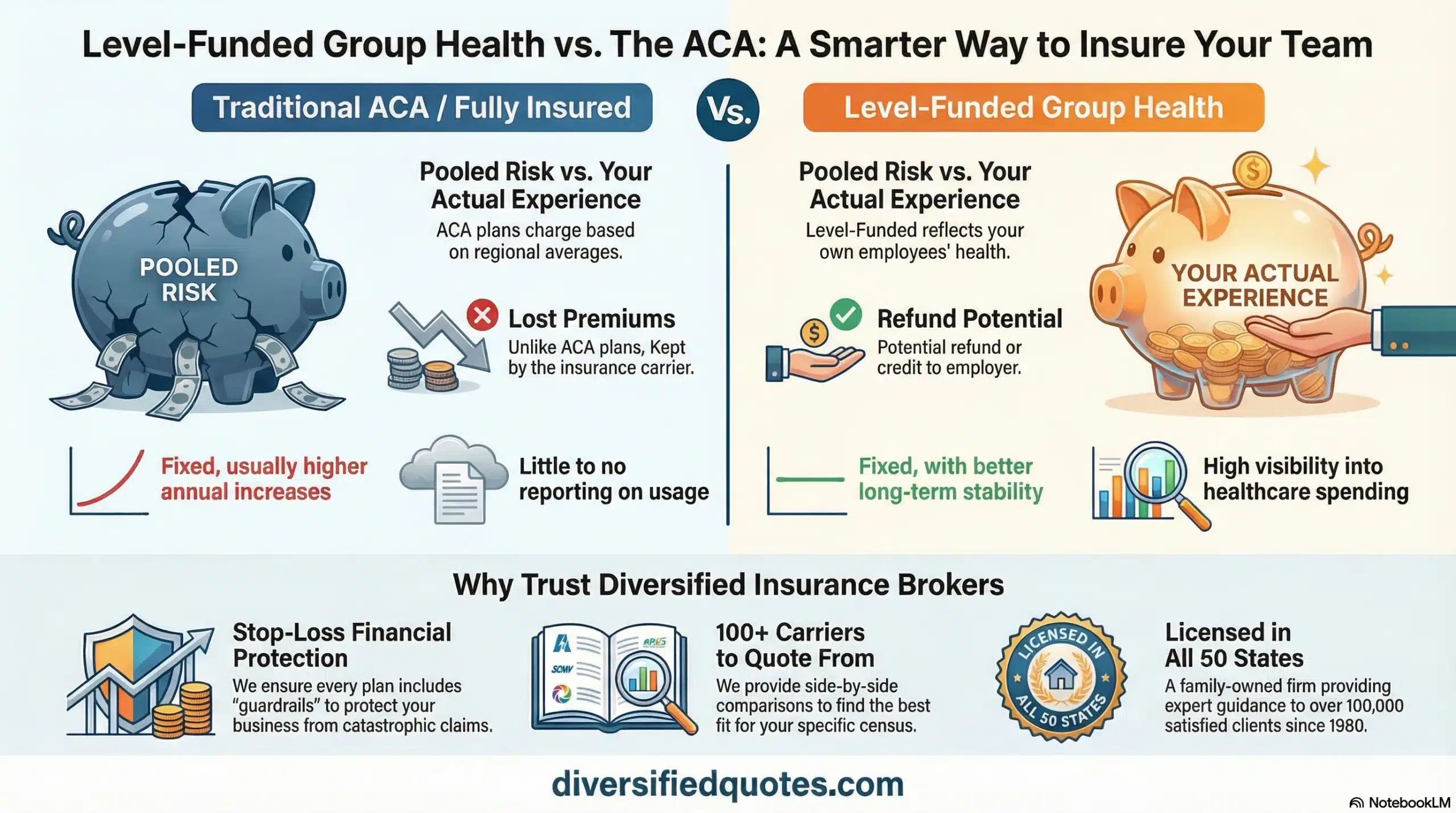
Level-funded plans are the most commonly appropriate structure for law firms in the 15–75 employee range — the segment where most regional law firms and boutique specialty practices sit. At this size, the group is large enough to generate meaningful claims data and to benefit from the pricing mechanics that reward efficient claims experience, while the level monthly payment structure maintains the cash flow predictability that law firm finance management requires. The stop-loss protection inherent in level-funded arrangements prevents catastrophic claims exposure while the detailed monthly reporting provides claims visibility that fully insured plans withhold entirely. Our resource on why group level funding covers the specific case for level-funded structures in professional service firms, and our resources on what is self-funded group health insurance and pros and cons of self-funded group health cover the transition mechanics for firms evaluating whether to go fully self-funded.
Self-funded plans serve larger law firms — typically 75 attorneys or more — that have sufficient administrative capacity, stable cash flow, and a long-term commitment to active plan governance. Multi-office law firms and regional or national practices often find self-funding the most cost-efficient long-term structure because the combination of claims transparency, plan design flexibility, and direct financial alignment between efficient utilization and renewal cost produces outcomes that no insured alternative can match. The prerequisite is genuine governance commitment — self-funding requires vendor management, stop-loss oversight, and a renewal process built around data rather than carrier pricing assumptions.
Partner Eligibility and Ownership Class Complexity
Partner eligibility is the most legally and administratively complex dimension of law firm benefits design — and the one that most off-the-shelf plans and non-specialized brokers handle inadequately. The correct treatment of equity partners in a group health plan depends on the firm’s legal entity structure (general partnership, limited liability partnership, professional corporation, or other structure) and the specific tax treatment of partner compensation. Partners treated as self-employed for federal income tax purposes — which describes equity partners in most general and limited partnerships — have different premium deductibility rules and different ACA compliance treatment than W-2 employees.
The practical implications are significant. An equity partner who is classified as self-employed cannot receive employer premium contributions in the same tax-free manner that a W-2 employee can — the contribution must be structured differently to be deductible for both the firm and the partner in the appropriate way. Firms that apply a uniform W-2 contribution structure to all employees, including equity partners who are tax-classified as self-employed, are handling partner benefits incorrectly — creating both tax exposure and potential compliance issues that become visible only when the firm faces an audit or a partner departure creates documentation requests. Our resource on creditable coverage and employer size covers the regulatory framework that governs employer-sponsored health coverage — context that helps clarify which rules apply to the firm’s specific structure and employee count.
Network Selection and Multi-Office Access
Network selection is the most consequential day-to-day plan experience variable for law firm employees — and the one most commonly evaluated inadequately by firms focused on premium rather than access. A plan that looks cost-effective on the proposal but routinely pushes employees out of network because their providers are not in the plan’s network is a plan that costs more than it appears: out-of-network claims are more expensive, employee dissatisfaction generates HR noise and attrition risk, and the renewal impact of elevated out-of-network claims is typically worse than the premium that would have been paid for a stronger in-network option from the beginning.
Multi-office law firms face an amplified version of this challenge. A network that covers downtown Chicago attorneys well may provide inadequate access for attorneys working from a satellite office in suburban Naperville or a branch in Indianapolis. National networks generally provide better geographic coverage but may sacrifice depth in specific metro areas. Regional networks often provide excellent depth in core markets but fail employees in secondary locations. The correct evaluation is employee-geography-based: where do the firm’s attorneys actually live, and can they access primary care, specialist care, and behavioral health within the plan’s network from their residential zip codes? Answering that question correctly requires looking at more than the carrier’s marketing materials.
The connection between network adequacy and mental health access is particularly important for law firms given the documented mental health challenges in the legal profession. A plan that technically includes behavioral health coverage but whose behavioral health network has long wait times, few in-network therapists, or no telehealth behavioral health option is effectively providing no meaningful behavioral health access — and attorneys evaluating the plan during recruiting will often verify access before accepting an offer. Plans that offer broad behavioral health networks with telehealth options alongside traditional in-person care serve the legal workforce meaningfully rather than just nominally. Our resource on best independent group health broker covers why independent carrier comparison is the mechanism that ensures network adequacy analysis is honest rather than carrier-marketed.
Contribution Strategy Across Multiple Compensation Tiers
Contribution strategy is the most underappreciated lever in law firm benefits optimization — and the most common place where plans fail to deliver their intended retention and recruiting value. The employer contribution to employee premium is not simply a cost item; it is a communication about how the firm values its people, and it is interpreted differently by different employee classes depending on their compensation level and financial situation.
For equity partners with high compensation, the specific employer contribution dollar amount is less meaningful than the quality and stability of the plan itself. For junior associates managing six-figure student loan obligations alongside entry-level attorney salaries, the difference between a $200 per month and a $350 per month employee premium deduction is a meaningful financial event that influences offer decisions and retention. For paralegals and administrative staff, a contribution structure that requires more than 5–7% of gross monthly income for employee-only coverage will produce waivers — not because the plan is bad, but because the math does not work at those salary levels.
The most effective contribution strategy for most law firms uses class-based contribution design: strong, near-100% employer contributions to employee-only coverage for all classes (because thin participation in any class degrades the risk pool and the renewal economics), with dependent coverage offered at a meaningful employee share that allows the firm to control its exposure to dependent coverage costs while still providing access. This structure keeps the employer’s cost predictable and manageable while ensuring that the plan’s enrollment is robust enough to stabilize the risk pool that determines future renewals. Our comparable resource on group health insurance for physician practices covers how similar multi-tier compensation structures are handled in medical practice benefits design — with directly applicable insights for law firm contribution strategy.
Complementary Benefits — What Law Firm Employees Evaluate Beyond Medical
Medical coverage is the foundation of the law firm benefits package, but most legal professionals evaluate a total benefits picture that extends beyond health insurance. Disability insurance is perhaps the most directly relevant supplemental benefit for attorneys and legal professionals — because the ability to work and bill is the professional’s primary economic asset, and disability during working years is statistically more likely than premature death for most working-age professionals. An attorney who cannot work due to injury or illness has the same economic problem as any professional: income stops while expenses continue. Our resource on disability insurance services covers the individual and group disability landscape, and our resource on disability business overhead expense insurance covers the specific protection for managing partners and small firm owners whose business fixed costs continue during a disabling event that prevents billing.
Dental and vision coverage are consistent top-requested supplemental benefits across all legal workforce classes — from partners to support staff — and their inclusion in the benefits package is a visible and frequently referenced positive in recruiting conversations. Our resource on best dental insurance rates covers the group dental plan comparison framework. Life insurance, long-term care planning, and retirement plan integration complete the comprehensive benefits picture that the most competitive law firms use to differentiate their total compensation positioning from peer firms offering the same base salary range but a thinner benefits package.
Renewal Management and Long-Term Cost Control
Renewal is the moment when the quality of the original plan design and the consistency of the management throughout the year either pay off or compound into a problem. Law firms that design a plan strategically and govern it throughout the year — reviewing claims reports in level-funded structures, maintaining stable participation through well-calibrated contributions, and making modest annual adjustments rather than disruptive overhauls — consistently outperform firms that treat the plan as a fixed cost until the renewal arrives and then scramble.
The most common renewal failure pattern in law firms is identical to most professional service businesses: the plan was set up years ago without strategic intent, premiums have increased every year without clear understanding of why, and the firm is now paying significantly more than peer firms for equivalent or inferior coverage. The fix is not always switching carriers — it is understanding what is driving cost, whether the funding structure is appropriate for the current group size, and whether the contribution and plan design are producing the enrollment pattern and claims behavior that support favorable renewal economics. Starting the renewal evaluation 90–120 days before the effective date — rather than reacting in the final 30 days — creates the information and time needed to make decisions that are strategic rather than reactive.
Design the Right Health Plan for Your Law Firm
We compare carriers, funding models, and contribution strategies — with specific attention to partner eligibility, multi-tier contribution design, and behavioral health network access. Clear, practical proposals with no obligation.
Contact Us for a Group Health ReviewRelated Pages
Group health resources for comparable professional service firms, plan structure analysis, and coverage sizing guides.
Financial Protection Essentials
Carrier reviews, retirement income planning, accidental death coverage, and specialized resources for legal professionals and firm owners.
Talk With an Advisor Today
Choose how you’d like to connect—call or message us, then book a time that works for you.
Schedule here:
calendly.com/jason-dibcompanies/diversified-quotes
Licensed in all 50 states • Fiduciary, family-owned since 1980
FAQs: Group Health Insurance for Law Firms
Can a small law firm with just a few employees get group health insurance?
Yes — most carriers offer group health plans to law firms with as few as two eligible full-time employees, though the specific minimum varies by state and carrier. Some states have established two-employee minimums while others require at least one W-2 employee beyond the firm owner, and a few states have even more flexible standards for very small groups. For a boutique legal practice or solo practitioner considering their first group plan, confirming whether the firm meets the carrier’s participation and contribution requirements is the essential first step. Most group health plans require a minimum participation rate — typically 70–75% of eligible employees who don’t have coverage elsewhere — which can be a challenge for very small firms where one or two partners or employees who have coverage through a spouse can push participation below the threshold. Our resource on minimum employees for group health insurance covers the specific carrier requirements by group size and state, and our resource on small business group health insurance covers the evaluation framework for legal practices at the entry point of group health plan eligibility.
What’s the difference between fully insured, level-funded, and self-funded plans?
The three plan funding structures differ in who bears claims risk, how pricing is determined, and what information the employer receives about what is driving costs. A fully insured plan charges a fixed monthly premium — the carrier prices the risk, pays claims, and retains the surplus when claims run favorably. The employer knows exactly what it will pay each month but has no visibility into claims drivers and no pathway to savings when the firm’s employees are healthy. A level-funded plan uses a stable monthly payment structure similar to fully insured, but the plan mechanics are built on a self-funded chassis with stop-loss protection. The firm pays a predictable monthly amount, receives detailed claims reporting, and may receive a surplus return when claims run below projections. A self-funded plan has the employer paying actual claims directly through a third-party administrator, purchasing stop-loss insurance to cap exposure to catastrophic claims, and managing the plan through direct governance. The upside is maximum transparency and control; the requirement is genuine administrative capacity and a disciplined governance process. Our resources on what is self-funded group health insurance and pros and cons of self-funded group health cover the tradeoffs in detail, and our resource on why group level funding makes the specific case for level-funded structures for professional service firms in the 15–75 employee range.
Are level-funded plans a good fit for law firms?
Often yes — and the reasons align specifically with how law firms operate and how legal professionals evaluate benefits. Level-funded plans provide the stable monthly payment that law firm financial management requires, the claims data transparency that allows partners to understand what is actually driving benefit costs, and the potential for savings in favorable claims years that fully insured plans withhold entirely. The stop-loss protection inherent in level-funded arrangements prevents catastrophic claims exposure, making the structure behave with the risk characteristics of insured coverage while delivering the economics and transparency of a self-funded arrangement. Law firms with 15–75 employees and relatively stable workforces — both common characteristics of mid-size regional and specialty legal practices — are often among the best-performing clients in level-funded structures because their demographic stability and professional culture tend to produce efficient claims patterns when the plan is designed and communicated correctly. The alternative — remaining fully insured through a series of double-digit renewal increases without any visibility into why costs are increasing or any lever to influence outcomes — is increasingly difficult to justify when level-funded structures are accessible and straightforward for firms of this size.
Can partners be covered under the firm’s group health plan?
Yes — partners can typically be covered, but the correct tax and compliance treatment of partner coverage depends heavily on the firm’s legal entity structure. This is one of the most commonly mishandled aspects of law firm benefits administration and it deserves specific attention rather than a generic answer. Equity partners in a general partnership or LLP are typically classified as self-employed for federal income tax purposes — not as W-2 employees. This classification affects how health insurance premiums are deducted and how ACA employer mandate provisions apply. Premium contributions for self-employed equity partners cannot be received as a tax-free fringe benefit in the same way that W-2 employee premium contributions work; instead, partners can typically deduct 100% of health insurance premiums as a self-employed health insurance deduction on their individual returns, subject to specific rules. Firms that treat equity partners identically to W-2 employees for premium contribution and payroll deduction purposes without confirming that the treatment is correct for the firm’s entity structure may be creating unintended tax exposure. Our resource on creditable coverage and employer size covers the employer mandate framework, and confirming partner eligibility and contribution treatment with qualified tax counsel alongside the benefits broker should be standard practice for any law firm establishing or redesigning its group health plan.
Do self-funded plans mean the firm is on the hook for unlimited claims?
No — properly structured self-funded plans use stop-loss insurance to define and limit the firm’s maximum claims exposure. Stop-loss coverage comes in two forms that work together to protect a self-funded employer from catastrophic exposure. Specific stop-loss (also called individual stop-loss) limits the firm’s liability for any single member’s claims in a plan year to a defined attachment point — often $50,000 to $150,000 per individual depending on the firm’s risk tolerance and premium budget. Claims above the specific stop-loss attachment point for any individual are covered by the stop-loss carrier rather than the firm. Aggregate stop-loss limits the firm’s total claims liability across all members to a defined percentage of expected claims — typically 125% of projected annual claims. If total plan-year claims exceed the aggregate stop-loss threshold, the stop-loss carrier covers the excess. Together, these two forms of stop-loss protection mean that a self-funded law firm can predict its maximum claims exposure before the plan year begins and plan around it — rather than facing unlimited liability as a structural feature of the arrangement. For law firms evaluating whether self-funding makes sense at their current size and cash flow, our resource on pros and cons of self-funded group health provides the comprehensive tradeoff analysis.
How can a law firm control renewals and reduce premium increases?
Renewal control comes from a combination of funding structure, claims transparency, contribution strategy, and proactive annual management — not from carrier loyalty or reactive negotiation in the final weeks before renewal. The most effective single change for a law firm facing recurring double-digit renewals is often moving from fully insured to level-funded, because the shift from opaque carrier pricing to transparent claims-based pricing creates the information needed to understand what is driving costs and the management leverage to address those drivers before they produce the next renewal increase. Beyond funding structure, maintaining strong participation across all employee classes — by calibrating contributions so that coverage is affordable enough that healthy employees don’t waive — is the most important claims pool management tool available to the employer. A risk pool where healthy employees participate is a fundamentally better pool than one where only employees with health events enroll, and the employer’s contribution strategy is the primary determinant of whether healthy employees stay enrolled or waive. Starting the renewal process 90–120 days before the effective date — rather than reacting in the final 30 days — creates the decision-making window needed to compare alternatives, model scenarios, and make changes that are strategic rather than forced. Our resource on best independent group health broker covers why independent market comparison is the structural mechanism that creates genuine renewal leverage rather than the single-carrier negotiation dynamic where the employer is always the weaker party.
Can a firm offer more than one health plan option to employees?
Yes — and offering two plan options is often a best practice for law firms with meaningful compensation variation across partner, associate, and staff classes. The two-option approach — typically a core plan with a sustainable employer contribution alongside a richer buy-up plan that employees can elect at a higher employee premium — accomplishes several objectives simultaneously. It preserves genuine employee choice, which is particularly valued by a professional workforce. It allows the employer to contribute at a sustainable level to the core plan rather than being locked into the richest plan for every employee. It creates annual renewal flexibility — the firm can adjust contribution splits or plan parameters in modest increments without the perception of eliminating benefits, because the structure itself communicates that choice is part of the design. And it enables associates and staff who genuinely want richer coverage to access it while not forcing that cost onto the employer universally. The most common structure is a HDHP/HSA core plan alongside a PPO or traditional copay buy-up — where the core plan is positioned around total compensation transparency (employer HSA contributions are part of the story) and the buy-up plan serves employees who prefer lower out-of-pocket predictability and are willing to pay for it.
What information is needed to quote group health insurance for a law firm?
Most group health insurance quotes require a census — a list of eligible employees with birthdate, zip code, and whether they want employee-only, employee-plus-spouse, employee-plus-children, or family coverage. This basic census, combined with the employer’s contribution strategy and the desired effective date, is sufficient to generate most carrier proposals. For level-funded and self-funded proposals, the carrier or TPA may also request a claims history report from the current carrier — typically the most recent 12–24 months of claims data — which is used to price the arrangement more accurately based on the firm’s actual experience rather than demographic assumptions alone. Firms that are currently insured with a carrier should be aware that claims data requests can sometimes be delayed or complicated by the incumbent carrier, and starting the renewal process early enough to gather this data is important for getting accurate alternative proposals. For a new group plan where no prior claims history exists, the proposal is typically generated from demographic assumptions — age, gender, zip code — which is why smaller firms and firms with older partner demographics sometimes see less favorable initial proposals that can improve in subsequent years as actual claims data becomes available.
How long does it take to set up a new group plan?
Timeline varies by plan type, carrier, and the completeness of the information provided, but most law firm group health plans can be implemented in three to six weeks from the point where the plan selection is finalized and the census is complete. Fully insured small group plans typically move fastest — as few as two to three weeks in straightforward cases. Level-funded plans may take three to five weeks due to additional underwriting steps and TPA onboarding. Self-funded arrangements typically require the longest implementation timeline — four to eight weeks or more — due to TPA contracting, stop-loss underwriting, and network access setup. The most common cause of implementation delays is incomplete census information: missing birthdates, incorrect zip codes, or unclear dependent information that requires follow-up. For firms with a specific effective date tied to a lease, fiscal year, or employee start date, allowing adequate implementation lead time — typically at least 30 days beyond the expected underwriting timeline — reduces the risk of gap coverage periods or rushed enrollment processes that create errors. Firms implementing benefits for the first time should also budget time for employee communications and benefits education, which is as important for effective enrollment as the administrative setup itself.
Can a law firm switch plans outside of the typical renewal date?
Mid-year plan changes are possible in specific circumstances but are not a routine option for most plan modifications. Qualifying events — significant changes in firm size such as a merger, acquisition, or rapid staff expansion — may allow a mid-year plan review and change depending on carrier rules and the nature of the event. In some cases, a substantially new plan can be established mid-year if the firm’s circumstances change significantly enough that the existing plan no longer serves the workforce adequately. For individual employee changes — adding a dependent after a qualifying life event such as marriage or birth, for example — group health plans typically allow mid-year enrollment changes within a defined window after the qualifying event, which is separate from the plan-level annual renewal process. For firms that want to change funding structures (from fully insured to level-funded, for example), the most practical timing is almost always the plan’s annual renewal date, as mid-year structural changes require agreement from the outgoing and incoming carriers and often create a gap period or administrative complexity that the annual renewal avoids entirely. Starting the renewal evaluation process 90–120 days before the effective date gives the firm adequate time to implement changes cleanly without mid-year friction.
About the Author:
Jason Stolz, CLTC, CRPC, DIA, CAA and Chief Underwriter at Diversified Insurance Brokers (NPN 20471358), is a senior insurance and retirement professional with more than 25 years of real-world experience helping individuals, families, and business owners protect their income, assets, and long-term financial stability. As a long-time partner of the nationally licensed independent agency Diversified Insurance Brokers, Jason provides trusted guidance across multiple specialties—including fixed and indexed annuities, long-term care planning, personal and business disability insurance, life insurance solutions, Group Health, Travel Medical and Evacuation Insurance, and short-term health coverage. Diversified Insurance Brokers maintains active contracts with over 100 highly rated insurance carriers, ensuring clients have access to a broad and competitive marketplace.
His practical, education-first approach has earned recognition in publications such as VoyageATL, and contributions from his agency featured in Kiplinger and GoBankingRates— highlighting his commitment to financial clarity and client-focused planning. Drawing on deep product knowledge and years of hands-on field experience, Jason helps clients evaluate carriers, compare strategies, and build retirement and protection plans that are both secure and cost-efficient. Visitors who want to explore current annuity rates and compare options across multiple insurers can also use this annuity quote and comparison tool.
Explore More Group Health Insurance Options: Browse our complete guide to Group Health Insurance by Industry — covering law firms, consulting, construction, medical practices, schools & more from 100+ carriers.
Last Reviewed: May 27, 2026 |
Reviewed by: Jason Stolz, CLTC, CRPC, DIA, CAA
Chief Underwriter, Diversified Insurance Brokers, Inc. | NPN: 20471358 | Diversified Insurance Brokers, Inc. — Licensed in all 50 states
Fact Checked by: Tonia Pettitt, CMIP©
Medicare Specialist, Diversified Insurance Brokers, Inc. | NPN: 14374308 | Diversified Insurance Brokers, Inc. — Licensed in all 50 states
Did you find this content helpful? Leave us a Google review — it helps others find trustworthy guidance too.
Editorial Standards: Diversified Insurance Brokers maintains rigorous editorial standards to ensure accuracy, clarity, and independence in all content. Learn more about our editorial standards and commitment to transparency.
