
How Much Health Insurance Does My Business Need
How Much Health Insurance Does My Business Need

Jason Stolz CLTC, CRPC, DIA, CAA
How much health insurance a business needs is not a question with a single dollar answer — it is a question about strategy, compliance, workforce goals, and financial architecture. The “right” amount of group health insurance for a business is the coverage level that satisfies any legal obligations that apply at your employee count, meets the financial expectations of the employees you are trying to attract and retain, can be funded within a contribution structure the business can sustain, and is designed with the right plan type to control long-term cost rather than simply the first year’s premium. At Diversified Insurance Brokers, Jason Stolz, CLTC, CRPC, DIA, CAA, works with business owners across all fifty states to answer this question with specificity — moving past the generic “offer health insurance” advice to the precise coverage structure, contribution strategy, and plan design that aligns with each employer’s workforce demographics, budget, and growth objectives.
The framing matters. Many business owners think about health insurance coverage as a cost to minimize. The most effective employers think about it as a total compensation component that either helps or hurts their ability to hire, retain, and engage the workforce that drives their business results. According to KFF’s annual benchmark employer health benefits survey, the average cost of employer-sponsored health insurance in 2025 was $9,325 annually for single coverage and $26,993 annually for family coverage — representing a six percent increase in family premiums over the prior year. On average, employers covered approximately eighty-four percent of single coverage premiums and seventy-four percent of family coverage premiums. These benchmarks provide context for evaluating whether a proposed contribution strategy is competitive in the current market, but the appropriate contribution level for any specific business depends on its workforce profile and competitive environment, not the national average.
Get a Clear Recommendation for Your Business
Coverage level, contribution strategy, and plan structure — based on your company size, workforce, and budget goals.
Request a Group Health ReviewThe Legal Starting Point: What the ACA Actually Requires
The first and most important threshold in determining what a business needs is whether any legal obligation exists to provide coverage at all. The Affordable Care Act’s employer shared responsibility provisions — commonly called the employer mandate — apply only to Applicable Large Employers: businesses with fifty or more full-time employees or full-time equivalent employees based on the prior calendar year. Businesses below this threshold have no federal legal obligation to offer group health insurance. The decision to offer coverage is entirely voluntary for employers with fewer than fifty full-time-equivalent employees, and many small employers choose to offer it for competitive reasons even without any mandate requiring them to do so.
For businesses at or above fifty full-time equivalents, the employer mandate requires offering affordable health coverage that meets minimum value standards to at least ninety-five percent of full-time employees and their dependents up to age twenty-six. For coverage to be considered “affordable” under the ACA’s affordability standards, the employee’s required contribution for employee-only coverage cannot exceed 9.02 percent of the employee’s household income for the 2025 plan year. Coverage meets “minimum value” if it pays at least sixty percent of the total allowed cost of covered benefits — essentially equivalent to a bronze-tier plan design. Employers who fail to meet these standards and have at least one full-time employee who receives a premium tax credit to purchase individual market coverage face penalties calculated per full-time employee. For the size pages covering different employee counts — including fifty employees, one hundred employees, and two hundred fifty employees — each includes discussion of the compliance obligations specific to that size band.
What “Enough” Coverage Actually Means Beyond Compliance
Minimum compliance — offering any plan that meets the ACA’s minimum value standard — is a legal floor, not a coverage strategy. A bronze-tier plan with a $7,000 individual deductible technically satisfies the employer mandate but may generate employee dissatisfaction, reduce the competitive attractiveness of the benefits package, and increase employee presenteeism or delayed care that ultimately costs more in productivity than the premium savings. Understanding what “enough” means for your specific business requires evaluating three distinct dimensions simultaneously: competitive benchmarking against what employers in your industry and region are offering, actuarial adequacy in terms of what the plan actually covers relative to expected employee utilization, and budget sustainability in terms of what the employer can contribute without impairing operational cash flow or growth capital.
For most small to mid-size businesses, “enough” coverage lands somewhere in the silver-to-gold plan design tier — plans with deductibles in the $1,500 to $3,500 individual range, copayments for office visits, and out-of-pocket maximums that protect employees from catastrophic expense. This tier balances meaningful employee protection with employer premium costs that are defensible in the context of total compensation. Our resource on how to choose the right group health plan provides the full framework for evaluating plan tier adequacy, and the resource on group health insurance cost for small business provides current market cost benchmarks by company size.
Coverage Requirements and Cost Benchmarks by Company Size
| Company Size | ACA Mandate? | Recommended Plan Structure | Typical Employer Contribution | Best Funding Model |
|---|---|---|---|---|
| 2–10 employees | No | Silver or Gold fully insured; QSEHRA if group plan not offered | 50–100% of employee-only premium | Fully insured; some carriers offer level-funding at 2+ |
| 11–49 employees | No | Level-funded strongly preferred; fully insured as fallback | 70–80% of employee-only; 30–50% of family add-on | Level-funded — refund potential, data transparency |
| 50–200 employees | Yes | Level-funded primary; multiple plan options to serve demographics | 75–85% of employee-only; defined contribution for family tiers | Level-funded; mid-size self-funded emerging |
| 200+ employees | Yes | Self-funded or level-funded; multi-plan option menu; HRA/HSA integration | 80–84% of employee-only; structured family contribution | Self-funded preferred for statistical stability and cost transparency |
The Employer Contribution Decision: How Much Should You Pay?
Employer contribution strategy is one of the most consequential decisions in group health plan design because it directly determines participation rate, plan affordability for employees, and the employer’s total benefit cost. Most carriers in the small and mid-size group market require the employer to contribute a minimum of fifty percent of the employee-only premium as a condition of offering coverage. This minimum threshold exists to ensure participation rates are sufficient to support the carrier’s risk pool — a plan where only sick employees enroll is not a viable insurance product. Many employers contribute significantly more than this minimum, both to drive participation and to remain competitive in hiring.
The KFF 2025 benchmark data shows that employers covered an average of eighty-four percent of single coverage premiums nationally. In practical terms for a small business offering a plan with a $777 monthly single coverage premium, the employer contributing eighty percent would pay approximately $622 per employee per month, with the employee paying roughly $155. The strategic question is where in this range your contribution should fall relative to your competitive market, your budget, and your workforce demographics. Businesses competing for skilled professionals in tight labor markets need contribution strategies at the higher end of the range. Businesses in industries with high turnover and lower average wages may find a more modest contribution is competitive in their market while protecting cash flow. The resource on how to get the best group health insurance rates covers the relationship between contribution strategy and total plan cost in detail.
Level Funding: The Right Plan Structure for Most Growing Businesses
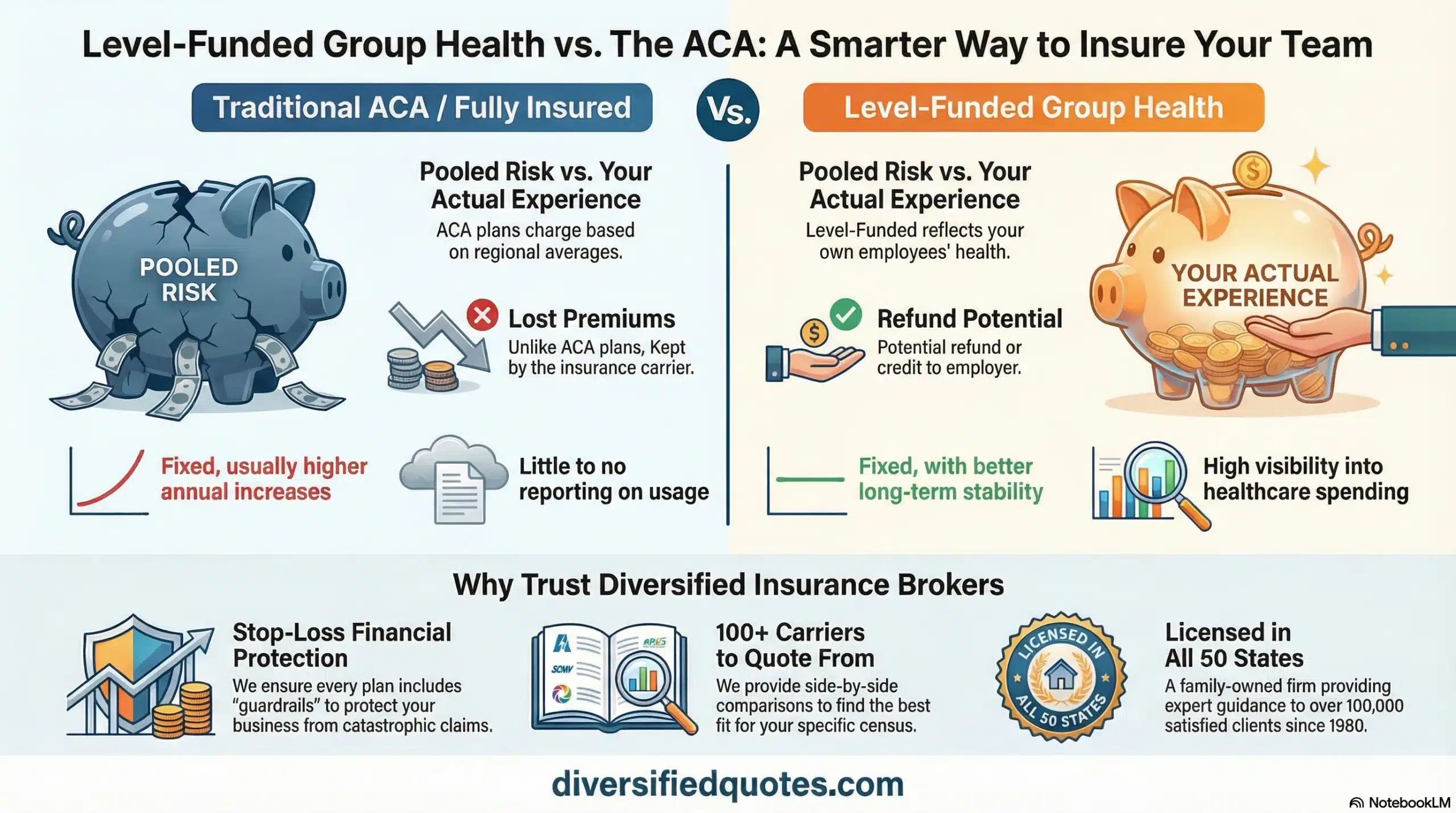
For most businesses with ten to two hundred employees that have healthy or average workforce demographics, level-funded group health insurance is the superior funding model — and it is the structure that Diversified Insurance Brokers recommends as the primary option before evaluating fully insured alternatives. Level funding is a hybrid between fully insured and self-funded coverage that provides fixed monthly costs identical to a fully insured plan in structure, while delivering claims data transparency, year-end refund potential when claims run below the funded budget, exemption from certain state premium taxes, and plan design flexibility that fully insured carrier products cannot match.
According to UnitedHealthcare data, employers on level-funded structures paid an average of approximately nineteen percent less than comparable fully insured groups. And according to KFF’s Employer Health Benefits Survey, thirty-seven percent of small firms reported having a level-funded plan in 2025, up from seven percent in 2019 — reflecting genuine market recognition of the structural advantages. The employer’s annual contribution under a level-funded plan includes three components in one fixed monthly payment: a claims fund allocation, a stop-loss insurance premium that protects against high claims, and an administrative services fee. If actual employee claims finish below the funded budget at year-end, the employer receives a refund of the unused claims balance. Fully insured plans keep that surplus as carrier profit — a structural transfer that level funding eliminates. Our comprehensive resources on why group level funding works, what self-funded group health insurance is, and whether small groups can get health insurance refunds provide the full mechanics of this model. The tax advantages available through level funding are covered in our resource on level-funded health insurance tax benefits.
Plan Design: What Good Coverage Actually Looks Like for Employees
The plan design — the specific deductibles, copayments, coinsurance rates, out-of-pocket maximums, and network structure — determines what the insurance actually means in practice for employees and their families. An employer can offer a plan with a generous contribution percentage that nonetheless provides poor value to employees because the underlying benefit design has a $6,000 individual deductible that discourages utilization and creates financial hardship when care is needed. Conversely, an employer with a more modest contribution percentage but a well-designed plan with a $1,500 deductible, $25 primary care copays, and a $4,000 individual out-of-pocket maximum may produce far better employee health outcomes and satisfaction at a comparable total employer cost.
The plan design dimensions that most directly affect employee experience are the deductible level, the copayment structure for primary care and specialist visits, the prescription drug benefit tiers, and the out-of-pocket maximum. In level-funded plan structures, the employer has more flexibility to customize these parameters than fully insured carrier shelf products typically allow. This customization capability is part of what makes level funding structurally superior — the employer can design a plan that actually fits the workforce’s utilization patterns and healthcare needs rather than accepting a standardized product that was designed for an average population. High-deductible health plan options paired with Health Savings Accounts provide employees with tax-advantaged savings vehicles that reduce net out-of-pocket costs while managing the employer’s premium contribution. Our resource on how to choose the right group health plan covers plan design considerations in detail for employers navigating these decisions.
Complementary Benefits: What Rounds Out a Complete Package
Group medical insurance is the foundational benefit, but the most competitive employers in the labor market treat the full benefits package as an integrated system. Group life insurance — typically offered with guaranteed-issue provisions that do not require underwriting for eligible employees — provides death benefit protection at a fraction of individual market cost. Our resource on group life insurance covers the standard benefit structures and employer funding options. Guaranteed issue group disability insurance provides income replacement protection that most employees lack on an individual basis. Dental and vision coverage are consistently ranked among the most valued benefits by employees — out-of-pocket dental and vision expenses are frequent and tangible, making even a modestly funded dental plan a visible and appreciated benefit. For employers with older workforces, group long-term care insurance provides access to group pricing that substantially undercuts individual LTC premiums. The most competitive employers do not ask how little they can spend on benefits — they ask how to allocate benefits dollars to maximize retention value per dollar spent, and the answer almost always involves a combination of strong medical coverage, group life, disability, and at least basic dental and vision.
How Coverage Needs Vary by Industry and Workforce Type
The right coverage level is not uniform across industries. Law firms, physician practices, accounting firms, and consulting firms compete for highly credentialed professionals who arrive with strong salary and benefits expectations — these employers need coverage levels closer to the upper benchmark, often with rich plan designs and meaningful contribution percentages toward family coverage. Construction firms, manufacturers, and service businesses with hourly workforces have different competitive benchmarks, different workforce demographics, and different utilization patterns that affect both the appropriate plan design and the supportable contribution level. Our industry-specific resources cover the coverage considerations for law firms, construction firms, physician practices, accounting firms, and consulting firms specifically, addressing how workforce demographics and industry compensation norms affect the appropriate coverage architecture. For smaller employee counts, size-specific resources including ten employees, thirty employees, and fifty employees cover the market options and cost ranges specific to each size band.
Working With an Independent Broker: Why It Changes the Answer
The answer to how much health insurance a business needs depends entirely on market comparison — and market comparison requires access to the full market. A captive agent or direct-to-carrier platform presents one company’s products at one set of prices against one carrier’s underwriting standards. An independent group health broker presents the full competitive spectrum: multiple fully insured options, multiple level-funded carriers, stop-loss market access, and the carrier selection expertise to match the employer’s workforce demographics to the carriers whose risk models produce the most favorable pricing for that specific group. For employers evaluating coverage for the first time or reviewing an existing plan, our second opinion on group health insurance service provides a competitive market comparison that frequently reveals significant savings or superior coverage options at comparable cost. Our resources on finding the best independent group health broker and why an independent broker matters explain how the selection process works and what to look for in a broker relationship.
Talk With an Advisor Today
Choose how you’d like to connect—call or message us, then book a time that works for you.
Schedule here:
calendly.com/jason-dibcompanies/diversified-quotes
Licensed in all 50 states • Fiduciary, family-owned since 1980
Frequently Asked Questions: How Much Health Insurance Does My Business Need?
Is my business legally required to offer health insurance?
The federal obligation to provide health insurance — the ACA employer shared responsibility mandate — applies only to Applicable Large Employers with fifty or more full-time employees or full-time equivalent employees based on the prior calendar year. Businesses below this threshold have no federal legal requirement to offer group health insurance. If your business has fewer than fifty full-time equivalents, the decision to offer coverage is entirely voluntary. However, many employers below this threshold offer coverage for competitive reasons: to attract qualified candidates, reduce turnover, and build a workforce that views the business as a stable long-term employer. Businesses at or above fifty full-time equivalents must offer affordable coverage that provides minimum value to at least ninety-five percent of full-time employees and their dependents up to age twenty-six, or face potential penalties under the ACA employer mandate. Affordability for the 2025 plan year is defined as employee cost-sharing for employee-only coverage not exceeding 9.02 percent of the employee’s household income. The size-specific resources — including fifty employees and one hundred employees — cover the compliance thresholds and requirements for each size band.
How much should employers contribute toward employee health insurance premiums?
Most small and mid-size group health carriers require a minimum employer contribution of fifty percent of the employee-only premium as a condition of offering coverage — this minimum threshold exists to ensure adequate participation rates. In practice, the competitive market pulls contributions well above this minimum. According to KFF’s 2025 Employer Health Benefits Survey, employers covered an average of eighty-four percent of single coverage premiums nationally. For family coverage, the average employer contribution covered the total family premium minus the $6,850 annual employee contribution. For a business offering a plan with a $777 monthly single coverage premium at eighty percent employer contribution, that is approximately $622 per employee per month in employer premium cost. The appropriate contribution percentage for your business depends on your competitive landscape, workforce demographics, and budget constraints — businesses competing for skilled professionals in tight labor markets need contributions at the upper end of the competitive range, while businesses in industries with different compensation norms may find a more modest contribution is market-appropriate. Our resource on group health insurance cost for small business provides regional cost benchmarks to inform this decision.
What is the difference between fully insured and level-funded group health insurance?
Fully insured group health insurance is the traditional model: the employer pays a fixed monthly premium to an insurance carrier, and in exchange the carrier assumes all financial responsibility for employee health claims. The premium is the same regardless of how much or how little employees use their coverage — and if the group has an excellent health year with minimal claims, the carrier keeps every dollar of unused premium as profit. Level-funded group health insurance is a hybrid model where the employer pays the same fixed monthly amount as a fully insured plan, but that monthly payment is divided into a claims fund allocation, a stop-loss insurance premium, and an administrative fee. If actual employee claims for the year come in below the funded claims budget, the employer receives a refund of the unused balance — money that a fully insured employer surrenders to the carrier. Level-funded plans also provide the employer with detailed monthly claims data showing exactly where costs are going, enabling proactive plan management. According to UnitedHealthcare data, employers on level-funded structures paid an average of approximately nineteen percent less than comparable fully insured groups. For most businesses with ten or more employees and reasonably healthy workforces, level funding is the structurally superior model. For a complete comparison, see our resource on what self-funded group health insurance is and the dedicated why group level funding works page.
What plan design should I choose — HMO, PPO, or HDHP?
The plan design — HMO, PPO, or High-Deductible Health Plan — refers to the network structure and cost-sharing mechanics employees experience when accessing care, and the right choice depends on your workforce’s care preferences and geographic distribution. HMO plans restrict employees to a defined network of providers and typically require referrals for specialist visits, but carry lower premiums and more predictable employee cost-sharing. PPO plans provide broader provider choice including out-of-network access at higher cost, and typically carry higher premiums. HDHPs pair a lower premium with a higher deductible, and are paired with Health Savings Accounts that allow employees to build tax-advantaged savings to cover the higher cost-sharing. For employers with geographically concentrated workforces in areas with strong HMO networks, HMO plans often produce the best combination of premium cost and employee utilization predictability. Employers with dispersed workforces or employees who value specialist access prefer PPO designs. HDHPs are increasingly popular among employers seeking to moderate premium costs while providing employees with the HSA benefit, particularly in workforces with younger, healthier demographics who expect lower utilization. The plan design decision should be made in the context of workforce demographics — a workforce of older employees with chronic conditions has different plan design needs than a young, healthy professional services workforce. Our resource on how to choose the right group health plan covers plan design selection in detail.
Can 1099 contractors and self-employed individuals get group health insurance?
Access to group health insurance for 1099 contractors and self-employed individuals depends on several factors including state, carrier, and how the business is structured. In most traditional group health arrangements, coverage is available to W-2 employees who meet the employer’s eligibility definition — typically full-time employees working thirty or more hours per week. However, some level-funded carriers offer group structures accessible to businesses with primarily 1099 workforces in specific circumstances, and the rules vary meaningfully by state and carrier. For self-employed business owners without any employees, separate pathways exist through the individual market, SHOP marketplace options in some states, and association health plans that pool purchasing power across multiple small businesses in the same industry or geography. The QSEHRA (Qualified Small Employer Health Reimbursement Arrangement) is specifically designed for businesses with fewer than fifty employees and allows tax-free reimbursement of individual market premiums, making group coverage accessible even for employers who cannot sponsor a traditional group plan. Our resources on whether 1099s can get group level funding and how to get group health insurance as a self-employed person address the specific options and limitations for non-traditional workforces.
What other employee benefits should I offer alongside health insurance?
The most competitive employers in the labor market treat group medical insurance as the foundational benefit in a broader package that addresses multiple financial risks employees face. Group life insurance provides a death benefit to employee families at group pricing — typically with guaranteed issue provisions that allow eligible employees to obtain coverage without individual underwriting — making it accessible to employees who might not otherwise qualify for individual life insurance at affordable rates. Group disability insurance provides income replacement when employees cannot work due to illness or injury, a risk that statistics show is more common during working years than premature death but that most employees lack adequate coverage for on an individual basis. Dental and vision coverage are consistently ranked among the benefits employees value most even when employer contributions are modest, because the expenses are frequent and tangible — employees feel the benefit of dental coverage every time they use it. Group long-term care insurance provides access to group pricing for LTC protection, particularly valuable for employers with older workforces. The most effective benefits packages are designed around the specific demographics of the workforce — what matters to a team of twenty-five-year-old software engineers is different from what matters to a workforce of forty-five-year-old healthcare professionals — and an independent broker who works across all benefit lines can design the package rather than selling individual products in isolation. See our resource on group life insurance and dental and vision insurance for details on these complementary coverages.
How does group health insurance affect my business taxes?
Employer contributions to group health insurance premiums are fully deductible as a business expense — they are treated as compensation paid to employees and reduce the business’s taxable income in the year paid. Employee contributions to employer-sponsored plans are typically made through pre-tax payroll deductions under a Section 125 cafeteria plan, which reduces both the employee’s taxable income and the employer’s payroll tax base for Social Security and Medicare taxes. The payroll tax savings on employee pre-tax contributions — typically 7.65 percent of the contribution amount — can represent meaningful savings for businesses with substantial employee headcount and contribution volumes. For small businesses with fewer than twenty-five full-time employees and average wages below a defined threshold, the ACA Small Business Health Care Tax Credit provides an additional tax credit — worth up to fifty percent of premiums paid by eligible small employers — for businesses that purchase coverage through the SHOP marketplace. This credit is only available to businesses meeting the employee count and wage thresholds. Level-funded plans operated as ERISA plans also provide exemption from certain state premium taxes and state-mandated benefit requirements that apply to fully insured plans, which is one component of their cost advantage over fully insured alternatives. Our resource on level-funded health insurance tax benefits covers the ERISA tax advantages in detail.
How do I know if my current group health plan is competitive?
Your current plan is competitive if it provides coverage that employees find meaningful relative to their expectations and their peer market, at an employer contribution level that does not lag materially behind what comparable employers in your industry and geography are offering, through a plan structure that provides cost stability and predictability over multiple renewal cycles. The practical test is whether your health benefits are helping you hire and retain employees — if you are consistently losing candidates or employees to competitors citing better benefits, the package is not competitive for your market. Benchmarking your current plan against the KFF survey data (average employer contribution of eighty-four percent of single coverage, total single coverage premium of $9,325 annually) provides a national reference point, but local and industry-specific benchmarks are more relevant for your specific competitive context. Working with an independent group health broker who can run a competitive market analysis — including both the funding structure comparison and the carrier pricing comparison — provides a more complete picture than national survey data alone. If you have not reviewed your group health plan against the current market in the last twelve to eighteen months, our second opinion on group health insurance service provides a comprehensive competitive analysis that frequently identifies superior options at comparable or lower cost.
About the Author:
Jason Stolz, CLTC, CRPC, DIA, CAA and Chief Underwriter at Diversified Insurance Brokers (NPN 20471358), is a senior insurance and retirement professional with more than 25 years of real-world experience helping individuals, families, and business owners protect their income, assets, and long-term financial stability. As a long-time partner of the nationally licensed independent agency Diversified Insurance Brokers, Jason provides trusted guidance across multiple specialties—including fixed and indexed annuities, long-term care planning, personal and business disability insurance, life insurance solutions, Group Health, Travel Medical and Evacuation Insurance, and short-term health coverage. Diversified Insurance Brokers maintains active contracts with over 100 highly rated insurance carriers, ensuring clients have access to a broad and competitive marketplace.
His practical, education-first approach has earned recognition in publications such as VoyageATL, and contributions from his agency featured in Kiplinger and GoBankingRates— highlighting his commitment to financial clarity and client-focused planning. Drawing on deep product knowledge and years of hands-on field experience, Jason helps clients evaluate carriers, compare strategies, and build retirement and protection plans that are both secure and cost-efficient. Visitors who want to explore current annuity rates and compare options across multiple insurers can also use this annuity quote and comparison tool.
Browse More Resources: Return to our complete Health Insurance, Dental, Vision & Disability guide — covering short term health, dental, vision, group health & disability.
Last Reviewed: June 11, 2026 |
Reviewed by: Jason Stolz, CLTC, CRPC, DIA, CAA
Chief Underwriter, Diversified Insurance Brokers, Inc. | NPN: 20471358 | Diversified Insurance Brokers, Inc. — Licensed in all 50 states
Fact Checked by: Tonia Pettitt, CMIP©
Medicare Specialist, Diversified Insurance Brokers, Inc. | NPN: 14374308 | Diversified Insurance Brokers, Inc. — Licensed in all 50 states
Did you find this content helpful? Leave us a Google review — it helps others find trustworthy guidance too.
Editorial Standards: Diversified Insurance Brokers maintains rigorous editorial standards to ensure accuracy, clarity, and independence in all content. Learn more about our editorial standards and commitment to transparency.
