
Hospital Indemnity Insurance: What It Covers & Costs
Hospital Indemnity Insurance: What It Covers & Costs

Jason Stolz CLTC, CRPC, DIA, CAA
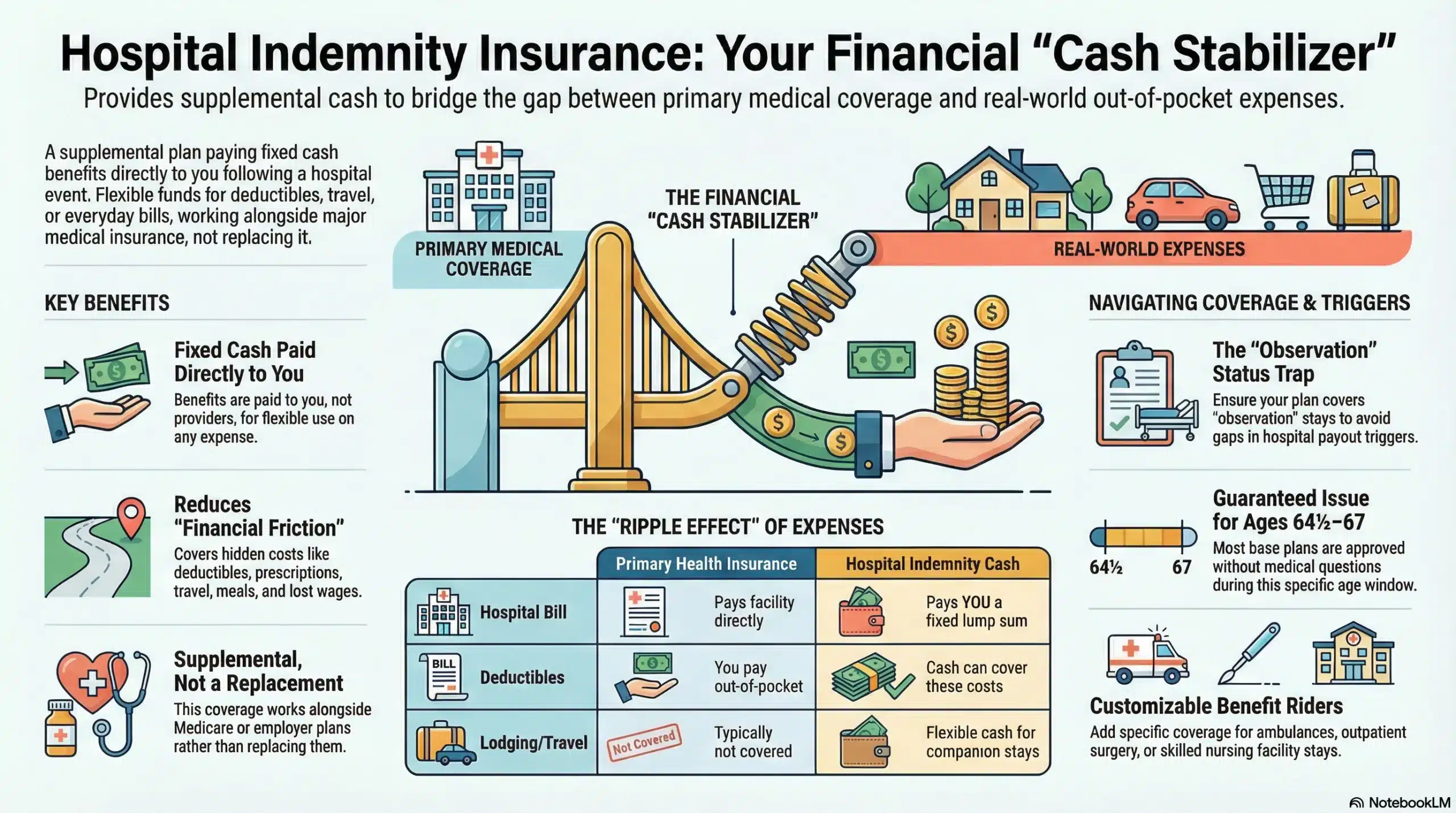
Hospital indemnity insurance is one of the most practical and most misunderstood supplemental coverage products in the market. At its core, the product does something simple: it pays you a fixed cash benefit when a covered hospital event occurs. Not the provider. Not the facility. You. The cash arrives according to a defined schedule and you use it however it helps most — for the hospital bill co-pay, the prescription refill on the way home, the week of missed work income, the hotel room for a companion who flew in, the pet boarding while you were admitted, or simply to rebuild the emergency fund balance that took the hit. Hospital indemnity is not a replacement for health insurance. It is a financial shock absorber for the specific category of disruption that hospital and serious medical events create around and beyond the hospital bill itself.
At Diversified Insurance Brokers, we help clients design hospital indemnity coverage that fits how care actually happens — not how marketing materials suggest it happens. That means we build around benefit triggers first: what counts as a covered event, how observation status versus inpatient classification changes payouts, what the plan does when an episode starts in the ER, and how riders for outpatient surgery, skilled nursing, and therapy can address the full arc of a medical episode rather than just the peak. We compare options across more than 100 carriers and confirm state-specific availability and underwriting requirements before making any recommendation. Our guide to the best hospital indemnity riders for seniors explains what to add and what to skip, and our page on observation vs. inpatient and how cash benefits pay covers the most important structural decision in any hospital indemnity design.
Compare Hospital Indemnity Insurance Options
We compare benefits, riders, and pricing from 100+ top-rated carriers — built to work alongside Medicare, Medicare Advantage, or employer coverage.
Call 800-533-5969
What Hospital Indemnity Insurance Is — and What It Is Not
Hospital indemnity insurance is supplemental coverage — it is designed to sit alongside your primary health coverage, not replace it. Your primary coverage (Medicare, Medicare Advantage, employer group health, or an ACA individual plan) determines what providers and facilities get paid and how much you owe in cost-sharing. Hospital indemnity operates independently: it pays you a fixed cash benefit according to a schedule defined in the policy contract, triggered by covered events that the policy defines as qualifying hospitalizations, admissions, or related services.
The distinction between “pays providers” and “pays you” is not a technicality — it is the central feature that makes hospital indemnity useful for non-medical costs. The $300 you spend on gas and hotel during five days of out-of-network treatment does not appear anywhere on your Explanation of Benefits. Your primary insurance does not reimburse it. Your hospital indemnity plan’s cash benefit does not either, specifically — but the cash benefit you receive can cover it. That flexibility is the practical value proposition: fixed, predictable cash that arrives when you need it and that you control. It works for the medical bill portion of your out-of-pocket, for the ripple-effect costs around the episode, or for simple financial stability during a period when routine expenses continue while income may not.
Hospital indemnity is not major medical insurance, not long-term care insurance, and not disability income insurance. It does not replace those coverages and should be evaluated as a complement to them. Our resource on disability insurance covers the income replacement dimension that hospital indemnity cannot address — the weeks and months of reduced working capacity that frequently follow a serious hospitalization. Our resource on Medicare planning services covers the primary coverage context within which hospital indemnity most commonly operates for people 65 and older.
How Hospital Indemnity Benefits Are Structured
Hospital indemnity plans use one of two primary benefit payment structures — daily benefits or lump-sum benefits — or sometimes a combination of both within the same contract. Understanding which structure you are purchasing is essential, because it determines how the payout is calculated when an event occurs.
A daily benefit design pays a fixed dollar amount for each covered day of hospitalization, up to a defined maximum number of days per confinement and per benefit year. You select the daily benefit amount at purchase — common amounts range from $100 to $500 or more per day — and the plan pays that multiplied by the number of covered days. A three-day inpatient stay with a $250 daily benefit and a five-day maximum per confinement pays $750. Daily benefit designs work well when the goal is proportional cash flow during multi-day hospitalizations, because the payout scales with the length of the stay.
A lump-sum benefit design pays a single fixed payment per covered confinement — regardless of whether the stay is two days or seven days. Some lump-sum designs differentiate between short admissions (under 24 hours or under 48 hours) and longer stays, paying a partial benefit for shorter and a full benefit for longer. Lump-sum designs work well when the goal is a single meaningful cash infusion per hospital episode, particularly for covering a deductible or a single major cost item.
Many practical designs combine both structures: a lump-sum admission benefit that pays when the patient is admitted, plus a daily benefit that continues for each subsequent covered day. This combination addresses both the front-end cost shock of the admission event and the ongoing daily accumulation of costs during a multi-day stay. Our resource on hospital indemnity for observation stays and our guide on guaranteed issue hospital indemnity at 65 cover specific design considerations for the two most important clinical classification and eligibility scenarios.
The Observation vs. Inpatient Problem — The Most Important Thing to Understand
The single most common source of hospital indemnity claim surprises is the observation versus inpatient classification distinction — and it is the first thing to resolve when evaluating any hospital indemnity plan design. A patient can spend two nights in a hospital bed, receive full hospital-level care, and be classified as “observation” rather than “inpatient” for billing purposes. This classification is a Medicare and hospital billing determination, not a medical judgment about the severity of the patient’s condition. Observation status is technically classified as outpatient care even when the patient is physically inside the hospital overnight.
Why does this matter for hospital indemnity? Because many hospital indemnity plans historically required “inpatient admission” as the trigger for their daily or lump-sum hospital confinement benefit. An observation stay — even a two-night one — would not trigger that benefit under the strict inpatient-only definition. A patient who expected a $500 benefit for a two-night stay and received nothing because the stay was classified as observation would have a reasonable complaint that the plan did not match their expectation.
The insurance market has responded to this problem by developing plan designs that include explicit observation coverage — separate benefit tiers or provisions for stays classified as observation, with defined triggers such as a 7-hour, 12-hour, or 24-hour observation threshold. Some plans define observation as a separate benefit category at a different amount from inpatient; others include observation within the inpatient benefit framework using time-based criteria that automatically qualify a patient once the observation stay exceeds a defined threshold. Selecting a plan that clearly addresses observation coverage — with specific policy language confirming how observation stays trigger benefits — is the most consequential product selection decision in hospital indemnity planning. Our full resource on observation vs. inpatient: how cash benefits pay explains the clinical and billing mechanics in full and identifies the specific policy language elements that create versus prevent this gap.
How Episodes Actually Flow: ER Through Admission Through Recovery
| Episode Phase | Common Event | Hospital Indemnity Coverage Option | Resource |
|---|---|---|---|
| Entry | Emergency room visit or urgent care | ER/urgent care rider — pays cash per qualifying visit | ER & Urgent Care: When Hospital Indemnity Pays |
| Monitoring | Overnight observation classification | Observation benefit — pays defined amount for qualifying hour threshold | Observation vs. Inpatient: How Cash Benefits Pay |
| Inpatient | Formal inpatient admission (multi-day) | Daily confinement benefit and/or admission lump sum | Base policy design; benefit amount × covered days |
| Outpatient procedure | Same-day surgery at outpatient or ASC facility | Outpatient surgery rider — pays defined per-procedure amount | Outpatient Surgery & Rehab Riders |
| Recovery | Skilled nursing facility transition post-hospitalization | SNF daily benefit rider — pays defined per-day amount at SNF | Skilled Nursing Facility Rider Explained |
| Rehabilitation | Physical, occupational, or speech therapy visits | Outpatient rehab/therapy rider — pays per qualifying visit | Outpatient Surgery & Rehab Riders |
| Major event | Heart attack, stroke, or cancer diagnosis | Condition-specific cash benefit riders — lump sum on qualifying diagnosis | Heart Attack & Stroke Rider | Cancer Diagnosis Rider |
Who Hospital Indemnity Coverage Fits Best
Hospital indemnity is most useful for people who face meaningful financial exposure from a hospital episode and who want a predictable, no-claims-adjudication cash benefit to absorb that exposure rather than depleting savings or accumulating debt. Three specific groups tend to get the most value per premium dollar from well-designed hospital indemnity coverage.
Medicare enrollees — whether on Original Medicare or Medicare Advantage — face specific out-of-pocket exposure that hospital indemnity can directly address. Original Medicare’s inpatient hospital deductible ($1,676 per benefit period in 2025, subject to annual change) represents a meaningful one-time cost shock for the first day of each benefit period, with coinsurance for longer stays. Medicare Advantage plans have their own cost-sharing structures that vary by plan and change annually. Hospital indemnity’s fixed cash benefit can be structured to address these specific deductibles and cost-sharing amounts regardless of how they change year to year, because the benefit is based on the policy schedule rather than on Medicare’s current cost-sharing structure. Our resource on best Medicare supplement plans for seniors covers the Medigap alternative for Original Medicare enrollees who prefer a more comprehensive cost-sharing protection approach, and our guide on best-rated Medicare Advantage companies provides context on how Medicare Advantage cost-sharing varies across plans and carriers.
People with high-deductible employer health plans often find hospital indemnity useful as a gap supplement that provides cash during the deductible accumulation period. A $4,000 family deductible means the first $4,000 of covered medical expenses each year comes entirely out of pocket before the plan begins paying. A hospital episode early in the benefit year that generates $4,000 in covered charges can arrive entirely as patient responsibility. Hospital indemnity’s fixed cash benefit — whether $500, $1,000, or $2,000 depending on the benefit design selected — does not replace the full deductible but meaningfully reduces the financial shock, particularly when the benefit is structured to trigger at the events most likely to cause deductible exposure: inpatient admission, observation stays, and ER visits.
Caregivers and households where a hospitalization creates ripple-effect financial disruption beyond the medical bill itself are often the most deeply appreciative of hospital indemnity’s cash flexibility. The travel costs when treatment is at a distant hospital. The companion lodging. The missed work income for a spouse who stays by the bedside. The childcare. The household expenses that continue regardless of who is hospitalized. None of these appear on the Explanation of Benefits. All of them can be addressed with the flexible cash benefit that hospital indemnity pays directly to the policyholder. Our resource on travel, lodging, and pet care benefits explained covers the riders specifically designed for these non-medical cost categories.
Optional Riders: Building the Right Coverage Stack
The base hospital indemnity plan covers the core inpatient hospitalization scenario. Riders extend coverage to the full arc of medical episodes — the ER visit before admission, the outpatient procedure that never required an admission, the skilled nursing facility stay after discharge, and the repeated therapy visits over months of recovery. The right rider selection targets your most likely cost exposures rather than adding every available option.
The ambulance benefit addresses emergency transport costs — ground ambulance transport costs averaging over $1,200 per trip nationally, with air ambulance potentially reaching tens of thousands of dollars. The ambulance rider pays a defined cash amount per qualifying transport event, subject to annual maximums. Most effective for patients with cardiovascular or neurological risk factors, chronic conditions that elevate emergency event probability, or those who live far from hospital facilities.
The outpatient surgery rider addresses the modern reality that an increasing proportion of surgical procedures — including many significant ones — are performed in outpatient settings and ambulatory surgery centers that do not generate a hospital inpatient admission. Without this rider, a patient who has a same-day surgical procedure may trigger no hospital indemnity benefit despite meaningful cost-sharing exposure from the procedure. The rider pays a defined per-procedure amount for qualifying outpatient surgical events, often structured with different amounts for hospital outpatient department procedures versus free-standing ASC procedures. Our resource on outpatient surgery and rehab riders: what to know covers the design specifics and triggers in full.
The increasing benefit rider — commonly structured as a 5% annual step-up — addresses the inflation dimension of a fixed-benefit policy. A $200 daily benefit that seemed adequate when purchased may feel inadequate five years later if hospital costs have increased significantly. The step-up rider increases the daily benefit amount by a defined percentage each policy year, typically up to a plan maximum, keeping the benefit more proportional to medical cost inflation over time. Our resource on the increasing daily benefit rider (5% step-ups) explains the compounding versus simple increase distinction and why it matters for long-term benefit adequacy.
The cancer diagnosis cash benefit rider and the heart attack and stroke cash benefit rider provide lump-sum payments triggered by the covered diagnosis or event, separate from any daily confinement benefit associated with the hospital stay itself. These condition-specific riders are designed for the patients who want an additional financial buffer specifically for the highest-severity health events — where the financial disruption extends well beyond the hospital episode itself into months of treatment, rehabilitation, and recovery. Our dedicated resources on the cancer diagnosis cash benefit rider and heart attack and stroke cash benefit rider explain how these triggers work and how the benefits interact with the base hospital confinement coverage.
What Hospital Indemnity Costs and How to Evaluate Value
Hospital indemnity premiums depend on age, state, selected benefit amounts, optional riders, and plan design availability. Because these variables produce wide premium ranges across the market, the most useful cost evaluation framework is value per premium dollar rather than absolute premium level — specifically, what combination of triggers and benefit amounts does a given premium purchase, and how likely are those triggers to produce a benefit payment given your realistic hospitalization risk and typical episode patterns.
A 65-year-old who selects a $200 daily benefit with a 5-day maximum, observation coverage, and an ER rider at $50 to $70 per month receives a plan that addresses the most common hospitalization trigger scenarios with meaningful but not maximal cash benefits. A 65-year-old who selects a $400 daily benefit with a 7-day maximum, observation coverage, skilled nursing rider, outpatient surgery rider, and cancer and cardiac diagnosis riders at $130 to $180 per month is purchasing substantially broader coverage with proportionally higher premium. Both may be appropriate depending on the individual’s Medicare plan cost-sharing structure, financial reserve level, and personal risk tolerance. The comparison question is whether the premium cost is justified by the realistic benefit probability — and that comparison is most useful when done across multiple carriers for equivalent benefit structures.
For the disability income coverage dimension — income replacement for the weeks and months when a hospital event prevents working — our resources on disability insurance and why disability insurance matters even when you’re young and healthy provide the income protection framework that hospital indemnity cannot address. For the critical illness dimension — broader coverage for serious diagnoses beyond the hospitalization event — our resources on what critical illness insurance is, whether you should consider critical illness insurance, and Assurity Life critical illness insurance cover the complementary supplemental coverage category that often pairs well with hospital indemnity in a complete protection plan.
Design Benefits That Match Real Hospital Scenarios
We compare carriers and tailor triggers and riders around observation, inpatient, outpatient, and recovery needs — so the plan pays where and when it matters most.
Call 800-533-5969
Helpful Hospital Indemnity Guides
Benefit trigger explanations, rider guides, and coverage design resources for hospital indemnity planning.
ER & Urgent Care: When Hospital Indemnity Pays
Outpatient Surgery & Rehab Riders: What to Know
Skilled Nursing Facility Rider Explained
Increasing Daily Benefit Rider (5% Step-Ups)
Heart Attack & Stroke Cash Benefit Rider
Travel, Lodging & Pet Care Benefits Explained
Medicare Planning Services
Financial Protection Essentials
Supplemental coverage guides, disability income resources, and critical illness information from Diversified Insurance Brokers.
Talk With an Advisor Today
Choose how you’d like to connect—call or message us, then book a time that works for you.
Schedule here:
calendly.com/jason-dibcompanies/diversified-quotes
Licensed in all 50 states • Fiduciary, family-owned since 1980
Hospital Indemnity FAQs
Is hospital indemnity insurance the same as health insurance?
No — hospital indemnity is supplemental coverage that pays fixed cash benefits to you after covered events. It is not a substitute for major medical insurance, Medicare, or ACA-compliant coverage. Your primary health coverage determines what providers and facilities get paid and how much cost-sharing you owe. Hospital indemnity operates independently of that system: it pays you a defined cash amount according to a benefit schedule when a covered event (such as a qualifying inpatient admission, observation stay, or ER visit) occurs. You use that cash however it helps most — for the out-of-pocket medical cost portion, for non-medical costs around the episode, or for simple financial stability while you recover.
Hospital indemnity cannot replace major medical coverage — it does not pay providers, does not satisfy network requirements, and does not meet ACA minimum essential coverage standards. It is specifically designed as a complement to existing primary coverage, not a standalone health insurance solution. Evaluating it as a supplement to Medicare, Medicare Advantage, or employer coverage — rather than as a replacement for any of those — produces accurate expectations about what it does and does not provide.
How do hospital indemnity benefits get paid?
Benefits are paid according to the policy benefit schedule when a covered event occurs that matches the policy’s definitions. The plan does not reimburse providers or facilities based on a bill — it pays you a defined cash amount based on the type of covered event and its duration. A daily benefit design pays a fixed dollar amount for each covered day of hospitalization. A lump-sum design pays a single payment per covered confinement. Some designs combine both: an admission benefit at the time of qualifying admission plus a daily benefit for each subsequent covered day.
The benefit payment process is typically straightforward: after a covered event, you file a claim with documentation confirming the event occurred (usually hospital admission records, discharge summary, or facility statement). The insurer verifies that the event matches the policy’s definitions and then sends the benefit payment directly to you. Most plans process standard claims within days to a few weeks of receiving complete documentation. Because the benefit is paid to you rather than to providers, you decide how to allocate the cash — whether toward medical cost-sharing, non-medical ripple-effect costs, or general financial stability during recovery.
Will hospital indemnity pay for observation stays?
It depends on the specific plan design — and this is the most important coverage question to resolve before purchasing. Many hospitals classify overnight stays as “observation” rather than “inpatient” for billing purposes, which affects how Medicare and other coverage treats the stay. Historically, some hospital indemnity plans required a formal “inpatient admission” to trigger benefits, meaning a patient who spent two nights in a hospital bed under observation status might receive no benefit despite being physically hospitalized overnight.
The insurance market has addressed this by developing plans with explicit observation coverage — separate benefit provisions or time-based triggers (such as 7-hour, 12-hour, or 24-hour thresholds) that allow observation stays to qualify for a defined benefit regardless of the formal billing classification. When evaluating any hospital indemnity plan, confirm specifically: does the policy include observation coverage? What is the hour threshold? What benefit amount applies for observation versus inpatient? Selecting a plan that clearly addresses observation with specific policy language is the most consequential product decision in hospital indemnity design. Our full resource on observation vs. inpatient: how cash benefits pay explains the clinical and billing mechanics that drive this distinction in full detail.
Can I add riders for surgery, rehab, ambulance, or skilled nursing?
Often yes — and selecting the right riders is where the difference between a plan that “pays when needed” and a plan that “pays only for the base scenario” is determined. Common optional riders include outpatient surgery benefits (for same-day procedures that don’t generate a hospital admission), outpatient rehab and therapy benefits (per-visit cash for PT/OT/speech therapy during recovery), ambulance benefits (defined cash per qualifying transport event), and skilled nursing facility daily benefits (for patients who transition to a SNF post-hospitalization for recovery care).
Rider availability and limits are state-specific and carrier-specific, so what is available where you live may differ from what is described generically in marketing materials. The right rider strategy targets your most likely cost exposures rather than adding every option available — which is why we recommend designing around the specific episode patterns most relevant to your health situation and the primary coverage structure you already have in place. Condition-specific riders — such as the heart attack and stroke cash benefit rider and the cancer diagnosis cash benefit rider — add lump-sum benefits for covered diagnoses and are often chosen by people who want additional financial protection specifically for the highest-severity health events.
What waiting periods or pre-existing condition rules apply?
Most hospital indemnity plans include two common limitations that affect initial coverage. A waiting period — typically around 30 days from the policy effective date — means that benefits are not payable for covered events that occur within the first 30 days of coverage. This prevents people from purchasing coverage in anticipation of an imminent planned hospitalization and immediately filing a claim. The waiting period typically does not apply to accidental injuries, which are covered from the policy’s effective date in most designs.
A pre-existing condition limitation period — commonly around six months — means that claims arising from conditions that existed before the coverage effective date may be excluded from benefit payment during that limitation period. After the limitation period expires, pre-existing conditions are typically covered like any other covered condition. The exact waiting period and pre-existing condition terms are plan-specific and state-specific — your personalized quote will confirm the specific terms that apply in your state and under the specific plan design being evaluated. These limitations are standard industry practice and should not deter purchase, but they do affect the timing of benefit availability for known conditions.
Is there a guaranteed-issue option near age 65?
Some hospital indemnity designs offer a guaranteed-issue window where the base daily hospital benefit can be approved without medical underwriting questions — typically for applicants in a specific age range around age 65, commonly described as those whose policy effective date falls between approximately age 64½ and 67. This window is valuable for people transitioning into Medicare who want supplemental coverage in place as their primary coverage changes, particularly those who have accumulated health conditions that might complicate full underwriting.
Important nuances: the guaranteed-issue provision typically applies to the base daily hospital confinement benefit. Optional riders — such as outpatient surgery, SNF, ambulance, or diagnosis-specific benefits — may still require underwriting depending on the carrier and state. The specific effective date requirements, benefit limitations during any applicable pre-existing condition period, and which components are truly guaranteed issue (versus simplified issue) should be confirmed before application. Our resource on guaranteed issue hospital indemnity at 65 covers the eligibility window, state availability, and coverage limitations in full detail.
Does hospital indemnity work with Medicare or Medicare Advantage?
Yes — hospital indemnity is specifically designed to work alongside Medicare and Medicare Advantage because it pays cash benefits to you independently of how Medicare processes provider claims. When you have a qualifying hospitalization, Medicare (or Medicare Advantage) handles its portion of the bill according to its coverage rules. Your hospital indemnity plan independently triggers its cash benefit based on the covered event, pays it directly to you, and you use the cash for whatever financial need is most pressing — the Medicare Part A deductible, coinsurance for longer stays, non-covered costs, or non-medical expenses.
Hospital indemnity does not replace Medicare and is not a Medicare supplement (Medigap) plan. Medigap plans specifically pay toward Medicare’s defined cost-sharing amounts. Hospital indemnity pays fixed cash regardless of what Medicare’s cost-sharing amounts are — which means it remains useful even if Medicare’s cost-sharing structure changes from year to year, because the benefit is based on the policy schedule rather than on Medicare’s current cost-sharing rules. For Medicare enrollees choosing between Medigap and supplemental cash benefit products, our resources on best Medicare supplement plans for seniors and Medicare planning services provide the comparative framework.
What’s the biggest “gotcha” to watch for with hospital indemnity?
The most common claim surprise — and the most consistently identified source of disappointment with hospital indemnity coverage — is the observation versus inpatient classification problem. A person can be physically hospitalized overnight in a hospital bed, receiving hospital-level care and monitoring, and still be classified as “observation” rather than “inpatient” for billing purposes. Medicare and some hospital indemnity plans treat these two classifications differently. A plan that requires formal “inpatient admission” as the trigger for its confinement benefit may pay nothing for an observation stay — even if that observation stay lasted 48 hours and generated significant patient cost-sharing.
The solution is to specifically evaluate and confirm observation coverage before purchasing — not to assume it is included. Ask explicitly: does this plan cover observation stays? What hour threshold triggers the observation benefit? What amount does the observation benefit pay? Plans that clearly address observation in their policy language and provide defined benefits for observation stays that exceed a time threshold are structurally superior to plans with ambiguous or inpatient-only trigger language. Our full resource on observation vs. inpatient: how cash benefits pay provides the complete explanation of why this distinction exists, how to identify it in policy language, and which plan designs address it most effectively.
Browse More Hospital Indemnity Guides
About the Author:
Jason Stolz, CLTC, CRPC, DIA, CAA and Chief Underwriter at Diversified Insurance Brokers (NPN 20471358), is a senior insurance and retirement professional with more than 25 years of real-world experience helping individuals, families, and business owners protect their income, assets, and long-term financial stability. As a long-time partner of the nationally licensed independent agency Diversified Insurance Brokers, Jason provides trusted guidance across multiple specialties—including fixed and indexed annuities, long-term care planning, personal and business disability insurance, life insurance solutions, Group Health, Travel Medical and Evacuation Insurance, and short-term health coverage. Diversified Insurance Brokers maintains active contracts with over 100 highly rated insurance carriers, ensuring clients have access to a broad and competitive marketplace.
His practical, education-first approach has earned recognition in publications such as VoyageATL, and contributions from his agency featured in Kiplinger and GoBankingRates— highlighting his commitment to financial clarity and client-focused planning. Drawing on deep product knowledge and years of hands-on field experience, Jason helps clients evaluate carriers, compare strategies, and build retirement and protection plans that are both secure and cost-efficient. Visitors who want to explore current annuity rates and compare options across multiple insurers can also use this annuity quote and comparison tool.
Browse All Insurance & Annuity Resources: Return to our complete Insurance & Annuity FAQs hub — annuity products, supplemental insurance, life insurance, health, dental, vision & wealth strategies.
Last Reviewed: June 10, 2026 |
Reviewed by: Jason Stolz, CLTC, CRPC, DIA, CAA
Chief Underwriter, Diversified Insurance Brokers, Inc. | NPN: 20471358 | Diversified Insurance Brokers, Inc. — Licensed in all 50 states
Fact Checked by: Tonia Pettitt, CMIP©
Medicare Specialist, Diversified Insurance Brokers, Inc. | NPN: 14374308 | Diversified Insurance Brokers, Inc. — Licensed in all 50 states
Did you find this content helpful? Leave us a Google review — it helps others find trustworthy guidance too.
Editorial Standards: Diversified Insurance Brokers maintains rigorous editorial standards to ensure accuracy, clarity, and independence in all content. Learn more about our editorial standards and commitment to transparency.
