
Increasing Daily Benefit Rider (5% Step-Ups)
Increasing Daily Benefit Rider (5% Step-Ups)

Jason Stolz CLTC, CRPC, DIA, CAA
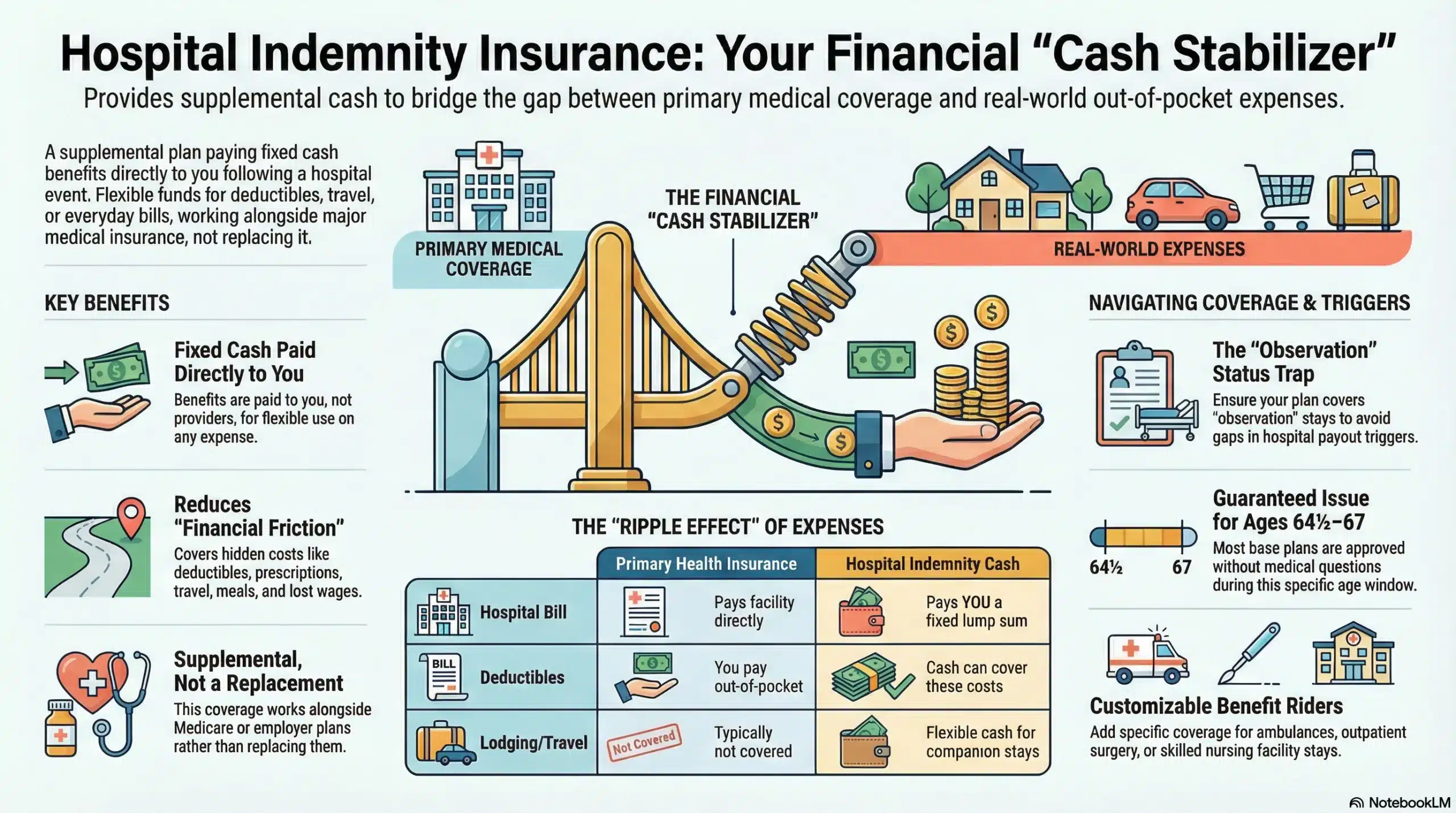
The Increasing Daily Benefit rider — most commonly structured as a 5% annual step-up — is the feature inside a hospital indemnity plan that prevents the daily cash benefit from becoming progressively less useful as healthcare costs rise over the years you hold the policy. Hospital indemnity insurance pays a defined cash benefit when a covered medical event occurs — an inpatient hospital admission, an emergency room visit, an observation stay, or any other benefit trigger the plan recognizes — and that cash goes directly to you to use however you need it. The challenge is that a fixed daily benefit that felt meaningful at the time of purchase can feel noticeably smaller five, ten, or fifteen years later as facility costs, cost-sharing obligations, and general healthcare expenses trend upward. Without any growth mechanism built into the plan, the daily cash benefit effectively loses real-world purchasing power every year simply through the passage of time and the upward trajectory of medical costs. The Increasing Daily Benefit rider is designed to address this structural problem: it automatically applies a defined percentage increase to your daily hospital benefit at each policy anniversary, so the daily amount in force when you actually use the plan is larger than the original starting amount.
The rider is designed to be automatic and passive — it does not require you to reapply, undergo new medical underwriting, request an update, or manage the increase in any way. The increase applies at the contract anniversary according to the terms of the rider, and the daily benefit in force at the time of a claim is the amount used to calculate the cash you receive. This automatic quality is one of the rider’s most practical virtues: for consumers who intend to keep hospital indemnity coverage for many years and prefer not to periodically re-shop or re-apply to maintain relevant benefit levels, the step-up rider provides a built-in maintenance mechanism. The rider does not change what triggers a benefit, what qualifies as a covered event, or how the plan classifies a hospital stay — those are determined by the plan’s benefit definitions, which are separate from the rider’s function. What the rider changes is simply the dollar amount that those definitions produce when a claim is paid.
This page covers the Increasing Daily Benefit rider in comprehensive practical detail: the mechanics of simple versus compound increases, how different step-up designs produce different outcomes over varying holding periods, which plan benefits the rider typically applies to and which it may not, how to evaluate the premium cost of step-ups relative to alternative uses of that premium, how the rider interacts with the rest of a hospital indemnity benefit design, and who this rider fits best as a planning decision. Understanding the rider’s role clearly allows you to decide whether it belongs in your specific plan and how it should be structured relative to your coverage priorities and expected holding period. For the foundational context on how hospital indemnity insurance works as a product category, our resource on hospital indemnity insurance: what it covers and costs covers the complete product landscape. For the classification issue that affects how all hospital indemnity benefits are triggered — including daily benefits that step up over time — our resource on observation vs. inpatient: how cash benefits pay covers the single most consequential structural fact about how hospital stays are billed and how that affects benefit payment.
Add 5% Annual Step-Ups to Your Daily Cash Benefit
We’ll illustrate how a step-up rider changes your daily benefit over time and show whether it or a higher starting amount is the better use of premium for your situation.
Request My QuoteOr call us directly: 800-533-5969
What the Increasing Daily Benefit Rider Does — The Core Mechanics
The Increasing Daily Benefit rider increases the base daily hospital confinement benefit by a stated percentage at each policy anniversary. The percentage is defined in the rider at the time of purchase and applies automatically going forward. In most designs, the percentage is either 3% or 5%, with 5% being the most commonly discussed step-up structure and the one that gives the rider its informal name. The increase is contractually defined — the carrier applies it according to the rider terms, and the updated daily benefit applies to any claims that occur after the increase date. The original daily benefit — the amount stated in the base policy at issue — is the starting point. Over time, step-up credits accumulate and the daily benefit in force grows, producing a higher daily cash amount when a covered hospital event eventually occurs.
The critical operational distinction that makes this rider meaningful is the timing: the claim is paid at the daily benefit in force at the time of the claim, not the original daily benefit from the date the policy was issued. This is the promise the rider delivers — a future hospital stay is paid at a higher rate than a hospital stay that occurred earlier, because the daily benefit has grown. Without the rider, every hospital event regardless of when it occurs is paid at the original daily amount (unless the plan is specifically redesigned). With the rider in force, the daily amount available at the time of a future claim reflects however many annual increases have accumulated since the policy was issued. For long-term policyholders, this accumulated growth can be substantial — particularly with a compound increase structure — and the difference between a claim paid at the original daily benefit and a claim paid at a benefit that has grown for a decade or more can be meaningful in dollar terms.
Step-Up Rider Design Comparison
| Design Option | How the Increase Works | Illustrative Effect on $200/Day Benefit | Premium Impact | Best Suited For |
|---|---|---|---|---|
| No Step-Up Rider | Daily benefit remains fixed at original amount indefinitely | Stays at $200/day regardless of how long policy is held | Lowest premium — no rider cost | Short-term holders; applicants who prefer to maximize starting daily benefit; those who expect to re-evaluate coverage within a few years |
| 3% Simple Increase | Adds 3% of original daily benefit each year — fixed dollar increase per year | Adds $6/day each year: after 10 years ≈ $260/day; after 20 years ≈ $320/day | Modest premium addition — most affordable step-up option | Older buyers with shorter expected holding periods; budget-constrained applicants who want some growth without large premium addition |
| 5% Simple Increase | Adds 5% of original daily benefit each year — fixed dollar increase per year | Adds $10/day each year: after 10 years ≈ $300/day; after 20 years ≈ $400/day | Moderate premium addition | Mid-term holders; applicants who want meaningful growth without the higher cost of compound |
| 5% Compound Increase | Applies 5% to current daily benefit each year — dollar amount of increase grows as benefit grows | After 10 years ≈ $326/day; after 20 years ≈ $531/day; after 30 years ≈ $865/day | Higher premium addition — most expensive step-up option but provides the most long-term benefit growth | Younger buyers with long expected holding periods who prioritize benefit growth that outpaces simple increases over time |
| 3% Compound Increase | Applies 3% to current daily benefit each year | After 10 years ≈ $269/day; after 20 years ≈ $361/day; after 30 years ≈ $485/day | Middle-tier premium addition — lower than 5% compound but higher than simple designs | Buyers seeking compound growth at a more manageable premium; mid-life purchasers who want meaningful long-term benefit growth without the highest rider cost |
Illustrations are approximate examples for conceptual understanding only — not tied to any specific carrier’s product terms. Actual benefit growth depends on the specific rider design, any caps or limits defined in the policy, and the applicable state contract. Premium costs for riders vary by carrier, applicant age, starting daily benefit, and state. Always review the specific policy contract and rider terms before purchase. Rider designs and availability vary by carrier and state.
Simple vs. Compound — The Math That Makes the Difference Over Time
The distinction between simple and compound step-up designs is the single most consequential question in evaluating any Increasing Daily Benefit rider, and it is the place where consumer assumptions most often diverge from reality. A simple increase applies the stated percentage to the original daily benefit — the amount written in the policy at issue — every single year. The dollar amount added each year is therefore fixed for the life of the rider. A 5% simple rider on a $200 daily benefit adds exactly $10 per day each year: year one produces $210, year five produces $250, year ten produces $300, year twenty produces $400. The increments are identical in dollar terms regardless of when in the policy’s life they occur.
A compound increase applies the stated percentage to the current daily benefit — the amount in force at the most recent policy anniversary. The dollar amount added each year therefore grows as the benefit grows, because the same percentage is being applied to a larger number. A 5% compound rider on a $200 daily benefit adds $10 in year one (producing $210), but in year two it adds 5% of $210 ($10.50), and in year three it adds 5% of $220.50 ($11.03), and so on. The differences in the early years are small and easily overlooked. Over ten or fifteen years, the compound design produces a meaningfully higher daily benefit than the simple design — and over twenty or thirty years, the compound benefit grows substantially larger. The mathematical principle is the same one that makes compound interest powerful in savings contexts: the growth compounds on itself, producing acceleration that becomes significant over long time horizons. For a policyholder who buys in their 50s and keeps the coverage into their 70s or 80s, the choice between simple and compound can translate into hundreds of dollars of daily benefit difference at the time of a potential claim.
Caps and Limits — What Every Rider Has That You Need to Confirm
Many Increasing Daily Benefit rider designs include caps — defined limits on how high the daily benefit can grow, how many annual increases can occur, or both. Caps are a normal and expected feature of product pricing: they allow carriers to offer the rider at a predictable cost while still providing meaningful annual increases. The presence of a cap does not automatically make a rider undesirable. A cap that allows the daily benefit to grow substantially from the original amount before reaching its ceiling can still provide years of meaningful inflation protection. The key is knowing the ceiling before you purchase the rider, rather than discovering after years of step-ups that the benefit has reached its maximum and will no longer increase.
When evaluating any step-up rider, confirm three specific elements of the cap structure. First, what is the maximum daily benefit the rider can produce? Some designs cap at a multiple of the original daily benefit (for example, twice the original amount), while others cap at a specific dollar amount or a specific number of annual increases. Second, does the cap apply to the step-up amount specifically, or does it produce a true ceiling beyond which the daily benefit cannot grow regardless of the rider structure? Third, once the cap is reached, does the premium for the rider change, or does the policyholder continue paying the rider cost even though no further increases are being applied? These are contractual terms that must be confirmed from the policy document rather than assumed based on the rider’s general description. The difference between a rider with a meaningful cap and one with a low or short-duration cap can be substantial when evaluated against a long holding period.
Which Benefits the Rider Applies To — The Most Common Assumption Error
One of the most frequent misunderstandings about the Increasing Daily Benefit rider is the assumption that the step-up applies to every benefit in the hospital indemnity plan. In most designs, the rider specifically increases the base daily hospital confinement benefit — the per-day cash amount for a covered inpatient or observation hospital stay. It does not automatically increase the emergency room benefit, the urgent care benefit, the skilled nursing facility daily benefit, the critical illness lump-sum benefit, or other optional riders that may be part of the plan. Each of those benefit categories has its own terms, and unless the policy explicitly states that the step-up rider applies to a specific optional benefit, that benefit remains at its original contracted amount regardless of how many years of step-up increases the base daily benefit has received.
This is not a defect in the rider — it is a design feature that reflects how hospital indemnity plans are structured. The base daily hospital confinement benefit is the core of the product, and the rider is designed to maintain its relevance over time. Other benefits serve different purposes at different stages of a medical episode, and many of them are event-triggered (paying a flat benefit upon occurrence of a specific event) rather than duration-based (paying per day of a stay). The practical takeaway is to verify precisely which benefits in your specific plan are covered by the step-up rider before you purchase it. This verification requires reading the rider language, not just the product summary. If maintaining the relevance of all your benefits over time is a priority, the conversation needs to include whether other riders in the plan have their own increase provisions or whether the step-up rider’s growth is limited to one specific benefit tier.
Start Higher or Grow Over Time — The Core Design Decision
The most practically consequential decision in step-up rider evaluation is not which step-up percentage to choose but whether to use premium for the step-up rider at all versus using the same premium to purchase a higher starting daily benefit with no rider. Both approaches address the goal of having a meaningful daily benefit, but they reach that goal through different mechanisms and produce different outcome curves over time. A higher starting benefit is immediately more useful — if you experience a covered event in year one or year two, the higher starting amount produces more cash than a lower amount with growth that hasn’t yet accumulated. A step-up rider with a lower starting benefit becomes progressively more useful over time, eventually exceeding what the same premium spent on a higher fixed amount would have produced — but only after enough annual increases have accumulated to close and then surpass the gap.
The practical evaluation framework is to ask two questions about your specific situation. First, how long do you realistically expect to keep this coverage in force? If the answer is fewer than five years, the step-up rider may not have time to produce meaningful accumulated benefit before the policy is replaced or discontinued. If the answer is ten years or more, compound step-ups in particular can produce substantial benefit growth relative to the additional premium. Second, what is your primary concern — strong protection in the near term or a plan that remains relevant many years from now? If near-term protection is the priority, front-loading premium into a higher starting benefit and stronger early-stage triggers (like emergency room and observation recognition) often produces better near-term results. If the goal is a plan that still feels meaningful in retirement, the step-up rider provides a built-in mechanism for that growth without requiring ongoing management decisions. We model both approaches — higher starting amount versus step-up rider — when quoting for clients who are uncertain, because seeing the projected daily benefit at specific future years makes the comparison intuitive in a way that a general description cannot replicate.
Why Observation vs. Inpatient Classification Still Matters More
A step-up rider increases the daily benefit amount — but the daily benefit only matters if the plan pays it. The most consequential structural factor in whether a hospital indemnity plan actually produces cash during a hospital episode is not the daily benefit level but the benefit triggers: what events the plan recognizes as qualifying for benefits, and specifically how the plan handles the observation versus inpatient distinction that has become a dominant feature of modern hospital utilization. Many hospital indemnity plans are designed around inpatient admission triggers — they pay the daily benefit when a patient is formally admitted as an inpatient. Under current hospital billing practice, a significant proportion of hospital stays are classified as observation status rather than inpatient admission — meaning the patient occupies a hospital bed, receives hospital-level services, and experiences the financial exposures of a hospital stay, but the stay is billed as outpatient observation rather than inpatient admission. A plan that only pays the daily benefit for inpatient status may not pay — or may pay a materially lower amount — for observation stays.
This classification distinction is more important than the step-up rider for most applicants, because a daily benefit that grows over time at 5% per year but fails to trigger during a common type of hospital stay produces less value than a flat daily benefit that pays reliably across both inpatient and observation statuses. The rider and the trigger rules are separate policy elements that must both be evaluated carefully. The step-up rider is worth adding if the plan’s trigger rules are solid — specifically if the plan pays the daily benefit for both inpatient admissions and observation stays, or at least recognizes observation status for some meaningful cash benefit. If the plan has weak observation recognition, improving that design element should be the first priority before adding the step-up rider. Our resource on observation vs. inpatient: how cash benefits pay covers the full classification framework and how to evaluate whether a specific plan’s trigger rules match the way modern hospitals actually bill care.
How Step-Ups Coordinate With ER, SNF, and Recovery Riders
Hospital indemnity plans with a strong benefit design typically pay across multiple stages of a medical episode rather than just for the main hospital stay. Emergency room and urgent care riders pay cash when the episode begins — often the most immediate and stressful financial moment, regardless of whether the patient ends up admitted, placed in observation, or sent home. ER visits create their own cost-sharing even when no inpatient stay follows. A cash benefit at that front-end trigger can reduce the financial disruption independently of whatever the daily benefit does. Our resource on ER and urgent care: when hospital indemnity pays covers how these event-triggered benefits work in practical terms. The step-up rider typically does not increase ER or urgent care flat-rate benefits — those have their own contracted amounts — but a well-designed plan includes both growing daily benefits and strong ER/observation recognition to cover the full episode from start to finish.
Recovery after a hospital stay can create its own financial exposure. Skilled nursing facility care — when a patient transitions from a hospital stay to a skilled rehab facility for recovery — involves daily cost-sharing that is separate from the hospital stay itself. A skilled nursing facility rider pays a per-day cash benefit during that post-hospital phase, which is separate from the daily hospital confinement benefit that the step-up rider affects. Our resource on the skilled nursing facility rider explained covers this benefit in detail. Other recovery-phase costs can include transportation to and from care facilities, lodging for family members who need to be nearby during a prolonged hospital or rehab stay, and similar expenses that are real but difficult to anticipate. Our resource on travel, lodging, and pet care benefits explained covers how these supplemental cash benefits fit into a complete hospital indemnity design. Serious cardiac events like heart attacks and strokes can create lump-sum expense needs that differ from the per-day structure of the daily benefit — our resource on the heart attack and stroke cash benefit rider covers how those event-triggered benefits complement the per-day structure that the Increasing Daily Benefit rider affects. For the broader Medicare coordination context that makes hospital indemnity planning relevant for many of these consumers, our Medicare planning services overview covers how supplemental cash coverage interacts with Medicare Advantage and Medicare Supplement plan designs.
Long-Term Care Coordination — When Step-Up Thinking Applies to LTC as Well
The step-up or inflation protection rider concept applies not only to hospital indemnity insurance but also to traditional long-term care insurance, where maintaining the relevance of the daily or monthly benefit over a potentially decades-long gap between policy purchase and claim use is a central planning challenge. In the long-term care insurance context, inflation protection riders — particularly 3% or 5% compound automatic increase riders — are considered one of the most important design elements for buyers who purchase LTC coverage in their 50s or 60s and may not use the benefits until their 80s. The mathematical logic is the same: a daily or monthly LTC benefit that was adequate at the time of purchase but never grew can be substantially less than adequate twenty years later when care costs may have increased significantly. Our resources on long-term care insurance services, long-term care insurance with pre-existing conditions, non-qualified long-term care annuity, and can you use long-term care insurance overseas cover the LTC planning landscape for consumers who are evaluating both hospital indemnity and long-term care coverage as complementary components of a complete retirement healthcare risk management plan.
Talk With an Advisor Today
Choose how you’d like to connect—call or message us, then book a time that works for you.
Schedule here:
calendly.com/jason-dibcompanies/diversified-quotes
Licensed in all 50 states • Fiduciary, family-owned since 1980
FAQs: Increasing Daily Benefit Rider (5% Step-Ups)
What is the Increasing Daily Benefit rider and what does it do?
The Increasing Daily Benefit rider — commonly structured as a 5% annual step-up — automatically increases the base daily hospital confinement benefit by a stated percentage at each policy anniversary. The increase applies without requiring the policyholder to reapply, undergo new underwriting, or take any active steps. The daily benefit in force at the time of a covered claim is the increased amount, not the original starting amount. The rider addresses the practical problem of a fixed daily benefit losing relevance over time as healthcare costs rise — by building automatic growth into the plan, the daily cash available at a future claim is larger than what the original daily benefit would have provided. The rider does not change what triggers a benefit or how claims are classified; it only changes the dollar amount those triggers produce.
What is the difference between a simple and compound 5% step-up?
A simple 5% step-up adds 5% of the original daily benefit — the amount stated in the policy at issue — every year. The dollar amount added per year is fixed for the life of the rider. A 5% simple rider on a $200 daily benefit adds exactly $10 per day every year: after 10 years the benefit is $300/day; after 20 years it is $400/day. A compound 5% step-up applies 5% to the current daily benefit each year, meaning the dollar amount of the increase itself grows as the benefit grows. A 5% compound rider on a $200 daily benefit adds $10 in year one, but $10.50 in year two, $11.03 in year three, and so on. After 10 years the benefit is approximately $326/day; after 20 years approximately $531/day. The compound design produces meaningfully higher daily benefits over long holding periods but costs more in rider premium than the simple design.
Does the step-up rider increase all benefits in my hospital indemnity plan?
In most designs, no — the Increasing Daily Benefit rider specifically increases the base daily hospital confinement benefit and does not automatically increase other optional benefits such as the emergency room benefit, urgent care benefit, skilled nursing facility daily benefit, or critical illness lump-sum benefits. Each of those benefits has its own contracted amount, and unless the policy explicitly states that the step-up rider applies to a specific optional benefit, those benefits remain at their original amounts. This is a common source of misunderstanding — the rider’s name references “daily benefit,” which refers specifically to the per-day hospital confinement benefit. Always verify which specific benefits in your plan the step-up rider applies to by reviewing the rider language in the policy document before purchase.
Are there caps on how high the step-up rider can grow my daily benefit?
Many Increasing Daily Benefit rider designs include caps — either a maximum daily benefit amount, a maximum number of annual increases, or both. Caps are a normal product design feature that allows carriers to price the rider predictably while still providing meaningful annual growth. The presence of a cap does not automatically make a rider undesirable; a cap that allows substantial benefit growth before its ceiling is reached can still provide years of valuable inflation protection. The key is confirming the cap terms before purchase. Specifically, confirm what the maximum daily benefit amount is (or how many years of increases apply), and whether the policyholder continues paying the rider premium once the cap is reached and no further increases are occurring.
Should I choose a step-up rider or a higher starting daily benefit?
The choice between the step-up rider and a higher starting daily benefit depends primarily on two factors: how long you expect to keep the coverage in force, and when you most want the plan to be powerful. A higher starting daily benefit is more immediately useful — if you experience a covered event in the first few years, the higher starting amount produces more cash than a lower amount with accumulated step-ups. A step-up rider with a lower starting benefit becomes progressively more useful over time, eventually producing a higher daily benefit than the same premium spent on a fixed higher amount — but only after enough years of growth have accumulated. For short-term holders or those primarily concerned about near-term protection, starting higher often makes more sense. For long-term holders who want a plan that remains meaningful in retirement, compound step-ups provide built-in growth without requiring ongoing coverage management decisions.
Does the step-up rider change how the claim is paid or what triggers the benefit?
No — the Increasing Daily Benefit rider changes the dollar amount of the daily benefit but does not change what events trigger the benefit or how hospital stays are classified. The plan’s benefit triggers — what qualifies as a covered inpatient admission, whether observation status is recognized, what constitutes a covered ER visit — are defined by the policy’s core benefit provisions, not by the rider. The rider’s function is exclusively to grow the daily benefit amount over time. This is why evaluating the plan’s trigger rules and classification approach is at least as important as evaluating the step-up rider — a growing daily benefit only delivers value if the plan pays it when a covered event occurs. Plans with weak observation status recognition, for example, may not pay the daily benefit for a common type of hospital stay regardless of how high the stepped-up daily amount is.
Who benefits most from the Increasing Daily Benefit rider?
The rider provides the most planning value for consumers who plan to keep their hospital indemnity coverage for many years — particularly those buying in their 50s or 60s who expect to maintain the plan well into retirement — and who prefer a built-in mechanism for benefit growth rather than periodically re-shopping or re-applying. The compound version benefits holders with longer time horizons more significantly than simple versions, because the compounding effect becomes most pronounced over multi-decade holding periods. The rider is also a good fit for consumers who prefer the simplicity of automatic benefit growth and want to avoid the friction of trying to adjust coverage manually later in life when health status changes might affect eligibility or pricing. It is less compelling for short-term holders, applicants who primarily want near-term protection, or those for whom premium efficiency favors a higher starting amount over scheduled growth.
How does the Increasing Daily Benefit rider relate to long-term care insurance inflation protection?
The Increasing Daily Benefit rider in hospital indemnity insurance is conceptually similar to the inflation protection rider available in traditional long-term care insurance — both are designed to prevent a fixed daily or monthly benefit from losing relevance as care costs rise over the years between purchase and claim. In long-term care insurance, the inflation protection rider is often considered one of the most critical design elements for buyers in their 50s and 60s, because the expected gap between purchase and claim is potentially decades. Both product categories use the same simple vs. compound distinction, with compound increases generally recommended for younger buyers with longer expected holding periods. The specific rules, required benefit levels, and state Partnership regulations differ between hospital indemnity and LTC insurance, but the fundamental planning logic — build in growth to maintain the real-world value of the daily benefit — is identical.
About the Author:
Jason Stolz, CLTC, CRPC, DIA, CAA and Chief Underwriter at Diversified Insurance Brokers (NPN 20471358), is a senior insurance and retirement professional with more than 25 years of real-world experience helping individuals, families, and business owners protect their income, assets, and long-term financial stability. As a long-time partner of the nationally licensed independent agency Diversified Insurance Brokers, Jason provides trusted guidance across multiple specialties—including fixed and indexed annuities, long-term care planning, personal and business disability insurance, life insurance solutions, Group Health, Travel Medical and Evacuation Insurance, and short-term health coverage. Diversified Insurance Brokers maintains active contracts with over 100 highly rated insurance carriers, ensuring clients have access to a broad and competitive marketplace.
His practical, education-first approach has earned recognition in publications such as VoyageATL, and contributions from his agency featured in Kiplinger and GoBankingRates— highlighting his commitment to financial clarity and client-focused planning. Drawing on deep product knowledge and years of hands-on field experience, Jason helps clients evaluate carriers, compare strategies, and build retirement and protection plans that are both secure and cost-efficient. Visitors who want to explore current annuity rates and compare options across multiple insurers can also use this annuity quote and comparison tool.
Browse More Resources: Return to our complete Supplemental, Hospital Indemnity & Critical Illness guide — covering hospital indemnity, accident insurance & critical illness coverage.
Last Reviewed: June 2, 2026 |
Reviewed by: Jason Stolz, CLTC, CRPC, DIA, CAA
Chief Underwriter, Diversified Insurance Brokers, Inc. | NPN: 20471358 | Diversified Insurance Brokers, Inc. — Licensed in all 50 states
Fact Checked by: Tonia Pettitt, CMIP©
Medicare Specialist, Diversified Insurance Brokers, Inc. | NPN: 14374308 | Diversified Insurance Brokers, Inc. — Licensed in all 50 states
Did you find this content helpful? Leave us a Google review — it helps others find trustworthy guidance too.
Editorial Standards: Diversified Insurance Brokers maintains rigorous editorial standards to ensure accuracy, clarity, and independence in all content. Learn more about our editorial standards and commitment to transparency.
