
Best Hospital Indemnity Riders for Seniors (What to Add, What to Skip)
Best Hospital Indemnity Riders for Seniors (What to Add, What to Skip)

Jason Stolz CLTC, CRPC, DIA, CAA
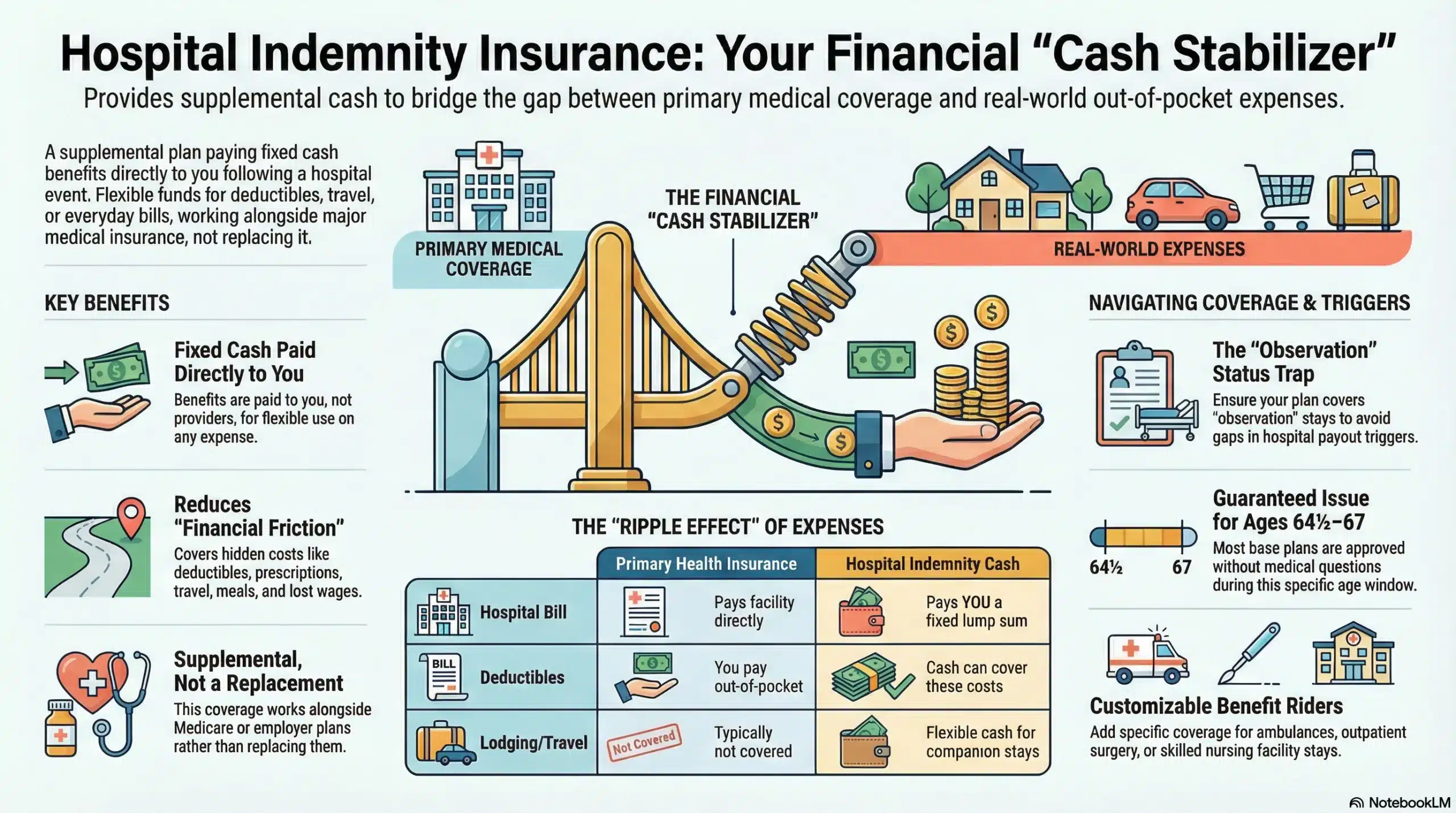
Hospital indemnity insurance pays fixed cash benefits directly to you when defined healthcare events occur — not reimbursements calculated from your actual bill, but predictable dollar amounts triggered by the specific things that most frequently create financial surprise for seniors: an ambulance ride, an ER visit, an observation stay, a hospital admission, a same-day surgery, a skilled nursing stay, or a diagnosis. The daily or per-event cash benefit is the base product. The riders are the customization layer that determines whether the plan actually mirrors your real-world cost exposure or pays benefits in situations you rarely encounter. A well-chosen rider combination turns a hospital indemnity plan from a generic supplemental product into a targeted coverage tool that pays cash for the specific episodes your primary coverage handles least predictably. A poorly-chosen rider combination does the opposite: adds premium without adding meaningful value because the riders duplicate coverage you already have or address scenarios that are unlikely for your specific situation. Our resource on hospital indemnity insurance: what it covers and costs covers the base product mechanics and how the fixed-benefit structure works alongside your primary Medicare coverage.
The rider evaluation process for seniors is not the same as it is for working-age enrollees, because the underlying coverage structure is different. Seniors on Medicare Advantage plans face defined copay structures — typically a fixed dollar amount per day for inpatient hospital stays (commonly $295–$350/day for days 1–3, then decreasing), a fixed ER copay ($90–$120 per visit in many plans), and a fixed SNF per-day charge for post-acute recovery. These predictable per-event costs can be precisely mirrored by hospital indemnity riders, making the benefit math clear and the value straightforward. Seniors on Original Medicare with a Medigap supplement like Plan G already have most of those per-event costs covered — their hospital indemnity need is different, focused more on disruption cash, non-medical expenses, and the gaps Medigap doesn’t address (ambulance mileage add-ons, companion lodging, household expenses during a hospital episode). Our resource on hospital indemnity for Medicare Advantage members covers the MA-specific use case, and our resources on best Medicare Supplement plans for seniors and Medicare Advantage vs Medicare Supplement provide the primary coverage context that determines which riders make the most sense.
One of the most important gaps hospital indemnity addresses for seniors — and the one most families discover after the fact rather than before — is the observation status problem. Medicare’s rules for skilled nursing facility coverage require a qualifying three-day inpatient hospital stay before Medicare Part A will pay for SNF rehabilitation. When a hospital codes a stay as “observation” rather than inpatient admission — a coding distinction that can occur even when the patient sleeps in a hospital bed for two or three nights — the three-day inpatient clock does not advance, Medicare SNF coverage does not trigger, and the patient faces the full cost of skilled nursing rehabilitation out of pocket. The observation benefit rider on a hospital indemnity plan pays a cash benefit for those 6–24 hour observation stays that generate real costs but don’t satisfy Medicare’s inpatient admission criteria. Our resource on hospital indemnity for observation stays covers this specific problem in detail, and our resource on observation vs. inpatient: how cash benefits pay explains exactly how the benefit triggers differ between these two hospitalization categories.
Build a Rider Package That Fits Your Coverage
We match riders to your actual copays and exposures — so premium stays reasonable and benefits stay useful when you need them.
Request My QuoteHospital Indemnity Rider Quick-Reference Guide
The table below covers the primary riders seniors evaluate when designing a hospital indemnity plan. Coverage details, benefit limits, and rider availability vary by carrier and state — use this as a starting-point evaluation framework, not as a guarantee of any specific plan’s terms.
| Rider | What It Covers | Add When… | Skip or Reduce When… |
|---|---|---|---|
| Ambulance Rider | Fixed cash benefit for covered ambulance transport; separate limits typically for ground vs. air transport; annual use limits common | You live in a rural or suburban area, have fall risk, cardiac history, or face meaningful ambulance cost-sharing; Medicare occasionally denies ambulance claims deemed non-medically-necessary, leaving significant out-of-pocket exposure | Your primary plan handles ambulance costs reliably at low net cost to you and emergency transport is genuinely rare in your situation |
| ER / Urgent Care Rider | Cash per qualifying ER visit or urgent care visit; visit limits apply annually; benefit may differ between ER and urgent care depending on plan design | You have Medicare Advantage with a meaningful ER copay ($90–$120+/visit); you manage a chronic condition with unpredictable urgent care episodes; you want immediate out-of-pocket predictability at the ER level | Your plan keeps ER cost-sharing at very low net cost and you use ER or urgent care infrequently; Original Medicare + strong Medigap members may find this less essential than MA members |
| Observation Stay Benefit (6–24 hrs) | Partial or full cash benefit for hospital stays coded as “observation” rather than inpatient admission; bridges the gap between ER benefit and full inpatient benefit for short-stay monitoring episodes | You want to avoid the observation status cost trap; short monitoring episodes (chest pain rule-outs, respiratory flares, infections, falls with monitoring) are realistic for your health profile; you want SNF-related protection if observation coding blocks the inpatient clock | Only if the plan’s base benefit already handles observation adequately and your primary concern is strictly multi-day inpatient cost-sharing |
| Daily Hospital Benefit (Inpatient Confinement) | Cash per day of covered inpatient hospital confinement; mirrors Medicare Advantage per-day copay structure; day range selected at enrollment; ICU/intensive care may have a separate (higher) daily benefit on some plans | You have MA with per-day inpatient copays you want to offset; you want a direct dollar-for-dollar mirror of your plan’s inpatient cost structure; you have history of or risk for conditions requiring multi-day hospital stays | You have robust Medigap coverage that already eliminates per-day inpatient cost-sharing; you prefer a lump-sum admission benefit for upfront cash flexibility over per-day coverage |
| Lump-Sum Hospital Admission Benefit | One-time cash payment per admission or qualifying hospital event; delivers immediate flexible cash early in the episode when non-medical costs (travel, lodging, household) cluster alongside medical cost-sharing | You want cash “up front” to cover early-episode expenses; your plan has meaningful first-day copays; you prefer flexibility over day-count precision; you travel and want episode-of-care cash available regardless of how long the stay lasts | Your daily benefit already mirrors your per-day copay structure accurately and adding both would create more premium than value; very budget-conscious seniors may pick one or the other, not both |
| Outpatient Surgery Rider | Cash per covered outpatient or same-day surgical procedure; subject to frequency limits and procedure schedule definitions; covers common senior procedures — cataracts, scopes, minor orthopedic, cardiac monitoring procedures | You have planned upcoming procedures; your plan has significant outpatient procedure copays or coinsurance; you have a history of recurring outpatient interventions; more surgical procedures shift to outpatient every year, increasing relevance for most seniors | Outpatient cost-sharing in your plan is already low; you don’t have scheduled procedures and rarely need outpatient surgical care; budget-first seniors may defer this until a procedure is more imminent |
| Outpatient Rehab / Therapy Rider | Cash per covered PT/OT/ST visit up to annual limits; supports post-surgical rehab, post-stroke rehabilitation, fall recovery, and chronic pain management — the costs that continue after discharge | You have orthopedic conditions, balance concerns, planned joint replacements, or chronic pain management needs; rehab is the “hidden” multi-week cost after a hospital episode that insurance often underpays | Your plan covers therapy robustly with low copays; you rarely use PT/OT services; very lean designs may defer rehab rider and focus on inpatient/ER/ambulance core |
| Skilled Nursing Facility (SNF) Rider | Daily cash for qualifying SNF stays following a hospital admission; typically covers a defined day range; particularly important given that post-acute SNF cost-sharing can be significant even when Medicare Part A is active | You have fall risk, joint replacement history, cardiac conditions, or any profile that increases SNF likelihood after hospitalization; MA plans with high per-day SNF copays make this especially valuable | You have strong post-acute coverage and low SNF cost-sharing; a leaner design focused on ER/ambulance/inpatient may better fit your budget and risk profile |
| Diagnosis Rider (Cancer, Heart Attack, Stroke) | Lump-sum payment upon first diagnosis of a covered condition; benefit is flexible cash — can be used for specialist travel, second opinions, household expenses, caregiving support, or out-of-pocket medical costs; policy definitions and look-back rules apply | You want broader event coverage beyond hospital-episode benefits; you have limited emergency savings; you expect that a major diagnosis would require specialty travel or create significant household financial disruption; family history may increase relevance | You want to keep the plan lean and episode-focused; existing critical illness coverage or robust savings reduce the marginal value; definitions and waiting periods require careful review before relying on this rider |
| Increasing Daily Benefit (Inflation Step-Up) | Automatically increases the daily hospital benefit by a set percentage each year up to a defined cap; designed to keep benefits aligned with rising copays and cost-sharing over the life of the policy | You plan to keep the policy for many years; you want long-term benefit stability as Medicare cost-sharing tends to increase annually; you prefer a slightly lower initial benefit that grows over time rather than the highest possible upfront benefit at fixed premium | You want the highest possible starting benefit and prefer fixed premium; the plan is primarily a short-term bridge (1–3 years); starting with a higher base benefit and no step-up may be more cost-efficient for shorter hold periods |
Rider availability, benefit amounts, coverage definitions, visit limits, and day limits vary significantly by carrier, plan design, and state. This table reflects general market patterns for educational purposes only. Verify all benefit details, waiting periods, pre-existing condition limitations, and enrollment requirements in the actual policy documents before any purchase decision. Riders shown above may not all be available from any single carrier or in every state.
Why Hospital Indemnity Riders Matter for Seniors Specifically
For most seniors, the most financially disruptive healthcare events are not routine primary care visits — they are short, concentrated episodes that generate multiple types of cost-sharing simultaneously: a facility charge, a procedure copay, a transport cost, a recovery period with its own daily charges, and the non-medical expenses (travel to specialists, companion lodging, household help during recovery) that arrive alongside the medical bills. Hospital indemnity insurance was originally designed for exactly this pattern — it pays defined cash at episode trigger points rather than reimbursing specific itemized bills, which makes it administratively simple and financially flexible. The cash benefit goes directly to the insured and can be used for anything: the ambulance bill, the hotel for a family member staying nearby, the frozen meals during recovery, the lost income from a working family member who took time off to provide care. Our resource on is Medicare expensive covers the full cost-sharing structure of Medicare that hospital indemnity riders are designed to address, and our resource on best Medicare rates covers how primary Medicare costs interact with supplemental planning decisions.
The Observation Status Trap — The Gap No One Tells Seniors About
One of the most financially significant — and least understood — Medicare coverage gaps for seniors is the observation status problem. When a hospital admits you as an inpatient, Medicare Part A hospital coverage applies, and if you subsequently need skilled nursing facility rehabilitation, the Medicare SNF benefit can activate after a qualifying three-day inpatient stay. When a hospital places you under “observation status” — a billing classification that can apply even when you spend two or three nights in an actual hospital bed receiving active medical management — you are technically classified as an outpatient. The three-day inpatient clock does not advance. If you then need SNF care, Medicare Part A SNF coverage does not trigger, and the full cost of skilled nursing rehabilitation falls on you out of pocket. Skilled nursing facility care can cost thousands of dollars per month — a surprise bill that arrives at exactly the wrong moment, when the family is already managing a medical crisis.
The observation benefit rider on a hospital indemnity plan pays a defined cash benefit for those 6–24 hour observation stays that generate real cost-sharing but don’t count as inpatient admissions. It does not restore the Medicare SNF benefit — that regulatory issue stands on its own — but it provides cash during the observation period and reduces the financial shock of an episode that the rest of the coverage doesn’t fully address. For seniors with fall risk, cardiac monitoring history, respiratory conditions, infections that require monitoring, or any other profile that makes short hospital stays realistic, the observation rider is one of the highest-value additions available. Our resources on hospital indemnity for observation stays and observation vs. inpatient: how cash benefits pay cover the mechanics of this distinction and how the benefit triggers in each scenario.
The Ambulance Rider — The Cost Nobody Plans For
Ambulance costs are one of the most consistently underestimated exposure categories in senior healthcare planning. Medicare covers ambulance rides when they are medically necessary — but “medically necessary” is evaluated retrospectively, and Medicare has become more aggressive in challenging ambulance claims that are deemed non-emergency or insufficiently documented. An ambulance trip that results in a Medicare review and partial or full denial can generate a bill in the hundreds to over a thousand dollars, particularly when mileage surcharges, fuel fees, and “non-emergency” classification add to the base transport cost. Outside metro areas — where the nearest hospital may be substantially farther away — ambulance exposure is higher both in frequency and in cost. For seniors with fall risk, cardiac conditions, respiratory disease, or any profile that increases emergency transport likelihood, the ambulance rider is typically one of the first additions worth evaluating. Our resource on ER and urgent care: when hospital indemnity pays covers the benefit trigger mechanics for ER visits, which frequently follow ambulance transport as part of the same emergency episode.
Daily Benefit vs. Lump-Sum Admission — Choosing the Right Structure
Two fundamentally different base structures exist for hospital episode benefits, and understanding the difference prevents the common mistake of choosing the structure that sounds better without matching it to how your primary plan actually charges. A daily hospital benefit pays a defined dollar amount for each day of covered inpatient confinement — it is most valuable when your primary plan uses a per-day copay structure, which is common in Medicare Advantage plans (often $295–$350/day for the first several days of hospitalization). The daily benefit can mirror that per-day charge precisely, creating a predictable offset. A lump-sum admission benefit pays a one-time amount upon qualifying hospital admission regardless of the length of stay — it is most useful when you want upfront cash flexibility at the start of an episode, particularly for non-medical costs that cluster in the first days (transportation, companion support, household adjustments) or when your plan’s cost-sharing is not structured per-day. Many seniors with Medicare Advantage choose a daily benefit because their plan has explicit per-day copays to mirror. Many seniors with Original Medicare and strong Medigap coverage choose a lump-sum because the medical cost-sharing is already mostly covered and they want flexible episode cash rather than a per-day payment. Some choose both — a modest daily benefit plus a lump sum — when the premium trade-off is acceptable.
SNF Rider — Post-Acute Recovery Where Cost-Sharing Bites
The skilled nursing facility rider pays a daily cash benefit for qualifying SNF stays, typically following a covered hospital admission and continuing for a defined range of days. Post-acute rehabilitation in a skilled nursing facility is where many seniors experience their most extended and expensive cost-sharing. Even with Medicare Part A active and a qualifying inpatient stay, Medicare SNF coverage includes a cost-sharing structure that produces meaningful daily charges after the initial fully-covered days — and Medicare Advantage plans may impose their own SNF per-day copays independent of Part A. For seniors with fall risk, joint replacement history, cardiovascular conditions, or any profile that makes post-acute skilled rehabilitation realistic, the SNF rider addresses one of the longer-duration cost-sharing exposures in the senior healthcare landscape. Our resource on skilled nursing facility rider explained covers the mechanics of how this rider triggers and how it interacts with Medicare’s SNF qualification rules. Our resource on does Medicare cover long-term care provides the broader context for understanding the distinction between SNF short-term rehabilitation coverage and the long-term custodial care that Medicare does not cover at all.
Diagnosis Riders — Cancer, Heart Attack, Stroke
Diagnosis riders pay a defined lump sum upon first occurrence of a covered condition — typically a specific cancer diagnosis, a qualifying heart attack, or a qualifying stroke. The payment is immediate flexible cash, not a medical bill reimbursement, which means it can be applied to anything the insured needs at that point: specialist travel and lodging, second-opinion consultations, caregiving support at home, household expenses during treatment, or out-of-pocket medical costs. For many seniors, the appeal of diagnosis riders is the “early cash at the worst moment” feature — in the weeks following a major diagnosis, financial disruption begins before bills fully arrive, and having a defined cash reserve creates decision-making flexibility. The important caveats are that diagnosis riders increase premium, rely on specific policy definitions of what qualifies as a covered diagnosis, typically include waiting periods, and may have pre-existing condition look-back windows that affect eligibility for recently diagnosed conditions. Adding a diagnosis rider is a deliberate choice — it shifts the policy toward broader event coverage rather than strictly hospital-episode coverage — and it is most appropriate when the senior wants a wider financial safety net and has the budget for the additional premium.
The Increasing Daily Benefit Rider — Long-Term Policy Relevance
An increasing daily benefit rider — sometimes called an inflation step-up rider — automatically increases the daily hospital confinement benefit by a defined percentage each year, typically up to a cap. The rationale is straightforward: Medicare cost-sharing tends to increase over time as CMS adjusts deductibles, copays, and coinsurance annually. A daily benefit that precisely mirrors today’s Medicare Advantage per-day copay may underperform five years from now if the copay has increased and the benefit has stayed flat. The step-up rider ensures the benefit stays relevant across the expected life of the policy rather than eroding against rising cost-sharing. This rider is most valuable for seniors who plan to hold the policy for many years and who prioritize long-term benefit stability over the highest possible upfront benefit amount. It is less valuable for seniors using the policy as a short-term bridge or for those who prefer to start with the highest available base benefit at a fixed premium. Our resource on increasing daily benefit rider explained covers the mechanics and how the compound vs. simple step-up structures compare over a defined policy holding period.
Design Strategies by Primary Coverage Type
The strongest hospital indemnity rider design is one built around how your primary plan actually generates costs — not a generic template. Medicare Advantage and Original Medicare create very different cost-sharing environments, and the rider combination that makes sense for one may be poorly matched to the other. For Medicare Advantage members, the most practical starting point is mapping the plan’s per-day inpatient copay structure, ER copay, observation cost-sharing, and SNF per-day charges, then building a rider combination that mirrors those specific numbers. Daily benefit + ER/urgent care + observation + ambulance covers the most common cost-generating episode sequence for most MA members, and adding SNF and outpatient surgery expands coverage for the next tier of likely events. For Original Medicare members with Plan G or another strong Medigap plan, most per-day inpatient and specialist costs are already covered — the hospital indemnity design shifts toward disruption cash (lump-sum admission), ambulance, and observation coverage for the gaps Medigap doesn’t fully address. For seniors in any coverage category with planned orthopedic procedures, adding outpatient surgery and therapy riders before the procedure creates coverage for a predictable cost-generating sequence. Our resources on best Medicare supplement plans for seniors and Medicare services provide the primary coverage context that informs which riders fill real gaps versus which ones duplicate existing protection. Our resource on how to protect your funds in retirement covers the broader financial protection framework within which hospital indemnity planning sits.
Guaranteed Issue Windows, Underwriting, and Enrollment Timing
For seniors enrolling around Medicare eligibility ages, many carriers offer a guaranteed-issue window for the base daily hospital benefit — meaning the base policy is available without health questions during a defined enrollment period typically tied to Medicare enrollment. This GI window is an important planning opportunity because it locks in base coverage without medical underwriting during a period when the insured may have emerging health conditions that would complicate future applications. Most riders, however — including ambulance, ER/urgent care, SNF, outpatient surgery, diagnosis riders, and others — still require health questions and underwriting even when the base benefit is guaranteed. This means that adding riders during the GI window while health permits is generally preferable to attempting to add them later when new health events may restrict options. Outside the GI window, standard underwriting applies to both base and rider coverage, and pre-existing condition look-back periods may reduce or eliminate benefits for conditions that developed before the policy’s look-back window. Our resource on guaranteed-issue hospital indemnity at 65 covers the enrollment timing details and what the GI window includes and excludes. Our resource on getting a second opinion on your Medicare quote covers the review process for seniors who already have coverage and want to evaluate whether their current plan and rider combination is still optimized for their situation.
Talk With an Advisor Today
Choose how you’d like to connect—call or message us, then book a time that works for you.
Schedule here:
calendly.com/jason-dibcompanies/diversified-quotes
Licensed in all 50 states • Fiduciary, family-owned since 1980
FAQs: Best Hospital Indemnity Riders for Seniors
Which hospital indemnity riders are most useful for seniors?
For most seniors, the highest-value riders address the most common real-world cost sequence: ambulance, ER or urgent care, observation stay, and either a daily inpatient benefit or a lump-sum admission benefit. These riders pay along the path that most hospital episodes follow — transport, emergency evaluation, monitoring, and admission — and they address the gaps that Medicare and Medicare Advantage most commonly leave open. The SNF (skilled nursing facility) rider adds meaningful value for seniors with fall risk, orthopedic conditions, or cardiovascular history. The outpatient surgery rider is increasingly practical as more procedures move to same-day settings. After those, diagnosis riders (cancer, heart attack, stroke) and the increasing daily benefit step-up rider are the secondary tier most commonly worth evaluating based on individual budget and planning goals.
What is the observation status problem and how does a hospital indemnity rider help?
Observation status is a hospital billing classification that applies when a patient is placed under monitoring rather than formally admitted as an inpatient. The financial consequence for seniors is significant: Medicare’s SNF (skilled nursing facility) benefit requires a qualifying three-day inpatient stay before it activates. A stay classified as observation — even one spanning multiple nights in an actual hospital bed — does not count toward that three-day inpatient clock. If the patient then needs skilled nursing facility rehabilitation after discharge, Medicare Part A SNF coverage does not trigger, and the full cost of skilled nursing care falls on the patient out of pocket. An observation benefit rider on a hospital indemnity plan pays a defined cash benefit for these short-stay observation episodes, providing financial support during a period that the rest of the coverage framework doesn’t fully address.
Should Medicare Advantage members choose different riders than Original Medicare members?
Yes, often significantly. Medicare Advantage plans use fixed copay structures — defined dollar amounts per ER visit, per day of inpatient hospitalization, per SNF day — that can be precisely mirrored by hospital indemnity riders. For MA members, the practical approach is to map those per-event copays and build riders that offset them specifically. ER/urgent care, observation, ambulance, daily hospital benefit, and SNF riders are typically the highest-value combination for MA members. Original Medicare members with a strong Medigap plan like Plan G already have most per-day inpatient and specialist costs covered — their hospital indemnity focus shifts toward disruption cash (lump-sum admission), ambulance coverage for cost-sharing gaps, and observation coverage for the gap Medigap doesn’t address. The “right” rider design is always a function of how the primary plan charges, not a universal template.
Are hospital indemnity riders guaranteed-issue at age 65?
Often the guaranteed-issue window applies to the base daily hospital benefit only. Most riders — including ambulance, ER/urgent care, SNF, outpatient surgery, and diagnosis riders — typically require health questions and underwriting even when the base benefit is guaranteed. The GI window, usually available around Medicare enrollment ages (approximately 64.5–70 depending on the carrier and state), is an important planning opportunity because it locks in the base policy without medical underwriting. Adding riders during that same enrollment window while health permits is generally preferable to attempting to add them later when new health events may restrict options. Availability varies significantly by carrier and state — verify specific GI window terms and rider underwriting requirements with any carrier you’re evaluating.
What is the difference between a daily hospital benefit and a lump-sum admission benefit?
A daily hospital benefit pays a defined cash amount for each day of covered inpatient confinement — it is most valuable when your primary plan uses a per-day copay structure (common in Medicare Advantage plans at approximately $295–$350/day for the first several days). The daily benefit can mirror that per-day charge precisely. A lump-sum admission benefit pays a one-time amount per qualifying hospital admission regardless of stay length — it provides immediate flexible cash at the start of an episode, useful for non-medical expenses that cluster in the first days (transportation, companion support, household adjustments) and for seniors whose medical cost-sharing is not structured per-day. Many Medicare Advantage members choose a daily benefit to mirror per-day copays; many Original Medicare + Medigap members choose a lump sum for flexible episode cash. Some choose both in a modest combined design when the premium is acceptable.
How do I avoid overbuying riders?
The most reliable approach to avoiding overbuying is matching riders to your largest and most likely out-of-pocket exposures rather than adding every available option. Start by mapping your primary plan’s actual cost-sharing structure: what does your ER visit cost you? What are your per-day inpatient charges? What is your SNF daily cost-sharing? What does ambulance transport typically leave you paying? Riders that address real numbers in your real coverage are almost always worth evaluating; riders that duplicate protection you already have from Medigap, strong employer retiree coverage, or a robust Medicare Advantage plan add premium without adding value. A targeted design with four to six well-matched riders consistently outperforms a wide-coverage design with every rider available in terms of premium efficiency and actual payment frequency.
Do diagnosis riders (cancer, heart attack, stroke) make sense for seniors on hospital indemnity plans?
Diagnosis riders can add meaningful value for seniors who want flexible lump-sum cash early in a major illness event — particularly for specialty care travel, second opinions, household disruption costs, and out-of-pocket expenses that accumulate before treatment bills fully arrive. The practical considerations are that definitions, waiting periods, and pre-existing condition look-back rules apply strictly; the premium impact is noticeable relative to the base plan; and the rider’s value depends on how broadly or narrowly the policy defines “qualifying diagnosis.” They are best added when the senior wants broader event coverage beyond hospital-episode benefits and has budget for the additional premium. Seniors who want to keep the plan tightly focused on hospital-episode cost-sharing may prioritize ER, observation, ambulance, and SNF riders before adding a diagnosis benefit.
Can I add riders to an existing hospital indemnity plan later?
Often yes, but adding riders after initial enrollment may require new health questions, and new waiting periods or pre-existing condition limitation periods can restart from the new rider effective date. Many seniors find it simpler and more cost-effective to add the riders they realistically expect to use at initial enrollment — before health events occur that might restrict options or trigger new waiting periods — rather than attempting to retrofit the plan later. If you are reconsidering an existing plan’s rider combination, a second-opinion review can help evaluate whether the current design is still well-matched to your primary coverage structure and whether adding or adjusting riders is practical given current underwriting and policy terms.
About the Author:
Jason Stolz, CLTC, CRPC, DIA, CAA and Chief Underwriter at Diversified Insurance Brokers (NPN 20471358), is a senior insurance and retirement professional with more than 25 years of real-world experience helping individuals, families, and business owners protect their income, assets, and long-term financial stability. As a long-time partner of the nationally licensed independent agency Diversified Insurance Brokers, Jason provides trusted guidance across multiple specialties—including fixed and indexed annuities, long-term care planning, personal and business disability insurance, life insurance solutions, Group Health, Travel Medical and Evacuation Insurance, and short-term health coverage. Diversified Insurance Brokers maintains active contracts with over 100 highly rated insurance carriers, ensuring clients have access to a broad and competitive marketplace.
His practical, education-first approach has earned recognition in publications such as VoyageATL, and contributions from his agency featured in Kiplinger and GoBankingRates— highlighting his commitment to financial clarity and client-focused planning. Drawing on deep product knowledge and years of hands-on field experience, Jason helps clients evaluate carriers, compare strategies, and build retirement and protection plans that are both secure and cost-efficient. Visitors who want to explore current annuity rates and compare options across multiple insurers can also use this annuity quote and comparison tool.
Browse More Resources: Return to our complete Supplemental, Hospital Indemnity & Critical Illness guide — covering hospital indemnity, accident insurance & critical illness coverage.
Last Reviewed: June 4, 2026 |
Reviewed by: Jason Stolz, CLTC, CRPC, DIA, CAA
Chief Underwriter, Diversified Insurance Brokers, Inc. | NPN: 20471358 | Diversified Insurance Brokers, Inc. — Licensed in all 50 states
Fact Checked by: Tonia Pettitt, CMIP©
Medicare Specialist, Diversified Insurance Brokers, Inc. | NPN: 14374308 | Diversified Insurance Brokers, Inc. — Licensed in all 50 states
Did you find this content helpful? Leave us a Google review — it helps others find trustworthy guidance too.
Editorial Standards: Diversified Insurance Brokers maintains rigorous editorial standards to ensure accuracy, clarity, and independence in all content. Learn more about our editorial standards and commitment to transparency.
