
Guaranteed-Issue Hospital Indemnity at 65
Guaranteed-Issue Hospital Indemnity at 65

Jason Stolz CLTC, CRPC, DIA, CAA
Guaranteed-Issue Hospital Indemnity at 65
New to Medicare? Many plans offer a limited guaranteed-issue (GI) window — often with no health questions — for the base daily hospital benefit. Request My Quote or call 800-533-5969.
Guaranteed-issue hospital indemnity at 65 can be one of the simplest ways to add cash benefits for real hospital scenarios — without medical questions on the base benefit during the GI window. Hospital indemnity is supplemental coverage that pays you cash when covered events happen. You can use that cash for hospital copays, deductibles, coinsurance, prescriptions, travel, meals, caregiver costs, or everyday bills that don’t pause just because you’re recovering.
This matters at Medicare age because many people are transitioning coverage at the same time they’re trying to build a more predictable healthcare budget. Medicare Advantage plans often use structured copays — such as daily hospital copays for the first several days — while other Medicare decisions can still leave you exposed to cost-sharing and the “domino effect” of expenses that follow an ER visit or short hospital stay. A GI hospital indemnity option is attractive because it can put basic cash protection in place quickly with no health questions on the base benefit, and then you can decide whether adding riders later is worth it based on budget, health, and how you want the plan to function.
At Diversified Insurance Brokers, we focus on three things: confirming whether the GI window exists in your state, showing which base benefit amounts are eligible for GI, and building a benefit design that aligns with your Medicare or Medicare Advantage cost-sharing so the plan pays in the situations you actually worry about. For context on how Medicare and supplemental coverage coordinate more broadly, our Medicare planning services page explains how different coverage layers work together at Medicare age.
Confirm Your GI Eligibility and Dates
We’ll verify your Medicare/MA start date rules, show GI-eligible benefit amounts, and price a design that matches your cost-sharing.
GI Window Basics: How It Works
A GI window is typically a limited enrollment period tied to Medicare timing. During that window, many plans allow you to elect a base daily hospital confinement benefit with no health questions. The key detail is that “GI” most often applies to the base daily benefit only — not to every optional add-on. That’s why the right approach is to treat GI as the easiest on-ramp to core coverage, then decide whether riders should be included now (with underwriting) or added later (if available) when it makes sense for your situation and budget.
Effective date rules can be critically important. Some designs require your hospital indemnity effective date to line up with your Medicare effective date or your Medicare Advantage start month. If the plan has a strict rule and your effective date misses the window, the GI option may be lost — which is why we confirm the timing before you apply rather than relying on assumptions. GI rules also vary by state: some states have more availability than others, and benefit amounts within GI limits may differ. The quote and application details will show what is actually available where you live. For context on how Medicare enrollment timing works and the penalties that can arise from missing enrollment windows, our resource on how to avoid Medicare late enrollment penalties explains the timing rules that also affect when supplemental coverage windows open.
What Hospital Indemnity Is — and Why It Matters at 65
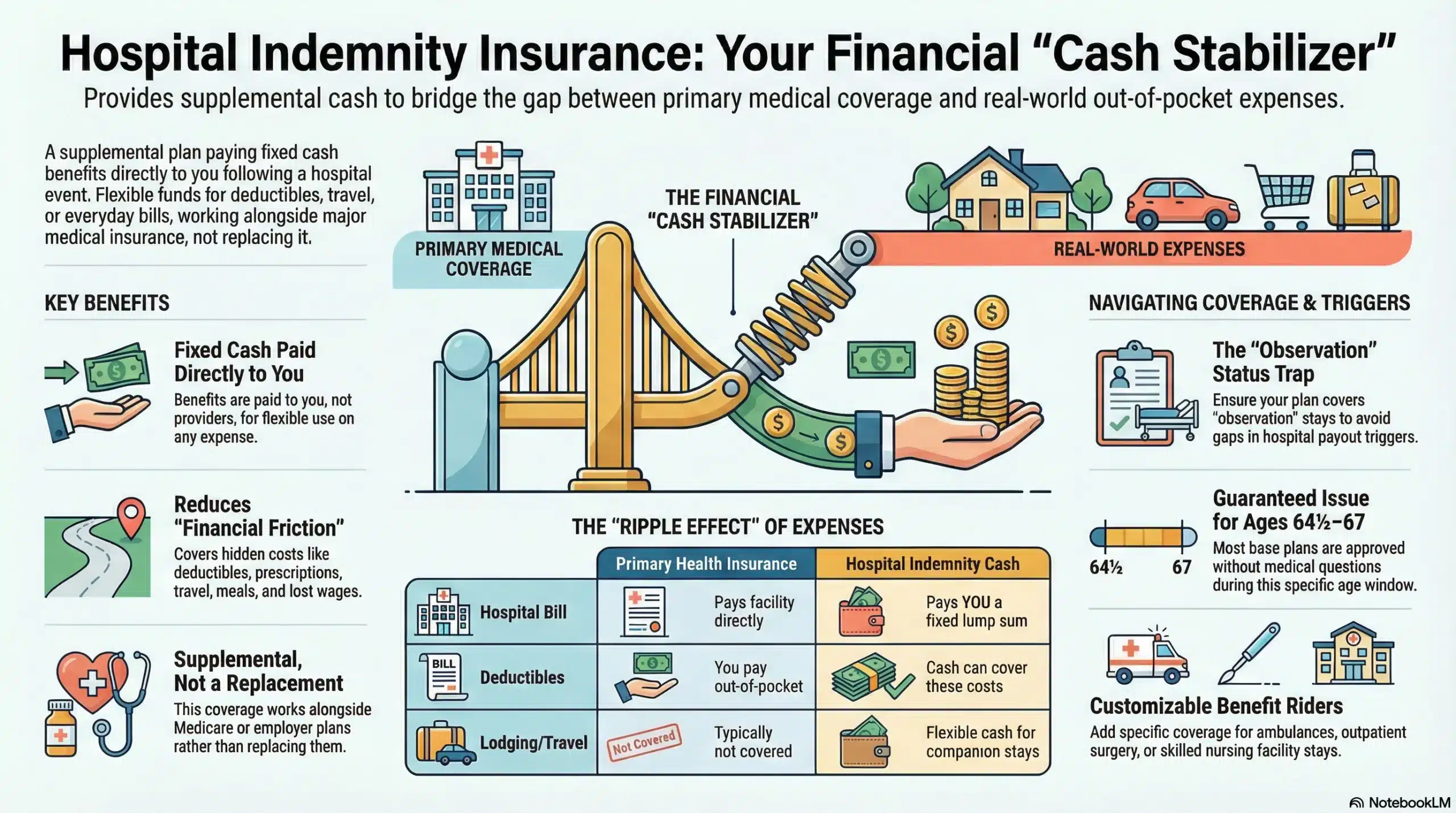
Hospital indemnity insurance is supplemental coverage that pays fixed cash benefits directly to you when covered medical events occur — it is not a replacement for Medicare or Medicare Advantage, and it does not reimburse medical providers directly. The cash benefit you receive can be used for anything: hospital copays, deductibles, coinsurance, transportation, lodging for a family member staying nearby, meals, prescription copays during recovery, or simply maintaining household bills while you’re unable to work. That flexibility is one of the defining advantages of indemnity-style coverage: the money goes where you need it rather than being restricted to specific approved expenses.
At Medicare age, the financial case for hospital indemnity is often built around Medicare Advantage cost-sharing structures. Many Medicare Advantage plans use a per-day hospital copay — often in the range of $250 to $500 or more per day for the first several inpatient days — rather than a large single deductible. A hospital indemnity plan with a daily benefit sized to offset that per-day copay can convert a potentially large variable expense into a covered cash benefit. For a foundational explanation of how hospital indemnity coverage works across its full range of benefits and typical costs, our resource on hospital indemnity insurance — what it covers and costs provides the complete framework before evaluating specific plan designs.
Why the Observation vs. Inpatient Distinction Matters for Cash Benefits
One of the most consequential but least understood distinctions in hospital coverage is the difference between inpatient admission status and observation status. When a patient is placed under observation rather than formally admitted as an inpatient — which happens frequently, particularly for shorter hospital stays — the classification affects both what Medicare covers and how hospital indemnity benefits may be triggered. An observation stay may involve the same hospital bed, the same nursing care, and similar services as a formal inpatient stay, but the billing and benefit rules operate differently.
For hospital indemnity coverage, this means that how a plan defines eligible events and calculates benefits for observation-classified stays can significantly affect how much you actually receive. Some plans pay a different daily amount for observation than for inpatient admission; others may have specific short-stay provisions; others may have limited observation coverage or none at all. For the clearest explanation of how this classification works and why it creates gaps for people who don’t plan around it, our resource on observation vs. inpatient: how cash benefits pay explains the mechanics in plain terms. For a plan design perspective on how to structure coverage to avoid observation-related gaps, our resource on hospital indemnity for observation stays: avoid surprise bills shows how to evaluate and close this specific gap.
What Typically Qualifies for Guaranteed Issue During the GI Window
During the GI window, the most common GI-eligible benefit is the base daily hospital confinement benefit — you typically choose the daily amount and the day count within the plan’s GI limits. This foundation is often the part that is easiest to align to per-day hospital copays used by many Medicare Advantage plans, and it provides the core cash protection that makes the plan useful for the most common hospital scenarios.
Some plans also allow additional benefits during GI, but this varies by plan and state. A lump-sum per-admission benefit may be available in certain states or designs under GI, while in other cases it requires underwriting. Observation-related benefits may be built into the plan, may be selectable, or may be paid under separate short-stay provisions depending on the specific plan design. Because short stays and observation classifications are common at Medicare age, we always review how the plan treats observation and inpatient status so your benefits aren’t unintentionally narrow. For context on how hospital indemnity specifically serves Medicare Advantage members — including how benefit designs are typically structured to complement MA cost-sharing — our resource on hospital indemnity for Medicare Advantage members provides the relevant framework.
Riders and Add-Ons: What Usually Requires Underwriting
GI is usually focused on the base daily benefit. Once you move into riders and add-ons, most plans require health questions. That doesn’t automatically mean you should avoid riders — it simply means you should decide whether “GI-only” is the right first step or whether it makes sense to include certain riders now so the policy is designed to support the full episode of care you’re trying to protect against.
Common rider categories include ambulance coverage, ER and urgent care admission benefits, outpatient surgery benefits, rehab or therapy benefits, and skilled nursing facility benefits. Some designs also offer diagnosis-driven riders such as cancer or heart attack and stroke coverage. For a focused explanation of how the skilled nursing facility rider works and why it matters for Medicare-age policyholders — particularly given the cost-sharing structure of Medicare’s skilled nursing benefit — our resource on the skilled nursing facility rider explained provides the relevant context. For a senior-focused guide to prioritizing which riders to add versus skip based on real-world cost and frequency, our resource on best hospital indemnity riders for seniors helps you evaluate the trade-offs in plain terms. For ambulance cost-sharing specifically — which surprises many people because it can be expensive even for short transports — our resource on ER and urgent care: when hospital indemnity pays explains how admission-triggered and transport-related benefits interact.
Designing Benefits to Match Your Medicare Costs
Hospital indemnity works best when it mirrors your real cost-sharing. If your Medicare Advantage plan charges a daily inpatient copay for the first several days, a daily hospital benefit can be designed to offset those days directly. If your exposure is more concentrated at the “front end” of an event — like an ER visit that becomes observation or a short stay — then observation and short-stay provisions and admission-style benefits can matter just as much as inpatient daily amounts. A common approach for Medicare Advantage members is to choose a daily hospital benefit that aligns to the plan’s most likely hospital copay pattern, then consider whether a modest admission-style benefit is useful for non-medical disruption costs like transportation and meals.
Another practical consideration is the ER copay. Many Medicare Advantage plans charge an ER copay of $100 to $200 or more per visit, separate from inpatient copays. An ER benefit rider can provide a cash payment triggered by an emergency room visit that helps offset that cost-sharing. The right benefit design is the one that addresses your most likely scenarios given your Medicare plan’s specific cost-sharing structure — not a generic design that assumes the same exposure as every other Medicare enrollee. Understanding how Medicare enrollment decisions affect what supplemental coverage you’ll need is also important context: our resource on Medicare enrollment for people still working is relevant for anyone whose GI window timing intersects with delayed Part B enrollment due to active employer coverage.
Who Qualifies and Key Timing Scenarios
GI is most commonly available for people enrolling around Medicare age, but timing details can differ. If you are turning 65 and starting Medicare on schedule, you may have the cleanest path to GI eligibility for the base benefit — your Medicare effective date provides the timing anchor that most GI windows require. If you delayed Part B because you had active employer coverage, your GI opportunity may be tied to your Special Enrollment Period when you start Part B, and the hospital indemnity effective date should be aligned to that SEP timing. If you are already past 65 and have had Medicare in force for a while, GI may no longer be available and underwriting will typically be required — but we can still shop for plan designs appropriate for your goals and health profile.
Because GI windows can be strict about effective dates, the safest approach is to confirm your Medicare and Medicare Advantage start month first, then align the hospital indemnity effective date to match any GI rules. That prevents the most common GI problem: missing the window because the effective date did not line up as required. For a broader overview of how to choose the best Medicare plan option — including how Medicare Advantage versus original Medicare affects what supplemental coverage you’ll need — our resource on how to choose the best Medicare plan provides useful context before finalizing both your Medicare selection and supplemental coverage decisions together.
Don’t Miss Your GI Window
Lock in the base daily benefit with no health questions (where available) and price riders separately so you can choose what’s worth adding.
Financial Protection Essentials
Medicare supplemental coverage, hospital indemnity benefit design, observation stay protection, and enrollment timing resources.
Related Hospital Indemnity Pages
Talk With an Advisor Today
Choose how you’d like to connect—call or message us, then book a time that works for you.
Schedule here:
calendly.com/jason-dibcompanies/diversified-quotes
Licensed in all 50 states • Fiduciary, family-owned since 1980
Guaranteed-Issue Hospital Indemnity at 65 FAQs
The GI window is limited and typically tied directly to Medicare enrollment timing rather than to a fixed calendar period. Some plans require the hospital indemnity effective date to match your Medicare or Medicare Advantage start month exactly — meaning the window is effectively one month wide if you are enrolling in Medicare Advantage. Others may have a slightly broader window, but in most designs, the GI period is measured in weeks or a few months rather than an extended open enrollment. Because GI windows can be strict about effective date alignment, the safest approach is to confirm the timing rules for your specific state and plan options before applying — and to initiate the hospital indemnity application while your Medicare timing is clear rather than after the fact. We verify your exact Medicare or MA start date and confirm the applicable GI window rules before quoting so there are no timing surprises.
Most commonly, the base daily hospital confinement benefit is available as guaranteed-issue within GI limits during the enrollment window. This means you can typically elect a daily cash benefit for each day of a covered hospital confinement without answering health questions, within the dollar amounts and day counts the plan allows under GI. Observation provisions may be built into the base benefit in some plan designs, or they may be a separate selectable benefit. Admission-style lump-sum benefits — a single payment per covered admission regardless of length of stay — may also be available under GI in certain states and plan designs, while in other markets they require underwriting. Because GI availability varies by state and by plan design, the quote process will show exactly which benefit amounts and feature categories are GI-eligible where you live, which is why we confirm availability before applying rather than making assumptions based on general industry descriptions.
Often yes. Many riders — including ambulance coverage, ER and urgent care admission benefits, outpatient surgery benefits, skilled nursing facility benefits, rehab and therapy benefits, and diagnosis-driven riders like cancer or heart attack and stroke riders — typically require underwriting even when the base daily hospital benefit is available on a guaranteed-issue basis. This doesn’t mean you should automatically skip riders, but it does mean you should make an intentional decision about whether to include them now with underwriting or focus on the GI base benefit first. When we quote, we typically show two clean designs side by side: a GI-only design that gets the base benefit in place with no health questions, and a GI-plus-riders design that adds specific riders matching your plan’s cost-sharing exposures. That makes it straightforward to decide what is worth including now and what can be reconsidered later. For guidance on which riders tend to provide the most value for Medicare-age enrollees, our resource on best hospital indemnity riders for seniors provides a practical add-versus-skip framework.
Often yes. When you delay Part B because of active employer-sponsored group health coverage and then later enroll in Medicare through a Special Enrollment Period when that employer coverage ends, the SEP timing may create a GI window for hospital indemnity enrollment similar to the window available when turning 65 on schedule. The key is that the hospital indemnity effective date needs to align with your Part B effective date or your Medicare Advantage start month according to the specific plan’s GI rules. If you are in this situation, confirming your Medicare SEP timing and your Medicare Advantage plan’s effective date before initiating the hospital indemnity application ensures the effective dates line up correctly. Our resource on Medicare enrollment for people still working explains how the SEP process works and what documentation is typically needed, which is relevant context for aligning supplemental coverage timing with your Part B start.
If the GI window passes without enrollment — either because you were unaware of it, because the effective date didn’t align correctly, or because enrollment wasn’t initiated in time — you can still apply for hospital indemnity coverage, but health questions will typically be required. Underwriting-based enrollment means the insurer will evaluate your health history, current conditions, and medications before approving coverage and determining which benefits you qualify for. Depending on your health profile, the underwriting process may approve a full-benefit design, may approve a more limited design, or may decline specific benefits. We can still shop plans and identify designs appropriate for your goals and current health profile — the range of options available through underwriting is broader than many people assume. What you lose by missing the GI window is the ability to lock in the base daily benefit with no health questions, which can matter if health history has accumulated since Medicare age.
Not automatically. Whether observation stays trigger hospital indemnity benefits — and how much they pay — depends entirely on the specific plan’s definitions and benefit structure, not on whether the base benefit was enrolled through a GI window. Observation stays are classified differently from inpatient admissions by Medicare, and that classification affects both what Medicare pays and how hospital indemnity benefits may be triggered. Some plans pay a full daily inpatient benefit for observation; others pay a reduced daily amount under a short-stay provision; others have limited observation coverage or none at all. Because observation classifications are common — particularly for shorter hospital stays — and because the financial exposure from an unplanned observation stay can be meaningful, understanding exactly how the plan handles observation status is one of the most important design questions to answer before enrolling. Your quote will show the specific triggers and amounts for both inpatient and observation scenarios. Our resource on observation vs. inpatient: how cash benefits pay explains the mechanics in detail.
No. Hospital indemnity is supplemental coverage designed to work alongside Medicare or Medicare Advantage — it pays you fixed cash benefits when covered events occur rather than paying medical providers directly and does not replace your primary Medicare coverage. Think of it as a cash layer that helps offset cost-sharing expenses your Medicare plan leaves to you. Hospital indemnity does not affect your Medicare coverage, does not change your Medicare benefits, and does not count against your Medicare Advantage plan’s out-of-pocket maximum in most cases. It is a separate supplemental policy that pays you directly when covered events happen, and you use that cash however you need it — for medical cost-sharing or for the non-medical costs that accompany a hospital event. Understanding how hospital indemnity fits into the broader picture of Medicare supplemental coverage — alongside other options like Medicare Supplement and critical illness coverage — is useful context before making enrollment decisions. Our Medicare planning services page explains how different coverage layers work together at Medicare age.
To confirm GI eligibility and provide accurate quoting, the most important details are: your Medicare effective date (and if you’re enrolling in Medicare Advantage, your MA plan’s start month), your state of residence (since GI availability and benefit limits vary by state), and what benefit categories you want priced — both a GI-only base benefit design and a GI-plus-riders design so you can compare and decide what is worth adding. With those details we can confirm which timing rules apply in your state, verify that the GI window is still open based on your Medicare dates, show which benefit amounts are GI-eligible, and price both a clean GI-only design and an expanded design with specific riders selected to match your Medicare plan’s cost-sharing structure. If you are not yet sure which Medicare Advantage plan you’ll be on, we can work with your Medicare start date and provide designs calibrated to common MA cost-sharing structures.
About the Author:
Jason Stolz, CLTC, CRPC, DIA, CAA and Chief Underwriter at Diversified Insurance Brokers (NPN 20471358), is a senior insurance and retirement professional with more than 25 years of real-world experience helping individuals, families, and business owners protect their income, assets, and long-term financial stability. As a long-time partner of the nationally licensed independent agency Diversified Insurance Brokers, Jason provides trusted guidance across multiple specialties—including fixed and indexed annuities, long-term care planning, personal and business disability insurance, life insurance solutions, Group Health, Travel Medical and Evacuation Insurance, and short-term health coverage. Diversified Insurance Brokers maintains active contracts with over 100 highly rated insurance carriers, ensuring clients have access to a broad and competitive marketplace.
His practical, education-first approach has earned recognition in publications such as VoyageATL, and contributions from his agency featured in Kiplinger and GoBankingRates— highlighting his commitment to financial clarity and client-focused planning. Drawing on deep product knowledge and years of hands-on field experience, Jason helps clients evaluate carriers, compare strategies, and build retirement and protection plans that are both secure and cost-efficient. Visitors who want to explore current annuity rates and compare options across multiple insurers can also use this annuity quote and comparison tool.
Browse More Resources: Return to our complete Supplemental, Hospital Indemnity & Critical Illness guide — covering hospital indemnity, accident insurance & critical illness coverage.
Last Reviewed: June 9, 2026 |
Reviewed by: Jason Stolz, CLTC, CRPC, DIA, CAA
Chief Underwriter, Diversified Insurance Brokers, Inc. | NPN: 20471358 | Diversified Insurance Brokers, Inc. — Licensed in all 50 states
Fact Checked by: Tonia Pettitt, CMIP©
Medicare Specialist, Diversified Insurance Brokers, Inc. | NPN: 14374308 | Diversified Insurance Brokers, Inc. — Licensed in all 50 states
Did you find this content helpful? Leave us a Google review — it helps others find trustworthy guidance too.
Editorial Standards: Diversified Insurance Brokers maintains rigorous editorial standards to ensure accuracy, clarity, and independence in all content. Learn more about our editorial standards and commitment to transparency.
