
Hospital Indemnity for Observation Stays (Avoid Surprise Bills)
Hospital Indemnity for Observation Stays (Avoid Surprise Bills)

Jason Stolz CLTC, CRPC, DIA, CAA
Hospital Indemnity for Observation Stays — What the Billing Classification Means and How Fixed Cash Benefits Protect Against Surprise Costs
Observation status is one of the most misunderstood billing classifications in the American healthcare system — and one of the most financially consequential for patients who encounter it without understanding what it means for their cost-sharing. When a hospital places a patient under observation rather than formally admitting them as an inpatient, the classification changes how Medicare, commercial insurance, and supplemental coverage apply to every charge generated during that stay. From the patient’s perspective the experience is identical to being admitted: they are in a hospital bed, being monitored, receiving diagnostics, and potentially spending the night. From the billing system’s perspective they are an outpatient, which means different deductibles, different coinsurance rates, different cost-sharing categories, and potentially no coverage at all for certain services that would have been covered under an inpatient admission. Hospital indemnity insurance with a properly designed observation stay benefit addresses this gap by paying a defined cash benefit when observation criteria are met — creating a predictable financial offset for the cost-sharing that a medical plan’s outpatient treatment of observation does not cover. At Diversified Insurance Brokers, Jason works with individuals, families, Medicare beneficiaries, and employer groups to evaluate hospital indemnity plans built around realistic observation and inpatient triggers — confirming that the plan’s benefit definitions match how observation is actually used by hospitals rather than how a policy marketing summary suggests it will apply. Whether Medicare covers nursing home care — including the critical 3-day inpatient stay requirement that triggers the SNF benefit and that observation status does not satisfy — establishes the Medicare coverage gap that makes observation status financially significant for Medicare beneficiaries specifically.
Why Observation Status Creates a Different Cost-Sharing Exposure Than Inpatient Admission
The distinction between observation and inpatient admission is not visible to the patient during the episode of care — it is a billing decision made by the hospital’s utilization review team based on clinical criteria that assess whether the level of care required rises to the inpatient admission threshold. For Medicare beneficiaries, the practical consequences of that decision are substantial. An inpatient admission triggers Part A coverage — the hospital insurance benefit — with its defined per-benefit-period deductible and predictable cost structure. An observation stay is treated as outpatient care under Part B, which applies a 20% coinsurance to covered services rather than the fixed Part A structure, and which can result in separate cost-sharing for each service provided during the stay rather than a single consolidated inpatient bill. The most significant Medicare consequence of observation status is that observation days do not count toward the three consecutive inpatient days required to qualify for Medicare’s skilled nursing facility benefit — meaning a patient who spends two days under observation, is discharged, and then requires skilled nursing care may discover they have no Part A SNF benefit available despite having been hospitalized for two days. Medicare supplement plans — Medigap coverage that fills the cost-sharing gaps in Original Medicare — address the inpatient cost-sharing structure with well-defined benefit limits, but their treatment of outpatient observation cost-sharing varies by plan design in ways that beneficiaries often do not discover until a claim is filed. Whether Medicare covers long-term care — it does not cover custodial care — is the downstream planning gap that the observation status issue connects to directly when a patient who was in observation is denied the SNF benefit that would have provided the bridge between hospital discharge and the need for ongoing skilled care. Medicare enrollment at 65 — including the enrollment window mechanics, the consequences of missed enrollment, and the plan selection decisions that affect observation stay cost-sharing — is the entry point for Medicare beneficiaries evaluating how their complete coverage structure handles hospital stays that are classified as observation.
Get Observation Stay Indemnity Options
We compare hospital indemnity plans that recognize observation and inpatient status — so short stays don’t become surprise bills. We confirm observation triggers, hour thresholds, and how benefits apply if your stay changes to inpatient.
Request My QuoteHow Hospital Indemnity Benefits Are Structured — What to Evaluate Before Purchasing
| Benefit Component | How It Works | What to Confirm Before Purchasing |
|---|---|---|
| Observation benefit trigger | Pays a defined cash amount when the insured is held under formal observation status for a minimum duration; the trigger may require a minimum number of hours, documentation of observation classification by the hospital, or both; some designs also require the stay to originate from an ER visit before the observation benefit activates | Whether the minimum hour threshold matches the realistic duration of common observation stays; whether the benefit pays if observation begins in the ER and transitions to a unit; whether the plan’s definition of observation matches how your hospital system classifies stays in practice |
| Inpatient admission benefit | Pays a defined cash amount when the insured is formally admitted as an inpatient; may include a daily confinement benefit that pays for each day of inpatient stay beyond the initial admission benefit; the inpatient benefit is distinct from the observation benefit in most plans and typically pays more per event | Whether the plan pays the observation benefit and then a separate inpatient benefit if observation converts to admission, or whether it pays only the inpatient benefit when conversion occurs; the waiting period before the inpatient daily benefit begins; whether pre-existing condition exclusions apply during an initial waiting period |
| ER benefit | Pays a fixed cash amount for an emergency room visit that meets the plan’s definition of emergency care; most designs require the ER visit to result in treatment or evaluation rather than a simple screening; some plans pay the ER benefit only if the visit does not result in observation or inpatient admission, while others pay the ER benefit in addition to the observation or inpatient benefit | Whether the ER benefit and the observation benefit can both pay for the same episode; whether the ER benefit applies to urgent care visits or only to hospital-based emergency departments; the definition of emergency versus non-emergency that determines eligibility for the full ER benefit amount |
| Ambulance, diagnostic, and specialist riders | Additional cash benefits that pay for ambulance transport, imaging, and specialist services that commonly accompany an observation or inpatient stay; these benefits address the ancillary cost-sharing that a patient incurs beyond the facility charge itself — the components that make a single hospital episode generate multiple bills from multiple providers | Whether ambulance and diagnostic benefits require the transport or testing to occur in connection with a qualifying hospital event or whether they pay independently; the per-event maximum for imaging and specialist benefits; whether specialist benefits apply when the specialist is called to consult during an observation or inpatient stay versus only when the specialist is the primary treating provider |
The four benefit components interact to determine what the plan actually pays across the full arc of a hospital episode — from the ambulance call through the ER, through observation, and potentially into a formal inpatient admission. A plan that pays each benefit independently and cumulatively for the same episode produces substantially better protection than a plan that caps total event payment or requires the patient to choose which benefit applies. Whether working past 65 affects Social Security and Medicare — including how active employer coverage interacts with Medicare and when hospital indemnity becomes the most valuable supplemental layer — establishes the enrollment timing context for beneficiaries evaluating when to add an observation stay indemnity benefit alongside existing coverage.
Who Needs Observation Stay Indemnity Most — The Risk Profiles That Make This Coverage Most Valuable
The value of observation stay indemnity is greatest for the patients most likely to encounter observation status in the first place — and that profile is heavily weighted toward adults over 60, particularly those managing chronic conditions that are the most common triggers for observation stays. Chest pain evaluation, cardiac monitoring after a cardiac episode, respiratory distress, dehydration requiring IV treatment, infection assessment, neurological monitoring after a fall or head trauma, and metabolic condition management are the clinical scenarios that most frequently produce observation classification rather than immediate inpatient admission. These are exactly the scenarios that become more frequent in the later decades of life, which is why observation stay indemnity is among the most relevant supplemental coverage additions for Medicare beneficiaries and for older adults in their mid-50s who are approaching Medicare eligibility. Life insurance after a heart attack — a parallel planning concern for the same demographic — addresses the protection planning conversation that follows a cardiac event for patients who now face both higher healthcare utilization and more complex insurance underwriting. Burial insurance after a heart attack covers the final expense planning dimension for the same population — ensuring that the financial protection plan is complete even when traditional life insurance underwriting has become complicated by cardiac history. Long-term care planning strategies address the downstream planning gap that observation status most directly affects for Medicare beneficiaries: the 3-day inpatient requirement that triggers the SNF benefit is the bridge between hospital discharge and skilled nursing coverage, and observation stays that do not satisfy that requirement leave a patient without the SNF benefit they may have assumed they would have available. How much long-term care insurance costs relative to the care costs it covers is the planning comparison that gives the long-term care discussion its financial context — particularly relevant for beneficiaries who experienced an observation stay and whose discharge planning revealed the gap in SNF coverage that the observation classification created.
Hospital Indemnity in the Employer Benefits Context — Group Plans and Self-Funded Employer Health
Hospital indemnity insurance is offered in both individual and group contexts — and the design options, underwriting requirements, and premium structures differ meaningfully between the two. In the individual market, hospital indemnity plans are typically available on a guaranteed or simplified-issue basis for Medicare beneficiaries and as individually underwritten products for under-65 buyers. In the employer group market, hospital indemnity is increasingly offered as a voluntary benefit alongside major medical coverage — either as a standalone voluntary product or as a component of a supplemental benefits package that also includes critical illness and accident coverage. For employers on level-funded or self-funded health plans, hospital indemnity offered voluntarily to employees provides a cost-sharing offset layer that reduces employees’ out-of-pocket exposure from the deductible and coinsurance structure of the underlying medical plan without requiring the employer to change the major medical plan design. Group health insurance for physician practices — which often involves a level-funded plan with higher deductibles and broader employee cost-sharing exposure — is one of the employer contexts where voluntary hospital indemnity most directly addresses the employee financial protection gap created by the medical plan’s cost-sharing design. Group health for two-person businesses establishes the small employer context where voluntary supplemental benefits are increasingly offered alongside high-deductible health plans as an employee retention and benefits enrichment strategy without additional employer premium cost. Stop-loss insurance in level-funded plans is the employer-side risk management layer that protects the employer’s claims fund from catastrophic single claims — hospital indemnity for employees is the consumer-side offset that reduces individual cost-sharing exposure from the same medical plan design. Short-term health insurance addresses the coverage gap period — between jobs, after COBRA expiration, or between plan years — when hospital indemnity provides meaningful but not comprehensive protection as a standalone product rather than as a supplement to major medical coverage. Travel medical insurance for large groups addresses the hospital cost-sharing scenario specifically for employees traveling internationally, where the underlying major medical plan may have limited out-of-network coverage and where observation or inpatient stays at foreign facilities create a cost-sharing structure entirely different from domestic coverage. Disability income insurance for nurses — and healthcare workers generally — is the income protection complement to hospital indemnity for employees whose occupational exposure increases both their frequency of observation-triggering health events and the financial impact of any period of work interruption that follows. Disability coverage for nurses and other clinical workers specifically addresses the own-occupation disability definition that healthcare professionals need to protect income dependent on physically performing their clinical role.
Compare Observation Stay Indemnity Plans
We evaluate observation benefit triggers, hour thresholds, ER-to-observation coordination, status change provisions, and how the plan stacks with your existing Medicare or major medical coverage before recommending any specific design.
Request My Quote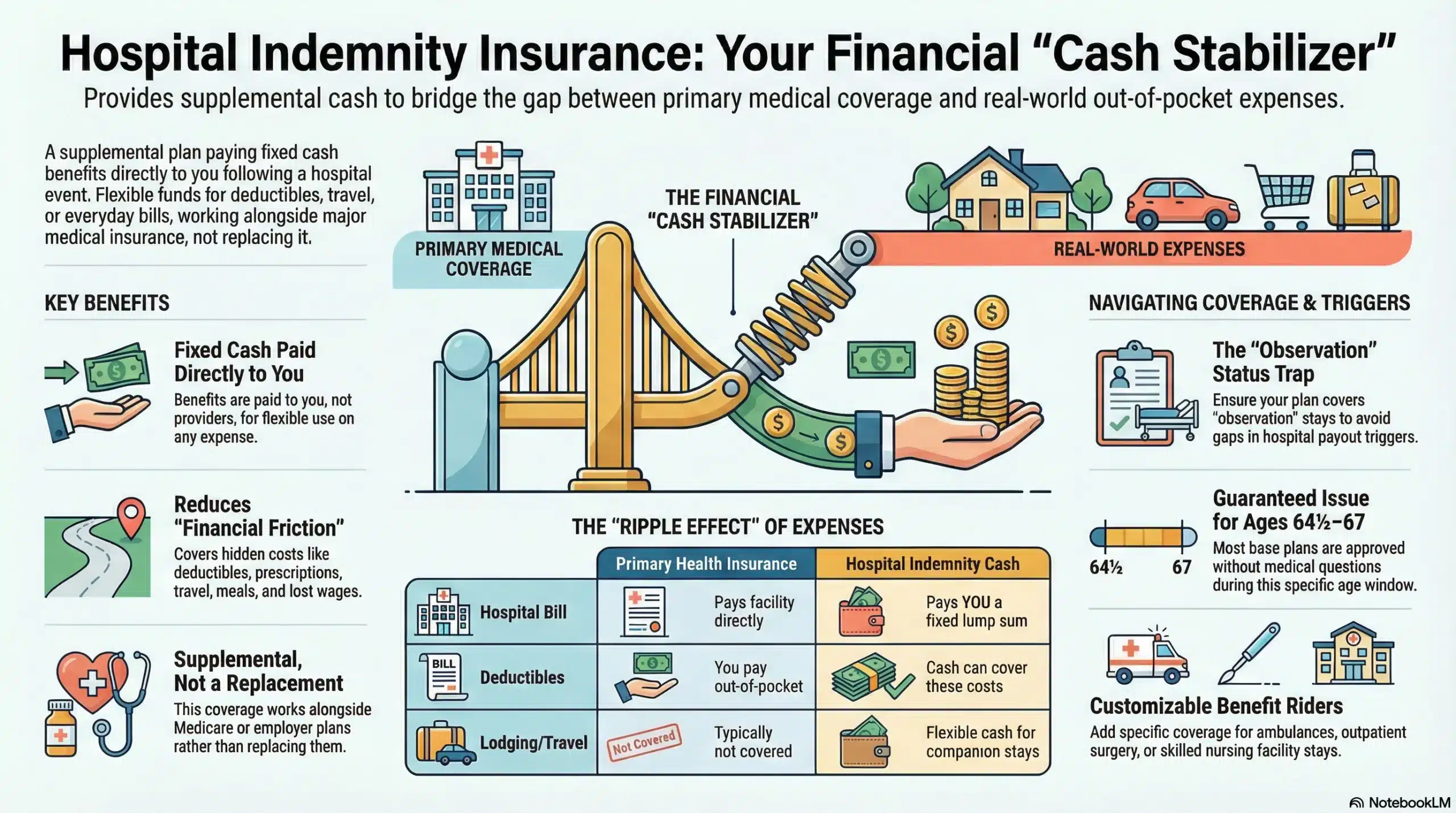
Talk With an Advisor Today
Choose how you’d like to connect—call or message us, then book a time that works for you.
Schedule here:
calendly.com/jason-dibcompanies/diversified-quotes
Licensed in all 50 states • Fiduciary, family-owned since 1980
FAQs: Hospital Indemnity for Observation Stays
What exactly is observation status and why does it matter for my insurance?
Observation status is a billing classification hospitals use when a patient needs monitoring and evaluation but has not yet met the clinical threshold for formal inpatient admission. From the patient’s perspective, observation and inpatient admission often look identical — the same hospital bed, the same nursing care, the same monitoring equipment. The difference is entirely in how the stay is classified in the billing system, and that classification determines which insurance benefits apply, what cost-sharing obligations the patient faces, and what downstream Medicare benefits become available or unavailable.
For Medicare beneficiaries, observation status means the stay is processed under Part B as outpatient care rather than under Part A as inpatient hospitalization. This changes the coinsurance structure — outpatient Part B coinsurance of 20% applies to each covered service rather than the fixed Part A deductible structure — and it means the stay does not count toward the three consecutive inpatient days required to qualify for the Medicare skilled nursing facility benefit. A patient who spends two days under observation and is then discharged to a skilled nursing facility may find that no Part A SNF coverage applies, leaving them responsible for the full SNF daily cost that would otherwise have been covered. This is the most financially damaging consequence of observation status, and it is the reason hospital indemnity with a well-designed observation benefit is particularly valuable for Medicare beneficiaries with any chronic conditions that increase their likelihood of hospital monitoring stays.
How does hospital indemnity pay for an observation stay — does it pay the bill directly?
Hospital indemnity insurance pays a fixed cash benefit directly to the policyholder — not to the hospital, not to the medical plan, and not as a reimbursement of actual charges. When the qualifying event criteria are met — the required observation duration is documented, the hospital classification matches the plan’s definition, and any additional requirements are satisfied — the plan issues the defined cash benefit to you. You can use that cash for anything: paying the hospital’s cost-sharing, covering the 20% Medicare Part B coinsurance on multiple services, handling the balance billing from a non-participating provider, paying for transportation or incidental costs during the stay, or any other use you choose.
This payment structure — fixed cash rather than reimbursement — is both the strength and the limitation of hospital indemnity. The strength is that the payment is predictable and unconditional once the trigger is met. The limitation is that the fixed benefit amount may be more or less than your actual out-of-pocket cost depending on the severity and duration of the episode. A well-designed plan with adequate benefit amounts and clear, realistic triggers will align closely with typical observation stay cost-sharing. A plan with benefit amounts that are too low or triggers that are too restrictive will pay something but leave a meaningful portion of the cost-sharing unaddressed.
What happens if I start under observation and then get formally admitted as an inpatient?
The treatment of status change — from observation to formal inpatient admission during the same episode — is one of the most important design questions to resolve before purchasing any hospital indemnity plan. Plans handle this transition differently, and the difference materially affects the benefit outcome for patients whose condition worsens and requires full admission. Some plans pay the observation benefit for the hours spent in observation and then pay a separate inpatient benefit when the formal admission is documented — treating them as distinct, stackable benefits for the same episode. Other plans apply only the inpatient benefit when admission occurs, treating the earlier observation period as part of the admission event and paying one benefit rather than two. A third design applies the observation benefit only when observation is the final status — meaning the benefit is not triggered if the stay converts to inpatient.
The design that provides the best protection for patients whose condition may evolve during a stay is the one that pays both benefits when both statuses are documented — the observation benefit for the hours of observation monitoring, and the inpatient benefit for the formal admission period. When reviewing any plan, the question to ask is: “If I spend 18 hours in observation and then am admitted as an inpatient, will both benefits pay?” The answer to that question distinguishes genuinely comprehensive observation stay indemnity from plans that provide partial coverage only for the inpatient portion.
Does hospital indemnity cover the cost-sharing I’ll face under Medicare Advantage for a hospital stay?
Hospital indemnity insurance is one of the most effective supplemental tools for Medicare Advantage members specifically because MA plans apply a copay-based cost-sharing structure for inpatient stays that creates a defined, predictable per-stay financial obligation rather than the deductible-and-coinsurance model of Original Medicare. A Medicare Advantage plan might charge a $300 per-day inpatient copay for days 1 through 5, a $600 per-day copay for days 6 through 10, and a $0 copay beyond day 10 in a plan year. A hospital indemnity plan that pays a daily inpatient benefit can offset those copay tiers directly — you receive the daily cash benefit and apply it to the day’s copay, reducing or eliminating the out-of-pocket cost for the hospital stay.
For observation stays specifically, the MA cost-sharing applies outpatient rules — typically a per-visit copay plus 20% coinsurance on services rather than the per-day inpatient copay structure. A hospital indemnity plan with a specific observation benefit can offset that outpatient cost-sharing. The key evaluation step for MA members is confirming that the hospital indemnity plan’s benefit triggers are designed for the MA cost-sharing structure — specifically that the observation benefit’s hour threshold and trigger documentation match how the patient’s MA plan and their hospital system classify observation, and that the ER benefit and observation benefit can both pay for the same episode when the emergency visit transitions to observation monitoring.
Can I get hospital indemnity if I already have a pre-existing condition?
Many hospital indemnity plans — particularly those designed for Medicare beneficiaries — are available on a guaranteed-issue basis for eligible enrollees during defined enrollment windows such as Medicare open enrollment, Medicare Advantage enrollment periods, or guaranteed-issue windows tied to life events. For these plans, pre-existing conditions do not affect eligibility or premium — the plan accepts all eligible applicants at the same rate regardless of health status. This makes guaranteed-issue hospital indemnity particularly valuable for Medicare beneficiaries with chronic conditions who are the most likely to encounter observation and inpatient stays but who might otherwise find individually underwritten coverage priced to reflect their elevated utilization risk.
Plans that are not guaranteed issue — typically individually underwritten hospital indemnity for under-65 buyers — may apply pre-existing condition waiting periods during which benefits do not pay for conditions that existed before the policy’s effective date, or they may rate the policy based on health history. The specific waiting period and pre-existing condition definition vary by carrier and plan design. For buyers with conditions that are the most common triggers for observation stays — cardiac conditions, COPD, diabetes, kidney disease, neurological conditions — the pre-existing condition waiting period is the most important policy provision to evaluate before purchase, since a plan that excludes the conditions most likely to cause the events the plan is being purchased for provides substantially less value than its marketing suggests.
How does hospital indemnity work alongside my existing major medical or Medigap plan?
Hospital indemnity is a supplemental product — it is designed to work alongside, not instead of, major medical or Medicare coverage. Its cash benefits are paid based on your plan’s defined triggers regardless of what your primary insurance pays, and in most states the hospital indemnity benefit does not reduce based on what your primary plan covers. You receive both your primary insurance’s coverage of the provider’s charges and the hospital indemnity plan’s defined cash benefit for the qualifying event. This stacking of benefits is what makes hospital indemnity additive rather than duplicative — it fills the cost-sharing gap that the primary plan leaves rather than replacing the primary plan’s coverage of the underlying services.
For Medigap holders on Original Medicare, the combination of a comprehensive Medigap plan with hospital indemnity typically provides very complete protection — the Medigap covers most of the inpatient cost-sharing under Medicare Part A, and the hospital indemnity provides cash for observation stay cost-sharing that Medigap may not fully address, for additional expenses during a stay, and as an income replacement buffer during a recovery period when work capacity is reduced. For Medicare Advantage members who cannot hold a Medigap plan, hospital indemnity fills a larger portion of the cost-sharing offset function and should be sized to reflect the specific copay structure of the MA plan rather than a generic assumption about what the plan charges per day.
About the Author:
Jason Stolz, CLTC, CRPC, DIA, CAA and Chief Underwriter at Diversified Insurance Brokers (NPN 20471358), is a senior insurance and retirement professional with more than 25 years of real-world experience helping individuals, families, and business owners protect their income, assets, and long-term financial stability. As a long-time partner of the nationally licensed independent agency Diversified Insurance Brokers, Jason provides trusted guidance across multiple specialties—including fixed and indexed annuities, long-term care planning, personal and business disability insurance, life insurance solutions, Group Health, Travel Medical and Evacuation Insurance, and short-term health coverage. Diversified Insurance Brokers maintains active contracts with over 100 highly rated insurance carriers, ensuring clients have access to a broad and competitive marketplace.
His practical, education-first approach has earned recognition in publications such as VoyageATL, and contributions from his agency featured in Kiplinger and GoBankingRates— highlighting his commitment to financial clarity and client-focused planning. Drawing on deep product knowledge and years of hands-on field experience, Jason helps clients evaluate carriers, compare strategies, and build retirement and protection plans that are both secure and cost-efficient. Visitors who want to explore current annuity rates and compare options across multiple insurers can also use this annuity quote and comparison tool.
Browse More Resources: Return to our complete Supplemental, Hospital Indemnity & Critical Illness guide — covering hospital indemnity, accident insurance & critical illness coverage.
Last Reviewed: June 10, 2026 |
Reviewed by: Jason Stolz, CLTC, CRPC, DIA, CAA
Chief Underwriter, Diversified Insurance Brokers, Inc. | NPN: 20471358 | Diversified Insurance Brokers, Inc. — Licensed in all 50 states
Fact Checked by: Tonia Pettitt, CMIP©
Medicare Specialist, Diversified Insurance Brokers, Inc. | NPN: 14374308 | Diversified Insurance Brokers, Inc. — Licensed in all 50 states
Did you find this content helpful? Leave us a Google review — it helps others find trustworthy guidance too.
Editorial Standards: Diversified Insurance Brokers maintains rigorous editorial standards to ensure accuracy, clarity, and independence in all content. Learn more about our editorial standards and commitment to transparency.
